
Tattoo Needles Market Size and Share
Market Overview
| Study Period | 2021 - 2032 |
|---|---|
| Market Size (2027) | USD 425.79 Million |
| Market Size (2032) | USD 507.07 Million |
| Growth Rate (2027 - 2032) | 3.56 % |
| Fastest Growing Market | Asia-Pacific |
| Largest Market | North America |
| Market Concentration | Low |
Major Players *Disclaimer: Major Players sorted in no particular order Image © Mordor Intelligence. Reuse requires attribution under CC BY 4.0. | |
Tattoo Needles Market Analysis by Mordor Intelligence
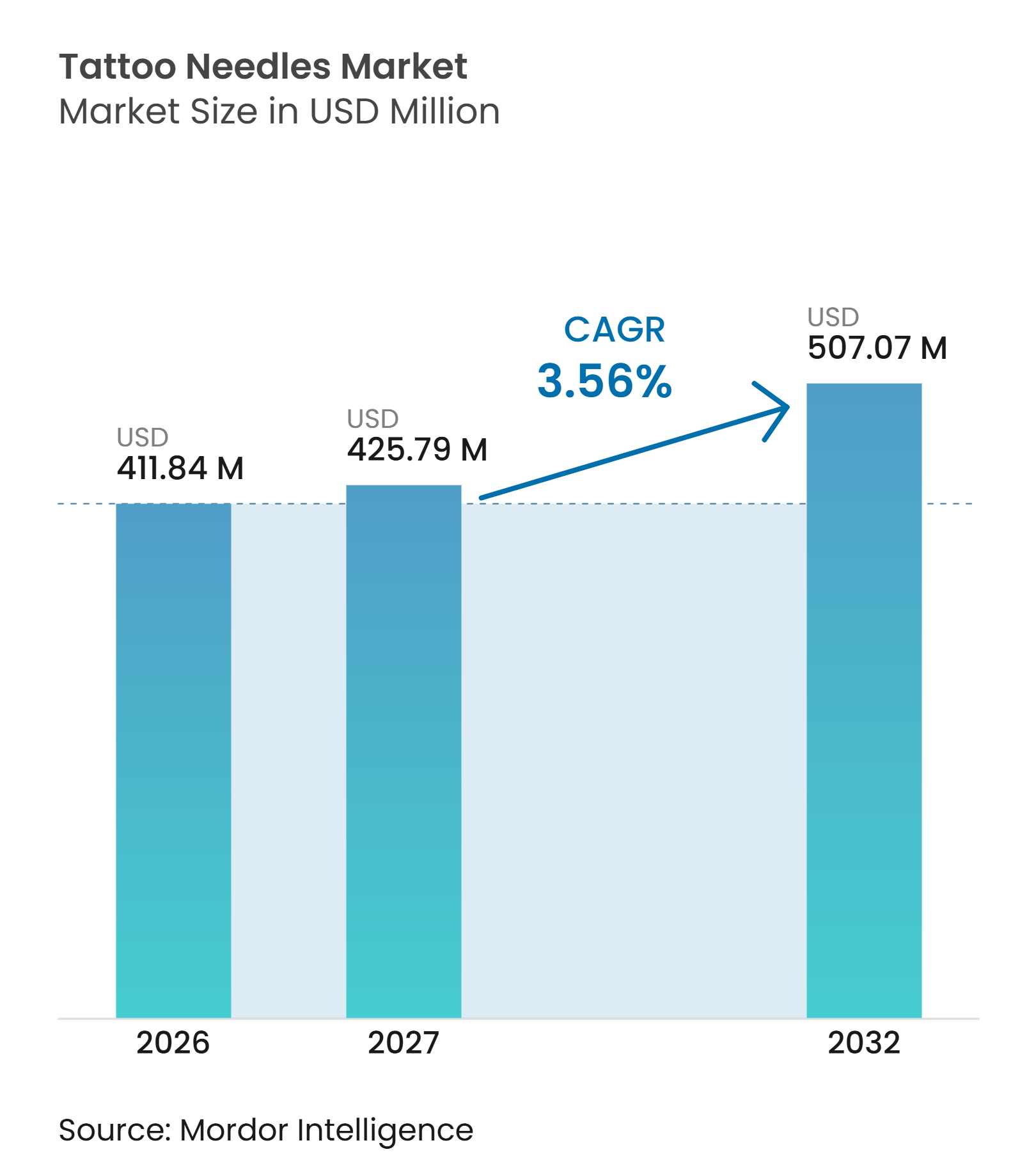
The Tattoo Needles Market size is projected to expand from USD 411.84 million in 2026 and USD 425.79 million in 2027 to USD 507.07 million by 2032, registering a CAGR of 3.56% between 2027 and 2032.
The market is moving toward pre-sterilized cartridge systems, which carry a higher unit value than conventional needle bars and reduce setup work during a procedure. This change supports revenue growth even where the number of studios grows more slowly. Demand from permanent makeup, scar camouflage, and scalp micropigmentation is broadening the buyer base beyond decorative tattoo studios. These settings place more emphasis on sterility, traceability, and precise needle configurations. The tattoo needles market therefore favors suppliers that can pair consistent manufacturing with professional support and reliable distribution.
Key Report Takeaways
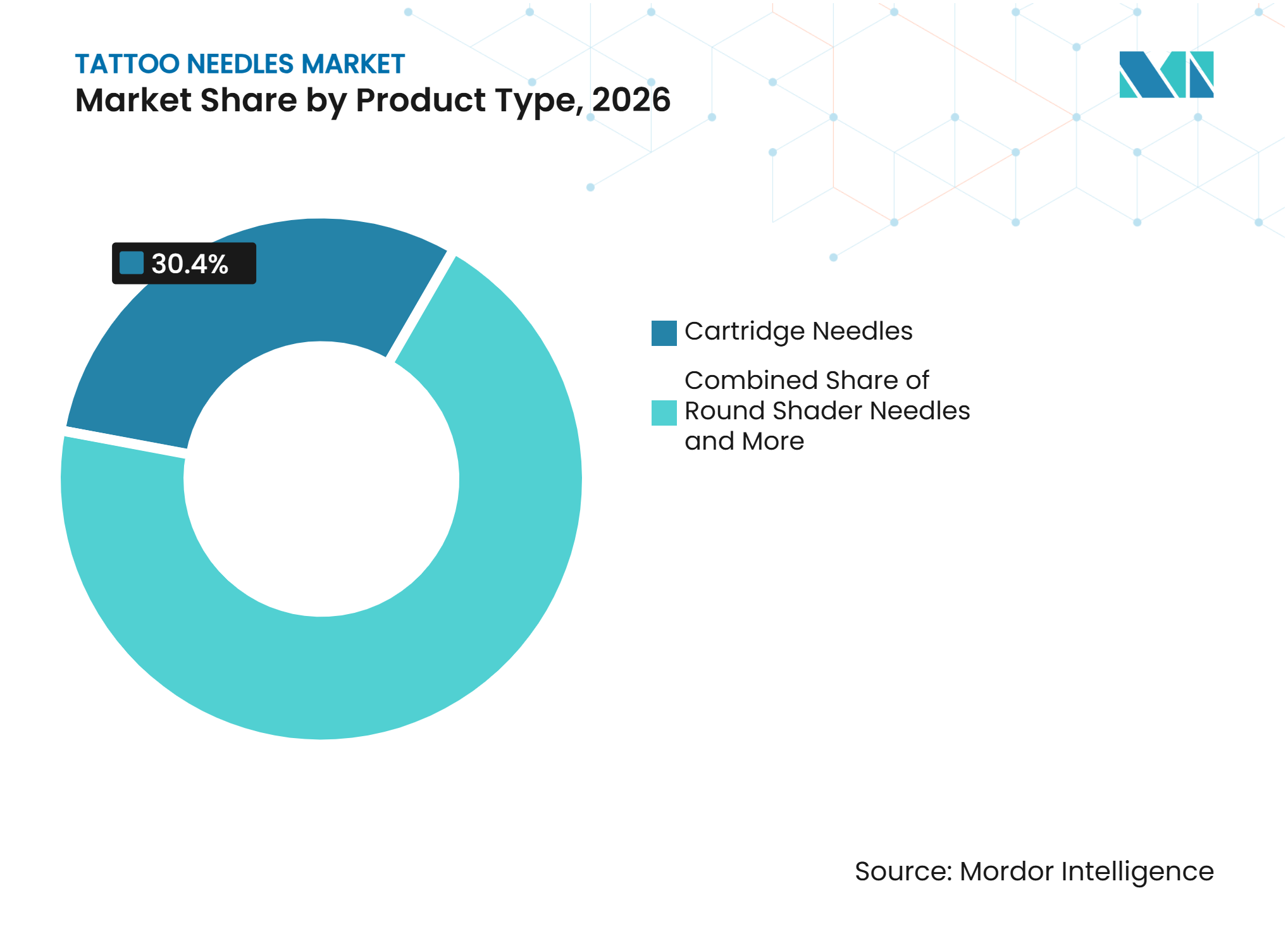
- By product type, cartridge needles held 30.42% revenue share in 2026, while cartridge needles are forecast to grow at a 5.18% CAGR through 2032.
- By needle configuration, standard configuration needles held 42.87% market share in 2026, while custom configuration needles are forecast to grow at a 4.93% CAGR through 2032.
- By needle gauge and diameter, 12 gauge 0.35 mm needles held 34.56% of segment revenue in 2026, while bugpin and specialty diameter needles are forecast to grow at a 5.47% CAGR through 2032.
- By form, disposable cartridges held 46.38% of segment revenue in 2026, while membrane cartridges are forecast to grow at a 5.92% CAGR through 2032.
- By application, shading held 24.81% of segment revenue in 2026, while fine-line and micro-detail work are forecast to grow at a 6.24% CAGR through 2032.
- By end user, professional tattoo studios held 56.74% of demand in 2026, while cosmetic tattoo artists are forecast to grow at a 5.66% CAGR through 2032.
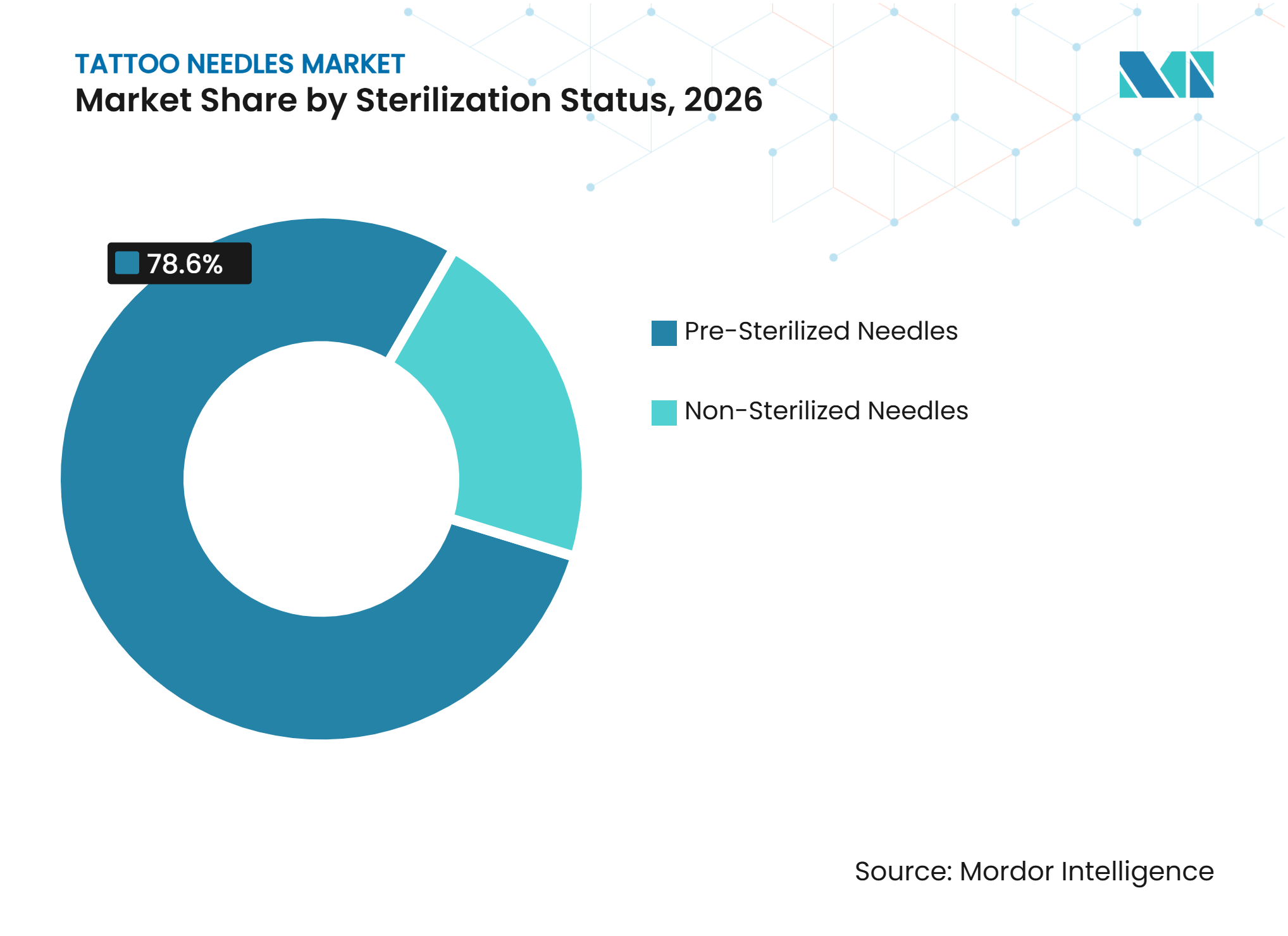
- By sterilization status, pre-sterilized needles held 78.63% of segment revenue in 2026 and are forecast to grow at a 4.08% CAGR through 2032.
- By distribution channel, specialty tattoo distributors held 36.85% of channel revenue in 2026, while e-commerce and digital marketplaces are forecast to grow at a 7.12% CAGR through 2032.
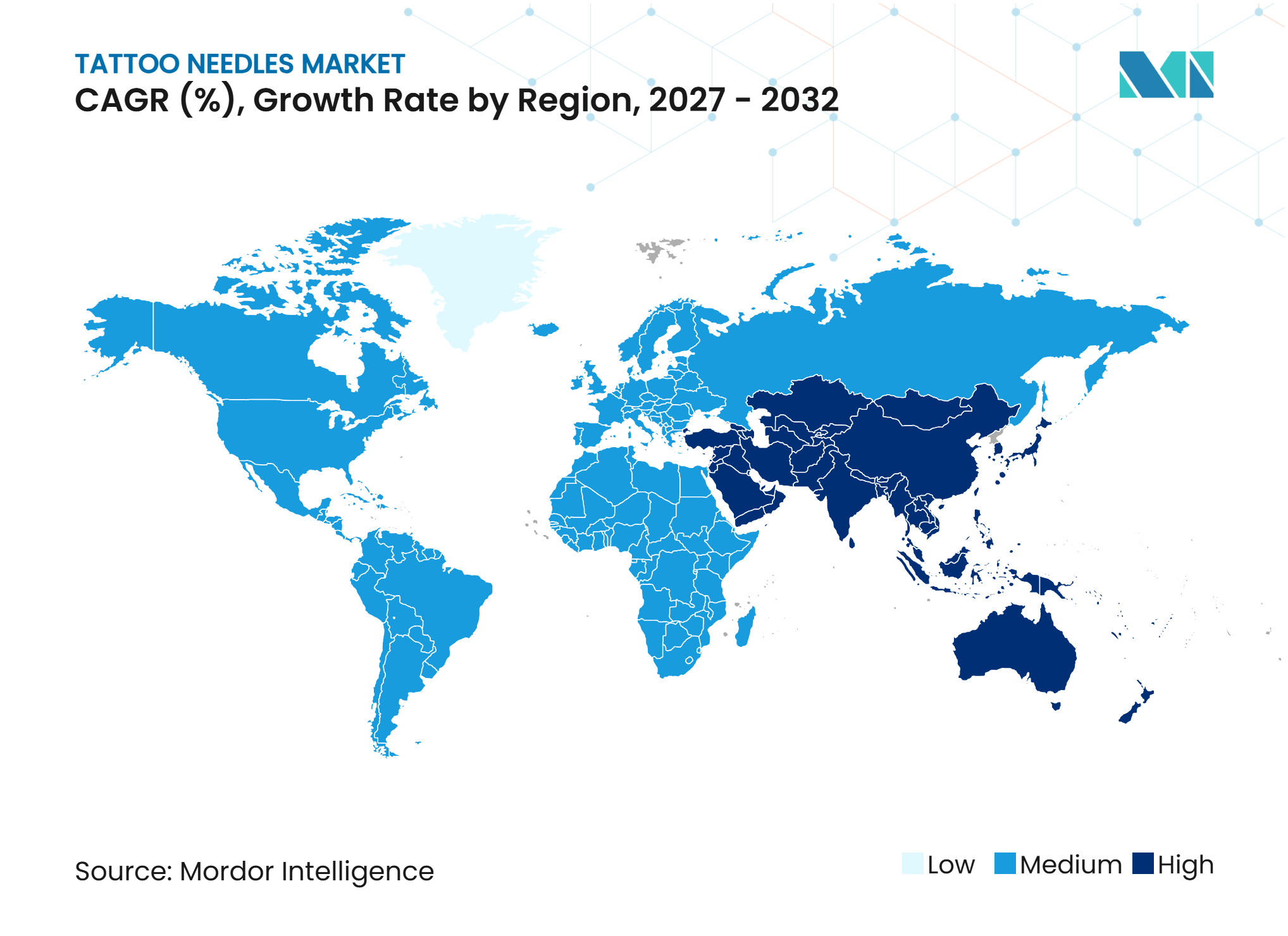
- By geography, North America held 34.27% of revenue in 2026, while Asia-Pacific is forecast to grow at a 5.84% CAGR through 2032.
Note: Market numbers in this report are based on Mordor Intelligence's proprietary estimation framework, which combines nine months of actuals with Q4 projections for base year 2026.
Market Trends and Insights
Drivers Impact Analysis of Tattoo Needles Market of Tattoo Needles Market*
| Driver | (~) % Impact on CAGR Forecast | Geographic Relevance | Impact Timeline |
|---|---|---|---|
| Mainstreaming of Tattooing and Body Art | +0.7% | Global, led by North America and Western Europe | Medium term (2-4 years) |
| Expansion of Professional Tattoo Studios | +0.6% | North America, Europe, Brazil, South Korea | Short term (≤ 2 years) |
| Shift Toward Sterile, Single-Use Cartridge Systems | +0.9% | Global, strongest in North America and EU | Short term (≤ 2 years) |
| Growth of Cosmetic, Permanent Makeup and Medical Tattooing | +0.5% | Europe, North America, APAC core | Medium term (2-4 years) |
| Fine-Line, Realism and Customization-Driven Needle Demand | +0.5% | Global, led by North America, Europe, East Asia | Short term (≤ 2 years) |
| Social-Commerce and Direct-to-Artist Purchasing | +0.4% | Global, with APAC and North America leading digital adoption | Medium term (2-4 years) |
| Source: Mordor Intelligence | |||
Mainstreaming of Tattooing and Professional Studio Demand
Tattooing is becoming more established across a wider range of adult consumers, changing the mix of services that studios provide. The supplied evidence indicates that older adults and higher-income professionals are more likely to commission detailed work, which can require more specialized needle formats. Longer and more complex sessions increase the need for dependable replenishment by studios and artists. This supports recurring purchasing rather than only occasional buying by new studios. The tattoo needles market gains when professional studios can source a stable, broad configuration range. The expansion of professional studios in North America, Europe, Brazil, and South Korea also creates more points of sale for distributors. Direct purchasing through social platforms and online stores gives artists another route to compare configurations, availability, and fulfillment times.
Shift Toward Sterile, Single-Use Cartridge Systems
The shift from needle bars to disposable cartridges is the strongest structural driver in the tattoo needles market. In the United States, OSHA requires employers covered by its Bloodborne Pathogens Standard to use engineering and work-practice controls to limit occupational exposure to bloodborne pathogens[1]. Cartridge systems help studios meet hygiene expectations because each configuration can be used once and recorded as part of the procedure workflow. Germany's hygiene guidance has increased the value of documented cartridge lot, manufacturer, and expiry information. Membrane designs add a further barrier against fluid traveling back into the machine body. Suppliers are therefore competing on membrane performance, housing design, ink flow, and stable manufacturing rather than only on needle count.
Growth of Cosmetic, Permanent Makeup and Medical Tattooing
Permanent makeup, scalp micropigmentation, areola restoration, and scar camouflage are creating a separate professional demand base for tattoo needles. These procedures are conducted in medical-adjacent or cosmetology settings, where practitioners need fine-gauge and precision-grouped configurations. The supplied material identifies bugpin and single-needle formats as particularly relevant for this work. Hygiene and traceability requirements can favor certified manufacturers because these settings use documented procedures and repeat purchasing. Karnataka health officials called for quality and sterility standards for tattoo needles after concerns about tattoo-ink safety, highlighting the direction of regulatory attention in India. The tattoo needles market can benefit when these services become more formalized because users place a higher value on validated products.
Fine-Line, Realism, and Direct Purchasing
Fine-line and realism work requires closer control over taper, grouping, and diameter than many traditional bold-line designs. The demand is for single-needle, 3RL, bugpin, and custom configurations. Artists working in these styles can select hardware around their own approach to line work, shading, and skin response. This makes a broader configuration range more important for manufacturers and distributors. Online ordering and social commerce help artists source such specialized products directly, especially when a local distributor has limited selection. The tattoo needles market consequently has room for suppliers that make detailed specifications easy to compare and reliably reorder.
Restraints Impact Analysis of Tattoo Needles Market of Tattoo Needles Market*
| Restraint | (~) % Impact on CAGR Forecast | Geographic Relevance |
|---|---|---|
| Regulatory Compliance and Sterilization Costs | -0.5% | EU, North America, emerging markets |
| Price Competition and Private-Label Penetration | -0.6% | Global, strongest in APAC and emerging markets |
| Counterfeit and Non-Validated Sterile Products | -0.4% | Global, acute in South Korea, India, parts of Southeast Asia |
| Stainless-Steel Input-Cost Volatility and Supply Concentration | -0.4% | Global, with heightened impact in North America and EU |
| Source: Mordor Intelligence | ||
Regulatory Compliance and Sterilization Costs
Regulatory requirements can raise operating costs for studios and their suppliers, particularly for smaller independent businesses. France requires practitioners in tattooing and permanent makeup to meet hygiene training requirements through its regional health system. North Rhine-Westphalia also introduced registration and hygiene-plan requirements for tattoo practitioners in 2025. Compliance can require recordkeeping, staff training, and purchases of validated single-use products. Larger chains can spread these costs across several locations, while small studios have less room to absorb them. Tighter enforcement of chemical and product-safety rules can also extend scrutiny from ink into connected consumables and supplier documentation.
Price Competition, Counterfeit Products, and Supply Costs
Low-priced cartridges and private-label offerings put pressure on mid-tier suppliers, especially in APAC and emerging markets. Some online listings are priced 60-70% below premium alternatives, making price comparison more direct for artists and training institutions. This can reduce the resources available for the development of needle geometry, membrane systems, and quality assurance. Counterfeit or non-validated products create a related risk because buyers may have limited visibility into sterilization records and manufacturing control. Italian police reported the seizure of used needles from an unauthorized tattoo operator in March 2025, illustrating the public-health risk associated with non-compliant practices. Input-cost volatility and concentrated supply of stainless steel may add further pressure where manufacturers cannot pass costs through to buyers.
*Our forecasts treat driver/restraint impacts as directional, not additive. The impact forecasts reflect baseline growth, mix effects, and variable interactions.
Tattoo Needles Market Segment Analysis
By Product Type:
Cartridge Formats Displace Traditional SystemsCartridge needles hold 30.42% of revenue share in 2026 and are forecast to grow at a 5.18% CAGR through 2032. This makes cartridges both the leading product type and the fastest-growing product type in the tattoo needles market. Their workflow value comes from allowing artists to change configurations during a session without disassembling the machine. This can shorten setup time when a design needs outlining, shading, color packing, and small details. The cartridge format also aligns with the preference for single-use consumables in professional settings. Traditional needle bars remain relevant where cartridge adoption is less developed or where artists retain established working methods.
Round liner and round shader formats remain important for bold outlines and color work. Magnum and curved magnum configurations support larger shading areas and are used for backpieces, sleeves, and other large designs. Flat needles serve geometric work, while textured needles are used where increased ink uptake supports blackwork and color saturation. Cheyenne introduced Premium Liners with 24 configurations in 2025, including Capillary and Safety Liner variants, showing how product breadth is used to serve specialized methods. Kwadron launched Combat Curved Magnum 73CM and 85CM cartridges in June 2026 for large-format work, according to the company's supplied development information. These launches indicate that product development is focused on the distinct needs of both precision work and high-coverage sessions.



By Needle Configuration:
Standard Leads, Custom AcceleratesStandard configuration needles accounted for 42.87% of tattoo needles market share in 2026. Their position reflects broad compatibility with coil and rotary machines and their usefulness across different artist skill levels. Standard products give studios a predictable base assortment for routine outline, shading, and color work. They are also easier for distributors to stock because demand is spread across many conventional tattoo styles. The tattoo needles market continues to rely on these established configurations for dependable volume. This installed base gives suppliers meaningful volume in configurations that artists already know how to use.
Custom configuration needles are projected to grow at a 4.93% CAGR through 2032, the fastest rate in this segment. Artists increasingly specify grouping count, taper length, and solder-point placement to suit their individual technique. Bugpin configurations use finer needles in close groupings and are associated with fine-line and micro-realism work. Tapered formats are used where artists want controlled gradient shading in gray-realism. Kwadron's digital platform supports configuration reorders across more than 80 countries, according to the supplied company material. The growing availability of this type of ordering can make specialized preferences easier to repeat, rather than requiring an artist to rely on a standard catalog selection.
By Needle Gauge and Diameter:
Specialty Formats Gain GroundThe 12 gauge, or 0.35 mm, format accounted for 34.56% of gauge-segment revenue in 2026. Its broad use reflects compatibility with a large share of commercial cartridge systems. The 10 gauge, or 0.30 mm, format provides a smaller step toward more precise work without moving far from conventional equipment. The 8 gauge, or 0.25 mm, and 6 gauge, or 0.20 mm, formats are used in detailed portrait and botanical work. The tattoo needles market needs this range because different visual styles require different balances of coverage, control, and line definition. Together, these formats give artists practical choices between coverage, control, and line definition.
Bugpin and specialty diameter needles are forecast to grow at a 5.47% CAGR through 2032. This demand follows the rising use of fine-line and micro-realism techniques described in the supplied content. Smaller diameters require more consistent manufacturing because narrow tolerances are central to line quality and skin response. The category also supports further product differentiation through taper profile, material finish, and packaging. EZ Tattoo launched its V-Select Gold Series in January 2026 with a Ti-AU needle tip that the company states has 3× the durability of standard 304 surgical steel[2]. Such claims show that suppliers are using material design as well as configuration choice to compete in a category once defined mainly by needle count.
By Form:
Membrane Cartridges Grow Fastest on Safety GroundsDisposable cartridges represented 46.38% of form-segment revenue in 2026. The share reflects extensive adoption of cartridge delivery systems in Western professional markets. Single-use formats fit professional workflows because they simplify preparation and avoid the need to reuse a needle assembly. They also make product labeling, batch records, and expiry-date checks more practical for studios. The tattoo needles market size for disposable systems is supported by the broader move toward visible hygiene controls in professional environments.
Membrane cartridges are forecast to grow at a 5.92% CAGR through 2032, the highest rate among form types. Their internal membrane is intended to limit the movement of ink and blood into the machine body. This feature supports infection-control practices and makes the format relevant for permanent makeup and scalp micropigmentation procedures. Rubber-band cartridges are losing preference where membrane alternatives have become more cost-competitive. Conventional needle bars still have demand in parts of Southeast Asia and Latin America where cartridge adoption is lower. Over time, the form segment is likely to remain shaped by the balance between documented hygiene, cost, and the installed base of studio equipment.
By Application:
Fine-Line Grows Fastest, Shading Anchors VolumeShading accounted for 24.81% of application-segment revenue in 2026. It is used across gray-realism, blackwork, and color portraiture, where a design requires coverage over larger skin areas. Curved magnum and soft-edge magnum configurations are important for this work because they support gradual fill and smoother transitions. Sessions that require substantial fill can consume needles in quantity, which helps sustain volume demand. The tattoo needles market remains tied to shading because it is a common service across a wide range of studios. Shading therefore remains a core application for studio purchasing and distributor inventory planning.
Fine-line and micro-detail work are projected to grow at a 6.24% CAGR through 2032. This is the highest growth rate across the application segment. The work uses fine-gauge, small-group, and precise liner configurations. Color applications continue to rely on tightly grouped standard-diameter magnums, while large-format blackwork supports demand for oversized formats. Cosmetic tattooing and permanent makeup use dedicated precision cartridges, and paramedical work adds a smaller premium application with strong certification needs. The application mix leaves suppliers serving a broad spectrum, from high-consumption shading sessions to specialized detail-focused procedures.
By End User:
Professional Studios Lead, Cosmetic Artists RiseProfessional tattoo studios held 56.74% of end-user demand in 2026. Their leading position comes from regular procedure volume and established purchasing relationships with specialist distributors. Studio demand is often predictable because artists need a steady range of needles across routine appointments. Larger studios can use product sampling, inventory credit, and event-based support offered by distributors. For the tattoo needles market, this group provides a recurring base of consumption across many product formats. Independent artists also make up an important buyer group and combine distributor purchases with direct online ordering.
Cosmetic tattoo artists are forecast to grow at a 5.66% CAGR through 2032. This group includes practitioners focused on permanent makeup and scalp micropigmentation, which are developing dedicated training and supply requirements. Their procedures call for precision, consistent depth control, and documented hygiene. Kwadron introduced the VELURE Wireless PMU Machine in May 2026 for brow, lip, and eyeliner micropigmentation, according to the supplied development. The launch illustrates how equipment providers are building connected machine and cartridge offerings for cosmetic practitioners. Medical practitioners and training institutions provide an additional base of demand, although their purchasing needs differ from high-volume decorative studios.
By Sterilization Status:
Pre-Sterilized Formats Overwhelmingly DominantPre-sterilized needles held 78.63% of segment revenue in 2026. They are also forecast to grow at a 4.08% CAGR through 2032, making them both the leading and fastest-growing status category. This result reflects the near removal of reusable studio-sterilized formats from professional practice in tightly regulated markets. Pre-sterilized products give studios a clearer route to single-use procedures and traceability. The high share also indicates that safety practice has become a central product feature rather than an optional add-on.
OSHA's Bloodborne Pathogens Standard is a relevant federal framework for covered U.S. workplaces that handle potential blood exposure. State-level requirements in California, Michigan, and New Jersey require autoclave records where reusable instruments are used. Such requirements create a practical cost barrier to reusable needle use, even when reuse is technically possible. Non-sterilized formats are concentrated in jurisdictions with newer regulation or looser enforcement, including parts of Southeast Asia, South Asia, and Latin America. As sterility requirements spread, validated pre-sterilized products are likely to remain the reference format. This makes documented quality assurance a key consideration for manufacturers seeking professional accounts.

By Distribution Channel:
Specialty Distributors Lead, E-Commerce AcceleratesSpecialty tattoo distributors accounted for 36.85% of channel revenue in 2026. Their role extends beyond delivery because they provide product education, sampling, inventory credit, and regional event participation. These services are useful when artists are selecting among many configurations and assessing new equipment. Distributors also help suppliers reach studios that prefer local relationships and immediate stock availability. The tattoo needles market still depends on this service model where buyers require advice alongside product access. This model remains difficult for purely digital sellers to replicate in every location.
E-commerce and digital marketplaces are forecast to grow at a 7.12% CAGR through 2032. This is the fastest channel growth rate and follows the move toward direct-to-artist purchasing through online and social-commerce routes. EZ Tattoo established a Los Angeles warehouse to improve U.S. delivery speed, illustrating how overseas suppliers are narrowing a traditional distributor advantage. Direct websites can make niche configurations easier to find, while distributors can continue to provide service and trusted local support. Studio-chain and bulk-contract channels are also relevant as multi-location operators formalize procurement. The channel structure will depend on how effectively suppliers combine fast delivery with product guidance and verified documentation.
Geography Analysis
North America
North America held 34.27% of the tattoo needles market share in 2026. The region is supported by a large professional studio base in the United States and by hygiene practices that favor pre-sterilized, single-use cartridges. OSHA provides the national occupational safety framework for bloodborne pathogen exposure in covered workplaces. State-level rules in California, Michigan, New Jersey, and Oregon further support the practical use of documented single-use products. Canada has comparable provincial health frameworks that support structured tattoo and body-art practices. These regulatory influences make product traceability and reliable supply important commercial considerations. Fine-line and cosmetic tattooing also concentrate demand toward higher-specification configurations in the United States. Mexico is the fastest-growing sub-market in the supplied analysis as studios update equipment and respond to styles shared through North American social media.
Asia-Pacific
Asia-Pacific is forecast to expand at a 5.84% CAGR through 2032, the highest regional rate in the tattoo needles market. China, South Korea, India, and Australia are at different points of studio development and regulatory maturity. South Korea's classification of tattooing as a medical act has complicated certified distribution because unlicensed practitioners may source products outside formal channels. In India, the Karnataka health communication on tattoo-ink safety brought greater attention to sterility standards and possible quality requirements for needles. This can increase the importance of verified supply records as formal oversight develops. Australia has more established state health controls and a professional environment closer to European standards. Regional growth will be shaped by whether suppliers can serve diverse price points without compromising traceability or product quality.
Europe, Middle East, Africa, and South America
Europe is the second-largest regional cluster in the supplied analysis, and Italy had 9,614 tattoo and piercing businesses by June 2026, according to Unioncamere-InfoCamere data reported by Il Sole 24 Ore. France's hygiene requirements for tattooing and permanent makeup create a structured environment for certified products. The European Commission's REACH restrictions remain an important compliance factor for tattoo-related products. In the Middle East and Africa, the GCC is the key demand cluster, with UAE and Saudi Arabia studio infrastructure supported by expatriate demand for decorative and cosmetic services. Brazil leads South America in the supplied analysis, while Argentina's studio network is moving toward more formal procurement of certified cartridges. These mixed regions have uneven regulation and distribution, leaving suppliers to adapt their portfolio, documentation, and fulfillment to local practice. A common opportunity is the space between premium European products and unvalidated commodity supply, particularly where professional studios seek consistent gauge tolerances and sterility records.
Competitive Landscape
Market Concentration
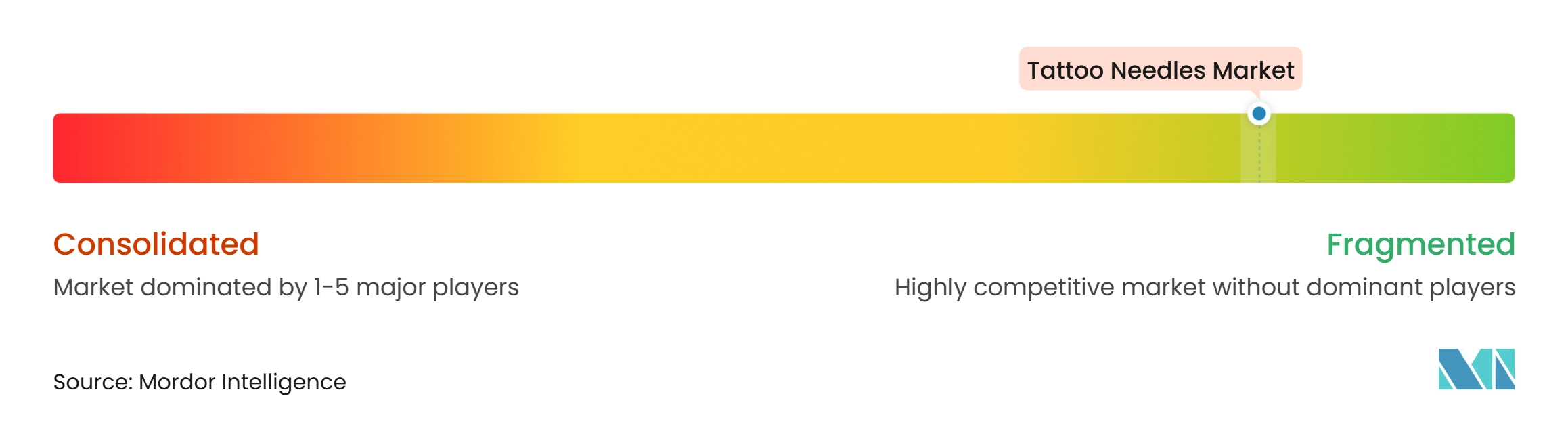
The tattoo needles market has a semi-fragmented competitive structure. Kwadron, Cheyenne Professional Tattoo Equipment GmbH, and EZ Tattoo represent distinct approaches to product design, distribution, and pricing. Kwadron has built its offering around cartridge systems and full-membrane technology, along with a distribution footprint that reaches more than 80 countries. Cheyenne emphasizes German engineering and a connected equipment system in which cartridges work with its machine range. EZ Tattoo competes through product development speed, cost positioning, and online distribution. The tattoo needles market therefore contains different competitive positions rather than a single common model. These different approaches mean that competition is not based on price alone.
Product specialization is central to premium positioning. Cheyenne's March 2025 Premium Liners launch added 24 configurations, including Capillary and Safety Liner variants for fine-line and bold-outline work: Kwadron's June 2026 Combat Curved Magnum formats targeted large-format blackwork, backpieces, and full-sleeve sessions. EZ Tattoo used its January 2026 V-Select Gold Series to promote a Ti-AU tip material for professional artists. These launches show that suppliers are pursuing specialized performance claims for distinct applications. Equipment providers are also extending their product systems into permanent makeup, where device and cartridge compatibility can encourage repeat purchasing.
The lower and middle tiers include many private-label and regional producers from China, Taiwan, and South Korea. These suppliers often compete through price, availability, and delivery time. Their presence can make it harder for mid-tier brands to sustain investment in quality systems and new designs. At the same time, counterfeit and non-validated products remain a risk to practitioner safety and brand confidence. Italian enforcement action in 2025 demonstrates that unauthorized practices remain a public-health concern. Manufacturers that can provide sterilization records, clear labeling, and stable gauge tolerances have a practical way to differentiate in professional accounts. The tattoo needles market remains open to regional specialists because no supplier has the scale to dictate terms across every product class and geography.
Tattoo Needles Industry Leaders
-
Cheyenne Professional Tattoo Equipment GmbH
-
Kwadron
-
Dragonhawk
-
Bishop Rotary
-
EZ Tattoo
- *Disclaimer: Major Players sorted in no particular order
Tattoo Needles Market Companies Covered in this Report
- Barber DTS
- Bishop Rotary
- Black Claw
- Cheyenne Professional Tattoo Equipment GmbH
- Dragonhawk
- Elite Tattoo
- Envy Tattoo Needles
- EZ Tattoo
- Inkeeze
- Killer Ink
- Kwadron
- Magic Moon
- Mithra Tattoo Supplies
- Peak Needles
- Precision Needles
- Stigma-Rotary
- TATSoul
- T-Tech
- Vertix Needles
Recent Industry Developments in Tattoo Needles Market
- June 2026: Kwadron launched Combat Curved Magnum 73CM and 85CM cartridges, the largest curved magnum configurations commercially available, designed to reduce pass counts in large-format blackwork, backpieces, and full-sleeve fill sessions, targeting professional studios where session productivity drives consumable purchasing decisions.
- May 2026: Kwadron introduced the VELURE Wireless PMU Machine, a cordless permanent makeup device incorporating a 4.8W brushless motor engineered for the precision requirements of brow, lip, and eyeliner micropigmentation. The launch extends Kwadron's ecosystem from needle cartridges into PMU-specific hardware, targeting the fast-growing cosmetic tattoo artist segment as a distinct buyer cohort.
- April 2026: EZ Tattoo hosted the Gold Needle Relay at Gods of Ink 2026 in Frankfurt, a live two-day event showcasing artists using 18K gold- and titanium-nitride-coated needle technology, anchoring the brand's product launch messaging around verified performance under professional conditions.
Global Tattoo Needles Market Report Scope
As per the report's scope, a tattoo needle is not a single point; it comprises a precision-soldered cluster of multiple small steel pins, or sharps, mounted on a bar or enclosed in a disposable cartridge. As the tattoo machine operates, these micro-needles rapidly puncture the skin’s dermis to deposit pigment.
The Tattoo Needles Market is segmented by product type, needle configuration, needle gauge and diameter, form, application, end user, sterilization status, distribution channel, and geography. By product type, the market is segmented into round liner needles, round shader needles, magnum needles, curved magnum needles, flat needles, cartridge needles, textured needles, and other product types. By needle configuration, the market is segmented into standard configuration, bugpin configuration, tapered configuration, textured configuration, and custom configuration. By needle gauge and diameter, the market is segmented into 12 gauge (0.35 mm), 10 gauge (0.30 mm), 8 gauge (0.25 mm), 6 gauge (0.20 mm), and bugpin and specialty diameters. By form, the market is segmented into traditional needle-on-bar, disposable cartridge, membrane cartridge, and rubber-band cartridge. By application, the market is segmented into lining, shading, colouring, blackwork, realism and portrait work, fine-line and micro-detail work, cosmetic tattooing and permanent makeup, and medical and paramedical tattooing. By end user, the market is segmented into professional tattoo studios, independent tattoo artists, cosmetic tattoo artists, medical tattoo practitioners, and training institutions. By sterilization status, the market is segmented into pre-sterilized needles and non-sterilized needles. By distribution channel, the market is segmented into specialty tattoo distributors, direct manufacturer sales, e-commerce and digital marketplaces, specialty retail stores, and studio-chain and bulk contracts. By geography, the market is segmented into North America, Europe, Asia-Pacific, the Middle East and Africa, and South America. The market report also covers estimated market sizes and trends for 17 countries across major regions worldwide. The report offers market size and forecasts in value (USD) for the above segments.
Segmentation Overview
| Round Liner Needles |
| Round Shader Needles |
| Magnum Needles |
| Curved Magnum Needles |
| Flat Needles |
| Cartridge Needles |
| Textured Needles |
| Other Product Types |
| Standard Configuration |
| Bugpin Configuration |
| Tapered Configuration |
| Textured Configuration |
| Custom Configuration |
| 12 Gauge, 0.35 mm |
| 10 Gauge, 0.30 mm |
| 8 Gauge, 0.25 mm |
| 6 Gauge, 0.20 mm |
| Bugpin and Specialty Diameters |
| Traditional Needle-on-Bar |
| Disposable Cartridge |
| Membrane Cartridge |
| Rubber-Band Cartridge |
| Lining |
| Shading |
| Colouring |
| Blackwork |
| Realism and Portrait Work |
| Fine-Line and Micro-Detail Work |
| Cosmetic Tattooing and Permanent Makeup |
| Medical and Paramedical Tattooing |
| Professional Tattoo Studios |
| Independent Tattoo Artists |
| Cosmetic Tattoo Artists |
| Medical Tattoo Practitioners |
| Training Institutions |
| Pre-Sterilized Needles |
| Non-Sterilized Needles |
| Specialty Tattoo Distributors |
| Direct Manufacturer Sales |
| E-Commerce and Digital Marketplaces |
| Specialty Retail Stores |
| Studio-Chain and Bulk Contracts |
| North America | United States |
| Canada | |
| Mexico | |
| Europe | Germany |
| United Kingdom | |
| France | |
| Italy | |
| Spain | |
| Rest of Europe | |
| Spain | |
| Rest of Europe | |
| Asia-Pacific | China |
| Japan | |
| India | |
| Australia | |
| South Korea | |
| Rest of Asia-Pacific | |
| Middle East and Africa | GCC |
| South Africa | |
| Rest of Middle East and Africa | |
| South America | Brazil |
| Argentina | |
| Rest of South America |
| By Product Type | Round Liner Needles | |
| Round Shader Needles | ||
| Magnum Needles | ||
| Curved Magnum Needles | ||
| Flat Needles | ||
| Cartridge Needles | ||
| Textured Needles | ||
| Other Product Types | ||
| By Needle Configuration | Standard Configuration | |
| Bugpin Configuration | ||
| Tapered Configuration | ||
| Textured Configuration | ||
| Custom Configuration | ||
| By Needle Gauge and Diameter | 12 Gauge, 0.35 mm | |
| 10 Gauge, 0.30 mm | ||
| 8 Gauge, 0.25 mm | ||
| 6 Gauge, 0.20 mm | ||
| Bugpin and Specialty Diameters | ||
| By Form | Traditional Needle-on-Bar | |
| Disposable Cartridge | ||
| Membrane Cartridge | ||
| Rubber-Band Cartridge | ||
| By Application | Lining | |
| Shading | ||
| Colouring | ||
| Blackwork | ||
| Realism and Portrait Work | ||
| Fine-Line and Micro-Detail Work | ||
| Cosmetic Tattooing and Permanent Makeup | ||
| Medical and Paramedical Tattooing | ||
| By End User | Professional Tattoo Studios | |
| Independent Tattoo Artists | ||
| Cosmetic Tattoo Artists | ||
| Medical Tattoo Practitioners | ||
| Training Institutions | ||
| By Sterilization Status | Pre-Sterilized Needles | |
| Non-Sterilized Needles | ||
| By Distribution Channel | Specialty Tattoo Distributors | |
| Direct Manufacturer Sales | ||
| E-Commerce and Digital Marketplaces | ||
| Specialty Retail Stores | ||
| Studio-Chain and Bulk Contracts | ||
| By Geography | North America | United States |
| Canada | ||
| Mexico | ||
| Europe | Germany | |
| United Kingdom | ||
| France | ||
| Italy | ||
| Spain | ||
| Rest of Europe | ||
| Spain | ||
| Rest of Europe | ||
| Asia-Pacific | China | |
| Japan | ||
| India | ||
| Australia | ||
| South Korea | ||
| Rest of Asia-Pacific | ||
| Middle East and Africa | GCC | |
| South Africa | ||
| Rest of Middle East and Africa | ||
| South America | Brazil | |
| Argentina | ||
| Rest of South America | ||
Key Questions Answered in the Report
What is the projected value of tattoo needles by 2032?
The tattoo needles market is forecast to reach USD 507.07 million by 2032, growing at a 3.56% CAGR from 2027.
Which tattoo needle product type is growing fastest?
Cartridge needles are both the leading product type, with 30.42% revenue share in 2026, and the fastest-growing product type, with a 5.18% CAGR through 2032.
Why are membrane tattoo cartridges gaining adoption?
Membrane cartridges are forecast to grow at a 5.92% CAGR because they help prevent fluid from entering the machine body and support documented hygiene practices.
Which tattoo application is expanding fastest?
Fine-line and micro-detail work is forecast to grow at a 6.24% CAGR through 2032, supported by demand for precise, small-group needle configurations.
What is the largest end-user group for tattoo needles?
Professional tattoo studios account for 56.74% of demand in 2026 because their procedure volume requires regular purchasing across many configurations.
Which region has the highest forecast growth?
Asia-Pacific is forecast to grow at a 5.84% CAGR through 2032, supported by changing regulation, studio development, and growing interest in verified supplies.