
Tank Insulation Market Size and Share
Market Overview
| Study Period | 2021 - 2031 |
|---|---|
| Market Size (2026) | USD 7.49 Billion |
| Market Size (2031) | USD 9.15 Billion |
| Growth Rate (2026 - 2031) | 4.08 % |
| Fastest Growing Market | Asia-Pacific |
| Largest Market | Asia-Pacific |
| Market Concentration | Low |
Major Players *Disclaimer: Major Players sorted in no particular order Image © Mordor Intelligence. Reuse requires attribution under CC BY 4.0. | |
Tank Insulation Market Analysis by Mordor Intelligence
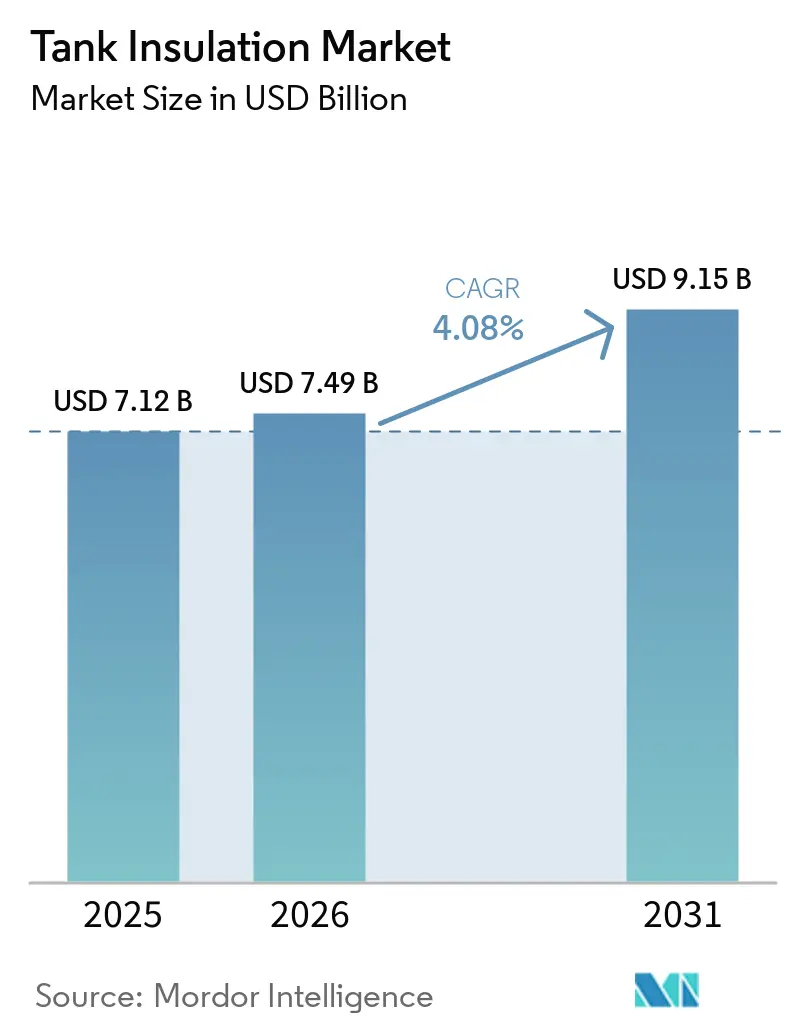
The Tank Insulation Market size was valued at USD 7.12 billion in 2025 and is estimated to grow from USD 7.49 billion in 2026 to reach USD 9.15 billion by 2031, at a CAGR of 4.08% during the forecast period (2026-2031). The tank insulation market is supported by tighter energy-efficiency requirements, growing LNG and cryogenic infrastructure, and chemical and petrochemical investment in Asia-Pacific and the Middle-East, where new tank farms and industrial facilities require thermal containment systems. Demand from oil and gas, food and beverage, and process industries provides a stable base for the market, even when raw material costs rise, as these end users require continuous temperature control and operational reliability. Suppliers compete on thermal performance, fire certification, and corrosion-under-insulation resistance rather than price alone, placing greater value on verified specifications and reliable installation performance. Digital monitoring is becoming relevant in LNG terminals and petroleum storage sites, where insulation systems support predictive maintenance, asset integrity programs, and earlier identification of moisture-related risks. Suppliers that combine insulation materials with monitoring services can build longer customer relationships, increase switching costs, and develop service offerings that extend beyond initial material supply.
Key Report Takeaways
- By material, polyurethane (PU) and polyisocyanurate (PIR) held 33.27% of the tank insulation market share in 2025, while elastomeric foam is projected to grow at a 5.28% CAGR through 2031.
- By type, storage tank insulation accounted for 62.18% of the tank insulation market share in 2025, while transportation tank insulation is forecast to expand at a 4.95% CAGR through 2031.
- By end-user industry, oil and gas accounted for 35.62% of the tank insulation market share in 2025, while chemical and petrochemical industries are projected to grow at a 4.88% CAGR through 2031.
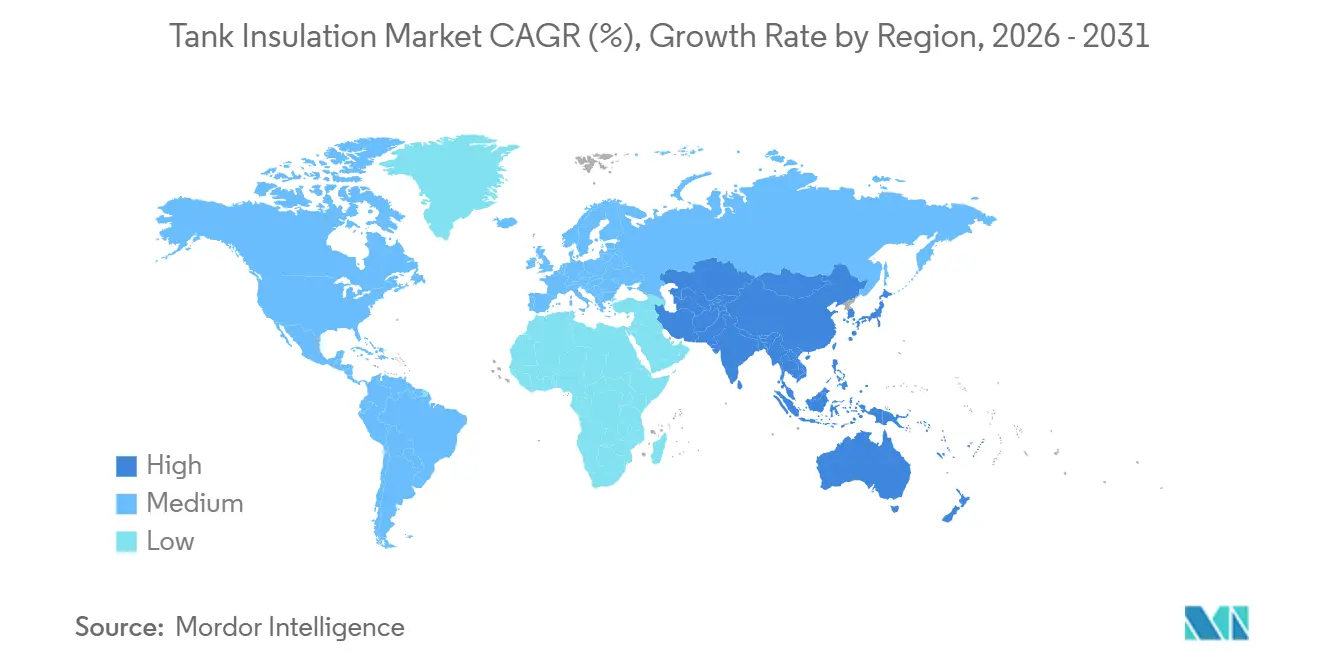
- By geography, Asia-Pacific accounted for 41.83% of the tank insulation market share in 2025 and is expected to advance at a 4.93% CAGR through 2031.
Note: Market size and forecast figures in this report are generated using Mordor Intelligence’s proprietary estimation framework, updated with the latest available data and insights as of January 2026.
Market Trends and Insights
Drivers Impact Analysis of Tank Insulation Market*
| Drivers | (~) % Impact on CAGR Forecast | Geographic Relevance | Impact Timeline |
|---|---|---|---|
| Stringent Industrial Energy Efficiency and Emission Reduction Regulations | +1.2% | EU core, UK, North America, and Asia-Pacific (APAC) regulatory adopters | Short term (≤ 2 years) |
| Expansion of LNG, Industrial Gas, and Cryogenic Storage Infrastructure | +1.0% | Asia-Pacific, North America, and Europe | Medium term (2-4 years) |
| Increasing Investments in Chemical, Petrochemical, and Process Industries | +0.8% | Asia-Pacific, the Middle-East, and Brazil | Medium term (2-4 years) |
| Growing Demand for Temperature-Controlled Storage in the Food and Beverage Sector | +0.6% | Asia-Pacific, North America, and Europe | Medium term (2-4 years) |
| Adoption of Digital Monitoring and Predictive Maintenance for Tank Insulation Systems | +0.4% | Global, with early adoption in LNG-focused Asia-Pacific and Gulf infrastructure | Long term (≥ 4 years) |
| Source: Mordor Intelligence | |||
Stringent Industrial Energy Efficiency and Emission Reduction Regulations
Industrial energy regulations are creating near-term demand for tank insulation system upgrades. European requirements for energy audits and energy management systems place greater emphasis on documented energy-saving measures at large industrial sites. Thermal insulation on process tanks and vessels is part of this broader effort to control heat loss and improve operating efficiency, particularly at facilities using older insulation systems. The revised EU Construction Products Regulation also affects the performance information that insulation products must provide in the European market, making documented material properties more relevant during procurement. These requirements are encouraging retrofit activity in Germany, France, and Italy, where industrial energy consumption remains substantial and existing tank fleets represent a large potential base for upgrades. Similar procurement cycles are emerging in North America as building and energy codes place greater emphasis on the operational efficiency and performance of industrial facilities.
Expansion of Liquefied Natural Gas (LNG), Industrial Gas, and Cryogenic Storage Infrastructure
LNG projects moving forward in 2026 are driving demand for insulation capable of operating at cryogenic temperatures. Caturus LLC announced a positive final investment decision for the 9.5 million tons per annum (Mtpa) Commonwealth LNG facility in Cameron, Louisiana, supported by USD 9.75 billion in project financing. Bechtel also received a limited notice to proceed from Cheniere for Train 7 at the Sabine Pass Liquefaction Expansion in May 2026. Cryogenic tanks require materials with low moisture absorption, high compressive strength, and reliable performance at -160°C, as insulation failure can compromise thermal control and operational reliability. These requirements support the use of cellular glass, polyurethane/polyisocyanurate (PU/PIR), perlite systems, and other specialized solutions that perform better in cryogenic service than conventional insulation options. New capacity along the US Gulf Coast, the Canadian Pacific coast, and East Asian import terminals provides contractors and material suppliers with multiple demand centers in the tank insulation market.
Increasing Investments in Chemical, Petrochemical, and Process Industries
New chemical facilities require insulated tanks for feedstock, intermediate products, and finished goods. China National Petroleum Corporation (CNPC) increased annual ethylene capacity at the Dushanzi Petrochemical Complex to more than 3 million metric tons in July 2026 through a 1.2 million ton-per-year green ethylene expansion. Tasnee completed a USD 500 million ethylene cracker expansion at its Saudi Ethylene and Polyethylene Company (SEPC) site in Al-Jubail in July 2026, increasing olefins production by 18%. The Eastern Mediterranean Petrochemical Cluster in Ceyhan attracted more than USD 3 billion in investment as of July 2026, including a USD 2 billion polypropylene facility and a liquid bulk terminal. Each project adds tank assets that require insulation during construction and maintenance during operation, as the materials must support both process conditions and stored-product temperature requirements. This installed base creates service opportunities for contractors, particularly as scheduled maintenance needs become more apparent after commissioning.
Growing Demand for Temperature-Controlled Storage in the Food and Beverage Sector
Food and beverage facilities require stable tank temperatures for dairy processing, brewing, juice concentration, and edible oil handling. These systems need insulation that supports temperature control, cleanable surfaces, and food-safety requirements, as uncontrolled temperatures can affect product handling and processing operations. The EU formaldehyde restriction, effective from August 2026, is increasing interest in formaldehyde-free binders near food-contact infrastructure. Knauf Insulation launched Performance+ Pipe and Tank Insulation in April 2025 as a formaldehyde-free fiberglass product with Asthma and Allergy Friendly and Verified Healthier Air certifications[1]. Cold-chain expansion in South and Southeast Asia is also increasing the need for temperature-controlled storage, as urban growth and rising middle-income demand drive the development of modern handling infrastructure. Food processors are incorporating insulation systems into facility quality-management frameworks, rather than treating them solely as thermal equipment, which raises the importance of material selection and installation quality.
Restraints Impact Analysis of Tank Insulation Market*
| Restraints | (~) % Impact on CAGR Forecast | Geographic Relevance | Impact Timeline |
|---|---|---|---|
| Volatility in Raw Material Prices for Polymer and Mineral Fiber Insulation | -0.8% | Global, especially South and Southeast Asia, and MENA | Short term (≤ 2 years) |
| High Installation, Retrofit, and Maintenance Costs for Industrial Tank Insulation | -0.7% | Global, with stronger constraints in North America and Western Europe | Medium term (2-4 years) |
| Performance Degradation Due to Moisture Ingress and Corrosion Under Insulation | -0.5% | Global, especially the Gulf, Southeast Asia, and Brazil | Long term (≥ 4 years) |
| Source: Mordor Intelligence | |||
Volatility in Raw Material Prices for Polymer and Mineral Fiber Insulation
Polyurethane (PU) and polyisocyanurate (PIR) systems depend on methylene diphenyl diisocyanate (MDI), toluene diisocyanate (TDI), and polyether polyols, which are exposed to crude oil price cycles, regional capacity utilization, and supply disruptions. Cost movements in these inputs can reduce converter margins when contracts are fixed before materials are purchased, particularly where suppliers cannot quickly pass higher costs to project owners. Producers with upstream capacity are better positioned than smaller fabricators to manage these changes and maintain supply during periods of market disruption. BASF completed the final phase of its Geismar MDI expansion in mid-2026, bringing capacity to 600,000 metric tons per year. Smaller manufacturers can face pressure when input costs rise during fixed-price projects, affecting bid discipline and supplier selection in the tank insulation market. The EU Fluorinated Gases (F-Gas) transition also adds formulation and compliance costs for European PU/PIR producers.
Performance Degradation Due to Moisture Ingress and Corrosion Under Insulation
Corrosion under insulation remains a major operational concern for insulated tanks in oil, gas, and chemical facilities. Moisture can enter through jacketing seams, supports, and roof depressions, and remain against the tank surface for extended periods without being visible during normal operations. This issue is particularly significant in humid and coastal locations, where degradation may only be discovered during planned shutdowns, and where repairs can disrupt operating schedules. Cellular glass, aerogel blankets, and spray-on insulating coatings are used in applications where moisture control is critical. These materials carry a higher initial cost but can reduce maintenance exposure over the operating life of an asset and support better asset integrity management. The tank insulation market presents opportunities for systems that address corrosion risk at the design stage, rather than relying solely on remedial maintenance after damage is identified.
*Our forecasts treat driver/restraint impacts as directional, not additive. The impact forecasts reflect baseline growth, mix effects, and variable interactions.
Tank Insulation Market Segment Analysis
By Material:
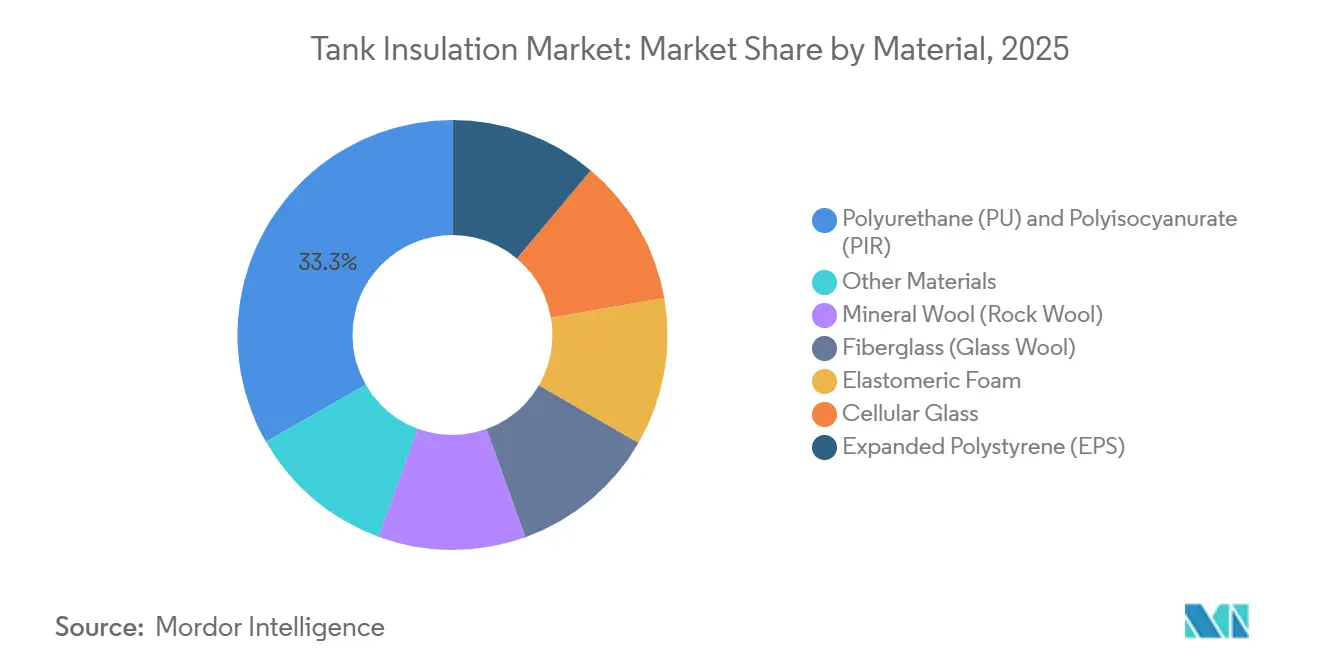
PU/PIR Leads Current Demand While Specialty Materials Gain Use in Critical ApplicationsPU/PIR held 33.27% of the tank insulation market share in 2025. Their thermal performance per unit thickness and fabrication flexibility support use across storage and transportation applications, where operators need reliable insulation across ambient and sub-zero service conditions. Oil, gas, and chemical operators support their broad use in ambient- and moderate-temperature tanks because these materials can be fabricated to suit varied tank shapes and project specifications. European compliance requirements also reinforce the role of documented product performance, product marking, and consistent installation quality in material selection. Mineral wool and fiberglass follow PU/PIR because they provide noncombustibility and high-temperature capability, which remains important for refinery, process, and large storage-tank projects. These materials are cost-effective options for large-diameter storage tanks where fire resistance and operating-temperature requirements take priority over minimum insulation thickness. They are often selected by operators who require fire-resistance-rated insulation systems that can be applied over broad external tank surfaces. This balance keeps several material families relevant in the tank insulation market, rather than a single material being suitable for every operating environment.
Elastomeric foam is the fastest-growing material, with the tank insulation market size for this material forecast to expand at a 5.28% CAGR through 2031. Its closed-cell structure resists moisture ingress and helps address corrosion-under-insulation risk, particularly where conventional insulation systems can retain moisture near a tank surface. Its flexibility also supports use on complex transportation tanks and LNG vessel pipework, where geometry can make rigid products harder to install. Refrigerant phase-down requirements are supporting replacement activity in commercial refrigeration and cold-chain infrastructure, where pipe and vessel insulation must maintain stable operating conditions. BASF launched ELASTOSPRAY BMB isocyanate in April 2026, with a product carbon footprint up to 29% lower than conventional spray polyurethane foam systems under ISO 14067:2018. Cellular glass remains important where zero moisture absorption is required, particularly in cryogenic and high-temperature service, where a moisture-resistant barrier is a design requirement. Expanded Polystyrene (EPS) continues to serve cost-sensitive applications with lower fire-performance requirements and less demanding temperature conditions. Low-carbon PU/PIR formulations can also improve the position of polymer solutions in sustainability-focused procurement, where buyers assess thermal performance alongside product carbon information.

By Type:
Storage Tanks Form the Installed Base, While Transportation Tanks Gain From LNG LogisticsStorage tank insulation accounted for 62.18% of the tank insulation market share in 2025. Fixed storage assets in refineries, chemical complexes, LNG terminals, and food-processing sites form a large base, as these facilities rely on tanks to store feedstocks, intermediate products, and finished goods. New petrochemical complexes, LNG terminals, and cold-storage facilities add storage tanks during construction, creating demand for insulation before operations begin. The same assets generate demand for replacement and maintenance when jacketing, insulation layers, or corrosion-protection systems require renewal. Storage systems can remain in service for 20 to 30 years, extending the need for inspection, repair, and insulation services across their operational life. API 650 and EN 14015 influence the performance criteria that systems must meet, including conditions affecting tank construction and external protection. Temperature resistance and jacketing integrity are important aspects of these requirements because they help maintain the insulation system's intended performance. This installed base provides stable demand for the tank insulation market across both greenfield projects and operating facilities.
Transportation tank insulation is forecast to grow at a 4.95% CAGR through 2031. LNG trade growth and the wider use of ISO tank containers for chemical and cryogenic logistics support this expansion, as the products transported must remain within defined temperature ranges throughout transit. Commonwealth LNG and the Sabine Pass Train 7 project will require insulation across related LNG storage and transport infrastructure. LNG carriers use vacuum-insulated panels and perlite systems to control cryogenic heat loss during transport, while related tanks must resist moisture exposure and mechanical demands. International Maritime Organization requirements and the IGC Code set thermal-loss limits for gas carriers, making insulation performance a regulated requirement. These standards make performance certification important in supplier selection, limiting buyers' ability to select materials based solely on initial price. Specialized materials can therefore retain value even when cost competition increases across broader industrial insulation categories. Transportation applications are a fast-growing segment of the tank insulation market, increasing the importance of specialized installation capabilities.
By End-User Industry:
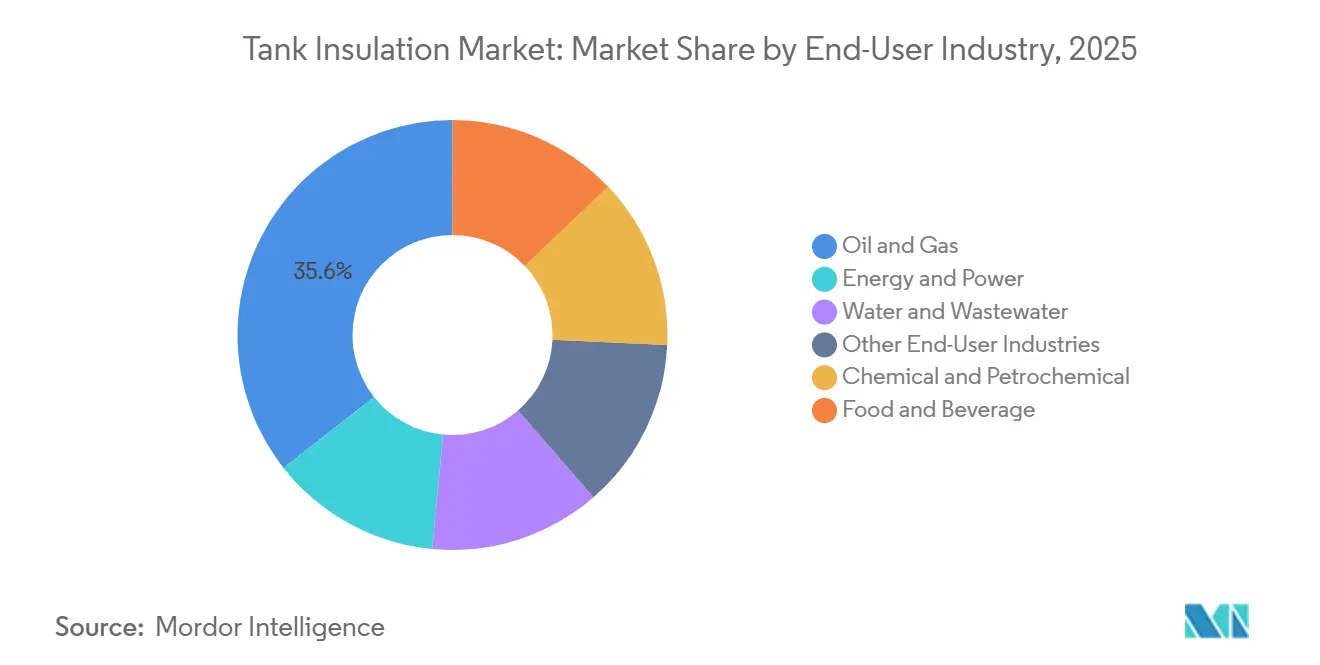
Oil and Gas Leads Demand While Chemicals and Petrochemicals Expand FasterOil and gas accounted for 35.62% of the tank insulation market share in 2025. The sector has a large installed base of crude-oil storage tanks, refinery vessels, and LNG terminal systems that require temperature control, fire performance, and protection from moisture-related deterioration. Operators in the GCC and Southeast Asia are upgrading systems as part of asset-integrity programs, particularly where existing tanks require higher-performing materials or renewed jacketing. This retrofit activity increases demand beyond new projects and gives suppliers work that does not depend solely on the timing of major construction approvals. Tanks that operate within corrosion-sensitive temperature ranges require close attention to moisture barriers and inspection practices throughout service. Cellular glass, aerogel, and spray-on coatings are relevant options in these settings because they can help manage moisture accumulation around the tank surface. These materials help operators manage corrosion-under-insulation exposure while accounting for maintenance requirements throughout the asset's life. Oil and gas, therefore, remains the largest end-user segment in the tank insulation market.
Chemical and petrochemical applications are projected to advance at a 4.88% CAGR through 2031. Capacity additions in Asia and the Middle-East are increasing requirements for tank farms and insulated storage, as new crackers and processing units need facilities for feedstock, intermediate products, and finished chemical inventories. CNPC expanded the Dushanzi Complex in July 2026, while Tasnee completed its Saudi Ethylene & Polyethylene Company (SEPC) expansion in Al-Jubail during the same month. Food and beverages, energy, and power generate steadier demand linked to regulatory requirements, operating needs, and the need to maintain controlled process conditions. Food processors are using ISO 22000 management systems and materials that meet applicable food-contact requirements, which can raise the standard for materials used around tanks and piping. Water and wastewater operators use insulated tanks in desalination and treatment facilities across the GCC and North Africa, although these applications represent a smaller share of the market. Procurement in these applications can also reflect drinking-water quality requirements and facility operating needs. This wider mix of end users supports demand across the tank insulation market and reduces reliance on a single application area.
Geography Analysis
APAC Tank Insulation Market
Asia-Pacific accounted for 41.83% of the tank insulation market share in 2025 and is forecast to grow at a 4.93% CAGR through 2031. China and India are the primary demand centers, driven by petrochemical investment, LNG infrastructure development, and industrial expansion. Japan and South Korea contribute high-specification demand from LNG import terminals and refinery upgrade programs. BASF's Zhanjiang Verbund site began production in early 2026, following an EUR 8.7 billion (~USD 9.99 billion) investment. Such projects support demand for cellular glass and aerogel insulation in LNG and process applications that require high performance.
North America Tank Insulation Market
North America remains a significant market for tank insulation, with the U.S. Gulf Coast serving as a major LNG export hub and an active center for petrochemical and refinery investment. The Sabine Pass Train 7 expansion and Commonwealth LNG investment reflect the capital directed toward liquefaction, storage, and process infrastructure. These assets require insulation for cryogenic tanks and process vessels, while replacement projects in mature LNG infrastructure provide an additional source of demand for suppliers. Mexico has a smaller demand base due to investment in energy and chemical processing.
EMEA and South America Tank Insulation Market
Europe's tank insulation market is shaped by industrial decarbonization and energy security investments. Germany, the UK, France, and Italy are the primary national demand centers, where procurement is tied to energy-efficiency requirements and the F-Gas transition. In 2026, Rockwool agreed to acquire Ravago's 40,000-ton-per-year stone wool plant in Hungary, expanding its capacity to serve Central and Eastern Europe[2]. The Middle-East, Africa, and South America hold smaller market shares, but their project pipelines remain positive. Tasnee's capacity additions in Saudi Arabia and its investment in Turkey's Ceyhan industrial zone support this outlook, thereby generating demand for new tank farms and associated process facilities. Regional project activity provides a positive medium-term demand base beyond the larger Asia-Pacific, North American, and European markets.
Competitive Landscape
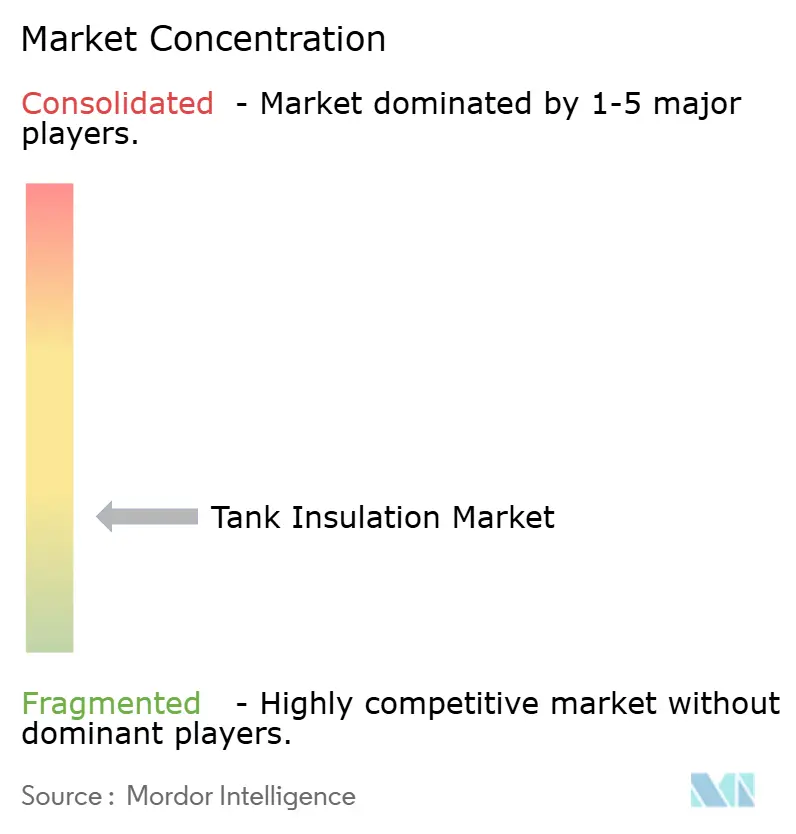
The tank insulation market is moderately fragmented. Rockwool A/S, Saint-Gobain, Owens Corning, BASF SE, and Armacell compete through material portfolios and geographic reach, while regional and specialist suppliers compete through application knowledge, delivery times, and proximity to projects. BASF represents the integrated chemical producer model, supplying Methylene Diphenyl Diisocyanate (MDI), polyol blends, and spray polyurethane systems to downstream fabricators. Armacell and L'ISOLANTE K-FLEX represent finished-product specialists that design factory-fabricated insulation sections for specific applications. This structure means upstream chemical supply can influence material selection for a project and can affect the position of smaller fabricators.
BASF completed the final phase of its Geismar MDI expansion in mid-2026, reaching an annual capacity of 600,000 metric tons. Covestro is planning a 660-kilotonne MDI production train in Shanghai and has initiated a feasibility study for a site in the UAE, indicating greater upstream competition in Asian and Middle-Eastern project markets. These developments strengthen large chemical suppliers' ability to support polyurethane systems in key growth regions. Suppliers without integrated raw-material access may face greater pressure during MDI shortages, when mineral wool becomes a more attractive alternative.
Corrosion Under Insulation (CUI)-resistant systems, cryogenic products, and digital monitoring create room for differentiation. Suppliers are presenting life-cycle maintenance savings rather than focusing solely on unit material costs, while monitoring systems can support service agreements beyond the initial installation. Rockwool acquired ScanArc Plasma Technologies in 2026 to support the electrification of stone-wool melting furnaces and to address lower-carbon procurement requirements. Fire-performance certifications and environmental product declarations are becoming important for European industrial projects and can raise entry barriers for smaller suppliers. The competitive structure remains consistent with a moderate concentration level, as no single supplier holds an outsized disclosed market share.
Tank Insulation Industry Leaders
-
Rockwool A/S
-
Owens Corning
-
Saint-Gobain
-
Kingspan Group
-
ARMACELL
- *Disclaimer: Major Players sorted in no particular order
Tank Insulation Market Companies Covered in this Report
- ARMACELL
- BASF SE
- Cabot Corporation
- Etex Group
- Huntsman Corporation
- ITW Insulation
- J.H. Ziegler GmbH
- Johns Manville
- Kingspan Group
- Knauf Insulation
- L'ISOLANTE K-FLEX S.p.A.
- Owens Corning
- Röchling
- Rockwool A/S
- Saint-Gobain
- Sekisui Foam International
Recent Industry Developments in Tank Insulation Market
- July 2026: Saudi National Industrialization Company (Tasnee) completed its USD 500 million ethylene cracker expansion at Saudi Ethylene and Polyolefins Company's Al-Jubail facility, increasing ethylene output by 18%. The expanded complex requires new product storage tank infrastructure and insulation systems across its petrochemical value chain.
- May 2026: Caturus announced a positive final investment decision for the 9.5 million tons per annum (Mtpa) Commonwealth LNG export facility in Cameron, Louisiana, securing USD 9.75 billion in project financing. The facility includes LNG liquefaction trains and storage tank infrastructure requiring cryogenic-grade insulation across the full asset scope, with Engineering, Procurement, and Construction (EPC) partner Technip Energies leading construction.
Global Tank Insulation Market Report Scope
Tank insulation involves applying specialized material to the exterior of a storage container to control internal temperatures, prevent heat loss or gain, and reduce condensation. Its primary purposes include energy savings, frost protection, and process stability.
The tank insulation market is segmented by material, type, end-user industry, and geography. By material, the market is segmented into polyurethane (PU) and polyisocyanurate (PIR), mineral wool (rock wool), fiberglass (glass wool), elastomeric foam, cellular glass, expanded polystyrene (EPS), and other materials. By type, the market is segmented into storage tank insulation and transportation tank insulation. By end-user industry, the market is segmented into oil and gas, chemical and petrochemical, food and beverage, energy and power, water and wastewater, and other end-user industries. The report also covers market size and forecasts for tank insulation across 16 countries in major regions. The market sizes and forecasts are provided in terms of value (USD).
| Polyurethane (PU) and Polyisocyanurate (PIR) |
| Mineral Wool (Rock Wool) |
| Fiberglass (Glass Wool) |
| Elastomeric Foam |
| Cellular Glass |
| Expanded Polystyrene (EPS) |
| Other Materials |
| Storage Tank Insulation |
| Transportation Tank Insulation |
| Oil and Gas |
| Chemical and Petrochemical |
| Food and Beverage |
| Energy and Power |
| Water and Wastewater |
| Other End-User Industries |
| Asia-Pacific | China |
| India | |
| Japan | |
| South Korea | |
| Rest of Asia-Pacific | |
| North America | United States |
| Canada | |
| Mexico | |
| Europe | Germany |
| United Kingdom | |
| France | |
| Italy | |
| Russia | |
| Rest of Europe | |
| South America | Brazil |
| Argentina | |
| Rest of South America | |
| Middle-East and Africa | Saudi Arabia |
| South Africa | |
| Rest of Middle-East and Africa |
| By Material | Polyurethane (PU) and Polyisocyanurate (PIR) | |
| Mineral Wool (Rock Wool) | ||
| Fiberglass (Glass Wool) | ||
| Elastomeric Foam | ||
| Cellular Glass | ||
| Expanded Polystyrene (EPS) | ||
| Other Materials | ||
| By Type | Storage Tank Insulation | |
| Transportation Tank Insulation | ||
| By End-User Industry | Oil and Gas | |
| Chemical and Petrochemical | ||
| Food and Beverage | ||
| Energy and Power | ||
| Water and Wastewater | ||
| Other End-User Industries | ||
| By Geography | Asia-Pacific | China |
| India | ||
| Japan | ||
| South Korea | ||
| Rest of Asia-Pacific | ||
| North America | United States | |
| Canada | ||
| Mexico | ||
| Europe | Germany | |
| United Kingdom | ||
| France | ||
| Italy | ||
| Russia | ||
| Rest of Europe | ||
| South America | Brazil | |
| Argentina | ||
| Rest of South America | ||
| Middle-East and Africa | Saudi Arabia | |
| South Africa | ||
| Rest of Middle-East and Africa | ||
Key Questions Answered in the Report
What is current market size of Tank Insulation Market?
The Tank Insulation Market size was valued at USD 7.12 billion in 2025 and is estimated to grow from USD 7.49 billion in 2026 to reach USD 9.15 billion by 2031, at a CAGR of 4.08% during the forecast period (2026-2031).
Which material drives the demand for tank insulation?
PU/PIR led demand with a 33.27% share in 2025 because of its thermal performance and fabrication flexibility. It is used across storage and transportation applications in ambient and sub-zero service.
Which tank insulation material is growing fastest?
Elastomeric foam is projected to grow at a 5.28% CAGR through 2031. Its moisture resistance and flexibility support cold-chain, transportation, and complex pipework applications.
Which end-user sector is the largest buyer of tank insulation?
Oil and gas were the largest end-user sector, accounting for a 35.62% share in 2025. Refinery, storage, and LNG assets require temperature control and protection against moisture-related deterioration.