
Taiwan Plastic Waste Management Services Market Size and Share
Market Overview
| Study Period | 2020 - 2031 |
|---|---|
| Forecast Data Period | 2026 - 2031 |
| Base Year Market Size (2025) | USD 0.52 Billion |
| Market Size (2026) | USD 0.54 Billion |
| Market Size (2031) | USD 0.7 Billion |
| Growth Rate (2026 - 2031) | 5.33 % |
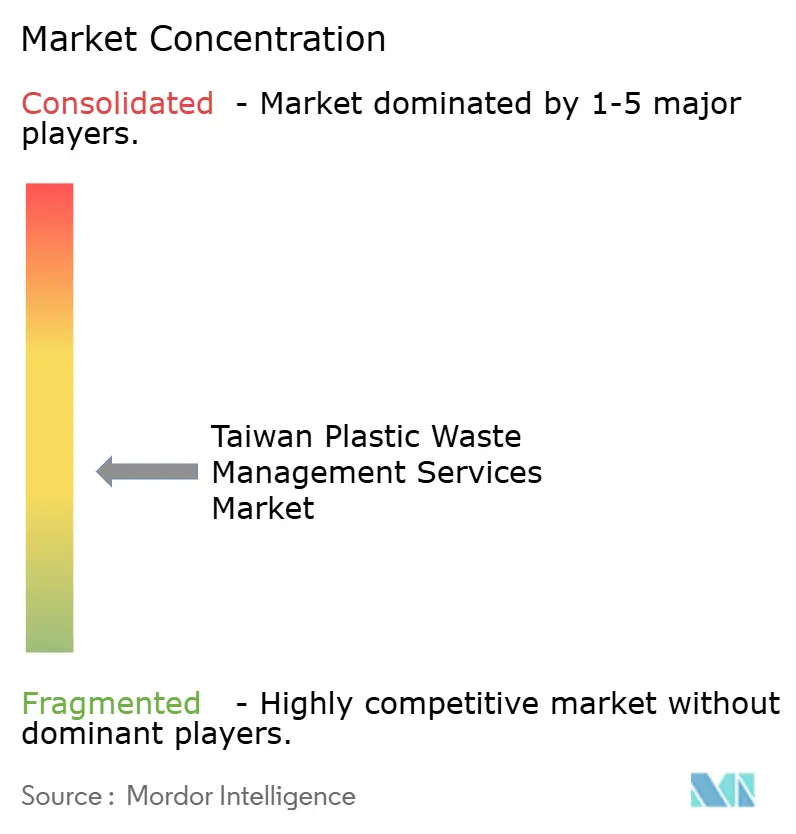
| Market Concentration | Medium |
Major Players *Disclaimer: Major Players sorted in no particular order Image © Mordor Intelligence. Reuse requires attribution under CC BY 4.0. | |
Taiwan Plastic Waste Management Services Market Analysis by Mordor Intelligence
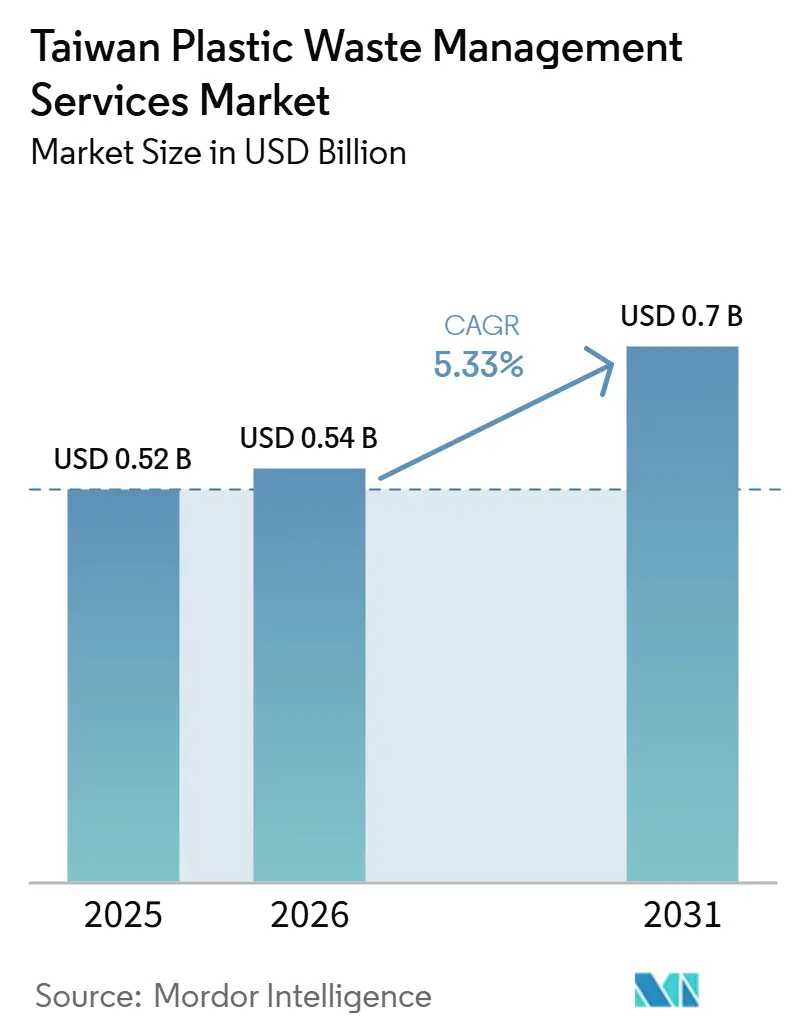
The Taiwan Plastic Waste Management Services Market size is expected to increase from USD 0.52 billion in 2025 to USD 0.54 billion in 2026 and reach USD 0.7 billion by 2031, growing at a CAGR of 5.33% over 2026-2031.
Growth in the Taiwan plastic waste management services market is being driven by rising plastic waste volumes, tighter waste-handling rules, and continued investment in treatment capacity. Taiwan's domestic plastic consumption reached 3.4 million tons annually, accounting for 40% of total plastic demand. In contrast, the domestic recycling rate stood at 40%, keeping formal recovery and disposal services central to the system. Taiwan's extended producer responsibility framework also supports recurring demand for licensed operators because fee-funded collection and recovery systems reduce exposure to swings in recovered plastic prices. Demand is also moving toward higher-value services because semiconductor and advanced electronics production generate contaminated polymer streams that require secure handling, documented transport, and certified treatment. Risks remain around labor availability, infrastructure capacity, and compliance costs. Still, those same pressures are likely to strengthen the position of scaled and licensed operators across the Taiwan plastic waste management services market.
Key Report Takeaways
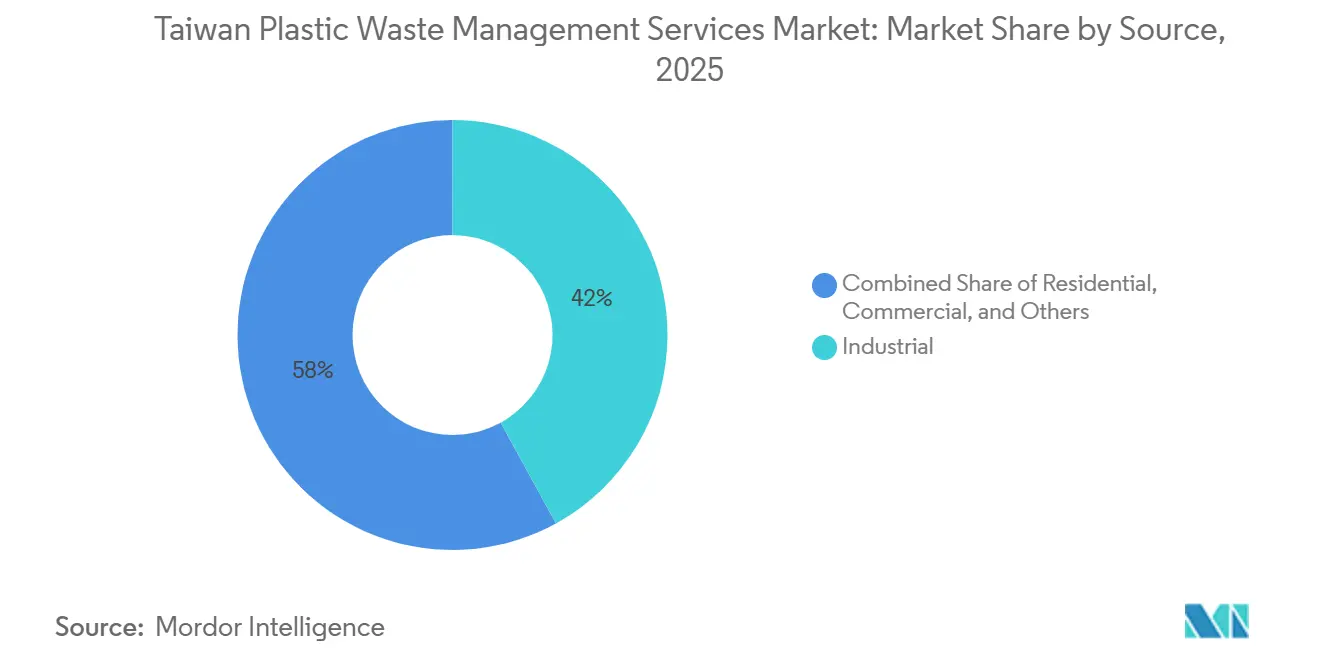
- By source, the industrial segment accounted for 42.00% of the Taiwan plastic waste management services market share in 2025, while commercial streams are projected to be the fastest-growing at 6.0% CAGR through 2031.
- By service provider, public/municipal accounted for 30.50% of the Taiwan plastic waste management services market size in 2025, and private waste management companies are expected to register 6.70% CAGR through 2031.
- By service type, collection, transportation, sorting, and segregation accounted for 41.0% in 2025, while disposal/treatment registered 7.00% CAGR over 2026-2031.
Note: Market size and forecast figures in this report are generated using Mordor Intelligence’s proprietary estimation framework, updated with the latest available data and insights as of January 2026.
Taiwan Plastic Waste Management Services Market Trends and Insights
Drivers Impact Analysis*
| Driver | (~) % Impact on CAGR Forecast | Geographic Relevance | Impact Timeline |
|---|---|---|---|
| Strong Government Regulatory Framework And EPR Policies | +1.4% | National, Taiwan-wide | Medium term (2-4 years) |
| Rising Plastic Waste Generation Driven By Rapid Urbanization And Consumption Growth | +1.1% | National, concentrated in Taipei, Taichung, and Kaohsiung metropolitan areas | Short term (≤ 2 years) |
| Growing Investments In Waste-To-Energy Infrastructure | +1.0% | National, with early gains in Taichung, Chiayi, Tainan, and Kaohsiung | Medium term (2-4 years) |
| Growing Corporate Sustainability Commitments And ESG Reporting Mandates | +0.9% | National, with early gains in Hsinchu, Taichung Science Park, and Tainan clusters | Medium term (2-4 years) |
| Rising Demand For Hazardous And Specialized Plastic Waste Handling | +0.8% | National, concentrated in semiconductor and electronics manufacturing hubs | Short term (≤ 2 years) |
| Public Awareness And High Household Participation In Waste Sorting Programs | +0.6% | National, Taiwan-wide | Short term (≤ 2 years) |
| Source: Mordor Intelligence | |||
Strong Government Regulatory Framework and EPR Policies
Taiwan's waste regulation model covers producer fees, collection, handler licensing, and end treatment, which keeps more plastic waste inside formal commercial channels. The Ministry of Environment pre-announced in May 2025 that the Resource Recycling Act would be renamed and expanded into the Resource Circulation Promotion Act, with coordination spanning 10 ministries and 14 regulatory frameworks. The same proposal also introduced a Circular Experiment Sandbox and government priority procurement for circular products, which broadens the policy reach beyond waste disposal alone. Taiwan's Responsible Enterprise Regulated Recyclable Waste Management Regulations require designated plastic container producers and importers to pay monthly recycling fees based on production or import volumes. From January 2025, containers that meet certified recycled-content or green-design standards were eligible for EPR fee discounts of up to 45%, which encouraged producers to work more closely with licensed recyclers and documented recovery partners. This structure supports the Taiwan plastic waste management services market by formalizing waste flows, improving traceability, and creating more stable revenue conditions for qualified service providers.[1]Ministry of Environment, “Responsible Enterprise Regulated Recyclable Waste Management Regulations,” oaout.moenv.gov.tw
Rising Plastic Waste Generation Driven by Rapid Urbanization and Consumption Growth
Taiwan's per capita daily waste generation averaged 1.36 kg, indicating a large and consistent volume of waste that requires collection, disposal, and recovery services. Growth in food delivery, online commerce, and event-related logistics has lifted the use of single-use and secondary plastic packaging faster than source reduction programs have been able to offset it. By mid-2024, 840,000 tonnes of household waste were being temporarily stored in landfills nationwide, highlighting the gap between waste generation and disposal throughput. That backlog has practical value for the Taiwan plastic waste management services market because municipalities facing bottlenecks need more contracted support from licensed operators. Even if plastic intensity falls in selected product categories, total waste volumes are likely to remain high enough to sustain baseline demand for collection, sorting, and treatment services.
Growing Investments in Waste-To-Energy Infrastructure
Taiwan's Environmental Management Administration manages 25 large-scale incineration plants that handle 6.5 million tons of waste each year and generate 3.3 billion kWh of electricity. The same system reduced carbon emissions by 1.6 million metric tons of CO2e, which shows that waste treatment capacity is also linked to broader environmental targets. As of 2024, 17 plants had entered upgrade projects under the Diversified Waste Treatment Program, with 330,000 tons of additional annual processing capacity expected from those projects. National incineration throughput increased from 6.5 million tons to 6.8 million tons in 2025, and the national target stands at 7 million tons by 2027. In December 2025, Mitsubishi Heavy Industries Environmental and Chemical Engineering signed a contract to supply equipment for the Taichung Wenshan waste-to-energy BOT project, a 900-ton-per-day facility operating under a 30-year concession from 2026 to 2056. These long concession structures strengthen the Taiwan plastic waste management services market by raising entry barriers and giving winning operators durable control over local treatment corridors.
Growing Corporate Sustainability Commitments and ESG Reporting Mandates
Corporate buyers are placing greater weight on traceable records of disposal and recovery, pushing demand beyond basic waste pickup. The reporting burden is becoming more formal in Taiwan, and listed companies now face stronger expectations for environmental disclosure, supply chain audits, and documented waste-handling practices. Export-linked manufacturers also face pressure from overseas packaging regulations, making compliant plastic recovery more important in supplier qualification processes. Invest Taiwan noted that plastic levies on unrecyclable plastic packaging became operative in Italy in July 2024 and are planned for Germany, which will raise the cost of weak circularity performance for Taiwan-based exporters. As a result, companies increasingly need third-party-verified chain-of-custody records and certified recovery pathways, rather than minimum-compliant disposal alone. This trend expands the Taiwan plastic waste management services market because licensed providers can package collection, treatment, documentation, and audit-ready reporting into a single commercial offer.
Restraints Impact Analysis*
| Restraint | (~) % Impact on CAGR Forecast | Geographic Relevance | Impact Timeline |
|---|---|---|---|
| Workforce Shortages In Waste Collection And Treatment Operations | -0.7% | National, Taiwan-wide | Medium term (2-4 years) |
| Limited Land Availability For New Waste Treatment Infrastructure | -0.5% | National, particularly acute in Nantou, Keelung, and densely urbanized areas | Long term (≥ 4 years) |
| High Operating Costs For Licensed Waste Management Companies | -0.6% | National, Taiwan-wide | Short term (≤ 2 years) |
| Increasing Compliance Burden From Evolving Environmental Regulations | -0.4% | National, Taiwan-wide | Medium term (2-4 years) |
| Source: Mordor Intelligence | |||
Workforce Shortages in Waste Collection and Treatment Operations
Labor supply remains a direct constraint on service growth because collection, sorting, and treatment work is physically demanding and often difficult to staff. The Ministry of Environment reported that green collar vacancies averaged more than 21,000 per month from January through April 2025, indicating that labor tightness had spread across environmental services. Taiwan also opened the waste recycling sector to migrant worker recruitment in 2025, which signaled that many operators had already stretched the available local hiring pool. When staffing is tight, operators cannot add collection routes, sorting shifts, or treatment line coverage as quickly as demand requires. This slows capacity utilization even as investment in plants and equipment continues to grow. In the Taiwan plastic waste management services market, the result is a supply-side cap that favors larger operators with stronger recruitment systems, greater training capacity, and greater ability to absorb wage pressure.
Limited Land Availability for New Waste Treatment Infrastructure
Land scarcity is a structural restraint because Taiwan has a dense population base and tight siting rules for environmentally sensitive areas. Research on industrial waste management in Taiwan identified limited space for legal landfilling as a binding constraint, especially near population centers where collection economics are strongest.[2]H. Zhou et al., “Comprehensive Waste Management Strategy, Risk Control of Waste Production and Disposal,” Journal of the Society for Information Display, doi.org Community resistance and lengthy environmental impact assessment processes also slow approvals for new projects, making greenfield development difficult even as waste volumes rise. Nantou County highlighted the scale of this problem by accumulating 310,000 tons of unprocessed waste by the end of 2025, despite still lacking an operating incineration facility. The Environmental Management Administration has therefore prioritized upgrades at existing sites and coordination with maintenance shutdowns, rather than relying on large numbers of new locations. This helps incumbent operators in the Taiwan plastic waste management services market because licensed sites are harder to replicate, even though the same land barrier also limits their own expansion.
*Our forecasts treat driver/restraint impacts as directional, not additive. The impact forecasts reflect baseline growth, mix effects, and variable interactions.
Segment Analysis
By Source: Industrial Volumes Anchor the Market, Commercial Growth Accelerates
Industrial generators accounted for 42.0% of activity in 2025. Industrial waste sources held the leading position in Taiwan's plastic waste management services market in 2025, as Taiwan's manufacturing base generates large, recurring plastic waste streams. Semiconductor, electronics, petrochemical, and precision manufacturing plants produce engineering polymers, contaminated liners, chemical-resistant films, and cleanroom packaging that need controlled handling. These streams usually require documented transport, certified treatment, and tighter chain-of-custody controls than for ordinary municipal plastics. That requirement creates a stronger need for licensed specialists and increases the value per contract in the Taiwan plastic waste management services industry. It also means demand from industrial accounts is supported by compliance needs as much as by waste volume.
Commercial sources are forecast to grow at a 6.0% CAGR through 2031, making them the fastest-growing segment in the Taiwan plastic waste management services market, as organized retail, food service, office buildings, logistics hubs, and fulfillment networks generate more dispersed plastic flows. E-commerce packaging and food delivery formats have created new streams outside older producer-manufacturer relationships, which broaden the customer base for contracted services. Commercial clients also tend to need regular collection, segregation support, and documentation, which suits scalable service models. Residential and institutional streams remain important in absolute terms, but their growth is steadier because Taiwan's household recycling participation is already well established under the Four-in-One Recycling System. Agricultural and other smaller categories remain a smaller part of the Taiwan plastic waste management services market, and their growth depends more on product-specific EPR extensions than on broad structural change.



By Service Provider: Municipal Foundations Remain Strong, Private Specialists Capture Growth
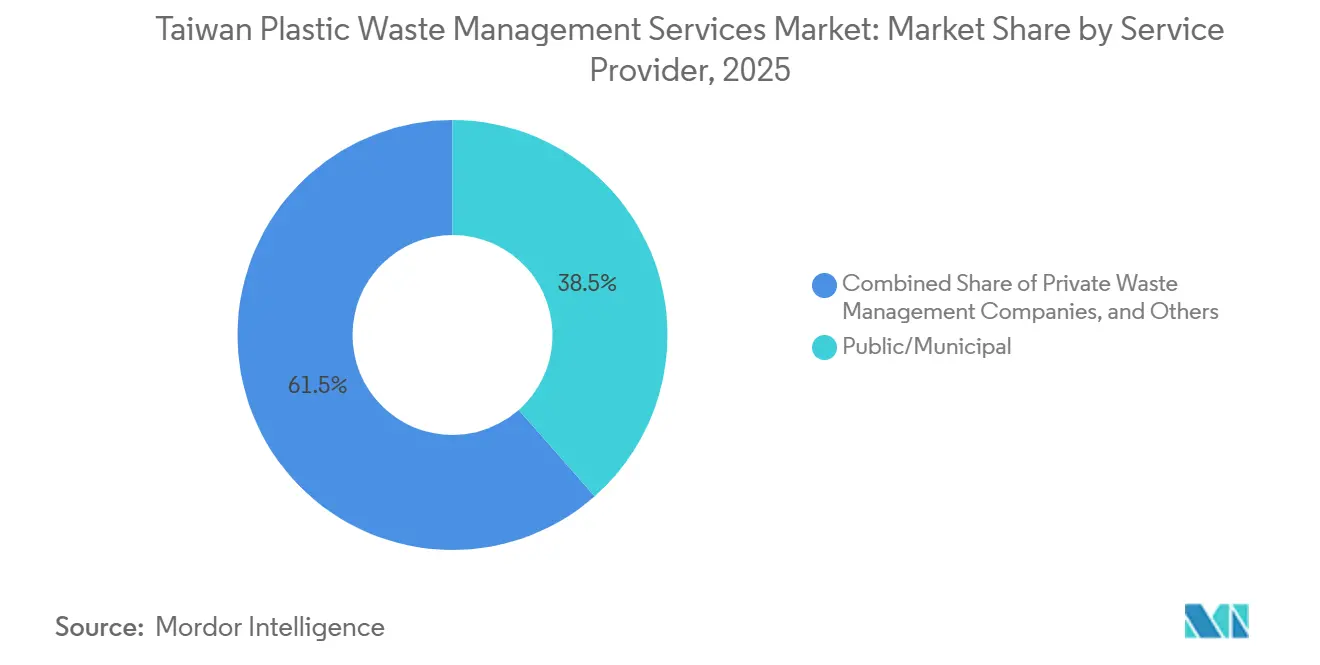
Public and municipal entities retained the broadest operating footprint in 2025, accounting for 38.50% of the market share as they sit at the center of Taiwan's collection network, public treatment assets, and government-funded waste programs. Their role is reinforced by direct links to municipal truck fleets, transfer points, and public contracting cycles that support stable demand. This makes the base of the Taiwan plastic waste management services market difficult to displace, especially in household and general commercial collection. Public operators also benefit from policy alignment when treatment upgrades are being planned or funded through national programs. That foundation keeps municipal providers central even as private competition expands around them.
Private waste management companies are projected to grow faster, registering a CAGR of 6.70%, because they are better positioned to handle complex industrial waste, provide specialized treatment, and offer tailored compliance services. They can often respond faster to customer needs in semiconductor, electronics, and higher-specification recycling work, where documentation and technical controls matter more. Private operators also benefit when municipalities need overflow handling or when corporate buyers want single vendor responsibility for collection, treatment, and reporting. As the compliance burden rises, smaller informal handlers find it harder to keep pace with digital tracking, audit records, and certification requirements. This gives the Taiwan plastic waste management services industry a clearer divide between broad public coverage at the base and faster private growth in higher complexity service niches.
By Service Type: Collection Infrastructure Leads by Volume, Treatment Services Drive Value Growth
Collection, transportation, sorting, and segregation accounted for 41.0% of revenue in 2025, because Taiwan already has a mature collection layer built over decades of formal recycling activity. The Four-in-One Recycling System connects households, municipalities, recycling enterprises, and the Recycling Fund, providing this segment with strong structural support. PET, PP, PE, PVC, and PS recovery has therefore been supported by an established operational network across consumer and industrial channels. Because the collection layer is already broad, its growth rate is more closely tied to total waste generation than to dramatic structural shifts. Even so, its scale keeps it central to the Taiwan plastic waste management services market.
Disposal/Treatment is forecast to grow at a 7.0% CAGR through 2031, making it the fastest service track in the Taiwan plastic waste management services market. Disposal and treatment are set to grow faster as Taiwan adds incineration upgrades, BOT facilities, and more specialized downstream processing capacity. Recycling and resource recovery services benefit from stronger corporate demand for documented recovery, while incineration and waste-to-energy are receiving the clearest capital support through publicly and concession-backed projects. Treatment services also have greater pricing power when waste streams are mixed, contaminated, or subject to higher compliance standards. This is especially important for customers who cannot rely on standard municipal routes, as their plastic waste involves technical or regulatory complexities. Consulting, audit, and training services remain smaller, but they are gaining relevance as service users want better verification and internal waste governance.
Geography Analysis
The regional demand patterns differ in line with industrial concentration, population density, and treatment infrastructure. Northern Taiwan, led by Taipei and New Taipei, generates high volumes of commercial and residential plastic waste and supports a dense network of sorting and transfer activities. The same region also has a broad base of licensed collection operators that serve both municipal and private contracts. This makes the north a key operating zone for the Taiwan plastic waste management services market, even without the heaviest industrial load.
Central Taiwan, with Taichung at its core, remains the main industrial hub for petrochemicals, machinery, electronics, and other manufacturing-related plastic waste streams. The region is also attracting significant investment in treatment, including the Taichung Wenshan waste-to-energy BOT project, supplied by Mitsubishi Heavy Industries Environmental and Chemical Engineering under a 30-year concession. Southern Taiwan, especially Kaohsiung and Tainan, combines heavy municipal volumes with large industrial waste flows from steel, petrochemicals, and semiconductor fabrication. Chiayi and nearby central western areas are also strengthening as treatment investment corridors through the Green Energy Sustainable Circulation Center project. JFE Engineering's 2024 equipment order for the same Chiayi project shows that international technical partnerships remain active in regional capacity building.[3]Mitsubishi Heavy Industries Environmental & Chemical Engineering Co., Ltd., “MHIEC Signs Contract to Supply Key Equipment for Waste to Energy Plant in Taichung City, Taiwan,” mhi.com
Taiwan's 40% plastic recycling rate still leaves a sizable gap relative to broader circular-economy ambitions, underscoring the continued demand for recovery and treatment capacity. In the Taiwan plastic waste management services market, that means regional growth will be shaped less by demand and more by where infrastructure can be upgraded or newly deployed. Providers with balanced exposure across northern, central, and southern Taiwan are better placed to capture municipal contract cycles and rising corporate demand for traceable service coverage.
Competitive Landscape
The Taiwan plastic waste management services market is moderately concentrated in large-scale waste-to-energy and specialized treatment, but remains fragmented across collection, sorting, and standard recycling activities. Long-duration BOT and ROT structures create localized concentration because only a limited number of operators can win, finance, and operate large treatment assets. That pattern raises barriers to entry in treatment while leaving room for many smaller licensed players in collection and material handling. The result is a market where concentration depends strongly on the service layer rather than on a uniform national structure. This keeps the Taiwan plastic waste management services market open in everyday operations while still rewarding scale in capital-intensive treatment niches.
Veolia's Onyx Ta-Ho joint venture received Gold Ministry of Environment evaluation ratings for 3 municipal incineration plants in 2025, demonstrating that operating performance is a clear competitive advantage in public treatment contracts. REMONDIS Taiwan advanced a new Changhua hot-water wash recycling facility with an investment of NTD 1.8 billion (USD 56 million) and an annual processing capacity of more than 50,000 tonnes of post-consumer plastic containers. ECOVE also widened its operating footprint in 2026 by securing the Keelung City Resource Center ROT project and the Taichung Houli EfW Center operation-and-maintenance project. These moves show that strategic positioning in the Taiwan plastic waste management services market centers on long-term contracts, treatment capacity, and operational credibility rather than price competition alone. Companies that can combine technical compliance, concession experience, and processing scale are in the strongest position.
A second competitive divide lies between general waste handlers and operators who can manage high-specification industrial streams. Semiconductor-linked plastics, contaminated process materials, and export-oriented recovery contracts demand more documentation and tighter service standards than standard municipal flows. That gives an advantage to firms that already operate inside industrial compliance frameworks or have proven treatment infrastructure. At the same time, rising documentation and licensing demands may pressure smaller operators that lack the capital to invest in digital tracking and audit-ready systems. Overall, competition in the Taiwan plastic waste management services market is therefore likely to remain fragmented in upstream services but to tighten around scaled treatment and specialty handling capabilities.
Taiwan Plastic Waste Management Services Industry Leaders
ECOVE Environment Corporation
Cleanaway Co., Ltd.
Veolia Taiwan
REMONDIS Taiwan Co., Ltd.
Da Fon Environmental Technology Co., Ltd.
- *Disclaimer: Major Players sorted in no particular order

Recent Industry Developments
- May 2026: ECOVE secured the Keelung City Resource Center ROT Project under a 20-year operating contract and the Taichung Houli EfW Center Operation and Maintenance Project under a 5+5-year contract, consolidating operational coverage across northern and central Taiwan service corridors.
- January 2026: Ministry of Environment launched recycling-fee discount initiative granting up to 45% levy reductions for plastic containers incorporating ≥25% recycled content, targeting 25% recycled-material proportion in packaging by year-end 2025 and 30% by 2030.
- December 2025: Mitsubishi Heavy Industries Environmental & Chemical Engineering Co., Ltd. (MHIEC) signed a contract on December 19, 2025, to supply key equipment, including its proprietary V-type stoker waste incinerator, for the Taichung Wenshan Waste-to-Energy Plant BOT project (900 tons/day, 2 × 450 tons/day units), operated by TCC Wenshan Environmental Protection Technology Co., Ltd., a joint venture of Onyx Ta-Ho Environmental Services and TCC Chemical Corporation under a 30-year concession (2026-2056).
- May 2025: Taiwan's MOENV pre-announced the draft Resource Circulation Promotion Act, renaming and substantially expanding the Resource Recycling Act, establishing a cross-ministerial Resource Circulation Promotion Committee, mandating full lifecycle material management, and introducing a Circular Experiment Sandbox mechanism for industry innovation, alongside parallel amendments to the Waste Disposal Act covering emerging waste types, including photovoltaic panels and wind turbine blades.


Taiwan Plastic Waste Management Services Market Report Scope
The Taiwan Plastic Waste Management Services Market Report is Segmented by Source (Residential, Commercial, Industrial, and Others), by Service Provider (Public/Municipal, Private Waste Management Companies, and Others), and by Service Type (Collection, Transportation, Sorting & Segregation, Disposal / Treatment, and Others). The Market Forecasts are Provided in Terms of Value (USD).
| Residential |
| Commercial (retail, office, etc.) |
| Industrial |
| Others (institutional, agricultural, etc) |
| Public/Municipal |
| Private Waste Management Companies |
| Others - Producer Responsibility Organizations (PROs), etc. |
| Collection, Transportation, Sorting & Segregation | |
| Disposal / Treatment | Landfill |
| Recycling & Resource Recovery | |
| Incineration & Waste-to-Energy | |
| Others (Chemical Treatment, Composting, etc.) | |
| Others (Consulting, Audit & Training, etc.) |
| By Source | Residential | |
| Commercial (retail, office, etc.) | ||
| Industrial | ||
| Others (institutional, agricultural, etc) | ||
| By Service Provider | Public/Municipal | |
| Private Waste Management Companies | ||
| Others - Producer Responsibility Organizations (PROs), etc. | ||
| By Service Type | Collection, Transportation, Sorting & Segregation | |
| Disposal / Treatment | Landfill | |
| Recycling & Resource Recovery | ||
| Incineration & Waste-to-Energy | ||
| Others (Chemical Treatment, Composting, etc.) | ||
| Others (Consulting, Audit & Training, etc.) | ||


Key Questions Answered in the Report
What is the 2026 value of plastic waste management services in Taiwan?
The sector reached USD 0.54 billion in 2026 and is projected to reach USD 0.70 billion by 2031, with a 5.3% CAGR.
What is driving demand for waste management services in Taiwan?
The main drivers of demand are rising plastic waste volumes, stricter EPR-backed regulation, greater investment in treatment, and higher corporate demand for traceable disposal and recovery records.
Which source segment is most important in Taiwan?
Industrial waste is the largest source segment because Taiwan's manufacturing base generates recurring volumes of higher-complexity plastic waste that require licensed handling.
Which type of service is growing the fastest?
Disposal and treatment are expanding faster than collection-led services because Taiwan is adding incineration upgrades, BOT projects, and more downstream processing capacity.
Why do municipal and private operators both matter in Taiwan?
Municipal providers retain the broadest footprint in core collection systems, while private companies are growing faster in industrial, specialized, and documentation-heavy service categories.
Where are the main regional opportunities developing?
The north remains strong in commercial and residential activity; central Taiwan is a major industrial and treatment corridor; the south combines heavy industrial and municipal demand; and Nantou remains a clear infrastructure gap.
Page last updated on:





