
Taiwan Apparel Market Size and Share
Market Overview
| Study Period | 2021 - 2031 |
|---|---|
| Forecast Data Period | 2026 - 2031 |
| Base Year Market Size (2025) | USD 9.94 Billion |
| Market Size (2026) | USD 10.15 Billion |
| Market Size (2031) | USD 11.38 Billion |
| Growth Rate (2026 - 2031) | 2.32 % |
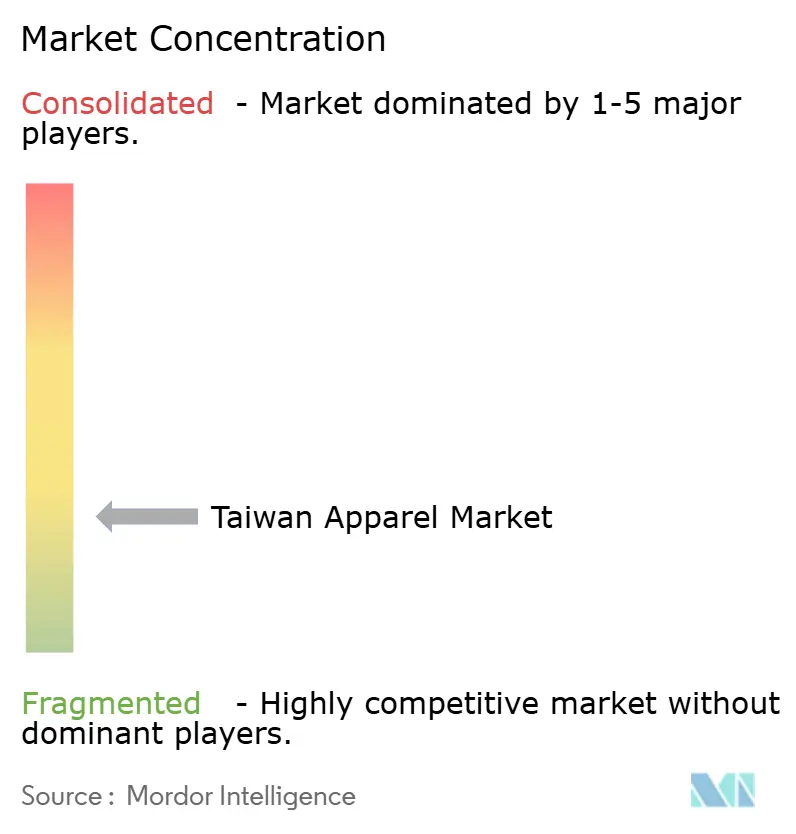
| Market Concentration | Low |
Major Players *Disclaimer: Major Players sorted in no particular order Image © Mordor Intelligence. Reuse requires attribution under CC BY 4.0. | |
Taiwan Apparel Market Analysis by Mordor Intelligence
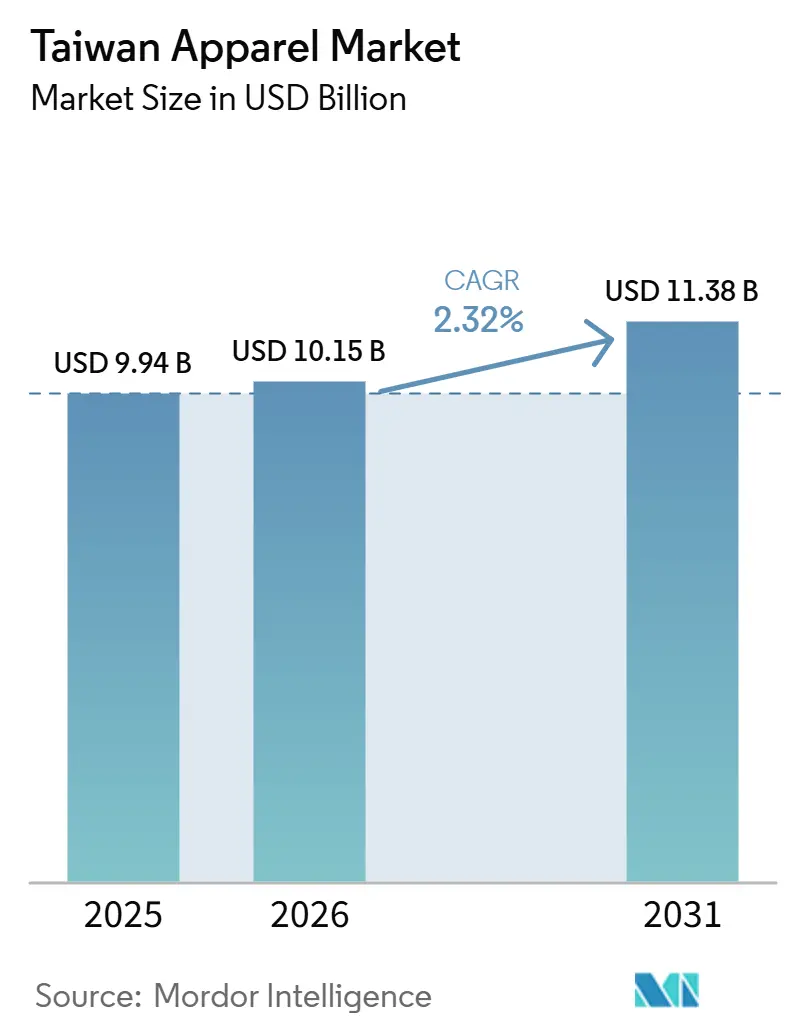
The Taiwan apparel market was valued at USD 9.94 billion in 2025 and is estimated at USD 10.15 billion in 2026, with the market projected to reach USD 11.38 billion by 2031, growing at a CAGR of 2.32% during 2026–2031. Market growth is driven by increasing demand for comfortable, versatile, and functional apparel that aligns with evolving consumer lifestyles and changing fashion preferences. Continuous advancements in high-performance textile technologies are enabling manufacturers to introduce value-added products across multiple apparel categories. The growing influence of social media, influencer marketing, celebrity collaborations, and international fashion trends is accelerating product innovation and shortening fashion cycles, while omnichannel retailing, AI-powered personalization, and digital shopping platforms are improving consumer engagement and product accessibility.
Key Report Takeaways
- By product type, casual wear held 55.07% of the Taiwan apparel market share in 2025, while sportswear recorded the highest projected CAGR at 4.15% through 2031.
- By end user, women accounted for 48.60% of the market in 2025, while the same segment is forecast to expand at the fastest CAGR of 3.25% through 2031.
- By fabric material, polyester captured 43.30% of segment value in 2025, while nylon is projected to grow at the fastest CAGR of 4.47% through 2031.
- By category, mass products represented 67.59% of the market in 2025, while premium products are expected to advance at the highest CAGR of 3.09% through 2031.
- By distribution channel, offline stores held 76.85% of the market in 2025, while online stores are forecast to grow at the fastest CAGR of 5.12% through 2031.
Note: Market size and forecast figures in this report are generated using Mordor Intelligence’s proprietary estimation framework, updated with the latest available data and insights as of January 2026.
Taiwan Apparel Market Trends and Insights
Drivers Impact Analysis*
| Driver | (~) % Impact on CAGR Forecast | Geographic Relevance | Impact Timeline |
|---|---|---|---|
| Growing participation in sports, fitness, and active lifestyles | +0.5% | National, with above-average demand intensity in Taiwan's six major municipalities | Medium term (2–4 years) |
| Advancements in functional fabric and apparel design innovations | +0.4% | National; upstream supply chain concentrated in Taichung and New Taipei industrial zones | Long term (≥ 4 years) |
| Brand influence through social media, influencers, and celebrity endorsements | +0.3% | National, with highest digital-consumer density in Taipei and New Taipei | Short term (≤ 2 years) |
| Accelerating global fashion trends and cross-border style adoption | +0.2% | Urban-concentrated; K-fashion penetrating Taipei, Taichung commercial districts | Medium term (2–4 years) |
| Evolving consumer preference for versatile and occasion-based apparel | +0.2% | National | Medium term (2–4 years) |
| Expansion of premium and designer apparel collections | +0.2% | Taipei, Taichung; secondary presence in Tainan and Kaohsiung outlet formats | Long term (≥ 4 years) |
| Source: Mordor Intelligence | |||
Growing participation in sports, fitness, and active lifestyles
The growing adoption of sports, fitness, and wellness-oriented lifestyles is a significant driver of the Taiwan apparel market, particularly for performance wear, athleisure, and functional clothing. Consumers are increasingly seeking apparel that offers moisture management, stretchability, breathability, and enhanced comfort for activities such as running, cycling, gym workouts, and outdoor recreation. This trend is encouraging apparel manufacturers to expand collections featuring advanced technical fabrics, ergonomic designs, and performance-enhancing features suitable for both exercise and everyday wear. According to the 2025 Sports Participation Survey by Taiwan's Ministry of Sports (MOS), 35.6% of the population met the "7333 regular exercise standard" in 2025 [1]. Furthermore, under the 2025 Taiwan iSports 2.0 Program, more than 35,000 sporting events were organized, attracting over 2.5 million participants. As sports and physical activity become an integral part of daily life, demand for functional and sports-inspired apparel continues to grow, supporting sustained growth in Taiwan's apparel market.
Advancements in functional fabric and apparel design innovations
Continuous advancements in functional fabric technologies and apparel design are driving growth in the Taiwan apparel market by enabling brands to offer garments with enhanced comfort, durability, and performance. Manufacturers are increasingly incorporating moisture-wicking, UV-protective, antibacterial, wrinkle-resistant, stretchable, thermoregulating, and lightweight materials into everyday apparel, sportswear, and outdoor clothing to meet evolving consumer expectations. Innovations such as seamless knitting, 3D garment design, and smart textile manufacturing are improving garment fit, reducing material waste, and accelerating product development cycles. Taiwan's strong textile innovation ecosystem and expertise in high-performance fabrics have further strengthened collaboration between textile manufacturers and apparel brands, enabling the commercialization of technologically advanced clothing. These ongoing innovations are enhancing product differentiation, supporting premiumization, and expanding the adoption of functional apparel across diverse consumer groups, thereby contributing to the sustained growth of the Taiwan apparel market.
Brand influence through social media, influencers, and celebrity endorsements
The growing influence of social media, digital influencers, celebrities, and athlete collaborations is driving the Taiwan apparel market by accelerating fashion awareness and strengthening consumer engagement. Apparel brands are increasingly leveraging influencer marketing, livestream shopping, social commerce, and celebrity partnerships to launch exclusive collections, build brand loyalty, and encourage faster purchasing decisions. Limited-edition collaborations and locally relevant campaigns create a sense of exclusivity and increase consumer interest in new product releases. For instance, in April 2026, Nike opened its Taipei 101 Brand Experience Store, featuring collaborative designs with Taiwanese actor Hsu Kuang-han, exclusive Taipei city-edition products, and appearances by professional athletes. Such initiatives strengthen brand visibility, enhance consumer interaction, and stimulate demand for both lifestyle and performance apparel, supporting the continued growth of Taiwan's apparel market.
Accelerating global fashion trends and cross-border style adoption
The rapid adoption of global fashion trends and cross-border style influences is driving growth in the Taiwan apparel market by increasing consumer demand for internationally inspired clothing and faster product refresh cycles. Digital platforms, social media, online fashion communities, and cross-border e-commerce enable consumers to access emerging styles from global fashion capitals almost instantly, encouraging apparel brands to introduce trend-driven collections with shorter development timelines. International brand collaborations, designer partnerships, and limited-edition launches are further shaping purchasing behavior, while exposure to Korean, Japanese, European, and North American fashion trends continues to diversify consumer preferences. To remain competitive, apparel manufacturers and retailers are investing in agile product development, flexible sourcing, and rapid inventory replenishment to respond quickly to evolving fashion trends and support market growth.
Restraints Impact Analysis*
| Restraint | (~) % Impact on CAGR Forecast | Geographic Relevance | Impact Timeline |
|---|---|---|---|
| Rising prevalence of counterfeit apparel products | -0.3% | National, with highest incidence via cross-border e-commerce parcels originating from China and Hong Kong | Short term (≤ 2 years) |
| Dependence on imported raw materials for certain textile inputs | -0.2% | National; concentrated impact on downstream apparel manufacturers in Taoyuan and Tainan production clusters | Medium term (2–4 years) |
| High cost pressures in the premium and luxury apparel segment | -0.2% | Taipei metropolitan area; secondary effects in Taichung luxury retail | Long term (≥ 4 years) |
| Margin volatility due to fluctuating raw material prices | -0.2% | National | Medium term (2–4 years) |
| Source: Mordor Intelligence | |||
Rising prevalence of counterfeit apparel products
The increasing circulation of counterfeit apparel products is restraining the Taiwan apparel market by undermining brand reputation, reducing sales of legitimate manufacturers, and weakening consumer confidence in branded clothing. Counterfeit products often imitate well-known fashion labels while offering inferior fabric quality, poor craftsmanship, and limited durability, making it difficult for consumers to distinguish authentic products from imitations. The widespread availability of counterfeit goods through unauthorized retail channels and online marketplaces intensifies price competition, affecting the profitability of genuine apparel brands and discouraging investment in product innovation. According to Taiwan Customs, during the first half of 2025, authorities seized more than 30,000 counterfeit items, highlighting the continued scale of intellectual property infringements in the market [2].
Dependence on imported raw materials for certain textile inputs
Dependence on imported raw materials for selected textile inputs restrains the Taiwan apparel market by exposing manufacturers to supply chain disruptions, longer procurement lead times, and inconsistent material availability. Although Taiwan has a well-developed textile manufacturing industry, many apparel producers continue to rely on imported natural fibers, specialty yarns, high-performance textiles, dyes, trims, and accessories that are not produced domestically in sufficient quantities. Disruptions in international shipping, trade regulations, or supplier operations can delay production schedules and affect timely product launches. Fluctuations in the availability of imported inputs also make inventory planning more challenging and may limit manufacturers' ability to respond quickly to changing fashion trends. These sourcing dependencies can reduce operational flexibility, particularly for brands producing technically advanced or premium apparel, thereby constraining overall market growth.
*Our forecasts treat driver/restraint impacts as directional, not additive. The impact forecasts reflect baseline growth, mix effects, and variable interactions.
Segment Analysis
By Product Type: Casual Wear Anchors the Market, Sportswear Accelerates
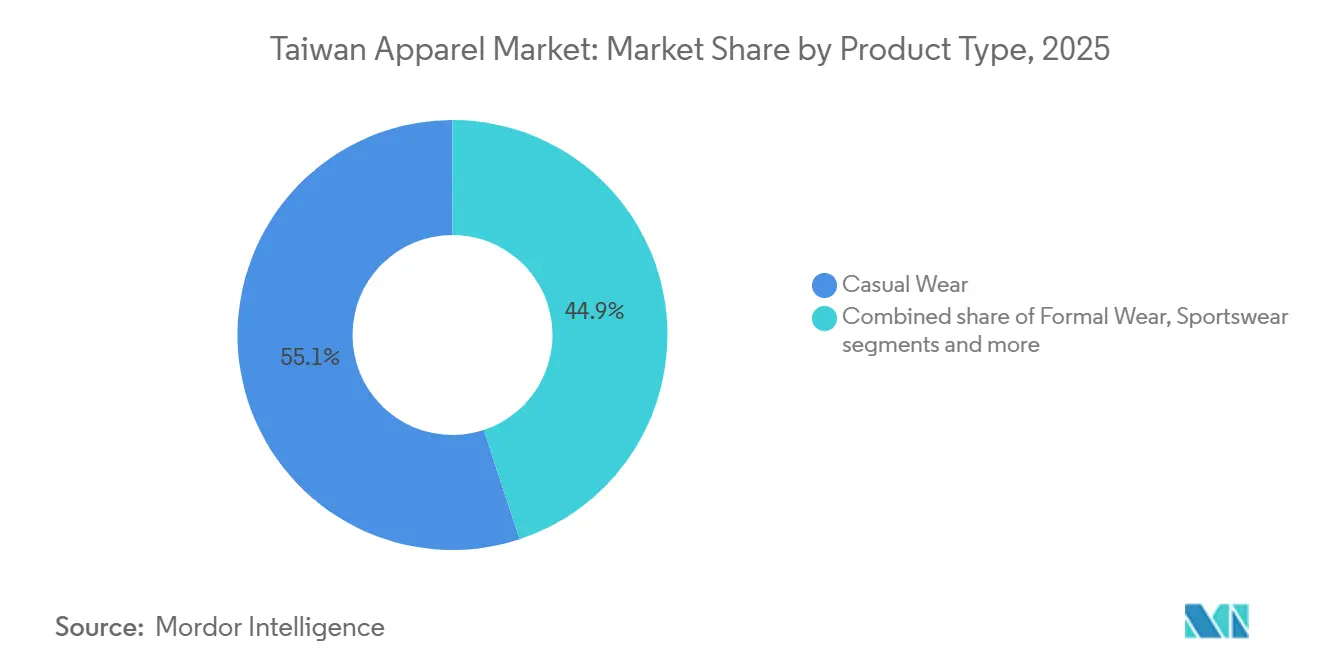
Casual wear dominated the Taiwan apparel market with a 55.07% value share in 2025, driven by growing consumer preference for comfortable, versatile, and easy-to-style clothing suitable for multiple daily occasions. The increasing adoption of hybrid work models, flexible workplace dress codes, and lifestyle-focused fashion has accelerated demand for apparel that combines comfort with contemporary aesthetics. Consumers are increasingly choosing garments made from lightweight, breathable, stretchable, and easy-care fabrics that offer all-day wearability with minimal maintenance. Continuous innovation in functional textiles, including moisture-wicking, wrinkle-resistant, UV-protective, and antibacterial materials, has further supported the appeal of casual apparel. According to the International Monetary Fund (IMF), Taiwan had 11.63 million employed people in 2025, supporting sustained demand for versatile apparel that can transition between work, commuting, leisure, and social activities, thereby reinforcing the segment's dominant position in the market.
Sportswear is projected to be the fastest-growing segment in the Taiwan apparel market, registering a CAGR of 4.15% through 2031, driven by the increasing integration of fitness and wellness into daily lifestyles and the rising popularity of recreational and outdoor activities. Demand is supported by consumers seeking high-performance apparel that offers enhanced mobility, durability, breathability, and weather resistance for activities such as running, cycling, hiking, gym workouts, and yoga. Apparel brands are expanding their portfolios with performance-enhancing features such as seamless construction, compression technology, four-way stretch fabrics, and thermoregulating materials to improve comfort during physical activity. The growing adoption of wearable fitness technologies and participation in organized sporting events has further encouraged purchases of specialized athletic apparel.

By End User: Women Drive Both Volume and Value Growth
Women's apparel accounted for 48.60% of the Taiwan apparel market by value in 2025 and is projected to register the fastest CAGR of 3.25% through 2031. The segment maintains its leading position due to the higher frequency of wardrobe refreshes, broader product availability, and continuous innovation in fashion collections across casual, formal, athleisure, and seasonal wear. Apparel brands regularly introduce new designs, fabric innovations, and limited-edition collections that cater to evolving style preferences, while digital fashion campaigns, influencer collaborations, and omnichannel retail strategies further strengthen consumer engagement. The segment is also supported by rising demand for multifunctional apparel, sustainable fashion collections, size-inclusive offerings, and technologically enhanced fabrics that combine comfort, performance, and style.
Men's apparel continues to represent a significant share of the Taiwan apparel market, driven by increasing demand for functional, minimalist, and versatile clothing suitable for professional, casual, and outdoor settings. Growing adoption of smart casual dressing, premium basics, and performance-inspired apparel has encouraged brands to expand product portfolios featuring wrinkle-resistant, stretchable, moisture-wicking, and easy-care fabrics. The increasing popularity of direct-to-consumer brands, personalized online shopping experiences, and collaborations between fashion labels and lifestyle brands is further supporting demand. Greater interest in grooming, personal styling, and fashion-conscious purchasing behavior continues to strengthen growth across the men's apparel segment.
By Fabric Material: Polyester Leads by Share, Nylon Charges Ahead
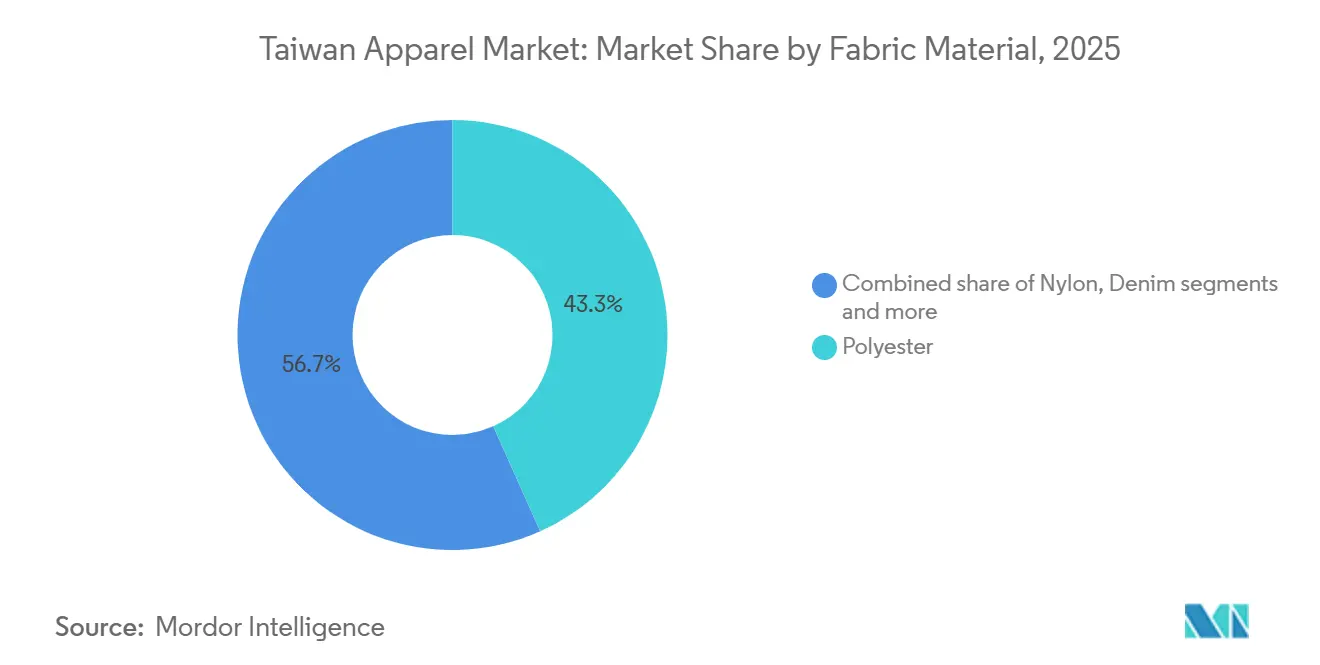
Polyester accounted for 43.30% of the Taiwan apparel market by fabric material in 2025, driven by its versatility, durability, lightweight characteristics, and compatibility with advanced textile manufacturing processes. Its ability to retain shape, resist wrinkles, dry quickly, and support high-quality color retention makes it a preferred material across a wide range of apparel categories. Manufacturers increasingly use polyester in blends with natural fibers to enhance garment performance while maintaining comfort and ease of maintenance. Additionally, the growing adoption of recycled polyester and improved production technologies is strengthening the material's position as brands expand sustainable apparel collections without compromising product functionality.
Nylon is projected to be the fastest-growing fabric material segment, registering a CAGR of 4.47% through 2031, supported by increasing demand for high-performance apparel requiring superior strength, flexibility, and durability. The material's abrasion resistance, elasticity, lightweight structure, and moisture-management capabilities make it well suited for performance-driven garments that require enhanced comfort and mobility. Continuous advancements in engineered nylon fibers, seamless knitting technologies, and bio-based nylon innovations are further expanding its use in technically advanced apparel. Growing emphasis on lightweight, durable, and functional clothing with improved wear resistance is expected to sustain the segment's growth over the forecast period.
By Category: Mass Market Prevails, Premium Reshapes the Margin Picture
The mass segment accounted for 67.59% of the Taiwan apparel market in 2025, driven by strong consumer preference for affordable, functional, and frequently refreshed apparel collections for everyday wear. Brands in this segment benefit from high-volume product launches, rapid inventory turnover, and broad style assortments that respond quickly to changing fashion trends. The expansion of fast-fashion business models, efficient supply chain management, and omnichannel retailing has improved product accessibility and shortened time-to-market, enabling manufacturers and retailers to meet evolving consumer preferences with greater speed and variety. In addition, manufacturers are increasingly incorporating functional features such as wrinkle resistance, moisture management, stretch fabrics, and easy-care finishes into value-priced garments, enhancing product appeal without substantially increasing costs.
The premium segment is projected to be the fastest-growing category, registering a CAGR of 3.09% through 2031, supported by increasing demand for superior craftsmanship, high-quality fabrics, and differentiated product offerings. Consumers are placing greater emphasis on apparel featuring advanced functional textiles, sustainable materials, exclusive designs, and enhanced durability, encouraging brands to introduce premium collections with greater value addition. Limited-edition releases, designer collaborations, personalization services, and transparent sourcing practices are further strengthening the appeal of premium apparel, while continuous innovation in fabric technology and garment construction is expected to support sustained growth throughout the forecast period.
By Distribution Channel: Offline Stores Remain Dominant, Online Commerce Accelerates
Offline stores accounted for 76.85% of the Taiwan apparel market by distribution channel in 2025, driven by consumers' preference for physically evaluating garment quality, fabric texture, fit, color, and overall comfort before making a purchase. In-store shopping also offers immediate product availability, personalized assistance from sales staff, easy size exchanges, and access to exclusive collections and promotional events. Apparel retailers continue to enhance the shopping experience through modern store layouts, interactive displays, omnichannel services such as click-and-collect, and in-store alterations, strengthening customer engagement and reinforcing the dominance of offline retail.
Online stores are projected to be the fastest-growing distribution channel, registering a CAGR of 5.12% through 2031, supported by the rapid adoption of mobile commerce, AI-powered product recommendations, virtual fitting technologies, livestream shopping, and convenient home delivery services. Fashion brands are increasingly leveraging social commerce, influencer marketing, and personalized digital campaigns to improve customer acquisition and retention. Flexible return policies, secure digital payment options, and seamless omnichannel integration are further strengthening consumer confidence in online apparel purchases. According to Taiwan's Ministry of Economic Affairs, online retail sales of textiles and clothing reached approximately TWD 34.23 billion in 2025, highlighting the accelerating shift toward digital apparel retailing and supporting the channel's strong growth outlook [3].
Geography Analysis
Northern Taiwan is the core of the country's apparel market, supported by its dense urban population, established retail infrastructure, and concentration of international and domestic fashion brands. The Taipei–New Taipei metropolitan region serves as the primary hub for fashion retail, brand launches, and premium shopping experiences. Apparel companies frequently open flagship stores, concept outlets, and experiential retail formats in this region to strengthen consumer engagement. The region also benefits from a well-developed omnichannel ecosystem, where physical retail is closely integrated with digital commerce, enabling brands to test new collections, marketing campaigns, and shopping technologies before expanding to other parts of Taiwan.
Central Taiwan, led by Greater Taichung, has emerged as an important growth region due to expanding commercial developments, modern shopping malls, and an increasing presence of specialty fashion retailers. The region attracts investment from both domestic and international apparel brands seeking to broaden their customer base beyond the capital region. Strong transportation connectivity, an expanding retail landscape, and rising adoption of omnichannel retail strategies have improved market accessibility. The growing presence of lifestyle shopping centers and mixed-use commercial developments continues to support apparel sales. Retailers are increasingly using the region to strengthen nationwide distribution networks and improve supply chain efficiency.
Southern Taiwan, encompassing Kaohsiung and Tainan, represents a steadily expanding apparel market characterized by growing retail modernization and increasing consumer interest in lifestyle, casual, and value-oriented fashion. The region has seen continued development of shopping malls, outlet centers, and large-format retail complexes that improve access to both local and international apparel brands. Tourism, urban redevelopment, and investments in commercial infrastructure have further supported retail activity, while the expansion of e-commerce and click-and-collect services is complementing traditional brick-and-mortar stores.
Competitive Landscape
The Taiwan apparel market is fragmented, with competition characterized by the presence of established domestic retailers alongside international fashion and sportswear brands. Market participants compete on product quality, fashion relevance, functional fabric innovation, pricing strategies, retail network expansion, and omnichannel capabilities. Companies continuously refresh their product portfolios with seasonal collections, limited-edition releases, and apparel featuring performance-oriented and sustainable materials to strengthen brand differentiation. Digital transformation, including AI-powered personalization, social commerce, and integration between online and offline retail channels, has also become a key competitive strategy for expanding customer reach and improving shopping experiences.
Key companies such as NET Clothing Co., Ltd. (NET), Fast Retailing Co., Ltd., Nike, Inc., PUMA SE, and New Balance Athletics, Inc. maintain strong market positions through extensive product portfolios, well-established retail footprints, and continuous investments in innovation and brand engagement. These companies emphasize advanced functional fabrics, sustainable sourcing, athlete and celebrity collaborations, and localized marketing campaigns to enhance consumer loyalty. International brands continue to introduce exclusive collections and premium shopping experiences, while domestic players leverage their understanding of local fashion preferences, agile merchandising strategies, and competitive pricing to strengthen their market presence.
Competition is further supported by Taiwan's active fashion ecosystem, which encourages innovation and strengthens brand visibility. Industry events provide opportunities for apparel companies, designers, textile manufacturers, and fashion retailers to showcase new collections, sustainable materials, and emerging design concepts. For instance, Taipei Fashion Week AW26, held from March 26–29 at Songshan Cultural and Creative Park, highlighted new fashion collections, innovative textile applications, and collaborations between designers and industry stakeholders. Such initiatives promote creativity, accelerate the adoption of new fashion trends, and encourage continuous product development, reinforcing the competitive dynamics of the Taiwan apparel market.
Taiwan Apparel Industry Leaders
-
NET Clothing Co., Ltd. (NET)
-
Fast Retailing Co., Ltd.
-
Nike, Inc
-
PUMA SE
-
New Balance Athletics, Inc.
- *Disclaimer: Major Players sorted in no particular order
Recent Industry Developments
- July 2026: Musinsa has established a new subsidiary in Taiwan, extending the South Korean fashion platform's regional presence as it moves to capture demand for Korean fashion across Asia. The platform plans to open 15 stores over the next five years in Taiwan under its private label, Standard.
- May 2026: UNIQLO opened its largest-floor-area store in central Taiwan at Mitsui Outlet Park Taichung Port. The store offers an extensive selection of the brand's apparel and lifestyle items, with product offerings such as the UV Protection series tailored to the local climate and commuter lifestyle.
- March 2026: Nishimatsuya, a prominent Japanese baby and children's clothing retailer, opened its first overseas store in Taiwan. Located at the Tainan Mitsui Outlet Park in the Guiren District of Tainan City, this marks a significant step in the brand's overseas expansion into the Asian market.
Taiwan Apparel Market Report Scope
Apparel refers to clothing, particularly outerwear, garments, or attire. The Taiwan apparel market is segmented by product type, end-user, fabric material, category, and distribution channel. Based on product type, the market is segmented into formal wear, casual wear, sportswear, nightwear/loungewear, lingerie, and others. Based on end-user, the market is segmented into men, women, and children. Based on fabric material, the market is segmented into cotton, polyester, nylon, denim, and others. Based on category, the market is segmented into mass and premium. Based on distribution channel, the market is segmented into offline stores and online stores. For each segment, the market sizing and forecast have been done based on the value (in USD million).
| Formal Wear |
| Casual Wear |
| Sportswear |
| Nightwear/Loungewear |
| Lingerie |
| Others |
| Men |
| Women |
| Children |
| Cotton |
| Polyester |
| Nylon |
| Denim |
| Others |
| Mass |
| Premium |
| Offline Stores |
| Online Stores |
| By Product Type | Formal Wear |
| Casual Wear | |
| Sportswear | |
| Nightwear/Loungewear | |
| Lingerie | |
| Others | |
| By End-User | Men |
| Women | |
| Children | |
| By Fabric Material | Cotton |
| Polyester | |
| Nylon | |
| Denim | |
| Others | |
| By Category | Mass |
| Premium | |
| By Distribution Channel | Offline Stores |
| Online Stores |
Key Questions Answered in the Report
What is the 2031 outlook for apparel demand in Taiwan?
The Taiwan apparel market is expected to reach USD 11.38 billion by 2031 from USD 10.15 billion in 2026, growing at a 2.3% CAGR.
Which product group is leading sales in Taiwan right now?
Casual wear remained the largest product group in 2025 with a 55.07% share, supported by versatile use across work, leisure, and social settings.
Which category is growing the fastest through 2031?
Sportswear is the fastest-growing product type at a 4.15% CAGR, reflecting stronger fitness participation and broader adoption of active dressing.
Why are women so important to apparel spending in Taiwan?
Women represented 48.60% of 2025 sales and are also the fastest-growing end-user group at a 3.25% CAGR, which makes them central to future value growth.