
Table Sauce Market Size and Share
Market Overview
| Study Period | 2022 - 2032 |
|---|---|
| Market Size (2027) | USD 11.51 Billion |
| Market Size (2032) | USD 15.22 Billion |
| Growth Rate (2027 - 2032) | 5.75 % |
| Fastest Growing Market | Middle East and Africa |
| Largest Market | Asia-Pacific |
| Market Concentration | Medium |
Major Players *Disclaimer: Major Players sorted in no particular order Image © Mordor Intelligence. Reuse requires attribution under CC BY 4.0. | |
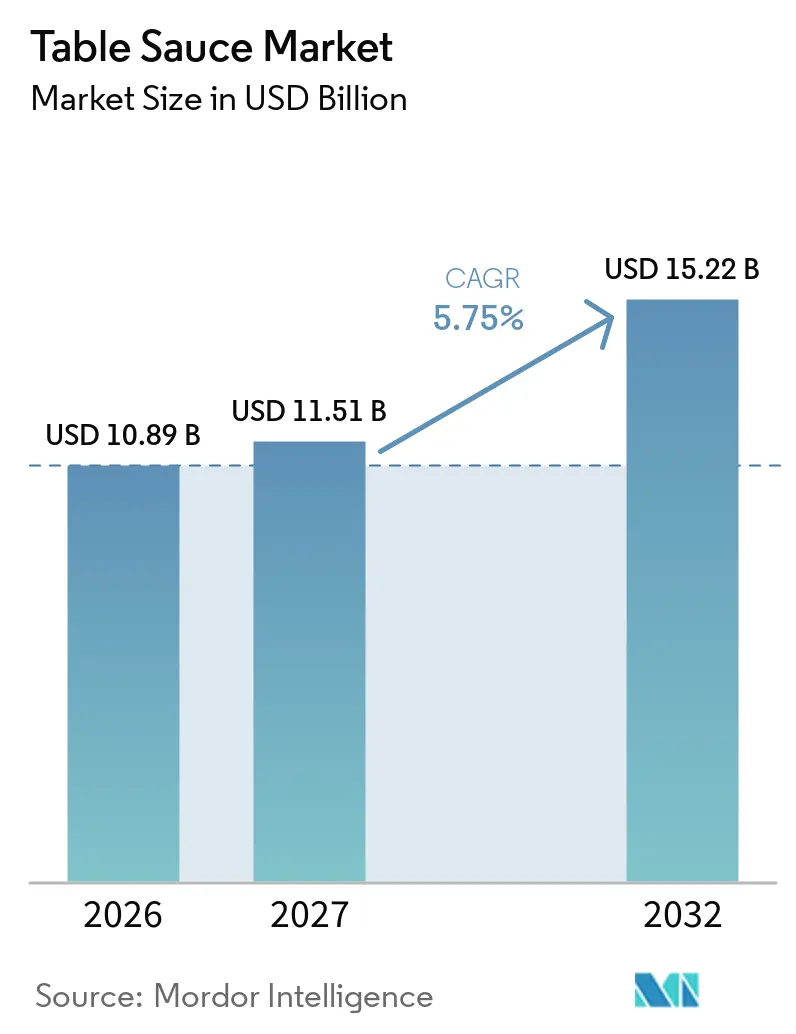
Table Sauce Market Analysis by Mordor Intelligence
The Table Sauce Market size is expected to grow from USD 10.89 billion in 2026 to USD 11.51 billion in 2027 and is forecast to reach USD 15.22 billion by 2032 at a 5.75% CAGR over 2027-2032. The market is driven by changing consumer preferences, rising demand for convenient food options, and growing interest in diverse flavors and culinary experiences. Increasing consumption of ready-to-eat meals and restaurant-inspired foods is supporting the use of sauces as everyday meal accompaniments. Manufacturers are introducing new flavors and formulations to meet evolving consumer preferences, with product innovation and premiumization shaping market development. Expanding foodservice operations and the growing popularity of home cooking are further supporting demand for table sauces across global markets.
Key Report Takeaways
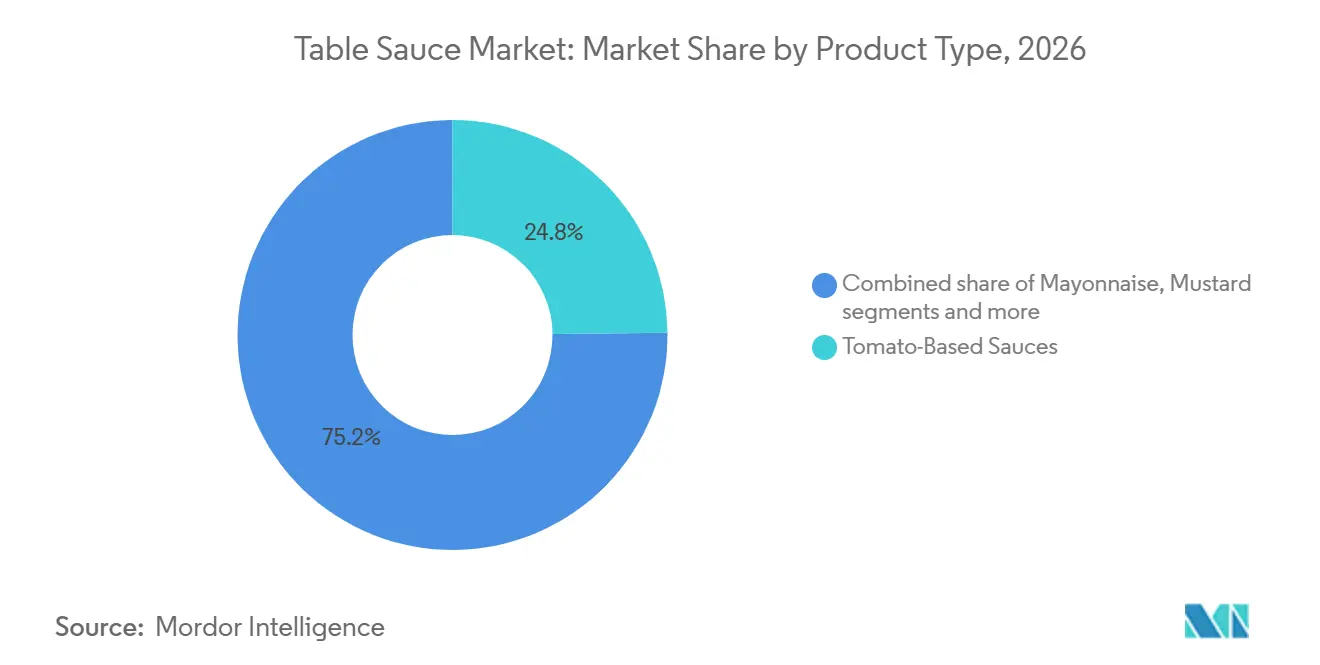
- By product type, tomato-based sauces held a 24.83% share in the table sauce market in 2026, while hot sauce and chili sauce are forecast to grow at a 7.18% CAGR during 2027 to 2032.
- By packaging type, bottles and jars held a 38.47% share in 2026, while pouches are forecast to grow at a 6.76% CAGR during 2027 to 2032.
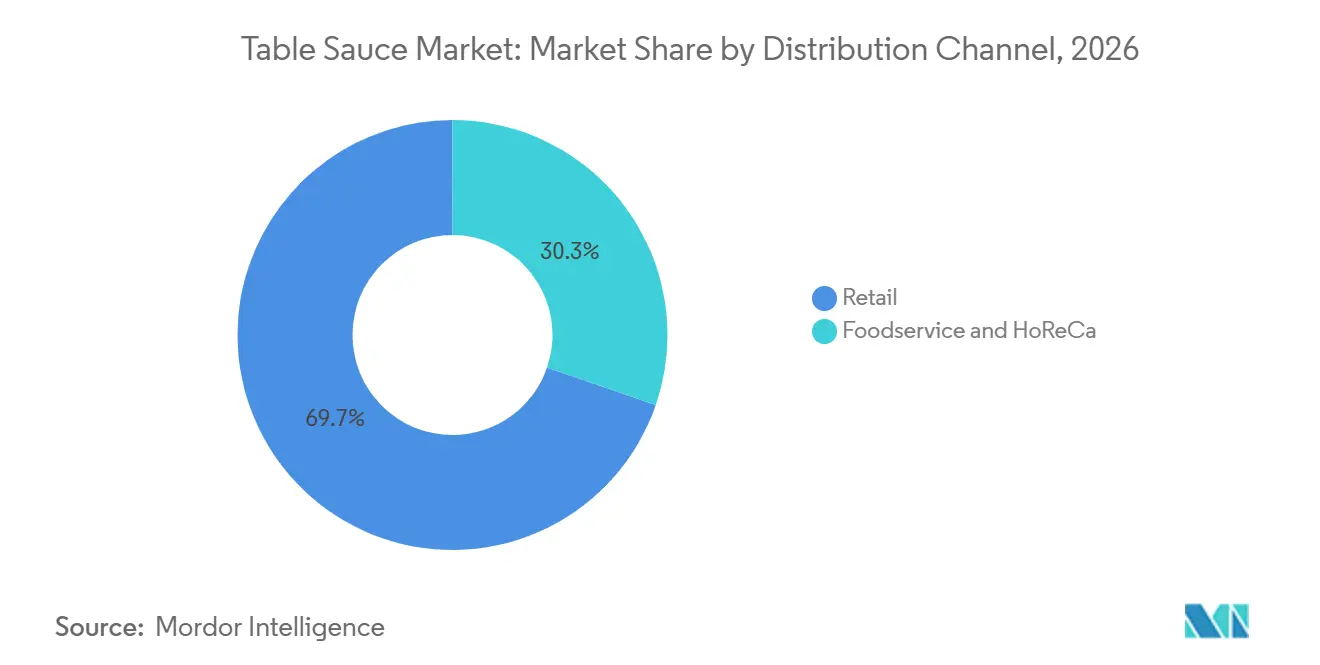
- By distribution channel, retail held a 69.73% share in the table sauce market in 2026, while foodservice and HoReCa are forecast to grow at a 6.84% CAGR during 2027 to 2032.
- By geography, Asia-Pacific held a 36.17% share in 2026, while the Middle East and Africa are forecast to grow at a 7.36% CAGR during 2027 to 2032.
Note: Market numbers in this report are based on Mordor Intelligence's proprietary estimation framework, which combines nine months of actuals with Q4 projections for base year 2026.
Market Trends and Insights
Drivers Impact Analysis of Table Sauce Market*
| Driver | (~) % Impact on CAGR Forecast | Geographic Relevance | Impact Timeline |
|---|---|---|---|
| Demand for convenience foods and ready-to-eat meals | +1.3% | Global | Short term (≤ 2 years) |
| Cross-cultural adoption of global flavors | +1.1% | North America, Europe, Asia-Pacific | Medium term (2–4 years) |
| Expansion of foodservice and quick-service restaurant offerings | +0.9% | Asia-Pacific, Middle East and Africa, Latin America | Medium term (2–4 years) |
| Growing demand for healthier and clean-label table sauce formulations | +0.7% | North America, Europe | Medium term (2–4 years) |
| Growing demand for restaurant-inspired sauces for at-home consumption | +0.8% | North America, Europe | Short term (≤ 2 years) |
| Product premiumization and demand for differentiated sauces | +0.6% | North America, Europe, Asia-Pacific | Long term (≥ 4 years) |
| Source: Mordor Intelligence | |||
Demand for Convenience Foods and Ready-to-Eat Meals
Growing demand for convenient meal solutions is supporting table sauce consumption, as consumers look to enhance meals with minimal preparation. Table sauces such as ketchup, mayonnaise, and mustard serve as convenient accompaniments for sandwiches, wraps, and ready-to-eat foods, reducing the need for additional cooking. According to the International Food Information Council's 2025 Food & Health Survey, 32% of Americans who considered convenience important in food and beverage purchases said ease of cooking or preparation had a significant impact on their purchasing decisions[1]. This preference supports demand for table sauces that simplify everyday meal preparation and complement convenient food products. Their ease of use allows consumers to incorporate familiar accompaniments into meals without adding further preparation steps. As a result, table sauces remain relevant to everyday eating occasions where simplicity and convenience are key considerations.
Cross-Cultural Adoption of Global Flavors
Growing exposure to international cuisines is encouraging consumers to explore table sauces inspired by diverse culinary traditions, expanding the range of flavors used in everyday meals. According to the National Restaurant Association's 2025 State of the Restaurant Industry report, 58% of American adults said they eat a wider variety of global cuisines than they used to, including Asian, South American, European, and African dishes[2]. This growing interest creates opportunities for table sauces featuring distinctive regional seasonings and flavor combinations. Products inspired by cuisines such as Korean, Mexican, and Southeast Asian cooking can introduce international flavors into familiar meals. As consumers explore a broader range of cuisines, globally influenced table sauces can help them recreate diverse flavor experiences across everyday eating occasions.
Expansion of Foodservice and Quick-Service Restaurant Offerings
The expansion of foodservice establishments, particularly quick-service restaurants (QSRs), is supporting demand for table sauces used in burgers, sandwiches, fried foods, and other menu items. According to the International Franchise Association's 2025 Franchising Economic Outlook, franchised QSR establishments in the United States were forecast to grow by 2.2% in 2025, exceeding 204,000 outlets[3]. This expansion creates additional points of consumption for condiments used in food preparation and meal service. As restaurant networks grow, demand for sauces such as ketchup, mustard, and mayonnaise increases through their use in standard menu items, supporting table sauce consumption across a growing base of foodservice locations.
Growing Demand for Healthier and Clean-Label Table Sauce Formulations
Growing consumer interest in healthier food choices is encouraging manufacturers to develop table sauces with simpler ingredient lists and improved nutritional profiles. Consumers are increasingly attentive to ingredients such as added sugars, sodium, artificial preservatives, and synthetic additives when selecting everyday condiments. In response, manufacturers are exploring reduced-sugar and reduced-sodium formulations, alongside products that use recognizable ingredients and fewer artificial additives. Clean-label positioning is gaining relevance as consumers seek greater transparency regarding the composition of packaged foods. This is encouraging product reformulation and diversification across the table sauce market, with manufacturers seeking to balance health-oriented attributes with the taste, texture, and functionality expected from conventional sauces.
Restraints Impact Analysis of Table Sauce Market*
| Restraint | (~) % Impact on CAGR Forecast | Geographic Relevance | Impact Timeline |
|---|---|---|---|
| Health concerns related to sodium, sugar, and fat content | -0.9% | Global | Short term (≤ 2 years) |
| Price volatility in key raw material inputs | -0.7% | Global, especially Europe and North America | Short term (≤ 2 years) |
| Shelf-life and microbial stability challenges in clean-label sauce formulations | -0.4% | North America, Europe | Medium term (2–4 years) |
| Ingredient traceability, allergen management, and labeling compliance challenges | -0.3% | Global | Long term (≥ 4 years) |
| Source: Mordor Intelligence | |||
Health Concerns Related to Sodium, Sugar, and Fat Content
Growing awareness of the health implications of excessive sodium, sugar, and fat consumption can restrain demand for certain table sauce products. Conventional sauces may contain added sugars, high sodium levels, or fat-rich ingredients, depending on their formulation and intended use. Consumers looking to manage their dietary intake may limit consumption of these products or become more selective when choosing condiments. Such preferences can create challenges for manufacturers whose existing products do not align with changing nutritional expectations. Reformulating sauces to reduce these components while maintaining taste, texture, and shelf stability may also require adjustments to established production processes. As a result, health-related concerns may influence purchasing decisions and limit consumption of some traditional table sauce formulations.
Price Volatility in Key Raw Material Inputs
Fluctuations in the prices of key raw materials can constrain growth in the table sauce market by increasing production costs and creating uncertainty in procurement planning. Ingredients such as tomatoes, chilli peppers, vegetable oils, sugar, vinegar and spices are influenced by changes in agricultural output, weather conditions, transportation expenses and supply availability. These fluctuations can make it difficult for manufacturers to maintain stable production costs and consistent pricing across their product portfolios. When input costs rise, manufacturers may need to absorb additional expenses or adjust selling prices, potentially affecting profit margins and price competitiveness. Frequent cost changes can also complicate purchasing decisions, inventory management and long-term supply arrangements, creating operational challenges for table sauce producers.
*Our forecasts treat driver/restraint impacts as directional, not additive. The impact forecasts reflect baseline growth, mix effects, and variable interactions.
Table Sauce Market Segment Analysis
By Product Type:
Tomato-Based Sauces Anchor Share While Heat Formats ScaleTomato-based sauces hold the largest market share at 24.83% in 2026, supported by their widespread use as everyday condiments across retail and foodservice channels. Established consumer acceptance, affordability, versatility, and convenient storage characteristics sustain demand across diverse markets. The segment benefits from its compatibility with a broad range of foods and consumption occasions. However, changing dietary preferences are encouraging manufacturers to refine formulations in response to demand for reduced sugar, lower sodium, and fewer additives. These developments are influencing product innovation while supporting the segment's continued relevance in the global table sauce market.
Hot sauce/chili sauce is the fastest-growing product segment, with a CAGR of 7.18% over 2027–2032, driven by rising consumer interest in spicy flavors and varied taste experiences. Demand is further supported by growing experimentation with flavor combinations and increasing product differentiation across the category. Manufacturers are responding through new formulations, varying heat intensities, and flavor innovations to appeal to a wider consumer base. Broader interest in premium and differentiated condiments is also encouraging innovation across other table sauce categories. These developments are strengthening product variety and supporting the expansion of the hot sauce segment.

By Packaging Type:
Rigid Formats Hold Ground as Pouches DisruptBottles and jars account for the largest market share at 38.47% in 2026, supported by their established presence across retail and foodservice distribution channels. These formats offer convenient storage, product visibility, and consumer familiarity, supporting their continued use across table sauce categories. Rigid packaging also provides opportunities for differentiated presentation and product positioning. However, manufacturers are increasingly evaluating packaging alternatives that balance product protection, cost efficiency, and ease of handling. These considerations are influencing packaging choices as the market adapts to changing consumer and operational requirements.
Pouches are the fastest-growing packaging format, with a CAGR of 6.76% over 2027–2032, driven by demand for lightweight, space-efficient, and cost-effective packaging solutions. Lower transportation weight and material requirements improve distribution efficiency, while flexible barrier materials help maintain product quality. Manufacturers are also exploring packaging designs that support material recovery and align with evolving sustainability requirements. Meanwhile, sachets continue to serve single-portion applications, supported by convenience and portion control. These developments are encouraging greater diversification in table sauce packaging, with flexible formats gaining relevance across consumer and foodservice applications.
By Distribution Channel:
Retail Commands Revenue but HoReCa Dictates TrendsRetail accounts for the largest market share at 69.73% in 2026, supported by extensive distribution networks and accessibility across multiple purchasing channels. Supermarkets and hypermarkets remain important sales channels, while online platforms are expanding consumer access to a wider range of products. Retail demand is also influenced by brand recognition, product availability, pricing, and changing shopping preferences. Competition among established brands and private-label offerings is shaping product positioning and pricing strategies. These factors continue to reinforce retail's dominant role in table sauce distribution.
Foodservice and HoReCa is the fastest-growing distribution channel, with a CAGR of 6.84% over 2027–2032, driven by the expansion of foodservice establishments and demand for consistent sauce offerings across commercial kitchens. Increasing emphasis on menu differentiation and standardized food preparation is supporting demand for sauces in bulk and portion-controlled formats. Foodservice channels also provide opportunities for manufacturers to introduce distinctive formulations that may subsequently gain consumer interest in retail markets. Suppliers are responding by developing products suited to varying operational requirements and serving volumes. These developments are supporting foodservice demand and strengthening its role in the table sauce market.
Geography Analysis
APAC Table Sauce Market
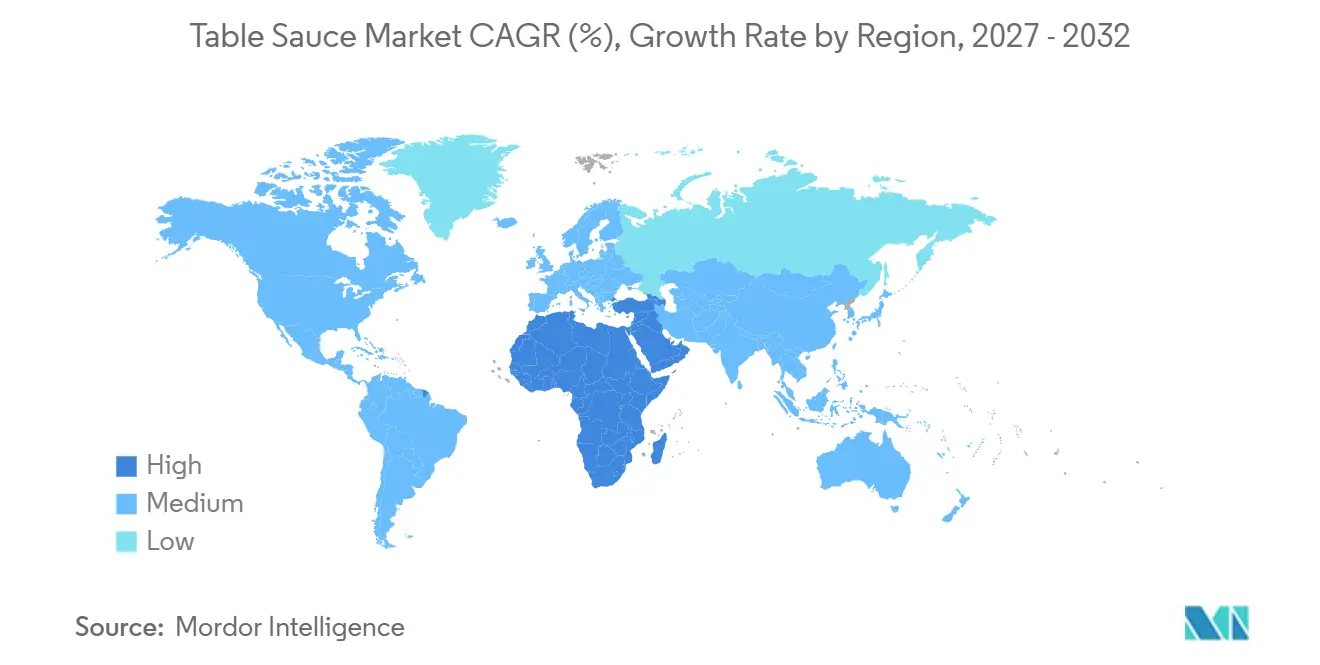
Asia-Pacific holds the largest market share at 36.17% in 2026, supported by the widespread use of table sauces in everyday food preparation and established regional consumption habits. Demand is reinforced by diverse culinary preferences, expanding foodservice networks, and growing interest in convenient, ready-to-use condiments. Manufacturers are also adapting product formulations to meet changing consumer preferences and evolving food labeling requirements. The expansion of compound sauces and increasing product diversification are further shaping regional market development.
MEA Table Sauce Market
The Middle East and Africa is the fastest-growing region, with a CAGR of 7.36% over 2027–2032, driven by urbanization, changing consumption patterns, and the expansion of organized retail and foodservice channels. A growing hospitality sector is supporting demand for a wider variety of table sauces, while younger consumers and evolving food preferences are creating opportunities for product innovation. Improvements in distribution networks are also increasing product accessibility across regional markets. These factors are expected to support continued growth throughout the forecast period.
The Americas and Europe Table Sauce Market
North America and Europe remain established markets, supported by mature consumption patterns, broad product availability, and demand for premium and differentiated sauces. Product innovation, changing dietary preferences, and competition between established brands and private-label products are influencing market development. South America also presents growth opportunities, driven by urbanization, changing purchasing preferences, and increasing exposure to diverse cuisines. Across these regions, manufacturers are focusing on product differentiation and adapting their offerings to meet evolving consumer preferences.
Competitive Landscape
The global table sauce market is moderately fragmented, with competition spread across multinational food manufacturers and regional specialists serving different product categories and geographies. Major players include Kraft Heinz, Inc., Unilever PLC, Nestlé S.A., McCormick & Company, Inc., and Conagra Brands, Inc. Their competitive positions are supported by established brands, broad product portfolios, extensive distribution networks, and strong retail and foodservice relationships. Competition is shaped by brand recognition, pricing, product differentiation, and the ability to respond to changing consumer preferences.
Leading companies are focusing on portfolio expansion, product innovation, and strengthening their positions across condiment categories and distribution channels. Manufacturers are introducing differentiated flavor profiles and adapting formulations to evolving consumer preferences, while strategic transactions are reshaping the competitive landscape. These activities allow established players to broaden their product offerings, improve market reach, and pursue opportunities across retail and foodservice channels. Investment in established brands and complementary product categories also supports their ability to compete across multiple regional markets.
Emerging and smaller players are gaining opportunities through specialty products, distinctive flavor combinations, and premium positioning. Artisan brands are using digital platforms and direct-to-consumer channels to reach consumers beyond traditional retail distribution. Foodservice operators are also creating opportunities for branded sauce products by extending distinctive offerings into retail channels. In addition, demand for differentiated formulations and packaging is encouraging product development among smaller manufacturers. These developments are increasing product variety and intensifying competition across the global table sauce market.
Table Sauce Industry Leaders
-
Kraft Heinz, Inc.
-
Unilever PLC
-
Nestlé S.A.
-
McCormick & Company, Inc.
-
Conagra Brands, Inc.
- *Disclaimer: Major Players sorted in no particular order
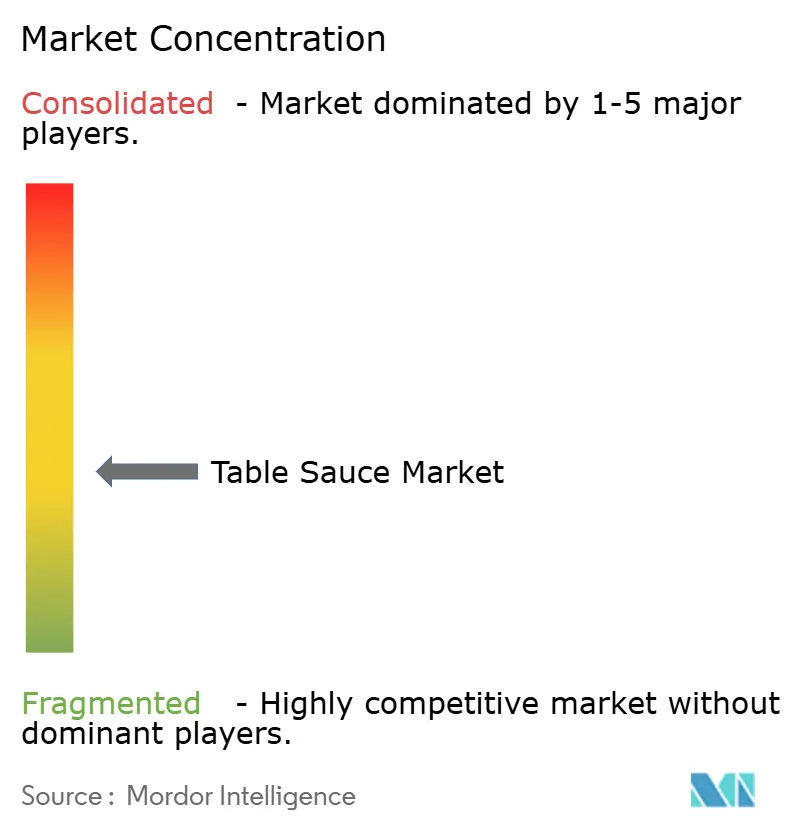
Table Sauce Market Companies Covered in this Report
- Kraft Heinz, Inc.
- Unilever PLC
- McCormick & Company, Inc.
- Kikkoman Corporation
- Conagra Brands, Inc.
- Nestlé S.A.
- Mizkan Holdings Co., Ltd.
- Lee Kum Kee Company Limited
- Kewpie Corporation
- The Campbell’s Company
- PepsiCo, Inc.
- General Mills, Inc.
- Ajinomoto Co., Inc.
- Foshan Haitian Flavouring & Food Co., Ltd.
- Del Monte Foods, Inc.
- Goya Foods, Inc.
- Orkla ASA
- McIlhenny Company
- Huy Fong Foods, Inc.
- Barilla Holding S.p.A.
Recent Industry Developments in Table Sauce Market
- May 2026: The Marzetti Company completed its acquisition of Bachan’s, a Japanese barbecue sauce brand, for USD 400 million. The acquisition is intended to strengthen its sauce portfolio and expand distribution through retail and foodservice channels.
- April 2026: Nestlé launched Minor’s Kitchen, its first at-home condiment range in the United States. The four-sauce lineup includes Lemon Garlic Aioli, Creamy Korean BBQ, Spicy Chili Truffle, and American Smokehouse, initially available nationwide through Amazon.
- March 2026: Kraft Heinz entered a five-year global partnership with the National Football League, becoming its first global condiment partner. The agreement includes brand visibility, co-branded marketing, limited-edition packaging, and retail activations featuring its food portfolio.
- February 2025: Heinz introduced its Flavor Tour range of three globally inspired sauces: Mexican-inspired Street Corn, Korean-inspired Sweet & Tangy BBQ, and Thai-inspired Sweet Chili. The launch expanded the brand's offerings beyond ketchup and responded to interest in internationally inspired flavors.
Global Table Sauce Market Report Scope
The table sauce market comprises sauces and condiments used to enhance the flavor, texture, and taste of prepared foods. It includes a variety of products designed for household consumption and foodservice applications. The table sauce market is segmented by product type, including tomato-based sauces, mayonnaise, mustard, soy sauce, and other products; packaging type, including bottles and jars, pouches, sachets, and other packaging formats; distribution channel, including retail and foodservice and HoReCa; and geography, including North America, Europe, Asia-Pacific, South America, and the Middle East and Africa. The market forecasts are provided in terms of value (USD) and volume (kilotons).
Segmentation Overview
| Tomato-Based Sauces |
| Mayonnaise |
| Mustard |
| Soy Sauce |
| Hot Sauce/Chili Sauce |
| Barbecue Sauce |
| Salsa |
| Other Table Sauces |
| Bottles/Jars |
| Pouches |
| Sachets |
| Other Packaging Formats |
| Retail | Supermarkets and Hypermarkets |
| Convenience and Grocery Stores | |
| Specialty and Independent Food Stores | |
| Online Retail Stores | |
| Direct-to-Consumer Channels | |
| Foodservice and HoReCa | Quick-Service Restaurants |
| Full-Service Restaurants | |
| Hotels, Catering, and Institutional Foodservice |
| North America | United States |
| Canada | |
| Mexico | |
| Rest of North America | |
| Europe | Germany |
| United Kingdom | |
| Italy | |
| France | |
| Spain | |
| Netherlands | |
| Poland | |
| Belgium | |
| Sweden | |
| Rest of Europe | |
| Asia-Pacific | China |
| India | |
| Japan | |
| Australia | |
| Indonesia | |
| South Korea | |
| Thailand | |
| Singapore | |
| Rest of Asia-Pacific | |
| South America | Brazil |
| Argentina | |
| Colombia | |
| Chile | |
| Peru | |
| Rest of South America | |
| Middle East and Africa | South Africa |
| Saudi Arabia | |
| United Arab Emirates | |
| Nigeria | |
| Egypt | |
| Morocco | |
| Turkey | |
| Rest of Middle East and Africa |
| By Product Type | Tomato-Based Sauces | |
| Mayonnaise | ||
| Mustard | ||
| Soy Sauce | ||
| Hot Sauce/Chili Sauce | ||
| Barbecue Sauce | ||
| Salsa | ||
| Other Table Sauces | ||
| By Packaging Type | Bottles/Jars | |
| Pouches | ||
| Sachets | ||
| Other Packaging Formats | ||
| By Distribution Channel | Retail | Supermarkets and Hypermarkets |
| Convenience and Grocery Stores | ||
| Specialty and Independent Food Stores | ||
| Online Retail Stores | ||
| Direct-to-Consumer Channels | ||
| Foodservice and HoReCa | Quick-Service Restaurants | |
| Full-Service Restaurants | ||
| Hotels, Catering, and Institutional Foodservice | ||
| By Geography | North America | United States |
| Canada | ||
| Mexico | ||
| Rest of North America | ||
| Europe | Germany | |
| United Kingdom | ||
| Italy | ||
| France | ||
| Spain | ||
| Netherlands | ||
| Poland | ||
| Belgium | ||
| Sweden | ||
| Rest of Europe | ||
| Asia-Pacific | China | |
| India | ||
| Japan | ||
| Australia | ||
| Indonesia | ||
| South Korea | ||
| Thailand | ||
| Singapore | ||
| Rest of Asia-Pacific | ||
| South America | Brazil | |
| Argentina | ||
| Colombia | ||
| Chile | ||
| Peru | ||
| Rest of South America | ||
| Middle East and Africa | South Africa | |
| Saudi Arabia | ||
| United Arab Emirates | ||
| Nigeria | ||
| Egypt | ||
| Morocco | ||
| Turkey | ||
| Rest of Middle East and Africa | ||
Key Questions Answered in the Report
What is the forecast growth rate for table sauces?
The category is projected to grow at a 5.75% CAGR from 2027 to 2032 and reach USD 15.22 billion in 2032.
Which table sauce product has the largest share?
Tomato-based sauces lead product demand with a reported 24.83% share in 2026.
Which product category is forecast to grow the fastest?
Hot sauce and chili sauce are forecast to record the highest product CAGR at 7.18% during 2027 to 2032.
Which region is expected to grow fastest?
The Middle East and Africa are forecast to grow at a 7.36% CAGR from 2027 to 2032.