
T3P Market Size and Share
Market Overview
| Study Period | 2021 - 2031 |
|---|---|
| Market Size (2026) | USD 46.82 Million |
| Market Size (2031) | USD 63.88 Million |
| Growth Rate (2026 - 2031) | 6.41 % |
| Fastest Growing Market | Asia-Pacific |
| Largest Market | North America |
| Market Concentration | Medium |
Major Players *Disclaimer: Major Players sorted in no particular order Image © Mordor Intelligence. Reuse requires attribution under CC BY 4.0. | |
T3P Market Analysis by Mordor Intelligence
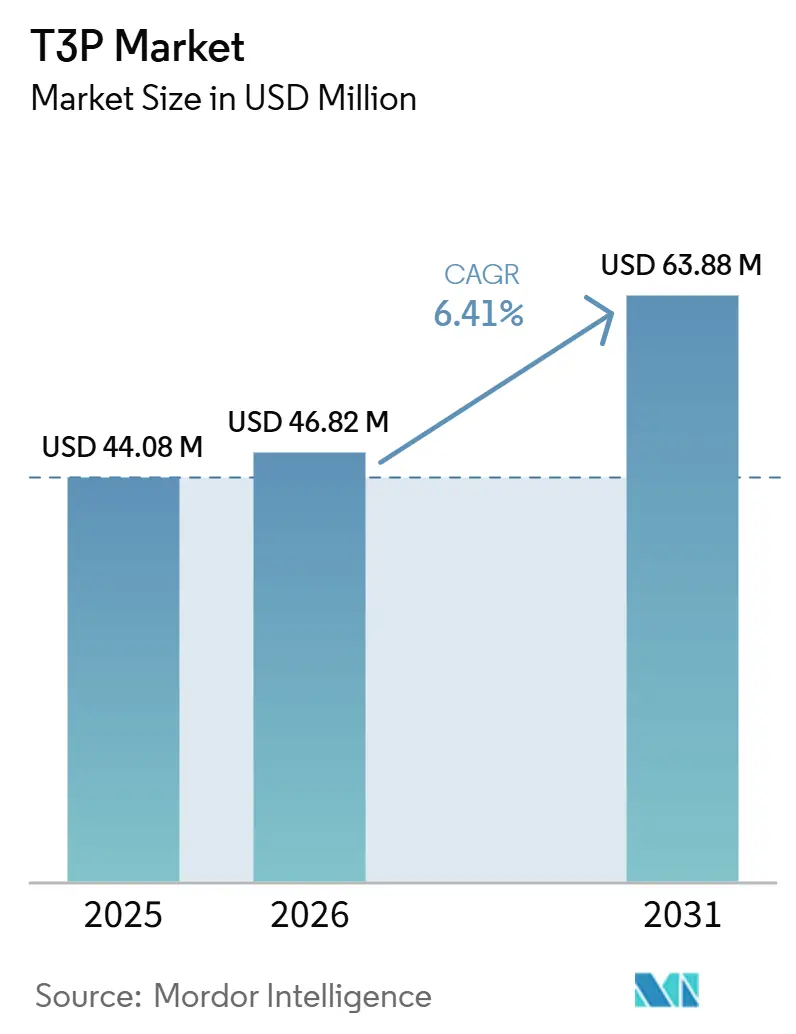
The T3P Market size is projected to expand from USD 44.08 million in 2025 and USD 46.82 million in 2026 to USD 63.88 million by 2031, and is expected to register a CAGR of 6.41% between 2026 and 2031. The T3P market serves pharmaceutical active pharmaceutical ingredient (API) production, solid-phase peptide synthesis, and agrochemical intermediate manufacturing, with commercial supply concentrated in 50% and 70% solution formats in solvents suitable for industrial handling. Growth in the T3P market aligns with larger peptide drug programs, the shift toward cleaner process chemistry, and demand for reagents that simplify workup and reduce downstream purification steps. The market is also supported by procurement patterns that favor auditable Good Manufacturing Practice (GMP)-grade suppliers, as pharmaceutical companies emphasize documentation, batch consistency, and supply reliability when qualifying materials for regulated production. Solvent choice, concentration format, and compatibility with automated synthesis platforms continue to influence adoption, keeping operational practicality as important as reaction performance in purchasing decisions. Competitive conditions in the T3P market remain moderate, with a small group of GMP-focused manufacturers serving core pharmaceutical demand and a broader group of regional suppliers competing in research and price-sensitive end uses.
Key Report Takeaways
- By concentration, the 50% solution held 58.72% share in 2025, while the 70% solution is forecast to grow at a 6.93% CAGR through 2031.
- By solvent type, ethyl acetate led with 54.61% share in 2025, while acetonitrile is projected to expand at a 6.84% CAGR through 2031.
- By application, pharmaceutical API synthesis accounted for 31.74% share in 2025, while peptide synthesis is forecast to grow at a 7.51% CAGR through 2031.
- By geography, North America held 36.82% share in 2025, while Asia-Pacific is forecast to expand at a 7.13% CAGR through 2031.
Note: Market size and forecast figures in this report are generated using Mordor Intelligence’s proprietary estimation framework, updated with the latest available data and insights as of January 2026.
Market Trends and Insights
Drivers Impact Analysis of T3P Market*
| Drivers | (~) % Impact on CAGR Forecast | Geographic Relevance | Impact Timeline |
|---|---|---|---|
| Growing Demand for Pharmaceutical Active Pharmaceutical Ingredient (API) and Peptide-Based Drug Manufacturing | +2.0% | Global, with North America and Europe as primary demand centers | Short term (≤ 2 years) |
| Increasing Adoption of T3P in Green Chemistry Frameworks and Large-Scale GMP Synthesis | +1.5% | EU, North America | Short term (≤ 2 years) |
| Rising Outsourcing of Pharmaceutical Manufacturing and Supply Chain Realignment | +1.1% | North America, Europe, and spillover to India | Short term (≤ 2 years) |
| Expanding Use of T3P in Agrochemical, Fine, and Specialty Chemical Synthesis | +0.7% | Global, with growth concentrated in Asia-Pacific and North America | Medium term (2-4 years) |
| Increasing Research and Development (R&D) Investment in Peptide-Based Therapeutics and Novel API Modalities | +0.5% | North America, Europe, South Korea, Japan | Long term (≥ 4 years) |
| Source: Mordor Intelligence | |||
Growing Demand for Pharmaceutical Active Pharmaceutical Ingredient (API) and Peptide-Based Drug Manufacturing
The T3P market is benefiting from the transition of peptide-based therapies from specialized development to large-volume commercial manufacturing. This shift is significant because manufacturers no longer purchase coupling reagents only for research batches; they now require them for broader and more predictable industrial programs. T3P supports this requirement by enabling amide bond formation while producing a water-soluble byproduct that is easier to remove than residues associated with several competing systems. This operational advantage becomes more relevant as manufacturers work to reduce purification time, solvent use, and batch throughput constraints across commercial API lines. As a result, the T3P market now has greater relevance in the production of metabolic disease, oncology, and cardiovascular drugs than it did a few years ago. As more peptide programs move through development and into scale-up, demand in the T3P market is likely to remain linked to capacity decisions by large pharmaceutical manufacturers and their contract partners.
Increasing Adoption of T3P in Green Chemistry Frameworks and Large-Scale Good Manufacturing Practice (GMP) Synthesis
The T3P market is also gaining support from the broader shift toward greener and safer process chemistry in regulated manufacturing. Procurement teams and plant operators increasingly assess waste generation, hazard profiles, and ease of removal when selecting coupling reagents for large-scale use. A 2026 study in Organic Letters is expected to report that Cyclover-assisted liquid-phase peptide synthesis using T3P achieved a 2.7-fold reduction in process mass intensity and a 93% isolated yield for the model peptide Leu-enkephalin, providing the T3P market with a technical reference point for sustainability discussions[1]Priyanka Kushwaha, Marvin Mantel, Peter Talbiersky, Yongfu Li, Anamika Sharma, Beatriz G. de la Torre, and Fernando Albericio, “Cyclover-Assisted Liquid-Phase Peptide Synthesis Using T3P® as a Green Coupling Reagent,” Organic Letters, pmc.ncbi.nlm.nih.gov. This result supports the practical case for T3P because greener performance has commercial relevance when it links to better yield and a lower process burden. T3P also benefits from its availability in solution form, which improves handling in Good Manufacturing Practice (GMP) settings where solid reagents can create exposure and safety concerns. In the T3P market, green chemistry serves as an operational filter that influences qualification, plant workflows, and supplier preferences.
Rising Outsourcing of Pharmaceutical Manufacturing and Supply Chain Realignment
The T3P market is benefiting from the continued shift in pharmaceutical production toward outsourced manufacturing networks. As pharmaceutical companies place more Active Pharmaceutical Ingredient (API) and peptide work with Contract Development and Manufacturing Organizations (CDMOs), reagent demand becomes more concentrated among suppliers that can meet GMP expectations and support repeatable scale-up. This pattern gives manufacturers with strong documentation, broad formulation options, and the ability to support customer audits a competitive advantage. Curia’s March 2025 expansion project in Albuquerque, which is expected to add more than 70,000 square feet of manufacturing space and include two isolated filling lines, shows how suppliers are investing in line with anticipated pharmaceutical production needs. FUJIFILM Wako Pure Chemical also strengthened this supply-side position in May 2024 by installing new equipment to triple the production capacity of GMP-compliant raw materials for pharmaceutical manufacturing. These developments do not change the chemistry behind T3P, but they make the T3P market more responsive to regulated demand, regional sourcing priorities, and long-cycle supply agreements.
Expanding Use of T3P in Agrochemical and Fine & Specialty Chemical Synthesis
The T3P market is not limited to pharmaceutical applications, as the reagent also supports a broader range of synthetic steps in agrochemical and specialty chemical production. A 2025 paper in Organic & Biomolecular Chemistry is expected to show that T3P can mediate the synthesis of linear O-aryl carbamates and S-thiocarbamates from phenols, thiols, amines, and carbon dioxide under mild conditions. This finding matters commercially because it provides a phosgene-free route for chemistries relevant to herbicide, pesticide, and other intermediate manufacturing. T3P’s broad utility is also evident in heterocyclic ring-forming and rearrangement chemistry, where a single reagent can serve multiple process roles rather than a single narrow coupling task. This flexibility increases T3P’s relevance among specialty producers that need adaptable reagents across product lines and pilot campaigns. Therefore, the T3P market has a wider demand base than a peptide-focused view would suggest, although pharmaceuticals remain the primary revenue anchor.
Restraints Impact Analysis of T3P Market*
| Restraints | (~) % Impact on CAGR Forecast | Geographic Relevance | Impact Timeline |
|---|---|---|---|
| High Cost Compared to Alternative Coupling Reagents | -0.8% | Global, most pronounced in price-sensitive agrochemical and generics Active Pharmaceutical Ingredient (API) segments | Medium term (2-4 years) |
| Availability of Alternative Coupling Reagents with Established Regulatory Validation Histories | -0.5% | Global, particularly affecting commercially approved API programs | Long term (≥ 4 years) |
| Stringent Compliance Requirements for GMP-Grade Reagent Qualification and Supply Chain Documentation | -0.3% | North America, Europe, and spillover to India and Japan | Medium term (2-4 years) |
| Source: Mordor Intelligence | |||
High Cost Compared to Alternative Coupling Reagents
The T3P market continues to face cost challenges, as buyers often compare reagent prices directly with established alternatives. This challenge is most pronounced in generics manufacturing, research-scale applications, and agrochemical production, where input cost control often influences reagent selection more than downstream operating efficiency. T3P can reduce purification requirements, solvent disposal burdens, and cycle times. However, procurement teams making initial purchasing decisions do not always account for these savings. This gap between process value and purchase price slows adoption, even when the total cost of ownership may favor T3P over time. In price-sensitive end uses, manufacturers often continue to use lower-cost systems that align with their validated workflows and budget assumptions. Therefore, the T3P market grows faster in applications where purity, speed, and compliance are key requirements, while lower-value applications show slower adoption.
Availability of Alternative Coupling Reagents
The T3P market also competes with an established group of alternative coupling reagents with long commercial histories. O-(7-Azabenzotriazol-1-yl)-N,N,N′,N′-tetramethyluronium hexafluorophosphate (HATU), O-Benzotriazole-N,N,N′,N,N′-tetramethyl-uronium-hexafluoro-phosphate (HBTU), O-(1H-6-Chlorobenzotriazole-1-yl)-1,1,3,3-tetramethyluronium hexafluorophosphate (HCTU), and carbodiimide-based systems remain familiar to process chemists and are established in research and commercial manufacturing routines. When an approved synthesis route already uses one of these reagents, switching to T3P may require additional validation, updated filings, and broader internal review. These requirements slow switching in mature products, even when T3P offers operational benefits in purification or safety. Several alternative reagents also have multiple qualified suppliers, which makes multi-sourcing easier and reduces supply risk for buyers. Therefore, the T3P market remains more established in new process development and new commercial programs, while incumbent chemistry remains harder to displace in established production lines.
*Our forecasts treat driver/restraint impacts as directional, not additive. The impact forecasts reflect baseline growth, mix effects, and variable interactions.
T3P Market Segment Analysis
By Concentration:
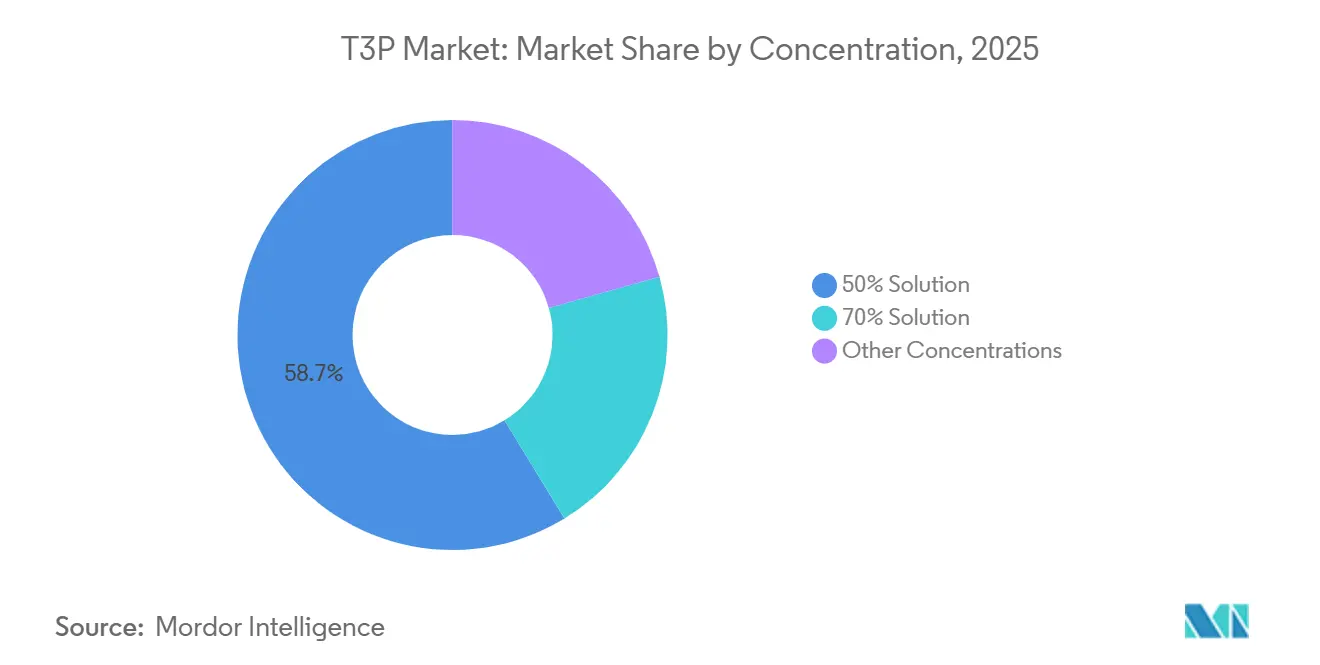
Industrial Momentum Behind the 50% Solution, 70% Solution Scaling for GLP-1 ProgramsThe 50% solution is expected to hold 58.72% of the T3P market share in 2025, reflecting its role in handling requirements and reaction performance. This format remains the practical standard across automated synthesis platforms, GMP reactors, and routine laboratory work because it provides stable flow properties and supports volumetric dispensing. Users also prefer it when they need to balance active reagent strength with operating convenience. In many production settings, dosing control and lower handling complexity matter as much as marginal gains in concentration. This operating logic keeps the 50% solution central to the T3P market, even as newer peptide programs require higher efficiency.
The T3P market size for the 70% solution is projected to expand at a CAGR of 6.93% between 2026 and 2031, making it the fastest-growing concentration format during the forecast period. Industrial peptide manufacturing shows the strongest adoption, as higher reagent density can reduce total solvent volume per batch and support process mass efficiency targets. This factor matters more in large production campaigns than in small laboratory runs because solvent load and reactor throughput become significant cost drivers at scale. The 2026 Organic Letters study supports this efficiency trend by linking T3P-based peptide workflows with materially lower process mass intensity under optimized conditions. Other concentration formats remain niche and serve custom synthesis needs and specialized research programs rather than broad industrial demand. Across the T3P industry, the shift toward higher-concentration formats remains gradual but is visible in applications where process efficiency delivers cost and sustainability benefits.
The 50% solution also benefits from its alignment with GMP documentation and repeatability requirements, as consistent dispensing reduces the risk of avoidable batch variation. In high-throughput manufacturing, this reliability can outweigh the theoretical efficiency benefits of a more concentrated format when companies have already optimized their processes. Buyers in the T3P market often view the 50% solution as the low-friction option for qualification and scale transfer. This position keeps its installed base strong, especially when pharmaceutical producers aim to limit operational changes during commercial execution. By contrast, the 70% solution is more closely associated with next-stage optimization efforts in large peptide programs. This dynamic creates a concentration split in the T3P market, with one format anchored by installed practice and the other supported by scale-driven efficiency goals.



By Solvent Type:
Ethyl Acetate Entrenched, Acetonitrile Rising on Purification Convergence LogicEthyl acetate is expected to account for 54.61% of the T3P market in 2025, reflecting its fit with pharmaceutical manufacturing requirements. Its broad acceptance and lower toxicity profile make it a practical solvent base for T3P formulations used in regulated settings. In commercial operations, solvent choice affects residual testing, plant handling, and the speed of internal approvals. Buyers often prefer options that reduce friction across quality and manufacturing teams rather than only improving reaction performance on paper. Therefore, ethyl acetate remains the leading solvent platform in the T3P market because it aligns with everyday GMP expectations.
The T3P market size for acetonitrile is projected to expand at a CAGR of 6.84% between 2026 and 2031, making it the fastest-growing solvent segment. Process convergence is a key driver: manufacturers already use acetonitrile widely in peptide purification, which can simplify workflows when suppliers provide the coupling reagent in the same solvent environment. This approach reduces the need for solvent exchange and can strengthen the link between reaction and purification steps in larger peptide programs. In scale-up work, these workflow gains can affect both turnaround time and operating consistency. As a result, the T3P market is seeing stronger interest in acetonitrile, particularly among manufacturers seeking integration between synthesis and downstream processing. This growth does not displace ethyl acetate, but it expands the role of solvent strategy in customer selection.
Dimethylformamide (DMF)-based formulations remain relevant, especially in settings where existing processes and customer familiarity support continued use. Even so, their long-term growth path is more constrained because buyers are placing greater value on lower-risk solvent systems and easier compliance. This trend keeps the T3P market focused on solvents that reduce process burden without requiring major chemistry changes. The other solvent category, including options such as 2-methyltetrahydrofuran and butyl acetate, remains smaller but plays a clear role in specialized development work. These formulations appeal to customers that want to test lower-toxicity or biobased alternatives within a green chemistry framework. Within the T3P industry, solvent choice is becoming a more visible part of supplier differentiation, especially in regulated and sustainability-focused accounts.
By Application:
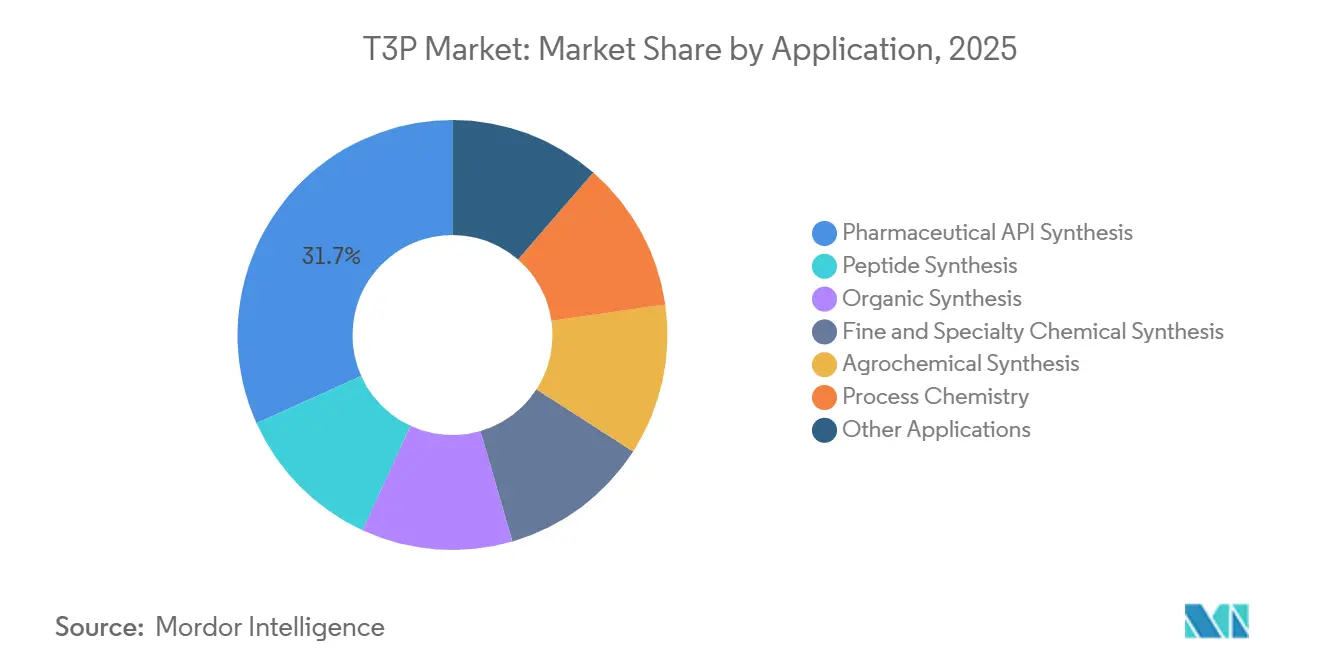
Pharmaceutical API Synthesis Anchors Revenue, Peptide Synthesis Accelerates as a Primary DriverPharmaceutical Active Pharmaceutical Ingredient (API) synthesis is expected to account for 31.74% of the T3P market in 2025, making it the largest application segment by current revenue. This leadership reflects T3P’s established role in amide bond formation for regulated drug substance manufacturing, where purity and workup simplicity can be decisive. Commercial API lines value reagents that support repeatability and reduce avoidable processing complexity. This is especially relevant in therapeutic areas with strict batch-quality targets and significant production volumes. For these reasons, pharmaceutical API synthesis remains the revenue anchor of the T3P market.
Peptide synthesis is the fastest-growing application and is projected to advance at a CAGR of 7.51% through 2031. This growth is closely linked to the scaling of peptide drug manufacturing, where efficient coupling and manageable byproduct removal matter across repeated synthesis cycles. The T3P market benefits from this trend because peptide workflows magnify the value of reagents that simplify purification and support cleaner plant operations. In practice, peptide production programs can shift reagent preferences more quickly than mature small-molecule lines, especially when companies qualify new capacity. Peptide demand also gives the T3P market a stronger long-term connection to commercial innovation because new therapeutic modalities often require fresh process development rather than legacy route protection. As a result, the fastest-growing application in the T3P market is also the one most closely linked to future manufacturing expansion.
Organic synthesis represents a broader application field where manufacturers value T3P for heterocyclic ring formation, rearrangement chemistry, and general process flexibility. This breadth matters because it makes the reagent relevant beyond a narrow coupling niche and helps support demand across different production environments. Fine and specialty chemical producers also contribute to the T3P market when they need a reagent that can support multiple transformations with manageable handling. The 2025 RSC publication on carbamate and thiocarbamate synthesis reinforces this extension by showing a mild and phosgene-free route with relevance to industrial intermediate production. Agrochemical synthesis, therefore, adds structural support, even if it does not yet rival pharmaceutical demand in value terms. Across the T3P market, non-pharmaceutical applications widen the base and reduce dependence on a single end-use pattern.
Geography Analysis
North America T3P Market
North America is expected to hold 36.82% of the T3P market share in 2025, making it the largest regional contributor by value. The region has a high concentration of pharmaceutical manufacturers, large CDMOs, and advanced peptide production programs. This concentration supports steady reagent demand, as customers in regulated manufacturing prioritize supplier quality systems, comprehensive documentation, and reliable delivery. Curia’s March 2025 Albuquerque expansion is expected to strengthen the regional supply base to meet future pharmaceutical production needs. As a result, qualification rigor and manufacturing intensity shape North American demand in the T3P market as much as the end-user count.
Europe T3P Market
Europe remains an important part of the T3P market, with Germany, the United Kingdom, France, and Italy supporting demand through pharmaceutical and specialty chemical activity. The region’s process-chemistry base and preference for materials that meet tightly controlled manufacturing standards support its position. European buyers also value solvent choice, traceability, and supplier audit readiness, which support GMP-grade formulations. Therefore, the regional profile of the T3P market favors higher-purity, well-documented supply over lower-cost catalog competition.
APAC T3P Market
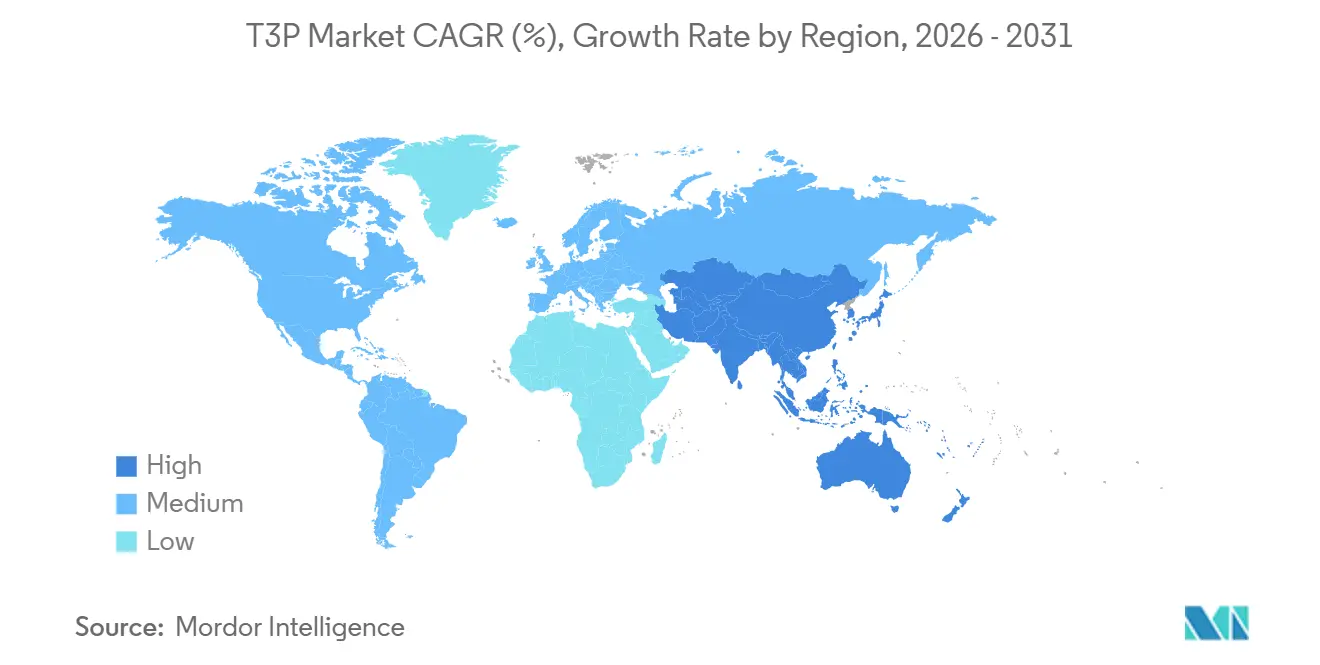
Asia-Pacific is the fastest-growing regional segment, with the T3P market projected to register a 7.13% CAGR through 2031. China remains the anchor market in regional volume terms due to its broad chemical manufacturing base and growing relevance in pharmaceutical and industrial synthesis. India adds momentum through its export-oriented API sector and increasing use of more complex process chemistry. Japan is supported by an established GMP reagent base, including FUJIFILM Wako Pure Chemical Corporation's May 2024 capacity expansion for pharmaceutical raw materials [2]FUJIFILM Wako Pure Chemical Corporation, “FUJIFILM Wako Pure Chemical Corporation Installs New Equipment to Triple Production Capacity of GMP-Compliant Raw Materials for Pharmaceutical Manufacturing,” FUJIFILM Press Release, fujifilm.com. South Korea contributes through biopharmaceutical development activity, while the rest of the world remains smaller and at an earlier stage of development. Together, these patterns indicate that the T3P market has a current concentration in North America, quality-led demand in Europe, and the fastest expansion in Asia-Pacific.

Competitive Landscape
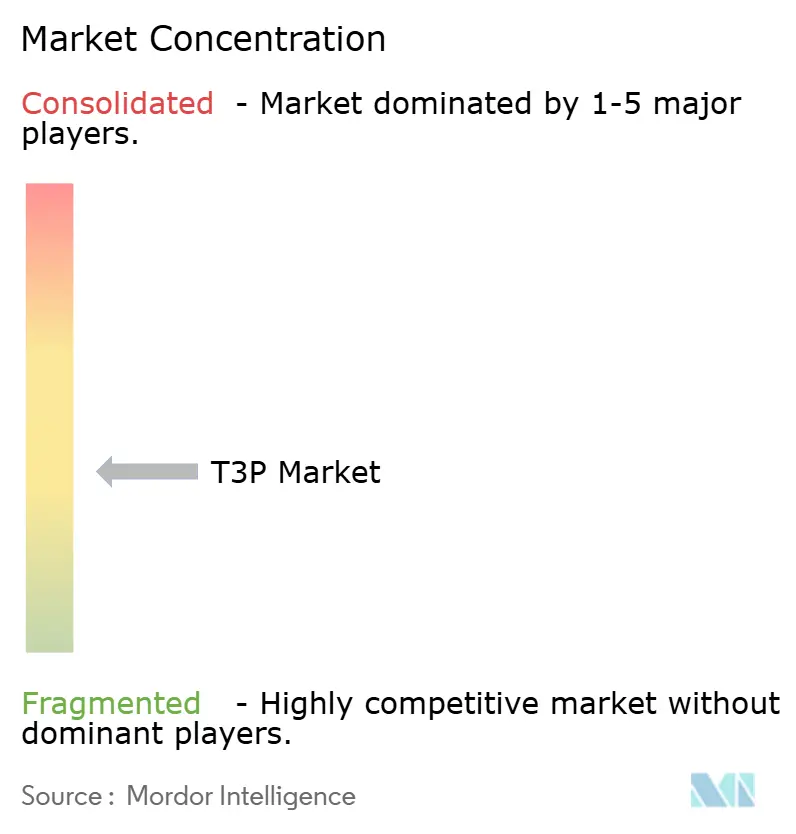
The T3P market is moderately fragmented, with a clear separation between GMP-focused suppliers serving pharmaceutical manufacturing and broader distributors serving research and smaller-volume applications. Curia Global, Merck KGaA through MilliporeSigma, and FUJIFILM Wako Pure Chemical are positioned to address regulated manufacturing requirements and support customers that need documentation. Tokyo Chemical Industry, Iris Biotech GmbH, AAPPTec, BLD Pharmatech, Fluorochem Limited, and Chem-Impex broaden the supplier base across research, catalog, and smaller commercial accounts. As a result, supplier positioning in the T3P market depends less on basic product availability and more on quality systems, solvent portfolio breadth, and customer support capabilities. Companies that can support customers from development through commercial production tend to hold stronger positions.
Curia’s Albuquerque expansion in March 2025 would represent a capacity-led strategy to strengthen its relevance in pharmaceutical manufacturing. FUJIFILM Wako Pure Chemical’s May 2024 decision to triple production capacity for GMP-compliant pharmaceutical raw materials reflects investment driven by regulated demand expectations. Merck KGaA’s June 2026 agreement to acquire Bio-Techne for USD 11.3 billion would mark a broader portfolio move, strengthening its position across life sciences tools and related manufacturing workflows. These initiatives do not target T3P alone, but they improve the competitive position of companies active in the same customer ecosystem. Therefore, the T3P market reflects both direct reagent competition and broader platform development across pharmaceutical manufacturing supply chains.
Another competitive divide in the T3P market exists between suppliers that compete on compliance depth and those that compete on price. Pharmaceutical customers qualifying materials for new APIs often prioritize solvent options, audit readiness, and support for regulated filings over unit price alone. This gives companies with established quality infrastructure and a track record in GMP-related supply a competitive advantage. Research and non-GMP applications remain accessible to regional distributors and lower-cost manufacturers, preventing the market from becoming highly consolidated. As a result, the T3P market offers entry points for smaller suppliers, while the high-value end remains more defensible due to qualification barriers. Future leadership will likely depend on companies that can combine scale, formulation flexibility, and regulatory support effectively.
T3P Industry Leaders
Merck KGaA
Tokyo Chemical Industry Co., Ltd.
FUJIFILM Wako Pure Chemical Corporation
Fluorochem Limited
Chem-Impex
- *Disclaimer: Major Players sorted in no particular order
T3P Market Companies Covered in this Report
- AAPPTec
- BLD Pharmatech Ltd.
- Carl Roth
- Chem-Impex
- Curia Global, Inc.
- Fluorochem Limited
- FUJIFILM Wako Pure Chemical Corporation
- Infinia Sciences Pvt. Ltd.,
- Iris Biotech GmbH
- Merck KGaA
- Santa Cruz Biotechnology, Inc.
- TargetMol Chemicals Inc.
- Tokyo Chemical Industry Co., Ltd.

Recent Industry Developments in T3P Market
- June 2026: Merck KGaA is expected to sign a definitive agreement to acquire Bio-Techne Corporation for USD 11.3 billion, expanding its Process Solutions business into reagents, multi-omics, precision diagnostics, and cell and gene therapy workflows. The transaction is expected to close by late 2026 or early 2027, subject to regulatory approvals. It is expected to expand Merck KGaA's life sciences reagent portfolio, including T3P and related chemical reagents used by pharmaceutical manufacturing clients.
- March 2025: Curia Global is expected to announce expansions across its global network of sterile fill-finish sites, including a USD 200 million multi-year project at its Albuquerque, New Mexico, facility. The project is expected to add more than 70,000 square feet of manufacturing space and two isolated filling lines.


Global T3P Market Report Scope
T3P (propanephosphonic acid anhydride) is a coupling reagent used primarily in organic synthesis for amide and peptide bond formation. Pharmaceutical researchers use it to produce high-purity products with minimal epimerization and racemization.
The T3P market is segmented by concentration, solvent type, application, and geography. By concentration, the market is segmented into 50% solution, 70% solution, and other concentrations. By solvent type, the market is segmented into ethyl acetate, dimethylformamide (DMF), acetonitrile, and other solvents. By application, the market is segmented into peptide synthesis, pharmaceutical API synthesis, organic synthesis, fine & specialty chemical synthesis, agrochemical synthesis, process chemistry, and other applications. The report also covers the market size and forecasts for T3P in 11 countries across major regions. The market sizes and forecasts are provided in terms of value (USD).
| 50% Solution |
| 70% Solution |
| Other Concentrations |
| Ethyl Acetate |
| Dimethylformamide (DMF) |
| Acetonitrile |
| Other Solvents |
| Peptide Synthesis |
| Pharmaceutical API Synthesis |
| Organic Synthesis |
| Fine & Specialty Chemical Synthesis |
| Agrochemical Synthesis |
| Process Chemistry |
| Other Applications |
| Asia-Pacific | China |
| India | |
| Japan | |
| South Korea | |
| Rest of Asia-Pacific | |
| North America | United States |
| Canada | |
| Europe | Germany |
| United Kingdom | |
| France | |
| Italy | |
| Russia | |
| Rest of Europe | |
| Rest of the World | South America |
| Middle-East and Africa |
| By Concentration | 50% Solution | |
| 70% Solution | ||
| Other Concentrations | ||
| By Solvent Type | Ethyl Acetate | |
| Dimethylformamide (DMF) | ||
| Acetonitrile | ||
| Other Solvents | ||
| By Application | Peptide Synthesis | |
| Pharmaceutical API Synthesis | ||
| Organic Synthesis | ||
| Fine & Specialty Chemical Synthesis | ||
| Agrochemical Synthesis | ||
| Process Chemistry | ||
| Other Applications | ||
| By Geography | Asia-Pacific | China |
| India | ||
| Japan | ||
| South Korea | ||
| Rest of Asia-Pacific | ||
| North America | United States | |
| Canada | ||
| Europe | Germany | |
| United Kingdom | ||
| France | ||
| Italy | ||
| Russia | ||
| Rest of Europe | ||
| Rest of the World | South America | |
| Middle-East and Africa | ||


Key Questions Answered in the Report
What is current market size of T3P Market?
The T3P Market size is projected to expand from USD 44.08 million in 2025 and USD 46.82 million in 2026 to USD 63.88 million by 2031, and is expected to register a CAGR of 6.41% between 2026 and 2031.
What is driving demand for T3P in pharmaceutical manufacturing?
Demand is supported by larger peptide and API production programs, easier byproduct removal, and greater interest in GMP-ready reagents that simplify downstream processing.
Which concentration format leads to the current demand for T3P?
The 50% solution led the T3P market in 2025 with a 58.72% share because it fit automated synthesis, plant dispensing, and broad GMP operating needs.
Which solvent segment is growing fastest in T3P formulations?
Acetonitrile is the fastest-growing solvent segment, with a 6.84% CAGR through 2031, helped by its fit with peptide purification workflows.
Page last updated on:





