
Synthetic Rope Market Size and Share
Market Overview
| Study Period | 2022 - 2032 |
|---|---|
| Market Size (2027) | USD 2.61 Billion |
| Market Size (2032) | USD 3.54 Billion |
| Growth Rate (2027 - 2032) | 6.33 % |
| Fastest Growing Market | Asia-Pacific |
| Largest Market | Asia-Pacific |
| Market Concentration | Medium |
Major Players *Disclaimer: Major Players sorted in no particular order Image © Mordor Intelligence. Reuse requires attribution under CC BY 4.0. | |
Synthetic Rope Market Analysis by Mordor Intelligence
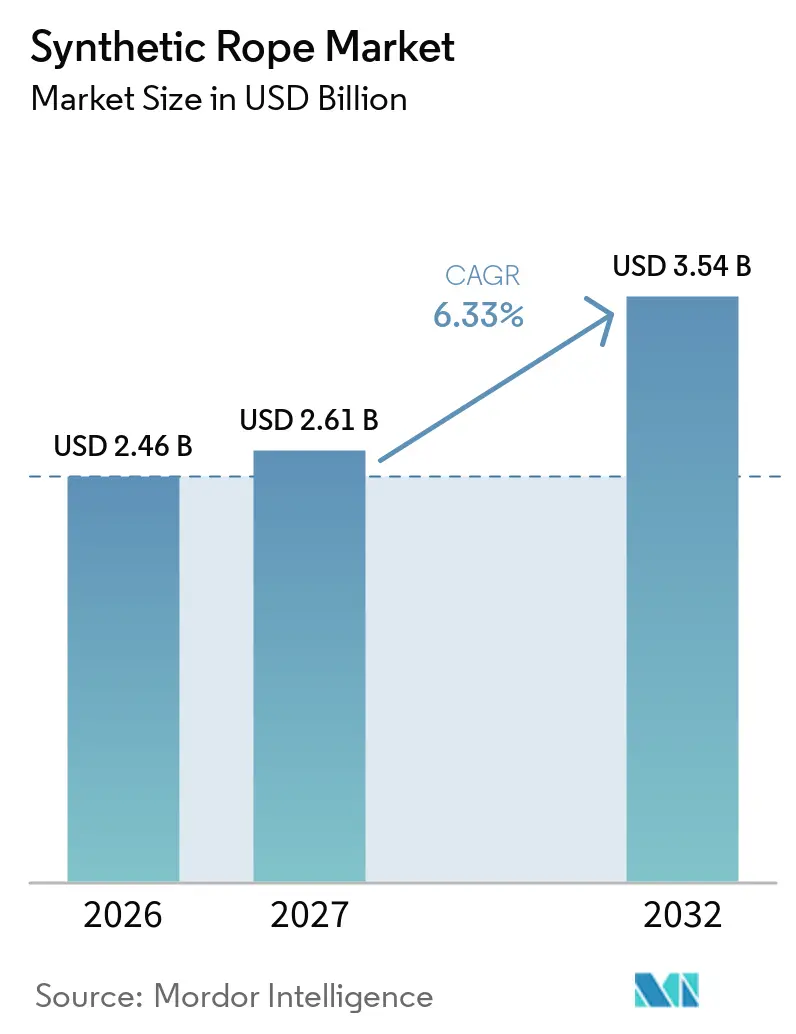
The Synthetic Rope Market size was valued at USD 2.46 billion in 2026 and is estimated to grow from USD 2.61 billion in 2027 to reach USD 3.54 billion by 2032, at a CAGR of 6.33% during the forecast period (2027-2032). This expansion comes from a wider shift in applications where line weight, handling burden, equipment loading, and safety procedures are important commercial considerations. The synthetic rope market is supported by the replacement of steel wire in lifting, mooring, and industrial work, where lower line weight can improve handling, lessen fatigue during manual tasks, reduce stored energy in a system, and make installation work more manageable in confined environments. Offshore energy projects are increasing the demand for ropes that combine high strength with low weight, stable performance under sustained loads, and established certification for permanent or safety-critical use, especially when a rope forms part of a long-life mooring arrangement. Manufacturers are responding through fiber development, braided designs, inspection tools, and approvals that support use in demanding applications and allow customers to compare alternatives against stated operating requirements, expected maintenance needs, and the standards applied by project owners. The synthetic rope market also benefits from port activity, aquaculture, construction lifting, and leisure use, although feedstock costs, rope durability, inspection requirements, exposure to abrasion and ultraviolet light, and access to technical approval remain important constraints. Competition is becoming more dependent on proven performance, technical service, the ability to meet customer approval requirements, and the capacity to provide documentation through the full working life of a rope, rather than on material price alone.
Key Report Takeaways
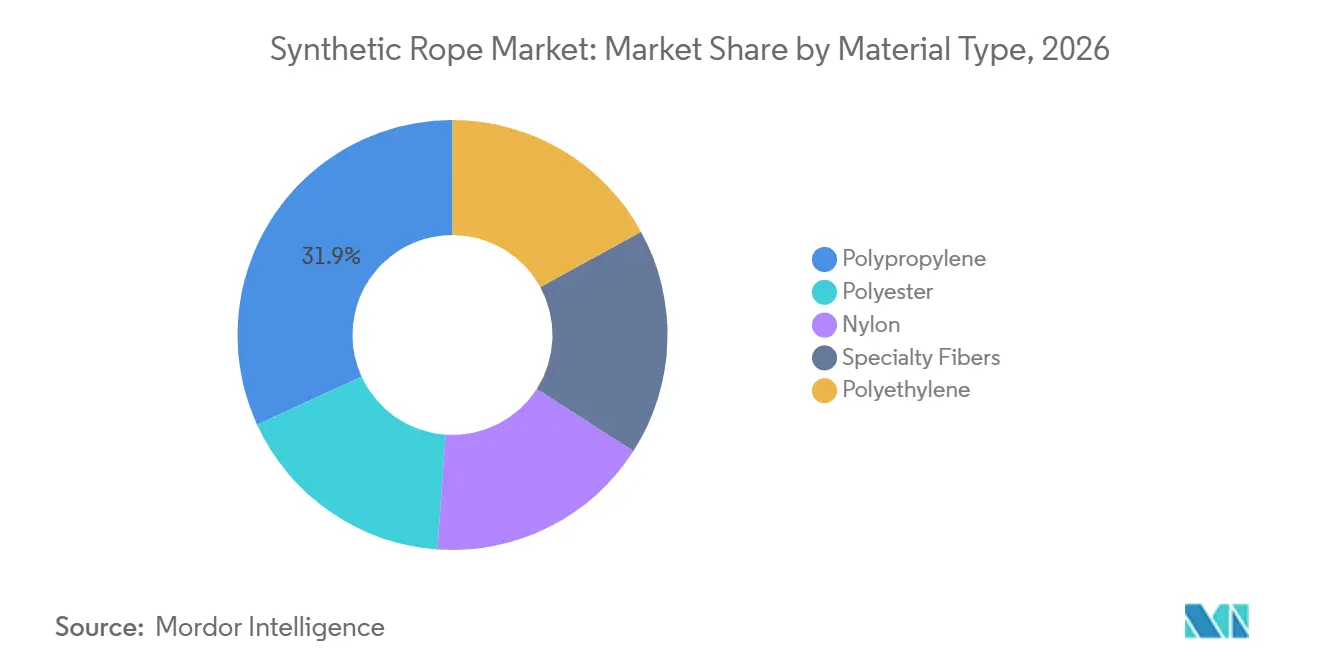
- By material type, polypropylene held 31.85% of the synthetic rope market share in 2026, while specialty fibers are forecast to advance at a 6.93% CAGR through 2032.
- By construction type, braided held 45.63% of the synthetic rope market share in 2026 and is forecast to advance at a 7.06% CAGR through 2032.
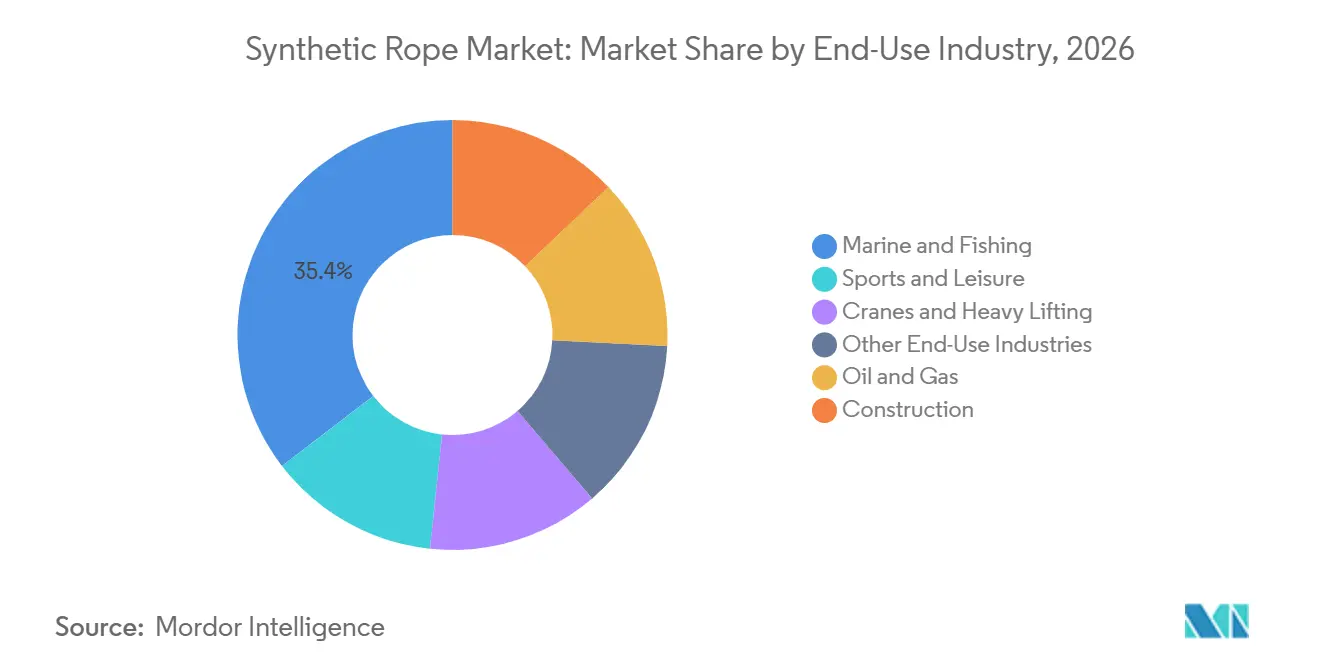
- By end-use industry, marine and fishing held 35.42% of the synthetic rope market share in 2026, while sports and leisure are forecast to advance at a 7.47% CAGR through 2032.
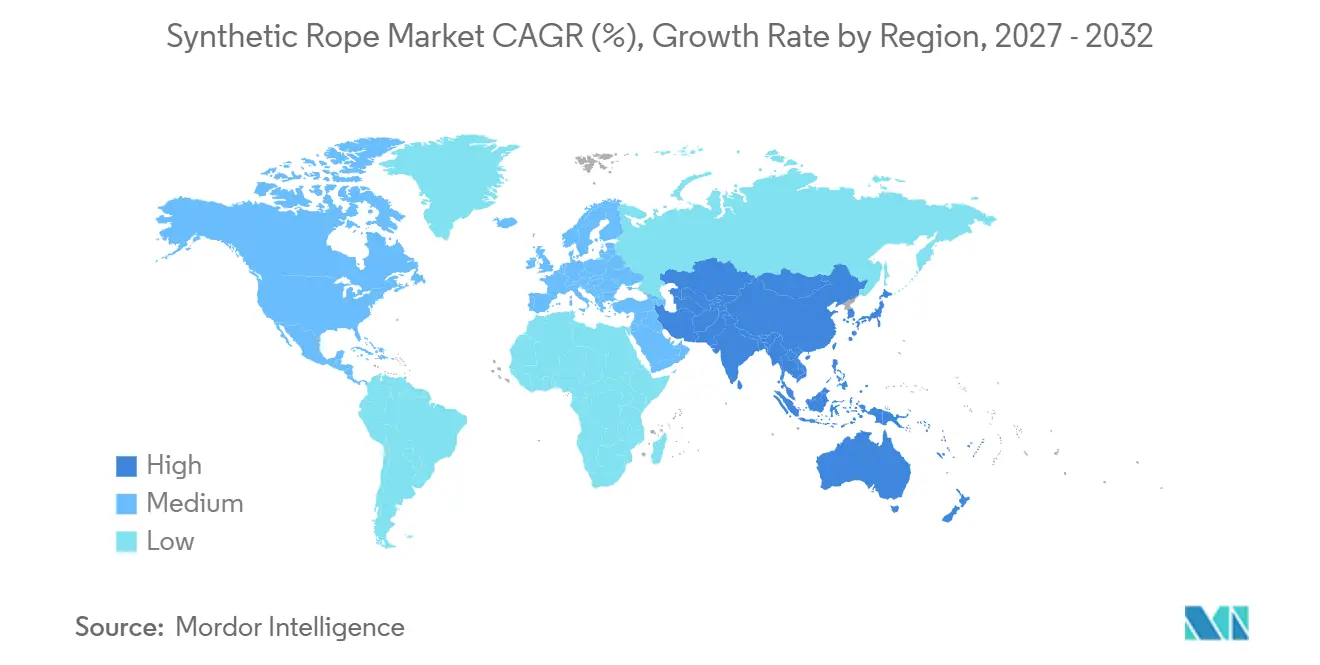
- By geography, Asia-Pacific held 32.38% of the synthetic rope market share in 2026 and is forecast to advance at a 7.32% CAGR through 2032.
Note: Market numbers in this report are based on Mordor Intelligence's proprietary estimation framework, which combines nine months of actuals with Q4 projections for base year 2026.
Market Trends and Insights
Drivers Impact Analysis of Synthetic Rope Market*
| Driver | (~) % Impact on CAGR Forecast | Geographic Relevance | Impact Timeline |
|---|---|---|---|
| Steel-Wire Rope Replacement in Lifting and Mooring | +1.8% | Global, concentrated in North America, Europe, and industrializing APAC markets | Medium term (2–4 years) |
| Deepwater, Floating Wind, and Offshore Energy Mooring | +1.5% | Europe (North Sea), APAC (Japan, South Korea, China), emerging in MEA | Long term (≥ 4 years) |
| Lightweight Safety and Lower Handling Burden | +1.0% | Global | Short term (≤ 2 years) |
| Infrastructure, Crane, and Industrial Lifting Expansion | +0.7% | APAC, North America, Middle East | Medium term (2–4 years) |
| HMPE and Aramid Performance Innovation | +0.6% | Global, early gains in Europe and North America | Long term (≥ 4 years) |
| Source: Mordor Intelligence | |||
Steel-Wire Rope Replacement in Lifting and Mooring
The synthetic rope market is gaining from replacement decisions in lifting and mooring that favor lower weight and safer handling. High-modulus polyethylene (HMPE) rope weighs close to one-fifth of equivalent-strength steel wire. Lower mass can reduce the effort required to deploy, recover, and position a line during demanding operations. It can also reduce the need for large handling equipment where crews work in restricted locations. Hybrid mooring arrangements using steel wire and polyester rope can reduce system weight and installation costs at intermediate water depths. System design remains important because the selected rope, hardware, maintenance plan, and operating procedure must work together. These operating benefits make replacement decisions relevant to ports, cranes, offshore assets, and other sites where line handling affects both safety and productivity.
Deepwater, Floating Wind, and Offshore Energy Mooring
Deepwater, floating wind, and offshore energy mooring is expanding the addressable demand for high-performance products in the synthetic rope market. Permanent floating offshore wind systems require mooring lines that maintain performance over long operating periods. Avient Corporation announced in July 2026 that its Dyneema DM20 fiber received ClassNK Type Approval for permanent floating offshore wind turbine mooring use[1]. This requirement raises the value of testing, traceability, and documented fiber performance for rope suppliers. The synthetic rope market can, therefore, gain from projects where early qualification helps suppliers participate in longer procurement cycles.
Lightweight Safety and Lower Handling Burden
Lightweight safety and lower handling burden support adoption where crews must handle mooring and lifting lines repeatedly. Lower rope weight can reduce physical strain during installation, recovery, and routine operations. The safety case also includes lower stored energy than steel wire in some system configurations. Suppliers are introducing web-based tools that help terminal and vessel operators assess total mooring system energy. The tool helps users assess stored mooring-line energy and document safety decisions. These practices encourage the synthetic rope market to compete on managed asset performance rather than purchase price alone.
Infrastructure, Crane, and Industrial Lifting Expansion
Infrastructure, crane, and industrial lifting expansion creates demand for ropes and slings that improve handling in heavy work. High-capacity lifting requires carefully engineered products with verified load performance. Rope suppliers are also serving marine construction and energy installation work that uses specialist lifting systems. WireCo reported field validation in April 2026 for UNION Gladiator synthetic boom pendants in draglines and electric rope shovels. The company reported a 13% reduction in harmonic energy, a 29% reduction in sideloading stress, and a 14% gain in component life against steel equivalents. These results support the synthetic rope market where equipment owners place value on reduced stress and longer component life.
Restraints Impact Analysis of Synthetic Rope Market*
| Restraint | (~) % Impact on CAGR Forecast | Geographic Relevance | Impact Timeline |
|---|---|---|---|
| High Specialty-Fiber and Certification Costs | -1.2% | Global, most acute in offshore energy and crane segments in Europe and North America | Long term (≥ 4 years) |
| Abrasion, UV, Creep, and Inspection Complexity | -0.8% | Global, elevated exposure in tropical APAC and MEA environments | Medium term (2–4 years) |
| Petrochemical Feedstock Price Volatility | -0.6% | Global, most acute for polypropylene and polyester rope producers in APAC and Europe | Short term (≤ 2 years) |
| Source: Mordor Intelligence | |||
High Specialty-Fiber and Certification Costs
High specialty-fiber and certification costs limit participation in premium parts of the synthetic rope market. HMPE and aramid fibers cost more than polypropylene and polyester, which affects the price of finished ropes. Offshore energy customers also require approval of specific rope constructions, quality systems, and performance claims. ClassNK, DNV, and Lloyd’s Register approval processes can require extended testing and continued quality commitments. These obligations make it harder for smaller suppliers to enter approved offshore applications. The result is a clear divide between qualified suppliers serving high-value contracts and producers competing in more price-sensitive applications.
Abrasion, UV, Creep, and Inspection Complexity
Abrasion, UV, creep, and inspection complexity can increase lifecycle costs for users of high-performance ropes. Permanent offshore use can expose ropes to hardware contact, sunlight, cyclic loading, and sustained tension. Research published in Ocean Engineering in 2026 found that creep behavior and joint strength differ among aramid, HMPE, and polyester ropes and require material-specific testing. A 2025 PLOS One study also found that wear behavior changes with material, rope construction, environmental conditions, and lubrication. Users may need more frequent inspection and condition assessment where damage risks are higher. This requirement can slow adoption in price-sensitive fishing and marine applications.
*Our forecasts treat driver/restraint impacts as directional, not additive. The impact forecasts reflect baseline growth, mix effects, and variable interactions.
Synthetic Rope Market Segment Analysis
By Material Type:
Specialty Fibers Rebalance a Polypropylene-Led MarketPolypropylene held 31.85% of the synthetic rope market share by material type in 2026. Its low density, chemical resistance, and accessible cost position support use in marine and fishing work. These applications often require regular rope replacement and do not always require the highest tensile performance. Polyester is used where low elongation and resistance to creep are important. It is relevant to mooring and towing applications that need stable behavior under load. Nylon remains useful in sports, leisure, and rescue uses because elasticity and shock absorption are valued. Standard polyethylene serves agricultural and packaging-adjacent applications across Asia-Pacific and South America. These material choices allow the synthetic rope market to meet a wide range of performance and budget requirements.
Specialty fibers are projected to advance at a 6.93% CAGR through 2032. This category includes HMPE, aramid, and hybrid constructions used in offshore energy and lifting. The synthetic rope market size for specialty fibers is supported by demand for high tensile strength with lower line weight. Scientific work on full-scale HMPE ropes has improved understanding of stiffness under quasi-static and dynamic conditions. That evidence supports specification for permanent offshore structures. Polypropylene is expected to retain its broad role because it remains appropriate for many routine applications. Specialty fibers are instead positioned to capture more value where technical performance and approval requirements are decisive.

By Construction Type:
Braided Architecture Consolidates Its LeadBraided construction held 45.63% of the synthetic rope market share by construction type in 2026 and is forecast to advance at a 7.06% CAGR through 2032. Its interlaced strand structure helps distribute tensile stress and supports high breaking strength at comparable diameters. Braided rope is used widely where consistent handling and reliable load behavior are needed. The design is well suited to high-performance fiber systems that require controlled internal geometry. Its role is especially important for applications that use HMPE. These applications can benefit from rope designs that manage fiber curvature and internal stress. The braided format, therefore, supports use in demanding lifting, marine, and offshore work. The synthetic rope market continues to use braided products as a major route to higher-value performance.
Braided ropes also benefit from advances in certification and compliance. Braided rope is also used in certified lightweight mooring applications, where suppliers must demonstrate that the finished line meets the relevant performance requirements. Twisted rope remains relevant in cost-sensitive fishing and agricultural use. Its properties can be appropriate where torque resistance and simpler construction matter. Plaited rope serves more specialized leisure boating uses that value dynamic load recovery. Each construction format, therefore, retains a distinct role instead of serving the same operating need. The synthetic rope market is likely to preserve this mix as customers select construction based on loading, handling, durability, and price.
By End-Use Industry:
Sports and Leisure Drive Growth While Marine and Fishing Anchor RevenueMarine and fishing held 35.42% of the synthetic rope market share in 2026. Mooring lines, trawl nets, and vessel rigging sustain demand across commercial fishing and cargo operations. These users require products that withstand wet conditions, repeated handling, and varied loading. Oil and gas also require both standard mooring ropes and specialty deepwater dynamic ropes. Construction, cranes, and heavy lifting are expanding uses as fiber ropes and synthetic slings move into more regular field deployment. The range of end uses limits reliance on any single customer group. It also allows the synthetic rope market to benefit from both replacement demand and project-based demand. Certification remains important where rope failure could affect people, equipment, or operating continuity.
Sports and leisure are projected to advance at a 7.47% CAGR through 2032. The segment includes climbing, ocean racing, arborist work, rescue, and related applications that value handling comfort and certified performance. Marlow Ropes became the Official Rope Supplier to SailGP through the 2027 season in April 2026. Marlow Ropes also launched its Gravitas static rope in May 2026 with EN 1891 Type A and NFPA technical certification. These developments show that suppliers are using certification and specialized products to address professional and sporting demand. Rope access and climbing users may place greater emphasis on safety standards than on the lowest purchase cost. This creates room for differentiated offerings within the synthetic rope market.
Geography Analysis
APAC Synthetic Rope Market
Asia-Pacific held 32.38% of the synthetic rope market share in 2026 and is projected to advance at a 7.32% CAGR through 2032. China supports regional demand through maritime logistics, aquaculture, and offshore oil and gas activity. South Korea adds shipbuilding demand and offshore wind installation activity. Japan is developing as a high-value location for floating offshore wind-related rope demand. These factors combine demand with a growing need for specialized high-performance lines.
ASEAN Synthetic Rope Market
ASEAN markets add demand through port construction and aquaculture activity. Regional manufacturers can serve polypropylene and polyester rope customers at competitive production costs. Asia-Pacific also has an export role for braided products supplied to European and North American original equipment manufacturers. The synthetic rope market size in the region is, therefore, shaped by both domestic use and manufacturing capacity. Regional growth can support investment in distribution, testing, and application support. The continued expansion of floating offshore wind could add demand for approved synthetic mooring systems.
The Americas, EMEA and APAC Synthetic Rope Market
North America remains a high-value location for offshore energy mooring, crane applications, and sports and leisure use. Europe is a major market for offshore wind, maritime activity, rope access, and premium certified products. Teufelberger introduced Solitec XD and its Alliance for Intelligent Rope Monitoring platform in June 2025, combining visual recognition, magnetic inductive testing, and geometric measurement for rope health monitoring[2]. South America is supported by offshore oil and gas, commercial fishing, and construction activity. Middle East and Africa includes oil and gas mooring demand and manufacturing capacity in South Africa. The synthetic rope market differs by region because certification-led demand in North America, Europe, and parts of Asia-Pacific contrasts with more price-led procurement in parts of South America, Middle East and Africa, and ASEAN fishing markets.
Competitive Landscape
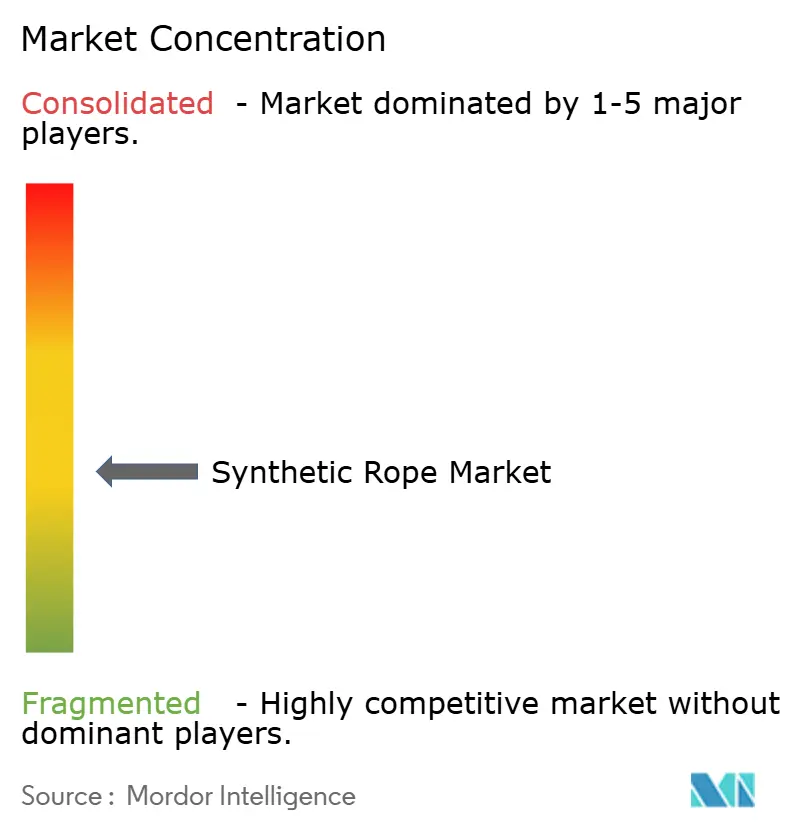
The synthetic rope market is moderately concentrated, with the top five players including WireCo, Cortland Limited, Samson Rope Technologies, Teufelberger, and Bekaert. Customers often evaluate a supplier’s ability to provide the required rope construction, fiber choice, technical documents, delivery support, and after-sales service. Larger technical suppliers have an advantage in applications that need certification, testing, and documented performance. Regional producers can remain competitive where customers prioritize availability, application knowledge, and cost. This structure keeps the synthetic rope market moderately fragmented rather than concentrated around one supplier. Product selection varies by fiber type, construction, certification, service support, and the operational conditions at the customer site.
Samson Rope Technologies, Cortland Limited, and WireCo have a presence in North American offshore and industrial applications. Marlow Ropes, Teufelberger, LANEX a.s., and English Braids serve European marine, sport, and industrial uses. DSR Corporation and Katradis Marine Ropes Ind. S.A. participate in fishing and marine mooring applications. These company positions reflect differences in customer requirements rather than a single uniform purchasing standard. Offshore users often require detailed documentation, defined inspection practices, and products that can be approved for a specified duty. Fishing and general marine customers may give more weight to ease of replacement, availability, and practical handling. Suppliers increasingly use digital inspection and lifecycle tools to build continuing customer relationships. Suppliers are expanding lifecycle tools that support stored-energy assessment and more structured maintenance decisions. Teufelberger’s 2025 monitoring platform is another example of a product-service approach that can support rope condition assessment. The synthetic rope market rewards these services when customers require a record of inspection and asset condition.
Marlow Ropes signed a 4-year agreement with Clipper Ventures in October 2026 to act as Official Rope Supplier across 5 platforms. The agreement extends the company’s relationship with the sailing group and supports activity in the Chinese sailing segment. WireCo reported performance results for UNION Gladiator synthetic boom pendants in April 2026, positioning the product around equipment stress reduction and component life. Avient Corporation’s 2026 ClassNK approval for Dyneema DM20 shows how approved fiber materials can influence rope manufacturer choices in floating offshore wind. Certification costs and customer qualification requirements can favor suppliers with established records in offshore applications. At the same time, Atlantic Braids Ltd., Novatec Braids, Ltd., Unirope Ltd., Yale Cordage, and Southern Ropes can serve applications that depend on local service and replacement support. The competitive position of each supplier depends on its product range, manufacturing capability, approval status, and ability to support the rope after delivery.
Synthetic Rope Industry Leaders
-
WireCo
-
Cortland Limited
-
Samson Rope Technologies
-
Teufelberger
-
Bekaert
- *Disclaimer: Major Players sorted in no particular order
Synthetic Rope Market Companies Covered in this Report
- Atlantic Braids Ltd.
- Bekaert
- Cortland Limited
- DSR Corporation
- English Braids
- Katradis Marine Ropes Ind. S.A.
- LANEX a.s.
- Marlow Ropes
- Novatec Braids, Ltd.
- Samson Rope Technologies
- Southern Ropes
- Teufelberger
- Unirope Ltd.
- WireCo
- Yale Cordage
Recent Industry Developments in Synthetic Rope Market
- September 2026: Four Brothers Rope showcased high-performance synthetic mooring ropes and its digital rope lifecycle management system at Shipbuilding, Machinery & Marine Technology (SMM) 2026 in Hamburg, Germany. The company also received Bureau Veritas type approval for its SINOROPE offshore polyester mooring rope, supporting the synthetic rope market through validated products for deepwater mooring applications.
- May 2026: Marlow Ropes launched Gravitas, an 11 mm high-performance polyester-over-nylon static rope certified to EN 1891 Type A and National Fire Protection Association (NFPA) technical standards, featuring 1.7% elongation at 300 lb and a minimum breaking strength of 35.1 kN. The launch supports the synthetic rope market by expanding specialized rope solutions for technical access, rescue operations and other applications requiring low stretch, high strength and reliable performance.
Global Synthetic Rope Market Report Scope
Synthetic ropes are manufactured from man-made polymer fibers designed to provide strength, flexibility, and resistance to moisture, abrasion, and environmental exposure. Their lightweight construction and handling characteristics make them suitable for applications requiring reliable load-bearing and tension performance.
The Synthetic Rope Market is segmented by material type, construction type, end-use industry, and geography. By material type, the market is segmented into polypropylene, polyester, nylon, polyethylene, and specialty fibers. By construction type, the market is segmented into braided, twisted, and plaited ropes. By end-use industry, the market is segmented into marine and fishing, oil and gas, sports and leisure, construction, cranes and heavy lifting, and other end-use industries. The report also covers the market size and forecasts for synthetic ropes across 15 countries. For each segment, the market sizing and forecasts have been done on the basis of value (USD).
Segmentation Overview
| Polypropylene |
| Polyester |
| Nylon |
| Polyethylene |
| Specialty Fibers |
| Braided |
| Twisted |
| Plaited |
| Marine and Fishing |
| Oil and Gas |
| Sports and Leisure |
| Construction |
| Cranes and Heavy Lifting |
| Other End-Use Industries |
| Asia-Pacific | China |
| India | |
| Japan | |
| South Korea | |
| ASEAN Countries | |
| Rest of Asia-Pacific | |
| North America | United States |
| Canada | |
| Mexico | |
| Europe | Germany |
| United Kingdom | |
| France | |
| Italy | |
| NORDIC Countries | |
| Rest of Europe | |
| South America | Brazil |
| Argentina | |
| Rest of South America | |
| Middle East and Africa | Saudi Arabia |
| South Africa | |
| Rest of Middle East and Africa |
| By Material Type | Polypropylene | |
| Polyester | ||
| Nylon | ||
| Polyethylene | ||
| Specialty Fibers | ||
| By Construction Type | Braided | |
| Twisted | ||
| Plaited | ||
| By End-Use Industry | Marine and Fishing | |
| Oil and Gas | ||
| Sports and Leisure | ||
| Construction | ||
| Cranes and Heavy Lifting | ||
| Other End-Use Industries | ||
| By Geography | Asia-Pacific | China |
| India | ||
| Japan | ||
| South Korea | ||
| ASEAN Countries | ||
| Rest of Asia-Pacific | ||
| North America | United States | |
| Canada | ||
| Mexico | ||
| Europe | Germany | |
| United Kingdom | ||
| France | ||
| Italy | ||
| NORDIC Countries | ||
| Rest of Europe | ||
| South America | Brazil | |
| Argentina | ||
| Rest of South America | ||
| Middle East and Africa | Saudi Arabia | |
| South Africa | ||
| Rest of Middle East and Africa | ||
Key Questions Answered in the Report
What is the size of the synthetic rope market?
The synthetic rope market size was valued at USD 2.46 billion in 2026 and is estimated to grow from USD 2.61 billion in 2027 to reach USD 3.54 billion by 2032, at a CAGR of 6.33% during the forecast period (2027-2032).
What is driving demand for synthetic ropes?
Replacement of steel wire, offshore energy mooring, safer handling, industrial lifting, and development of High Modulus Polyethylene (HMPE) and aramid ropes support demand.
Which material type held the largest share in 2026?
Polypropylene held 31.85% of the market share in 2026 because it combines low density, chemical resistance, and cost-effectiveness.
Which construction type held the largest share in 2026?
Braided held 45.63% of the market share in 2026, supported by its load distribution and suitability for high-performance fibers.