
Switzerland Plastic Waste Management Services Market Size and Share
Market Overview
| Study Period | 2020 - 2031 |
|---|---|
| Forecast Data Period | 2026 - 2031 |
| Base Year Market Size (2025) | USD 0.29 Billion |
| Market Size (2026) | USD 0.3 Billion |
| Market Size (2031) | USD 0.35 Billion |
| Growth Rate (2026 - 2031) | 3.13 % |
| Market Concentration | Medium |
Major Players *Disclaimer: Major Players sorted in no particular order Image © Mordor Intelligence. Reuse requires attribution under CC BY 4.0. | |
Switzerland Plastic Waste Management Services Market Analysis by Mordor Intelligence
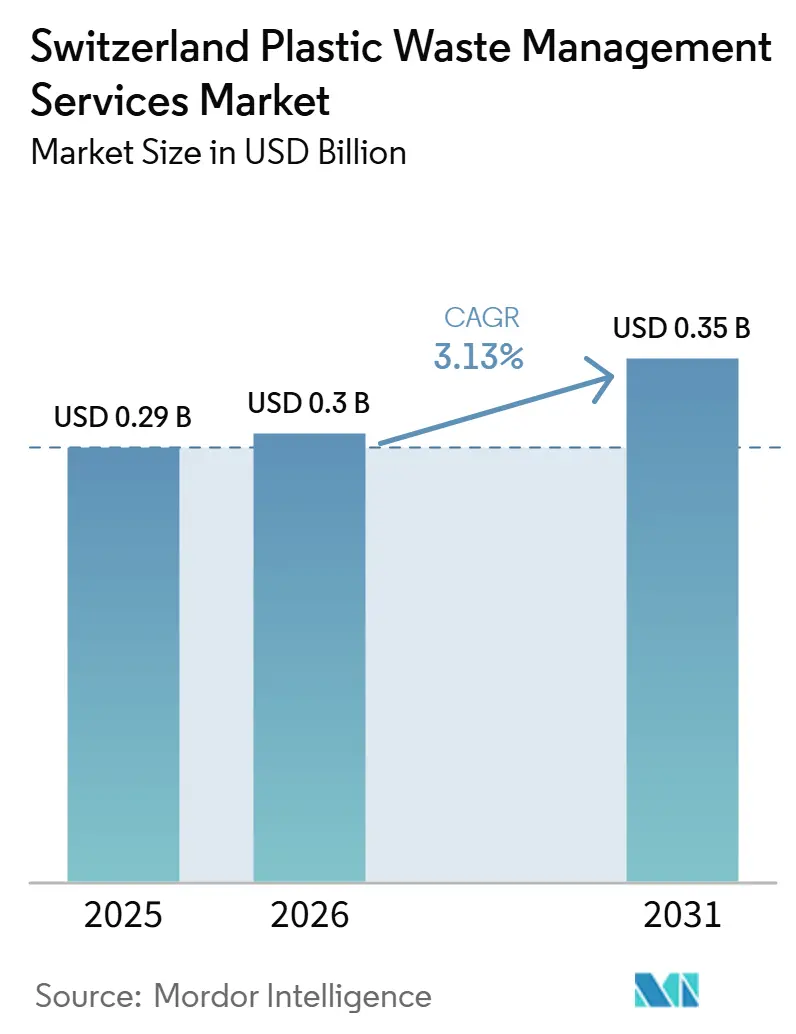
The Switzerland Plastic Waste Management Services Market size is expected to grow from USD 0.29 billion in 2025 to USD 0.3 billion in 2026 and is forecast to reach USD 0.35 billion by 2031 at 3.13% CAGR over 2026-2031.
Switzerland consumed 1 million tons of plastic each year, and only 9% of the resulting 790,000 tons of plastic waste was materially recycled, while 83% was thermally treated in waste incineration plants. The Federal Council adopted the new Packaging Ordinance on 24 June 2026, setting a 55% recycling target for single-use plastic packaging by 2031, with take-back obligations from 2031 and, if targets are missed, the introduction of deposit systems from 2032. The 2024 amendment to the Environmental Protection Act, with most provisions taking effect in 2025, strengthened the legal basis for moving plastic streams away from incineration and toward material recycling. A March 2026 study commissioned by the Swiss Federal Office of Energy found that 330,000 tons of plastics are technically recyclable, and 253,000 tons of that volume is still sent to energy recovery, keeping the Switzerland plastic waste management services market centered on new investment in collection, sorting, and processing. The expansion of household collection systems, growing producer obligations, and stronger demand for quality recycled are also pushing the Switzerland plastic waste management services market toward a more formal and compliance-led structure over the forecast period.
Key Report Takeaways
- By source, industrial held 36.8% of revenue in 2025, while commercial is forecast to expand at a 5.7% CAGR through 2031.
- By service provider, public and municipal operators held 43.9% of the Switzerland plastic waste management services market share in 2025, while private waste management companies recorded the highest projected CAGR at 4.6% through 2031.
- By service type, collection, transportation, sorting, and segregation accounted for 41.8% of the Switzerland plastic waste management services market size in 2025, while disposal and treatment are advancing at a 5.2% CAGR through 2031.
Note: Market size and forecast figures in this report are generated using Mordor Intelligence’s proprietary estimation framework, updated with the latest available data and insights as of January 2026.
Switzerland Plastic Waste Management Services Market Trends and Insights
Drivers Impact Analysis*
| Driver | (~) % Impact on CAGR Forecast | Geographic Relevance | Impact Timeline |
|---|---|---|---|
| Implementation of the New Swiss Packaging Ordinance | +0.8% | National | Long term (≥ 4 years) |
| Expansion of Nationwide Separate Plastic Collection Systems | +0.7% | National, with early gains in urban cantons including Bern, Zürich, and Basel | Medium term (2-4 years) |
| Increasing Demand for High-Quality Recycled Plastic Feedstock | +0.6% | National, with spillover to DACH export markets | Medium term (2-4 years) |
| Strong Municipal Focus on Waste to Resource Optimization | +0.5% | National, with intensity in cantonal capitals | Short term (≤ 2 years) |
| High Per Capita Plastic Consumption Creating Large Recoverable Waste Streams | +0.4% | National | Short term (≤ 2 years) |
| Expansion of Producer and Retail Collaboration for Plastic Recovery | +0.3% | National, with anchor presence in retail-dense urban areas | Medium term (2-4 years) |
| Source: Mordor Intelligence | |||
Implementation of the New Swiss Packaging Ordinance
The new Packaging Ordinance is the strongest policy change in the Switzerland plastic waste management services market in more than 2 decades. It was adopted on 24 June 2026 and entered into force on 1 January 2027, with phased obligations through 2032.[1]Swiss Confederation, “Verordnung vom 24. Juni 2026 über Verpackungen (Verpackungsverordnung, VerpV),” Fedlex, fedlex.admin.ch The ordinance requires 55% recycling of single-use plastic packaging and 70% for beverage cartons by 2031, and introduces take-back obligations from 1 January 2031. Producers and distributors must reduce packaging volume, avoid design choices that block recycling, and either join or fund an industry take-back body. The gap between the current 9% plastic recycling rate and the future 55% target shifts recycling from a voluntary activity to a compliance requirement, raising the value of early collection and sorting capacity.
Expansion of Nationwide Separate Plastic Collection Systems
Separate collection is expanding from a small base, which is improving the operating outlook for the Switzerland plastic waste management services market. Bring Plastic Back connected 2.4 million residents across 600 municipalities in 17 cantons by 2024, while RecyBag reached 1.2 million to 1.4 million households within 6 months of its national launch. More than 9,400 tons of household plastics were collected in 2025, compared with 9,090 tons in 2024. Bern showed how quickly volumes can scale as coverage expands, with recovered plastic rising from 430 tons in 2023 to 1,610 tons in 2025 as the number of participating municipalities increased from 50 to 216. VSPR monitoring shows that 53% of collected material is recycled, which supports better downstream economics as volumes and sorting accuracy improve.[2] Association of Swiss Plastic Recyclers, “Household Plastic,” VSPR, plasticrecycler.ch
Increasing Demand for High-Quality Recycled Plastic Feedstock
Demand for high-quality recyclate exceeds current supply, driving more capital into the Switzerland plastic waste management services market. SATW reported that demand for high-quality recycled materials in Switzerland is materially higher than the available supply. The March 2026 SFOE study also found that 253,000 tons of plastics now used for energy recovery could, in principle, be recycled, with packaging representing the largest identifiable sub-stream. EU Regulation 2025/40 introduced future recycled-content requirements for plastic packaging from 2030, which adds export-related demand pressure on Swiss recyclate producers serving nearby EU markets. This means the current 9% recycling rate acts more as a supply bottleneck than a demand limit, and operators that secure certified feedstock and stable output quality are likely to capture better pricing and longer customer relationships.[3]Swiss Academy of Engineering Sciences, “Plastics Recycling, Technology Outlook,” Swiss Academy of Engineering Sciences, satw.ch
Strong Municipal Focus on Waste-to-Resource Optimization
Municipal authorities remain central to how the Switzerland plastic waste management services market develops, as cantons and municipalities still control waste management on the ground. Switzerland generated 6 million tons of municipal solid waste in 2025 and reached a 52% municipal recycling rate, but plastics continued to lag that broader performance. The revised waste hierarchy now provides cantons with a clearer basis for supporting plastic take-back systems and moving away from fragmented local arrangements. Bern provides the clearest example, with 216 of 335 municipalities in a unified system by 2025, demonstrating how standardization can increase collection scale and private-sector interest. Municipalities that move early on certified concession models are more likely to draw investment into sorting and processing assets because operators can plan around stable volume and route density.
Restraints Impact Analysis*
| Restraint | (~) % Impact on CAGR Forecast | Geographic Relevance | Impact Timeline |
|---|---|---|---|
| Heavy Dependence on Waste-to-Energy Incineration | -0.7% | National, most acute in cantons with KVA operators | Long term (≥ 4 years) |
| Complex Collection Systems Across Cantons and Municipalities | -0.6% | National, with a concentration in rural and peri-urban cantons | Medium term (2-4 years) |
| Strict Quality Requirements for Recycled Plastic Materials | -0.4% | National, with export implications across EU markets | Short term (≤ 2 years) |
| Limited Economies of Scale Due To Small Domestic Market | -0.3% | National | Long term (≥ 4 years) |
| Source: Mordor Intelligence | |||
Heavy Dependence on Waste-to-Energy Incineration
Waste-to-energy remains the largest structural brake on the Switzerland plastic waste management services market. Switzerland’s 29 KVA plants processed 4 million tons of non-recyclable waste in 2024 and generated energy equal to 3% of national energy consumption. For plastics, 83% of the 790,000 tons generated each year is still thermally processed in KVA plants or cement works rather than returned to the material cycle. KVA operators benefit from tipping fees and energy revenues, which keep municipalities tied to the existing incineration model even as recycling priorities are strengthened in law. The legal change is already in place, but long-term contracts and established energy economics mean the shift away from incineration will take time to show up in actual operating flows.
Complex Collection Systems Across Cantons and Municipalities
Fragmentation across cantons and municipalities continues to slow the Switzerland plastic waste management services market even as national programs expand. Switzerland’s 26 cantons still manage waste as a sovereign function, and VSPR documents at least 8 certified household mixed plastic collection operators with different bag formats, accepted materials, and logistics models. Bring Plastic Back and RecyBag are moving toward greater alignment through commercial negotiations, but that process still depends on private agreements rather than a single, mandated national system. The European Environment Agency noted in 2025 that a comprehensive legal framework for a nationwide unified plastic collection system was still under development. These coordination costs keep per-unit collection expenses high, which, in turn, reduces the capital available for the sorting and processing capacity the country now needs.
*Our forecasts treat driver/restraint impacts as directional, not additive. The impact forecasts reflect baseline growth, mix effects, and variable interactions.
Segment Analysis
By Source: Industrial Anchors Revenue, Commercial Channels Drive Future Volume
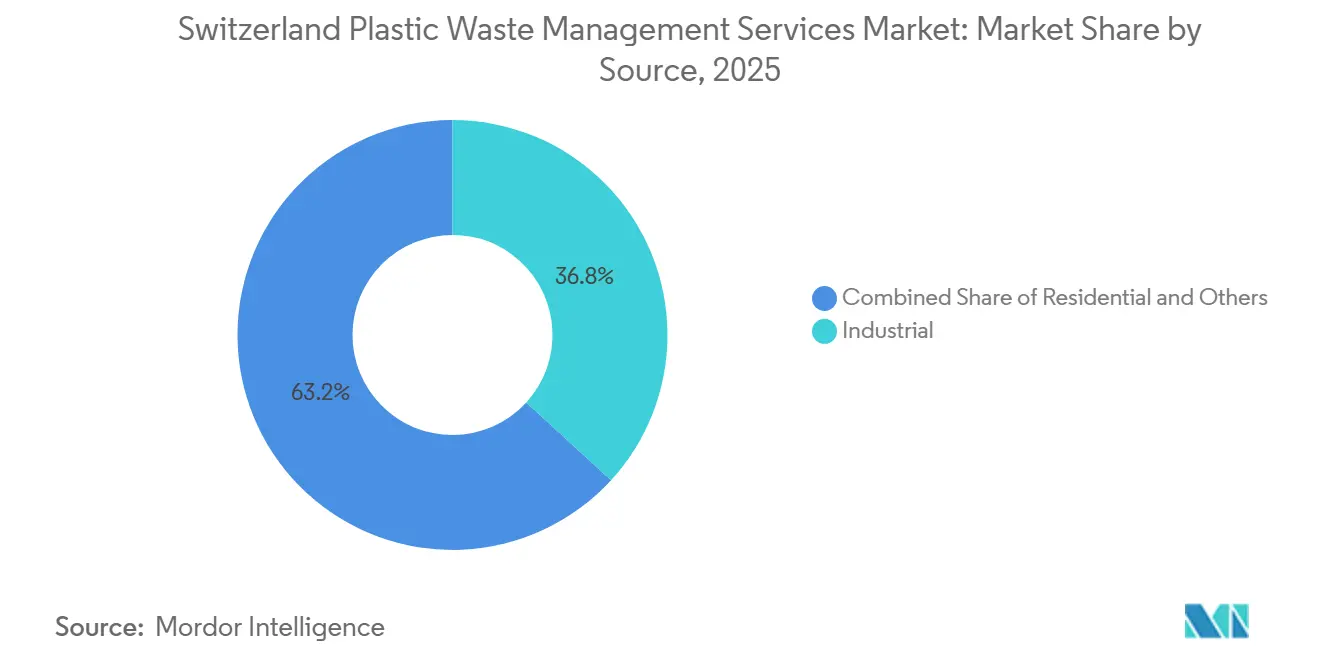
Industrial accounted for 36.8% of the Switzerland plastic waste management services market share in 2025, making it the largest source segment in the report. Industrial generators in manufacturing, logistics, and processing produce more uniform plastic streams, such as production offcuts, mono material film, and post-process scrap. This consistency makes industrial waste more attractive to mechanical recyclers, as it requires less sorting and usually produces higher-quality recyclate. Private waste operators have built dedicated routes around these customers, and multi-year contracts give them a level of volume stability that is harder to secure in residential collection. The others segment, which includes institutional and agricultural plastics, still offers room for expansion. Still, agricultural film remains difficult because soil contamination and low bulk density weaken sorting and transport economics.
Commercial is projected to post the fastest growth in the Switzerland plastic waste management services market, with a 5.7% CAGR from 2026 to 2031. The main reason is that the new ordinance places direct take-back pressure on retailers and manufacturers that place packaged goods into the consumer market. National retail groups involved in RecyBag and RecyPac already have store networks and customer touchpoints that can quickly support higher collection volumes. The March 2026 SFOE study identified packaging as the largest recoverable stream among the 253,000 tons of currently incinerated plastics that could be recycled, which supports the case for commercial packaging-focused investment. Residential collection still matters for long-term scale, but its lower, more mixed volumes mean returns depend more heavily on cantonal participation and standardized downstream infrastructure.



By Service Provider: Public Leadership in Reach, Private Operators in Value Creation
Public and municipal operators accounted for 43.9% of the Switzerland plastic waste management services market share in 2025, reflecting their central control over collection access and household coverage. Swiss law gives cantons a sovereign role in organizing waste disposal, and that keeps public entities at the center of local collection systems. Their scale comes from legal mandate and network reach rather than from faster commercial execution. That position is likely to remain important because municipalities still decide how concession models, local collection points, and public service integration will work in practice. At the same time, public systems often move more slowly because budgets, procurement rules, and political review processes can delay operating changes.
Private waste management companies are expected to deliver the fastest growth in the Switzerland plastic waste management services market, with a 4.6% CAGR through 2031. These companies have invested more heavily in sorting technology, route planning, quality control, and certified output, which matters more as producer obligations become more formal. Producer responsibility organizations are also becoming more important because the ordinance establishes a funding mechanism for take-back duties. However, their growth still depends on broader alignment with the collection system. RecyPac stands out because it combines retail backing with a broad national reach, giving it some of the operating flexibility of a private platform while operating at a near-public scale. That hybrid structure is beginning to blur the lines between waste generator, collection organizer, and waste manager in the Switzerland plastic waste management services market.
By Service Type: Collection Leads Current Revenue, Disposal and Treatment Gains Strategic Weight
Collection, transportation, sorting, and segregation accounted for 41.8% of the Switzerland plastic waste management services market in 2025, making it the largest service type by revenue. This reflects the capital intensity of collection bags, route systems, municipal pickup networks, sorting lines, and baling infrastructure. Operators also need high route density and sorting accuracy to protect margins, as differentiation in this segment is becoming harder to sustain. As collection programs scale across more cantons, logistics efficiency and quality consistency are likely to matter more than simple geographic presence. The segment remains large because every additional tonne collected must still pass through transport and sorting before it can move into recovery.
Disposal and treatment is projected to record the fastest growth, with the Switzerland plastic waste management services market size in this service area advancing at a 5.2% CAGR from 2026 to 2031. The real pull is in recycling and resource recovery, where food-grade rPET, VSPR-certified mechanical recyclate, and chemical recycling outputs command higher value than lower-grade materials. Landfill remains marginal because Switzerland has banned landfilling of combustible waste since 2000. Chemical treatment methods such as pyrolysis, solvolysis, and depolymerization are moving into commercial use through pilot and demonstration facilities, expanding the addressable stream beyond what mechanical recycling alone can handle. Consulting, audit, and training services are also gaining relevance because producers and municipalities now need help with EPR readiness, system certification, and recyclability assessment.

Geography Analysis
Switzerland recorded a 52% municipal recycling rate in 2025, but only 9% of plastic waste was materially recycled, which shows the central gap shaping geographic performance across the country. The country also maintained a zero combustible landfill rate since 2000, which confirms the maturity of its disposal system but also explains why incineration remains deeply embedded. That contrast defines the Switzerland plastic waste management services market at the national level, as the country performs well in overall waste handling but remains weak in plastics-specific circularity. The new Packaging Ordinance applies across all 26 cantons, meaning operators can no longer rely solely on isolated canton-by-canton positions to meet future compliance needs. Switzerland also joined the High Ambition Coalition at the UN plastics treaty talks in Geneva in August 2025, which keeps open the possibility of further regulatory tightening after the current ordinance.
Within the country, collection capability and investment are concentrated in the larger urban cantons. Bern, Zürich, and Basel-Stadt have moved faster because they combine higher population density, stronger municipal budgets, and earlier adoption of organized collection systems. Bern is the clearest example, with 216 of 335 municipalities in a unified Bring Plastic Back system by 2025, and household plastic collection there rose to 1,610 tons from 430 tons in 2023. Rural and peri-urban cantons still lag because lower collection point density and longer transport distances weaken the economics of private recycling. This internal divide matters because the next phase of Switzerland plastic waste management services market growth depends on extending certified systems into municipalities that are less connected, rather than simply adding more volume in cities.
Switzerland’s location in the DACH region also shapes market structure through cross-border trade in processed materials and recycled outputs. Domestic recyclers can move material into Germany and Austria, where larger industrial recycling systems often deliver lower processing costs. At the same time, Basel Convention controls on shipments of mixed plastic waste help limit low-quality inbound flows and support stricter feedstock standards for Swiss operators. Per capita waste generation reached 670 kg in 2024, which is high by European standards and confirms that Switzerland’s small size does not mean a small waste base. Operators that can manage cross-border logistics and EU compliance are likely to be better placed as the Switzerland plastic waste management services market becomes more closely tied to recycled-content demand from nearby European customers.
Competitive Landscape
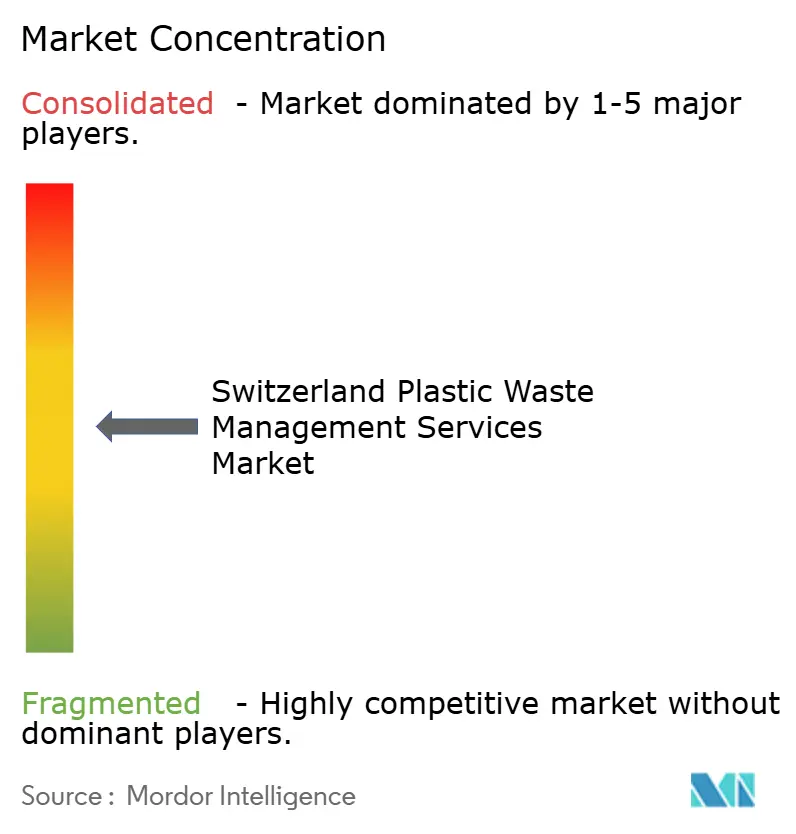
The Switzerland plastic waste management services market remains moderately fragmented, with domestic specialists, municipal operators, global environmental services groups, and chemical recycling entrants all active in different parts of the value chain. No single company controls collection, sorting, and final processing at the national level, leaving room for more vertically integrated models. Competition is strongest in collection and sorting because route density, tracking, and output quality increasingly determine contract strength. VSPR certification and reliable documentation are becoming increasingly important because producers under the new ordinance will need traceable compliance partners rather than only low-cost service providers.
Strategic positioning is now moving in 2 directions. Established operators are trying to secure larger collection footprints through partnerships and system consolidation, while newer players are targeting harder-to-recycle streams through chemical processes. The October 2025 declaration of intent between InnoRecycling and RecyPac is a clear example, as it moved Bring Plastic Back toward integration with the RecyBag platform and pushed collection leadership toward a more unified national model. Veolia’s 2025 modernization of its Frauenfeld PET recycling facility is another example, as it increased food-grade rPET output by 30%, or 6,000 tons per year, in response to stronger demand for packaging-compliant recyclate. The Switzerland plastic waste management services market is also seeing more attention on construction plastics, agricultural films, and mixed streams that older mechanical systems could not process efficiently.
Technology-led competition is becoming more visible, even though commercial scale is still limited. Sulzer launched PyroCon in January 2025 and, in June 2025, formed a joint venture with Sika to target difficult construction plastic waste through combined mechanical and chemical processing. DePoly opened a 500 tonne-per-year demonstration PET depolymerization plant in Monthey in July 2026, after securing commercial contracts ahead of full-scale deployment, demonstrating that the Switzerland plastic waste management services market is starting to convert laboratory capability into operating assets. As compliance pressure rises after 2027, companies that already control certified feedstock, stable municipal access, and scalable processing are likely to have the strongest competitive position.
Switzerland Plastic Waste Management Services Industry Leaders
InnoRecycling AG
Thommen-Furler AG
enespa AG
Syntonex GmbH
Recoplast AG
- *Disclaimer: Major Players sorted in no particular order

Recent Industry Developments
- July 2026: DePoly SA inaugurated its 500-tonne-per-year demonstration PET chemical recycling plant in Monthey, Valais—the first plastic monomer recycling facility in Switzerland. The facility processes unsorted, contaminated PET and polyester waste, including textiles, to produce virgin-grade monomers. Before its opening, the company had secured CHF 50 million (USD 60.2 million) in commercial contracts. DePoly plans to announce the location of a 50,000-tonne-per-year commercial-scale plant in the first half of 2027, representing a decisive step toward large-scale PET chemical recycling in Switzerland.
- June 2026: The Swiss Federal Council adopted the new Packaging Ordinance (VerpV), entering into force on 1 January 2027. The ordinance mandates minimum recycling rates of 55% for single-use plastic packaging and 70% for beverage cartons by 2031, introduces take-back obligations beginning January 2031, and enables mandatory deposit systems from 2032 if targets are not met. This is the most comprehensive packaging legislation in Switzerland's history (Fedlex, 2026).
- April 2025: DePoly secured USD 23 million in seed funding through a second closing led by MassMutual Ventures, with participation from Zürcher Kantonalbank, BASF Venture Capital, Beiersdorf Venture Capital, and Syensqo. Total financing across rounds exceeded USD 30 million, making DePoly one of the best-capitalized chemical recycling startups in Europe.
- October 2025: InnoRecycling AG and RecyPac signed a declaration of intent (MOU) integrating the "Bring Plastic Back" collection system into RecyPac's national RecyBag platform ahead of the incoming Packaging Ordinance. InnoWay is committed to refocusing its resources on sorting and processing operations; RecyPac assumed leadership of the collection system, advancing the consolidation of Switzerland's fragmented household plastic collection landscape.


Switzerland Plastic Waste Management Services Market Report Scope
The Switzerland Plastic Waste Management Services Market Report is Segmented by Source (Residential, Commercial, Industrial, and Others), by Service Provider (Public/Municipal, Private Waste Management Companies, and Others), by Service Type (Collection, Transportation, Sorting & Segregation, Disposal / Treatment, and Others). The Market Forecasts are Provided in Terms of Value (USD).
| Residential |
| Commercial (Retail, Office, etc.) |
| Industrial |
| Others (institutional, Agricultural, etc) |
| Public/Municipal |
| Private Waste Management Companies |
| Others - Producer Responsibility Organizations (PROs), etc. |
| Collection, Transportation, Sorting & Segregation | |
| Disposal / Treatment | Landfill |
| Recycling & Resource Recovery | |
| Incineration & Waste-to-Energy | |
| Others (Chemical Treatment, etc.) | |
| Others (Consulting, Audit & Training, etc.) |
| By Source | Residential | |
| Commercial (Retail, Office, etc.) | ||
| Industrial | ||
| Others (institutional, Agricultural, etc) | ||
| By Service Provider | Public/Municipal | |
| Private Waste Management Companies | ||
| Others - Producer Responsibility Organizations (PROs), etc. | ||
| By Service Type | Collection, Transportation, Sorting & Segregation | |
| Disposal / Treatment | Landfill | |
| Recycling & Resource Recovery | ||
| Incineration & Waste-to-Energy | ||
| Others (Chemical Treatment, etc.) | ||
| Others (Consulting, Audit & Training, etc.) | ||


Key Questions Answered in the Report
How large is the Swiss plastic waste management sector expected to become by 2031?
The sector is projected to grow from USD 0.29 billion in 2025 to USD 0.35 billion by 2031, at a CAGR of 3.1% from 2026 to 2031.
Why is Switzerland still seen as underperforming in plastics recycling?
Switzerland had a 52% municipal recycling rate in 2025, but only 9% of plastic waste was materially recycled, while 83% was still thermally treated.
Which source segment leads revenue, and which one is growing fastest?
Industrial led with 36.8% share in 2025 because of cleaner and more uniform plastic streams, while commercial is forecast to grow fastest at a 5.7% CAGR through 2031.
Which service area offers the strongest future opportunity?
Disposal and treatment are forecast to grow fastest at a 5.2% CAGR, mainly because recycling and resource recovery activities are gaining more policy and commercial support.
How competitive is the Swiss market today?
The market is moderately fragmented, with no single operator controlling the full value chain, and competition is rising around collection reach, certified sorting quality, and chemical recycling capability.
Page last updated on:





