
Swiss Watch Market Size and Share
Market Overview
| Study Period | 2021 - 2031 |
|---|---|
| Market Size (2026) | USD 56.78 Billion |
| Market Size (2031) | USD 67.73 Billion |
| Growth Rate (2026 - 2031) | 3.59 % |
| Fastest Growing Market | Asia-Pacific |
| Largest Market | Asia-Pacific |
| Market Concentration | Medium |
Major Players
*Disclaimer: Major Players sorted in no particular order Image © Mordor Intelligence. Reuse requires attribution under CC BY 4.0. |
|
Swiss Watch Market Analysis by Mordor Intelligence
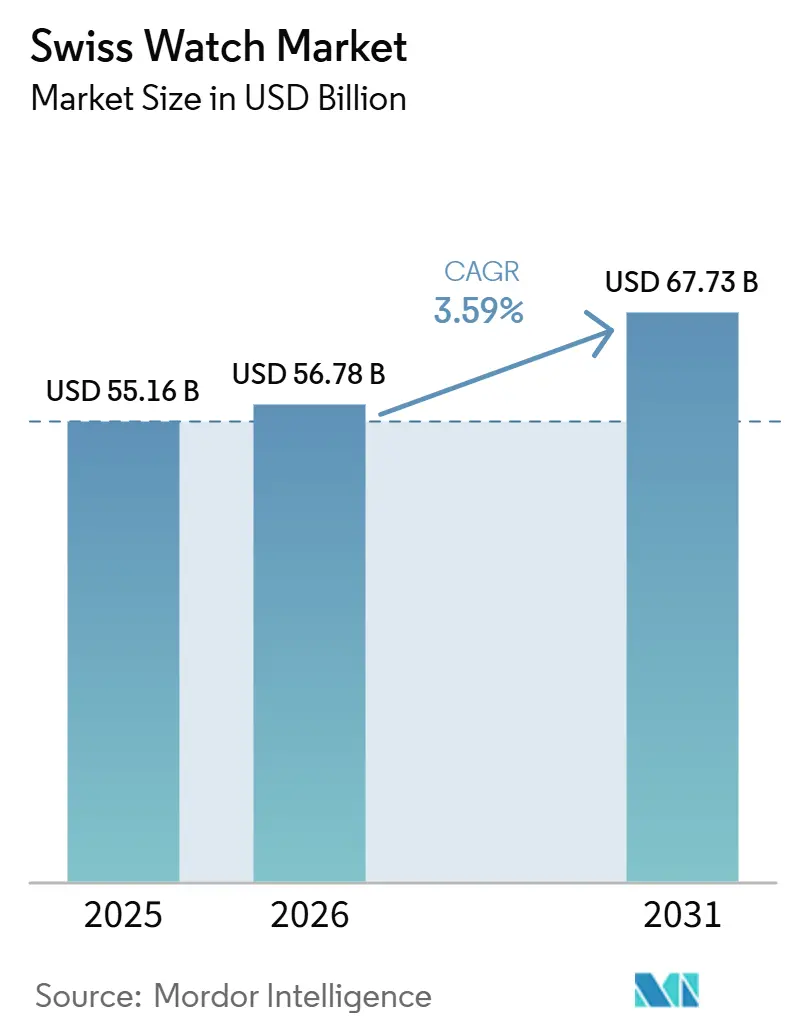
The Swiss watch market is projected to grow from USD 55.16 billion in 2025 to USD 56.78 billion in 2026 and reach USD 67.73 billion by 2031, registering a CAGR of 3.59% during 2026–2031. Growth is supported by sustained demand for luxury and premium timepieces, particularly among high-income consumers and collectors. The market is also benefiting from increasing interest in Swiss craftsmanship, brand heritage, and limited-edition watches. In addition, rising demand from emerging markets and the expansion of luxury retail and e-commerce channels are creating new growth opportunities. Product innovation, including smart features and modern materials, is further helping traditional Swiss watchmakers attract younger consumers.
Key Report Takeaways
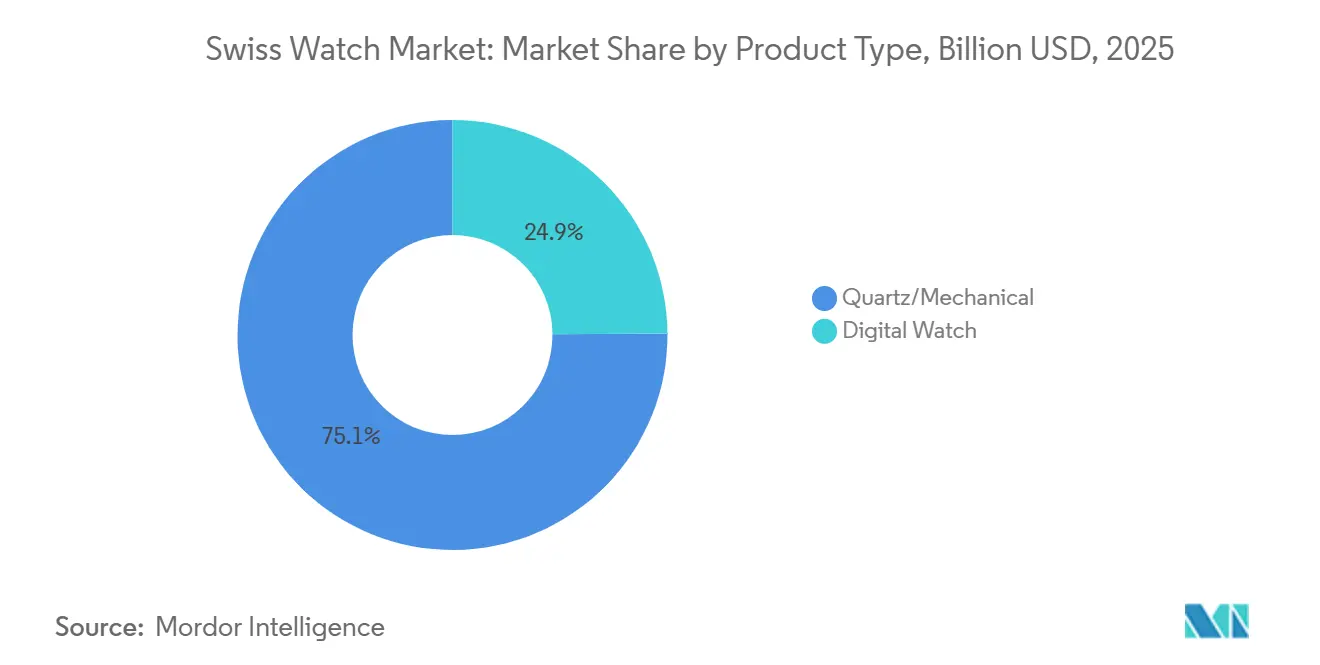
- By product type, quartz and mechanical watches held 75.12% of the Swiss watch market share in 2025, while digital watches are forecast to grow at a 5.24% CAGR through 2031.
- By category, mass watches accounted for 68.45% of the Swiss watch market share in 2025, while premium watches are expected to grow at a 5.53% CAGR through 2031.
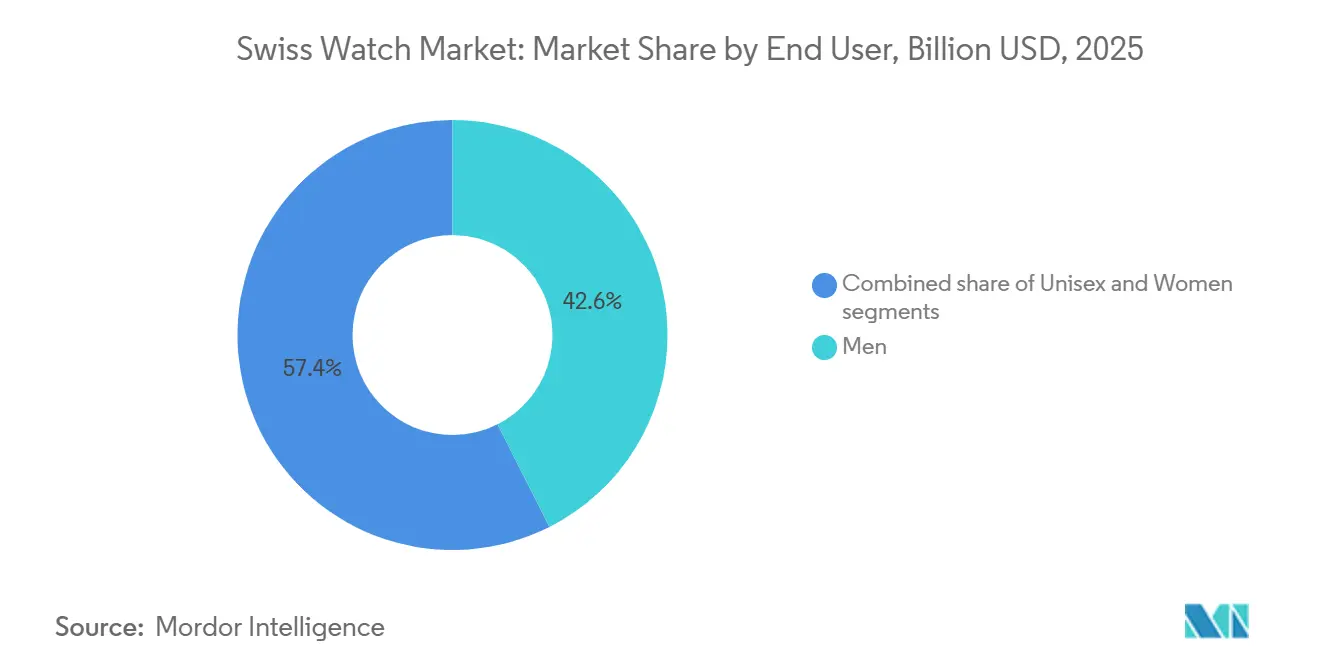
- By end user, men held 42.56% share in 2025, while unisex watches are forecast to expand at a 4.89% CAGR through 2031.
- By distribution channel, specialty stores accounted for 58.51% share in 2025, while online retail stores are projected to advance at a 6.03% CAGR through 2031.
- By geography, Asia-Pacific held 35.25% share in 2025 and is forecast to grow at a 5.1% CAGR through 2031.
Note: Market size and forecast figures in this report are generated using Mordor Intelligence’s proprietary estimation framework, updated with the latest available data and insights as of January 2026.
Market Trends and Insights
Drivers Impact Analysis of Swiss Watch Market*
| Driver | (~) % Impact on CAGR Forecast | Geographic Relevance | Impact Timeline |
|---|---|---|---|
| Growing demand for luxury and premium watches | +1.2% | Global, concentrated in North America, Europe, and Asia-Pacific | Medium term (2-4 years) |
| Growing collector interest in limited-edition watches | +0.5% | Global, led by North America and Europe | Long term (≥ 4 years) |
| Growth of high-net-worth individuals and affluent consumers | +0.8% | Asia-Pacific, particularly India and Singapore, with spillover to the Middle East and Africa | Long term (≥ 4 years) |
| Rising demand for mechanical and automatic watches | +0.6% | Global, strongest in North America and Europe | Medium term (2-4 years) |
| Increasing tourism and duty-free luxury shopping | +0.3% | Europe, Asia-Pacific, and the Middle East and Africa | Short term (≤ 2 years) |
| Strong brand equity and product innovation by Swiss watchmakers | +0.4% | Global | Long term (≥ 4 years) |
| Source: Mordor Intelligence | |||
Growing demand for luxury and premium watches
The Swiss watch market continued to shift toward premium products and lower unit volumes. According to the supplied industry material, watches retailing above CHF 50,000 accounted for 37.3% of Swiss export value in 2025, up from 33.5% in 2024. Products in this price range also generated 89% of export value growth in 2025, despite representing only 1.4% of units shipped[1]Federation of the Swiss Watch Industry FH, "Swiss watch exports in the first half of 2026", fhs.swiss. This trend favored companies that maintained brand scarcity, managed allocation carefully, and clearly justified higher price points through exclusivity, craftsmanship, and brand equity. It also increased pressure at the lower end of the Swiss watch market, as the supplied draft indicated that watches priced below CHF 500 recorded a 4% decline in unit sales in 2025. Brands positioned between entry-level products and established luxury names had to strengthen and differentiate their product offerings to avoid losing buyers to both lower-priced alternatives and higher-end luxury brands.
Growing collector interest in limited-edition watches
The growing interest in limited-edition and exclusive timepieces is strengthening demand within the Swiss watch market, as collectors increasingly value rarity, craftsmanship, heritage, and investment potential. Luxury watch brands are responding by launching restricted-production models, special collaborations, anniversary editions, and unique pieces that create exclusivity and encourage collectors to purchase quickly. For example, brands such as Rolex, Patek Philippe, Audemars Piguet, and Omega regularly attract strong interest for limited-production models and special releases. The scarcity of these watches can increase their desirability in the secondary market, where certain models may command substantial premiums over their original retail prices. Growing online collector communities, specialist auctions, and social media platforms are also improving access to information about rare models and increasing collector engagement.
Growth of high-net-worth individuals and affluent consumers
The concentration of wealth among high-net-worth individuals (HNWIs) is strengthening demand for luxury Swiss watches as high-value collectibles, status symbols, and alternative investments. The United States represents the largest concentration of affluent consumers globally, with 22.7 million individuals having a net worth exceeding USD 1 million in 2025, according to World Population Review[2]Source: World Population Review, “High Net Worth Individuals by Country”, worldpopulationreview.com. This large consumer base provides a substantial market for premium brands such as Rolex, Patek Philippe, and Audemars Piguet, whose watches are often associated with exclusivity, craftsmanship, and long-term value retention. Rising wealth among affluent consumers also increases their capacity to purchase high-priced limited-edition and collectible timepieces. In addition, the growing use of luxury watches as alternative assets is encouraging repeat purchases and strengthening collector demand.
Increasing tourism and duty-free luxury shopping
The expansion of international tourism is increasing opportunities for Swiss watch purchases through luxury retail and duty-free shopping channels. Swiss tourism reached a record level in 2025, with 43.9 million overnight stays, representing a 2.6% increase from 2024, while foreign visitors accounted for 22.8 million overnight stays, up 3.7% year-on-year[3]Source: State Secretariat for Economic Affairs, ““Tourism: record overnight stays in 2025”, SBA.gov. The rising flow of international tourists expands the potential customer base for premium and luxury timepieces purchased during travel. Visitors often seek authentic Swiss watches as souvenirs, status products, and high-value purchases, particularly in major tourist destinations and shopping hubs. Duty-free and tax-refund shopping further enhances the attractiveness of purchasing luxury watches by reducing the effective purchase cost for eligible international travelers.
Restraints Impact Analysis of Swiss Watch Market*
| Restraint | (~) % Impact on CAGR Forecast | Geographic Relevance | Impact Timeline |
|---|---|---|---|
| High retail prices limiting mass-market affordability | -0.5% | Global, strongest in emerging Asia-Pacific and South America | Medium term (2-4 years) |
| Economic uncertainty and volatile luxury spending | -0.8% | Global, concentrated in China, Germany, and Japan | Short term (≤ 2 years) |
| Shortage of skilled watchmaking professionals | -0.4% | Switzerland, with strain in Vallée de Joux, Le Brassus, and La Chaux-de-Fonds | Long term (≥ 4 years) |
| High costs of raw materials and precious metals | -0.6% | Global | Medium term (2-4 years) |
| Source: Mordor Intelligence | |||
High retail prices limiting mass-market affordability
The high retail prices of Swiss watches limit their affordability for mass-market consumers and restrict the potential customer base to relatively affluent buyers. Swiss watches often involve premium materials, intricate mechanical movements, skilled craftsmanship, brand heritage, and substantial research and development costs, which contribute to higher retail prices. This pricing structure makes luxury Swiss timepieces less accessible to middle-income consumers, particularly during periods of inflation or economic uncertainty. As a result, consumers may postpone purchases, choose lower-priced alternatives, or opt for fashion watches and smartwatches that offer greater affordability. The high price gap between Swiss luxury watches and mass-market timepieces therefore limits volume expansion and reduces penetration in price-sensitive consumer segments.
Economic uncertainty and volatile luxury spending
Economic uncertainty and volatility in luxury spending can limit demand for Swiss watches, as consumers tend to postpone or reduce discretionary purchases during periods of inflation, slower economic growth, geopolitical instability, or financial market volatility. Although high-income consumers are generally more resilient, uncertainty can still encourage them to delay major luxury purchases or prioritize wealth preservation over non-essential spending. This can affect sales of high-priced timepieces, particularly in markets dependent on international luxury consumption. Fluctuations in consumer confidence and exchange rates can further influence purchasing decisions and make luxury watches more expensive for international buyers. Consequently, periods of economic uncertainty can create volatility in demand, increase sales fluctuations, and make growth less predictable for Swiss watch brands and retailers.
*Our forecasts treat driver/restraint impacts as directional, not additive. The impact forecasts reflect baseline growth, mix effects, and variable interactions.
Swiss Watch Market Segment Analysis
By Product Type:
Mechanical Watches Lead While Digital Watches Grow FasterQuartz and Mechanical Watches held 75.12% of the Swiss watch market share in 2025. Their position reflects the importance of traditional craftsmanship, established repair networks, and the Swiss Made label. Controlled production in the luxury segment supports demand for mechanical models. Export data is also expected to indicate stronger volumes for mechanical watches in the CHF 200 to CHF 500 range in the first half of 2026. This trend creates opportunities for brands that offer credible entry points into mechanical watch ownership. Buyers in this range may transition to higher-value collections as they become more familiar with Swiss watchmaking. However, brands must protect quality and service standards, as a low entry price alone cannot build lasting loyalty. A well-supported mechanical product can also introduce customers to maintenance and resale practices that distinguish traditional watches from disposable electronics.
Digital Watches are forecast to register a CAGR of 5.24% through 2031, the highest growth rate within the product-type segmentation. Smart Watches benefit from health features, connectivity, and partnerships that link watches with sports and lifestyle activities. The supplied material identifies TAG Heuer's Connected Calibre E5 as an example of a Swiss brand moving toward proprietary software. Other digital formats, including hybrid and jump-hour displays, appeal to buyers seeking distinctive designs at more accessible prices. The Swiss watch market can use connected products to attract younger buyers while maintaining a clear distinction between digital convenience and traditional mechanical watchmaking.


By Category:
Mass Watches Sustain Volume While Premium Watches Drive GrowthMass watches commanded 68.45% of the Swiss watch market size in 2025. They support broad unit volumes and introduce more consumers to Swiss brands. However, affordable smartwatches continue to pressure products at the lower end of the category. Consumers seeking a visible luxury signal may also shift their spending toward premium watches. As a result, mass brands depend on clear product differentiation, selective pricing, and expansion in newer consumer markets. Their collections need recognizable designs and dependable quality without relying on luxury price points. Retail partners also need products that attract new buyers while protecting margins. These conditions make the category important for brand visibility, even though its ability to generate value remains more limited than that of the premium tier.
Premium watches are expected to record a 5.53% CAGR through 2031, making them the fastest-growing category. Strong demand for higher-priced models, limited-edition collections, and brand-controlled distribution supports this growth as affluent buyers continue to prioritize exclusivity and long-term brand value. Heritage, limited supply, and controlled access remain important sources of competitiveness in this category. India, Mexico, and parts of Southeast Asia offer opportunities where Swiss heritage continues to appeal to newly affluent consumers. The Swiss watch industry is more likely to generate value from premium pricing than from broad expansion in mass-volume production.
By End User:
Men Remain the Largest Buyer Group While Unisex Watches ExpandMen accounted for 42.56% of sales in 2025, making them the largest end-user group. This consumer base remains important for sports watches, technical complications, and collector-oriented mechanical products. Product design, brand heritage, and specialist retail relationships continue to support demand in this segment. However, heavy reliance on male collectors can expose brands to shifts in mature markets. Companies that retain their technical appeal while broadening their design language can reach new buyers more effectively. This opportunity is particularly relevant for watches positioned between jewelry and technical accessories. Brands need to communicate both the design value and functional attributes of each collection. They can build a broader audience without altering the historical foundations on which established brands depend.
Unisex watches are forecast to register a CAGR of 4.89% through 2031, the fastest growth rate in the end-user segmentation. The supplied material links this growth to gender-inclusive designs and increased interest from female buyers and Gen Z consumers. Brands are adapting complications, case sizes, and styling to appeal beyond traditional gender categories. Jewelry-oriented designs also help attract customers who may not have previously considered a technical timepiece. This shift gives the Swiss watch market an opportunity to expand demand while maintaining its association with craftsmanship and heritage.

By Distribution Channel:
Specialty Stores Hold the Lead While Online Retail Builds ReachSpecialty stores accounted for 58.51% of the Swiss watch market size in 2025. They remain important because buyers often value personal advice, product demonstrations, repair support, and access to limited-edition models. This channel is especially relevant for higher-priced mechanical watches, where trust influences purchase decisions. Multi-brand stores continue to offer buyers comparison opportunities, although many major maisons are seeking tighter control over retail access. Specialty stores will remain central in locations where personal service and established local relationships drive conversions. Store staff help buyers understand materials, movements, sizing, and care requirements before they make an expensive purchase. This hands-on support also remains valuable when consumers compare a new watch with a certified pre-owned alternative.
Online retail stores are forecast to record a 6.03% CAGR through 2031, the highest rate among distribution channels. Branded websites, certified pre-owned services, and online launches allow companies to reach customers beyond traditional store networks. Digital selling also gives brands more information about customer preferences and buying behavior. The supplied draft described a gap between consumer interest in multi-brand retailers and manufacturers' plans to open more mono-brand locations. The Swiss watch market is likely to use online selling most effectively when it complements service, authentication, and after-sales care rather than replacing them.
Geography Analysis
APAC Swiss Watch Market
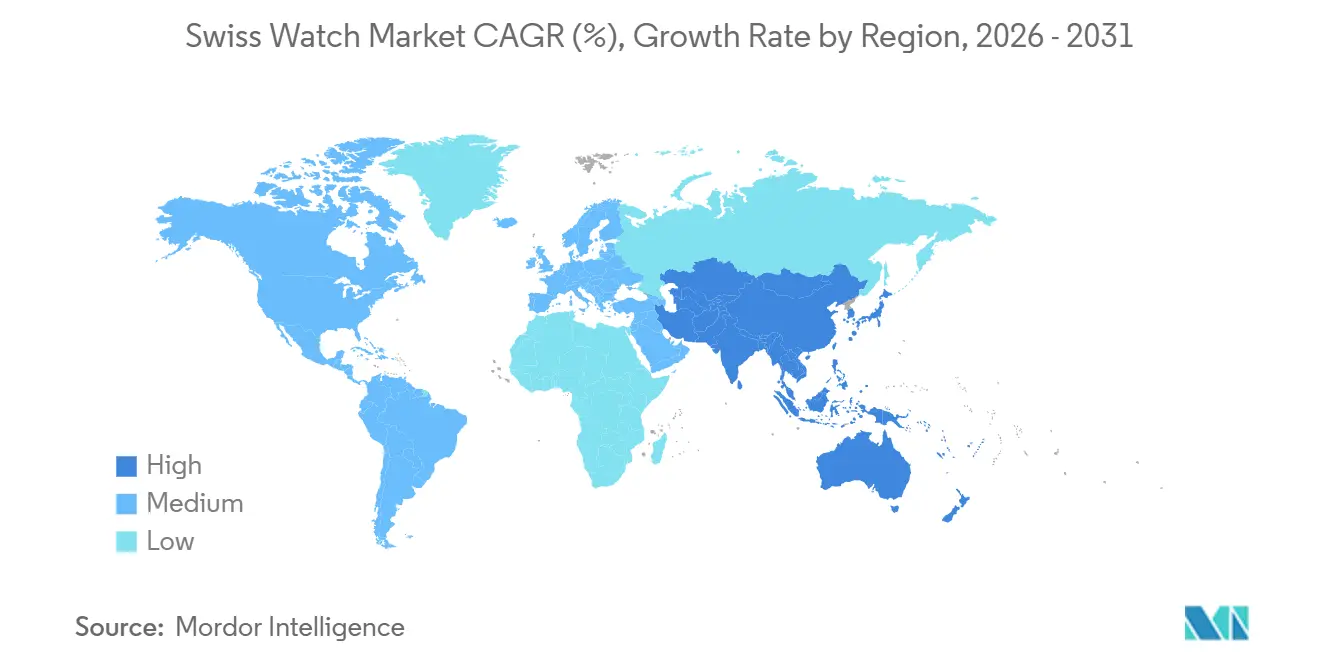
Asia-Pacific held the largest share of the Swiss watch market, accounting for 35.25% of the market in 2025. The region’s dominance is supported by rising disposable incomes, expanding affluent and middle-class consumer populations, and strong demand for luxury and premium watches. China, Japan, India, South Korea, and Southeast Asian markets are contributing to regional growth through increasing interest in Swiss luxury brands and high-end timepieces. The expansion of organized retail, luxury shopping malls, e-commerce platforms, and travel retail is also improving access to Swiss watches across the region. Asia-Pacific is also expected to remain the fastest-growing regional market, expanding at a CAGR of 5.11% through 2031.
North America and Europe Swiss Watch Market
North America remains strategically important because the United States has been the principal Swiss watch export destination since 2021. The supplied material reported CHF 4.4 billion in U.S.-bound exports during 2024 and described resilient underlying demand through early 2026. Trade patterns were distorted by shipments moved ahead of the U.S. tariff, so short-term changes must be interpreted carefully. Mexico registered a 27% rise in exports in the first 4 months of 2026. Europe benefits from its proximity to Switzerland and its deep-rooted watchmaking heritage, while countries such as France, Germany, Italy, and the United Kingdom remain important luxury consumption centers.
MEA and South America Swiss Watch Market
The Middle East and Africa and South America represent emerging markets with significant long-term growth potential for Swiss watch manufacturers. In the Middle East, high disposable incomes, luxury tourism, premium retail development, and strong demand for prestigious brands support the adoption of Swiss watches, particularly in Gulf countries. Africa is gradually gaining importance as urbanization, rising incomes, and the expansion of organized retail create new opportunities for premium timepieces. In South America, Brazil, Mexico, Argentina, and other markets are witnessing growing interest in luxury products as affluent consumer segments expand.

Competitive Landscape
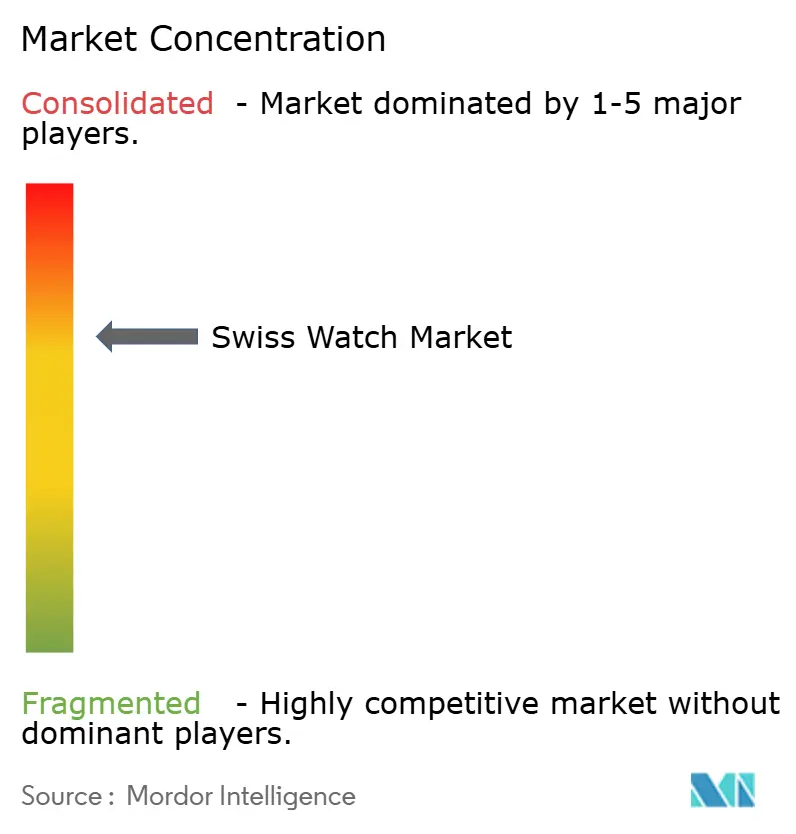
The Swiss watch market is consolidated, with a limited number of leading companies accounting for a significant share of the global market. Major players such as Rolex, The Swatch Group, Richemont, and Patek Philippe benefit from strong brand equity, extensive global distribution networks, and long-established watchmaking expertise. Companies such as Rolex and Patek Philippe have built significant competitive advantages through heritage, craftsmanship, exclusivity, and strong customer loyalty. The Swatch Group also maintains a broad market presence through brands covering multiple price segments, including Omega, Longines, Tissot, and Swatch. These established companies create substantial barriers to entry through brand recognition, technical expertise, retail relationships, and high marketing investments.
Competition among leading companies is primarily based on brand prestige, craftsmanship, product innovation, design, exclusivity, and technological capabilities. For example, Rolex focuses strongly on luxury positioning, technical performance, and limited availability, while Patek Philippe emphasizes high-end craftsmanship and collector appeal. The Swatch Group competes across multiple consumer segments through brands such as Omega, Longines, and Tissot, allowing it to serve different price categories. Richemont strengthens its market position through luxury watch brands such as Cartier, Jaeger-LeCoultre, and IWC Schaffhausen.
Despite the consolidated market structure, competition is intensifying as established players pursue growth in emerging markets and respond to evolving consumer preferences. Companies such as Rolex, Omega, Cartier, and TAG Heuer continue to expand their presence in Asia-Pacific and other high-growth markets through boutiques, authorized retailers, and digital engagement. At the same time, brands such as TAG Heuer and Omega are incorporating advanced materials, technical innovations, and selected connected features to appeal to younger consumers. Sustainability and responsible sourcing are also becoming increasingly important, with leading companies focusing on supply-chain transparency, material innovation, and responsible production practices.
Swiss Watch Industry Leaders
-
Rolex SA
-
The Swatch Group AG
-
LVMH Moët Hennessy Louis Vuitton SE
-
Compagnie Financière Richemont SA
-
Patek Philippe SA
- *Disclaimer: Major Players sorted in no particular order
Swiss Watch Market Companies Covered in this Report
- Rolex SA
- The Swatch Group AG
- Compagnie Financière Richemont SA
- LVMH Moët Hennessy Louis Vuitton SE
- Patek Philippe SA
- Audemars Piguet Holding SA
- Breitling SA
- Chopard & Cie SA
- Richard Mille SA
- Fossil Group, Inc.
- Citizen Watch Co., Ltd.
- Seiko Group Corporation
- Movado Group, Inc.
- Kering SA
- Hermès International SCA
- Franck Muller Group
- Raymond Weil SA
- Victorinox AG
- Ronda AG
- Titoni Ltd.

Recent Industry Developments in Swiss Watch Market
- July 2026: Swatch Group launched the Mission to the Moon 1969 MoonSwatch, featuring 18-karat Omega Moonshine Gold. The company used an algorithmic Electronic Swatch Timepiece Application process and limited distribution to 1,969 selected buyers through a 32-question lottery application form.
- July 2026: Vam Investments formally launched Groupe Chaumont, a new industrial platform headquartered in Neuchâtel, through the simultaneous acquisition of four Swiss watchmaking specialists: Efteor, Télôs Watch, Le Composant, and Henri Robert. The platform focused on producing movements, cases, tools, and components for high-end Swiss watch brands. It also planned further specialist acquisitions, establishing a new vertically integrated supply alternative to in-house manufacturing at major groups.
- June 2026: TAG Heuer, in partnership with TaylorMade Golf, released the Connected Calibre E5 x TaylorMade limited-edition smartwatch, which integrated strokes-gained data and course analytics for golfers. The collection targeted affluent sports enthusiasts and expanded TAG Heuer's licensed lifestyle collaboration portfolio, which was expected to begin with its Formula 1 title sponsorship in 2025.


Global Swiss Watch Market Report Scope
A watch is a portable timepiece intended to be carried or worn by a person. The switch market is segmented by product type, category, end user, distribution channel and geography. By product type, the market is segmented into quartz watches and digital watches. By category, the market is segmented into mass and premium. By end user, the market is segmented into women, men, and unisex. By distribution channel, the market is segmented into supermarkets/hypermarkets, specialty stores, online retail stores and other distribution channels. The market is segmented by geography into North America, Europe, Asia-Pacific, South America, and the Middle East and Africa. The market sizing has been done in value terms in USD for all the above mentioned segments.
| Quartz/Mechanical | |
| Digital Watch | Smart Watches |
| Other Digital Types |
| Mass |
| Premium |
| Men |
| Women |
| Unisex |
| Supermarkets/Hypermarkets |
| Specialty Stores |
| Online Retail Stores |
| Other Distribution Channels |
| North America | United States |
| Canada | |
| Mexico | |
| Rest of North America | |
| Europe | Germany |
| United Kingdom | |
| Italy | |
| France | |
| Spain | |
| Netherlands | |
| Poland | |
| Belgium | |
| Sweden | |
| Rest of Europe | |
| Asia-Pacific | China |
| India | |
| Japan | |
| Australia | |
| Indonesia | |
| South Korea | |
| Thailand | |
| Singapore | |
| Rest of Asia-Pacific | |
| South America | Brazil |
| Argentina | |
| Colombia | |
| Chile | |
| Peru | |
| Rest of South America | |
| Middle East and Africa | South Africa |
| Saudi Arabia | |
| United Arab Emirates | |
| Nigeria | |
| Egypt | |
| Morocco | |
| Turkey | |
| Rest of Middle East and Africa |
| By Product Type | Quartz/Mechanical | |
| Digital Watch | Smart Watches | |
| Other Digital Types | ||
| By Category | Mass | |
| Premium | ||
| By End User | Men | |
| Women | ||
| Unisex | ||
| By Distribution Channel | Supermarkets/Hypermarkets | |
| Specialty Stores | ||
| Online Retail Stores | ||
| Other Distribution Channels | ||
| By Geography | North America | United States |
| Canada | ||
| Mexico | ||
| Rest of North America | ||
| Europe | Germany | |
| United Kingdom | ||
| Italy | ||
| France | ||
| Spain | ||
| Netherlands | ||
| Poland | ||
| Belgium | ||
| Sweden | ||
| Rest of Europe | ||
| Asia-Pacific | China | |
| India | ||
| Japan | ||
| Australia | ||
| Indonesia | ||
| South Korea | ||
| Thailand | ||
| Singapore | ||
| Rest of Asia-Pacific | ||
| South America | Brazil | |
| Argentina | ||
| Colombia | ||
| Chile | ||
| Peru | ||
| Rest of South America | ||
| Middle East and Africa | South Africa | |
| Saudi Arabia | ||
| United Arab Emirates | ||
| Nigeria | ||
| Egypt | ||
| Morocco | ||
| Turkey | ||
| Rest of Middle East and Africa | ||


Key Questions Answered in the Report
What is the forecast for Swiss watches through 2031?
The Swiss watch market is forecast to reach USD 67.73 billion by 2031, expanding at a 3.59% CAGR from 2026.
Which Swiss watch product type is growing the fastest?
Digital Watches are forecast to grow at a 5.24% CAGR through 2031, supported by connected functions and lifestyle partnerships.
Which region leads demand for Swiss watches?
Asia-Pacific held 35.25% share in 2025 and is projected to grow at a 5.11% CAGR through 2031.
How important are online sales for Swiss watch brands?
Online Retail Stores are forecast to grow at a 6.03% CAGR through 2031, led by brand websites and certified pre-owned platforms.
Page last updated on:





