
Sulfur Pastilles Market Size and Share
Market Overview
| Study Period | 2022 - 2032 |
|---|---|
| Market Size (2027) | USD 1.74 Billion |
| Market Size (2032) | USD 2.13 Billion |
| Growth Rate (2027 - 2032) | 4.13 % |
| Fastest Growing Market | Asia-Pacific |
| Largest Market | Asia-Pacific |
| Market Concentration | Low |
Major Players *Disclaimer: Major Players sorted in no particular order Image © Mordor Intelligence. Reuse requires attribution under CC BY 4.0. | |
Sulfur Pastilles Market Analysis by Mordor Intelligence
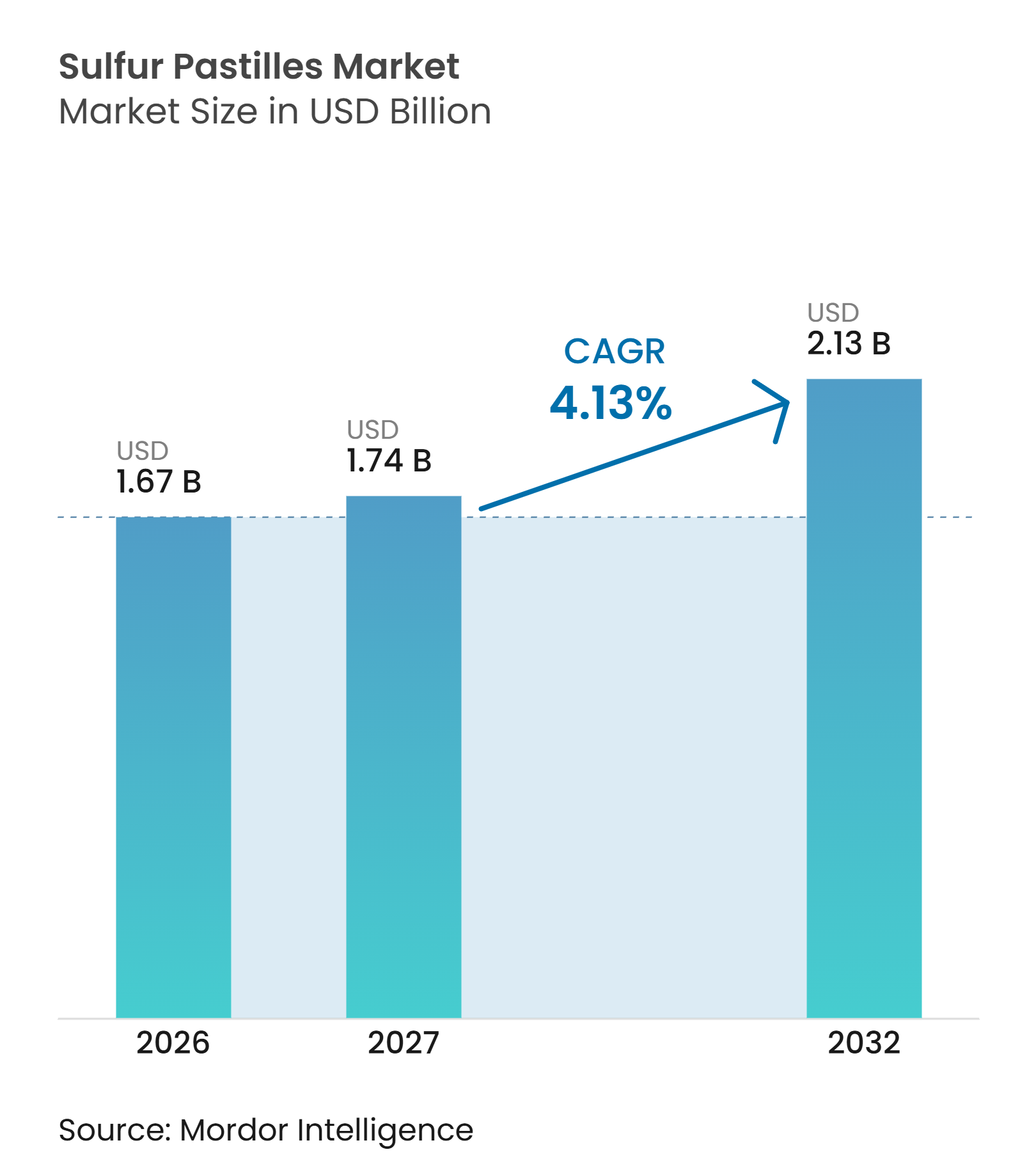
The sulfur pastilles market size was valued at USD 1.67 billion in 2026 and is estimated to grow from USD 1.74 billion in 2027 to USD 2.13 billion by 2032, at a CAGR of 4.13% during the forecast period (2027-2032). The sulfur pastilles market serves the needs of agricultural soil nutrition and industrial feedstocks. Solid pastilles are gaining preference over liquid and powdered sulfur because they can be transported in standard containers without requiring heated transport equipment. This improves access to inland agricultural markets in South and Southeast Asia. Reduced atmospheric sulfur deposition has increased the importance of sulfur in intensive oilseed, pulse, and cereal production systems. Supply conditions remain significant, as recovered sulfur from refinery and gas-processing operations is the primary feedstock for producers.
Key Report Takeaways
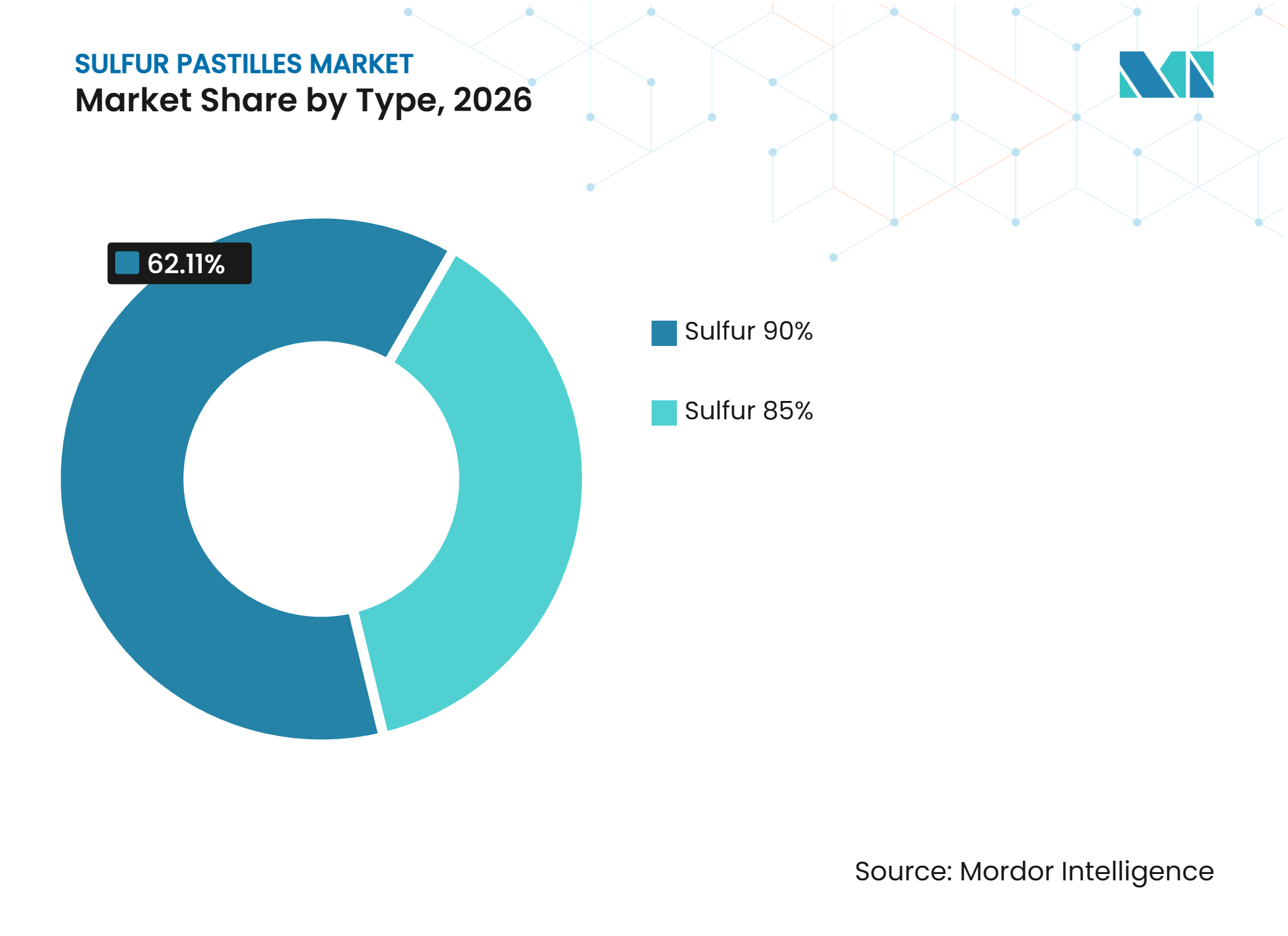
- By type, Sulfur 90% held 62.11% of the sulfur pastilles market share in 2026, while the same segment is forecast to grow at a 4.67% CAGR through 2032.
- By manufacturing process, Prilling/Pelletizing held 53.07% of the sulfur pastilles market share in 2026, while Extrusion is forecast to grow at a 4.88% CAGR through 2032.
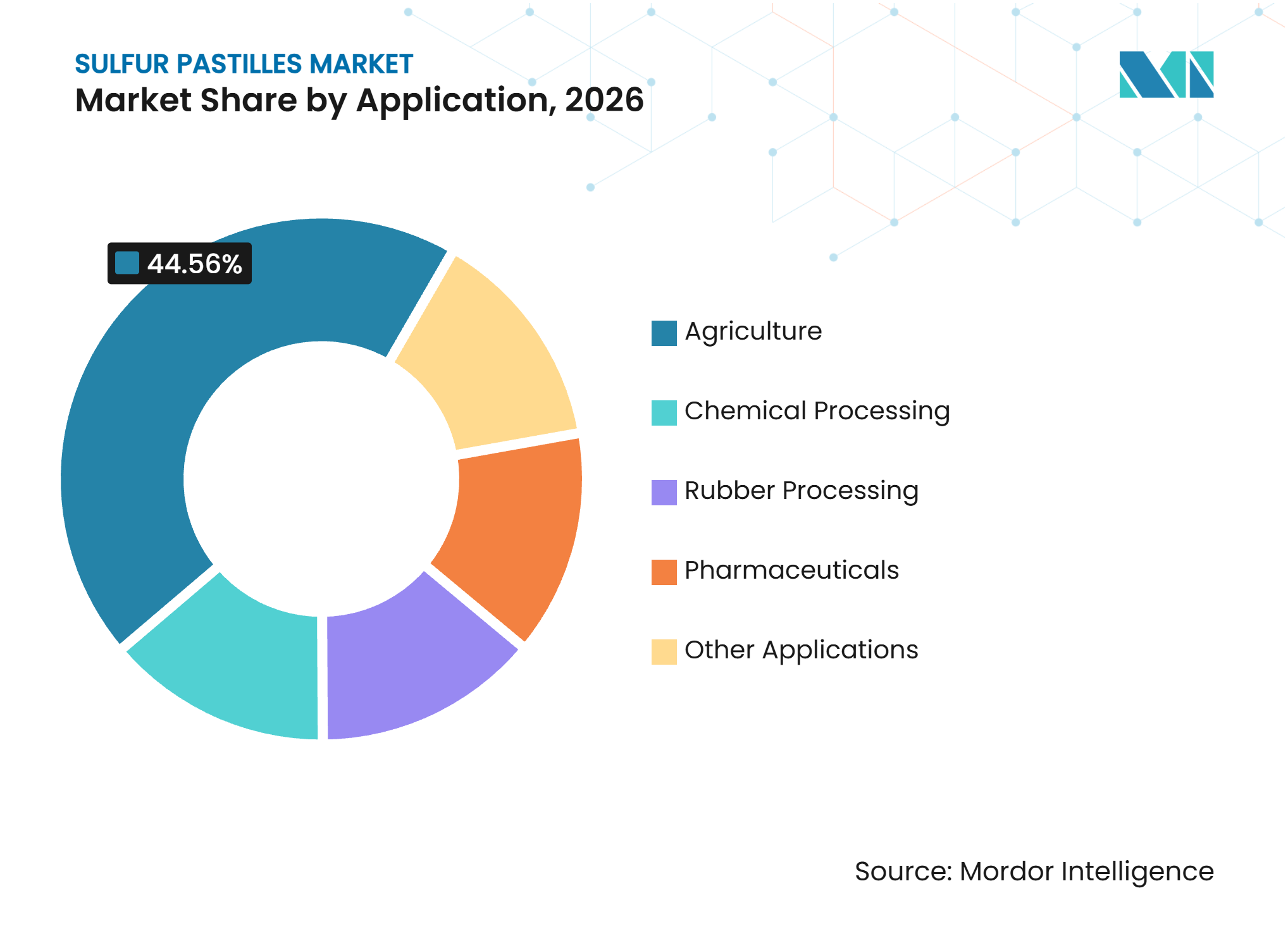
- By application, Agriculture accounted for 44.56% of the sulfur pastilles market size in 2026, while Rubber Processing is forecast to grow at a 5.05% CAGR through 2032.
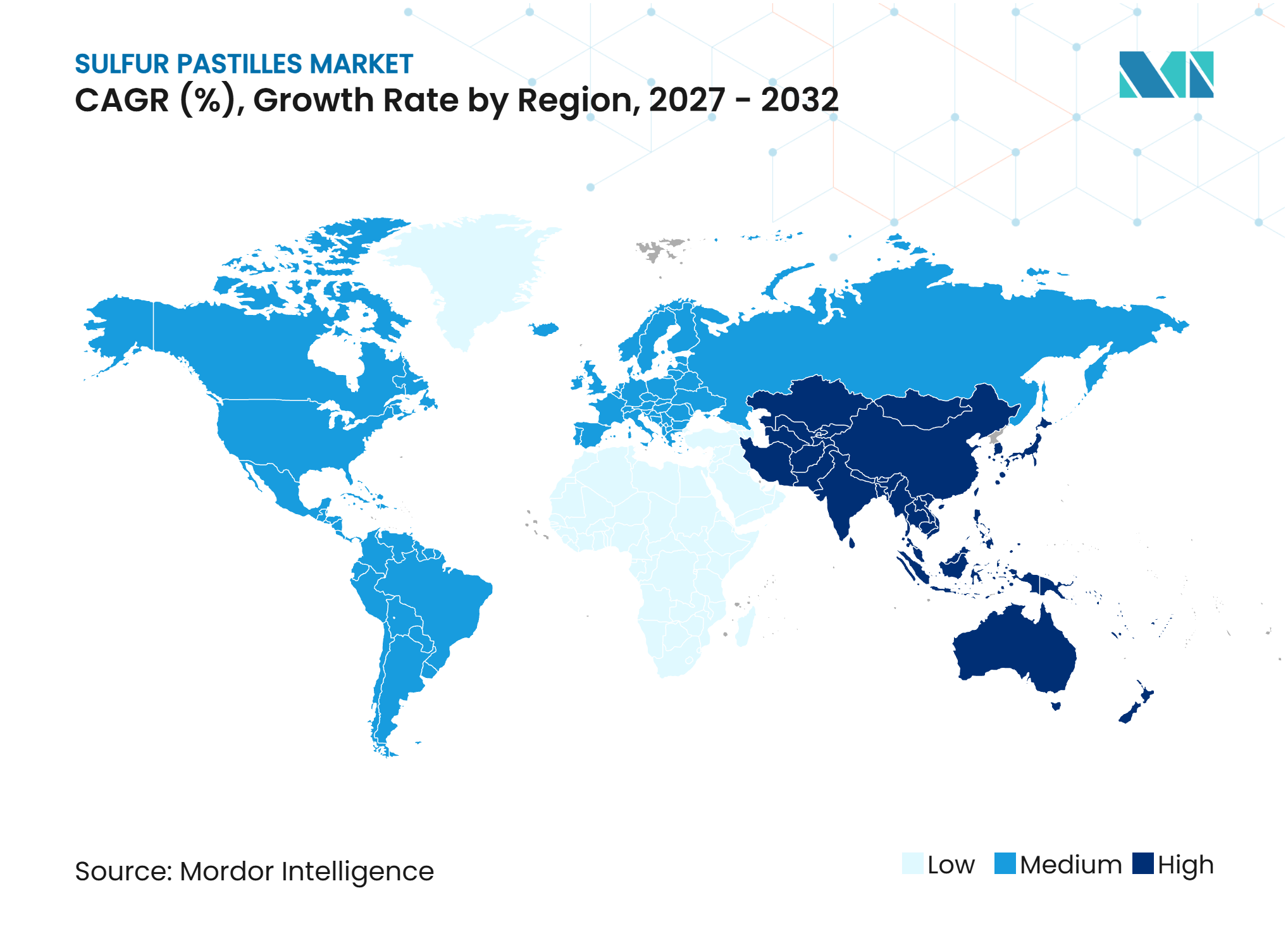
- By geography, Asia-Pacific held 34.72% of the sulfur pastilles market share in 2026 and is forecast to grow at a 4.92% CAGR through 2032.
Note: Market numbers in this report are based on Mordor Intelligence's proprietary estimation framework, which combines nine months of actuals with Q4 projections for base year 2026.
Market Trends and Insights
Drivers Impact Analysis of Sulfur Pastilles Market*
| Drivers | (~) % Impact on CAGR Forecast | Geographic Relevance | Impact Timeline |
|---|---|---|---|
| Sulfur Deficiency in Intensively Farmed Soils | +1.7% | Global, concentrated in South Asia, Sub-Saharan Africa, and East Asia | Long term (≥ 4 years) |
| Demand for Dust-Reduced and Logistics-Friendly Solid Sulfur | +0.8% | Global, with the strongest pull in inland South and Southeast Asia | Medium term (2-4 years) |
| Growth in Sulfuric Acid and Phosphatic Fertilizer Production | +0.9% | Asia-Pacific core, with spillover to the Middle East and Africa and South America | Medium term (2-4 years) |
| Expansion of Tire and Rubber Manufacturing | +0.6% | Asia-Pacific core, North America, and Europe | Long term (≥ 4 years) |
| Precision Crop Nutrition and Crop-Specific Sulfur Programs | +0.5% | North America and Europe, with emerging adoption in India and Brazil | Medium term (2-4 years) |
| Source: Mordor Intelligence | |||
Sulfur Deficiency in Intensively Farmed Soils
Sulfur deficiency has moved beyond isolated soil conditions and now affects intensive farming systems in many regions. Rutgers University reported that plant-available soil sulfur declined by 34% to 86% from 2000 to 2020 as tighter air-quality regulations reduced sulfur dioxide deposition and low-sulfur fertilizer blends became more common[1]. A 2025 meta-analysis of 181 studies in China found that sulfur fertilization increased average crop yields by 8.20%, with a 9.60% increase in sulfur-deficient soils. A systematic review also identified widespread sulfur depletion in highly weathered soils in Sub-Saharan Africa, with maize responses varying by application rate and local soil conditions. Bentonite-blended sulfur pastilles support controlled sulfur release, which can better align oxidation with crop nutrient demand. Their solid format also benefits growers and fertilizer blenders in areas with limited powder-handling equipment.
Demand for Dust-Reduced and Logistics-Friendly Solid Sulfur
Transport and storage requirements are driving the shift from molten and powdered sulfur toward solid pastilles. Molten sulfur requires heated storage, insulated rail or road transport, and dedicated unloading systems. Solid pastilles can be transported in standard 20-foot containers and stored without temperature control. Binh Son Petroleum and Petrochemical Trading launched production of sulfur pastilles at the Dung Quat Refinery in 2025 and identified China, India, and ASEAN as target export markets. Martin Midstream Partners stated in its 2025 Form 10-K that its Beaumont facility can process 5,500 short tons of molten sulfur per day into prilled and granulated solids. These logistics advantages help the sulfur pastilles market reach agricultural blenders and industrial buyers located away from refineries and ports.
Growth in Sulfuric Acid and Phosphatic Fertilizer Production
Sulfuric acid production links elemental sulfur demand to the phosphatic fertilizer supply chain. This connection is most significant where recovered refinery sulfur is solidified nearby and then sold to acid producers or fertilizer manufacturers. Coromandel International built a 2,000 tons per day (TPD) sulfuric acid plant at Kakinada, commissioned in early 2026, which increased its elemental sulfur throughput and supported backward integration. In December 2025, The Mosaic Company announced it would curtail single superphosphate production at its Brazilian Fospar and Araxá facilities and suspend future sulfur purchases due to higher sulfur prices. This decision illustrates how sulfur costs can affect the economics of phosphate fertilizer production and reinforces the importance of feedstock security for the sulfur pastilles market.
Expansion of Tire and Rubber Manufacturing
Tire production provides a non-agricultural source of sulfur demand through rubber vulcanization. The U.S. Tire Manufacturers Association projected U.S. tire shipments of 340.4 million units in 2025, with replacement-tire demand exceeding original-equipment demand. Replacement demand provides a more stable base for sulfur consumption than vehicle production alone. Electric vehicle tires require greater heat tolerance due to vehicle weight and instantaneous torque, favoring consistent sulfur particle size and purity in rubber compounding. Manufacturing growth in India, Indonesia, and other ASEAN countries may support shorter refinery-to-pastillation-to-tire-maker supply chains, potentially reducing reliance on longer supply routes from traditional exporters.
Restraints Impact Analysis of Sulfur Pastilles Market*
| Restraints | (~) % Impact on CAGR Forecast | Geographic Relevance | Impact Timeline |
|---|---|---|---|
| Recovered-Sulfur Feedstock Volatility | -0.4% | Global, particularly Asia-Pacific importers and European formulators | Short term (≤ 2 years) |
| Limited Oxidation in Dry or Poorly Moisturized Soils | -0.2% | Middle East and North Africa, Sub-Saharan Africa, and semi-arid South Asia | Long term (≥ 4 years) |
| Substitution by Lower-Cost Granular and Prilled Sulfur | -0.2% | Price-sensitive markets in South and Southeast Asia and South America | Medium term (2-4 years) |
| Source: Mordor Intelligence | |||
Recovered-Sulfur Feedstock Volatility
Recovered sulfur supply depends on refinery and gas-processing throughput rather than on demand from sulfur buyers. This can create shortages when fertilizer demand peaks during refinery maintenance periods. Martin Midstream Partners LP reported a USD 4.1 million decline in its fertilizer division's adjusted EBITDA in 2025, attributing it to rising sulfur input costs, which are expected to keep the fertilizer market compressed into 2026. Producers without integrated sulfur recovery assets are more exposed to these cost movements. Higher feedstock costs can reduce margins and weaken price competitiveness in the sulfur pastilles market. Spot-sourced granular or prilled material can become more attractive when price gaps widen.
Limited Oxidation in Dry or Poorly Moisturized Soils
Sulfur pastilles require soil microbes to oxidize elemental sulfur into plant-available sulfate. Oxidation slows at temperatures below 10 degrees Celsius and in soils where moisture is below field capacity. Arid and semi-arid farming areas in Pakistan, Iran, the Sahel, and Australia's wheat belt face this limitation. Growers in these regions may prefer sulfate fertilizers where immediate nutrient availability is more important than cost per unit. Reformulation alone cannot address this performance constraint. This issue limits adoption in some regions with substantial soil sulfur deficiency.
*Our forecasts treat driver/restraint impacts as directional, not additive. The impact forecasts reflect baseline growth, mix effects, and variable interactions.
Sulfur Pastilles Market Segment Analysis
By Type:
High-Purity Grade Leads Demand and GrowthSulfur 90% accounted for 62.11% of the sulfur pastilles market share in 2026 and is forecast to record a 4.67% CAGR through 2032. This indicates that the leading grade also retains the strongest growth outlook. The 90% grade delivers high elemental sulfur content while maintaining workable melting behavior and physical stability. These characteristics are important in fertilizer blending and chemical processing. Buyers commonly use this grade where reliable handling and predictable sulfur content are required.
Sulfur 85% continues to serve buyers who prioritize cost over purity. Its use remains relevant in selected ASEAN blending operations and in pharmaceutical and fungicide formulations that combine sulfur with other active ingredients. Precision agriculture programs are encouraging a shift from 85% to 90% material, with controlled bentonite-sulfur ratios required. These programs support crop-specific nutrient management and more consistent release behavior. Suppliers also serve industrial customers that require higher-purity certification, maintaining a distinction between agricultural and industrial-grade requirements.



By Manufacturing Process:
Prilling Remains Established While Extrusion Serves Specialty DemandPrilling/Pelletizing accounted for 53.07% of the sulfur pastilles market share in 2026. The process has an established equipment base, lower capital cost per ton, and broad compatibility with drop-forming systems. It produces consistent hemispherical or lenticular forms at scale. Martin Midstream Partners LP operates wet prill and granulation capacity of 5,500 short tons per day at its Beaumont facility. This scale supports the continued role of prilling in bulk agricultural and industrial distribution.
Extrusion is forecast to post the highest process CAGR of 4.88% through 2032. Its pressure-controlled die output supports dimensional consistency and density control. These features are relevant to precision agriculture and specialty industrial applications. Pharmaceutical sulfur, fungicide concentrate production, and high-performance rubber compounding have tighter particle specifications than bulk applications. Other processes include flaking and drum granulation. Refinery-adjacent producers are evaluating these alternatives where lower-cost solidification or product-specific handling can support local supply needs.
By Application:
Agriculture Leads in Quantity While Rubber Processing Records Faster GrowthAgriculture accounted for 44.56% of the sulfur pastilles market in 2026. Bentonite-sulfur pastilles are designed for soil oxidation and crop-season sulfur supply. Intensive cropping and lower soil organic matter are increasing the relevance of sulfur nutrition in India. Coromandel International doubled its bentonite sulfur capacity at Visakhapatnam to 50,000 MT in March 2025 to meet domestic demand. This capacity addition reflects fertilizer producers' role in improving domestic access to sulfur-containing products.
Chemical processing is the second-largest application and is closely tied to sulfuric acid production. Pastilles offer a safer feedstock form than molten sulfur for smaller acid plants in emerging economies. Rubber processing is forecast to expand at a 5.05% CAGR through 2032. Global tire demand and tighter specifications for electric-vehicle tires support this growth. Pharmaceuticals and other applications are smaller but remain relevant where purity certification is mandatory. Topical formulations and veterinary products are among the uses that require more stringent product quality control.

Geography Analysis
Asia-Pacific: Scale, Supply, and Fertilizer Demand
Asia-Pacific accounted for 34.72% of the sulfur pastilles market share in 2026 and is forecast to expand at a 4.92% CAGR through 2032. China supports regional activity through large sulfur production, sulfuric acid output, and phosphatic fertilizer demand. India remains dependent on imported sulfur to meet its fertilizer requirements, while its Nutrient Based Subsidy program helps make phosphorus and sulfur fertilizers more affordable for farmers. The Fertilizer Control Order shapes product standards for domestic fertilizer producers. Coromandel International is increasing sulfur-related capacity, and Binh Son Refining and Petrochemical Company Limited has added pellet production in Vietnam. Thailand and Indonesia also contribute to industrial demand through tire manufacturing, strengthening regional use beyond agriculture.
North America: Integrated Supply Chains and Specialized Products
North America benefits from recovered sulfur from refineries and natural gas processing facilities along the U.S. Gulf Coast. This feedstock base can lower exposure to international spot markets for integrated producers. Martin Midstream Partners collects sulfur from Gulf Coast refiners and distributes solid sulfur through barge, rail, road, and export networks. Tessenderlo Kerley acquired Tiger-Sul Products LLC in November 2024, combining sulfur recovery, pastillation, and agricultural distribution capabilities across the United States and Canada. The company also opened a liquid fertilizer facility in Defiance, Ohio, in August 2025 to strengthen Midwest distribution. Company-backed research published in the Soil Science Society of America Journal in 2025 highlighted the nitrification-inhibition properties of thiosulfate fertilizers, reflecting the region's focus on differentiated agronomic products. U.S. tire shipments offer an additional demand base for sulfur used in rubber processing.
Europe, South America, and Middle East and Africa: Compliance and Trade Repositioning
Europe's sulfur pastilles market is shaped by Regulation (EU) 2019/1009, which establishes requirements for fertilizing products and CE marking in the European Union. These compliance requirements can raise market-entry barriers for suppliers serving European blending facilities. South America depends on a large phosphate fertilizer base, and Mosaic's December 2025 curtailments in Brazil demonstrated the sensitivity of local operations to sulfur costs. Brazil and Argentina also have agricultural demand for balanced crop nutrition. Gulf states remain important sources of elemental sulfur exports, while Sub-Saharan Africa presents a longer-term opportunity given documented sulfur deficits. The distinct roles of exporters, importers, and fertilizer consumers are reshaping trade flows among the Middle East, Asia, and agricultural markets in Africa and South America.
Competitive Landscape
Market Concentration
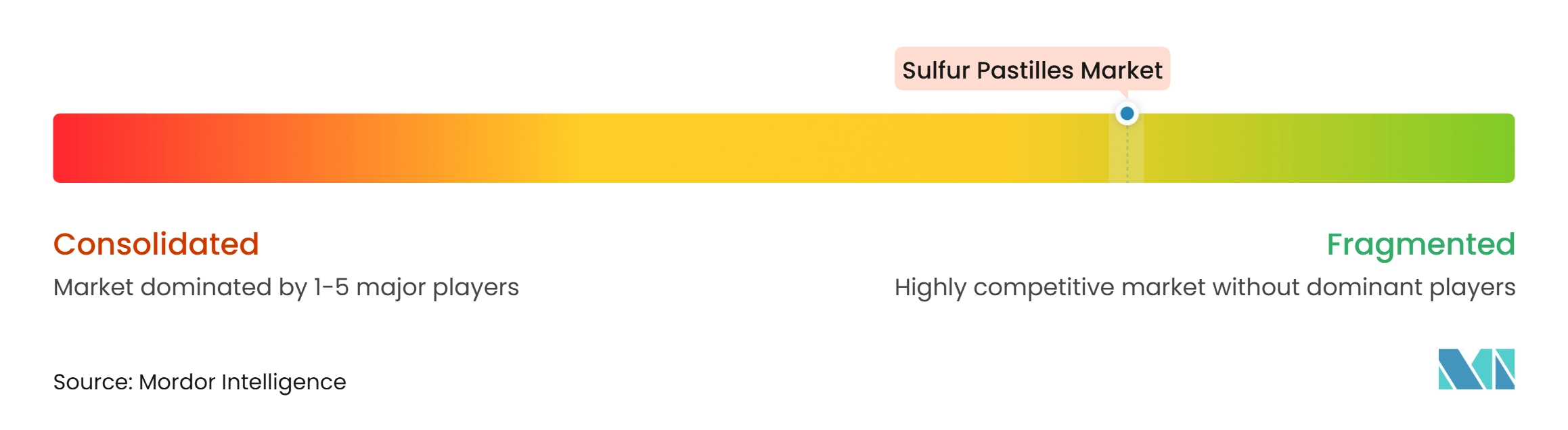
The sulfur pastilles market is fragmented, with regional concentration around the US Gulf Coast, the Middle East, Australia, and South Asia. No supplier holds a dominant position across all major geographies. Tessenderlo Kerley's acquisition of Tiger-Sul Products LLC in November 2024 was a significant consolidation move. The combined business links sulfur recovery, pastillation, agronomy support, and distribution across the United States and Canada. This broader platform serves agricultural, industrial, and specialty customers through a single regional network.
Integrated operators have an advantage when sulfur feedstock prices change. Martin Midstream Partners has stated that its Beaumont facility processes sulfur under contracts that provide guaranteed minimum fees. This fee-based model protects earnings when raw material costs rise. Pure-play formulators are more exposed to feedstock volatility and may face greater pressure in price-sensitive markets. Competition also depends on technical capability, including particle consistency, product purity, and dust-controlled packaging. These attributes are important for pharmaceutical sulfur, fungicide concentrates, and higher-performance rubber compounds.
Opportunities remain in pharmaceutical-grade pastilles, customized bentonite-sulfur ratios, and agricultural distribution in Sub-Saharan Africa. Refinery-adjacent production facilities in Vietnam compete on ASEAN and South Asian trade routes due to their proximity to feedstock and shipping infrastructure[2]. The EU Fertilizing Products Regulation and India's Fertilizer Control Order favor certified suppliers with established compliance systems. Large fertilizer cooperatives are also expanding specialty nutrient offerings, which increases the value of agronomic support alongside product supply.
Sulfur Pastilles Industry Leaders
-
Tessenderlo Kerley
-
Martin Midstream Partners L.P.
-
Coogee
-
Grupa Azoty S.A.
-
Swan Corp
- *Disclaimer: Major Players sorted in no particular order
Sulfur Pastilles Market Companies Covered in this Report
- American Elements
- Coogee
- Coromandel International Ltd
- DEVCO AUSTRALIA
- Georgia Gulf Sulfur Corporation
- Grupa Azoty S.A.
- Indian Farmers Fertiliser Cooperative Limited
- Jordan Sulphur
- Martin Midstream Partners L.P.
- National Establishment for Agricultural and Industrial Sulphur
- National Fertilizers Limited
- Swan Corp
- Tessenderlo Kerley
- The Mosaic Company
- Vasmate Sulphur Industries
Recent Industry Developments in Sulfur Pastilles Market
- February 2026: National Fertilizers Limited (India) received in-principle board approval to establish a 25,000 t/a bentonite sulfur plant at its Vijaipur unit, with an estimated capital investment of INR 1.04 billion (approximately USD 11.5 million), driven by rising domestic demand for sulfur pastilles. The project addresses the absence of existing bentonite sulfur capacity at the Vijaipur site.
- October 2025: Chinese sulfur spot prices at Zhenjiang port reached CNY 3,360 per ton, an approximately 180% year-on-year increase, driven by Middle East supply disruptions, fertilizer-season demand, and reduced refinery output. This price environment raised input costs for sulfur pastilles for APAC formulators.
Global Sulfur Pastilles Market Report Scope
Sulfur pastilles are small, uniform, hemispherical or button-shaped granules of pure or high-purity elemental sulfur. They are produced by cooling molten sulfur through a drop-forming (pastillation) process, rather than grinding it into a fine, dusty powder.
The sulfur pastilles market is segmented by type, manufacturing process, application, and geography. By type, the market is segmented into sulfur 90% and sulfur 85%. By manufacturing process, the market is segmented into prilling/pelletizing, extrusion, and others. By application, the market is segmented into agriculture, chemical processing, rubber processing, pharmaceuticals, and other applications. The report also covers market sizes and forecasts for sulfur pastilles across 15 countries in major regions. The market sizes and forecasts are provided in terms of value (USD).
Segmentation Overview
| Sulfur 90% |
| Sulfur 85% |
| Prilling/Pelletizing |
| Extrusion |
| Others |
| Agriculture |
| Chemical Processing |
| Rubber Processing |
| Pharmaceuticals |
| Other Applications |
| Asia-Pacific | China |
| India | |
| Japan | |
| South Korea | |
| ASEAN Countries | |
| Rest of Asia-Pacific | |
| North America | United States |
| Canada | |
| Mexico | |
| Europe | Germany |
| United Kingdom | |
| France | |
| Italy | |
| NORDIC Countries | |
| Rest of Europe | |
| South America | Brazil |
| Argentina | |
| Rest of South America | |
| Middle East and Africa | Saudi Arabia |
| South Africa | |
| Rest of Middle East and Africa |
| By Type | Sulfur 90% | |
| Sulfur 85% | ||
| By Manufacturing Process | Prilling/Pelletizing | |
| Extrusion | ||
| Others | ||
| By Application | Agriculture | |
| Chemical Processing | ||
| Rubber Processing | ||
| Pharmaceuticals | ||
| Other Applications | ||
| By Geography | Asia-Pacific | China |
| India | ||
| Japan | ||
| South Korea | ||
| ASEAN Countries | ||
| Rest of Asia-Pacific | ||
| North America | United States | |
| Canada | ||
| Mexico | ||
| Europe | Germany | |
| United Kingdom | ||
| France | ||
| Italy | ||
| NORDIC Countries | ||
| Rest of Europe | ||
| South America | Brazil | |
| Argentina | ||
| Rest of South America | ||
| Middle East and Africa | Saudi Arabia | |
| South Africa | ||
| Rest of Middle East and Africa | ||
Key Questions Answered in the Report
What is current market size of Sulfur Pastilles Market?
The sulfur pastilles market size was valued at USD 1.67 billion in 2026 and is estimated to grow from USD 1.74 billion in 2027 to USD 2.13 billion by 2032, at a CAGR of 4.13% during the forecast period (2027-2032).
Which application is expected to grow fastest?
Rubber Processing is forecast to record a 5.05% CAGR through 2032, supported by tire demand and tighter product specifications.
Which manufacturing process has the strongest growth outlook?
Extrusion is forecast to grow at a 4.88% CAGR through 2032, driven by tighter dimensional control.
Which region leads the sulfur pastilles market?
Asia-Pacific holds a 34.72% share in 2026 and is forecast to expand at 4.92% CAGR through 2032.