
Subscription Management Software Market Size and Share
Market Overview
| Study Period | 2020 - 2031 |
|---|---|
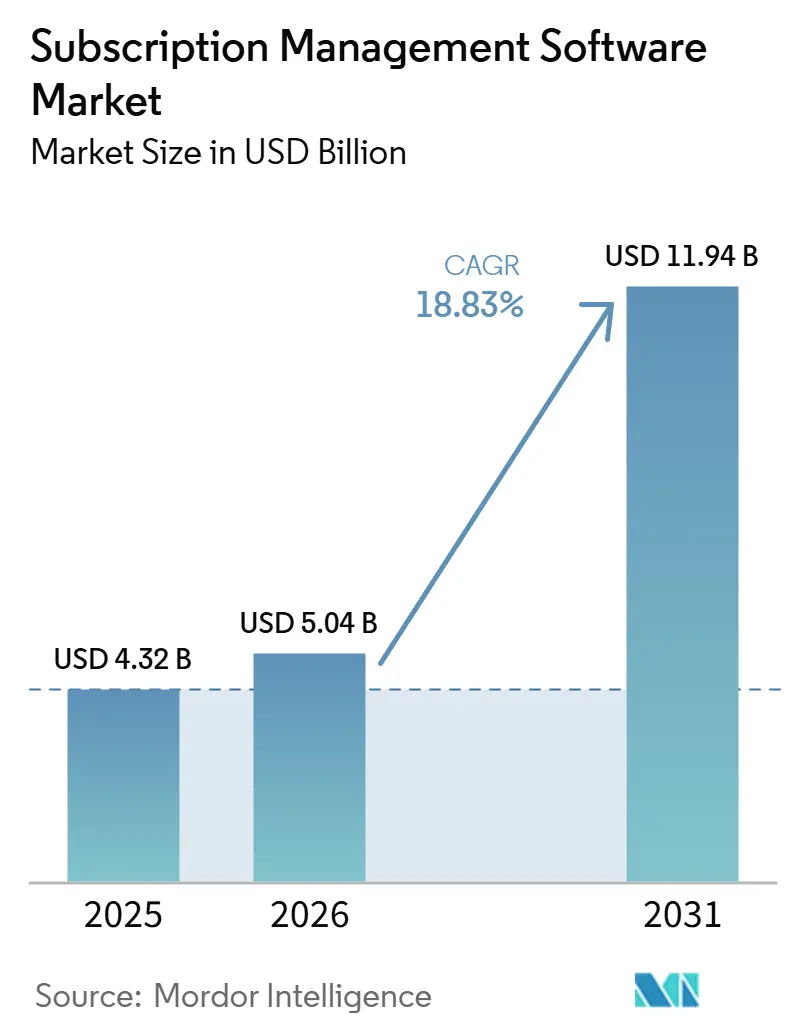
| Market Size (2026) | USD 5.04 Billion |
| Market Size (2031) | USD 11.94 Billion |
| Growth Rate (2026 - 2031) | 18.83 % |
| Fastest Growing Market | Asia-Pacific |
| Largest Market | North America |
| Market Concentration | Medium |
Major Players *Disclaimer: Major Players sorted in no particular order Image © Mordor Intelligence. Reuse requires attribution under CC BY 4.0. | |
Subscription Management Software Market Analysis by Mordor Intelligence
The Subscription Management Software Market size is projected to expand from USD 4.32 billion in 2025 and USD 5.04 billion in 2026 to USD 11.94 billion by 2031, registering a CAGR of 18.83% between 2026 and 2031. Growth reflects the rising difficulty of administering usage charges, hybrid plans, entitlements, and recurring invoices through systems built for traditional accounting. Buyers are moving toward platforms that integrate quoting, billing, payments, and revenue recognition in a single operating environment. Competitive choices increasingly depend on integrations with customer relationship management systems, enterprise resource planning systems, payment gateways, and tax tools. Providers can create opportunities through reliable migration services, embedded compliance features, and tools that help customers manage changing pricing models. The subscription management software market also faces slower buying decisions when firms must replace several legacy billing engines or address cross-border tax requirements.
Key Report Takeaways
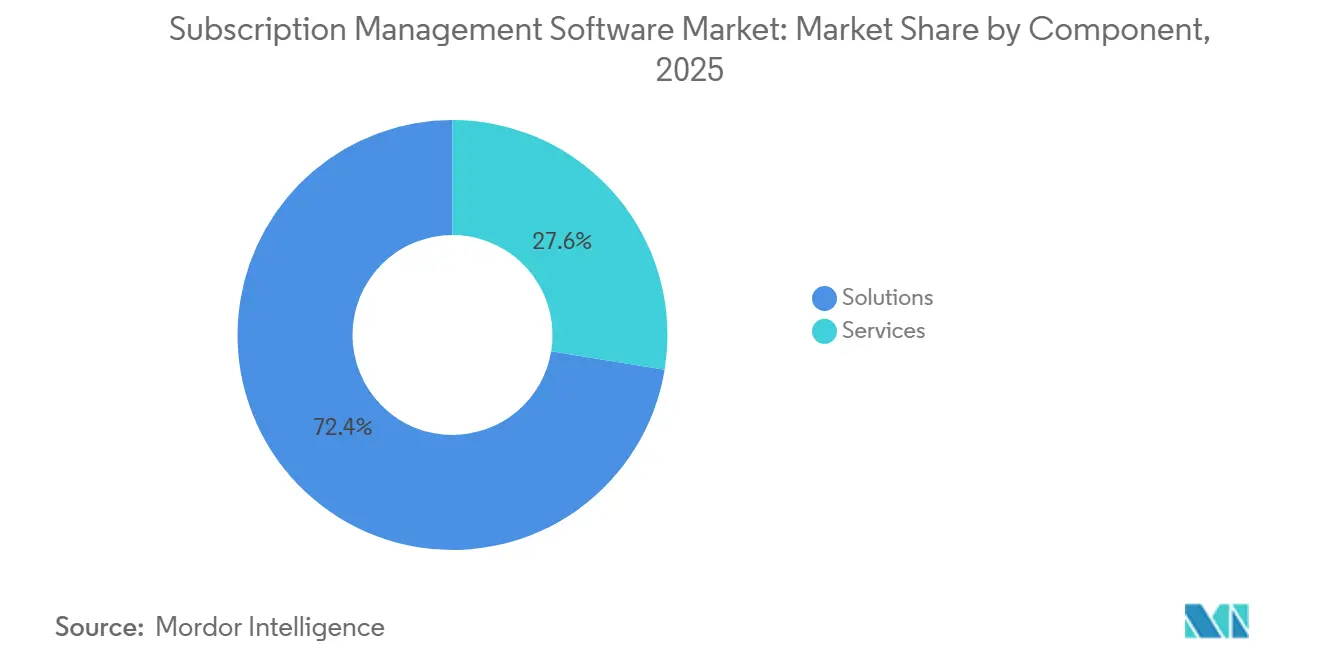
- By component, solutions accounted for 72.41% of revenue in the subscription management software market in 2025, while services are projected to expand at a 21.82% CAGR through 2031.
- By deployment mode, cloud accounted for 68.19% of the subscription management software market size in 2025, while hybrid deployment is expected to grow at a 20.43% CAGR through 2031.
- By enterprise size, large enterprises held 61.34% of revenue in the subscription management software market in 2025, while small and medium enterprises are projected to expand at a 22.16% CAGR through 2031.
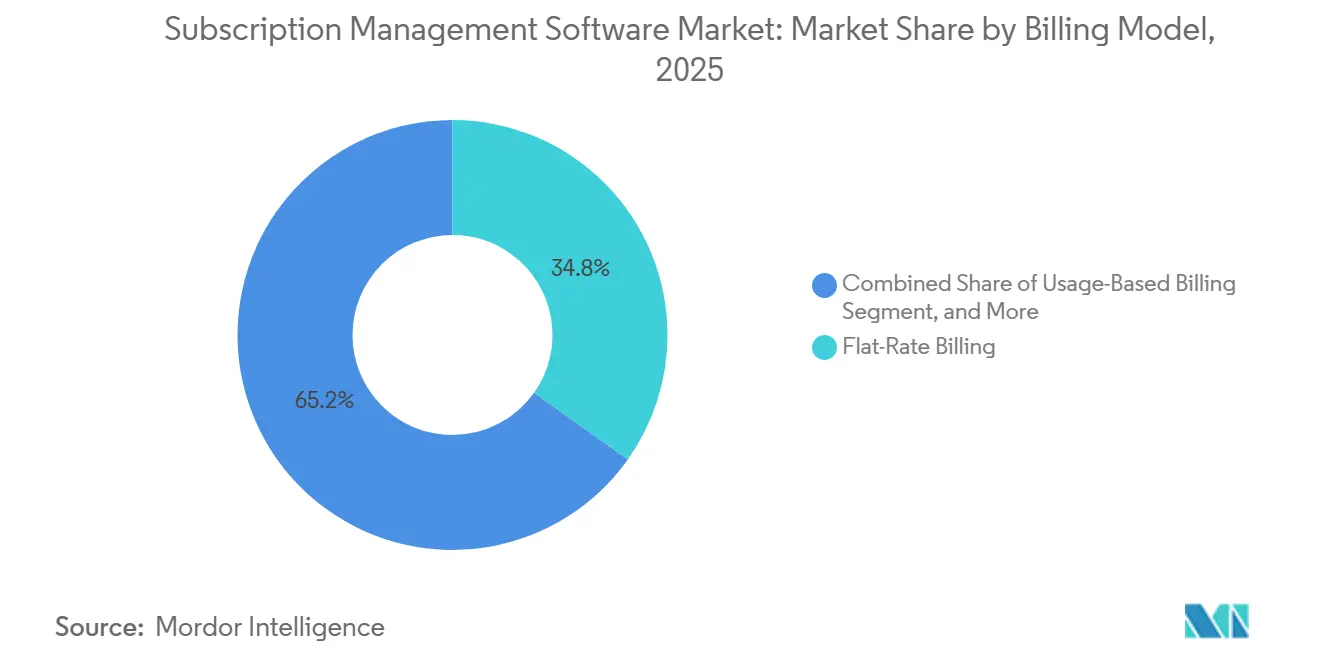
- By billing model, flat-rate billing captured 34.82% of revenue in 2025, while usage-based billing is projected to grow at a 24.73% CAGR through 2031.
- By end user, IT and telecommunications accounted for 24.86% of revenue in 2025, while healthcare and life sciences are expected to advance at a 21.39% CAGR through 2031.
- By geography, North America held 36.71% of revenue in the subscription management software market in 2025, while Asia-Pacific is projected to expand at a 23.48% CAGR through 2031.
Note: Market size and forecast figures in this report are generated using Mordor Intelligence’s proprietary estimation framework, updated with the latest available data and insights as of January 2026.
Market Trends and Insights
Drivers Impact Analysis of Subscription Management Software Market*
| Driver | (~) % Impact on CAGR Forecast | Geographic Relevance | Impact Timeline |
|---|---|---|---|
| Rising Adoption of Hybrid and Usage-Based Pricing Models | +4.2% | Global | Short term (≤ 2 years) |
| ASC 606 and IFRS 15 Automation Pressure | +3.8% | North America and Europe | Short term (≤ 2 years) |
| AI-Assisted Churn Analytics and Forecasting | +3.5% | Global | Medium term (2-4 years) |
| Embedded Billing APIs in Platform Businesses | +3.2% | North America and Asia-Pacific | Medium term (2-4 years) |
| Subscription Commerce Expansion in Asia-Pacific | +2.8% | Asia-Pacific core, spillover to Middle East and Africa | Long term (≥ 4 years) |
| Multi-Entity Marketplace and Managed Service Provider Billing Complexity | +2.4% | North America and Europe | Medium term (2-4 years) |
| Source: Mordor Intelligence | |||
Rising Adoption of Hybrid and Usage-Based Pricing Models
Software companies are changing how they charge customers, which is supporting demand in the subscription management software market. Usage-based and hybrid plans link charges to consumption, rather than relying only on seats or fixed monthly fees. AI providers and application programming interface platforms need billing systems that can measure tokens, compute classes, latency tiers, and other usage events in real time. This requirement is materially different from a standard per-user subscription, underscoring the value of capable billing platforms. It also increases demand for implementation and migration work, which supports the projected 21.82% CAGR for services through 2031. Chargebee acquired Orb in June 2025 to strengthen metering, real-time rating, and consumption-based monetization capabilities for these customer types.[1]Chargebee, “Billing and Monetization for SaaS and AI Companies,” Chargebee, chargebee.com.
ASC 606 and IFRS 15 Automation Pressure
ASC 606 and IFRS 15 have made revenue recognition software a more important buying consideration for subscription businesses. Finance teams must allocate transaction prices and recognize revenue across performance obligations in contracts with several products or service elements. Manual processes become difficult to maintain when a company handles large volumes of contract modifications, credits, variable consideration, and renewals. Zuora states that its revenue product automates these processes and can reduce month-end close time by up to 50%.[2]Zuora, “Revenue Recognition Software,” Zuora, zuora.com. In August 2025, Zuora expanded its Workday Financial Management integration to link billing sub-ledgers with the general ledger and reduce manual reconciliation. This need for audit-ready reporting supports demand in the subscription management software market among mid-sized and large organizations in North America and Europe.[3]Business Wire, “Zuora Expands Partnership with Workday to Simplify Revenue Management and Improve Financial Accuracy,” Business Wire, businesswire.com.
AI-Assisted Churn Analytics and Forecasting
AI tools are becoming a meaningful way for providers to differentiate their subscription management software market offerings. Traditional payment recovery workflows respond after a payment failure, while AI-based tools can evaluate product usage, behavioral signals, and payment data before cancellation. Recurly describes its Compass product as a set of tools for configuration, data analysis, retention automation, and code generation. The value of these systems rises as a provider accumulates longer customer histories and more transaction data. That data can improve prediction quality and may make it harder for newer vendors to match established platforms. Chargebee acquired payments intelligence company Inai in September 2025 to add fee analysis, payment recovery signals, and gateway optimization to its billing platform.
Embedded Billing APIs in Platform Businesses
Cloud marketplaces, AI infrastructure providers, financial technology platforms, and developer tools are placing billing functions directly within their products. These buyers need application programming interfaces that support tenant-level separation, real-time metering, multiple currencies, and payment collection across gateways. The buying group, therefore, includes engineering teams and platform operators, not only finance teams. Stripe Billing provides recurring payment and subscription capabilities through its payments platform.[4]Stripe, “Stripe Billing,” Stripe, stripe.com. Chargebee reported that it managed more than USD 10 billion in annual recurring revenue across its merchant base as of the first quarter of 2026 and supported more than 35 payment gateway integrations. These requirements widen the addressable buyer base for the subscription management software market and favor vendors with flexible interfaces and broad integration coverage.
Restraints Impact Analysis of Subscription Management Software Market*
| Restraint | (~) % Impact on CAGR Forecast | Geographic Relevance | Impact Timeline |
|---|---|---|---|
| Legacy Billing Migration and Integration Risk | -2.8% | Global | Short term (≤ 2 years) |
| Data Privacy and Cross-Border Tax Compliance Complexity | -2.4% | Global | Long term (≥ 4 years) |
| Pricing Model Fragmentation Across Multi-Product Portfolios | -2.0% | North America and Europe | Medium term (2-4 years) |
| Buyer Lock-In Concerns Around Enterprise Resource Planning and Customer Relationship Management Suites | -1.7% | Global | Long term (≥ 4 years) |
| Source: Mordor Intelligence | |||
Legacy Billing Migration and Integration Risk
Replacing a legacy billing system can create demand for subscription management software, but the transition can also delay a purchase. Organizations that grew through acquisition may operate several billing engines with undocumented pricing rules, inconsistent product codes, and manually adjusted revenue schedules. These conditions can lead to double billing, missed invoices, or incorrect deferred revenue during a cutover. Aria Systems advises organizations to use a staged migration process with validation and financial controls to reduce the risk of revenue disruption. Large deployments often begin with simpler fixed-price subscriptions before moving to usage-based and hybrid plans. The need for parallel runs, data cleanup, and finance approval can extend enterprise projects for 12 to 24 months and lengthen sales cycles.
Data Privacy and Cross-Border Tax Compliance Complexity
Subscription businesses operating in multiple countries face increasingly stringent requirements for privacy, invoicing, and tax reporting. Real-time e-invoicing rules can require direct links to tax authority systems, country-specific digital signatures, and rapid transaction reporting. Avalara and Chargebee announced an expanded partnership in May 2026 to embed e-invoicing and live reporting features into the billing lifecycle. The challenge is especially significant for mid-sized firms that began with a billing platform designed for one jurisdiction. Retrofitting tax rules and privacy controls can increase deployment cost and require specialized add-ons. The European Data Protection Board explains that the General Data Protection Regulation requires organizations to apply principles such as data minimization and safeguards for international data transfers.
*Our forecasts treat driver/restraint impacts as directional, not additive. The impact forecasts reflect baseline growth, mix effects, and variable interactions.
Subscription Management Software Market Segment Analysis
By Component:
Services Extend Platform Value Beyond Software LicensesSolutions held 72.41% of the subscription management software market share in 2025 because large buyers often prefer integrated systems for subscription administration, revenue recognition, and payment orchestration. A single platform can reduce the need to coordinate several point tools across finance, product, and operations teams. Mature solutions also offer deeper links to enterprise resource planning systems, customer relationship management systems, and payment providers. These integrations are important when a business has complex contracts or several ways to charge customers. The solutions category remains central to the subscription management software market because the core platform controls billing logic and financial data, while providing a base for analytics, tax, and retention products.
Services are projected to expand at a 21.82% CAGR through 2031, faster than the solutions category. Organizations often need help moving historical subscriptions, redesigning price catalogs, and validating accounting outputs before they can go live. The work is particularly demanding for businesses with multiple product lines and distinct pricing rules for each stock-keeping unit. Implementation engagements can run for 12 to 24 months in upper mid-sized and large environments. This creates longer customer relationships and can reduce platform churn, while managed services are gaining use among healthcare and utility providers without internal billing engineering teams in the subscription management software industry.


By Deployment Mode:
Cloud Leads While Hybrid Addresses Data Control NeedsCloud deployment accounted for 68.19% of revenue in 2025, making it the leading delivery model in the subscription management software market. It aligns with the delivery preferences of many startups and mid-sized software firms because it reduces infrastructure management and enables rapid updates. Cloud systems can also scale during high-volume billing events without requiring the customer to maintain local capacity. This model is well-suited to organizations that need regular product releases and broad access for distributed finance and operations teams. Its leading position reflects the broader adoption of software-as-a-service among recurring-revenue businesses and keeps cloud a core route to market for digital-native customers.
Hybrid deployment is projected to grow at a 20.43% CAGR through 2031. It appeals to buyers who want cloud scalability but must retain control over certain data or processing activities. On-premise systems continue to serve regulated industries and sovereign institutions with strict residency requirements, although they are declining as a share of new installations. European enterprises may require processing and storage to remain within approved regional environments while still using cloud capabilities for peak billing volumes. Vendors must clearly document data flows between local and cloud components, as hybrid options can support subscription management software market sales where legal, compliance, and security teams shape the final decision.
By Enterprise Size:
Small and Medium Enterprises Gain Access Through Simpler PlatformsLarge enterprises accounted for 61.34% of revenue in 2025 because their contracts, product portfolios, and reporting requirements led to higher average contract values. Many of these organizations manage multiple products, negotiate terms, and deal with complex revenue recognition requirements. They also tend to have formal procurement processes and dedicated finance teams that can support large software projects. Their need for ASC 606 and IFRS 15 compliance adds to the case for automated revenue systems. The large-enterprise segment remains important to the subscription management software industry because it supports substantial platform and services spending and values the integration depth offered by established providers.
Small and medium enterprises are projected to grow at a 22.16% CAGR through 2031, as low-friction, API-first billing tools reduce the barriers of lengthy deployments and high initial costs. Zoho introduced Zoho Billing Enterprise Edition in December 2025 with standard, project-based, subscription, and usage-based billing capabilities. AI software startups also support demand because many start with consumption pricing and need metering from their first customer contracts. In June 2026, GoCardless launched Recurring Pay by Bank to support flexible recurring collection under a single authorization. In July 2026, GoCardless and Sage expanded their partnership to add account-to-account payment options within Sage Business Cloud Accounting.
By Billing Model:
Usage-Based Billing Gains as Consumption Pricing ExpandsFlat-rate billing accounted for 34.82% of revenue in 2025 and remained the largest billing model because a fixed, recurring fee is easy to explain and administer. Flat-rate plans remain useful for products with stable feature sets and predictable usage patterns. They can also simplify budgeting for customers who do not want variable monthly charges. However, fixed pricing can limit revenue growth when customer usage rises substantially. This has encouraged many providers in the subscription management software market to add other pricing methods alongside flat-rate plans.
Usage-based billing is projected to grow at a 24.73% CAGR through 2031 as AI infrastructure providers, application programming interface companies, and Internet of Things platforms align charges with observed use. Tiered plans combine defined usage allowances with higher-price thresholds and can offer customers more predictable bills. Freemium remains the smallest revenue category, but it supports customer acquisition for developer-focused products before converting to paid plans. Businesses in the subscription management software market increasingly need to support multiple pricing methods within a single customer account. Maxio expanded its metering and hybrid monetization tools in May 2026, including visibility into customer cohort average revenue per user.

By End User:
IT and Telecommunications Lead While Healthcare and Life Sciences AccelerateIT and telecommunications accounted for 24.86% of the subscription management software market size in 2025. The sector has long managed contract-based customer relationships, service bundles, plan changes, and high-volume charging events. Telecommunications providers need billing systems that can handle multiple services, real-time rating, and frequent changes within a billing cycle. This makes specialized business support systems and operations support systems capabilities important for many telecom deployments. Cerillion achieved Diamond-level certification in the TM Forum Open API Conformance program in March 2026 across more than 50 standardized telecom application programming interfaces, supporting continued demand for strong integration and real-time processing capabilities.
Healthcare and life sciences are projected to expand at a 21.39% CAGR through 2031. Telehealth memberships, GLP-1 drug programs, and remote patient monitoring services need billing systems that can manage sensitive data, several plans, and detailed audit records. Generic billing platforms may require extensive configuration, while Recurly targets GLP-1 and telehealth operators with tools for healthcare-sensitive workflows and complex plan structures. Banking, financial services, insurance, retail, e-commerce, and media provide further demand through recurring fees, renewal billing, and payment recovery workflows. Manufacturing, government, energy, and utilities are early adopters that use these systems for service contracts and device-as-a-service programs in the subscription management software industry.
Geography Analysis
North America Subscription Management Software Market
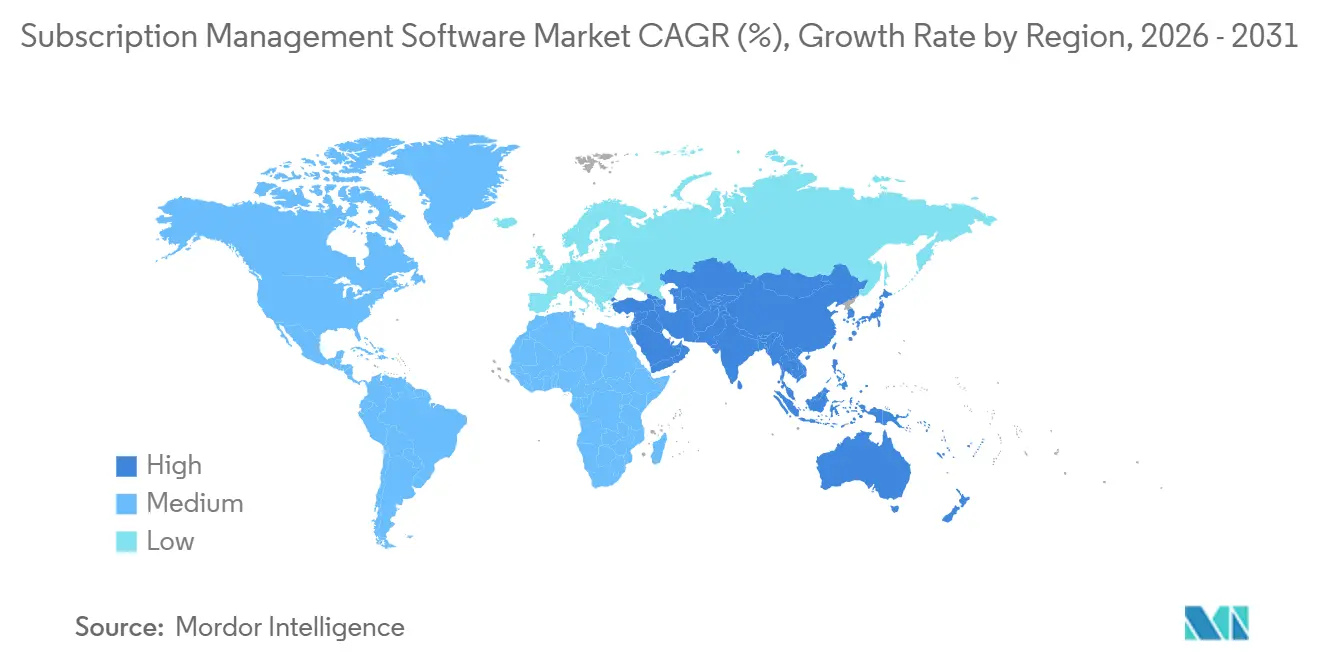
North America held 36.71% of global revenue in 2025. The region has a dense base of software vendors, recurring-revenue businesses, and public companies that need granular reporting processes aligned with ASC 606. These needs support purchases of automated billing and revenue platforms. North America also has a mature cloud infrastructure, which can reduce deployment barriers. This combination keeps the region central to the subscription management software market and supports continued platform investment.
Europe and APAC Subscription Management Software Market
Europe held 27% of global revenue in 2025, with Germany and the United Kingdom leading regional adoption. European buyers must balance data-residency requirements with billing modernization, while the General Data Protection Regulation, national e-invoicing programs, and Peppol-compatible connectivity shape vendor qualifications. Providers with compliant data processing and regional connectivity may have an advantage in enterprise selection processes. Asia-Pacific is projected to grow at a 23.48% CAGR through 2031, making it the fastest-growing geography. DHL eCommerce found that 71% of businesses in Australia, China, India, Malaysia, and Thailand offered a subscription-based delivery or returns model, while 35% of consumers in these markets had 3 or more active subscriptions. China, India, Japan, and Southeast Asia are combining to expand subscription commerce through growing software and AI ecosystems, widening the subscription management software market opportunity.
MEA and South America Subscription Management Software Market
The Middle East and Africa are at an earlier stage, but digital transformation programs and e-invoicing requirements in Saudi Arabia and the United Arab Emirates are supporting the adoption of modern billing systems. Africa has lower current demand, but mobile-first subscription models are expanding across fintech, health, and agricultural technology. South America has emerging potential led by Brazil, where fintech payment infrastructure and digital consumer adoption support subscription commerce. Complex tax rules, including Brazil's nota fiscal e-invoicing system, remain a barrier to wider platform adoption.

Competitive Landscape
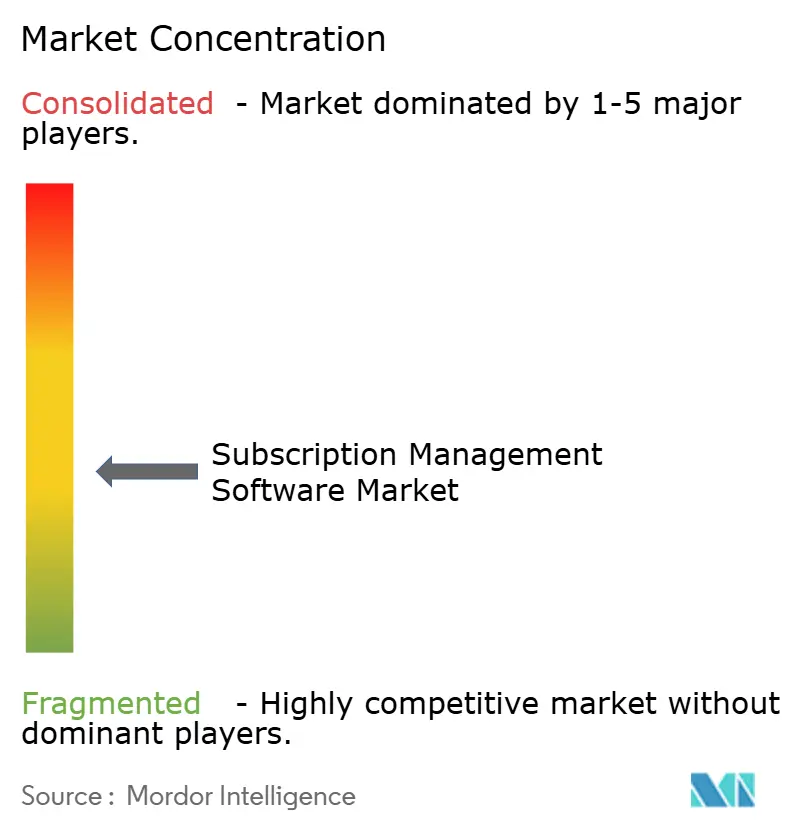
The subscription management software market is moderately fragmented in the mid-sized and upper mid-sized tiers. Enterprise demand is more concentrated around Zuora, Salesforce Revenue Cloud, Oracle, and SAP because these providers offer deep enterprise resource planning integrations and established service networks. Specialists compete through focused billing, metering, payment, and retention capabilities. Buyers increasingly want fewer vendors across billing, revenue recognition, churn management, and tax compliance. This preference creates pressure on subscription management software market providers to broaden their product portfolios, while leaving room for vertical specialists where generic platforms cannot meet detailed sector requirements.
Acquisition has been an important competitive response to the need for broader capabilities. Chargebee acquired Orb in 2025 to add usage-based pricing infrastructure and acquired Inai to strengthen payments intelligence. Recurly acquired Prive and Redfast in May 2025 to add e-commerce subscription management and subscriber engagement capabilities. Zuora completed its USD 1.7 billion privatization by GIC and Silver Lake in the first quarter of 2025. These moves show that vendors are seeking greater product depth and a stronger position in complex customer accounts.
Technology choices are also shaping competition in the subscription management software market. Cerillion released version 26.1 in April 2026 with Agent2Agent capabilities for coordinated work across billing, customer relationship management, and network systems. Smaller challengers in the subscription management software market use open-source frameworks and embedded billing software development kits to reach developers before a formal finance procurement process begins. Partnerships can deepen switching costs by linking billing to financial and compliance systems, as shown by the Zuora-Workday relationship and the Chargebee-Avalara partnership.
Subscription Management Software Industry Leaders
Zuora, Inc.
Chargebee Inc.
Recurly, Inc.
Stripe, Inc.
Oracle Corporation
- *Disclaimer: Major Players sorted in no particular order
Subscription Management Software Market Companies Covered in this Report
- Zuora, Inc.
- Chargebee Inc.
- Recurly, Inc.
- Stripe, Inc.
- Oracle Corporation
- SAP SE
- Salesforce, Inc.
- Aria Systems, Inc.
- Vindicia, Inc.
- Maxio, Inc.
- Paddle.com Market Limited
- GoCardless Ltd.
- Sage Group plc
- NetSuite, Inc.
- BillingPlatform Corp.
- AppDirect, Inc.
- Cleverbridge AG
- FastSpring, Inc.
- Cerillion plc
- Zoho Corporation Pvt. Ltd.

Recent Industry Developments in Subscription Management Software Market
- July 2026: GoCardless and Sage expanded their partnership to integrate GoCardless Pay by Bank natively into Sage Business Cloud Accounting, enabling instant open-banking-powered payments for small businesses across the United Kingdom and Ireland and automating payment reconciliation back into Sage's accounting ledger. The expansion built on GoCardless's June 2026 launch of the Recurring Pay by Bank scheme, which enables businesses with variable billing models, including energy, telecommunications, and insurance, to collect flexible amounts under a single customer authorization.
- May 2026: Maxio launched the first native surcharging solution for B2B SaaS and AI companies within its Maxio Payments product, allowing subscription businesses to recover credit card processing costs directly through existing billing workflows. Maxio manages USD 18 billion or more in billings across over 2,000 SaaS, AI, and subscription clients.
- May 2026: Avalara and Chargebee announced a preferred strategic partnership for global e-invoicing and live reporting compliance. The integration embeds real-time e-invoicing, digital signatures, QR codes, and country-specific tax authority connectivity directly into Chargebee's billing lifecycle, supporting compliance in Europe, Asia-Pacific, and South American markets.
- April 2026: Cerillion released version 26.1 of its BSS/OSS Suite, introducing Agent2Agent AI capabilities that enable coordinated, multi-step process execution across billing, customer relationship management, and network systems for communications service providers. The release also includes enhanced real-time charging, quota management, and quality-of-service-based rating.


Global Subscription Management Software Market Report Scope
The subscription management software market comprises the ecosystem of software solutions and services that automate and manage the lifecycle of subscription-based products and services. This encompasses critical operational capabilities, including subscriber onboarding, pricing and catalog management, flexible billing (including recurring, usage-based, and hybrid models), automated invoicing, payment processing, dunning management, and revenue recognition. Deployed via cloud, on-premise, or hybrid environments, these solutions cater to organizations of all sizes across diverse industries, including IT, media, BFSI, retail, and healthcare. By replacing manual, error-prone financial processes with scalable, automated systems, subscription management software enables businesses to efficiently adapt to shifting consumer preferences, ensure compliance with global accounting standards (such as ASC 606 and IFRS 15), reduce revenue leakage, and enhance the overall subscriber experience to drive long-term customer retention and predictable revenue growth.
The Subscription Management Software Market Report is Segmented by Component (Solutions, and Services), Deployment Mode (Cloud, On-Premise, and Hybrid), Enterprise Size (Large Enterprises, and Small and Medium Enterprises), Billing Model (Recurring Subscription Billing, Usage-Based Billing, Hybrid Billing, and One-Time and Add-On Billing), End User (IT and Telecommunication, BFSI, Healthcare and Life Sciences, Retail and E-Commerce, Industrial Manufacturing, Education and Research Institutions, Media and Entertainment, Government and Administration, Energy and Utilities, and Other End-User Industries), and Geography (North America, South America, Europe, Asia-Pacific, and Middle East and Africa). The Market Forecasts are Provided in Terms of Value (USD).
| Solutions |
| Services |
| Cloud |
| On-Premise |
| Hybrid |
| Large Enterprises |
| Small and Medium Enterprises |
| Recurring Subscription Billing |
| Usage-Based Billing |
| Hybrid Billing |
| One-Time and Add-On Billing |
| IT and Telecommunication |
| BFSI |
| Healthcare and Life Sciences |
| Retail and E-Commerce |
| Industrial Manufacturing |
| Education and Research Institutions |
| Media and Entertainment |
| Government and Administration |
| Energy and Utilities |
| Other End-user Industries |
| North America | United States | |
| Canada | ||
| Mexico | ||
| South America | Brazil | |
| Argentina | ||
| Rest of South America | ||
| Europe | Germany | |
| United Kingdom | ||
| France | ||
| Russia | ||
| Spain | ||
| Rest of Europe | ||
| Asia-Pacific | China | |
| Japan | ||
| India | ||
| South Korea | ||
| Southeast Asia | ||
| Rest of Asia-Pacific | ||
| Middle East and Africa | Middle East | Saudi Arabia |
| United Arab Emirates | ||
| Rest of Middle East | ||
| Africa | South Africa | |
| Nigeria | ||
| Rest of Africa | ||
| By Component | Solutions | ||
| Services | |||
| By Deployment Mode | Cloud | ||
| On-Premise | |||
| Hybrid | |||
| By Enterprise Size | Large Enterprises | ||
| Small and Medium Enterprises | |||
| By Billing Model | Recurring Subscription Billing | ||
| Usage-Based Billing | |||
| Hybrid Billing | |||
| One-Time and Add-On Billing | |||
| By End-user Industry | IT and Telecommunication | ||
| BFSI | |||
| Healthcare and Life Sciences | |||
| Retail and E-Commerce | |||
| Industrial Manufacturing | |||
| Education and Research Institutions | |||
| Media and Entertainment | |||
| Government and Administration | |||
| Energy and Utilities | |||
| Other End-user Industries | |||
| By Geography | North America | United States | |
| Canada | |||
| Mexico | |||
| South America | Brazil | ||
| Argentina | |||
| Rest of South America | |||
| Europe | Germany | ||
| United Kingdom | |||
| France | |||
| Russia | |||
| Spain | |||
| Rest of Europe | |||
| Asia-Pacific | China | ||
| Japan | |||
| India | |||
| South Korea | |||
| Southeast Asia | |||
| Rest of Asia-Pacific | |||
| Middle East and Africa | Middle East | Saudi Arabia | |
| United Arab Emirates | |||
| Rest of Middle East | |||
| Africa | South Africa | ||
| Nigeria | |||
| Rest of Africa | |||


Key Questions Answered in the Report
What is the Subscription Management Software Market size?
The Subscription Management Software Market is projected to increase from USD 5.04 billion in 2026 to USD 11.94 billion by 2031, at an 18.83% CAGR.
What is driving demand for subscription management software?
Usage-based pricing, hybrid plans, automated revenue recognition, and embedded billing needs are increasing demand for capable billing systems.
Which component is growing fastest in subscription management software?
Services are projected to grow at a 21.82% CAGR through 2031 because customers need implementation, migration, and ongoing support.
Which deployment model leads subscription management software adoption?
Cloud led with 68.19% of revenue in 2025, while hybrid deployment is projected to grow at a 20.43% CAGR through 2031.
Which billing model is growing fastest?
Usage-based billing is projected to grow at a 24.73% CAGR through 2031 as AI, application programming interface, and Internet of Things providers use consumption pricing.
Which region is expected to grow fastest through 2031?
Asia-Pacific is projected to expand at a 23.48% CAGR through 2031, supported by subscription commerce and expanding software ecosystems.
Page last updated on:


 Your data is secure and never sold or shared.


