
Stretch-Hood Films And Pallet Load-Stability Solutions Market Size and Share
Market Overview
| Study Period | 2020 - 2031 |
|---|---|
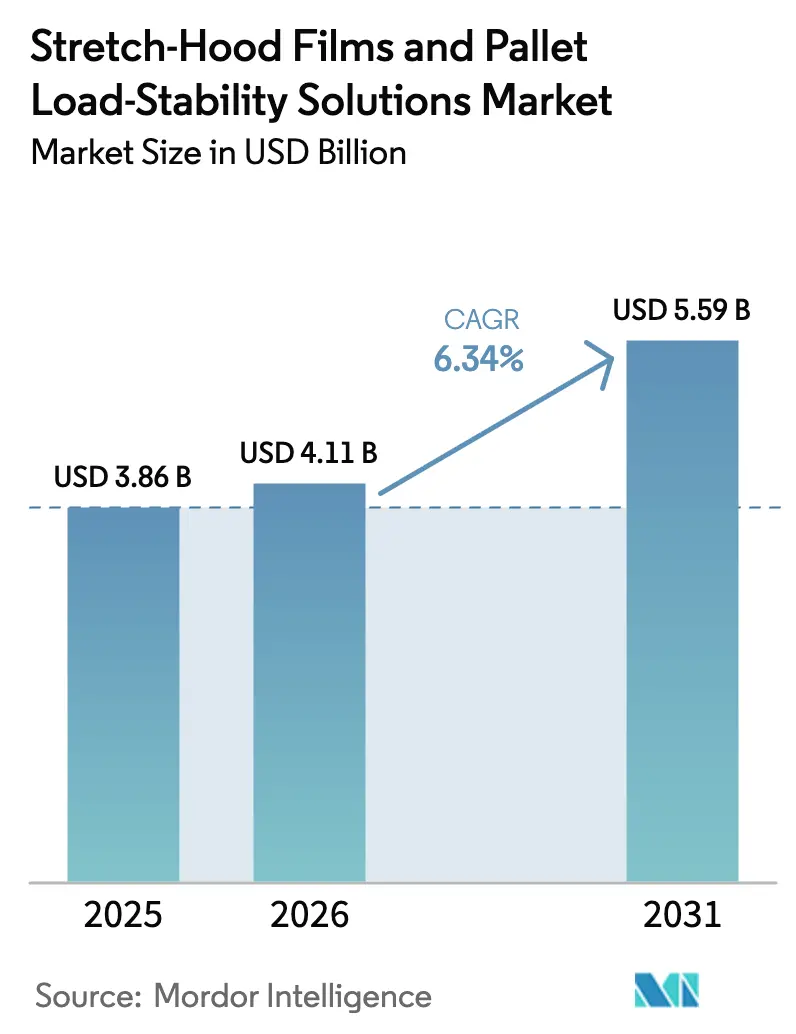
| Market Size (2026) | USD 4.11 Billion |
| Market Size (2031) | USD 5.59 Billion |
| Growth Rate (2026 - 2031) | 6.34 % |
| Fastest Growing Market | Asia Pacific |
| Largest Market | Asia Pacific |
| Market Concentration | Medium |
Major Players *Disclaimer: Major Players sorted in no particular order Image © Mordor Intelligence. Reuse requires attribution under CC BY 4.0. | |
Stretch-Hood Films And Pallet Load-Stability Solutions Market Analysis by Mordor Intelligence
The Stretch-Hood Films And Pallet Load-Stability Solutions Market size was valued at USD 3.86 billion in 2025 and estimated to grow from USD 4.11 billion in 2026 to reach USD 5.59 billion by 2031, at a CAGR of 6.34% during the forecast period (2026-2031). Accelerated e-commerce fulfillment, standardization of load-stability testing, and corporate decarbonization targets are expanding the installed base of automated pallet-securing systems. Single-shot palletizing lines now move three to five trailers per hour, doubling the throughput of legacy multi-shot machines and reinforcing demand for high-performance films. Brand-owner commitments to downgauged polyethylene and recycled content drive rapid material innovation, while insurers offer premium discounts once pallets are certified to EN 17321 and EUMOS 40509 protocols. The Asia-Pacific region leads capacity additions as exporters tighten containment specifications for ocean freight, and machinery suppliers consolidate to deliver turnkey film and equipment packages that guarantee a repeatable holding force. These converging forces position the stretch-hood films and pallet load-stability solutions market as the preferred alternative to shrink-hood and strapping in high-volume distribution environments.
Key Report Takeaways
- By material type, LLDPE captured 80.73% of the stretch-hood films and pallet load-stability solutions market share in 2025.
- By film thickness, the stretch-hood films and pallet load-stability solutions market size for sub-50 micron films is forecast to advance at a 6.75% CAGR through 2031.
- By machine type, automatic equipment captured 75.98% of the stretch-hood films and pallet load-stability solutions market share in 2025.
- By equipment throughput, the stretch-hood films and pallet load-stability solutions market size for units rated above 200 pallets per hour is forecast to advance at a 6.61% CAGR through 2031.
- By end-user, food and beverage captured 33.22% of the stretch-hood films and pallet load-stability solutions market share in 2025.
- By geography, the stretch-hood films and pallet load-stability solutions market size for Asia-Pacific is forecast to advance at a 7.49% CAGR through 2031.
Note: Market size and forecast figures in this report are generated using Mordor Intelligence’s proprietary estimation framework, updated with the latest available data and insights as of 2026.
Market Trends and Insights
Drivers Impact Analysis of Stretch-Hood Films And Pallet Load-Stability Solutions Market*
| Driver | (~) % Impact on CAGR Forecast | Geographic Relevance | Impact Timeline |
|---|---|---|---|
| E-Commerce Surge Elevates Automated Pallet Security Needs | +1.2% | Global, with APAC and North America leading | Short term (≤ 2 years) |
| Cost-Savings Versus Shrink-Hood and Strapping | +0.8% | Global, particularly Europe and North America | Medium term (2-4 years) |
| Shift to Multi-Layer LLDPE and POE Films with Downgauging | +0.7% | Global, with advanced manufacturing in APAC | Medium term (2-4 years) |
| Lab-Certified Load-Stability Standards (EN 17321/EUMOS) Drive OEM Retrofits | +0.6% | Europe primary, expanding to global markets | Long term (≥ 4 years) |
| Insurance-Premium Discounts for Verified Pallet Containment | +0.4% | North America and Europe, selective APAC | Medium term (2-4 years) |
| Carbon-Footprint Credits for Film Weight Reduction (Scope 3) | +0.5% | Global, with regulatory emphasis in EU | Long term (≥ 4 years) |
| Source: Mordor Intelligence | |||
E-Commerce Surge Elevates Automated Pallet Security Needs
Fulfillment centers built around high-speed robotics handle upwards of 800 cases an hour, forcing pallet stabilization systems to match robotic tempo without film failure.[1]Boston Dynamics, “Stretch Robot,” bostondynamics.com Single-shot hooding improves trailer cube use by as much as 10%, yet its success hinges on films that absorb shock during autonomous shuttling. The stretch-hood films and pallet load-stability solutions market capitalizes on this shift because hooded pallets arrive dry and intact even after cross-dock rotation. Retailers specify hooding to protect over-the-road loads that bypass stretch-wrapper touchpoints, cutting manual rework. Consequently, every new greenfield e-commerce hub now embeds integrated hood lines to lock in labor savings and throughput reliability.
Cost-Savings Versus Shrink-Hood and Strapping
Benchmark audits indicate that stretch-hood lines process approximately 150 pallets per hour, compared to 60 pallets on shrink-hood ovens, while eliminating gas burners that reach temperatures of 280 °C.[2]Innova Maquinaria Industrial, “Comparative: Stretch Hood or Shrink-Hood?,” directindustry.com Using thinner gauges matched to load dimensions reduces film weight by up to 40%, resulting in both lower resin spend and reduced Scope 3 emissions. Strapping alternatives lag behind because PET bands reach their maximum capacity near 580 kg, whereas hooded pallets can withstand four-ton loads without corner crush. Plants dispatching more than 40 outbound trucks daily reach payback within three years, which accelerates procurement cycles. These economics propel the stretch-hood films and pallet load-stability solutions market across high-volume consumer packaged goods sites.
Shift to Multi-Layer LLDPE and POE Films with Downgauging
Solution-phase polyethylene platforms manipulate molecular weight distribution to retain tear strength at gauges below 50 microns. Multi-layer co-extrusion concentrates barrier chemistry in thin outer shells while a POE core provides elasticity, allowing 300% elongation on automated applicators. Field trials confirm sub-50 micron hoods protect 1.2 m high beverage stacks through 2g acceleration tests without corner reinforcement. Resin suppliers embed anti-static and UV-shield packages so downgauged films survive both automated handling and outdoor storage. These breakthroughs lower film mass, bolstering sustainability claims and sharpening the competitiveness of the stretch-hood films and pallet load-stability solutions market.
Lab-Certified Load-Stability Standards (EN 17321/EUMOS) Drive OEM Retrofits
Europe’s EN 17321 and EUMOS 40509 protocols codify acceleration thresholds for pallet integrity, pushing shippers to document containment force with lab instrumentation.[3]EUMOS, “EUMOS 40509 Standard,” eumos.eu Legacy wrappers often fail the 0.8g braking test, prompting retrofits with servo-driven stretch-hood heads that apply uniform clamp pressure. Certification unlocks insurance rebates, compelling carriers to favor certified suppliers during tender cycles. Machinery OEMs respond with upgrade kits that digitize force measurement and auto-adjust film laydown, a feature highly valued in the stretch-hood films and pallet load-stability solutions market. As multinational retailers adopt the European benchmark worldwide, consistent compliance accelerates hooding system exports to North America and APAC.
Restraints Impact Analysis of Stretch-Hood Films And Pallet Load-Stability Solutions Market*
| Restraint | (~) % Impact on CAGR Forecast | Geographic Relevance | Impact Timeline |
|---|---|---|---|
| High CAPEX for Stretch-Hood Machinery | -0.9% | Global, particularly affecting SMEs | Short term (≤ 2 years) |
| Polyethylene Price Volatility | -0.6% | Global, with regional variations | Medium term (2-4 years) |
| Limited SME Skill-Set for Film-Machine Optimisation | -0.4% | Global, concentrated in emerging markets | Long term (≥ 4 years) |
| Recycling-Stream Contamination from Multi-Material Pallets | -0.3% | Europe and North America primarily | Long term (≥ 4 years) |
| Source: Mordor Intelligence | |||
High CAPEX for Stretch-Hood Machinery
A single-shot hooder project can exceed EUR 1 million (USD 1.08 million), including conveyors and civil works, deterring sites shipping fewer than 40 trucks a day. Although leasing spreads the expense, cumulative payments can top the purchase price over a five-year term. SMEs often settle for manual wrappers, which prolong labor exposure and result in inconsistent load security. Vendors introduce modular heads that retrofit existing stretch-wrappers, yet still require skilled technicians to fine-tune film overlap and cut length. Without accessible financing, this restraint tempers near-term expansion of the stretch-hood films and pallet load-stability solutions market.
Polyethylene Price Volatility
Resin costs correlate with crude oil swings, and spot LLDPE has moved by more than USD 400 a metric ton inside 12 months, eroding converter margins. Small film extruders struggle to hedge feedstock, occasionally pausing downgauging trials when premiums on metallocene grades spike. End-users postpone equipment orders in volatile quarters, preferring to exhaust existing shrink-hood inventory. Vertical integration helps Dow and ExxonMobil buffer volatility, but regional converters in Latin America or Southeast Asia remain exposed. Persistent price swings constrain predictable budgeting for stretch-hood films and pallet load-stability solutions market rollouts.
*Our forecasts treat driver/restraint impacts as directional, not additive. The impact forecasts reflect baseline growth, mix effects, and variable interactions.
Stretch-Hood Films And Pallet Load-Stability Solutions Market Segment Analysis
By Material Type:
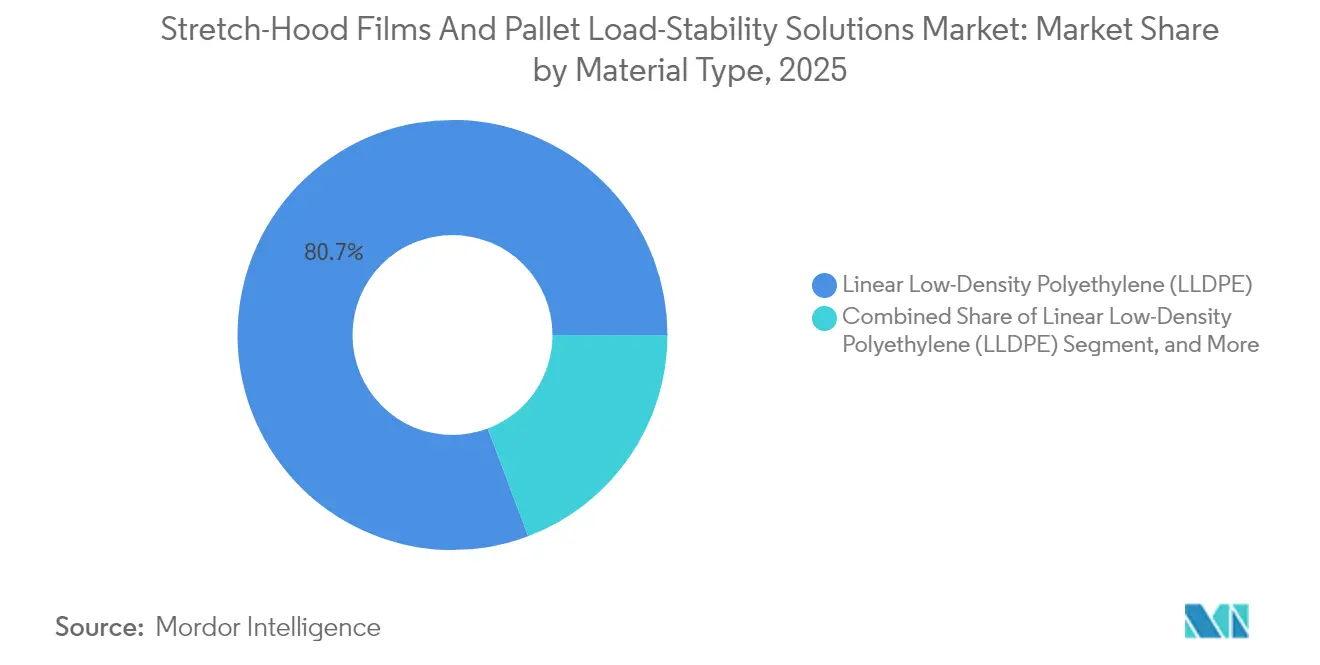
LLDPE Dominance Reinforces Performance LeadershipLinear low-density polyethylene captured 80.73% stretch-hood films and pallet load-stability solutions market share in 2025, and the segment is set to register a 6.82% CAGR to 2031. Adoption rests on its tensile strength and puncture resistance that permit 300% elongation without tearing, a prerequisite for automated hooders running at 200 pallets an hour. LDPE retains a niche where extra cling aids irregular bundles, while POE blends target frost-exposed fertilizer stacks needing impact flexibility. Amcor demonstrates that recycled LLDPE can substitute for virgin resin at 30% loadings and still pass drop tests, opening up material circularity pathways.
Continued investment in solution-phase reactors enables Dow to tailor molecular weight distributions for specific gauge ranges, empowering downgauging efforts crucial to the stretch-hood films and pallet load-stability solutions market. FDA food-contact compliance narrows resin choices for beverage fillers, solidifying LLDPE's position in premium applications. Specialty copolymers incorporate slip modifiers that reduce machine jaw sticking, thereby enhancing line uptime. As carbon-tax regimes gain momentum, converters that blend PCR with high-performance LLDPE are poised to secure new contracts ahead of their less agile rivals.



By Film Thickness:
Downgauging Trend Accelerates Sub-50 Micron AdoptionFilms in the 50-100 micron band controlled 31.12% of the stretch-hood films and pallet load-stability solutions market size in 2025, reflecting the industry’s historical comfort zone. However, formulations under 50 microns now post a 6.75% CAGR as resin science compensates for thickness cuts with multilayer strength. Extruders optimize layer stacking where a nanometric outer skin supplies a barrier while the core absorbs dynamic stress during forklift impact. Tests on 30-micron hoods confirm a 4,000-pound load resilience, validating commercial substitution.
Regulators accept downgauging as a direct Scope 3 lever, catalyzing procurement mandates that favor the thinnest certified option. Brands disclose annual film-weight reduction in CSR reports, elevating the strategic relevance of the stretch-hood films and pallet load-stability solutions market. High-density stacks of bagged cement still employ 120-micron hoods, indicating a ceiling on downgauging for heavy vertical loads. Even so, the trajectory clearly points to lighter gauges across mainstream consumer goods.
By Machine Type:
Automation Imperative Drives Equipment EvolutionAutomatic systems accounted for 75.98% of the stretch-hood films and pallet load-stability solutions market size in 2025, driven by the need to offset labor shortages and sustain 24-hour fulfillment. PLC-controlled heads calibrate film tension in milliseconds, guaranteeing uniform load force and higher pass rates in EUMOS tests. Semi-automatic units remain in mid-volume distribution where shift flexibility outweighs throughput, yet their share shrinks as leasing models make fully automatic equipment more accessible.
Integration with warehouse execution software underpins predictive maintenance, which schedules jaw replacement before failure, thereby extending uptime. Servo drives increase cycle speed by 15%, allowing for a 15% increase in daily pallet capacity without requiring mechanical redesign. The stretch-hood films and pallet load-stability solutions market increasingly bundles machine, film, and service in one invoice, simplifying ROI sign-off. This shift benefits players offering both resin science and motion control, reinforcing vertical integration trends.
By Equipment Throughput:
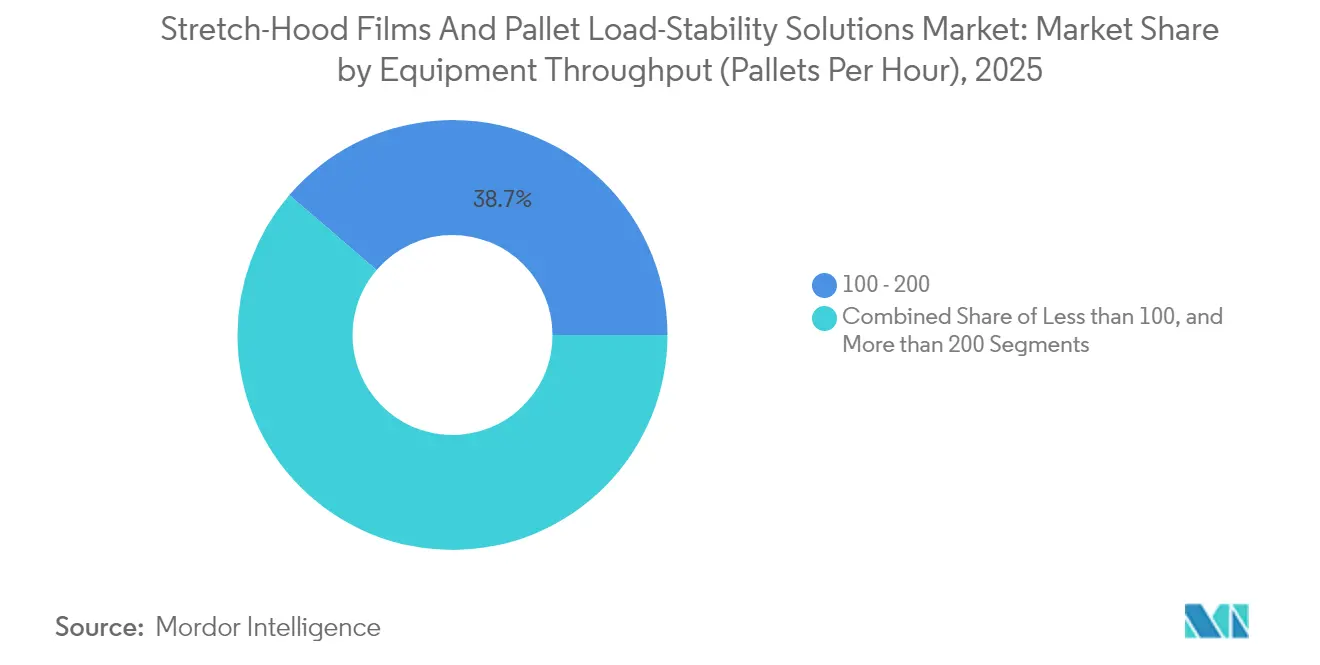
High-Speed Operations Command Premium PositioningEquipment rated for 100-200 pallets per hour held a 38.72% market share of stretch-hood films and pallet load-stability solutions in 2025, representing the productivity sweet spot for large CPG plants. Facilities shipping more than 2,000 pallets daily gravitate toward 200+ pallet lines, which log the fastest 6.61% CAGR through 2031. Servo-based film carriage acceleration and automatic roll exchange cut dwell time, helping mega-warehouses match outbound trailer sequencing.
Sub-100 pallet systems are designed for specialized environments, such as seasonal produce sheds, where variable load profiles preclude the need for high-speed uniformity. But as robotics permeates even medium-sized warehouses, demand migrates to faster heads that prevent upstream bottlenecks. The stretch-hood films and pallet load-stability solutions market rewards vendors that can fine-tune cycle times without sacrificing seal integrity at elevated speeds.
By End-User Industry:
Food and Beverage Leadership Reflects Stringent RequirementsFood and beverage accounted for 33.22% of the stretch-hood films and pallet load-stability solutions market size in 2025, driven by the need to avoid contamination and control condensation. Hooded pallets supply full top coverage, preventing dust ingress inside distribution centers and during refrigerated cross-dock transfers. Beverage manufacturers value the elimination of heat tunnels that could raise product temperature and breach HACCP limits.
Chemicals and fertilizers register the highest 7.39% CAGR as bagged granular loads require puncture-resistant hoods to minimize dermal exposure during handling. Building materials continue to specify UV-stable films for outdoor storage in yards. Consumer electronics shippers cite dust exclusion and retail-quality optics as decisive factors. Across end-users, the stretch-hood films and pallet load-stability solutions market advances on the strength of mission-critical hygiene and safety assurances.
Geography Analysis
APAC Stretch-Hood Films and Pallet Load-Stability Solutions Market
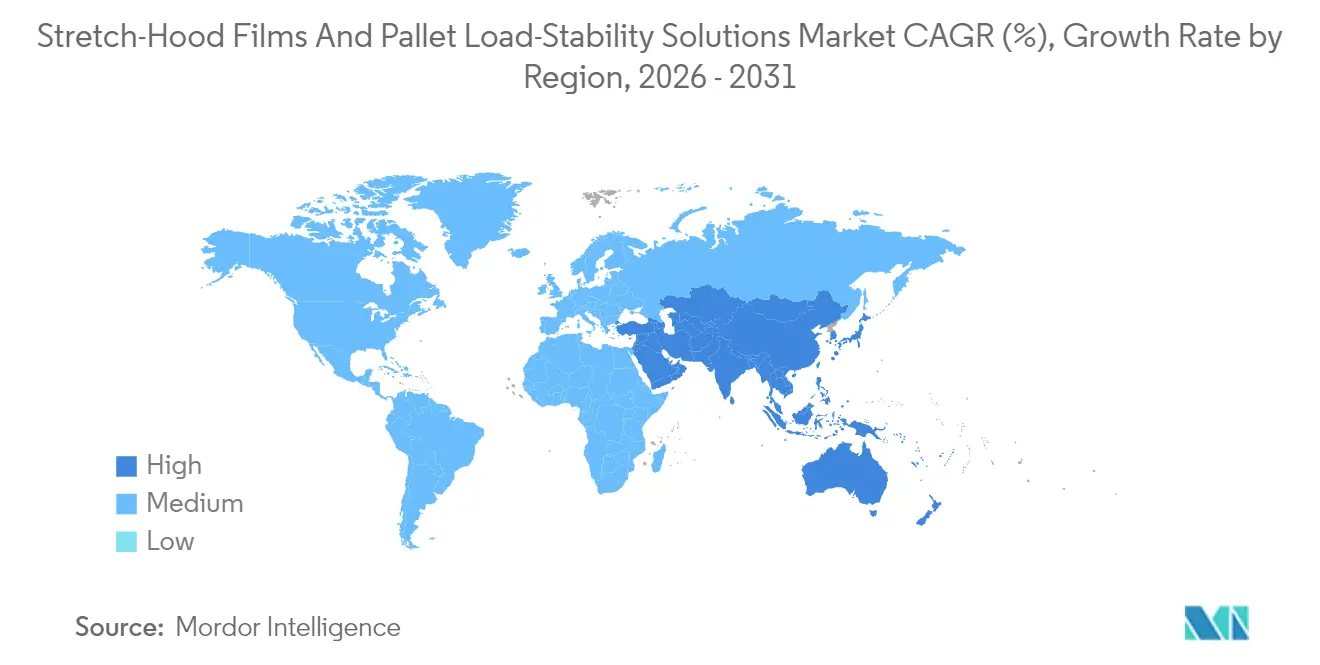
The Asia-Pacific commanded a 41.10% market share of stretch-hood films and pallet load-stability solutions in 2025 and is forecast to post a 7.49% CAGR through 2031. China’s export-oriented factories retrofit lines with hooders to clear European EUMOS certificates, while India’s National Logistics Policy funds modern distribution centers that include automated pallet security. Japan fits hood lines with IoT sensors that feed lean dashboards, and South Korea’s resin sector pilots specialty POE grades that enable downgauging.
Europe Stretch-Hood Films and Pallet Load-Stability Solutions Market
Europe ranks second as EN 17321 mandates ripple across supply chains, compelling German automotive tiers and French food processors to document the integrity of pallets. Italy’s luxury exports adopt clear hoods to protect high-gloss cartons without obscuring branding, and the United Kingdom accelerates adoption to defend export shelf presence post-Brexit. Regional recyclers invest in wash lines to meet PPWR goals, closing the loop for recovered hood film.
North America Stretch-Hood Films and Pallet Load-Stability Solutions Market
North America continues to grow steadily, driven by e-commerce giants that standardize single-shot hooding to minimize rework at cross-dock hubs. U.S. facilities integrate hood data into WMS platforms for real-time damage analytics, while Canada’s fertilizer exporters prefer thick, UV-stabilized hoods for Arctic rail corridors. Mexico’s near-shoring boom in electronics and automotive assembly triggers new hood lines aimed at meeting United States-Mexico-Canada Agreement shipping standards. Collectively, regulatory alignment and automation incentives cement the prominence of the stretch-hood films and pallet load-stability solutions market across major regions.

Competitive Landscape
The stretch-hood film and pallet load-stability solutions market maintains a moderate concentration, with the top five vendors controlling nearly 55% of sales. Amcor scales PCR integration, raising films with 30% recycled resin while preserving drop-test integrity, and Dow leverages its solution-polyethylene platform to customize grades for sub-50 micron targets. Machinery leaders BEUMER and FROMM emphasize servo automation that cuts cycle time and embeds diagnostic analytics.
Vertical integration accelerates as filmmakers acquire regional hooder OEMs to ensure film-machine harmony. FROMM pilots film subscription models that incorporate resin price hedging, attracting customers wary of polyethylene price fluctuations. Regional converters without equipment expertise partner with motion-control specialists, sharing intellectual property to compete on turnkey bids. Sustainability credentials have become a bid qualifier, forcing laggards to fast-track PCR sourcing.
Product innovation centers on downgauged multilayer films, energy-efficient seal jaws, and cloud dashboards that log every pallet’s containment force. Patent activity rises around anti-condensation film chemistry and predictive jaw wear. This innovation race keeps barriers to entry moderate, sustaining the stretch-hood films and pallet load-stability solutions market’s competitive tension.
Stretch-Hood Films And Pallet Load-Stability Solutions Industry Leaders
Amcor plc
Novolex Holdings, LLC
Innova Maquinaria Industrial SL
Intertape Polymer Group
RKW Group
- *Disclaimer: Major Players sorted in no particular order

Stretch-Hood Films And Pallet Load-Stability Solutions Market Companies Covered in this Report
- Amcor plc
- Trioworld Industrier AB
- Novolex Holdings, LLC
- Innova Maquinaria Industrial SL
- Intertape Polymer Group
- RKW Group
- Dow Chemical Company
- FROMM Group
- Bischof + Klein SE & Co. KG
- Zhejiang Bili Polymer Technology Co. Ltd.
- BEUMER Group GmbH & Co. KG
- MSK Covertech Group
- Signode Industrial Group LLC
- Premier Tech Ltd.
- Bocedi srl
- Aetna Group SPA
- PAGLIERANI s.r.l.
- Fisker Skanderborg A/S
- Ehcolo A/S
- Nipper B.V.

Recent Industry Developments in Stretch-Hood Films And Pallet Load-Stability Solutions Market
- August 2025: Amcor expanded recycling capacity at its Heanor UK plant, boosting reclaimed polyethylene output for hood film conversion.
- August 2025: ExxonMobil Signature Polymers partnered with XL Recycling to co-develop PCR rich stretch and shrink hood films targeting PPWR 35% thresholds.
- January 2025: Zeus Packaging launched the Apollo Pallet Wrapping System, claiming up to 60% plastic reduction and scope-3 carbon savings.
- November 2024: Tentoma installed a RoRo StretchPack XL line at JACKON Insulation Belgium to protect XPS boards in transit.


Global Stretch-Hood Films And Pallet Load-Stability Solutions Market Report Scope
| By Material Type | Linear Low-Density Polyethylene (LLDPE) |
| Low-Density Polyethylene (LDPE) | |
| Other Material Types | |
| By Film Thickness (Microns) | Less than 50 Micrometer |
| 50 - 100 Micrometer | |
| 100 - 150 Micrometer | |
| More than 150 Micrometer |
| By Machine Type | Automatic |
| Semi-automatic | |
| Manual | |
| By Equipment Throughput (Pallets/Hour) | Less than 100 |
| 100 - 200 | |
| More than 200 |
| Food and Beverage |
| Building and Construction Materials |
| Chemicals and Fertilisers |
| Consumer Appliances and Electronics |
| Pharmaceuticals and Healthcare |
| Logistics and 3PL Warehousing |
| Other End-User Industries |
| North America | United States | |
| Canada | ||
| Mexico | ||
| South America | Brazil | |
| Argentina | ||
| Rest of South America | ||
| Europe | Germany | |
| United Kingdom | ||
| France | ||
| Italy | ||
| Spain | ||
| Rest of Europe | ||
| Asia-Pacific | China | |
| Japan | ||
| India | ||
| South Korea | ||
| Australia | ||
| Rest of Asia-Pacific | ||
| Middle East and Africa | Middle East | Saudi Arabia |
| Turkey | ||
| United Arab Emirates | ||
| Rest of Middle East | ||
| Africa | South Africa | |
| Egypt | ||
| Rest of Africa | ||
| By Stretch-Hood Films | By Material Type | Linear Low-Density Polyethylene (LLDPE) | |
| Low-Density Polyethylene (LDPE) | |||
| Other Material Types | |||
| By Film Thickness (Microns) | Less than 50 Micrometer | ||
| 50 - 100 Micrometer | |||
| 100 - 150 Micrometer | |||
| More than 150 Micrometer | |||
| By Pallet Load-Stability Solutions | By Machine Type | Automatic | |
| Semi-automatic | |||
| Manual | |||
| By Equipment Throughput (Pallets/Hour) | Less than 100 | ||
| 100 - 200 | |||
| More than 200 | |||
| By End-User Industry | Food and Beverage | ||
| Building and Construction Materials | |||
| Chemicals and Fertilisers | |||
| Consumer Appliances and Electronics | |||
| Pharmaceuticals and Healthcare | |||
| Logistics and 3PL Warehousing | |||
| Other End-User Industries | |||
| By Geography | North America | United States | |
| Canada | |||
| Mexico | |||
| South America | Brazil | ||
| Argentina | |||
| Rest of South America | |||
| Europe | Germany | ||
| United Kingdom | |||
| France | |||
| Italy | |||
| Spain | |||
| Rest of Europe | |||
| Asia-Pacific | China | ||
| Japan | |||
| India | |||
| South Korea | |||
| Australia | |||
| Rest of Asia-Pacific | |||
| Middle East and Africa | Middle East | Saudi Arabia | |
| Turkey | |||
| United Arab Emirates | |||
| Rest of Middle East | |||
| Africa | South Africa | ||
| Egypt | |||
| Rest of Africa | |||


Key Questions Answered in the Report
What is the current value of the stretch-hood films and pallet load-stability solutions market?
The market is valued at USD 4.11 billion in 2026 and is on track to hit USD 5.59 billion by 2031.
Which region leads demand for stretch-hood pallet security solutions?
Asia-Pacific holds the top position with 41.10% share thanks to export-oriented manufacturing and logistics modernization.
Why are companies downgauging stretch-hood film thickness?
Advances in multi-layer LLDPE allow sub-50 micron gauges that cut resin use and carbon footprint while maintaining load stability.
Which end-use sector is growing fastest for stretch-hood systems?
Chemicals and fertilizers post the highest 7.39% CAGR because hooded pallets meet hazardous-material containment rules.
How do load-stability standards affect equipment purchases?
Compliance with EN 17321 and EUMOS 40509 compels shippers to upgrade to automated hooders that can prove certified containment, unlocking insurance savings.
What hampers adoption among small and medium enterprises?
High upfront machinery costs and limited technical skill for film-machine optimization remain prime barriers, although leasing and online training are easing entry.
Page last updated on:





