
Streaming Platform Technology Market Size and Share
Market Overview
| Study Period | 2020 - 2031 |
|---|---|
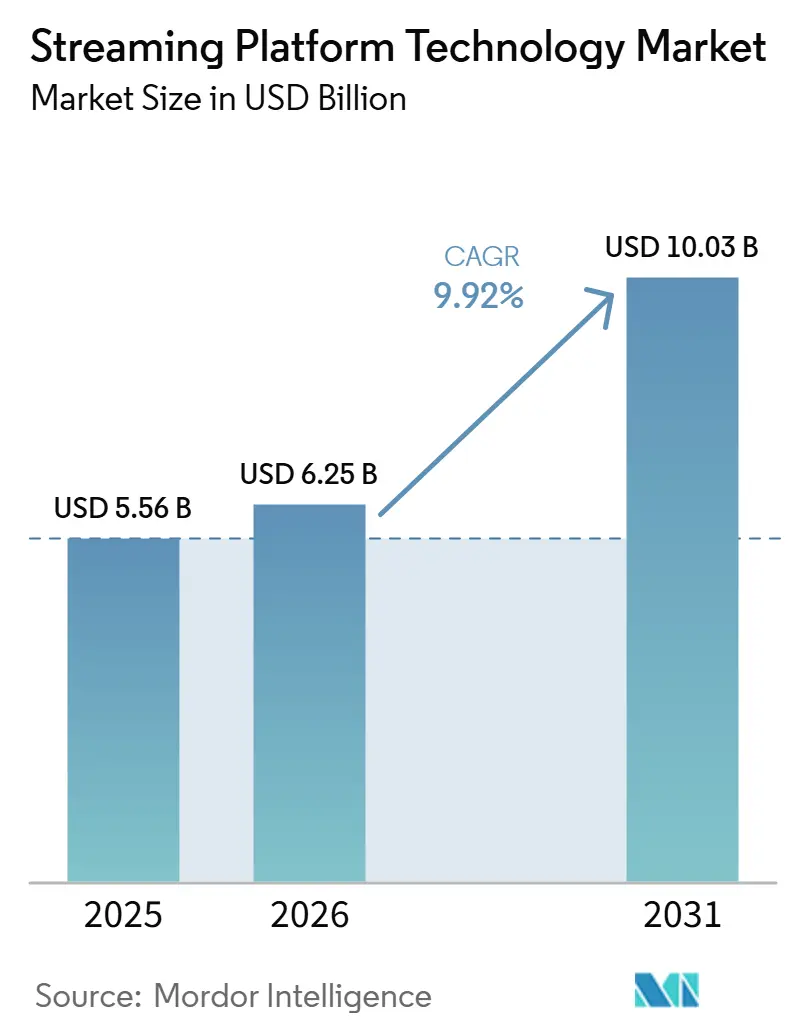
| Market Size (2026) | USD 6.25 Billion |
| Market Size (2031) | USD 10.03 Billion |
| Growth Rate (2026 - 2031) | 9.92 % |
| Fastest Growing Market | Asia-Pacific |
| Largest Market | North America |
| Market Concentration | Medium |
Major Players *Disclaimer: Major Players sorted in no particular order Image © Mordor Intelligence. Reuse requires attribution under CC BY 4.0. | |
Streaming Platform Technology Market Analysis by Mordor Intelligence
The Streaming platform technology market size was valued at USD 5.56 billion in 2025 and estimated to grow from USD 6.25 billion in 2026 to reach USD 10.03 billion by 2031, at a CAGR of 9.92% during the forecast period (2026-2031). The replacement of on-premises is shaping the streaming platform technology market broadcast systems with cloud-native media workflows across broadcasters, enterprises, and public agencies. Demand is rising for platforms that combine video processing, delivery, security, monetization, and workflow management without requiring separate tools for each activity. Low-latency live video, AI-supported content operations, and data residency requirements are changing the criteria for vendor selection. Large cloud providers are broadening their media portfolios, while specialist vendors focus on codec efficiency, latency, and workflow capabilities. Higher bandwidth and transcoding costs, together with different privacy and data rules across regions, continue to limit the pace of deployment for some operators.
Key Report Takeaways
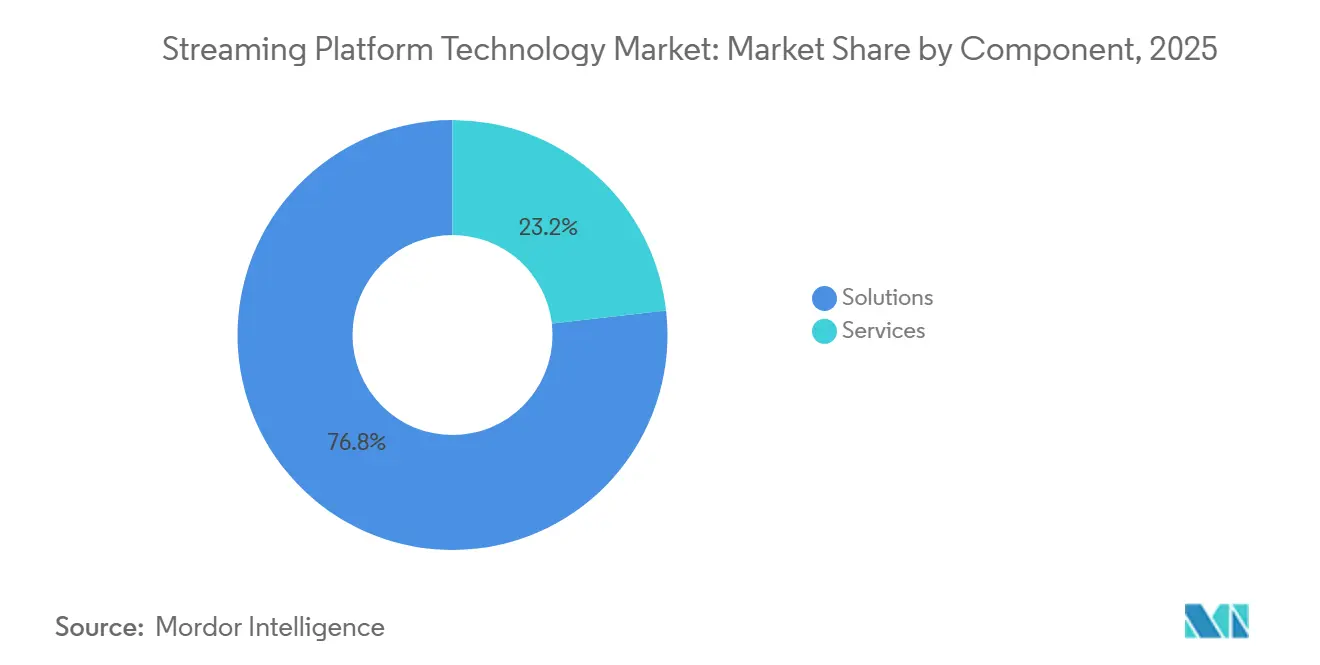
- By component, solutions held 76.82% of the streaming platform technology market share in 2025, while services are projected to expand at a CAGR of 10.63% through 2031.
- By streaming type, video-on-demand streaming accounted for 62.63% of the market value in 2025, while live streaming is projected to record the highest CAGR of 10.78% through 2031.
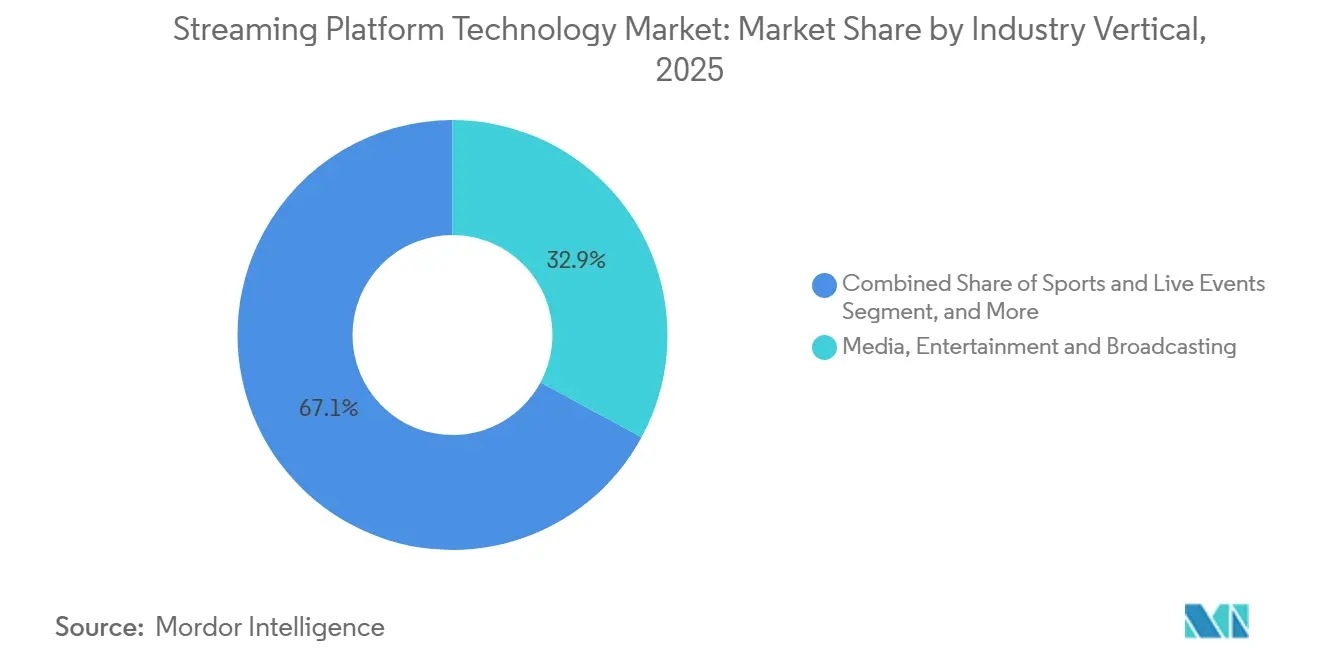
- By industry vertical, media, entertainment, and broadcasting accounted for 32.89% of the streaming platform technology market size in 2025, while education and e-learning are projected to expand at a CAGR of 10.31% through 2031.
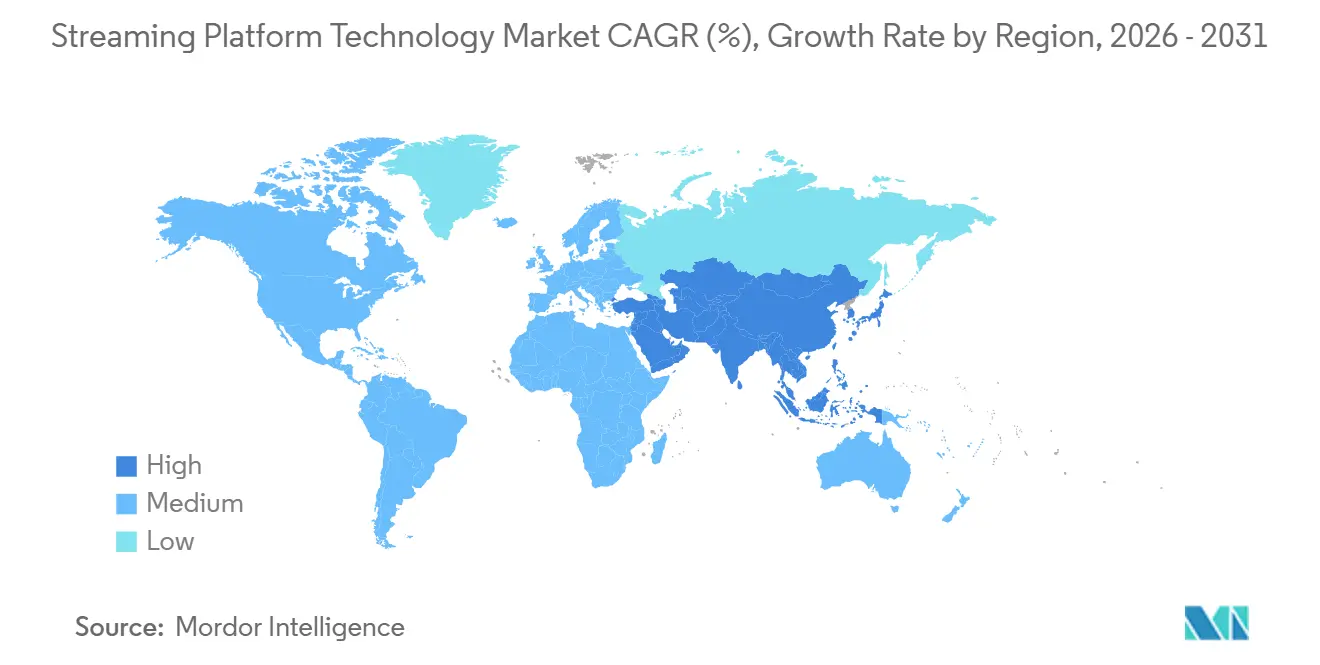
- By geography, North America held 37.41% of the market value in 2025, while the Asia-Pacific region is projected to grow at a CAGR of 10.38% through 2031.
Note: Market size and forecast figures in this report are generated using Mordor Intelligence’s proprietary estimation framework, updated with the latest available data and insights as of January 2026.
Market Trends and Insights
Drivers Impact Analysis of Streaming Platform Technology Market*
| Driver | (~) % Impact on CAGR Forecast | Geographic Relevance | Impact Timeline |
|---|---|---|---|
| Rising Demand for Low-Latency Live Experiences | +2.3% | Global, concentrated in North America, East Asia, and Western Europe | Short term (≤ 2 years) |
| AI-Powered Video Automation and Localization | +2.0% | Global, with highest uptake in North America and Asia-Pacific | Medium term (2-4 years) |
| Cloud-Native Video Workflows Lowering Time to Market | +1.6% | Global, with early adoption concentrated in North America and Europe | Medium term (2-4 years) |
| Expansion of Connected TV and Multi-Device Delivery | +1.2% | North America and Europe are primary, with Asia-Pacific and Middle East and Africa extending demand | Short term (≤ 2 years) |
| Growth of Ad-Supported and Hybrid Monetization | +0.9% | North America is primary, with Asia-Pacific and Europe secondary | Short term (≤ 2 years) |
| 5G and Edge Infrastructure Enabling Interactive Streaming | +0.7% | Asia-Pacific is core, including China, South Korea, and India, with spillover to North America and Europe | Long term (≥ 4 years) |
| Source: Mordor Intelligence | |||
Rising Demand for Low-Latency Live Experiences
The streaming platform technology market benefits as sub-second video delivery becomes a commercial requirement for live formats where viewers react, bid, or place bets in real time. Traditional HLS designs can introduce delays of 10-30 seconds, which limits their usefulness for synchronized sports, interactive commerce, polling, and second-screen programs. LL-HLS, CMAF-CTE, and Media over QUIC are reducing acceptable delay windows and increasing demand for specialized delivery networks, player software, and real-time analytics. Cloudflare introduced a globally distributed Media over QUIC relay network across more than 330 cities in 2025, with development involving Meta, Google, Cisco, and the IETF community.[1]Cloudflare, “MoQ: Refactoring the Internet's Real-Time Media Stack,” Cloudflare, blog.cloudflare.com Internet Initiative Japan, Fujitsu, and Nomura Research Institute demonstrated Local 5G and physical AI streaming at the KYOJO CUP racing series in July 2026, using AI-selected camera angles with low delay at an event scale.
AI-Powered Video Automation and Localization
The streaming platform technology market is changing video operations, moving beyond ingest and metadata tagging to include localization, accessibility, and advertising workflows. These capabilities reduce the manual work required to prepare the same content for several languages, devices, and regional audiences. Brightcove announced an expanded AI Suite in February 2026 that included captions in more than 90 languages, AI-supported audio descriptions, and contextual advertising based on content analysis. Kaltura expanded its platform after acquiring eSelf.ai and PathFactory, and it introduced Agentic Avatars that generate personalized media in more than 30 languages in real time. Akamai introduced cloud instances powered by NETINT video processing units in 2025, enabling lower-cost video processing for media workloads.
Cloud-Native Video Workflows Lowering Time to Market
Cloud-native production environments are reducing deployment cycles and giving operators more flexibility than fixed broadcast systems. Microservices-based designs support workload scaling, cost visibility, and faster changes to media workflows as viewing patterns or content schedules shift. AWS launched its Cloud-native Agile Production program at NAB 2025 with the BBC and Sky, and released tools for fast-turnaround workflows based on the Time-addressable Media Store specification. The ISO/IEC 23090-8 Network-Based Media Processing standard provides a Kubernetes-native framework for cloud and edge multimedia workflows, making interoperability and standards compliance more relevant in large procurements. The streaming platform technology market is also moving toward consumption-based contracts because cloud systems clearly show per-workflow costs and let operators assess delivery configurations in real time.
Expansion of Connected TV and Multi-Device Delivery
Connected TV is increasing the need for platforms that support advertising, security, analytics, and playback across many device types. The rise of ad-supported streaming makes server-side and dynamic ad insertion, as well as audience measurement, central to video platform deployments. In the streaming platform technology market, this creates greater value for player tools that combine advertising controls, digital rights management, and performance measurement into a single software development kit. This expansion increases the need for compatible encoding, packaging, and measurement infrastructure across different distribution environments. The wider mix of mobile phones, smart televisions, desktops, consoles, and in-car screens also increases demand for vendors that can test and manage streams across different operating environments.
Restraints Impact Analysis of Streaming Platform Technology Market*
| Restraint | (~) % Impact on CAGR Forecast | Geographic Relevance | Impact Timeline |
|---|---|---|---|
| Escalating Bandwidth and Transcoding Costs | -1.4% | Global, most acute for emerging-market operators and independent streaming platforms | Short term (≤ 2 years) |
| Privacy, Rights, and Data Residency Constraints | -1.1% | Europe is primary, with India and broader Asia-Pacific secondary and spillover to North America | Medium term (2-4 years) |
| Device, Codec, and Player Fragmentation | -0.8% | Global, most acute in emerging markets with legacy device populations | Short term (≤ 2 years) |
| Peak-Time Quality Instability in Emerging Networks | -0.5% | Asia-Pacific, Africa, and South America | Long term (≥ 4 years) |
| Source: Mordor Intelligence | |||
Escalating Bandwidth and Transcoding Costs
The streaming platform technology market faces high bandwidth and transcoding costs, as spending rises with concurrent audience size and higher video quality requirements. This cost structure favors operators that can secure committed-volume pricing or operate infrastructure at a large scale. Smaller providers often have fewer resources to manage multi-CDN routing, internal encoding ladders, and quality controls. Akamai's video processing unit cloud instances provide one route to lower compute costs for media workloads and demonstrate how cost efficiency has become a competitive requirement. Energy-efficiency obligations under European data center rules add another factor to provider selection and encourage some operators to consolidate workloads with providers that can document their operating performance.
Privacy, Rights, and Data Residency Constraints
Different privacy, rights, and residency rules require streaming providers to adapt how they store, secure, and process content data across markets. The EU Data Act became effective in September 2025, while India began implementing the Digital Personal Data Protection Rules 2025 in phases from November 2025. These requirements can require separate storage, encryption, logging, and access-control arrangements for services that operate in more than one jurisdiction. AWS launched the European Sovereign Cloud in January 2026 to keep workloads, encryption keys, and logs within the European Union for customers with sovereignty requirements.[2]Amazon Web Services, “AWS European Sovereign Cloud,” Amazon Web Services, aws.amazon.com The streaming platform technology market, therefore, has a stronger demand for digital rights management, access controls, and deployment models that meet regional requirements without interrupting delivery.
*Our forecasts treat driver/restraint impacts as directional, not additive. The impact forecasts reflect baseline growth, mix effects, and variable interactions.
Streaming Platform Technology Market Segment Analysis
By Component:
Solutions Form the Core Technology LayerSolutions accounted for 76.82% of the streaming platform technology market in 2025, as they cover the software functions required to operate a complete streaming service. Video processing, encoding, and packaging form the computational core, while delivery, playback, workflow, monetization, and security tools support the rest of the service. These layers are closely connected because problems in one part of the workflow can affect playback quality, advertising accuracy, or content protection. Video monetization and security functions are receiving greater attention as ad-supported services need accurate insertion and operators address data residency requirements. Analytics, observability, and quality-of-experience monitoring are also becoming increasingly important in vendor selection, as customers need evidence that service targets can be met. Akamai added MediaMelon's SmartSight video intelligence platform to its Qualified Compute Partner Program in 2025, linking streaming analytics with infrastructure deployment. Within the streaming platform technology market, these requirements keep solutions central to spending. Operators also prefer integrated systems when they need to coordinate content preparation, delivery, advertising, and security across multiple markets.
Services are projected to expand at a CAGR of 10.63% through 2031, making it the fastest-growing component category. Managed and professional services appeal to operators that need to deploy multi-CDN, adaptive bitrate, security, and cloud workflows without building large internal engineering teams. The model also supports contracts based on service quality and delivery outcomes, rather than solely on the sale of software licenses. Demand is particularly relevant for smaller operators in South America, Africa, and parts of the Asia-Pacific that may not have specialized video operations teams. Standards compliance is becoming part of larger public-sector and enterprise procurement processes, which supports providers with established cloud-native implementations. The component mix shows that the streaming platform technology industry is shifting toward technical support that helps customers operate complex environments after implementation. This change can shorten deployment time, but it also makes service quality and workforce capacity more important for suppliers. It allows vendors to deepen customer relationships once the platforms are deployed to production.


By Streaming Type:
Live Delivery Gains Importance Alongside VoDVideo-on-Demand Streaming held 62.63% of the streaming platform technology market share in 2025, supported by established investments in content libraries, recommendation tools, and subscriber management systems. Broadcasters and over-the-top services have spent years building infrastructure for asynchronous viewing, which keeps VoD the largest streaming type. New spending in this category is increasingly directed toward encoding efficiency, intelligent routing, personalization, and advertising functions rather than basic platform construction. These improvements help operators increase the value of existing content libraries while controlling delivery costs across devices. The mature VoD base also provides recurring demand for security, workflow, and measurement tools. It remains important for the streaming platform technology market because viewers continue to expect reliable access to large libraries at any time. Platform providers, therefore, need to preserve stable VoD operations while adapting products to changing device and advertising requirements. The scale of legacy content libraries also makes migration and workflow interoperability important in purchasing decisions.
Live Streaming is projected to grow at a CAGR of 10.78% from 2026 to 2031, the fastest rate among streaming types. The shift of premium sports rights to streaming, the rise of interactive commerce events in Asia-Pacific, and the growth of enterprise broadcasts are increasing demand for live delivery infrastructure. Customers increasingly expect low latency, concurrent rights protection, dynamic advertising, and the ability to handle sharp audience spikes within the same service. Kaltura delivered record-scale live streaming for the 2026 FIFA World Cup and previewed Agentic Avatar experiences for live sports, showing the use of real-time personalized overlays for large audiences. Mobile represented 55.2% of live streaming usage in 2025, while smart television viewing is expected to rise through 2031. Vendors must therefore maintain performance across mobile and connected television environments simultaneously. That requirement raises the engineering burden for companies that support live services and increases the value of proven playback, testing, and observability tools. The need to balance latency, scale, security, and monetization creates a high bar for new suppliers.
By Industry Vertical:
Media Remains Largest While Education ExpandsMedia, Entertainment, and Broadcasting accounted for 32.89% of the streaming platform technology market size in 2025, reflecting its long-standing role as the largest operator of streaming infrastructure. The sector requires high-capacity workflows for content preparation, delivery, rights protection, advertising, and viewer measurement. Sports and live events are increasing infrastructure needs because rights holders must handle large audiences, low-latency delivery, and digital rights management across territories. Telecommunications and pay-TV providers are also moving from legacy broadcast headends toward cloud-based streaming systems. Enterprise and corporate communications use broadcast-grade platforms for global town halls, investor events, and internal video services. These requirements keep the media-focused part of the streaming platform technology industry closely tied to both consumer viewing and professional communications. They also place greater importance on reliability, capacity planning, and multi-region operations. Larger media customers can focus their purchasing decisions because their technical and compliance needs often require multiple capabilities from the same supplier.
Education and E-Learning are projected to grow at a CAGR of 10.31% through 2031, making it the fastest-growing industry vertical. Coursera surpassed 200 million cumulative learners in the first quarter of 2026 and reported a fourth consecutive quarter of double-digit year-over-year consumer revenue growth, while advancing integration planning with Udemy. This growth supports the streaming platform technology market by driving demand for secure, scalable video platforms for lectures, assessment content, live sessions, and learner support. Healthcare also uses streaming for remote consultations, medical education, and surgical video, where encryption, residency controls, and watermarking are important. Banking, Financial Services and Insurance, government, and public-sector users similarly prioritize access control and compliance. Retail and e-commerce platforms are adopting live commerce formats, particularly in Asia-Pacific, where sellers need low-latency video and shopping features. Hospitality, logistics, and other verticals remain early-stage users, but their adoption broadens the range of enterprise video requirements. The wider vertical base reduces reliance on any single buyer group and creates a more varied set of needs for workflow, security, and delivery capabilities.

Geography Analysis
North America Streaming Platform Technology Market
North America held 37.41% of the streaming platform technology market share in 2025, supported by the region's concentration of cloud infrastructure, media companies, and enterprise customers. The region has a mature connected television ecosystem and a strong need for ad insertion, audience measurement, playback, and security tools. Canada creates bilingual localization needs, while Mexico adds early-stage demand as broadband access and streaming activity expand. These conditions support continued spending in the streaming platform technology market on systems that can operate across regions without compromising service quality.
APAC Streaming Platform Technology Market
Asia-Pacific is projected to grow at a CAGR of 10.38% through 2031, making it the fastest-growing regional segment. The region's scale, content spending, mobile use, and connected television expansion make it a priority growth area for the streaming platform technology market. Its large number of languages and wide range of network conditions increase the need for adaptable workflows, playback tools, and delivery methods.
EMEA and South America Streaming Platform Technology Market
Europe maintained a significant position in 2025 because broadcasters in the United Kingdom, Germany, France, and the Netherlands operate cloud-based live and VoD services at scale. ITV partnered with Akamai to launch Freely, leveraging content delivery, web application protection, and bot management for free streaming television.[3]Akamai Technologies, “ITV Partners With Akamai to Power the Launch of Freely,” Akamai Technologies, akamai.com The EU Data Act, NIS2 Directive, and DORA requirements are encouraging upgrades that support security and sovereignty requirements. South America is growing through broadband development and domestic content investment, with local language and regulatory needs favoring regional delivery capabilities. Middle Eastern investment in domestic content and sovereign cloud infrastructure is creating public-sector-led demand, while Africa requires mobile-first, bandwidth-efficient services for constrained networks. Together, these markets give the streaming platform technology market a broader regional base, although infrastructure quality, local compliance rules, and purchasing capacity differ widely.

Competitive Landscape
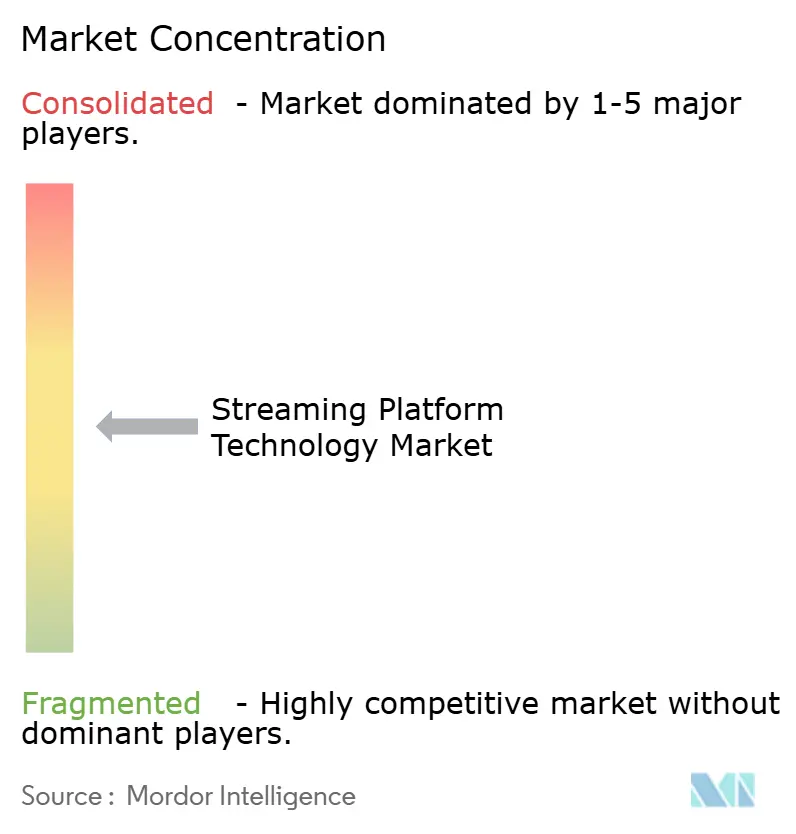
The streaming platform technology market is moderately fragmented because large cloud providers and specialist vendors compete in different parts of the video technology stack. Amazon.com, Alphabet, and Microsoft offer broad cloud media services, including AWS Elemental, Google Cloud Video Intelligence, and Azure Media Services. Specialists such as Bitmovin, Mux, Haivision, and Amagi compete through encoding, playback, latency optimization, monitoring, and workflow capabilities. The larger providers benefit from integrated infrastructure, while specialists focus on specific operational requirements that broad cloud portfolios may not fully address.
Kaltura acquired eSelf.ai and PathFactory and introduced Agentic Avatar capabilities for personalized media, strengthening its position in AI-supported video experiences. Brightcove expanded its AI product direction in 2026 with captions, audio descriptions, contextual advertising, and a redesigned platform interface. Akamai and Cloudinary formed a strategic alliance that combines Akamai's delivery capabilities with Cloudinary's AI-based media management tools. Bitmovin and Akamai deployed Akamai Adaptive Media Player 2 for NRJ Group in June 2026, bringing player, observability, stream testing, and content delivery functions into a single deployment.[4]Bitmovin and Akamai, “Bitmovin and Akamai Support NRJ Group to Deploy Next Generation Media Player, AMP2,” Bitmovin, bitmovin.com Akamai's cloud video processing unit instances also show how suppliers are competing on the cost of media processing as well as product functionality.
Open opportunities remain in AI-based streaming observability, sovereignty-ready digital rights management, and interactive streaming for regions with constrained network conditions. Media over QUIC may reduce latency for large-scale live delivery and increase competitive pressure on vendors that use proprietary real-time delivery approaches. Larger customers are likely to place greater weight on measurable quality-of-experience targets, compliance capability, and AI-supported workflows when evaluating suppliers. The streaming platform technology market, therefore, rewards cloud scale, specialized performance, regulatory readiness, and integration quality.
Streaming Platform Technology Industry Leaders
Amazon.com, Inc.
Alphabet Inc.
Microsoft Corporation
Akamai Technologies, Inc.
Cisco Systems, Inc.
- *Disclaimer: Major Players sorted in no particular order
Streaming Platform Technology Market Companies Covered in this Report
- Amazon.com, Inc.
- Alphabet Inc.
- Microsoft Corporation
- Akamai Technologies, Inc.
- Cisco Systems, Inc.
- Brightcove Inc.
- Kaltura, Inc.
- Vimeo, Inc.
- Wowza Media Systems, LLC
- Muvi LLC
- Bitmovin Inc.
- Haivision Systems Inc.
- Telestream, LLC
- Cloudinary Ltd.
- Mux, Inc.
- Panopto, Inc.
- JW Player, Inc.
- Dacast, Inc.
- Verimatrix, Inc.
- Synamedia Limited
- Amagi Media Labs Private Limited
- Dalet S.A.
- Conviva, Inc.

Recent Industry Developments in Streaming Platform Technology Market
- July 2026: Kaltura delivered record-scale live streaming for the 2026 FIFA World Cup and simultaneously previewed Agentic Avatar experiences for live sports, demonstrating real-time AI-personalized content layering at global mass-audience concurrent load. The deployment validated Kaltura's Agentic Digital Experience platform under peak stress conditions across multiple geographies simultaneously.
- June 2026: Bitmovin and Akamai announced the deployment of Akamai Adaptive Media Player 2, AMP2, for NRJ Group, France's largest multimedia company, marking NRJ as the first net new customer for AMP2. AMP2 integrates Bitmovin's player, Observability, and Stream Lab technologies with Akamai's CDN infrastructure, unifying playback, analytics, and monetization across NRJ's mobile, web, and third-party platform delivery chains.
- June 2026: Akamai earned the Solutions Partner with Certified Software designation for API Security within the Microsoft Azure AI Cloud Partner Program, extending Akamai's API security capabilities to Azure-native streaming workloads and deepening the Akamai-Microsoft integration across cloud-delivered media services.
- May 2026: Brightcove launched Prism, its most significant platform interface redesign, developed with input from more than 100 customers, following delivery of more than 20 major capabilities in the prior 12 months including Live 4K streaming, SSAI with DRM, vertical video support, animated thumbnails, and the full AI Suite. Further updates including live captions and contextual advertising are planned through the remainder of 2026.


Global Streaming Platform Technology Market Report Scope
The Streaming Platform Technology Market comprises software platforms, infrastructure, and associated services that enable the creation, management, processing, delivery, monetization, and optimization of digital streaming content over internet-based networks. The market includes technologies that support both live and on-demand streaming workflows, allowing organizations to securely distribute video, audio, and interactive content across multiple connected devices, including smartphones, tablets, smart TVs, desktops, gaming consoles, and web browsers.
The Streaming Platform Technology Market Report is Segmented by Component (Solutions, and Services), Streaming Type (Live Streaming and Video-on-Demand Streaming), Industry Vertical (Media, Entertainment and Broadcasting, Sports and Live Events, Telecommunications and Pay-TV, Enterprise and Corporate Communications, Education and E-Learning, Healthcare, Banking, Financial Services and Insurance, Government and Public Sector, Retail and E-Commerce, and Other Industry Verticals), and Geography (North America, South America, Europe, Asia-Pacific, Middle East, and Africa). The Market Forecasts are Provided in Terms of Value (USD).
| Solutions | Video Processing, Encoding and Packaging |
| Video Content Management and Workflow | |
| Video Delivery, Playback and Experience | |
| Video Monetization Solutions | |
| Video Security and Access Management | |
| Other Solutions | |
| Services |
| Live Streaming |
| Video-on-Demand Streaming |
| Media, Entertainment and Broadcasting |
| Sports and Live Events |
| Telecommunications and Pay-TV |
| Enterprise and Corporate Communications |
| Education and E-Learning |
| Healthcare |
| Banking, Financial Services and Insurance |
| Government and Public Sector |
| Retail and E-Commerce |
| Other Industry Verticals |
| North America | United States |
| Canada | |
| Mexico | |
| South America | Brazil |
| Argentina | |
| Rest of South America | |
| Europe | United Kingdom |
| Germany | |
| France | |
| Italy | |
| Spain | |
| Russia | |
| Rest of Europe | |
| Asia-Pacific | China |
| India | |
| Japan | |
| South Korea | |
| Australia | |
| Rest of Asia-Pacific | |
| Middle East | Saudi Arabia |
| United Arab Emirates | |
| Turkey | |
| Rest of Middle East | |
| Africa | South Africa |
| Nigeria | |
| Egypt | |
| Rest of Africa |
| By Component | Solutions | Video Processing, Encoding and Packaging |
| Video Content Management and Workflow | ||
| Video Delivery, Playback and Experience | ||
| Video Monetization Solutions | ||
| Video Security and Access Management | ||
| Other Solutions | ||
| Services | ||
| By Streaming Type | Live Streaming | |
| Video-on-Demand Streaming | ||
| By Industry Vertical | Media, Entertainment and Broadcasting | |
| Sports and Live Events | ||
| Telecommunications and Pay-TV | ||
| Enterprise and Corporate Communications | ||
| Education and E-Learning | ||
| Healthcare | ||
| Banking, Financial Services and Insurance | ||
| Government and Public Sector | ||
| Retail and E-Commerce | ||
| Other Industry Verticals | ||
| By Geography | North America | United States |
| Canada | ||
| Mexico | ||
| South America | Brazil | |
| Argentina | ||
| Rest of South America | ||
| Europe | United Kingdom | |
| Germany | ||
| France | ||
| Italy | ||
| Spain | ||
| Russia | ||
| Rest of Europe | ||
| Asia-Pacific | China | |
| India | ||
| Japan | ||
| South Korea | ||
| Australia | ||
| Rest of Asia-Pacific | ||
| Middle East | Saudi Arabia | |
| United Arab Emirates | ||
| Turkey | ||
| Rest of Middle East | ||
| Africa | South Africa | |
| Nigeria | ||
| Egypt | ||
| Rest of Africa | ||


Key Questions Answered in the Report
What is the size of the streaming platform technology market?
The streaming platform technology market is estimated at USD 6.25 billion in 2026 and is forecast to reach USD 10.03 billion by 2031, at a CAGR of 9.92%.
Which component leads streaming platform technology spending?
Solutions led with 76.82% of value in 2025 because they include the main software layers for processing, delivery, monetization, and security.
Which streaming format is growing the fastest?
Live Streaming is projected to grow at a CAGR of 10.78% through 2031 as sports, commerce, and enterprise users require low-delay video delivery.
Which end-user vertical is expanding fastest?
Education and E-Learning is projected to expand at a CAGR of 10.31% through 2031, supported by demand for scalable learning video and live sessions.
Which region is forecast to expand most quickly?
Asia-Pacific is projected to grow at a CAGR of 10.38% through 2031, supported by large user bases, content spending, mobile viewing, and connected television adoption.
What factors limit adoption of streaming platform technology?
Higher bandwidth and transcoding costs, privacy obligations, data residency rules, device fragmentation, and variable network quality can complicate deployment.
Page last updated on:





