
Sterilization Indicator Tape Market Size and Share
Market Overview
| Study Period | 2020 - 2031 |
|---|---|
| Market Size (2026) | USD 158.11 Million |
| Market Size (2031) | USD 203.24 Million |
| Growth Rate (2026 - 2031) | 5.15 % |
| Fastest Growing Market | Asia Pacific |
| Largest Market | North America |
| Market Concentration | Medium |
Major Players *Disclaimer: Major Players sorted in no particular order Image © Mordor Intelligence. Reuse requires attribution under CC BY 4.0. | |
Sterilization Indicator Tape Market Analysis by Mordor Intelligence
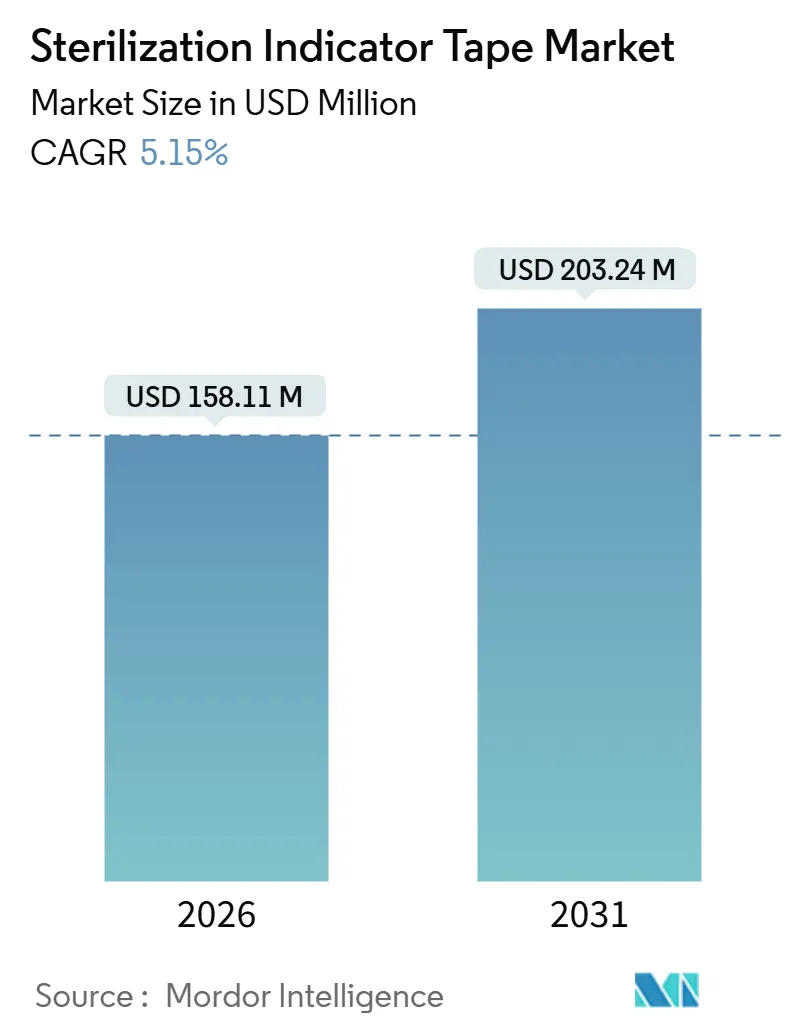
The Sterilization Indicator Tape Market size is estimated at USD 158.11 million in 2026, and is expected to reach USD 203.24 million by 2031, at a CAGR of 5.15% during the forecast period (2026-2031).
Growth stems from tighter infection-control reimbursement rules, mandatory digital audit trails, and the shift toward hydrogen-peroxide–based sterilization for heat-sensitive robotic tools. Hospitals are replacing basic Class 1 tapes with multi-parameter options that embed time, temperature, and sterilant-concentration checks, while ambulatory surgery centers (ASCs) expand low-temperature capacity to accelerate same-day procedures. Raw-material volatility in medical-grade cellulose paper is compressing converter margins, but localization strategies and sustainable substrates are partially offsetting cost spikes. Competitive differentiation now hinges on ISO 11140 certifications, integration with sterilization equipment, and software that connects each tape to hospital information systems.
Key Report Takeaways
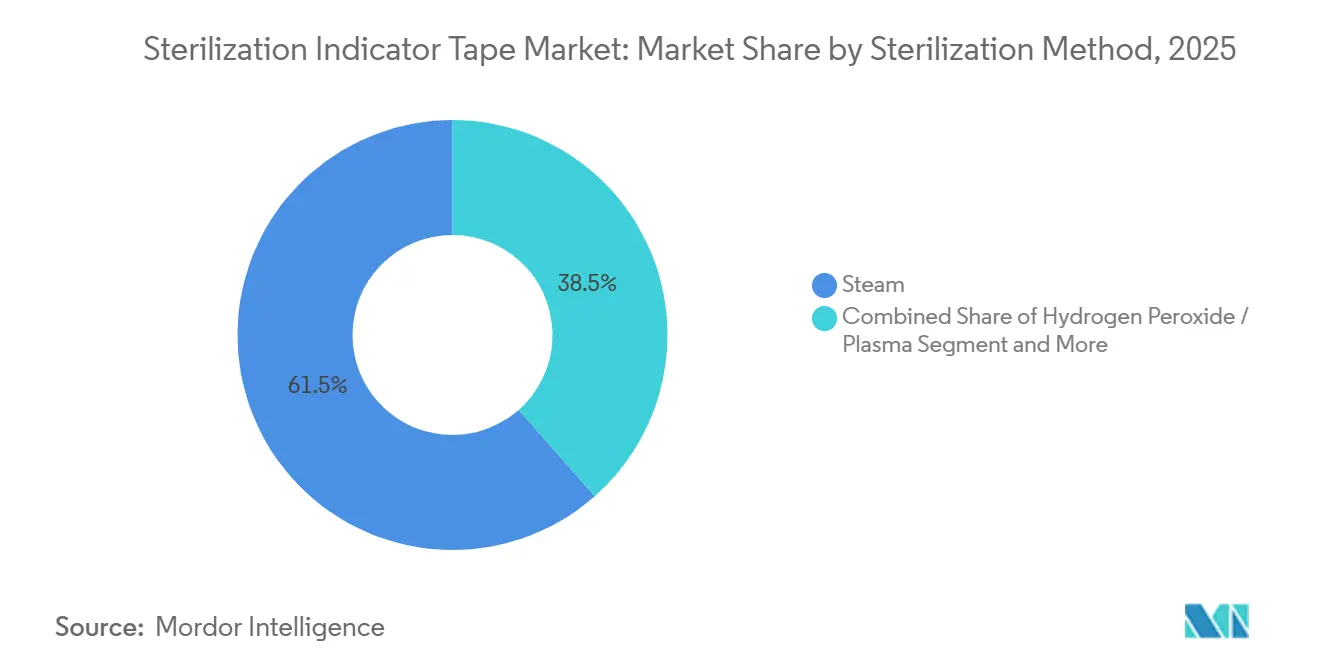
- By sterilization method, steam indicators led with 61.55% of 2025 revenue, whereas hydrogen-peroxide and plasma tapes are advancing at a 7.25% CAGR to 2031, the fastest among all modalities.
- By indicator class, Class 1 process tapes accounted for 54.53% of 2025 demand, while Class 4 and 5 multi-parameter products are growing at 7.85% annually through 2031, the quickest within this segmentation.
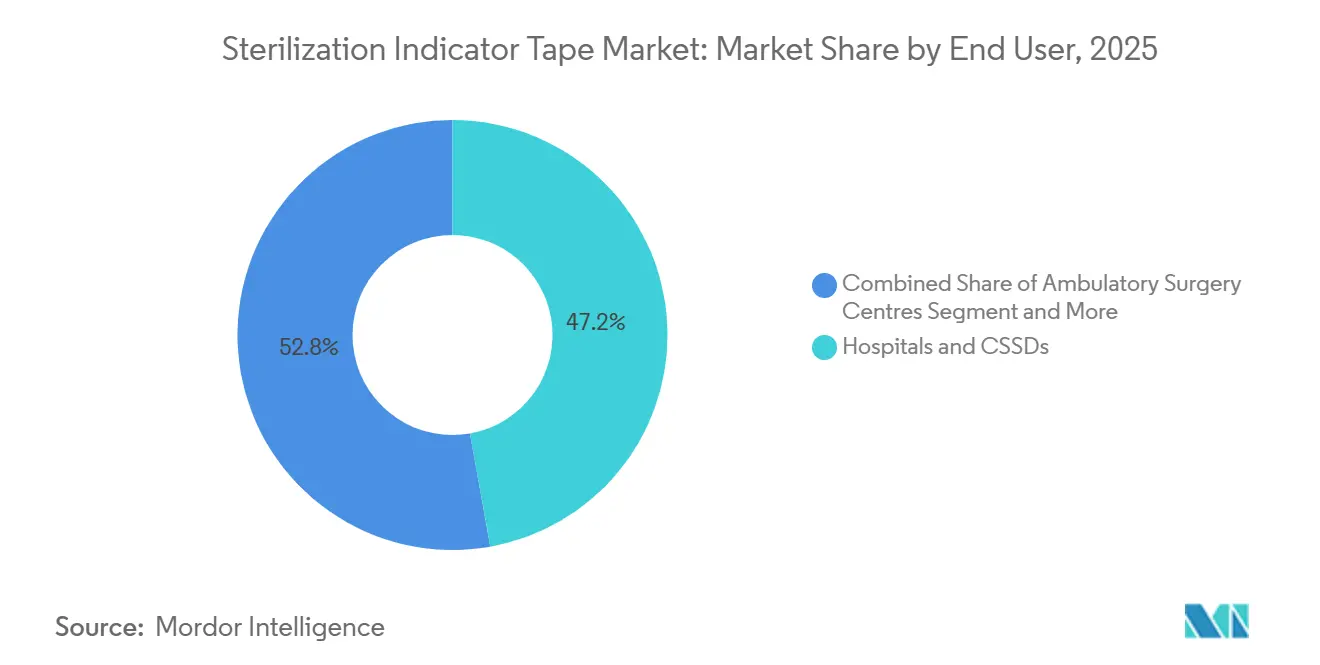
- By end user, hospitals and central sterile supply departments held 47.23% share in 2025, yet ASCs are expanding at a 6.55% CAGR, outpacing acute-care facilities over the outlook period.
- By geography, North America commanded 36.25% of global revenue in 2025, but Asia-Pacific is on track for a 6.21% CAGR to 2031, the highest regional rate.
Note: Market size and forecast figures in this report are generated using Mordor Intelligence’s proprietary estimation framework, updated with the latest available data and insights as of January 2026.
Market Trends and Insights
Drivers Impact Analysis of Sterilization Indicator Tape Market*
| Driver | (~) % Impact on CAGR Forecast | Geographic Relevance | Impact Timeline |
|---|---|---|---|
| Escalating post-pandemic HAI penalties | +0.9% | North America, EU core | Short term (≤ 2 years) |
| Mandated sterilization logs for reusable device re-processors | +0.7% | Global, led by US FDA and EU MDR jurisdictions | Medium term (2-4 years) |
| Expansion of low-temperature sterilizers in ASCs | +1.2% | North America, Western Europe, urban APAC | Medium term (2-4 years) |
| Surge in hydrogen-peroxide–compatible tapes for robotics | +0.8% | Global, tertiary-care hospitals | Medium term (2-4 years) |
| Smart tapes enabling digital audit trails | +0.6% | North America, EU, advanced APAC metros | Long term (≥ 4 years) |
| Localization of tape production | +0.5% | United States, EU manufacturing hubs | Short term (≤ 2 years) |
| Source: Mordor Intelligence | |||
Escalating Post-Pandemic HAI Penalties
The Centers for Medicare & Medicaid Services (CMS) cut 1% of Medicare payments from the worst-performing quartile of U.S. hospitals in fiscal 2026, directly linking reimbursement to hospital-acquired infection metrics. Each verified sterilization cycle therefore acts as a hedge against a penalty that can exceed USD 500,000 per mid-sized facility. Hospitals are upgrading from Class 1 to Class 4 and 5 tapes that deliver legally defensible records, and procurement teams favor vendors offering lot traceability and digital integration. Rural hospitals consolidate CSSD functions to cope with similar penalties despite smaller budgets, further standardizing tape choices.
Mandated Sterilization Logs for Reusable Device Re-Processors
The U.S. FDA requires validated chemical-indicator results for each reprocessed device lot, and ISO 11140 revisions now under committee review will tighten benchmarks for hydrogen-peroxide cycles[1]. Device makers embed tape specifications in instructions for use, compelling healthcare facilities to buy modality-matched indicators. The EU MDR applies similar documentation rules across Europe, pushing hospitals toward Class 6 emulating tapes that release instruments faster without sacrificing sterility assurance.
Expansion of Low-Temperature Sterilizers in Ambulatory Surgery Centers
The United States counted 6,148 Medicare-certified ASCs in January 2024, with hydrogen-peroxide cycles completing in as little as 28 minutes, versus hours for ethylene oxide. Getinge’s Poladus 150 VH2O2 unit auto-populates logs through RFID-enabled indicators, cutting transcription errors that once invalidated 8% of ASC records. Rapid instrument turnaround underpins same-day orthopedic and cardiac procedures, driving bulk purchases of hydrogen-peroxide tape rolls.
Surge in Hydrogen-Peroxide–Compatible Tapes for Robotics
Solventum’s Comply SteriGage indicators shift color only when 50 °C, 6-minute, 2.3 mg/L thresholds are met, protecting robotic devices from sub-optimal processing. Robotic surgery expansion requires dual workflows—steam for traditional tools and hydrogen-peroxide for electronics-laden parts—so hospitals color-code dispensers and scan barcodes to avoid mix-ups, lowering cycle invalidations by up to 60% at early-adopting academic centers.
Restraints Impact Analysis of Sterilization Indicator Tape Market*
| Restraint | (~) % Impact on CAGR Forecast | Geographic Relevance | Impact Timeline |
|---|---|---|---|
| Shrinking autoclave fleet in micro-practice dentistry | −0.3% | North America, Western Europe | Short term (≤ 2 years) |
| Counterfeit indicator rolls in APAC tier-3 hospitals | −0.6% | APAC core, sub-Saharan Africa | Medium term (2-4 years) |
| Raw-paper volatility amid global pulp shortages | −0.5% | Global, acute in North America and EU | Short term (≤ 2 years) |
| Slow regulatory harmonization for plasma indicators | −0.4% | Global, fragmented regulatory landscape | Long term (≥ 4 years) |
| Source: Mordor Intelligence | |||
Counterfeit Indicator Rolls in Price-Sensitive APAC Tier-3 Hospitals
A WHO survey found that only 6 of 64 countries run device track-and-trace systems, exposing rural hospitals to non-reactive counterfeit tapes[2]. Regulatory gaps across Asia create arbitrage routes for substandard products sold through informal channels, undermining sterility assurance and patient safety.
Raw-Paper Volatility Amid Global Pulp Shortages
Medical-grade cellulose costs fluctuate with pulp supply, and sterilization indicator tape makers allocate 30%–40% of total expenses to this input. Duties on Chinese imports compound volatility, forcing converters to hedge or vertically integrate to protect margins.
*Our forecasts treat driver/restraint impacts as directional, not additive. The impact forecasts reflect baseline growth, mix effects, and variable interactions.
Sterilization Indicator Tape Market Segment Analysis
By Sterilization Method:
Dual-Modality Workflows Drive Hydrogen-Peroxide UptakeSteam held 61.55% revenue share in 2025, yet hydrogen-peroxide and plasma modalities are forecast to expand at 7.25% annually, shifting the sterilization indicator tape market toward low-temperature applications. The sterilization indicator tape market size attributed to hydrogen-peroxide cycles is projected to climb steadily as robotic-assisted surgery volumes rise. RFID-linked indicators bundled with VH2O2 sterilizers now automate log entries, reducing staff workload in ASCs. Ethylene oxide remains vital for moisture-sensitive loads, but environmental regulations and community pushback restrict capacity expansions. Dry-heat indicators stay niche, catering to pharmaceutical glassware and powders.
Hospitals are phasing in barcode scanners at CSSD workstations, ensuring a steam label never lands on a VH2O2 tray. This IT layer adds USD 15,000–25,000 in capital but trims invalidation rates up to 60%, saving re-sterilization labor. ISO 11140 revisions will codify plasma-specific performance benchmarks, and early compliance grants suppliers a first-mover edge.

By Indicator Class:
Multi-Parameter Tapes Capture Regulatory TailwindsClass 1 tapes represented 54.53% of 2025 sales, yet Class 4 and 5 products, integrating time, temperature, and sterilant concentration, are slated for a 7.85% CAGR. The sterilization indicator tape market share for multi-parameter formats will expand as CMS penalties elevate documentation stakes. Class 6 emulating indicators, which mirror biological resistance but yield within-cycle feedback, appeal to third-party reprocessors keen on faster instrument release.
Mesa Laboratories’ USD 87.187 million purchase of GKE widened its chemical-indicator offerings and delivered USD 93.418 million in segment revenue during fiscal 2025[3]. STERIS follows suit with Smart Tags that link each indicator to individual instruments, blending chemical proof with device-level traceability.
By End User:
ASC Growth Outpaces HospitalsHospitals and CSSDs still anchor 47.23% of 2025 consumption, but ASCs are on a 6.55% growth trajectory through 2031. The sterilization indicator tape market size tied to ASCs benefits from roll-format hydrogen-peroxide tapes that serve multiple quick cycles daily. ASCs’ lean staffing models value indicators that self-record cycle data, shaving audit prep time. Dental micro-practices retire older autoclaves or outsource sterilization, trimming addressable demand. Conversely, medical-device manufacturers require Class 6 solutions for validation laboratories, a stable albeit smaller volume stream.
Geography Analysis
North America and Europe Sterilization Indicator Tape Market
North America accounted for 36.25% of 2025 revenues, fueled by CMS penalties, 6,148 active ASCs, and early adoption of digital audit trails. FDA oversight compels Class 4 and 5 tape upgrades, while tariffs stimulate domestic manufacturing despite input-cost swings. Europe mirrors this trajectory under the EU MDR, though slower ASC rollouts and tighter national budgets temper volume.
APAC Sterilization Indicator Tape Market
Asia-Pacific is forecast at a 6.21% CAGR to 2031, the fastest globally, driven by hospital construction in China and India and government insurance schemes that raise surgical volumes. China’s NMPA registration framework rewards suppliers with Class II approvals, whereas India’s uneven enforcement lets counterfeit rolls persist in tier-3 facilities. WHO data show 1 in 10 medical products in low-income nations fails quality standards, spotlighting the need for track-and-trace reforms. ASEAN regulatory harmonization remains a work in progress, prolonging market fragmentation.
MEA and South America Sterilization Indicator Tape Market
The Middle East, Africa, and South America contribute smaller shares but post selective growth. Brazil enforces sterilization under ANVISA RDC 15/2012, while Argentina’s ANMAT issues comparable rules, promoting ISO-certified tape adoption despite budget limits. Gulf Cooperation Council investments in medical tourism open avenues for premium multi-parameter indicators, even if overall volumes trail Asia.

Competitive Landscape
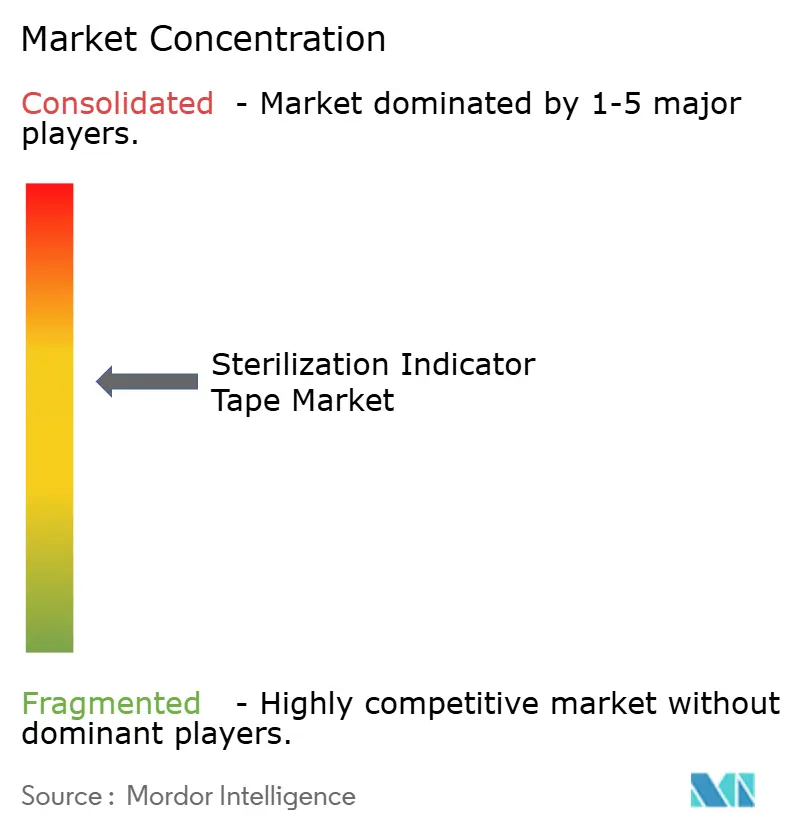
The sterilization indicator tape market is moderately concentrated. STERIS, Getinge, Solventum, and Cardinal Health leverage bundled equipment contracts and ISO 11140 portfolios to retain share. Solventum’s March 2025 launch of the Attest eBowie-Dick Test System delivers five-second results and slashes paper waste by 94%, underscoring the shift to digital-first formats. Getinge’s RFID-linked Poladus 150 VH2O2 tapes turn each strip into a data node, increasing customer lock-in via cloud dashboards. Mesa Laboratories integrates GKE products to cross-sell chemical and biological indicators, broadening sticky revenue streams.
White-space innovators target plasma-validated chemistries and biodegradable substrates. Terragene and PMS Healthcare Technologies focus on cost-sensitive markets where ISO enforcement lags. WHO estimates on counterfeit prevalence signal future tightening, which could consolidate share among certified producers. Hospitals adopting robotic surgery and ASCs scaling same-day joints will favor hydrogen-peroxide multi-parameter tapes, while low-resource facilities sustain demand for low-cost steam indicators, fragmenting the field across modality and price tiers.
Sterilization Indicator Tape Industry Leaders
-
Cardinal Health
-
Getinge AB
-
Medline Industries
-
Solventum Corporation
-
STERIS plc
- *Disclaimer: Major Players sorted in no particular order
Sterilization Indicator Tape Market Companies Covered in this Report
- Advanced Sterilization Products (Fortive)
- Cardinal Health
- Certol International
- Crosstex International
- Getinge
- GKE-GmbH
- Healthmark Industries
- Henry Schein
- Hu-Friedy Group
- Medline Industries
- Mesa Laboratories
- PMS Healthcare Technologies
- Propper Manufacturing
- Shinva Medical Instrument
- Solventum Corporation
- stericlin (VP Group)
- STERIS
- Terragene
- Tuttnauer
Recent Industry Developments in Sterilization Indicator Tape Market
- September 2024: Propper Manufacturing won FDA clearance for its EO Chex Ethylene Oxide Indicator Tape, broadening U.S. sales channels.
- October 2023: Advanced Sterilization Products expanded its SEALSURE Steam Indicator Tape line to streamline sterility checks for sterile-processing departments.
Global Sterilization Indicator Tape Market Report Scope
As per the scope of the report, sterilization indicator tape is a specially designed adhesive tape used in sterilization processes to visually indicate whether an item has been exposed to sterilization conditions. Typically, the tape changes color when subjected to specific sterilization methods such as steam, ethylene oxide, or hydrogen peroxide, providing a visual confirmation that the sterilization cycle has been completed. It is commonly used in healthcare settings to seal sterilization packages and ensure proper sterilization has occurred.
The sterilization indicator tape market is segmented by sterilization method, indicator class, end user, and geography. By sterilization method, the market is categorized into steam, ethylene oxide (EtO), hydrogen peroxide/plasma, and dry heat. By indicator class, it is divided into class 1 process indicator, class 4 & 5 multi-parameter indicator, and class 6 emulating indicator. By end user, the market includes hospitals & CSSDs, ambulatory surgery centers, dental & veterinary clinics, and pharmaceutical & medical-device manufacturers. By geography, the market is segmented into North America, Europe, Asia-Pacific, Middle East and Africa, and South America. The Market Forecasts are Provided in Terms of Value (USD).
Segmentation Overview
| Steam |
| Ethylene Oxide (EtO) |
| Hydrogen Peroxide / Plasma |
| Dry Heat |
| Class 1 Process Indicator |
| Class 4 & 5 Multi-parameter Indicator |
| Class 6 Emulating Indicator |
| Hospitals & CSSDs |
| Ambulatory Surgery Centres |
| Dental & Veterinary Clinics |
| Pharmaceutical & Medical-Device Manufacturers |
| North America | United States |
| Canada | |
| Mexico | |
| Europe | Germany |
| United Kingdom | |
| France | |
| Italy | |
| Spain | |
| Rest of Europe | |
| Asia-Pacific | China |
| India | |
| Japan | |
| Australia | |
| South Korea | |
| Rest of Asia-Pacific | |
| Middle East and Africa | GCC |
| South Africa | |
| Rest of Middle East and Africa | |
| South America | Brazil |
| Argentina | |
| Rest of South America |
| By Sterilization Method | Steam | |
| Ethylene Oxide (EtO) | ||
| Hydrogen Peroxide / Plasma | ||
| Dry Heat | ||
| By Indicator Class | Class 1 Process Indicator | |
| Class 4 & 5 Multi-parameter Indicator | ||
| Class 6 Emulating Indicator | ||
| By End User | Hospitals & CSSDs | |
| Ambulatory Surgery Centres | ||
| Dental & Veterinary Clinics | ||
| Pharmaceutical & Medical-Device Manufacturers | ||
| By Geography | North America | United States |
| Canada | ||
| Mexico | ||
| Europe | Germany | |
| United Kingdom | ||
| France | ||
| Italy | ||
| Spain | ||
| Rest of Europe | ||
| Asia-Pacific | China | |
| India | ||
| Japan | ||
| Australia | ||
| South Korea | ||
| Rest of Asia-Pacific | ||
| Middle East and Africa | GCC | |
| South Africa | ||
| Rest of Middle East and Africa | ||
| South America | Brazil | |
| Argentina | ||
| Rest of South America | ||
Key Questions Answered in the Report
How large is the global sterilization indicator tape market today?
The sterilization indicator tape market size reached USD 158.11 million in 2026 and is projected at USD 203.24 million by 2031, growing 5.15% annually.
Which sterilization modality is gaining share the fastest?
Hydrogen-peroxide and plasma indicators are expanding at a 7.25% CAGR, outpacing steam due to the rise of robotic and heat-sensitive surgical tools.
Why are multi-parameter tapes becoming popular?
Class 4 and 5 tapes satisfy FDA and EU documentation requirements and help hospitals avoid CMS infection-penalty revenue cuts.
Which region offers the strongest growth opportunity?
Asia-Pacific is forecast to grow 6.21% annually through 2031 as China and India invest in hospital infrastructure and surgical capacity.
How are suppliers adding value beyond color-change tapes?
Leading vendors embed RFID or barcodes in indicators, automate log uploads, and bundle tapes with sterilizers to integrate cycle data into hospital IT systems.
What risks could slow market expansion?
Counterfeit products in emerging markets, pulp-price volatility, and delayed harmonization of plasma-indicator standards all weigh on future growth.