
Sterility Indicators Market Size and Share
Market Overview
| Study Period | 2021 - 2032 |
|---|---|
| Market Size (2027) | USD 1.57 Billion |
| Market Size (2032) | USD 2.61 Billion |
| Growth Rate (2027 - 2032) | 10.73 % |
| Fastest Growing Market | Asia-Pacific |
| Largest Market | North America |
| Market Concentration | Medium |
Major Players *Disclaimer: Major Players sorted in no particular order Image © Mordor Intelligence. Reuse requires attribution under CC BY 4.0. | |
Sterility Indicators Market Analysis by Mordor Intelligence
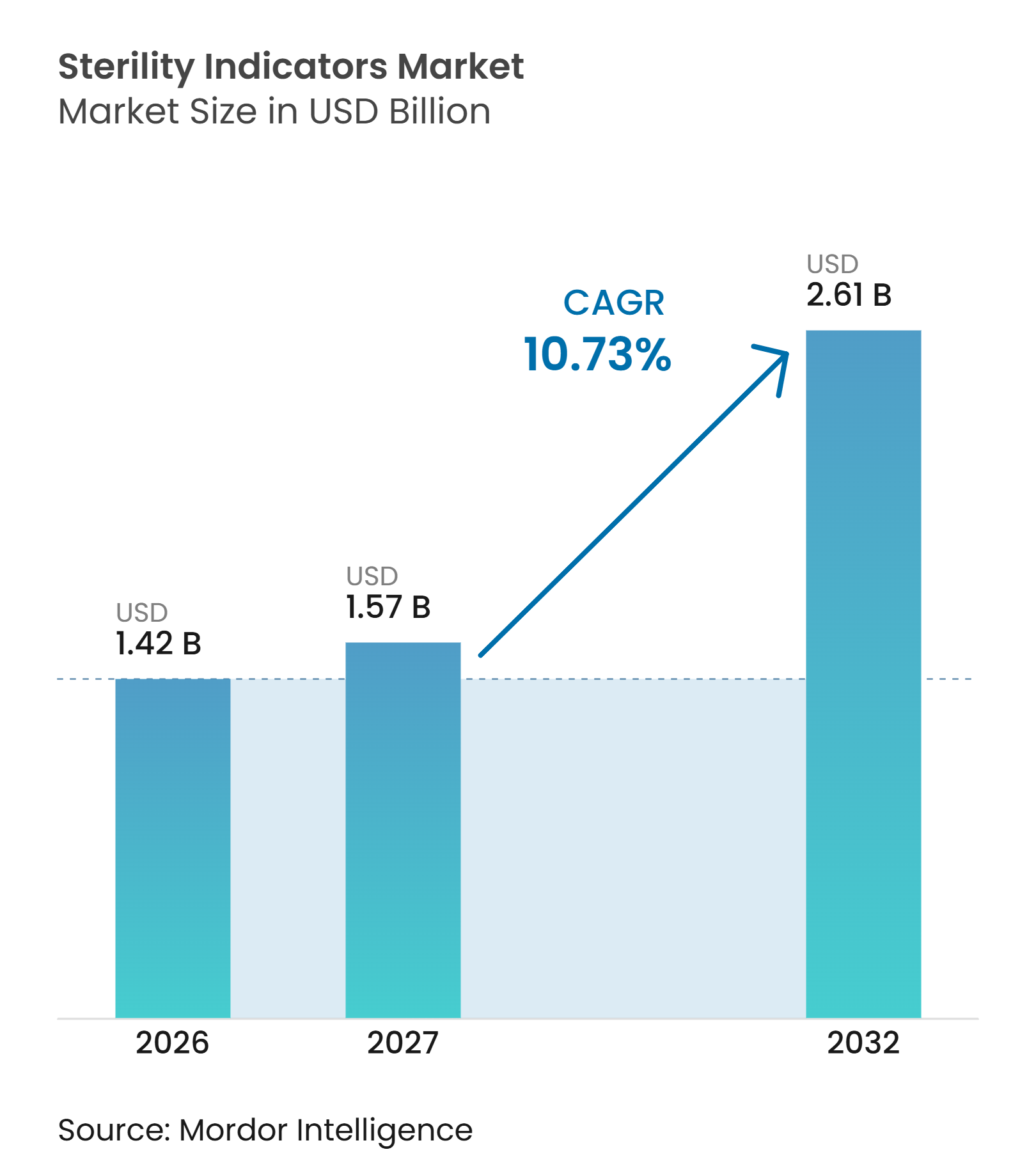
The Sterility Indicators Market size is projected to be USD 1.42 billion in 2026, USD 1.57 billion in 2027, and reach USD 2.61 billion by 2032, growing at a CAGR of 10.73% from 2027 to 2032.
Sterilization verification remains a recurring requirement in regulated care and manufacturing facilities because each validated cycle needs physical, chemical, or biological evidence. The sterility indicators market is gaining from rapid-readout products, regulated manufacturing expansion, and greater use of electronically documented monitoring systems. Facilities are moving from visual checks toward systems that generate a documented result for quality records and instrument tracking. Demand is supported by healthcare providers, pharmaceutical plants, and medical-device operations that need repeatable verification across their sterilization workflows. Competition is centered on validated indicator performance, faster results, easier documentation, and formats that limit manual assembly or interpretation errors.
Key Report Takeaways
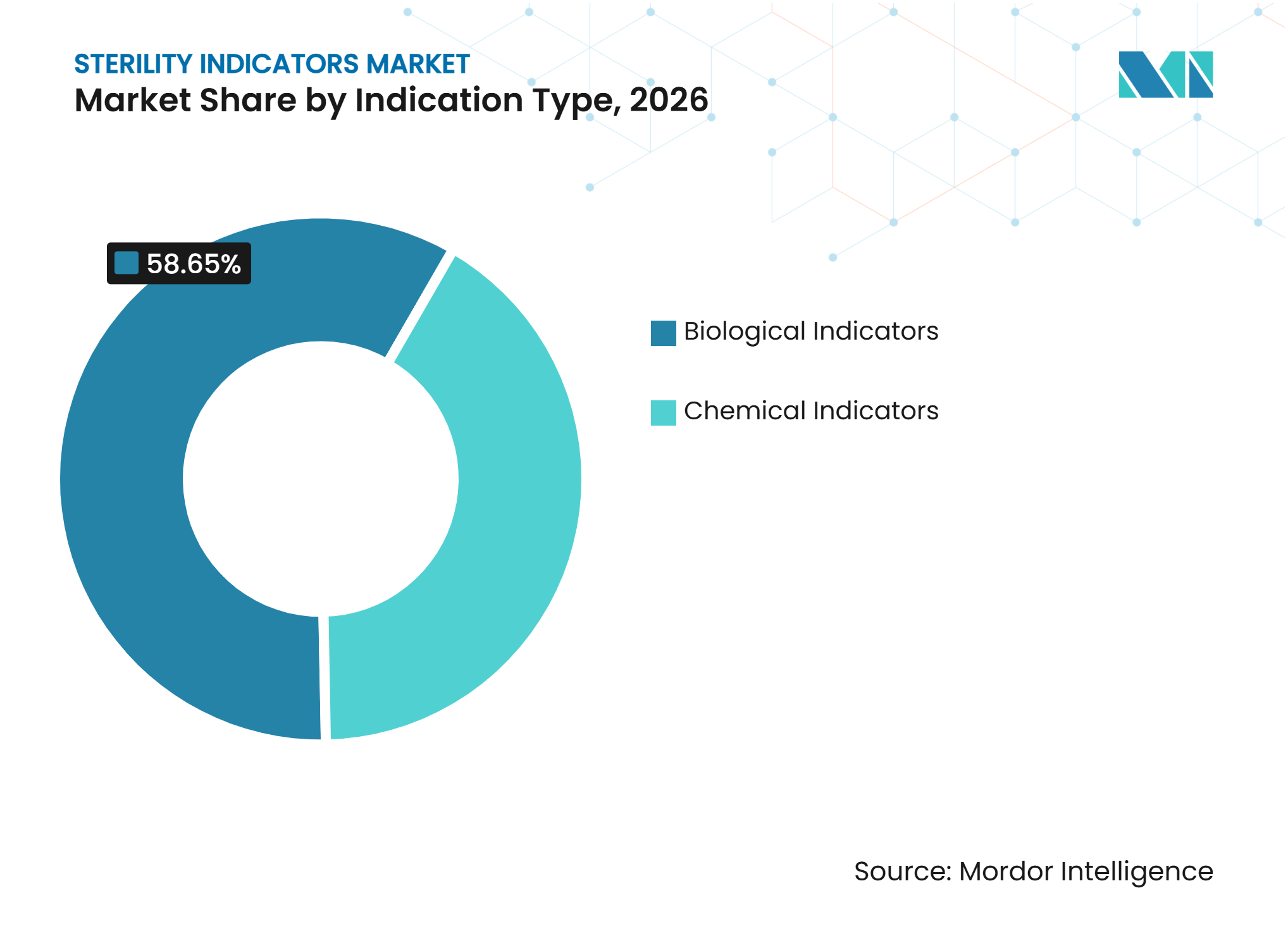
- By indicator type, Biological Indicators held 58.65% of the Sterility Indicators Market share in 2026, while Chemical Indicators are forecast to expand at a 12.76% CAGR through 2032.
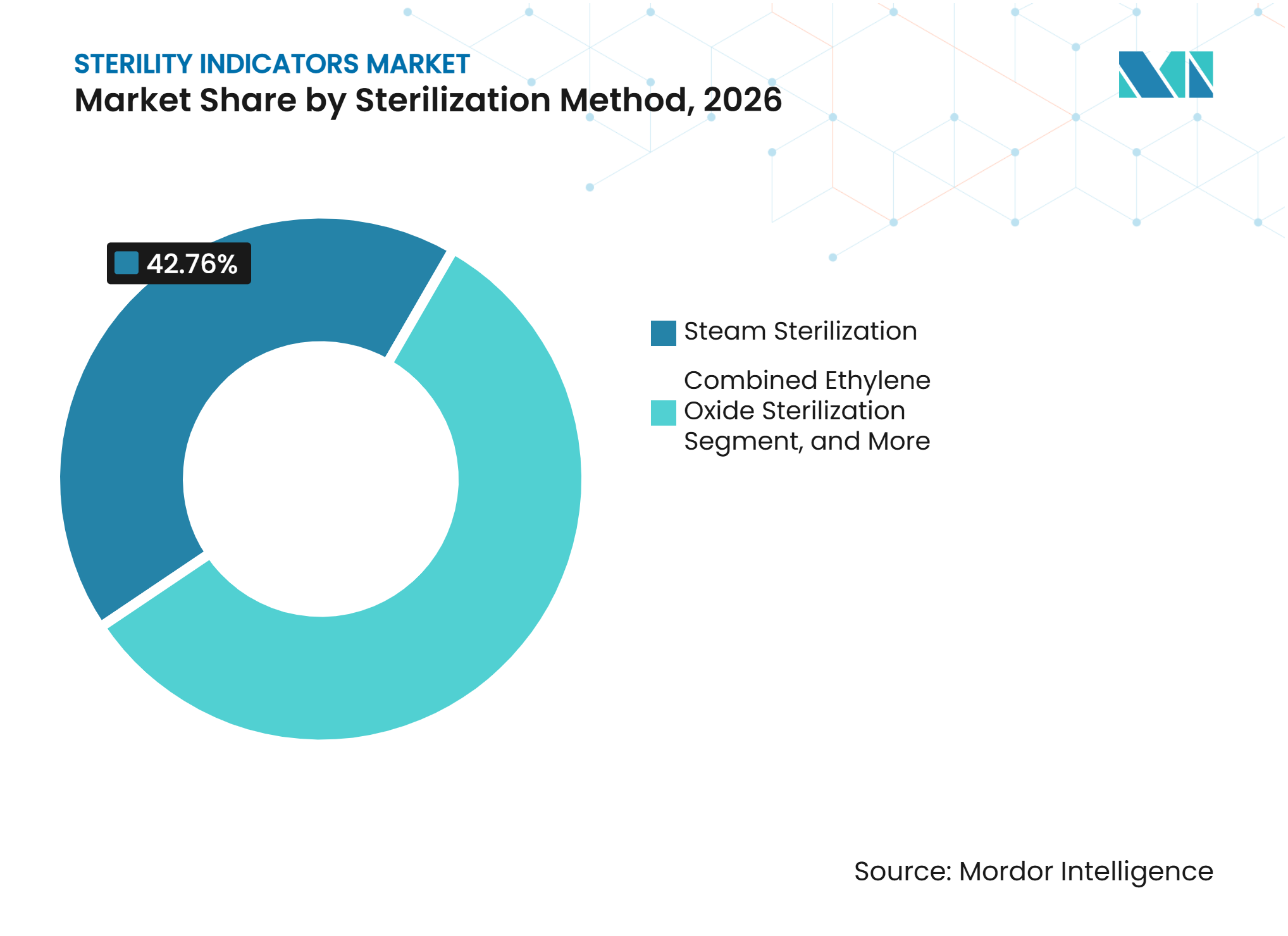
- By sterilization method, Steam Sterilization accounted for 42.76% of the Sterility Indicators Market size in 2026, while Dry-Heat Sterilization is projected to grow at a 12.88% CAGR through 2032.
- By end user, Hospitals and Clinics captured 44.87% of the Sterility Indicators Market share in 2026, while Ambulatory Surgery Centers and Dental Clinics are expected to record a 13.54% CAGR through 2032.
- By geography, North America accounted for the highest share of 41.87% in 2026, whereas Asia-Pacific is projected to grow at a CAGR of 11.54% over the forecast period.
Note: Market numbers in this report are based on Mordor Intelligence's proprietary estimation framework, which combines nine months of actuals with Q4 projections for base year 2026.
Market Trends and Insights
Drivers Impact Analysis of Sterility Indicators Market*
| Driver | (~) % Impact on CAGR Forecast | Geographic Relevance | Impact Timeline |
|---|---|---|---|
| Infection Prevention and Sterilization Validation Mandates | +2.5% | Global, with early enforcement gains in North America and Europe | Short term (≤ 2 years) |
| Growth in Surgical and Outpatient Procedures | +1.8% | North America and Asia-Pacific core, with spillover to Middle East and Africa | Short term (≤ 2 years) |
| Expansion of Pharmaceutical, Biologic, and Medical Device Manufacturing | +2.1% | Asia-Pacific core, North America, and Europe | Medium term (2-4 years) |
| Rapid Readout and Every Load Biological Indicator Adoption | +1.6% | Global, fastest in North America and high-income Asia-Pacific | Medium term (2-4 years) |
| Digital Traceability and Automated Sterilization Documentation | +1.3% | North America, Europe, Japan, and Australia | Long term (≥ 4 years) |
| Preassembled Challenge Packs Reduce Monitoring Workflow Errors | +0.9% | Global, strongest in high-volume CSSDs in North America and Europe | Long term (≥ 4 years) |
| Source: Mordor Intelligence | |||
Infection Prevention Mandates Anchor Non-Discretionary Demand
Sterilization monitoring links infection control with regulatory compliance, so purchasing is less discretionary than many hospital supplies. A 2025 multisociety guidance calls for physical, chemical, and biological monitoring of sterilization processes[1]. It also states that every implant load requires a biological indicator and a Type 5 chemical indicator. ISO 11138 supports biological indicator requirements, while ISO 11140-1 provides the framework for chemical indicator performance and classification. The United States also classifies sterility indicators under 21 CFR 880.2800, which reinforces the role of validated products in regulated workflows. A 2025 scientific study associated inadequate monitoring of sterilization parameters with a higher risk of surgical site infection.
Surgical Volume Growth Sustains Consumable Demand Across Decentralized Settings
The move toward outpatient and minimally invasive care distributes sterilization activity across more facilities with smaller sterile processing teams. Each operating location needs its own monitoring process, even when the procedure volume is lower than at a large hospital. Accreditation reviews have identified missing biological indicators and incomplete sterilization logs as important gaps in ambulatory care. This setting favors compact, ready-to-use products over high-volume bulk formats used in central sterile departments. A 2025 study found that more than 90% of sterile processing departments reported at least 1 measurable defect in a single week[2]. The Sterility Indicators Market therefore benefits from the need to make correct monitoring easier for facilities with limited specialist capacity.
Pharmaceutical and Biologic Manufacturing Expands Premium Demand
Pharmaceutical, biopharmaceutical, and medical-device manufacturing adds an industrial source of recurring demand to the Sterility Indicators Market. Biologics, biosimilars, and cell-and-gene therapy production require tightly controlled sterilization and batch-release procedures. In 2025, Recipharm opened dedicated parenteral development and sterility laboratories in Bengaluru with membrane filtration and direct inoculation capabilities. These operations require qualified validation methods and microbiological controls throughout the manufacturing process. Biological indicators that meet ISO 11138 requirements serve a premium use case beyond routine hospital procurement. Their repeat use across validated cycles makes manufacturing capacity additions relevant to demand for high-value monitoring products.
Rapid Readout, Digital Documentation, and Challenge Packs Improve Workflow Control
Traditional biological indicator methods can require lengthy incubation, which can extend the time before product release. In September 2025, Nelson Laboratories introduced RapidCert, which combines traditional biological indicators with rapid microbiological methods and reduces incubation to 48 hours. The service can reduce sterility confirmation for lot release to as few as 3 days. Digital readers also create a clear pass or fail record that can connect with hospital instrument-tracking systems. Solventum introduced its Attest eBowie-Dick Test System in March 2025 with a digital result in under 5 seconds. Preassembled packs further reduce manual assembly steps and make routine monitoring more consistent across different users.
Restraints Impact Analysis of Sterility Indicators Market*
| Restraint | (~) % Impact on CAGR Forecast | Geographic Relevance | Impact Timeline |
|---|---|---|---|
| Per Load Consumable Cost and Monitoring Budget Pressure | -1.4% | Global, most acute in emerging markets and budget-constrained ambulatory surgery centers | Short term (≤ 2 years) |
| Operator Training and Interpretation Variability | -1.0% | Global, most severe in emerging markets and new ambulatory surgery center entrants | Short term (≤ 2 years) |
| Indicator Performance Sensitivity to Storage, Transport, and Recovery Conditions | -0.8% | Emerging market supply chains and tropical climates in Southeast Asia, Middle East, and Africa | Medium term (2-4 years) |
| Fragmented Standards and Uneven Enforcement Across Emerging Markets | -0.6% | Middle East and Africa, South America, and Southeast Asia | Long term (≥ 4 years) |
| Source: Mordor Intelligence | |||
Per Load Consumable Cost Constrains Best-Practice Monitoring Frequency
Best-practice monitoring can create budget pressure where facilities operate with limited sterile processing resources. Biological monitoring is required for implant loads, while routine monitoring also requires chemical indicators and documentation. Smaller ambulatory centers and hospitals in lower-income settings can face a larger cost burden from self-contained indicators, packaging, and recordkeeping. Reimbursement systems do not always separately recognize inputs used to maintain sterilization quality. This can delay adoption of preassembled challenge packs and rapid-readout biological indicators, which have a higher price than basic spore-strip formats. Accreditation demands and infection-control concerns can still prompt facilities to return to required monitoring practices.
Training, Storage, and Uneven Enforcement Limit Consistent Use
Indicator reliability depends on correct use, result interpretation, recordkeeping, and suitable storage conditions. The 2025 sterile-processing study linked the absence of mandatory staff certification with significantly higher defect rates. Chemical color changes and biological growth results can be read incorrectly when training is insufficient. A 2025 study of 5 Cambodian hospitals found that recording standards were met in only 11% of observed cases. High turnover, limited continuing education, variable transport conditions, and uneven enforcement make these challenges more acute in some emerging settings. These gaps can reduce the practical value gained from even basic monitoring products until procedures and oversight improve.
*Our forecasts treat driver/restraint impacts as directional, not additive. The impact forecasts reflect baseline growth, mix effects, and variable interactions.
Sterility Indicators Market Segment Analysis
By Indicator Type:
Biological Indicators Remain the Core Validation ToolBiological Indicators held 58.65% of the sterility indicators market share in 2026, reflecting their central role in healthcare and pharmaceutical validation. They provide direct evidence of process performance through the response of resistant microorganisms under defined conditions. ISO 11138 supports their use in process validation and routine monitoring across steam, ethylene oxide, dry-heat, and hydrogen peroxide applications. Self-contained vials reduce handling steps and are suited to facilities seeking clearer workflow control. Rapid-readout biological indicators are relevant where manufacturers want to reduce the time tied to lot-release decisions.
Spore suspensions retain a role in pharmaceutical compounding, research, and specialized validation exercises. Spore strips continue to serve cost-sensitive users that require a familiar and simpler format. Chemical Indicators are the fastest-growing indicator type, with the sterility indicators market size for this segment projected to rise at a 12.76% CAGR through 2032. Growth is centered on Class 5 integrating and Class 6 emulating formats that assess critical sterilization parameters without an incubation delay. In January 2025, True Indicating received FDA 510(k) clearance for its CSPN-15 Class 5 steam integrating indicator, validated to ISO 11140-1:2014.



By Sterilization Method:
Steam Maintains Volume While Dry Heat Gains in ManufacturingSteam Sterilization accounted for 42.76% of the sterility indicators market size in 2026 because hospitals and pharmaceutical sites rely widely on autoclave-based processes. Its installed base spans central sterile departments, clinical instrument processing, and many pharmaceutical operations. Solventum launched the Attest eBowie-Dick Test System in March 2025 for steam sterilizer performance testing. The system supplies a digital result in under 5 seconds and links with hospital instrument-tracking systems. Ethylene oxide remains important for heat-sensitive devices that cannot use high-temperature steam processes.
Vaporized hydrogen peroxide and plasma methods support lower-temperature processing for specific medical instruments. In June 2025, Solventum introduced the Attest Super Rapid VH2O2 Clear Challenge Pack for routine monitoring across multiple sterilizer brands and cycle types. Dry-Heat Sterilization is forecast to grow at a 12.88% CAGR through 2032, the highest rate among the methods considered. Glass vials, stainless steel components, and moisture-sensitive instruments create a practical need for dry-heat sterilization and depyrogenation. Radiation sterilization remains a specialized method in medical-device contract sterilization, where indicator use supports the required validation process.

By End User:
Hospitals Lead While Ambulatory and Dental Sites Expand FasterHospitals and Clinics held 44.87% of the sterility indicators market share in 2026, supported by central sterile departments that run multiple daily cycles. Implant procedures require a biological indicator and a Type 5 chemical indicator for every load under the 2025 multisociety guidance. Traceability systems add value because they connect sterilization evidence with instrument records and quality documentation. A 2025 study reported that traceability implementation was associated with a 42.6% reduction in healthcare-associated infection rates. This makes electronic documentation relevant as hospitals are strengthening sterile processing controls.
Ambulatory Surgery Centers and Dental Clinics are expected to expand at a 13.54% CAGR through 2032. These settings need procedures that can be executed consistently by smaller teams with variable levels of sterile processing specialization. Missing biological indicators and incomplete logs remain relevant concerns during ambulatory-care inspections. Pharmaceutical and biopharmaceutical companies form a premium end-user group because validated aseptic manufacturing requires repeatable biological monitoring. Medical-device companies provide a stable demand base for ethylene oxide and radiation validation, including lot-release monitoring.
Geography Analysis
North America: Infrastructure and Documentation Support Premium Demand
North America held 41.87% of the global sterility indicators market share in 2026, supported by high surgical volumes and established accreditation infrastructure. The United States supplies most regional demand through its large hospital and ambulatory care base. FDA product requirements, 21 CFR 880.2800, and AAMI-aligned practices influence purchasing and validation activities. Joint Commission and AAAHC accreditation expectations further support structured monitoring and complete records. The shift from visual Bowie-Dick tests to electronic readers can increase the value of each monitoring workflow, as Solventum’s 2025 electronic system demonstrates through fast, documented, instrument-linked results.
Asia-Pacific: Manufacturing and Clinical Capacity Create Two Demand Channels
Asia-Pacific is projected to record an 11.54% CAGR through 2032, the fastest rate among the regions assessed. China and India combine hospital modernization with expanding pharmaceutical and medical-device production. This creates demand from clinical sterile processing and industrial validation at the same time. Recipharm’s 2025 Bengaluru laboratory opening demonstrates the continued development of in-region sterility testing capacity. Japan, Australia, and South Korea support electronic monitoring systems and documented workflows, which supports demand for cost-efficient products and advanced formats that reduce manual steps.
Europe, South America, and Middle East and Africa: Compliance Needs Meet Uneven Infrastructure
Europe’s demand is shaped by Medical Device Regulation and GMP Annex 1 expectations for aseptic manufacturing, documentation, and traceability. These requirements support steady indicator use in Germany, France, the United Kingdom, Italy, and Spain. South America has a mixed profile, with Brazil and Mexico expanding private healthcare capacity while Argentina faces economic constraints. The Middle East and Africa have hospital-modernization demand, particularly in GCC countries, but storage, transport, training, and uneven enforcement can limit consistent monitoring. Digital documentation and preassembled products can improve control where sterile processing capacity is developing.
Competitive Landscape
Market Concentration
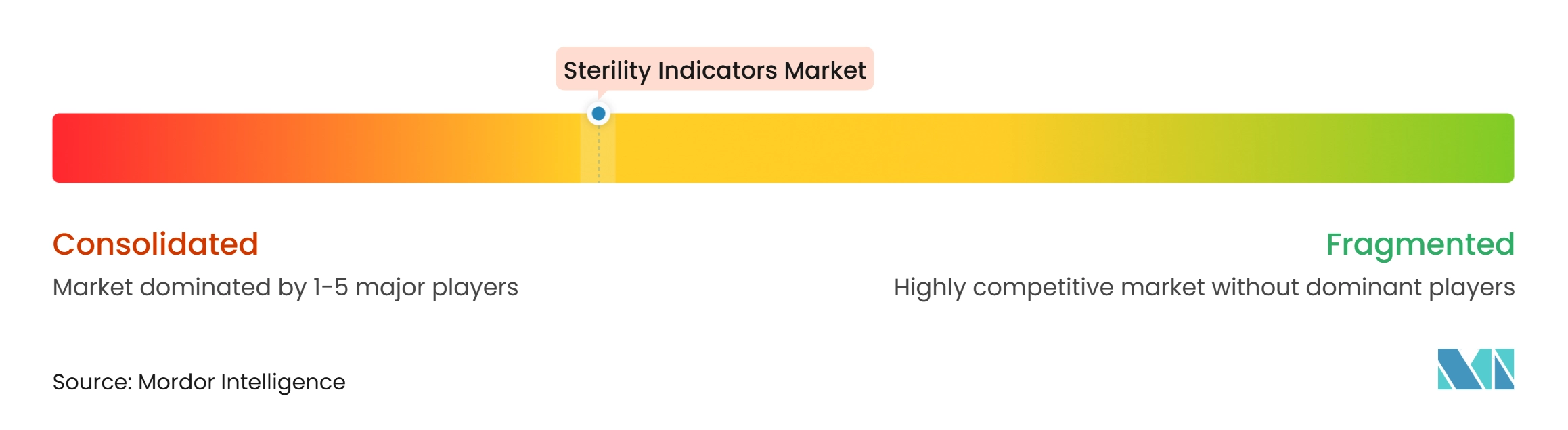
The sterility indicators market is moderately consolidated in the premium tier, where Solventum, STERIS plc, Mesa Laboratories, Advanced Sterilization Products, Terragene, and GKE-GmbH are established participants. These suppliers compete through validated biological indicators, advanced chemical indicators, rapid-readout systems, and documented workflow support. Local Chinese suppliers add pricing pressure in Asia-Pacific value segments. Established suppliers have an advantage where customers need recognized performance, regulatory documentation, and integrated tracking capabilities, although niche producers limit full concentration across chemical indicator formats.
Product design is a central competitive tool in the sterility indicators market because it can reduce handling, time to result, and documentation effort, as shown by Solventum’s June 2025 launch of the Attest Super Rapid VH2O2 Clear Challenge Pack for routine monitoring across multiple sterilizer brands and cycles. The ready-to-use format combines a biological indicator and chemical indicator in a transparent, single-use container. Its design addresses manual assembly errors and inventory complexity at the point of use. Solventum also launched its Attest eBowie-Dick system in 2025, providing an electronic result and connection to instrument-tracking workflows.
Niche companies can compete where they develop products for a defined monitoring gap and secure the required clearance. True Indicating received FDA 510(k) clearance in January 2025 for its CSPN-15 Type 5 steam integrating indicator. The product supports gravity-displacement and dynamic-air-removal cycles, has a 48-month shelf life, and illustrates how defined use cases can challenge larger suppliers. Nelson Laboratories introduced RapidCert in September 2025 to shorten biological indicator testing and sterility confirmation timelines. Digital traceability, faster results, and validated multi-format products will remain important points of differentiation as buyers seek workflow assurance.
Sterility Indicators Industry Leaders
-
Solventum
-
STERIS plc
-
Getinge AB
-
Mesa Laboratories, Inc.
-
Advanced Sterilization Products, Inc.
- *Disclaimer: Major Players sorted in no particular order
Sterility Indicators Market Companies Covered in this Report
- Advanced Sterilization Products, Inc.
- Cole-Parmer Instrument Company, LLC (Antylia Scientific)
- GKE-GmbH
- Getinge
- H.W.Andersen Products Ltd.
- Liofilchem S.r.l.
- LISTER BIOMEDICAL CO., LTD
- Medline Industries
- Mesa Laboratories, Inc.
- Propper Manufacturing Co., Inc.
- Solventum
- STERIS
- Terragene S.A.
- True Indicating LLC
- Zhejiang Tailin Bioengineering
Recent Industry Developments in Sterility Indicators Market
- November 2025: Getinge launched Automatiq, a robotic CSSD automation platform integrating self-navigating transport robots, intelligent conveyors, and smart loading systems, coordinated by T-DOC traceability software. The platform creates demand for digital-compatible indicator formats in hospitals adopting full workflow automation.
- September 2025: Nelson Laboratories (Sotera Health) launched RapidCert, the first rapid biological indicator sterility testing service for medical devices and pharmaceuticals. The service combines traditional BIs with rapid microbiological methods to reduce incubation from seven days to 48 hours, cutting sterility confirmation time for lot release to as little as three days.
- 2025: Solventum launched the Attest Super Rapid VH2O2 Clear Challenge Pack, the first and only FDA-cleared preassembled VH2O2 test pack for routine monitoring across multiple sterilizer brands and cycle types. The ready-to-use pack combines a biological indicator and a chemical indicator in a single transparent, single-use container, eliminating manual assembly errors and simplifying inventory management.
Global Sterility Indicators Market Report Scope
According to the report’s scope, sterility indicators are tools used to verify that sterilization conditions were achieved during a sterilization cycle. They use biological, chemical, or physical methods to provide evidence that a process was effective.
The sterility indicators market is segmented into indicator type, sterilization method, end user, and geography. By indicator type, the market is segmented into chemical indicators and biological indicators. The chemical indicators segment is further bifurcated into class 1 process indicators, class 2 specific-use indicators, class 3 single-variable indicators, class 4 multi-variable indicators, class 5 integrating indicators, and class 6 emulating indicators. The biological indicators segment is further bifurcated into self-contained vials and ampoules, spore strips, spore suspensions, and cards and rapid-readout biological indicators. By sterilization method, the market is segmented into steam sterilization, ethylene oxide sterilization, vaporized hydrogen peroxide and plasma sterilization, dry-heat sterilization, radiation sterilization, and other sterilization methods. By end user, the market is segmented into hospitals and clinics, ambulatory surgery centers and dental clinics, pharmaceutical and biopharmaceutical companies, medical-device companies, and other end users. By geography, the market is segmented into North America, Europe, Asia-Pacific, the Middle East and Africa, and South America. The report also covers the estimated market sizes and trends for 17 countries across major regions globally. The report offers values (USD) for all the above segments.
Segmentation Overview
| Chemical Indicators | Class 1 Process Indicators |
| Class 2 Specific-Use Indicators | |
| Class 3 Single-Variable Indicators | |
| Class 4 Multi-Variable Indicators | |
| Class 5 Integrating Indicators | |
| Class 6 Emulating Indicators | |
| Biological Indicators | Self-Contained Vials and Ampoules |
| Spore Strips | |
| Spore Suspensions | |
| Cards and Rapid-Readout Biological Indicators |
| Steam Sterilization |
| Ethylene Oxide Sterilization |
| Vaporized Hydrogen Peroxide and Plasma Sterilization |
| Dry-Heat Sterilization |
| Radiation Sterilization |
| Other Sterilization Methods |
| Hospitals and Clinics |
| Ambulatory Surgery Centers and Dental Clinics |
| Pharmaceutical and Biopharmaceutical Companies |
| Medical-Device Companies |
| Other End Users |
| North America | United States |
| Canada | |
| Mexico | |
| Europe | Germany |
| United Kingdom | |
| France | |
| Italy | |
| Spain | |
| Rest of Europe | |
| Asia-Pacific | China |
| Japan | |
| India | |
| Australia | |
| South Korea | |
| Rest of Asia-Pacific | |
| Middle East and Africa | GCC |
| South Africa | |
| Rest of Middle East and Africa | |
| South America | Brazil |
| Argentina | |
| Rest of South America |
| By Indicator Type | Chemical Indicators | Class 1 Process Indicators |
| Class 2 Specific-Use Indicators | ||
| Class 3 Single-Variable Indicators | ||
| Class 4 Multi-Variable Indicators | ||
| Class 5 Integrating Indicators | ||
| Class 6 Emulating Indicators | ||
| Biological Indicators | Self-Contained Vials and Ampoules | |
| Spore Strips | ||
| Spore Suspensions | ||
| Cards and Rapid-Readout Biological Indicators | ||
| By Sterilization Method | Steam Sterilization | |
| Ethylene Oxide Sterilization | ||
| Vaporized Hydrogen Peroxide and Plasma Sterilization | ||
| Dry-Heat Sterilization | ||
| Radiation Sterilization | ||
| Other Sterilization Methods | ||
| By End User | Hospitals and Clinics | |
| Ambulatory Surgery Centers and Dental Clinics | ||
| Pharmaceutical and Biopharmaceutical Companies | ||
| Medical-Device Companies | ||
| Other End Users | ||
| Geography | North America | United States |
| Canada | ||
| Mexico | ||
| Europe | Germany | |
| United Kingdom | ||
| France | ||
| Italy | ||
| Spain | ||
| Rest of Europe | ||
| Asia-Pacific | China | |
| Japan | ||
| India | ||
| Australia | ||
| South Korea | ||
| Rest of Asia-Pacific | ||
| Middle East and Africa | GCC | |
| South Africa | ||
| Rest of Middle East and Africa | ||
| South America | Brazil | |
| Argentina | ||
| Rest of South America | ||
Key Questions Answered in the Report
What is driving growth in sterility indicators?
The main factors are mandatory sterilization verification, growing outpatient care, pharmaceutical manufacturing expansion, and faster or digitally documented monitoring systems.
What is the forecast for sterility indicators through 2032?
The Sterility Indicators Market is projected to reach USD 2.61 billion by 2032 from USD 1.57 billion in 2027, at a 10.7% CAGR.
Which type of sterility indicator has the largest share?
Biological Indicators held 58.65% of revenue in 2026 because they remain central to validation across regulated healthcare and manufacturing settings.
Why are chemical indicators growing faster than biological indicators?
Chemical Indicators are projected to grow at a 12.76% CAGR through 2032 as Class 5 and Class 6 formats provide prompt evidence across critical sterilization parameters.
Which end users are expected to grow fastest?
Ambulatory Surgery Centers and Dental Clinics are expected to grow at a 13.54% CAGR through 2032 as decentralized care needs practical and documented sterilization monitoring.
What does digital traceability change in sterile processing?
Electronic readers and instrument-linked records can provide a clear monitoring result while reducing manual documentation and supporting traceability requirements.