
Steel Pipes and Tubes Market Size and Share
Market Overview
| Study Period | 2021 - 2031 |
|---|---|
| Market Size (2026) | USD 175.63 Billion |
| Market Size (2031) | USD 227.81 Billion |
| Growth Rate (2026 - 2031) | 5.34 % |
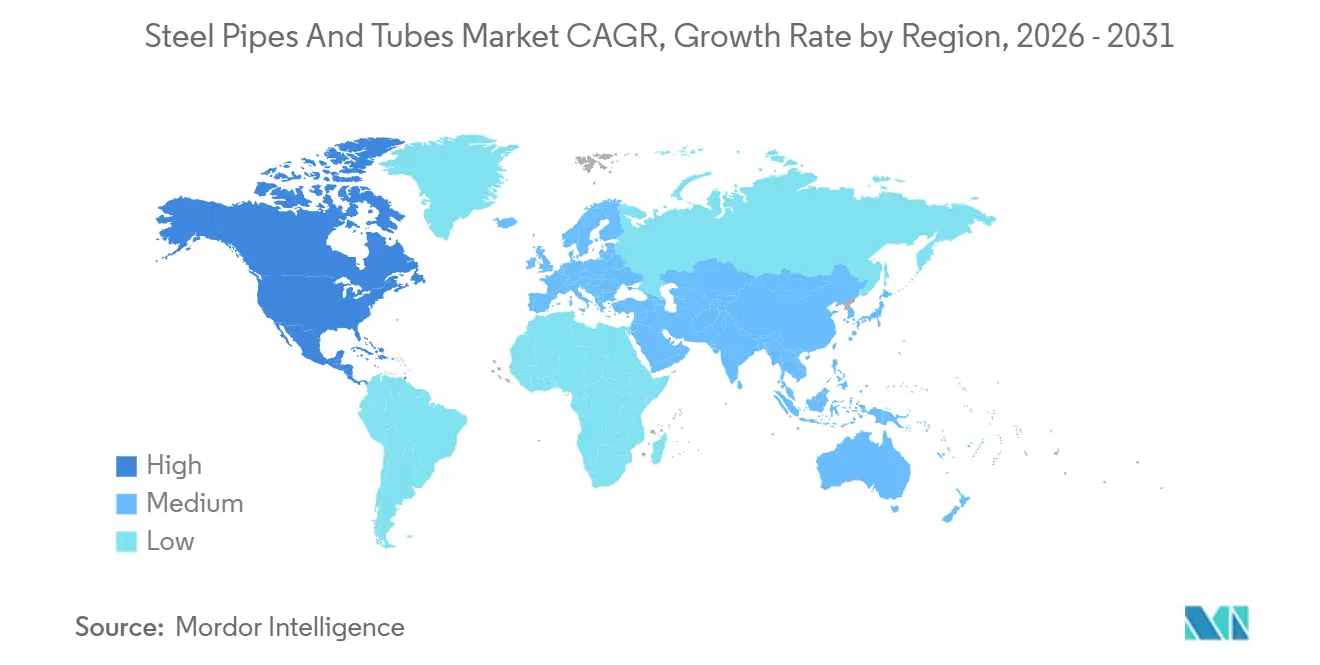
| Fastest Growing Market | North America |
| Largest Market | Asia-Pacific |
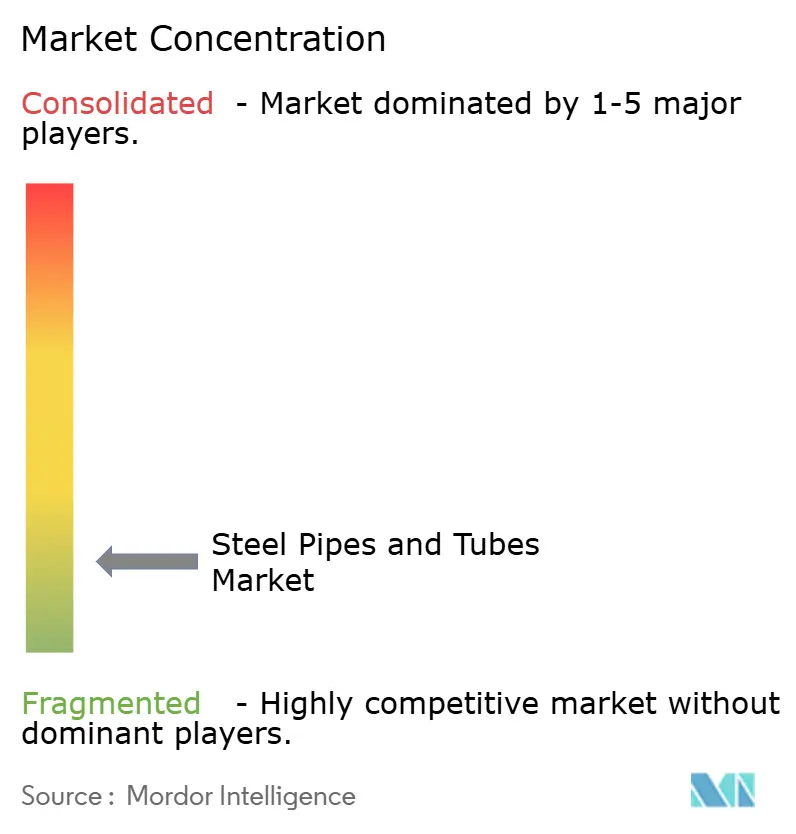
| Market Concentration | Low |
Major Players *Disclaimer: Major Players sorted in no particular order Image © Mordor Intelligence. Reuse requires attribution under CC BY 4.0. | |
Steel Pipes and Tubes Market Analysis by Mordor Intelligence
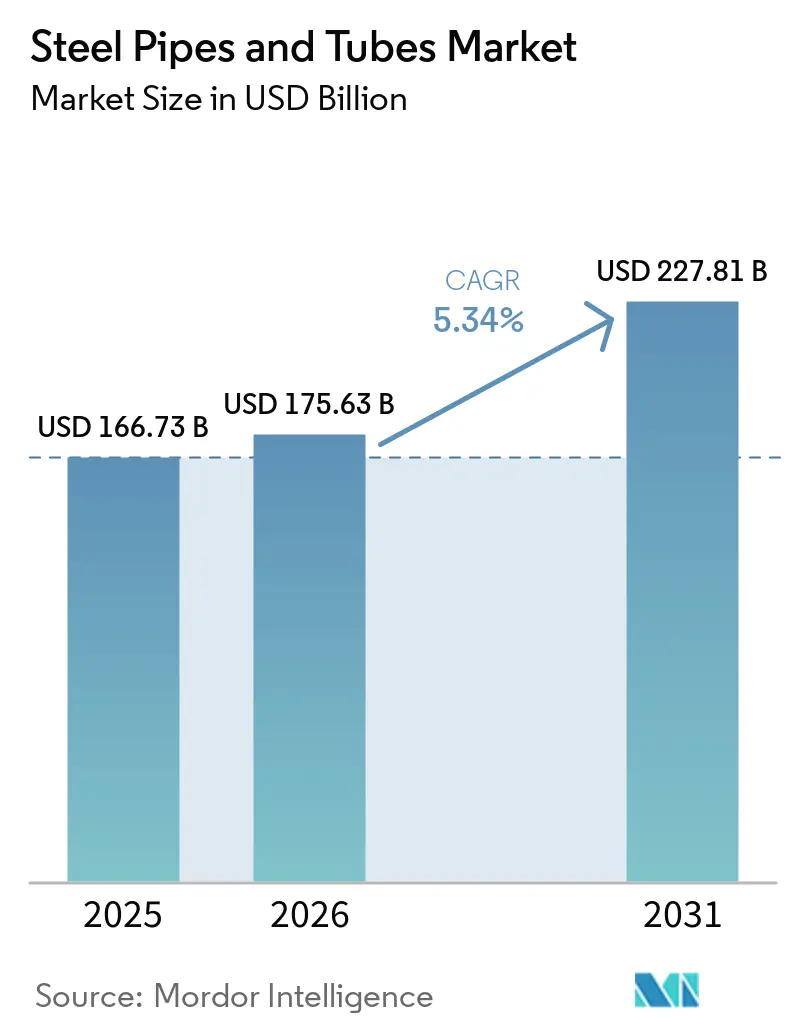
The Steel Pipes and Tubes Market size was valued at USD 166.73 billion in 2025 and is estimated to grow from USD 175.63 billion in 2026 to reach USD 227.81 billion by 2031, at a CAGR of 5.34% during the forecast period (2026-2031). The steel pipes and tubes market is supported by infrastructure programs across energy, utilities, and industrial facilities, because these systems need products that can transport fluids, support structural loads, operate under pressure, and remain in service for long periods. Large pipeline projects create demand that can continue beyond short-term changes in commodity prices, as transmission systems, liquefied natural gas (LNG) facilities, water networks, power plants, and industrial sites typically require phased procurement, installation, commissioning, maintenance, and eventual replacement. Utility renewal is also shifting procurement toward replacement work and pipes suited to difficult installation conditions, which broadens demand from new long-distance pipelines to municipal systems, local distribution lines, maintenance programs, and infrastructure upgrades that use a wider mix of dimensions and specifications. Producers are responding by expanding premium products, coatings, traceability, and testing capabilities, since customers in power, oil and gas, hydrogen, carbon dioxide transport, geothermal, offshore, and chemical processing increasingly evaluate documented performance as well as capacity, price, delivery timing, and local service support. The steel pipes and tubes market also has opportunities in applications that require higher pressure tolerance, corrosion resistance, and verified low-carbon production, while input cost swings, emissions compliance, and substitution in lower-pressure applications make product mix, upstream access, qualification capability, and geographic reach important for manufacturers. This balance between broad infrastructure demand and specialized technical requirements means that growth will not be uniform across every producer or product type, because suppliers serving commodity applications face different purchasing criteria from suppliers serving premium energy, process, and high-pressure projects. Companies that can align production capacity with customer approval standards may be better placed to participate in these higher-value opportunities, while companies that remain focused on standard products may depend more heavily on local construction, utility replacement, and conventional transmission spending.
Key Report Takeaways
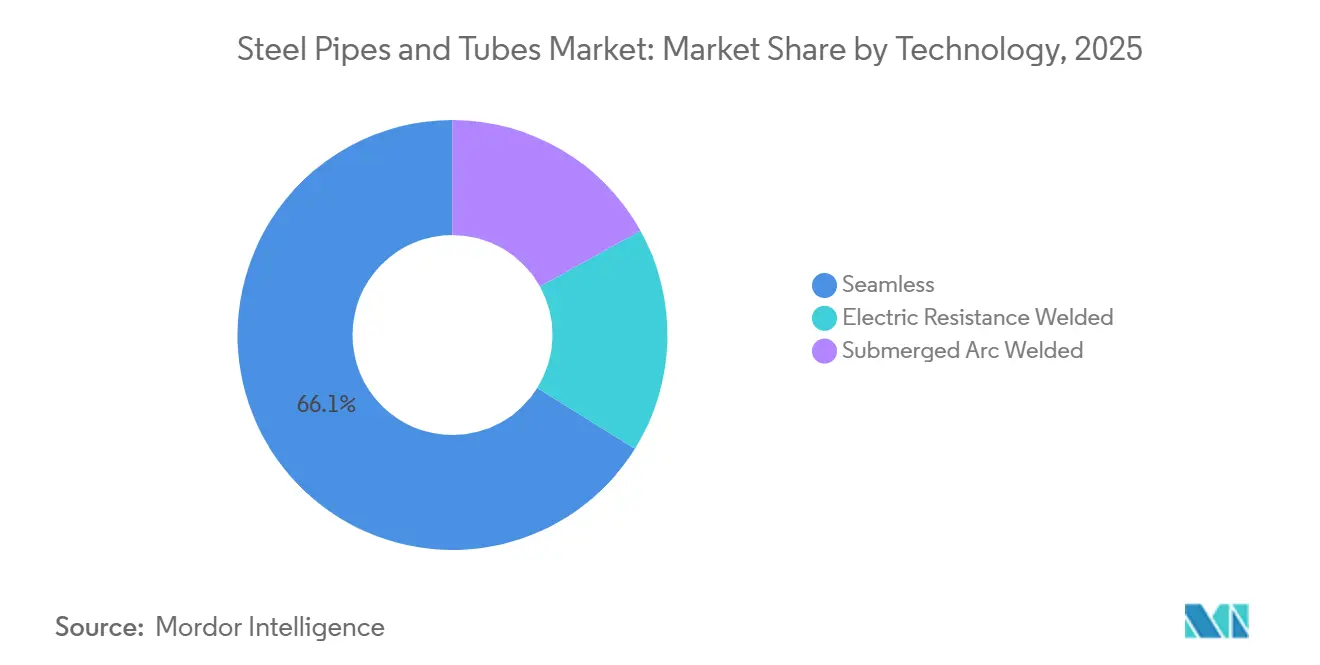
- By technology, seamless held 66.12% of the steel pipes and tubes market share in 2025, while electric resistance welded (ERW) is projected to advance at a 6.05% CAGR through 2031.
- By material, carbon steel held 70.24% of the steel pipes and tubes market share in 2025, while alloy steel is projected to advance at a 6.23% CAGR through 2031.
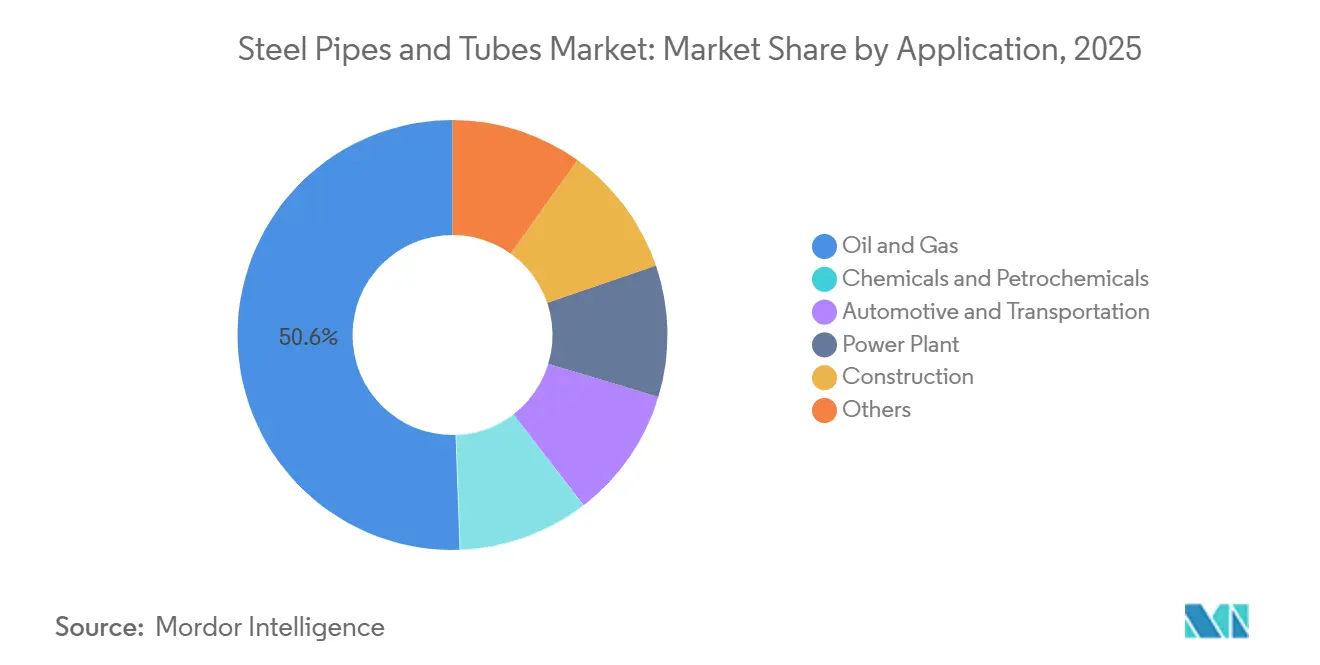
- By application, oil and gas held 50.56% of the steel pipes and tubes market share in 2025, while power plant is projected to advance at a 6.45% CAGR through 2031.
- By geography, Asia-Pacific held 58.51% of the steel pipes and tubes market share in 2025, while North America is projected to advance at a 5.89% CAGR through 2031.
Note: Market size and forecast figures in this report are generated using Mordor Intelligence’s proprietary estimation framework, updated with the latest available data and insights as of January 2026.
Market Trends and Insights
Drivers Impact Analysis of Steel Pipes and Tubes Market*
| Driver | (~) % Impact on CAGR Forecast | Geographic Relevance | Impact Timeline |
|---|---|---|---|
| Infrastructure Renewal and Urban Utility Expansion | +1.4% | Global, led by China, North America, and India | Medium term (2–4 years) |
| Oil and Gas Pipeline Replacement and Expansion | +1.2% | North America, Middle East, Asia-Pacific | Short term (≤ 2 years) |
| Hydrogen, Carbon Capture and Geothermal Pipeline Development | +0.9% | Europe, North America, Japan, Australia | Long term (≥ 4 years) |
| Expansion of Power Generation and Process Industries | +0.7% | Asia-Pacific core, spillover to MEA and South America | Medium term (2–4 years) |
| Advanced Tubular Requirements for High-Pressure Applications | +0.5% | Global, concentrated in APAC and North America | Long term (≥ 4 years) |
| Source: Mordor Intelligence | |||
Infrastructure Renewal and Urban Utility Expansion
Aging municipal networks are supporting pipe replacement programs that are less dependent on new construction cycles and can extend through planning, procurement, installation, repair, and maintenance stages. In fiscal year 2025, State Revolving Funds provided USD 12 billion for drinking water and wastewater infrastructure in the United States. The funding framework supports demand for water mains, sewer systems, and related tubular products over several procurement periods, rather than concentrating demand only in a single construction season. The steel pipes and tubes market benefits where municipalities require strength, long service life, or compatibility with trenchless installation methods that reduce surface disruption in populated areas. Rehabilitation programs can favor suppliers with smaller-diameter precision products as well as suppliers of conventional line pipe, because local network work can require varied product sizes and reliable delivery to contractors. This work broadens demand beyond large greenfield transmission projects and reduces dependence on a single end-use cycle, while also giving diversified producers an opportunity to serve both routine replacement work and more technically demanding utility upgrades.
Oil and Gas Pipeline Replacement and Expansion
Oil and gas investment remains a major source of pipe demand in North America, the Middle East, and Asia-Pacific, where projects involve production, transportation, processing, and established network maintenance. Developers plan 44.9 billion cubic feet per day of natural gas pipeline capacity additions in the United States during 2026 and 2027, and 70% of that capacity is already under construction[1]. LNG export facilities and gas-fired power generation both require transmission and feed gas connections, linking pipe demand to export infrastructure and domestic electricity needs. Integrity requirements also sustain replacement orders, even when new field development slows, because pipeline operators must maintain the performance and safety of existing systems. The steel pipes and tubes market, therefore, draws demand from both expansion projects and the maintenance of existing networks, with requirements differing by pipeline diameter, wall thickness, material grade, coatings, and end-use conditions. Large-diameter and heavy-wall specifications can tighten available mill capacity when several projects enter construction at the same time, making manufacturing capability and dependable delivery important to project schedules.
Hydrogen, Carbon Capture and Geothermal Pipeline Development
Hydrogen, carbon capture, and geothermal projects are adding new technical requirements for tubular products. High-pressure hydrogen service requires careful control of material properties because hydrogen can affect steel performance. Carbon dioxide transport and storage projects also require pipes that meet corrosion and pressure specifications. These requirements give qualified seamless and welded producers a route into higher-value orders. The steel pipes and tubes market can develop into a clearer split between standard grades and certified products for specialized energy infrastructure. Advanced tubular requirements for high-pressure applications reinforce this shift because testing, traceability, and material qualification are becoming more important in project selection.
Expansion of Power Generation and Process Industries
Power generation and process facilities use specialized pipes in boilers, heat recovery systems, steam circuits, refineries, and chemical plants. High-temperature service often requires chrome-molybdenum or other alloy grades rather than standard carbon steel. New LNG, ammonia, methanol, and hydroprocessing facilities can also require corrosion-resistant tubing in heat exchange and reactor systems. Growing electricity demand raises the need for transmission, generation, and industrial support infrastructure. The steel pipes and tubes market gains from these uses because they require material performance, not only volume capacity. Data center development can add to electricity-related construction and support demand for structural and pressure tubes.
Restraints Impact Analysis of Steel Pipes and Tubes Market*
| Restraint | (~) % Impact on CAGR Forecast | Geographic Relevance | Impact Timeline |
|---|---|---|---|
| Volatility in Steel, Scrap and Energy Costs | -1.2% | Global, most acute in Europe and export-dependent producers | Short term (≤ 2 years) |
| Decarbonization Capital Requirements and Emissions Compliance | -0.9% | Europe, APAC core; spillover to North America | Medium term (2–4 years) |
| Substitution by Plastic, Composite and Aluminum Piping | -0.6% | North America, Europe, Southeast Asia | Long term (≥ 4 years) |
| Source: Mordor Intelligence | |||
Volatility in Steel, Scrap and Energy Costs
Steel feedstock and energy costs can change quickly, placing pressure on pipe and tube margins. Hot-rolled coil is a key input for welded products, while billet and energy costs affect seamless tube production. Producers that own upstream steel capacity or have long-term supply arrangements can manage these changes more effectively. Independent mills may face margin pressure when input costs rise faster than pipe selling prices. Buyers may also face changing contract prices when raw materials and electricity costs remain volatile.
Decarbonization Capital Requirements and Emissions Compliance
Lower-carbon steel production requires capital spending, emissions measurement, and additional supply-chain reporting. Carbon Border Adjustment Mechanism requirements can increase the importance of verified embedded-emissions data for steel pipe and tube exporters. Pipe producers must increasingly coordinate with upstream steel suppliers to document the emissions associated with their inputs. These requirements may increase costs for mills that rely on conventional production routes or lack verified emissions records. The steel pipes and tubes market may see stronger procurement preference for low-carbon certified products in Europe and other regions that adopt similar requirements. Smaller producers can face a heavier compliance burden because their reporting systems and input sourcing are less integrated.
*Our forecasts treat driver/restraint impacts as directional, not additive. The impact forecasts reflect baseline growth, mix effects, and variable interactions.
Steel Pipes and Tubes Market Segment Analysis
By Technology:
Seamless Retains Its Structural Role While Electric Resistance Welded Gains Utility DemandSeamless held 66.12% of the steel pipes and tubes market share in 2025, reflecting its established position in demanding oil and gas, power generation, and chemical processing services. It is produced without a welded seam, which supports its use where pressure, temperature, or sour-service conditions place greater demands on material performance. Oil country tubular goods, boiler tubes, and selected hydrogen transport lines remain important examples of these applications. The product's role is determined primarily by operating conditions and project specifications, rather than by the lowest initial purchase cost. The steel pipes and tubes market size connected to seamless products is, therefore, supported by investments that prioritize pressure tolerance, consistent metallurgy, and service reliability.
Electric resistance welded is projected to advance at a 6.05% CAGR through 2031, supported by construction, urban utilities, and lower-pressure gas distribution projects. The process can supply high volumes efficiently where its performance is suitable for the operating environment, and customers pay close attention on delivered cost. Electric resistance-welded pipe is particularly relevant for replacement work because municipal and distribution systems often require standardized, readily available dimensions. Submerged arc welded serves a different requirement, supplying large-diameter products for long-distance oil, gas, and water transmission systems. Research on welded pipe grades for carbon dioxide transport may widen the applications available to qualified ERW suppliers. These developments do not displace seamless pipe in critical conditions, but they can increase the addressable demand for welded products.

By Material:
Carbon Steel Leads Revenue While Alloy Steel Supports Higher-Value UsesCarbon steel held 70.24% of the steel pipes and tubes market share in 2025, making it the principal material for routine construction, general industrial, and standard transmission applications. It provides mechanical strength, formability, availability, and delivered cost characteristics that suit a broad base of buyers. Many projects do not require specialized corrosion resistance or high-temperature performance, so higher-alloy materials would add cost without a corresponding operational benefit. Carbon steel consequently remains the base material across much of the steel pipes and tubes market.
Alloy steel is projected to advance at a 6.23% CAGR through 2031, driven by applications that require higher operating performance. Chrome-molybdenum products are used in high-pressure power boilers, while other grades support cryogenic, corrosive, and hydrogen-related service. Buyers can give greater weight to lifecycle performance where equipment failure, maintenance demands, or safety requirements carry substantial costs. Stainless steel continues to serve corrosion-sensitive work in offshore processing, pharmaceutical utilities, and food facilities. Duplex stainless, clad pipe, and specialty metallic composites have narrower uses but support technical needs that standard grades cannot meet. The steel pipes and tubes industry can generate more value from these materials because qualification, supply reliability, technical support, and material consistency influence customer selection.
By Application:
Oil and Gas Leads Demand While Power Plant Records Faster GrowthOil and gas accounted for 50.56% of the steel pipes and tubes market share in 2025, reflecting its use across upstream, midstream, and downstream activities. Upstream drilling and completion require oil country tubular goods, while midstream networks use line pipe to transport oil and natural gas. Refineries and petrochemical facilities add further demand for process piping, heat-exchange tubes, and corrosion-resistant products. The steel pipes and tubes market size tied to oil and gas also benefits from replacement needs in established pipeline networks. LNG exports and gas-fired power generation can increase transmission requirements, even where upstream activity changes by region.
Power plant is projected to advance at a 6.45% CAGR through 2031, supported by new capacity, geothermal projects, and retubing of existing units. Boiler and steam circuit applications require high-specification products that can withstand demanding pressure and temperature conditions. Chemical and petrochemical plants also continue to use alloy and stainless tubing in heat exchangers, reactors, and processing systems. Automotive and transportation applications include exhaust systems, structural components, drive shafts, and hydraulic equipment. Battery cooling circuits and hydrogen fuel-cell systems can retain some precision tube demand as vehicle technologies change. Construction, agriculture, shipbuilding, and mechanical engineering provide a diverse base of demand that reduces reliance on one application cycle.
Geography Analysis
APAC Steel Pipes and Tubes Market
Asia-Pacific held 58.51% of the steel pipes and tubes market share in 2025, giving the region a central role in global consumption and manufacturing. China, India, Japan, and South Korea combine large infrastructure requirements with significant pipe and tube production capacity. China supports demand through energy networks, urban utility work, industrial investment, and a wide domestic manufacturing base. India is expanding pipe capacity to serve construction, distribution systems, industrial users, and domestic infrastructure projects. Japan and South Korea place more emphasis on specialized energy, offshore, and high-value grades. The steel pipes and tubes market in Asia-Pacific, therefore, includes both cost-focused volume production and advanced capability in selected premium applications.
North America Steel Pipes and Tubes Market
North America is projected to advance at a 5.89% CAGR through 2031, supported by LNG infrastructure, natural gas pipelines, replacement programs, and growing electricity needs. Developers plan 44.9 billion cubic feet per day of natural gas pipeline capacity additions in the United States during 2026 and 2027. Canada remains important for natural gas transportation and for investment in steelmaking and pipe finishing capacity. Tenaris's Ontario program covers hot rolling, stretch reduction, heat treatment, testing, finishing, and threading for semi-premium and American Petroleum Institute connections[2].
EMEA and South America Steel Pipes and Tubes Market
Europe faces relatively high energy and compliance costs, although hydrogen network projects can create demand for qualified line pipe. Carbon reporting requirements are strengthening the importance of documented emissions data and low-carbon steel credentials in procurement decisions. South America benefits from offshore oil and gas work, including deepwater projects that need premium tubulars and protective coatings. The Middle East and Africa demand is associated with hydrocarbon development, water transmission, and industrial infrastructure. The steel pipes and tubes market share in these areas remains below Asia-Pacific's level, but the projects can require high-value specifications. International suppliers and regional mills are positioning capacity near long-cycle energy and water investments.
Competitive Landscape
The steel pipes and tubes market is highly fragmented, with the top five players including Tianjin Youfa Steel Pipe Group Co., Ltd., Tenaris, NIPPON STEEL CORPORATION, Vallourec, and TMK. Tenaris, Vallourec, NIPPON STEEL CORPORATION, and BAOWU Metal compete with APL Apollo, Jindal SAW Ltd., SeAH Steel Corporation, and Zekelman Industries across different customer groups, geographies, and product categories. Their competitive positions differ by technology, material grade, customer qualifications, local service, manufacturing scale, and proximity to end markets. Standard ERW and structural pipe face strong price competition where regional capacity is large, and products are widely interchangeable. Premium seamless products have higher entry barriers because metallurgy, American Petroleum Institute certification, testing, traceability, delivery reliability, and field performance influence customer approval.
Tenaris announced more than USD 90 million investment in its Koppel, Pennsylvania, steel shop and Ambridge, Pennsylvania, seamless pipe facility in June 2026. The program includes electric arc furnace capacity, automation, and productivity improvements that are intended to support growing United States oil and gas demand, with most projects scheduled for completion in the second half of 2027. Tenaris also announced a CAD 300 million investment (approximately USD 221.6 million) at its Sault Ste. Marie Industrial Centre in Ontario during May 2026. The investment covers hot rolling, stretch reduction, heat treatment, testing, finishing, and a threading line for semi-premium and American Petroleum Institute (API) connections, which strengthens its ability to serve customers requiring specialized finishing and connection capabilities.
SeAH Steel Corporation presented carbon capture, utilization, and storage pipe solutions and offshore structural products at Wire & Tube 2026 during April 2026, placing specialized pipe applications alongside its conventional offering. The move demonstrates the value of developing products for energy-transition infrastructure alongside conventional tube and pipe demand, because these projects can require more specific material, fabrication, testing, and documentation standards. Producers are also investing in coatings, threading, inspection, emissions data, and lower-carbon production methods to meet changing project requirements and to address customers who assess product suitability over the full operating life of an installation. These capabilities can influence access to projects where technical standards, verified material performance, and carbon criteria are part of the procurement process, while dependable production capacity and delivery timing remain necessary for larger infrastructure programs. The steel pipes and tubes market remains highly competitive in standard products, while qualified premium supply gives producers a more defensible position through application knowledge, approved product lines, established customer relationships, and the ability to support demanding projects from specification through delivery, including through product design, testing support, production planning, quality assurance, logistics coordination, and responsive service for customers managing complex and long-duration infrastructure work, without compromising reliability, quality requirements, or customer service across project stages.
Steel Pipes and Tubes Industry Leaders
-
Tianjin Youfa Steel Pipe Group Co., Ltd.
-
Tenaris
-
NIPPON STEEL CORPORATION
-
Vallourec
-
TMK
- *Disclaimer: Major Players sorted in no particular order
Steel Pipes and Tubes Market Companies Covered in this Report
- APL Apollo
- ArcelorMittal
- BAOWU Metal
- HYUNDAI STEELPIPE
- JFE Steel Corporation
- Jindal SAW Ltd.
- NIPPON STEEL CORPORATION
- SeAH Steel Corporation
- Tata Steel Limited
- Tenaris
- Tianjin Youfa Steel Pipe Group Co., Ltd.
- TMK
- United States Steel Corporation
- Vallourec
- Zekelman Industries
Recent Industry Developments in Steel Pipes and Tubes Market
- August 2026: Hi-Tech Pipes announced a USD 68 million capital expenditure plan to double its capacity to 2 million metric tonnes per year across facilities in Gujarat, Uttar Pradesh, and Andhra Pradesh. The expansion strengthened domestic production of steel pipes and tubes, including products manufactured using Direct Forming Technology.
- June 2026: Tenaris announced more than USD 90 million investment in its Pennsylvania steel shop and seamless pipe manufacturing facility, upgrading EAF capacity, automation, and productivity. The investment expanded U.S. seamless steel pipe production capabilities to support rising demand from the oil and gas sector.
Global Steel Pipes and Tubes Market Report Scope
Steel pipes and tubes are cylindrical steel products designed to transport fluids, gases, and solids or provide structural and mechanical support in industrial systems. They offer strength, durability, pressure resistance, and adaptability to demanding operating conditions, making them important components in infrastructure and industrial equipment.
The Steel Pipes and Tubes Market is segmented by technology, material, application, and geography. By technology, the market is segmented into seamless, electric resistance welded, and submerged arc welded. By material, the market is segmented into carbon steel, alloy steel, stainless steel, and others. By application, the market is segmented into oil and gas, chemicals and petrochemicals, automotive and transportation, power plant, construction, and others. The report also covers the market size and forecasts for steel pipes and tubes in 16 countries across major regions. For each segment, the market sizing and forecasts have been done on the basis of value (USD).
Segmentation Overview
| Seamless |
| Electric Resistance Welded |
| Submerged Arc Welded |
| Carbon Steel |
| Alloy Steel |
| Stainless Steel |
| Others |
| Oil and Gas |
| Chemicals and Petrochemicals |
| Automotive and Transportation |
| Power Plant |
| Construction |
| Others |
| Asia-Pacific | China |
| India | |
| Japan | |
| South Korea | |
| ASEAN Countries | |
| Rest of Asia-Pacific | |
| North America | United States |
| Canada | |
| Mexico | |
| Europe | Germany |
| United Kingdom | |
| France | |
| Italy | |
| NORDIC Countries | |
| Russia | |
| Rest of Europe | |
| South America | Brazil |
| Argentina | |
| Rest of South America | |
| Middle East and Africa | Saudi Arabia |
| South Africa | |
| Rest of Middle East and Africa |
| By Technology | Seamless | |
| Electric Resistance Welded | ||
| Submerged Arc Welded | ||
| By Material | Carbon Steel | |
| Alloy Steel | ||
| Stainless Steel | ||
| Others | ||
| By Application | Oil and Gas | |
| Chemicals and Petrochemicals | ||
| Automotive and Transportation | ||
| Power Plant | ||
| Construction | ||
| Others | ||
| By Geography | Asia-Pacific | China |
| India | ||
| Japan | ||
| South Korea | ||
| ASEAN Countries | ||
| Rest of Asia-Pacific | ||
| North America | United States | |
| Canada | ||
| Mexico | ||
| Europe | Germany | |
| United Kingdom | ||
| France | ||
| Italy | ||
| NORDIC Countries | ||
| Russia | ||
| Rest of Europe | ||
| South America | Brazil | |
| Argentina | ||
| Rest of South America | ||
| Middle East and Africa | Saudi Arabia | |
| South Africa | ||
| Rest of Middle East and Africa | ||
Key Questions Answered in the Report
What is the size of the steel pipes and tubes market?
The steel pipes and tubes market stands at USD 175.63 billion in 2026 and is projected to reach USD 227.81 billion by 2031.
What is driving demand for steel pipes and tubes?
Utility renewal, natural gas pipeline construction, LNG-related infrastructure, power projects, and industrial process facilities are supporting demand.
Which technology held the largest share in 2025?
Seamless held 66.12% of global revenue in 2025 because critical services require high pressure and temperature tolerance.
Which material is expected to grow fastest through 2031?
Alloy steel is projected to advance at a 6.23% CAGR through 2031, supported by power, LNG, hydrogen, and corrosive-service applications.