
Sprinkler Irrigation Systems Market Size and Share
Market Overview
| Study Period | 2021 - 2031 |
|---|---|
| Market Size (2026) | USD 4.10 Billion |
| Market Size (2031) | USD 5.86 Billion |
| Growth Rate (2026 - 2031) | 7.40 % |
| Fastest Growing Market | Africa |
| Largest Market | North America |
| Market Concentration | Medium |
Major Players *Disclaimer: Major Players sorted in no particular order Image © Mordor Intelligence. Reuse requires attribution under CC BY 4.0. | |
Sprinkler Irrigation Systems Market Analysis by Mordor Intelligence
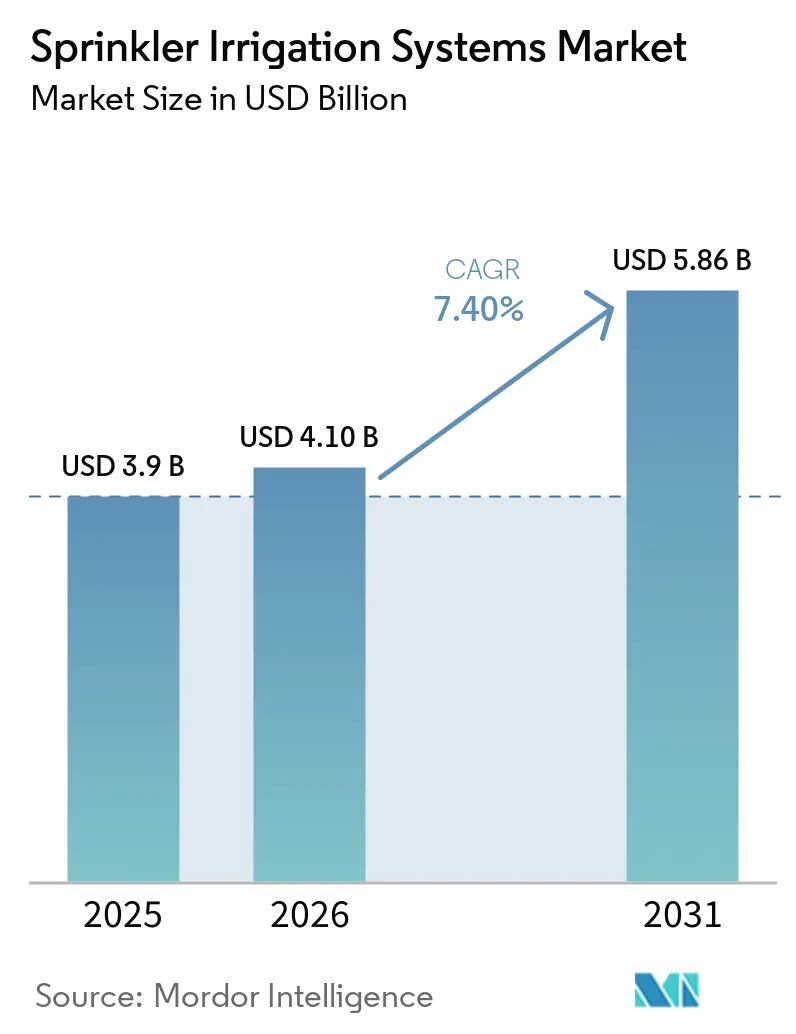
The Sprinkler irrigation systems market size was valued at USD 3.90 billion in 2025 and estimated to grow from USD 4.10 billion in 2026 to reach USD 5.86 billion by 2031, at a CAGR of 7.40% during the forecast period (2026-2031). The market is supported by water scarcity concerns, as agriculture accounted for 72% of global freshwater withdrawals and renewable water availability per person fell 7% over the preceding decade.[1]Water allocation regulations are increasing the importance of systems that enable measurable and controlled water application. Growing horticulture acreage is also driving demand for equipment that supports tighter irrigation scheduling. Established suppliers are combining mechanical equipment with connected controls to facilitate upgrades in mature markets and support new projects in emerging markets.
Key Report Takeaways
By system type, center pivot systems were the largest category in 2025, while lateral move systems were the fastest-growing category through 2031.
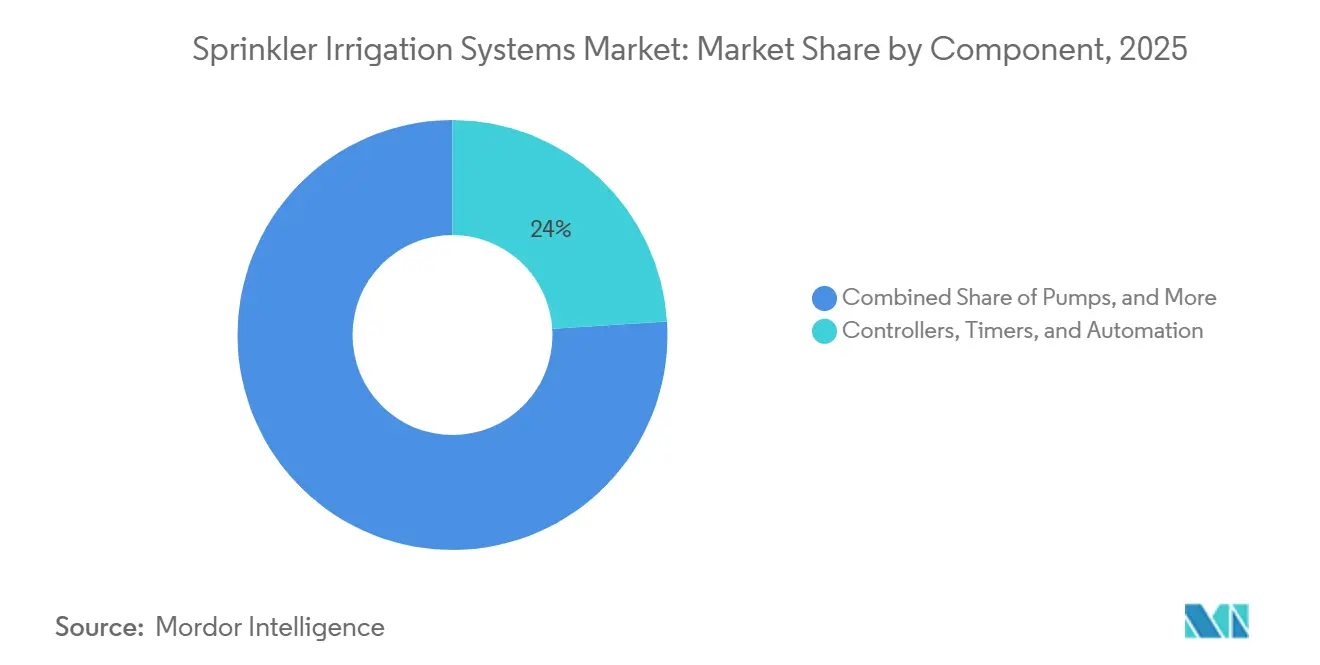
By component, controllers, timers, and automation held 24% revenue share in 2025 and are forecast to grow at 12.5% CAGR through 2031.
By mobility, stationary systems were the largest category in 2025, while towable and mobile systems are forecast to grow at 6.8% CAGR through 2031.
By field size, large fields above 25 hectares were the largest category in 2025, while small fields below 5 hectares are forecast to grow at 7.9% CAGR through 2031.
By crop type, cereals and grains were the largest category in 2025, while fruits and vegetables are forecast to grow at 7.2% CAGR through 2031.
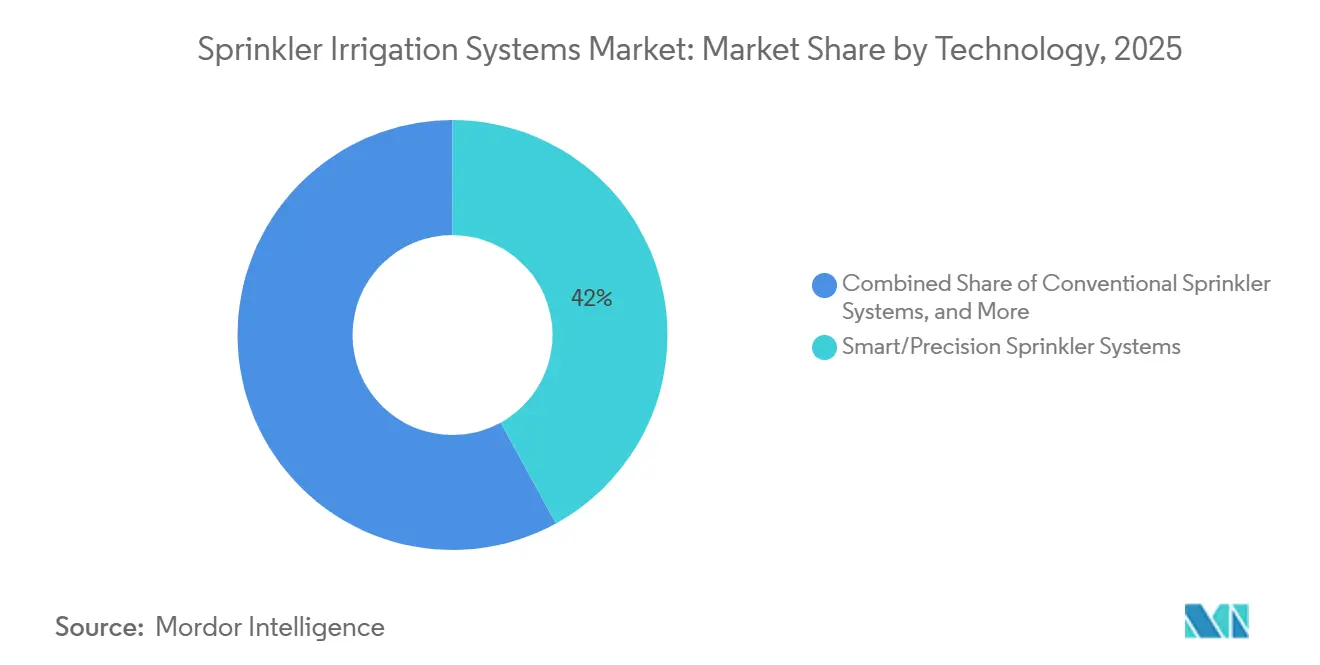
By technology, smart and precision systems held 42% share in 2025 and are forecast to grow at 13.8% CAGR through 2031.
By end user, commercial farms and agribusinesses held 32% share in 2025, while individual farmers and smallholders are forecast to grow at 8.1% CAGR through 2031.
Note: Market size and forecast figures in this report are generated using Mordor Intelligence’s proprietary estimation framework, updated with the latest available data and insights as of January 2026.
Market Trends and Insights
Drivers Impact Analysis of Sprinkler Irrigation Systems Market*
| Driver | (~) % Impact on CAGR Forecast | Geographic Relevance | Impact Timeline |
|---|---|---|---|
| Water Scarcity and Irrigation Modernization | +1.6% | Global, especially Western Asia, Northern Africa, Southern Asia, and Sub-Saharan Africa | Long term (≥ 4 years) |
| Government Subsidies and Water-Efficiency Programs | +1.4% | Asia-Pacific, Middle East, North America, and Europe | Medium term (2-4 years) |
| Precision Agriculture and Variable-Rate Application | +1.3% | North America, Europe, Australia, China, and Japan | Medium term (2-4 years) |
| Expansion of High-Value Horticulture | +0.9% | Asia-Pacific, Mediterranean Europe, Mexico, and South America | Medium term (2-4 years) |
| Retrofit Demand for Connected Irrigation Controls | +0.7% | North America, Australia, Spain, and Brazil | Short term (≤ 2 years) |
| Offline Automation for Smallholder Farms | +0.6% | Sub-Saharan Africa, South Asia, Brazil, and Mexico | Long term (≥ 4 years) |
| Source: Mordor Intelligence | |||
Water Scarcity and Irrigation Modernization
Water stress is changing how growers evaluate irrigation equipment. The FAO reported that more than 60% of irrigated cropland faced high or very high water stress, while freshwater withdrawals in Northern Africa increased 16% during the prior decade. In basins with allocation limits, a shift from flood irrigation to sprinklers can become necessary to maintain production. This need can persist even when crop prices weaken, as lower water access may otherwise reduce planted area. The sprinkler irrigation systems market therefore draws support from both compliance requirements and farm productivity goals. This condition favors suppliers that can offer application controls alongside field equipment.
Precision Agriculture and Variable-Rate Application
Variable-rate application is improving the value proposition for sprinkler upgrades. Research by the Institute of Water Resources and Hydropower Research found that combined variable-rate irrigation and fertilization reduced irrigation water use 31%, increased yield by 13%, and reduced fertilizer application by 18% compared with uniform irrigation[2]. A 2026 review also found that sensor and GPS equipped center pivots reduced water application 15% to 20% while maintaining maize yields in Nebraska studies. These results make retrofits more attractive where growers need to manage both water and input costs. Controllers, sensors, and software are gaining importance as they determine how mechanical equipment is operated. The sprinkler irrigation systems market benefits as digital upgrades generate demand beyond the replacement of pipes or pivots.
Government Subsidies and Water-Efficiency Programs
Public programs are lowering adoption barriers in several major agricultural regions. The U.S. Bureau of Reclamation selected 31 water-efficiency projects in 10 states for USD 38.9 million in fiscal 2025 grants, with selections announced in June 2026.[3] India approved the M-CADWM sub-scheme in April 2025 with an INR 1,600 crore outlay (USD 190 million) for IoT water accounting and pressurized irrigation to farm gates. The Per Drop More Crop program targets 100 lakh hectares under micro-irrigation during 2025-26 to 2029-30. These measures reduce the initial cost faced by growers and create demand for equipment that can document water use and support program requirements.
Expansion of High-Value Horticulture
Fruits, vegetables, and specialty crops require more precise water management than many broad-acre crops. India produced a record 377.78 million tonnes of horticulture in the 2025-26 crop year, with vegetable area reaching 11.88 million hectares and fruit output rising 3.25% to 121.48 million tonnes. Research published in 2026 found that climate-smart irrigation scheduling can reduce crop losses while maintaining horticultural quality under heat and drought conditions. Higher revenue per hectare can improve the payback case for precision equipment. The sprinkler irrigation systems market is therefore supported where growers expand fresh produce production, particularly where yield quality depends on consistent water application and timing.
Restraints Impact Analysis of Sprinkler Irrigation Systems Market*
| Restraint | (~) % Impact on CAGR Forecast | Geographic Relevance | Impact Timeline |
|---|---|---|---|
| High Upfront Equipment and Installation Costs | -1.4% | Sub-Saharan Africa, South Asia, South America, and Middle East smallholder segments | Long term (≥ 4 years) |
| Limited Technical Skills and After-Sales Service | -0.9% | Sub-Saharan Africa, South Asia, and Central America | Long term (≥ 4 years) |
| Low Return on Investment for Low-Value Crops | -0.7% | India, China, South Africa, Brazil, and Argentina | Long term (≥ 4 years) |
| Wind-Related Application Variability and Water-Use Scrutiny | -0.4% | U.S. Great Plains, Australia, Spain, Saudi Arabia, and South Africa | Medium term (2-4 years) |
| Source: Mordor Intelligence | |||
High Upfront Equipment and Installation Costs
Pumps, piping, civil works, and installation make sprinkler projects expensive for smaller farms, particularly where agricultural financing is limited. A University of Nebraska review of Ghana found that lenders have been reluctant to finance pivot irrigation for smallholders, despite the yield stabilization benefits of irrigation. Center pivots require capital before the first harvest can generate cash flow. Financing programs can reduce this barrier but do not eliminate the need for serviceable infrastructure. This constraint limits adoption in several high-growth areas of the sprinkler irrigation systems market.
Limited Technical Skills and After-Sales Service
Equipment performance depends on correct installation, pressure management, and routine maintenance. Smallholders may lack access to technicians capable of diagnosing issues with pumps, controllers, and nozzles. Weak local service networks can extend downtime during critical irrigation periods, a problem more pronounced in rural areas with fragmented farm structures. Suppliers need adequate training and distribution capacity to support equipment beyond the point of sale. Without this support, the sprinkler irrigation systems market may grow more slowly in remote regions.
*Our forecasts treat driver/restraint impacts as directional, not additive. The impact forecasts reflect baseline growth, mix effects, and variable interactions.
Sprinkler Irrigation Systems Market Segment Analysis
System Type:
Center Pivots Remain the Leading FormatCenter pivot systems held the largest share by system type in 2025. Their installed base is strong across large grain and oilseed farms in North America, South America, Central Asia, and the Middle East. Continuous movement supports regular application over circular fields. Center pivots also work with variable-rate controls and remote management tools, supporting their position in the sprinkler irrigation systems market.
Lateral move systems are the fastest-growing system type through 2031. They fit rectangular fields where circular pivot layouts leave corners without coverage. Solid set and traveling gun systems continue to serve orchards, turf, and fields where permanent or towable equipment is preferred. In February 2026, Valley introduced its Small Field Center Pivot for farms up to 60 acres and irregular fields, extending pivot designs to smaller farm configurations.
By Component:
Automation Holds the Leading PositionControllers, timers, and automation accounted for 24% of the sprinkler irrigation systems market share in 2025 and are projected to grow at a 12.5% CAGR through 2031. This category led both component share and forecast growth, indicating that controls are becoming more important to equipment value. Growers use them to schedule applications and review field activity, making this component category central to the modernization of installed systems.
Pumps, pipes, and tubing form the capital-intensive infrastructure layer, with demand tied more directly to new installation volume than to retrofit activity. Sprinkler heads and nozzles remain high-volume replacement items. Filters, fittings, and accessories serve both new systems and maintenance work. Requirements for pressure control and water management increase the value of related components across the sprinkler irrigation systems market.
By Mobility:
Fixed Systems Lead While Mobile Options ExpandStationary systems were the largest mobility category in 2025. Fixed infrastructure is widely used in agricultural fields and institutional applications, providing a permanent setup for operations with stable field layouts. The installed base also supports continued maintenance demand, reflecting the importance of long-term irrigation infrastructure for many commercial users.
Towable and mobile systems are projected to grow at a 6.8% CAGR through 2031. These systems can be redeployed among field blocks during a growing season, making them suitable for shared ownership models and areas where land tenure does not support permanent installations. Traveling gun systems also provide flexibility for forage and fodder operations. This option benefits the sprinkler irrigation systems market where farmers require operational flexibility at a lower fixed commitment.
By Field Size:
Large Farms Provide the Core Installed BaseLarge fields above 25 hectares were the leading field-size category in 2025. Larger operations can spread the cost of pivots, pumping systems, and controls across more hectares, improving the economic case for mechanized irrigation. Commercial farms also have greater access to credit and technical support, keeping large farms important to equipment demand.
Small fields below 5 hectares are forecast to grow at 7.9% CAGR through 2031. India reported cumulative sprinkler coverage across 114.6 lakh hectares under the PDMC scheme since 2015-16 and targets annual coverage of 20 lakh hectares through 2029-30. Subsidy programs and smaller product designs are supporting this group. Medium fields from 5 to 25 hectares also generate demand as farms move beyond basic fixed-head systems. The sprinkler irrigation systems market can serve this transition with modular equipment and practical controls.
By Crop Type:
Cereals Provide Scale While Horticulture Drives GrowthCereals and grains were the largest crop-type category in 2025. Irrigated wheat, maize, and rice account for a large share of mechanized pivot installations across North America, Eastern Europe, and Central Asia. Large fields make mechanized systems easier to deploy, providing a stable volume base for suppliers.
Fruits and vegetables are forecast to grow at 7.2% CAGR through 2031. The USDA reported that California's 2026 water allocations remained above drought-period levels from 2020 to 2022, supporting vegetable production. Sprinklers also support frost protection in fruit orchards. Oilseeds and pulses can use deficit-irrigation approaches, while forage and specialty crops sustain demand for tailored equipment. Crop requirements for uniform application broaden the sprinkler irrigation systems market beyond broad-acre farming.
By Technology:
Smart Systems Lead AdoptionSmart and precision systems held 42% of the technology segment in 2025, the largest technology share, and are forecast to expand at a 13.8% CAGR through 2031. This indicates that connected equipment has moved beyond a limited premium offering. Growers are adopting sensors, weather data, and remote controls during replacement cycles, increasing the sprinkler irrigation systems market size for this technology as digital functions become part of regular procurement.
Hunter introduced its MCC Controller in February 2026 for large commercial sites. Automated systems remain an intermediate option between conventional timers and full sensor-based controls. Conventional systems continue to serve low-connectivity and price-sensitive settings. Water metering requirements in European and US markets add pressure to improve system monitoring, sustaining demand for practical digital upgrades.
By End User:
Commercial Farms Lead While Smallholders ExpandCommercial farms and agribusinesses accounted for 32% of sprinkler irrigation systems market share in 2025. Their scale supports the purchase of complete irrigation systems and management platforms. They can also use farm credit and dedicated technical teams. This group remains the largest end-user category, with large project contracts also supporting demand from institutional farm operations.
Individual farmers and smallholders are forecast to grow at an 8.1% CAGR through 2031. Government subsidies, smaller equipment formats, and shared ownership models are improving access, and agricultural cooperatives can distribute system costs among members. Lindsay announced an USD 80 million Zimmatic and FieldNET agreement for a MENA customer in January 2026. Landscape contractors and facility managers also require multi-zone equipment for parks, sports facilities, and institutional grounds
Geography Analysis
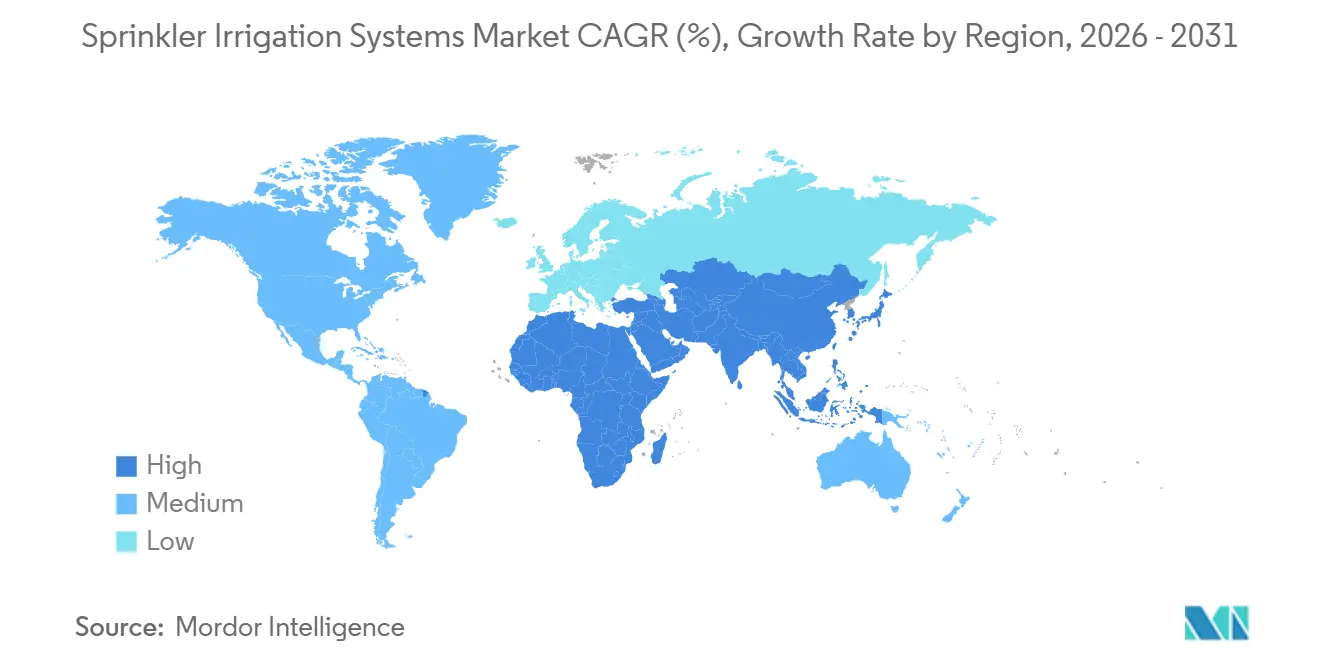
North America held the largest regional revenue share in 2025, supported by a dense center pivot base across the U.S. Great Plains and Canada's Prairie provinces and is forecast to grow at a 6.2% CAGR through 2031. Lindsay reported an 11% year-over-year decline in North American irrigation revenue in its fiscal 2026 third quarter, reflecting grower caution. Retrofit demand for controls, connected platforms, and pressure-regulating nozzles remains important. WaterSMART grants totaling USD 38.9 million across 31 projects support irrigation efficiency upgrades. South America is forecast to grow at 7.1% CAGR, supported by irrigated soy and corn production in Brazil, although credit conditions can delay smaller purchases.
Asia-Pacific is forecast to grow at 8.9% CAGR through 2031. India is expanding micro-irrigation coverage and water accounting through national programs. China continues to modernize agriculture in water-stressed grain basins. Japan, South Korea, and Australia are higher-specification markets where sensor integration is common. Europe is forecast to grow at 5.4% CAGR, with replacement-led demand shaped by water abstraction permits and the need for measurable delivery systems.
Africa is the fastest-growing regional segment at 9.2% CAGR through 2031, starting from a lower installed base with substantial under-irrigated land. Tanzania plans to increase irrigated area from 983,466 hectares in 2025 to 5 million hectares by 2030. The Middle East is forecast to grow at 8.6% CAGR, supported by food-security projects and protected agriculture. Financing and technical service gaps continue to limit smallholder adoption in both regions, supporting demand for equipment that is affordable, durable, and easy to service.
Competitive Landscape
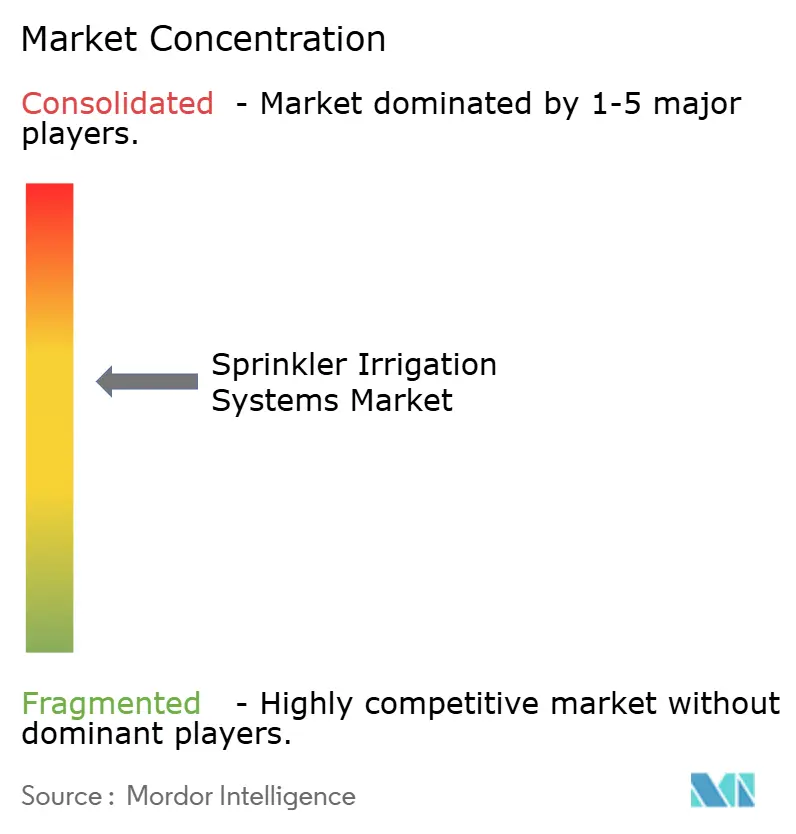
The sprinkler irrigation systems market was moderately concentrated in 2025, with Valmont, Lindsay, Rain Bird, Hunter Industries, and The Toro Company holding a combined 66.1% of revenue. Valmont held 23.9%, followed by Lindsay at 14.7%, Rain Bird at 12.4%, Hunter Industries at 8.8%, and The Toro Company at 6.3%. Scale in manufacturing, dealer coverage, and digital platforms supports their market positions. Competition increasingly focuses on application control and water productivity rather than equipment volume alone.
Valmont combined four irrigation management platforms into AgSense 365 in 2025. Lindsay began delivering a Zimmatic and FieldNET contract valued at USD 80 million for a MENA customer in fiscal 2026. Rivulis, DLL, and the AGRI3 Fund launched a blended finance program in June 2026 to improve access to sustainable irrigation for growers in emerging markets. These actions address system management, large-scale deployment, and financing. Suppliers are also developing pressure regulation, variable-rate nozzles, and sensor integration.
BAUER and OCMIS retain specialized positions in hose-reel traveler and raingun categories. Komet Irrigation and Nelson Irrigation compete through nozzle and end-gun engineering. Their products serve applications where pivot economics or digital platform breadth are not the primary buyer priority. Affordable systems for farms below 5 hectares and offline automation remain areas of supplier focus. The market has room for firms that combine reliable equipment with local financing and service support, providing a route to serve smaller farms without relying solely on large projects.
Sprinkler Irrigation Systems Industry Leaders
-
Valmont Industries, Inc.
-
Lindsay Corporation
-
Rain Bird Corporation
-
Hunter Industries Inc.
-
The Toro Company
- *Disclaimer: Major Players sorted in no particular order
Sprinkler Irrigation Systems Market Companies Covered in this Report
- Valmont Industries, Inc.
- Lindsay Corporation
- Rain Bird Corporation
- Hunter Industries Inc.
- The Toro Company
- Reinke Manufacturing Co., Inc.
- Netafim Ltd. (Orbia Advance Corporation, S.A.B. de C.V.)
- Jain Irrigation Systems Ltd.
- Rivulis Irrigation Ltd. (Temasek Holdings and Jain Irrigation Systems Ltd.)
- Nelson Irrigation Corporation
- T-L Irrigation Company
- Alkhorayef Industries Company
- Röhren- und Pumpenwerk BAUER GmbH
- OCMIS S.p.A.
- Komet Irrigation GmbH
Recent Industry Developments in Sprinkler Irrigation Systems Market
- August 2026: Hunter Industries launched the Hunter Sprinkler Store, its first direct-to-consumer eCommerce website, marking a channel expansion that bypasses traditional dealer networks for residential and light-commercial buyers and broadens market accessibility.
- June 2026: Orbia Netafim opened a 30,000-square-meter manufacturing facility in Hermosillo, Sonora, Mexico, the company's third production site in Mexico and one of its largest globally, to expand precision irrigation production capacity and Central America.
- June 2026: Rivulis, DLL, and the AGRI3 Fund jointly launched a blended finance program combining public and private capital with risk-sharing guarantees to expand access to sustainable irrigation in emerging markets, enabling turnkey system delivery for growers who lack conventional collateral.
Global Sprinkler Irrigation Systems Market Report Scope
The sprinkler irrigation market covers irrigation systems that distribute water to agricultural fields through pressurized sprinkler networks to provide controlled and efficient crop irrigation.
The Sprinkler Irrigation Systems Report is Segmented by System Type (Center Pivot Systems, Lateral Move Systems, Solid Set Systems, Traveling Gun Systems, and Other System Types), by Component (Sprinkler Heads and Nozzles, Pumps, Pipes and Tubing, Valves and Pressure Regulators, Controllers, Timers, and Automation, and Filters, Fittings, and Accessories), by Mobility (Stationary Systems and Towable and Mobile Systems), by Field Size (Small Fields, Below 5 Hectares, Medium Fields, 5 to 25 Hectares, and Large Fields, Above 25 Hectares), by Crop Type (Cereals and Grains, Oilseeds and Pulses, Fruits and Vegetables, Forages and Fodder Crops, and Specialty and Plantation Crops), by Technology (Conventional Sprinkler Systems, Automated Sprinkler System, and Smart/Precision Sprinkler Systems), by End User (Individual Farmers and Smallholders, Commercial Farms and Agribusinesses, Agricultural Cooperatives, Government and Institutional Farms, and Landscape Contractors and Facility Managers), and by Geography (North America, South America, Europe, Asia-Pacific, Middle East, Africa). The Market Forecasts are Provided in Terms of Value (USD).
Segmentation Overview
| Center Pivot Systems |
| Lateral Move Systems |
| Solid Set Systems |
| Traveling Gun Systems |
| Other System Types |
| Sprinkler Heads and Nozzles |
| Pumps |
| Pipes and Tubing |
| Valves and Pressure Regulators |
| Controllers, Timers, and Automation |
| Filters, Fittings, and Accessories |
| Stationary Systems |
| Towable and Mobile Systems |
| Small Fields, Below 5 Hectares |
| Medium Fields, 5 to 25 Hectares |
| Large Fields, Above 25 Hectares |
| Cereals and Grains |
| Oilseeds and Pulses |
| Fruits and Vegetables |
| Forages and Fodder Crops |
| Specialty and Plantation Crops |
| Conventional Sprinkler Systems |
| Automated Sprinkler System |
| Smart/Precision Sprinkler Systems |
| Individual Farmers and Smallholders |
| Commercial Farms and Agribusinesses |
| Agricultural Cooperatives |
| Government and Institutional Farms |
| Landscape Contractors and Facility Managers |
| North America | United States |
| Canada | |
| Mexico | |
| Rest of North America | |
| South America | Brazil |
| Argentina | |
| Rest of South America | |
| Europe | Germany |
| United Kingdom | |
| France | |
| Italy | |
| Spain | |
| Russia | |
| Rest of Europe | |
| Asia-Pacific | China |
| India | |
| Japan | |
| South Korea | |
| Australia | |
| Rest of Asia-Pacific | |
| Middle East | Saudi Arabia |
| United Arab Emirates | |
| Turkey | |
| Israel | |
| Rest of Middle East | |
| Africa | South Africa |
| Egypt | |
| Nigeria | |
| Kenya | |
| Rest of Africa |
| By System Type | Center Pivot Systems | |
| Lateral Move Systems | ||
| Solid Set Systems | ||
| Traveling Gun Systems | ||
| Other System Types | ||
| By Component | Sprinkler Heads and Nozzles | |
| Pumps | ||
| Pipes and Tubing | ||
| Valves and Pressure Regulators | ||
| Controllers, Timers, and Automation | ||
| Filters, Fittings, and Accessories | ||
| By Mobility | Stationary Systems | |
| Towable and Mobile Systems | ||
| By Field Size | Small Fields, Below 5 Hectares | |
| Medium Fields, 5 to 25 Hectares | ||
| Large Fields, Above 25 Hectares | ||
| By Crop Type | Cereals and Grains | |
| Oilseeds and Pulses | ||
| Fruits and Vegetables | ||
| Forages and Fodder Crops | ||
| Specialty and Plantation Crops | ||
| By Technology | Conventional Sprinkler Systems | |
| Automated Sprinkler System | ||
| Smart/Precision Sprinkler Systems | ||
| By End User | Individual Farmers and Smallholders | |
| Commercial Farms and Agribusinesses | ||
| Agricultural Cooperatives | ||
| Government and Institutional Farms | ||
| Landscape Contractors and Facility Managers | ||
| By Geography | North America | United States |
| Canada | ||
| Mexico | ||
| Rest of North America | ||
| South America | Brazil | |
| Argentina | ||
| Rest of South America | ||
| Europe | Germany | |
| United Kingdom | ||
| France | ||
| Italy | ||
| Spain | ||
| Russia | ||
| Rest of Europe | ||
| Asia-Pacific | China | |
| India | ||
| Japan | ||
| South Korea | ||
| Australia | ||
| Rest of Asia-Pacific | ||
| Middle East | Saudi Arabia | |
| United Arab Emirates | ||
| Turkey | ||
| Israel | ||
| Rest of Middle East | ||
| Africa | South Africa | |
| Egypt | ||
| Nigeria | ||
| Kenya | ||
| Rest of Africa | ||
Key Questions Answered in the Report
What is the current value of sprinkler irrigation systems?
The sprinkler irrigation systems market size was USD 4.10 billion in 2026. It is forecast to reach USD 5.86 billion by 2031 at a 7.40% CAGR, reflecting the stated outlook for the sprinkler irrigation systems market.
Which sprinkler system format has the largest installed presence?
Center pivot systems were the largest system type in 2025. Large-field agriculture and compatibility with variable-rate controls support their use.
Which region will grow the fastest through 2031?
Africa is forecast to grow at 9.2% CAGR through 2031. Asia-Pacific follows at 8.9%.
Which technology is expanding most rapidly?
Smart and precision systems led the technology category with 42% share in 2025. They are forecast to grow at 13.8% CAGR.