
Sports Mouthguard Market Size and Share
Market Overview
| Study Period | 2020 - 2031 |
|---|---|
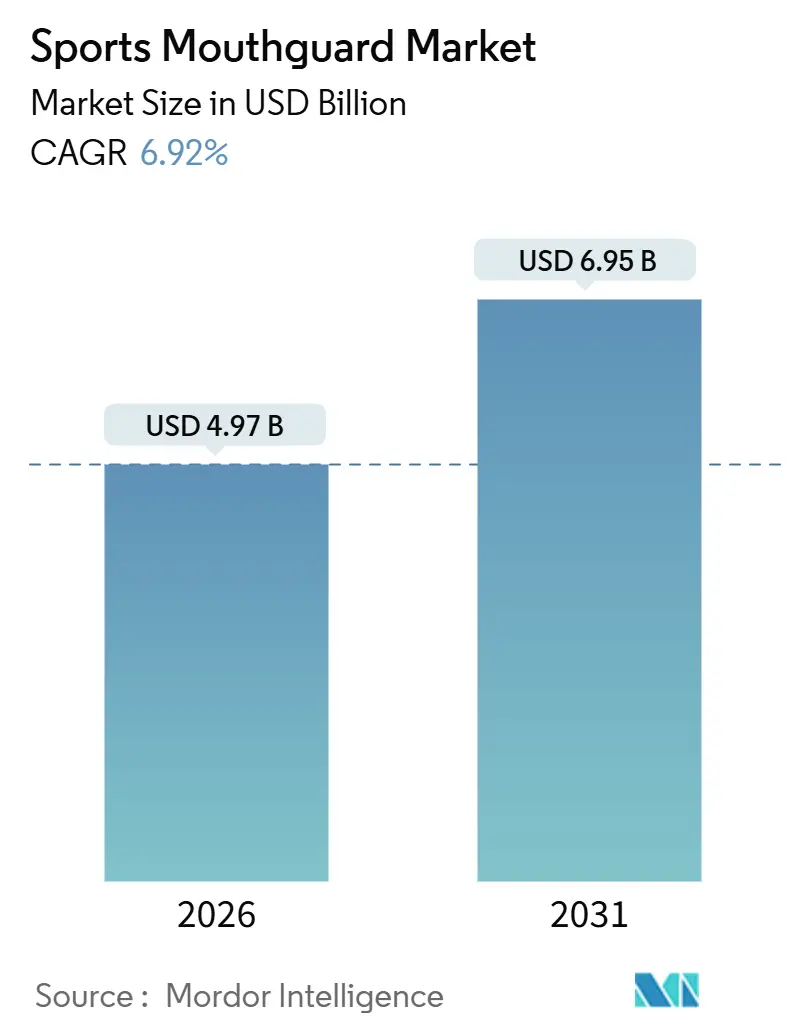
| Market Size (2026) | USD 4.97 Billion |
| Market Size (2031) | USD 6.95 Billion |
| Growth Rate (2026 - 2031) | 6.92 % |
| Fastest Growing Market | North America |
| Largest Market | Asia Pacific |
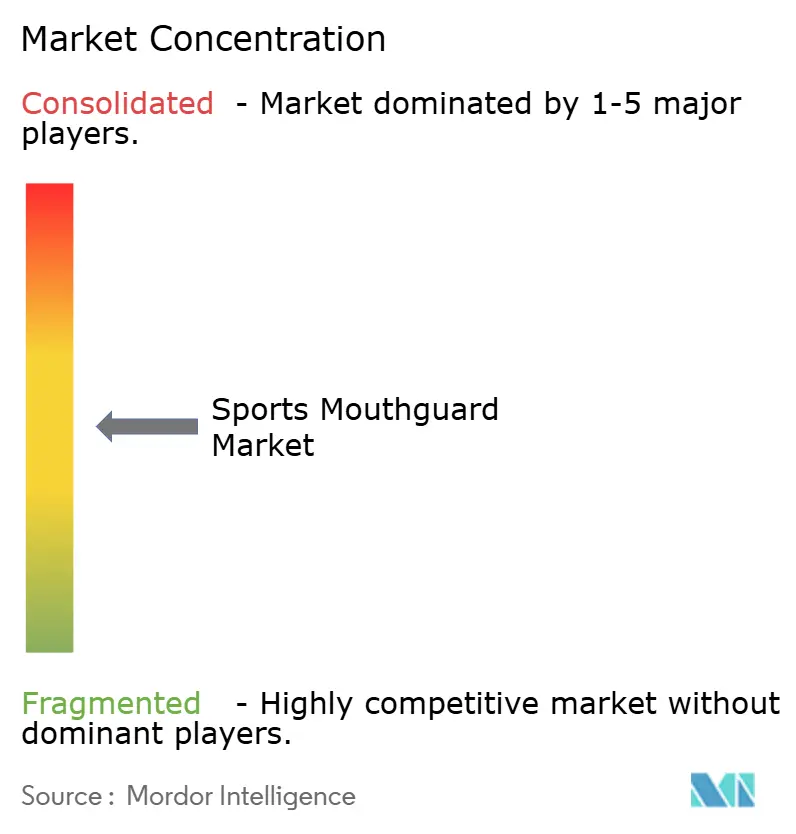
| Market Concentration | Medium |
Major Players *Disclaimer: Major Players sorted in no particular order Image © Mordor Intelligence. Reuse requires attribution under CC BY 4.0. | |
Sports Mouthguard Market Analysis by Mordor Intelligence
The Sports Mouthguard Market size is estimated at USD 4.97 billion in 2026, and is expected to reach USD 6.95 billion by 2031, at a CAGR of 6.92% during the forecast period (2026-2031).
Sharper enforcement of mouthguard mandates, rapid commercialization of sensor-equipped models, and the spread of direct-to-consumer subscription programs are widening the customer base and reshaping price elasticity. Governing bodies are codifying protective-gear rules, dental-technology firms are slashing fabrication lead times with digital workflows, and venture-backed brands are bundling replacements as recurring services. Together, these forces are converting what was once an episodic retail purchase into a data-driven health-monitoring accessory. On the supply side, acrylic and EVA still anchor output, yet bio-based polyurethanes and natural rubber are winning attention as Europe’s chemical regulations tighten. Competitive intensity remains moderate; incumbents retain institutional contracts, but scanner-makers, 3-printing specialists, and e-commerce natives are compressing margins through speed, customization, and lower distribution overheads.
Key Report Takeaways
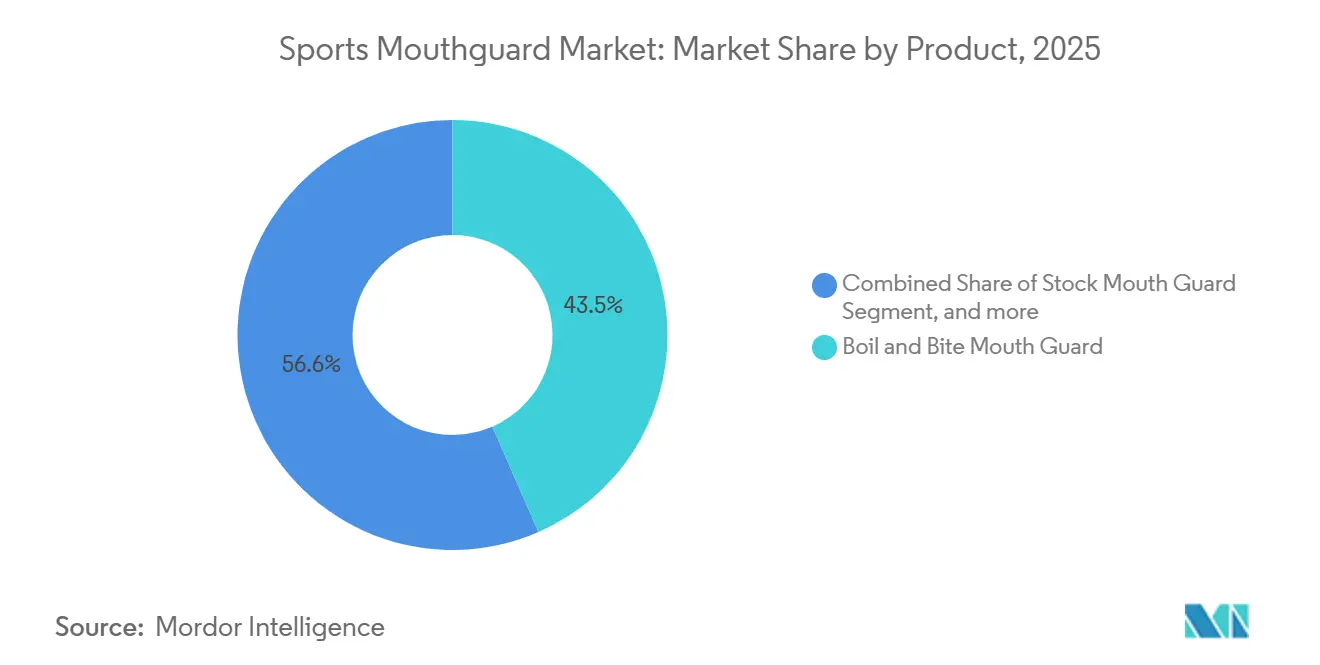
- By product, boil-and-bite designs captured 43.45% of revenue in 2025, while custom-made variants are on track for an 8.65% CAGR through 2031.
- By material, acrylic accounted for 48.65% in 2025; natural rubber is projected to expand at an 8.43% CAGR through 2031 as eco-compliant alternatives gain favor.
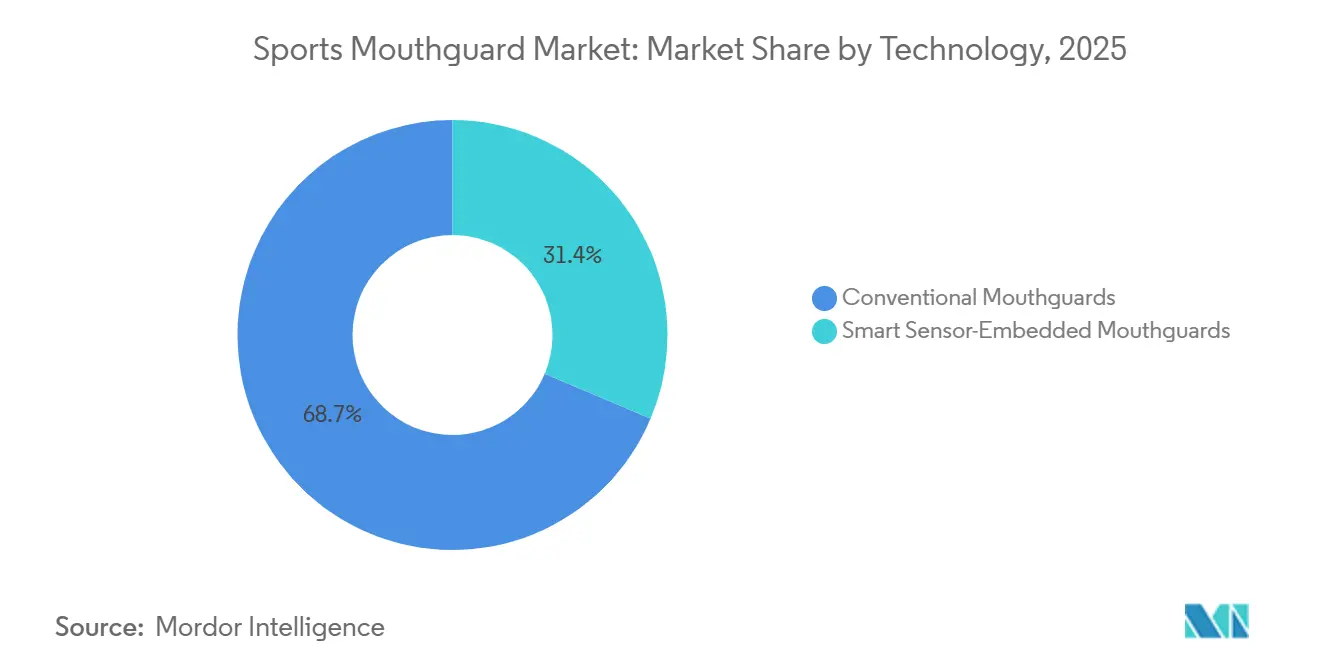
- By technology, conventional guards supplied 68.65% of 2025 sales, yet smart sensor-embedded units are set to record an 8.97% CAGR between 2026 and 2031.
- By distribution channel, offline outlets accounted for 71.32% in 2025, whereas online platforms are pacing the field with a 9.02% CAGR, owing to subscription-based shipping models that cost USD 10–USD 13 a month.
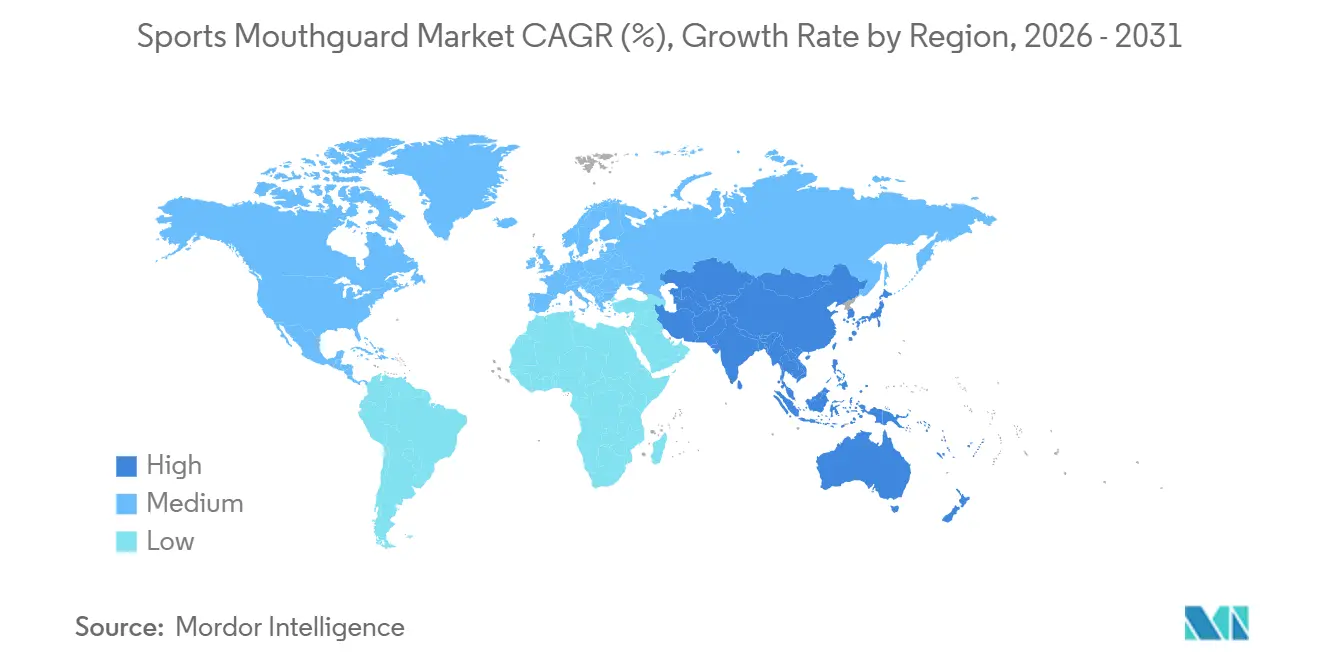
- By geography, North America led with 45.43% in 2025; Asia-Pacific is forecast to grow at 7.54% through 2031 on the back of disposable-income gains and state-funded sports infrastructure.
Note: Market size and forecast figures in this report are generated using Mordor Intelligence’s proprietary estimation framework, updated with the latest available data and insights as of January 2026.
Market Trends and Insights
Drivers Impact Analysis of Sports Mouthguard Market*
| Driver | (~) % Impact on CAGR Forecast | Geographic Relevance | Impact Timeline |
|---|---|---|---|
| Mandatory Mouthguard Policies In Amateur And Professional Sports | +1.8% | North America, Europe, Australia | Medium term (2-4 years) |
| Growth In Youth Participation In High-Impact Sports | +1.2% | Global, with concentration in North America and Asia-Pacific | Long term (≥ 4 years) |
| Advancements In 3D Printing For Custom-Fit Manufacturing | +1.5% | North America, Europe, emerging in Asia-Pacific | Medium term (2-4 years) |
| Integration Of Impact-Sensor Technology For Concussion Analytics | +1.1% | North America, Europe, Australia | Long term (≥ 4 years) |
| Direct-To-Consumer Subscription Replacement Models | +0.7% | North America, Europe | Short term (≤ 2 years) |
| Adoption Of Antimicrobial And Eco-Friendly Biomaterials | +0.6% | Global, regulatory push in EU | Medium term (2-4 years) |
| Source: Mordor Intelligence | |||
Mandatory Mouthguard Policies in Amateur and Professional Sports
State and national rulebooks are converting optional guidelines into binding requirements, thereby raising the baseline demand for sports mouthguards. The National Federation of State High School Associations now requires use in five contact sports, and Massachusetts extended coverage to middle school programs in 2024, adding 12,000 new mandated users. World Rugby’s clearance of smart guards for elite play in 2024 cues adoption waves across club and school leagues. Australia’s dental authority reinforced its call for compulsory guards in all collision sports, citing 60% fewer orofacial injuries when guards are properly fitted[1]American Dental Association, “ANSI/ADA Standard 99—Mouthguards,” ada.org. Performance thresholds detailed in ANSI/ADA Standard 99, such as 90-joule absorption, lift product quality, and squeeze substandard imports from institutional tenders.
Integration of Impact-Sensor Technology for Concussion Analytics
Embedding tri-axial accelerometers converts passive protection into a diagnostic node, but data fidelity governs uptake. OPRO and Prevent Biometrics deploy mouthguards that live-stream linear and rotational acceleration once hits exceed 95 g or 4,500 rad/s². Bupa’s HITIQ guard launched in 2024 with a subscription cloud dashboard, offering longitudinal exposure profiles for rugby squads. Laboratory tests at the Cleveland Clinic in 2025 found coupling variances that under-report peaks by up to 20%, prompting calls for tighter calibration. Oxford University detected thermal expansion drift over a 90-minute match, adding 8% error margins, a factor that led the NCAA to pause any mandate. Even so, the U.S. Department of Defense granted USD 2.1 million to refine algorithms for military drills, affirming the long-range promise.
Advancements in 3D Printing for Custom-Fit Manufacturing
Digital light processing, fused deposition modeling, and vat photopolymerization are dismantling the time and cost barriers that once confined custom guards to elite athletes. A 2025 Journal of Manufacturing Processes study showed that KeyOrtho resin guards absorbed 92 joules while trimming fabrication time by 70%. 3Shape’s scanner-to-cloud workflow delivers a guard within five business days and eliminates physical impressions, cutting patient visits in half. Modular prints from the University of São Paulo let athletes swap out only the inner cushion every six months, keeping shells in play longer. MIT’s shape-memory prototype softens at body temperature for insertion, then hardens to a custom geometry, hinting at adaptive fit products within five years. Henry Schein distributes the digital suite to 10,000 practices, setting the stage for sub-USD 100 custom options by 2028.
Adoption of Antimicrobial and Eco-Friendly Biomaterials
Frequent saliva exposure breeds biofilm that compromises both hygiene and mechanical integrity, steering the sports mouthguard market toward antimicrobial and biodegradable matrices. EVA doped with 2% chlorhexidine nanoparticles cut Streptococcus mutans by 95% over 30 days in 2024 laboratory work. Essential oil infusions at sub-1.5% concentrations deliver antibacterial activity while retaining tensile strength, according to 2025 University of Campinas findings. Natural rubber production is tied to the EU REACH crackdown on phthalates and bisphenol-A, forcing manufacturers to explore renewable feedstocks[2]European Chemicals Agency, “REACH restrictions for medical devices,” echa.europa.eu. Shock Doctor’s bio-based polyurethane prototype promises a 30% smaller carbon footprint, though it still awaits ASTM F697-24 impact confirmation. The American Dental Association’s 2025 policy now recommends antimicrobial formulations for high-contact sports, shifting procurement specs in collegiate athletics.
Restraints Impact Analysis of Sports Mouthguard Market*
| Restraint | (~) % Impact on CAGR Forecast | Geographic Relevance | Impact Timeline |
|---|---|---|---|
| High Price Point Of Custom-Fit Mouthguards | -0.9% | Global, most acute in price-sensitive emerging markets | Medium term (2-4 years) |
| Proliferation Of Low-Cost Counterfeit Alternatives Online | -1.2% | Global, concentrated in North America and Europe e-commerce channels | Short term (≤ 2 years) |
| Limited Validation Of Sensor Accuracy Hindering Institutional Uptake | -0.8% | North America, Europe, Australia | Long term (≥ 4 years) |
| Environmental Regulations Increasing Polymer Compliance Costs | -0.5% | Europe, emerging in North America | Medium term (2-4 years) |
| Source: Mordor Intelligence | |||
Proliferation of Low-Cost Counterfeit Alternatives Online
Third-party marketplaces list guards 60%–80% cheaper than branded units, but most lack biocompatibility tests or meet ASTM thickness rules. U.S. Customs reported that 93% of counterfeit seizures in 2020 arrived as small parcels that bypassed port inspections, with sports protective gear singled out as a high-risk category. The U.K. regulator has flagged dental devices sold online containing phthalate levels above EU limits. OECD analysis shows poor seller verification and weak recall integration across major platforms, allowing flagged listings to persist for months. Recycled EVA counterfeits swing in hardness from Shore A 55 to 75, outside the ASTM F697-24 window, and yield inconsistent energy absorption. Parents on tight budgets gravitate to USD 5–USD 10 items, unaware that energy-dissipating geometries defined in ANSI/ADA Standard 99 are absent.
Limited Validation of Sensor Accuracy Hindering Institutional Uptake
Smart-guard kinematics diverge from headform baselines in academic tests. Cleveland Clinic measured 12%–22% variance across five commercial models, with the worst on oblique strikes. Oxford researchers traced 0.8%–1.2% housing expansion at 37 °C, compounding drift over a match. Variable bite force adds 3 mm of potential sensor slippage, decoupling accelerometers from cranial motion. The NCAA withheld any mandate in 2024, citing false-positive concerns and inadequate peer-reviewed datasets. Until longitudinal studies correlate sensor readings with medical diagnoses, athletic directors hesitate to redirect budgets from proven conventional guards.
*Our forecasts treat driver/restraint impacts as directional, not additive. The impact forecasts reflect baseline growth, mix effects, and variable interactions.
Sports Mouthguard Market Segment Analysis
By Product:
Custom Precision Drives Premium ShiftCustom-made models are forecast to register an 8.65% CAGR from 2026 to 2031, the fastest among product tiers, as digital scanning and 3-printing shrink delivery times from weeks to days. Boil-and-bite units retained 43.45% of 2025 revenue because athletes value a USD 15–USD 40 price and same-day availability, yet their one-size geometry encourages mid-game removal and inconsistent compliance. Stock guards, already trailing in retention, keep losing ground because they fail ASTM F697-24 minimum thickness and draw coach scrutiny. Advancing workflows, such as 3Shape-GuardLab cloud design, now let dentists supply a printed guard in 5 days for USD 120–USD 180, democratizing custom-fit. The sports mouthguard market share for boil-and-bite products is set to erode as subsidized programs like Delta Dental’s Winning Smiles fund up to 75% of the purchase price for underserved youth.
3D studies confirm the quality jump: DLP-printed KeyOrtho guards absorb 92 joules, equal to vacuum-formed EVA, while cutting material waste by 40% and labor by 70%. Henry Schein’s distribution scale will sink costs closer to USD 100 by 2028, paring the premium over boil-and-bite. Modular two-layer designs born at the University of São Paulo allow athletes to replace only the inner cushion twice a year, prolonging shell life and lowering lifetime cost. As prices compress, custom units will migrate from professional and collegiate rosters into high school locker rooms, boosting overall adoption.



By Material:
Acrylic Dominance Meets Bio-Based DisruptionAcrylic resins accounted for 48.65% of 2025 revenue because polymethyl methacrylate cures into a rigid shell that broadly distributes collision forces across the dentition. Yet natural rubber’s projected 8.43% CAGR through 2031 signals a green pivot accelerated by EU REACH restrictions on phthalates and bisphenol-A. EVA remains indispensable for boil-and-bite and economical customs, softening at 60 °C to allow molding while rebounding to Shore A 65–70 hardness, the ASTM sweet spot. Antimicrobial advances, such as 2% chlorhexidine nanoparticle infusion, reduced bacterial colonization by 95% over 30 days without sacrificing tensile strength. The sports mouthguard market size for acrylic-based guards is expected to level off as bio-polyurethanes from castor oil enter production.
Natural rubber’s appeal lies in its biodegradability and hypoallergenic traits, yet its tear resistance is 60% that of EVA, limiting its uptake in stick- and puck-heavy sports. Essential-oil additives maintain antibacterial performance at sub-1.5% loadings, ensuring mechanical properties remain within ANSI/ADA tolerances. With the ADA now recommending antimicrobial guards for high-contact events, procurement officers are adding bacterial-reduction clauses to bid specifications, nudging suppliers to shift formulations accordingly.
By Technology:
Sensor Integration Redefines Value PropositionConventional guards commanded 68.65% of 2025-unit volume due to proven performance and clear regulatory boundaries, yet sensor-enabled models are forecast for an 8.97% CAGR, the steepest upward curve in any segment. OPRO’s Impact Monitor sends instant alerts once on-field acceleration exceeds 95 g or 4,500 rad/s², aligning with World Rugby’s 2024 blessing of wearable analytics. Bupa’s HITIQ subscription, priced at AUD 299 (roughly USD 200) per season, aggregates hit counts into dashboards for trainers and medical staff. The sports mouthguard industry still faces sensor-precision headwinds; Cleveland Clinic found 12%–22% variance against benchmark headforms, and Oxford’s thermal-drift research explains how match-length exposure skews readings. Nevertheless, the Defense Department’s funding and pending military applications add institutional gravity, projecting a future where concussion analytics are as standard as impact protection.
Until error margins narrow and alert protocols converge, adoption will cluster in programs with dedicated sports-medicine staff who can interpret raw data. Once algorithms mature, subscription dashboards could bundle with athlete health records, making smart guards a compliance item rather than experimental gear.
By Distribution Channel:
E-Commerce Disrupts Traditional GatekeepersOffline channels preserved 71.32% of 2025 sales, buoyed by dentist-led custom fittings and the trust that in-person assessment conveys. Yet online platforms are on a 9.02% CAGR tear as the sports mouthguard market shifts to direct-ship economics. Damage Control mails a fresh guard every three to six months for USD 10–USD 13 monthly, solving hygiene and habit persistence in a single subscription. GuardLab’s scan-once reorder pathway removes repeat office visits; athletes upload their archived scan and receive a new guard within a week. Cheeky and Impact Mouthguards push impression kits to customers’ homes, returning customs for USD 99–USD 149, eroding the dentist premium. Counterfeit risk clouds the e-commerce opportunity, with 93% of seized fakes arriving in small parcels that duck border checks. Hybrid models like Delta Dental’s subsidized program demonstrate how institutional backers can harness online logistics while retaining oversight.
Geography Analysis
North America Sports Mouthguard Market
North America accounted for 45.43% of the total 2025 revenue, driven by entrenched school mandates and robust household spending on youth athletics. The NFHS logged 8.27 million high school participants in 2024–2025 across mandated sports, translating into millions of guaranteed unit sales each season. Massachusetts’ middle school extension and Ontario’s all-division hockey rule add fresh compliance pools of 12,000 and 85,000 athletes, respectively[3]Ontario Minor Hockey Association, “Mouthguard rule update,” omha.net. Sensor pilots with NCAA football and NFL practice squads position the region to lead smart-guard institutional tenders. Counterfeit imports are the chief risk, pressuring prices and brand equity.
APAC Sports Mouthguard Market
Asia-Pacific is projected to clock a 7.54% CAGR through 2031, the quickest globally, as disposable incomes climb and governments invest in sports infrastructure. Australia’s nationwide rugby, Aussie-rules, and field hockey mandates anchor steady volume, bolstered by the Australian Dental Association’s 2025 call for universal guard use. China’s CNY 50 billion youth-sports fund aims for a 15% increase in participation by 2028, and as contact disciplines spread, an addressable market for affordable boil-and-bite guards emerges. India’s adoption lags due to price sensitivity—penetration sits below 10%—but local EVA guards priced at INR 300–INR 600 (USD 3.60–USD 7.20) could unlock volume growth once cricket and hockey federations firm up guidelines. Japan and South Korea show modest traction, centering on martial arts and ice hockey.
EMEA and South America Sports Mouthguard Market
Europe holds a mid-tier slice, its share tempered by varied sport-specific rules yet reinforced by stringent polymer and medical-device statutes. CE marking under MDR 2017/745 and ISO 10993 biocompatibility adds EUR 5,000–EUR 15,000 per SKU, raising entry barriers and privileging compliant incumbents. REACH limitations on phthalates accelerate the adoption of natural rubber and bio-polyurethanes, influencing global material supply chains. The GCC, South Africa, Brazil, and Argentina represent nascent demand pockets where rugby, MMA, and boxing are showing localized growth but face affordability constraints and limited dental-care access.

Competitive Landscape
The market exhibits moderate rivalry, with leading brands securing institutional contracts while newer entrants gain traction through agility, customization, and e-commerce expansion. Shock Doctor leverages its partnerships with the NFL, NCAA, and NFHS to maintain dominance in North American football and hockey markets. However, the brand faces challenges from grey-market knockoffs that undercut prices by 40%. OPRO’s integration of Prevent Biometrics positions the company as a leader in data-driven services, aligning with World Rugby’s endorsement of sensor-enabled play and creating a competitive edge through real-time analytics. Akervall’s ultra-thin SISU guards cater to court athletes prioritizing speech clarity, though their 1.6-mm profile limits adoption in high-impact stick sports.
Dental technology players, such as 3Shape, are disrupting traditional workflows by enabling scanner-equipped dentists to produce custom guards without milling hardware, thereby reducing turnaround times and compressing margins. Henry Schein’s 2024 agreement extends this capability to 10,000 practices, effectively commoditizing traditional lab roles and shifting value creation to software and materials. Direct-to-consumer brands like Damage Control, Cheeky, and Impact Mouthguards are transforming mouthguards into subscription-based consumables, mitigating churn risk by delivering replacements on hygiene schedules. The ASTM F697-24 update, effective in 2024, mandates a 90-joule absorption standard and a 3-mm thickness requirement, raising quality benchmarks and protecting established brands from low-cost imports.
Sports Mouthguard Industry Leaders
OPRO
Makura Sport
Shock Doctor Inc.
Akervall Technologies Inc.
Brain Pad
- *Disclaimer: Major Players sorted in no particular order
Sports Mouthguard Market Companies Covered in this Report
- Akervall Technologies Inc.
- Armourfit
- Brain Pad
- Decathlon
- Fight Dentist
- Gob Smacked Sports Mouthguards
- Makura Sport
- MAX Mouthguards
- Nike
- OPRO
- Shock Doctor Inc.
- Venum Predator

Recent Industry Developments in Sports Mouthguard Market
- December 2025: HeadAlert launched its groundbreaking smart impact-sensing mouthguard, designed to give community clubs, schools, amateur teams, and young athletes immediate awareness of potentially dangerous head impacts without requiring phones, Bluetooth, apps, or cloud connectivity.
- September 2025: HITIQ launched HITIQ PROTEQT, the world’s first instrumented mouthguard that can be fitted at home in the United Kingdom. It delivers elite-level head impact monitoring technology to athletes at every level.
- March 2025: Sportech Limited acquired Makura Sport Limited's brand and business assets, taking over worldwide distribution of Makura mouthguards. The deal follows over 15 years of successful distribution in Ireland.


Global Sports Mouthguard Market Report Scope
As per the scope of the report, a sports mouthguard is a protective device worn over the teeth and gums during sports activities. It helps prevent dental injuries, concussions, and soft tissue damage. Made from flexible, shock-absorbing materials, it enhances athlete safety.
The Sports Mouthguard Market is Segmented by Product (Stock Mouth Guard, Boil & Bite Mouth Guard, and Custom-Made Mouth Guard), Material (Acrylic Resins, Ethylene Vinyl Acetate, Natural Rubber, and Others), Technology (Conventional Mouthguards and Smart Sensor-Embedded Mouthguards), Distribution Channel (Online and Offline), and Geography (North America, Europe, Asia-Pacific, Middle East & Africa, and South America). The Market Forecasts are Provided in Terms of Value (USD). The market report also covers the estimated market sizes and trends for 17 countries across major regions globally. The report offers the value (in USD million) for the above segments.
| Stock Mouth Guard |
| Boil & Bite Mouth Guard |
| Custom-Made Mouth Guard |
| Acrylic Resins |
| Ethylene Vinyl Acetate (EVA) |
| Natural Rubber |
| Others |
| Conventional Mouthguards |
| Smart Sensor-Embedded Mouthguards |
| Online | |
| Offline | Hypermarkets/Supermarkets |
| Specialty Stores | |
| Sports Shops | |
| Dental Clinics |
| North America | United States |
| Canada | |
| Mexico | |
| Europe | Germany |
| United Kingdom | |
| France | |
| Italy | |
| Spain | |
| Rest of Europe | |
| Asia-Pacific | China |
| Japan | |
| India | |
| Australia | |
| South Korea | |
| Rest of Asia-Pacific | |
| Middle East & Africa | GCC |
| South Africa | |
| Rest of Middle East & Africa | |
| South America | Brazil |
| Argentina | |
| Rest of South America |
| By Product | Stock Mouth Guard | |
| Boil & Bite Mouth Guard | ||
| Custom-Made Mouth Guard | ||
| By Material | Acrylic Resins | |
| Ethylene Vinyl Acetate (EVA) | ||
| Natural Rubber | ||
| Others | ||
| By Technology | Conventional Mouthguards | |
| Smart Sensor-Embedded Mouthguards | ||
| By Distribution Channel | Online | |
| Offline | Hypermarkets/Supermarkets | |
| Specialty Stores | ||
| Sports Shops | ||
| Dental Clinics | ||
| Geography | North America | United States |
| Canada | ||
| Mexico | ||
| Europe | Germany | |
| United Kingdom | ||
| France | ||
| Italy | ||
| Spain | ||
| Rest of Europe | ||
| Asia-Pacific | China | |
| Japan | ||
| India | ||
| Australia | ||
| South Korea | ||
| Rest of Asia-Pacific | ||
| Middle East & Africa | GCC | |
| South Africa | ||
| Rest of Middle East & Africa | ||
| South America | Brazil | |
| Argentina | ||
| Rest of South America | ||


Key Questions Answered in the Report
How large is the sports mouthguard market in 2026?
The sports mouthguard market size stands at USD 4.97 billion in 2026 and is projected to reach USD 6.95 billion by 2031.
Which product type is growing fastest?
Custom-made guards are advancing at an 8.65% CAGR as digital scanning and 3-printing squeeze lead times and lower prices.
What region presents the strongest growth outlook?
Asia-Pacific is poised for a 7.54% CAGR through 2031, powered by public sports-facility investments and rising disposable income.
Are smart mouthguards accurate enough for mandates?
Current field studies show 12%-22% variance versus headform baselines, so governing bodies such as the NCAA have paused mandatory adoption until calibration improves.
How are online subscription models changing the market?
Brands like Damage Control ship guards on hygiene-based replacement cycles for USD 10-USD 13 per month, turning a one-off purchase into predictable recurring revenue that erodes offline share.
What materials are gaining favor for sustainability?
Natural rubber and bio-based polyurethanes are gaining traction as REACH curbs phthalates and as athletes seek biodegradable options with similar impact protection.
Page last updated on:





