
Sports Broadcasting Rights Market Size and Share
Market Overview
| Study Period | 2020 - 2031 |
|---|---|
| Market Size (2026) | USD 66.88 Billion |
| Market Size (2031) | USD 119.67 Billion |
| Growth Rate (2026 - 2031) | 12.34 % |
| Fastest Growing Market | Asia-Pacific |
| Largest Market | North America |
| Market Concentration | Medium |
Major Players *Disclaimer: Major Players sorted in no particular order Image © Mordor Intelligence. Reuse requires attribution under CC BY 4.0. | |
Sports Broadcasting Rights Market Analysis by Mordor Intelligence
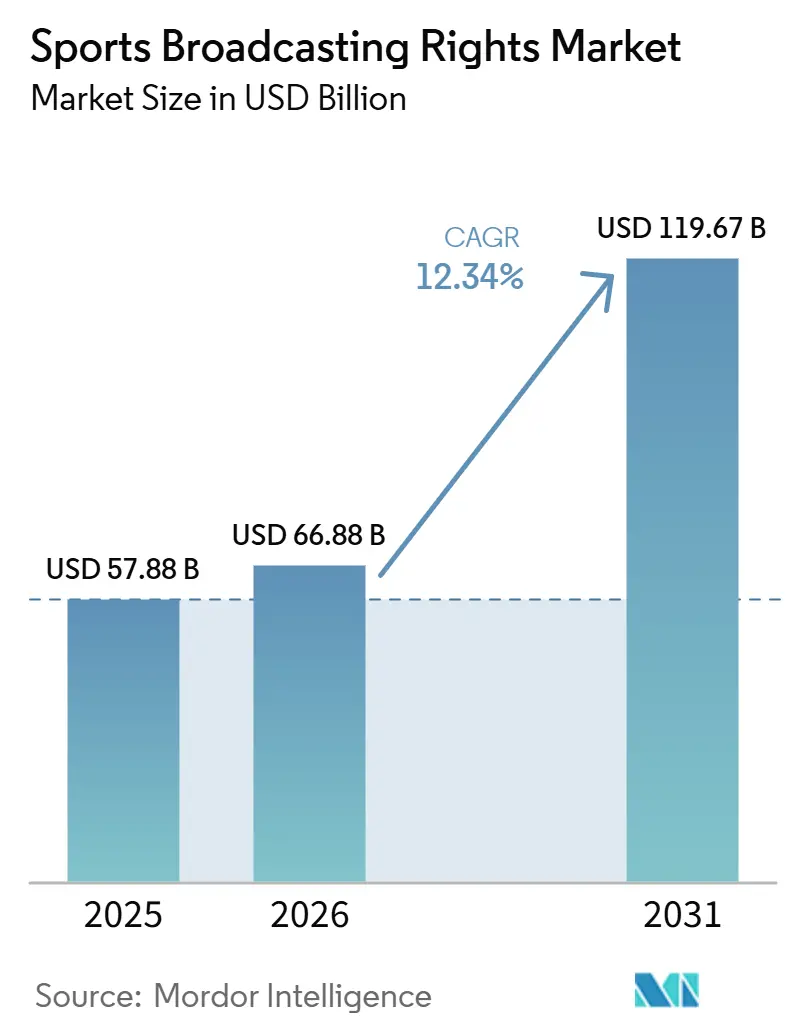
The sports broadcasting rights market size was valued at USD 57.88 billion in 2025 and estimated to grow from USD 66.88 billion in 2026 to reach USD 119.67 billion by 2031, at a CAGR of 12.34% during the forecast period (2026-2031). The sports broadcasting rights market is being pushed higher by the way live events now sit at the center of streaming subscriptions, advertising demand, and platform retention strategies across major media groups. Premium leagues are also changing deal design, because buyers now compete for separate live, highlight, mobile, and territorial packages instead of one broad national contract. The sports broadcasting rights market is also benefiting from wider international reach, especially as global leagues package more matches for export and as mobile viewing deepens audience access in Asia-Pacific. Competitive behavior has shifted as technology platforms accept longer payback periods than traditional broadcasters, which keeps bidding pressure elevated during major renewal cycles. At the same time, the sports broadcasting rights market still faces a hard commercial balance, because cord-cutting reduces the reach of legacy distribution while rights inflation continues to test subscriber and advertising recovery.
Key Report Takeaways
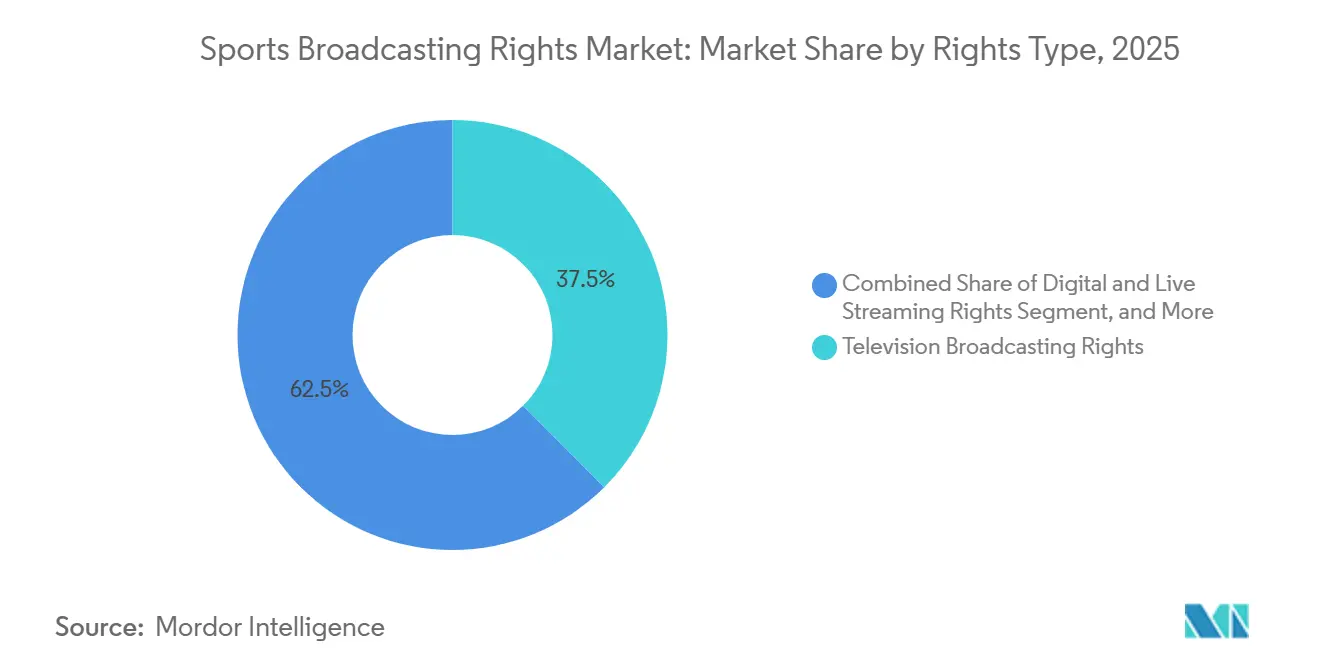
- By rights type, television broadcasting rights held 37.52% of the sports broadcasting rights market in 2025, while digital and live streaming rights are projected to expand at a 12.78% CAGR through 2031.
- By sports league, global premium sports leagues accounted for 53.46% of the sports broadcasting rights market in 2025, while regional and continental sports leagues are expected to grow at a CAGR at 13.27% through 2031.
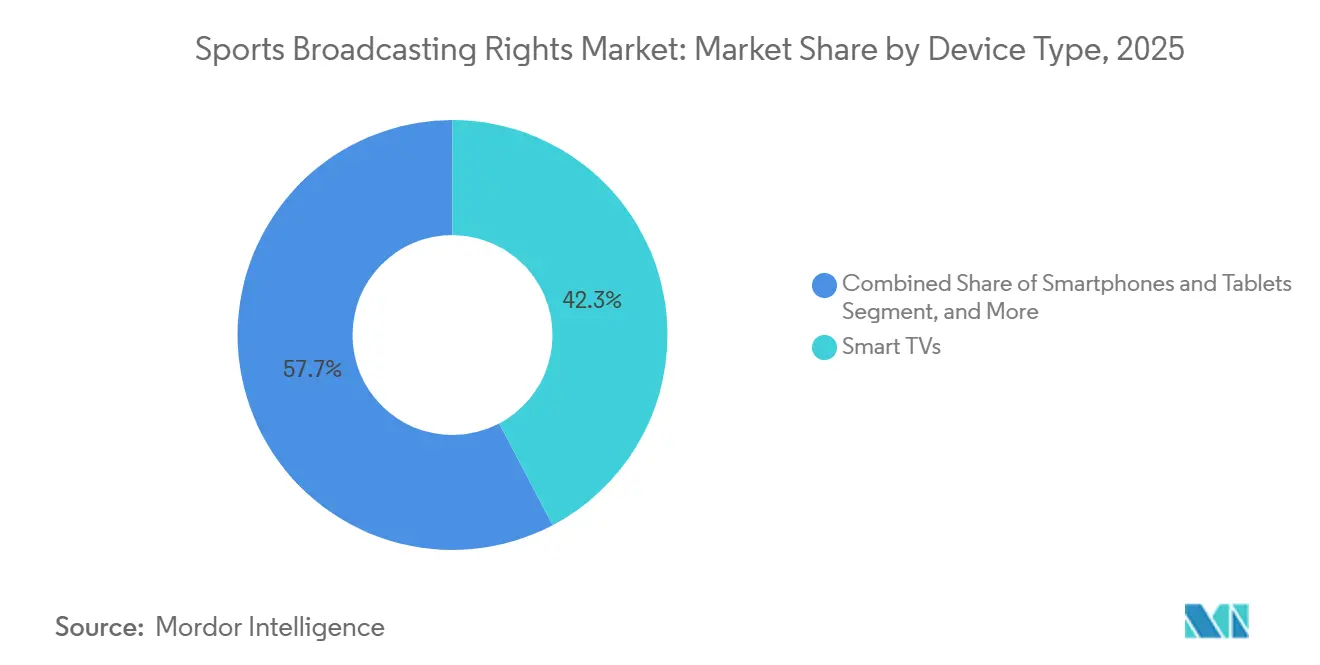
- By device type, smart TVs captured 42.28% of the sports broadcasting rights market in 2025, while smartphones and tablets are forecast to advance at a 12.86% CAGR through 2031.
- By sport type, football accounted for 36.72% of the sports broadcasting rights market in 2025, while cricket is projected to grow at a CAGR of 13.64% through 2031.
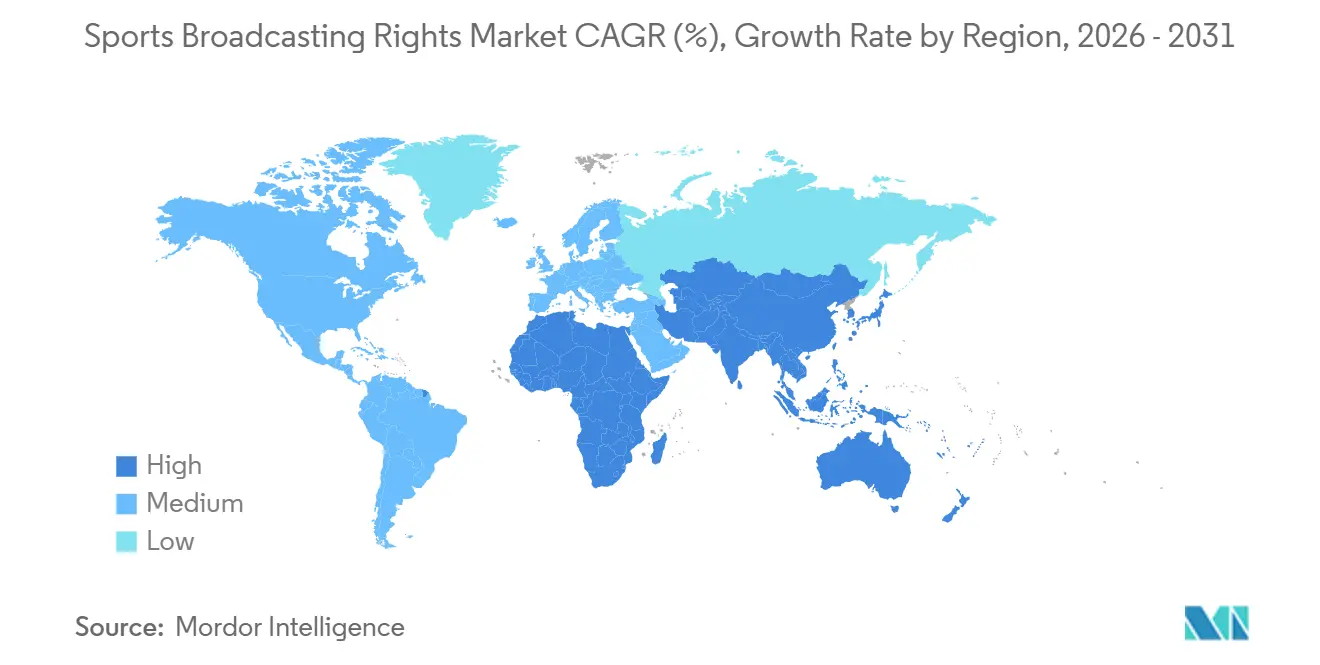
- By geography, North America held 48.54% of the sports broadcasting rights market in 2025, while Asia-Pacific is projected to expand at a 12.83% CAGR through 2031.
Note: Market size and forecast figures in this report are generated using Mordor Intelligence’s proprietary estimation framework, updated with the latest available data and insights as of January 2026.
Market Trends and Insights
Drivers Impact Analysis of Sports Broadcasting Rights Market*
| Driver | (~) % Impact on CAGR Forecast | Geographic Relevance | Impact Timeline |
|---|---|---|---|
| Rising Value of Live Sports as a Subscription Anchor | +2.4% | Global, most pronounced in North America and APAC | Medium term (2-4 years) |
| Rights Fragmentation Across Packages and Windows | +1.8% | Global, especially North America and Europe | Medium term (2-4 years) |
| Shift Toward Ad-Supported Streaming Sports Bundles | +1.5% | North America and Europe core, spill-over to APAC | Short term (≤ 2 years) |
| Globalization of Premier Leagues and Flagship Events | +1.2% | Global, concentrated in APAC and North America | Long term (≥ 4 years) |
| Rising Competition from Tech Platforms for Premium Rights | +0.9% | North America, Europe, and APAC | Medium term (2-4 years) |
| Direct-To-Consumer Monetization by Leagues and Federations | +0.7% | North America, early adoption in Europe and APAC | Long term (≥ 4 years) |
| Source: Mordor Intelligence | |||
Rising Value of Live Sports as a Subscription Anchor
Live sports remain one of the few content categories that still pull viewers to specific platforms at specific times, giving the sports broadcasting rights market unusual pricing power. The NBA's 11-year agreement with Disney, NBCUniversal, and Amazon begins in the 2025-26 season and places national games across widely distributed streaming services and broadcast television.[1]National Basketball Association, “NBA Signs New 11-Year Media Agreements with The Walt Disney Company, NBCUniversal and Amazon Prime Video through 2035-36 Season,” NBA.com, nba.com The Amazon portion of that package also adds broad international distribution rights, indicating that rights are now judged by how well they support platform scale and recurring engagement. This has changed the negotiation logic in the sports broadcasting rights market, because leagues can now press buyers on audience growth rather than only on programming budgets. That shift keeps renewal floors high, narrows the field to companies with stronger balance sheets, and makes live sports more central to long-cycle platform planning.
Rights Fragmentation Across Packages and Windows
Leagues are splitting rights into more packages because separate windows often attract more bidders than a single large national bundle would in the sports broadcasting rights market. The US Federal Communications Commission said NFL games were aired across 10 services in the United States in 2025, and noted that a fan trying to watch every game could spend more than USD 1,500. The Premier League's domestic live rights and free-to-air highlights were also sold through separate structures, which shows how top properties now monetize each viewing layer separately. This approach increases total value for rights sellers, but it also reduces the simplicity broadcasters once used to defend large, exclusive bids. The result is a sports broadcasting rights market where more contracts can be sold, but where each buyer must work harder to justify its own slice of the package.
Shift Toward Ad-Supported Streaming Sports Bundles
Ad-supported tiers have become more important because they give platforms another way to recoup the costs of expensive sports broadcasting rights contracts without relying solely on higher subscription prices. Live matches produce concentrated viewing, making sports inventory more useful for advertisers than many on-demand formats, which viewers can skip or delay. Broad distribution across streaming and broadcast also gives leagues and platforms more flexibility in how they package premium games for reach, targeting, and sponsorship. In practice, this means buyers can support large rights checks with a blend of subscriptions, advertising, and broader audience capture rather than relying on a single revenue stream. That model is making the sports broadcasting rights market more resilient at the premium end, even while lower-tier properties still face uneven monetization.
Globalization of Premier Leagues and Flagship Events
International reach continues to deepen because top leagues now build overseas demand into their rights planning instead of treating export sales as a secondary layer in the sports broadcasting rights market. LaLiga said total domestic audiovisual rights for the 2027/28-2031/32 cycle reached EUR 6.135 billion (USD 6.69 billion), a 9% increase from the prior period and reinforcing the strength of premium football rights cycles. Amazon's NBA agreement includes additional primetime international regular-season games across France, Germany, Italy, Spain, the UK, Ireland, Mexico, and Brazil. That kind of design matters because it ties league value to audiences far beyond the home market and keeps the sports broadcasting rights market exposed to a wider pool of demand. It also gives broadcasters and streamers more reasons to bid, as one contract can now support local, regional, and cross-border monetization simultaneously.
Restraints Impact Analysis of Sports Broadcasting Rights Market*
| Restraint | (~) % Impact on CAGR Forecast | Geographic Relevance | Impact Timeline |
|---|---|---|---|
| Cord-Cutting and Shrinking Pay TV Bundles | -1.8% | North America primary, spill-over to Western Europe | Short term (≤ 2 years) |
| Escalating Rights Fees Versus Slower Monetization Payback | -1.5% | Global, concentrated in APAC and North America | Medium term (2-4 years) |
| Fragmentation Fatigue for Consumers and Advertisers | -1.0% | North America and EU, emerging in APAC | Medium term (2-4 years) |
| Weak Growth for Mid-Tier and Regional Properties | -0.7% | Global, most visible in Europe and South America | Long term (≥ 4 years) |
| Source: Mordor Intelligence | |||
Cord-Cutting and Shrinking Pay TV Bundles
Cord-cutting continues to weaken the old distribution base that funded many premium contracts before streaming became central to the sports broadcasting rights market. When viewers lose a simple, all-in-one bundle, they face a harder path to finding games, which weakens the reach advantage that traditional broadcasters once offered leagues. The same FCC review that highlighted NFL fragmentation also showed how difficult the current viewing environment has become for consumers seeking full access to a single sport. This pressure pushes buyers toward shared windows, narrower packages, and selective rights bets instead of broad exclusivity. It also leaves the sports broadcasting rights market with a persistent gap between audience convenience and commercial recovery, especially where legacy pay-TV erosion is moving faster than streaming scale.
Escalating Rights Fees Versus Slower Monetization Payback
The sports broadcasting rights market is also constrained by the fact that rights inflation has outpaced monetization payback at several major platforms. Premium deals now require large up-front commitments, while subscriber gains and advertising improvements often arrive over a longer period than rights holders prefer. That timing mismatch matters because even well-capitalized buyers cannot keep stretching payback windows forever without becoming more selective in renewals and new bids. As a result, the sports broadcasting rights market can still support record contracts at the top tier, but it may show less tolerance for mispriced packages and slower-selling inventories below that level. This is why future rights cycles are likely to depend not only on fan demand but also on how many credible bidders still see room to recover their costs within a disciplined time frame.
*Our forecasts treat driver/restraint impacts as directional, not additive. The impact forecasts reflect baseline growth, mix effects, and variable interactions.
Sports Broadcasting Rights Market Segment Analysis
By Rights Type:
Television Retained Volume Leadership as Streaming Reshaped Deal DesignTelevision broadcasting rights accounted for 37.52% of the sports broadcasting rights market in 2025, which kept linear distribution as the largest single rights category even as viewing habits continued to change. That position reflects the staying power of large shared live experiences, where broadcasters still offer wide household reach, familiar discovery, and stable advertiser demand. The Premier League's sales process for UK live rights and free-to-air highlights showed that broad live coverage and secondary windows can still be monetized side by side rather than through one all-encompassing package.[2]Premier League, “Premier League Completes Sales Process for UK Live Rights and Free-to-Air Highlights,” PremierLeague.com, premierleague.com In the sports broadcasting rights market, television remains the default layer for mass events because it simplifies access for casual viewers and preserves premium inventory for advertisers during major fixtures. Radio broadcasting rights and highlight and clip rights are smaller, but they still play a useful role in expanding audience touchpoints, preserving free access, and extending value beyond the live match itself.
Digital and live streaming rights are projected to expand at a 12.78% CAGR through 2031, which makes them the fastest-growing rights type in the sports broadcasting rights market. The NBA's current rights structure shows why: every national game will be available on widely distributed streaming services while broadcast exposure also expands. This means streaming is no longer treated as an add-on window for premium leagues, but as a core path for national and international distribution across several platforms at once. In the sports broadcasting rights industry, that reduces the gap between television and digital rights because both are now being sold as linked parts of one commercial system. The practical effect is that future negotiations will focus less on one exclusive winner and more on how many windows, devices, and territories can be monetized without weakening the overall package.



By Sports League:
Premium Properties Set The Revenue Ceiling While Regional Leagues Extended ReachGlobal premium sports leagues held 53.46% of the sports broadcasting rights market in 2025, which confirms that a small group of marquee competitions still controls the largest value pools. The NFL, NBA, and Premier League continue to influence pricing because their contracts shape how buyers assess scale, scheduling consistency, and repeat-viewer behavior across the broader sports broadcasting rights market. Premium leagues also attract the broadest mix of broadcasters, general entertainment streamers, telecom-linked platforms, and advertising partners, helping sustain competition even as deal values rise sharply. That concentration at the top does not mean the field is closed, but it does mean that benchmark pricing is still set by a limited number of global properties. Those benchmark deals then shape expectations for other national and regional competitions that want to price themselves as scaled media assets rather than simple event schedules.
Regional and continental sports leagues are projected to grow at a 13.27% CAGR through 2031, making them the fastest-growing sports league category in the sports broadcasting rights market. The 2025-26 CAF Champions League final reached broadcasters including beIN Sports, Canal+, DAZN, SuperSport, and Channel 4 across more than 60 territories, demonstrating that continental football can travel well beyond its home audience. Growth in this layer comes from properties that were previously underdistributed, especially when rights can be sold into new markets without the price burden attached to the largest leagues. That gives buyers room to build differentiated portfolios, while leagues gain a route to wider monetization without matching the cost structure of top-tier global properties. The deeper point is that league value now depends not only on domestic fan intensity, but also on how easily a property can be exported into new language, platform, and sponsorship environments.
By Device Type:
Smart TVs Led Current Viewing While Mobile Became the Growth EdgeSmart TVs captured 42.28% of the sports broadcasting rights market in 2025, keeping the living room as the main screen for high-value live events. The large-screen setting remains important because sports viewing is often social, scheduled, and tied to premium advertising slots that perform best when audiences watch together. Broad multi-platform rights structures also support this pattern, since the same premium packages are now built to serve both broadcast households and app-based smart TV audiences. In the sports broadcasting rights market, smart TV leadership matters because it preserves the visual and commercial environment that leagues and advertisers still value most during major games. Laptops and desktops remain relevant for specific viewer groups, but they no longer define the primary premium viewing experience.
Smartphones and tablets are projected to grow at a 12.86% CAGR through 2031, which makes them the fastest-growing device segment in the sports broadcasting rights market. Mobile demand is strongest where streaming adoption is rising quickly, where younger viewers follow clips before full matches, and where sports viewing fits short daily windows rather than fixed home routines. That is why rights holders increasingly separate mobile access from other digital permissions and treat it as a distinct monetization window rather than a free extension of desktop or broadcast access. As mobile audiences scale, the sports broadcasting rights market gains a broader base for localized feeds, shorter highlight formats, in-app sponsorships, and more flexible subscription tiers. This shift does not reduce the role of big screens, but it does make mobile the most commercially dynamic part of future rights design, especially in markets where portable viewing already shapes how fans discover and follow live sport.
By Sport Type:
Football Held the Broadest Base While Cricket Accelerated FastestFootball accounted for 36.72% of the sports broadcasting rights market in 2025, making it the largest sport by revenue. That lead reflects football's unmatched volume of league, cup, and continental content, along with its ability to monetize domestic, international, highlight, and free-to-air windows simultaneously. The Premier League's UK rights structure and LaLiga's domestic audiovisual cycle both underline how durable football remains as a rights product for multiple buyer types. Football also benefits from year-round scheduling, deep club ecosystems, and strong international portability, which together make it easier to place across many channels. That combination keeps football at the center of portfolio planning for broadcasters and streamers that need consistent, repeatable live inventory.
Cricket is projected to expand at a 13.64% CAGR through 2031, making it the fastest-growing sport in the sports broadcasting rights market. Growth is supported by India's large digital audience, a packed tournament calendar, and diaspora demand that lifts viewing across several overseas territories. Cricket's economics are still more exposed to bidder concentration than football's, because fewer buyers can meaningfully compete for the most valuable packages in each cycle. This makes cricket highly attractive, but also more sensitive to shifts in platform strategy, consolidation, and renewal discipline. Basketball is also gaining wider reach through the NBA's new structure, while secondary sports such as tennis, motorsports, and combat sports remain useful for platform differentiation when companies want depth beyond one flagship property.
Geography Analysis
North America Sports Broadcasting Rights Market
North America held 48.54% of the sports broadcasting rights market share in 2025, making it the largest regional revenue center. The region's lead stems from contract values that remain unmatched elsewhere, especially in the NFL and NBA, where annual obligations sit far above those of most non-North American leagues. The NBA's 11-year, USD 77 billion agreement shows how premium US rights combine broadcast scale with large streaming commitments rather than forcing a choice between them. That model is especially important in North America because major leagues still expect broad reach, heavy live viewing, and strong advertising support simultaneously. It also means that the region remains the clearest reference point for pricing, packaging, and platform competition across the global sports broadcasting rights market.
APAC Sports Broadcasting Rights Market
Asia-Pacific is projected to expand at a 12.83% CAGR through 2031, which makes it the fastest-growing geography in the sports broadcasting rights market. Growth is being supported by mobile-first viewing, rising streaming penetration, and the scale of cricket-led engagement across India and nearby markets. Asia-Pacific also matters because buyers in the region often use sport to anchor broader entertainment bundles, which keeps rights strategically important even when short-term payback is tight. As international football, cricket, and mixed local portfolios spread further across the region, the sports broadcasting rights market gains more buyers that need differentiation through language, access, and sport mix. This leaves Asia-Pacific as the key growth region for future rights expansion, even though pricing discipline will still matter when platform consolidation reduces the number of active bidders.
EMEA and South America Sports Broadcasting Rights Market
Europe remained one of the largest revenue bases in the sports broadcasting rights market because football continued to define the region's monetization structure. The Premier League completed a domestic deal worth GBP 6.7 billion (USD 8.51 billion) for 2025-29, while LaLiga said its 2027/28-2031/32 domestic audiovisual rights reached EUR 6.135 billion (USD 6.69 billion). Canal+ extended its UEFA men's club competition rights across Belgium, Poland, Austria, and Switzerland through the 2030-31 season, while DAZN renewed exclusive Serie A rights in France through 2028-29.[3]Canal+ Group, “Canal+ and UC3’s European Partnership Expanded and Extended until 2031,” Canal+ Group, canalplusgroup.com South America, the Middle East, and Africa still represent smaller pools, but broader international coverage of the CAF Champions League final showed that African club football is drawing more cross-border media attention than before.

Competitive Landscape
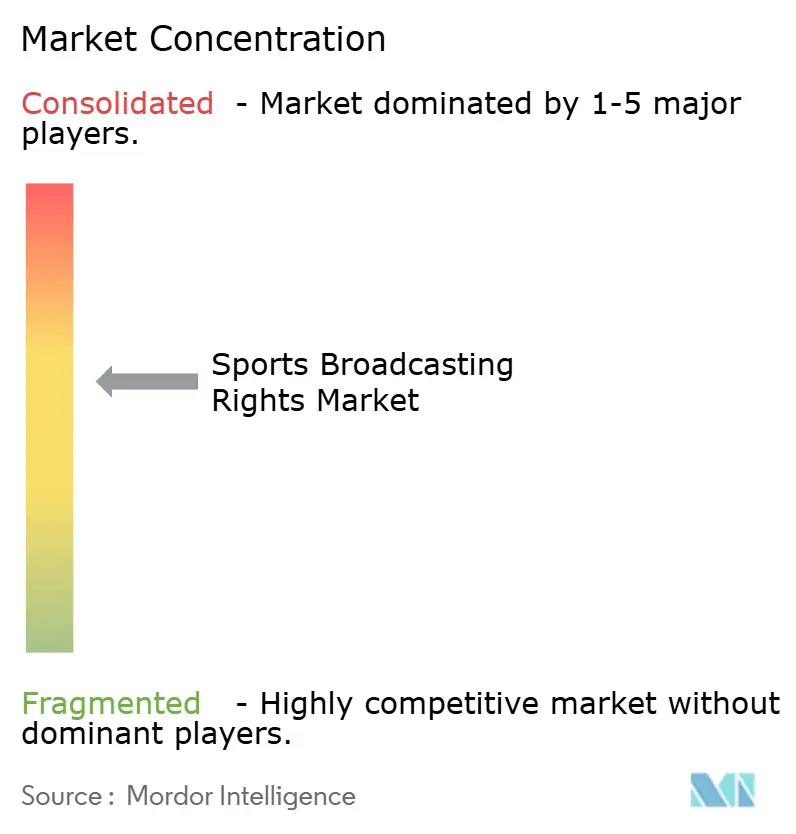
The sports broadcasting rights market remains moderately concentrated at the premium tier, because a limited set of global media and technology groups still controls most of the costliest contracts. Companies such as The Walt Disney Company, Comcast Corporation, Amazon.com, Fox Corporation, Alphabet Inc., and Netflix compete from different positions, but all of them need sport when they want large live audiences and stronger platform stickiness. The biggest difference is not whether they want rights, but how they recover costs, since some rely on cable and broadband bundles, while others use subscriptions, advertising, and broader ecosystem retention. In the sports broadcasting rights market, this creates a field where the same property can attract broadcasters, streamers, and hybrid buyers with very different return thresholds. It also explains why pricing tension remains high during major auctions even when some buyers are more selective outside the top tier.
Amazon's NBA agreement is one of the clearest strategic moves because it combines domestic premium inventory with a wider set of international regular-season games and gives the company a stronger sports position across several territories. DAZN has followed a different path by building depth across selected categories and geographies, including exclusive Serie A rights in France and a 5-year Liga Endesa agreement with expanded international access.[4]DAZN Group, “DAZN Renews Exclusive Serie A Rights Through 2029 in France,” DAZN Group Press Room, dazngroup.com Canal+ has also widened its football reach in Europe by extending UEFA men's club competition rights across several countries through 2030-31. These moves show that the sports broadcasting rights market does not reward one model alone, because scale, category depth, and territorial reach can each support a durable position. What matters most is whether a buyer can spread rights costs across enough revenue streams and enough viewing surfaces to justify staying in future cycles.
The next competitive opening is likely to come from services that reduce the friction created by multi-platform distribution in the sports broadcasting rights market. Viewers now face a more fragmented path to live games, so companies that simplify discovery, payments, and switching may gain leverage even without owning the biggest contracts. There is also room in women's sports, combat sports, esports, and other underpenetrated categories where audience growth can outpace current rights costs. That means the sports broadcasting rights market should stay active and contested, even if the most expensive properties remain concentrated among a limited number of global buyers.
Sports Broadcasting Rights Industry Leaders
The Walt Disney Company
Comcast Corporation
Fox Corporation
Paramount Global
Warner Bros. Discovery, Inc.
- *Disclaimer: Major Players sorted in no particular order
Sports Broadcasting Rights Market Companies Covered in this Report
- The Walt Disney Company
- Comcast Corporation
- Fox Corporation
- Paramount Global
- Warner Bros. Discovery, Inc.
- Amazon.com, Inc.
- Alphabet Inc.
- Netflix, Inc.
- Apple Inc.
- DAZN Group Limited
- Viacom18 Media Private Limited
- Sky Group Limited
- Canal+ Group
- European Broadcasting Union
- TelevisaUnivision, Inc.
- Tencent Holdings Limited

Recent Industry Developments in Sports Broadcasting Rights Market
- July 2026: The Bundesliga signed a 5-year English-language rights deal with Versant for the US market beginning with the 2026-27 season, ending a 6-year arrangement with ESPN. Over 30 matches will air on USA Network, and 275 matches per season will stream free on Fandango, significantly broadening the Bundesliga's US audience reach.
- July 2026: ZEE Entertainment Enterprises secured exclusive television and digital media rights for the Bundesliga in India for 5 years from the 2026-27 season, to be broadcast on Unite8 Sports and streamed on ZEE5, following ZEE's acquisition of FIFA rights covering 39 events through 2034.
- June 2026: Fox Corporation announced its acquisition of Roku in a cash-and-stock deal valued at USD 22 billion, merging Fox's live sports, news, and Tubi streaming content with Roku's connected TV platform and its more than 100 million global streaming household footprints. The transaction is expected to close in the first half of 2027 pending regulatory clearance, positioning Fox as the third-largest US television business by viewership.
- August 2025: DAZN and ESPN signed a multi-year sub-licensing agreement granting DAZN live rights to US college football and basketball across selected territories in Europe and the Middle East and North Africa region, available free-to-view for a limited time, extending DAZN's non-football sports portfolio breadth.


Global Sports Broadcasting Rights Market Report Scope
The sports broadcasting rights market covers the licensing and distribution of rights that allow broadcasters, streaming platforms, and other media companies to telecast or stream live and recorded sports events across television, digital, and other media channels. The scope of the report includes an analysis of rights ownership, acquisition, and distribution models; major sports properties; media platforms; regional market trends; and the key factors influencing demand for sports content during the study period.
The Sports Broadcasting Rights Market Report is Segmented by Rights Type (Television Broadcasting Rights, Digital and Live Streaming Rights, Radio Broadcasting Rights, Highlight and Clip Rights, and Other Rights Types), Sports League (Global Premium Sports Leagues, Regional/Continental Sports Leagues, Domestic Sports Leagues, and Other Sports Leagues), Device Type (Smartphones and Tablets, Smart TVs, Laptops and Desktops, and Other Device Types), Sport Type (Football, Cricket, Basketball, Tennis, Motorsports, and Other Sport Types), and Geography (North America, South America, Europe, Asia-Pacific, Middle East, and Africa). The Market Forecasts are Provided in Terms of Value (USD).
| Television Broadcasting Rights |
| Digital and Live Streaming Rights |
| Radio Broadcasting Rights |
| Highlight and Clip Rights |
| Other Rights Types |
| Global Premium Sports Leagues |
| Regional/Continental Sports Leagues |
| Domestic Sports Leagues |
| Other Sports Leagues |
| Smartphones and Tablets |
| Smart TVs |
| Laptops and Desktops |
| Other Device Types |
| Football |
| Cricket |
| Basketball |
| Tennis |
| Motorsports |
| Other Sport Types |
| North America | United States |
| Canada | |
| Mexico | |
| South America | Brazil |
| Argentina | |
| Chile | |
| Rest of South America | |
| Europe | Germany |
| United Kingdom | |
| France | |
| Italy | |
| Spain | |
| Rest of Europe | |
| Asia-Pacific | China |
| Japan | |
| India | |
| South Korea | |
| Australia | |
| Rest of Asia-Pacific | |
| Middle East | Saudi Arabia |
| United Arab Emirates | |
| Qatar | |
| Rest of Middle East | |
| Africa | South Africa |
| Egypt | |
| Nigeria | |
| Rest of Africa |
| By Rights Type | Television Broadcasting Rights | |
| Digital and Live Streaming Rights | ||
| Radio Broadcasting Rights | ||
| Highlight and Clip Rights | ||
| Other Rights Types | ||
| By Sports League | Global Premium Sports Leagues | |
| Regional/Continental Sports Leagues | ||
| Domestic Sports Leagues | ||
| Other Sports Leagues | ||
| By Device Type | Smartphones and Tablets | |
| Smart TVs | ||
| Laptops and Desktops | ||
| Other Device Types | ||
| By Sport Type | Football | |
| Cricket | ||
| Basketball | ||
| Tennis | ||
| Motorsports | ||
| Other Sport Types | ||
| By Geography | North America | United States |
| Canada | ||
| Mexico | ||
| South America | Brazil | |
| Argentina | ||
| Chile | ||
| Rest of South America | ||
| Europe | Germany | |
| United Kingdom | ||
| France | ||
| Italy | ||
| Spain | ||
| Rest of Europe | ||
| Asia-Pacific | China | |
| Japan | ||
| India | ||
| South Korea | ||
| Australia | ||
| Rest of Asia-Pacific | ||
| Middle East | Saudi Arabia | |
| United Arab Emirates | ||
| Qatar | ||
| Rest of Middle East | ||
| Africa | South Africa | |
| Egypt | ||
| Nigeria | ||
| Rest of Africa | ||


Key Questions Answered in the Report
How large is the sports broadcasting rights market in 2026?
The sports broadcasting rights market was estimated at USD 66.88 billion in 2026 and is forecast to reach USD 119.67 billion by 2031, with a 12.34% CAGR.
Which rights type leads to current revenue?
Television broadcasting rights led in 2025 with a 37.52% share, supported by broad household reach and strong advertiser demand around live events.
Which sport is growing fastest through 2031?
Cricket is projected to grow at a 13.64% CAGR through 2031, supported by India's digital audience base, tournament density, and cross-border diaspora demand.
Which region is expanding the fastest?
Asia-Pacific is forecast to record the highest CAGR at 12.83% through 2031, driven by mobile-first viewing and continued streaming adoption.
Why are premium rights still becoming more expensive?
Premium rights remain expensive because live sports support subscriptions, advertising, and platform retention, which keep major broadcasters and streamers active in large renewal cycles.
What is changing the buyer strategy the most?
Fragmented rights packaging is changing strategy the most, because buyers now need to assess separate windows, devices, and territories instead of one simple exclusive package.
Page last updated on:





