
Spain Enterprise Content Management Market Size and Share
Market Overview
| Study Period | 2020 - 2031 |
|---|---|
| Forecast Data Period | 2026 - 2031 |
| Base Year Market Size (2025) | USD 1.75 Billion |
| Market Size (2026) | USD 1.94 Billion |
| Market Size (2031) | USD 3.40 Billion |
| Growth Rate (2026 - 2031) | 11.83% CAGR |
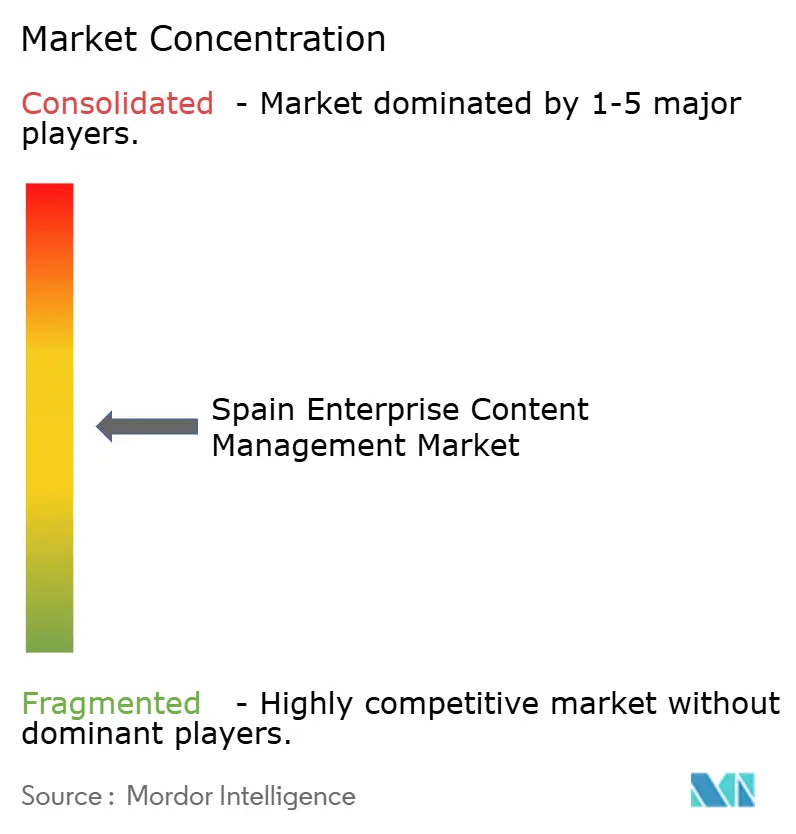
| Market Concentration | Medium |
Major Players *Disclaimer: Major Players sorted in no particular order Image © Mordor Intelligence. Reuse requires attribution under CC BY 4.0. | |
Spain Enterprise Content Management Market Analysis by Mordor Intelligence
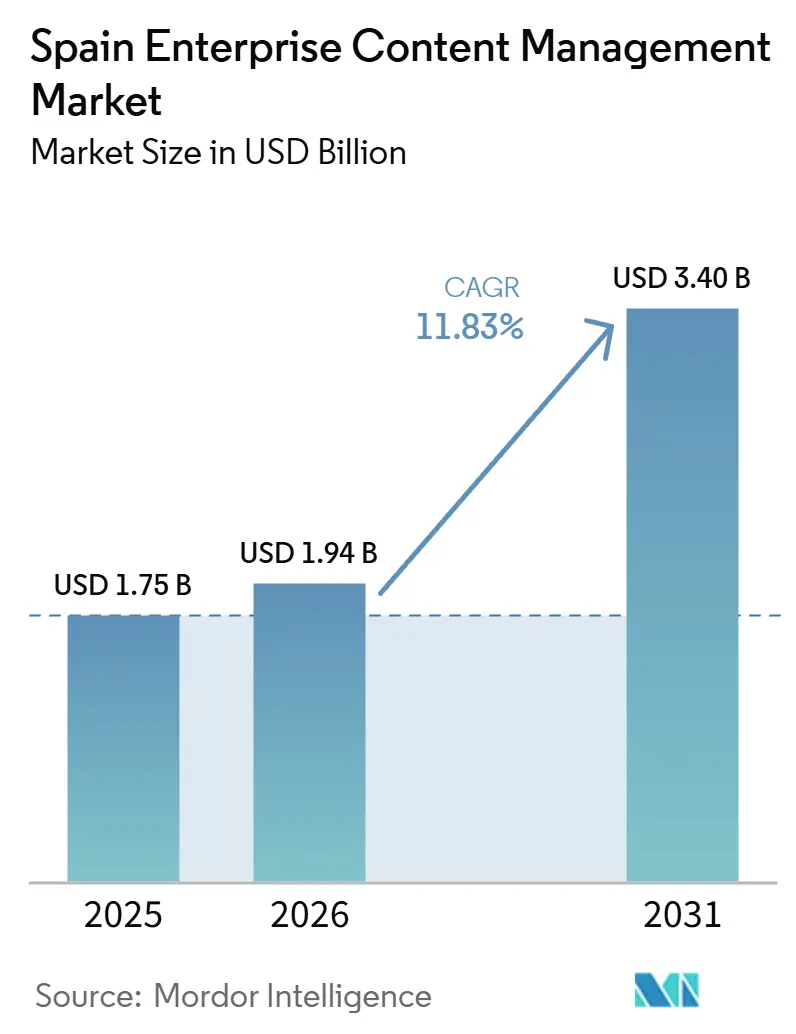
The Spain enterprise content management market size was valued at USD 1.75 billion in 2025 and estimated to grow from USD 1.94 billion in 2026 to reach USD 3.40 billion by 2031, at a CAGR of 11.83% during the forecast period (2026-2031). The Spain enterprise content management market is moving beyond file storage and toward governed, searchable, and automation-ready content environments across banking, healthcare, manufacturing, and public administration. Public digital investment is supporting this shift because content systems now sit close to compliance, workflow control, and enterprise modernization rather than optional back-office upgrades. Cloud adoption remains the main deployment path, while hybrid models continue to hold relevance where data sovereignty, audit chains, and network isolation shape buying decisions. Regulatory mandates around invoicing, digital records, privacy, and auditability are also tightening the link between content platforms and day-to-day operating processes. Competitive gains will likely favor vendors that combine Spanish-language support, compliance alignment, and scalable cloud delivery as the Spain enterprise content management market expands by USD 1.46 billion between 2026 and 2031.
Key Report Takeaways
- By solution type, document management held 28.36% of revenue in 2025, while workflow and business process management is projected to expand at a 13.09% CAGR through 2031.
- By deployment mode, cloud held 74.18% of the Spain enterprise content management market share in 2025 and is projected to expand at a 12.54% CAGR through 2031.
- By enterprise size, large enterprises accounted for 62.27% of the revenue of the Spani enterprise content management market in 2025, while SMEs are projected to grow at a 12.61% CAGR through 2031.
- By end-user industry, BFSI held 23.58% of revenue in 2025, while healthcare and life sciences is projected to expand at a 13.78% CAGR through 2031.
Note: Market size and forecast figures in this report are generated using Mordor Intelligence’s proprietary estimation framework, updated with the latest available data and insights as of January 2026.
Spain Enterprise Content Management Market Trends and Insights
Drivers Impact Analysis*
| Driver | (~) % Impact on CAGR Forecast | Geographic Relevance | Impact Timeline |
|---|---|---|---|
| Accelerating AI-Based Classification and Retrieval | +3.2% | Global, with concentrated uptake in Madrid financial corridor and Barcelona technology district | Short term (≤ 2 years) |
| Audit-Ready Governance Demand in Regulated Industries | +2.5% | National, with early gains in BFSI and healthcare verticals across autonomous communities | Medium term (2-4 years) |
| Shift Toward Cloud-Native and Hybrid ECM Architectures | +2.1% | National, hybrid intensity higher in Basque Country, Catalonia, and Madrid industrial clusters | Medium term (2-4 years) |
| End-To-End Workflow Automation in Document-Heavy Processes | +1.8% | National, spillover to multinational subsidiaries operating from Spain | Short term (≤ 2 years) |
| Expansion of Remote, Mobile, and Distributed Work Models | +1.2% | National, with accelerated impact in Madrid, Barcelona, Valencia, and Seville | Short term (≤ 2 years) |
| Content Intelligence Adoption for Contract and Case Analytics | +0.9% | BFSI and legal services clusters in Madrid and Barcelona | Long term (≥ 4 years) |
| Source: Mordor Intelligence | |||
Accelerating AI-Based Content Classification and Retrieval
AI-led document processing is reshaping buying priorities in the Spain enterprise content management market because enterprises now expect systems to classify, tag, route, and surface documents in near real time. Many legacy platforms were not built for this level of automated retrieval, which makes replacement and modernization more urgent in regulated environments. In the first quarter of 2025, 21.1% of Spanish enterprises reported active AI use, and that was an 8.7 percentage-point increase from the prior year.[1]Instituto Nacional de Estadística, “Press Release: Survey on the Use of ICT and E-Commerce in Enterprises. Year 2024 – First Quarter 2025. Definitive Data,” Instituto Nacional de Estadística, ine.es This pattern matters because AI adoption is moving faster than metadata and taxonomy standardization in many organizations, which raises quality and governance pressure around content models. That gap supports platforms that can combine AI classification with traceable records control, a need that is becoming more visible across the Spain enterprise content management market.
Rising Demand for Audit-Ready Information Governance in Regulated Industries
Audit readiness has become a stronger purchase trigger in the Spain enterprise content management market as privacy enforcement and data handling obligations have tightened. In 2025, the AEPD issued 299 fines totaling EUR 40 million (USD 43.6 million) and received 2,765 data breach notifications. Organizations that still treat content platforms as low-priority storage tools are facing higher exposure when retention rules, access logs, and document lineage cannot be demonstrated quickly. LOPDGDD-related governance requirements are also reinforcing the need for audit logs, retention scheduling, and permission controls across multiple regulated sectors. This keeps compliance-led refresh cycles active and gives modern platforms a clearer role in operational risk control within the Spain enterprise content management market.
Shift Toward Cloud-Native, Hybrid ECM Architectures in Spain
Cloud and hybrid deployment strategies continue to define architecture choices in the Spain enterprise content management market. Spain’s large-enterprise cloud adoption rate reached 73.59% in 2024, while the SME rate stood at 31.85%, highlighting the uneven digital maturity across buyer groups. That split is shaping vendor offers because large organizations tend to prioritize AI depth and systems integration, while SMEs focus more on cost, speed of deployment, and usability. Data sovereignty is also pushing many regulated buyers toward hybrid models that keep sensitive records under tighter governance boundaries while still using cloud scale for broader processes. Santander’s completion of its Gravity migration in Spain in June 2025 showed that full-cloud process and content environments can operate at scale even in a highly regulated banking context.[2]Banco Santander, “Santander Completes the Digitalization of Its Technology Infrastructure in Spain with the Deployment of Gravity,” Santander Press Releases, santander.com
Increased Need for End-To-End Workflow Automation Across Document-Heavy Processes
Workflow automation is becoming a direct compliance requirement in the Spain enterprise content management market rather than an optional productivity feature. VeriFactu takes effect from July 2026, and B2B e-invoicing obligations under Ley Crea y Crece are pushing organizations to build chained records, time stamping, and connected document flows into core systems. Manual or disconnected processes are poorly suited to these rules because invoice integrity, traceability, and evidence need to be maintained across the full transaction path. This is pulling investment toward workflow and business process management modules that sit inside or alongside governed content repositories. Once those process maps and document controls are in place, many buyers are likely to extend the same platform into contracts, case handling, HR files, and other record-heavy workflows across the Spain enterprise content management market.
Restraints Impact Analysis*
| Restraint | (~) % Impact on CAGR Forecast | Geographic Relevance | Impact Timeline |
|---|---|---|---|
| Legacy Repository Migration Complexity and Content Sprawl | -1.8% | National, with strongest friction in industrial, utility, and government sectors | Medium term (2-4 years) |
| Compliance Burden Across GDPR, Sector Rules, and Records Retention | -1.4% | National, disproportionate impact on SMEs and multi-sector organizations | Long term (≥ 4 years) |
| Security Concerns Around Sensitive Content in Multi-Tenant Deployments | -1.0% | National, concentrated in BFSI and healthcare sectors | Medium term (2-4 years) |
| Skill Gaps in ECM Administration, Taxonomy Design, and Governance | -0.7% | National, with particular shortfall in secondary cities and SME segment | Long term (≥ 4 years) |
| Source: Mordor Intelligence | |||
Legacy Repository Migration Complexity and Content Sprawl
Migration complexity remains a core drag on the Spain enterprise content management market because many organizations still hold documents across email archives, shared drives, legacy platforms, and shadow SaaS tools. The main difficulty is often not buying a new platform, but finding, cleaning, classifying, and assigning ownership to large volumes of unstructured content. Industrial groups, utilities, and public bodies are especially exposed because they often carry older archives and stricter continuity requirements during transition periods. Long deployment cycles can delay revenue conversion for vendors and keep some buyers on interim systems for much longer than planned. This has also created a service-led entry point where discovery, deduplication, and classification work becomes the first step before broader platform replacement in the Spain enterprise content management market.
Compliance Burden Across GDPR, Sector Rules, and Records Retention
The compliance burden can slow adoption in the Spain enterprise content management market even when the long-term need for governance is clear. Organizations often need to manage GDPR limits, sector retention rules, e-signature obligations, and emerging AI oversight within a single operating model. That work requires taxonomy design and governance skills that are not always available inside smaller IT teams or regional operations. The burden falls harder on SMEs because they rarely maintain dedicated information governance roles and often work with tighter implementation budgets. As a result, some projects move forward in stages, which preserves demand but can slow the pace at which the Spain enterprise content management market converts interest into full platform rollouts.
*Our forecasts treat driver/restraint impacts as directional, not additive. The impact forecasts reflect baseline growth, mix effects, and variable interactions.
Segment Analysis
By Solution Type: Workflow Automation Pulls the Market Forward
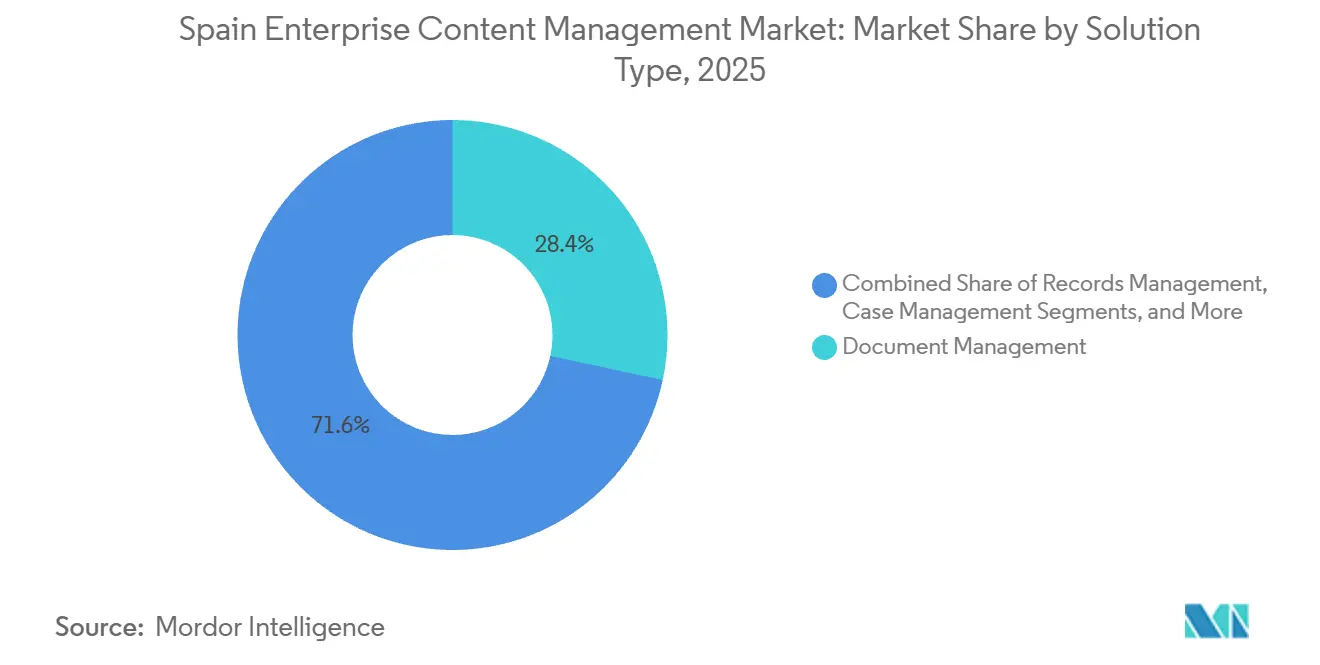
Document management accounted for 28.36% of the Spain enterprise content management market size in 2025, which kept it as the largest solution category by revenue. That base reflects steady demand for capture, indexing, retrieval, and controlled storage across banking, manufacturing, and public administration. Records management and web content management continue to add volume through digitization programs and structured publishing needs, while digital asset management is becoming more relevant in retail, media, and entertainment. Case management is also gaining traction in insurance and legal workflows, where many documents need to move together under clear control paths.
Workflow and business process management is forecast to expand at a 13.09% CAGR from 2026 to 2031, which makes it the fastest-growing solution type in the Spain enterprise content management market. Regulatory mandates around invoicing and employer compliance are directing investment toward automation-first process design rather than stand-alone repositories. This is raising the value of platforms that can connect forms, records, approvals, and audit evidence within one governed workflow. The Spain enterprise content management industry is therefore seeing solution demand shift toward platforms that treat documents as part of an operating process instead of isolated files.



By Deployment Mode: Cloud Dominance with a Hybrid Backstop
Cloud held 74.18% of the Spain enterprise content management market share in 2025 and is projected to expand at a 12.54% CAGR through 2031. That combination made cloud both the largest and the fastest-growing deployment mode, which shows that the migration cycle still has room to run. Many buyers are not starting from zero, but expanding cloud use into more sensitive processes as governance and integration controls improve. The 2026 Digital Decade country report still pointed to further improvement needs in cloud technology uptake, which suggests the runway remains open even after several years of progress.
On-premises environments continue to matter in government and highly regulated financial settings where document sovereignty and isolated networks remain important. Hybrid models are the practical middle path because they let organizations combine control over sensitive repositories with cloud-based scale for wider workflows. Santander’s June 2025 migration showed that large regulated institutions can move farther into cloud-native operations when architecture and governance are aligned. Hyland’s expanded federation and cloud capabilities in 2026 also addressed the need to govern content across older repositories without forcing immediate data migration.[3]Hyland, “Hyland Launches Next Wave of AI Platform Innovations to Unlock the Content-Powered Agentic Enterprise,” Hyland Newsroom, hyland.com
By Enterprise Size: SMEs Create the Strongest Expansion Opportunity
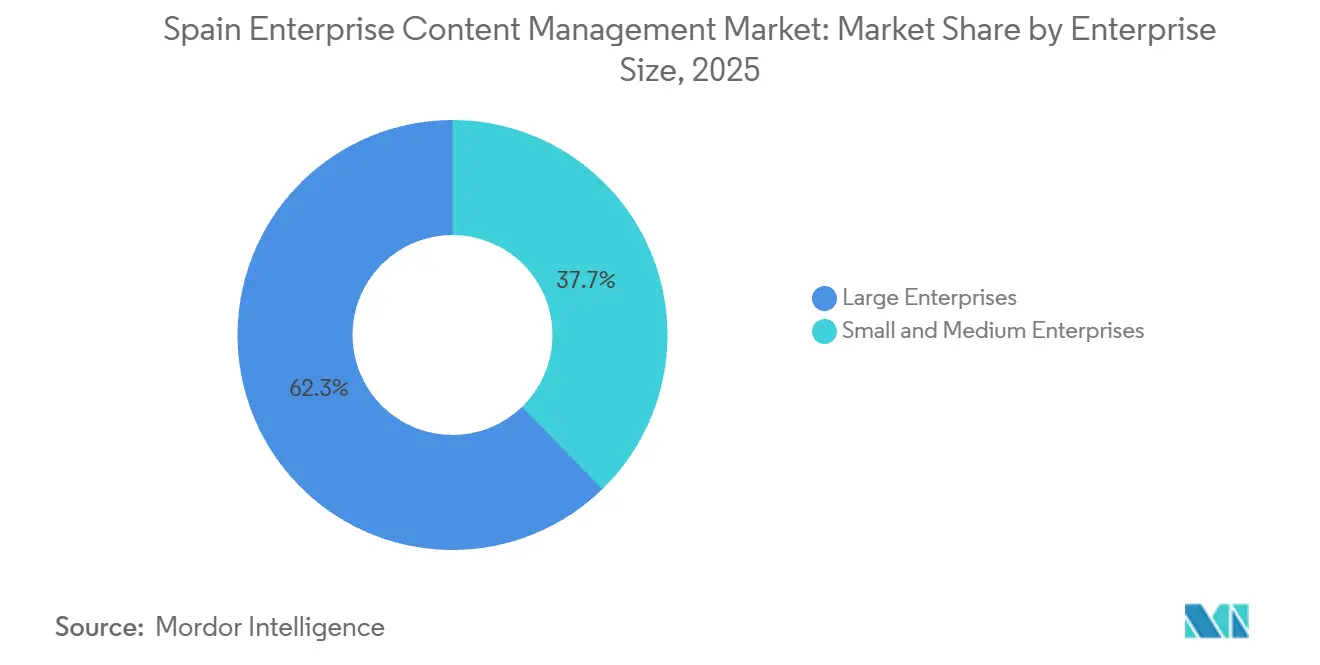
Large enterprises held 62.27% of the Spain enterprise content management market in 2025, supported by established deployments in banking, manufacturing, and government. Their buying patterns are usually tied to longer license cycles, ERP integration, and enterprise-wide governance requirements, which makes revenue more stable but usually slower-moving. OpenText strengthened this layer in November 2025 when its Core Content Management for SAP solutions received certification for SAP S/4HANA Cloud Public Edition. SAP’s Spain operations also continue to position enterprise content management as a unified process and content layer for SAP-led environments.
SMEs are forecast to grow at a 12.61% CAGR from 2026 to 2031, which makes them the most important structural expansion pocket in the Spain enterprise content management market. The April 2026 Barómetro de Digitalización found that only 9% of Spanish SMEs had reached solid digitalization, while 43% spent less than EUR 1,000 (USD 1,090) annually on cloud services. That gap shows why entry-level tools and subsidies have mattered, but it also shows how much room remains for SaaS platforms with simpler deployment and Spanish-language templates. The Spain enterprise content management industry is likely to benefit as these smaller buyers move from basic digital tools toward governed records, workflow, and e-signature functions.
By End-User Industry: Healthcare Extends the Next Growth Frontier
BFSI captured 23.58% of the Spain enterprise content management market size in 2025, which kept it as the largest end-user industry. Banks continue to move from fragmented digital processes toward integrated content environments that support loan origination, compliance reporting, onboarding, and service records. Unicaja’s 10-year agreement with DXC Technology in July 2025 showed how intelligent document processing and automation are being treated as strategic workstreams in domestic banking operations. Bankinter also moved further into AI-led document access in 2026 when it launched an AI agent for natural-language querying of its Annual Report under its IA First governance model.
Healthcare and life sciences is forecast to grow at a 13.78% CAGR from 2026 to 2031, which makes it the fastest-growing end-user segment in the Spain enterprise content management market. The national HCDSNS program had reached more than 90% population coverage by the end of 2025, and more than 66,000 interregional professional consultations were recorded between January 2024 and October 2025. Spain’s proposed Digital Health Law also adds another governance layer around interoperability, access controls, and auditability for health record management systems. Government, IT and telecom, and manufacturing remain a stable middle group, while retail, media, education, and energy are expanding from a smaller base as document automation needs become more formalized.
Geography Analysis
Spain, the sole geographic unit within the Spain enterprise content management market, reached USD 1.75 billion in 2025 and is estimated at USD 1.94 billion in 2026. Even within a single-country market, adoption patterns vary sharply by city cluster and industry base. Madrid and Barcelona act as the two main demand centers because they combine corporate headquarters, regulated sectors, and stronger access to implementation partners. Madrid’s financial corridor supports strong BFSI demand tied to core banking modernization, operational resilience, and documentation control. Barcelona and the wider Catalonia cluster add a complementary base in logistics, retail, and manufacturing, where workflow automation and supply-chain documentation remain central use cases.
The Basque Country and Navarra contribute concentrated demand from engineering and industrial firms that need tighter control over technical records, quality documentation, and engineering change processes. Spain’s digital policy position within the EU also supports the Spain enterprise content management market because public modernization spending continues to lift demand across administrative and regulated use cases. The country’s national digital transformation plan included EUR 33.8 billion, or USD 36.9 billion, and EU Recovery and Resilience Facility support added EUR 40.4 billion, or USD 44.0 billion. Part of that broader push supports local government digitization, court record handling, and inter-agency document exchange, which keeps public sector demand structurally relevant.
SME adoption remains less even across the country, and that unevenness shapes the next phase of the Spain enterprise content management market. Madrid, Barcelona, Valencia, Seville, and Bilbao show stronger uptake because buyers are closer to technology partners and digital funding programs. Spain’s enterprise cloud adoption rate reached 53% in 2026, above the EU average of 44%, while ERP integration through cloud stood at 47% against a European average of 30%.[4]Aire, “Observatorio Cloud Nation 2026: La Soberanía del Dato Marca la Estrategia Cloud en España,” Silicon.es, silicon.es Andalusia, Valencia, and the Canary Islands are also becoming secondary demand centers as regional digitization efforts and public administration upgrades widen the buyer base.
Competitive Landscape
The Spain enterprise content management market is moderately concentrated, with Microsoft, OpenText, Hyland, SAP SE, and Adobe holding much of the large enterprise opportunity while regional and mid-market vendors remain active in SME and public sector accounts. The main line of competition has shifted toward AI capability, repository federation, workflow depth, and compliance readiness rather than basic storage features. Hyland was one of the most visible movers in 2026 as it expanded its Content Innovation Cloud, launched new AI platform features, and deepened its Microsoft alignment around Azure deployment and regulated-industry go-to-market efforts. That matters in Spain because buyers increasingly want AI-led retrieval and automation without losing governance over legacy repositories. Microsoft also continues to benefit from its installed productivity footprint, which helps content tools integrate closer to daily work patterns.[5]Microsoft, “SharePoint at 25: Global Enterprise Knowledge in the AI Era,” Microsoft 365 Blog, microsoft.com
Another strong competitive theme is ecosystem integration. OpenText reinforced its SAP-led position through certified support for SAP S/4HANA Cloud Public Edition, which is important for Spanish manufacturing and retail groups that already rely on SAP-centered workflows. M-Files also pushed a clear adoption strategy through closer links with Microsoft 365, SharePoint Embedded, and Copilot, which reduces friction for users who already work inside those environments. These moves show that the Spain enterprise content management market is rewarding vendors that can place governed content inside familiar operating stacks instead of asking users to shift to isolated repositories.
White-space opportunities still exist, especially where global platforms remain too costly or complex for smaller buyers. SMEs continue to leave room for SaaS providers that can offer faster deployment, Spanish-language governance templates, and simpler pricing without losing core compliance functions. The public sector also remains contestable because long-standing open-source positions are being challenged by cloud-native offers with stronger managed-service models. SERgroup and other Europe-focused vendors remain relevant where GDPR-aligned governance and public administration integration matter, while newer automation-focused products from Laserfiche and similar providers keep pressure on the broader field. The Spain enterprise content management market is therefore not closed to new wins, but entry barriers are rising as AI readiness, ISO 27001 expectations, and eIDAS-related trust requirements become more central in procurement decisions.
Spain Enterprise Content Management Industry Leaders
OpenText Corporation
Microsoft Corporation
IBM Corporation
DocPath
Hyland Software, Inc.
- *Disclaimer: Major Players sorted in no particular order

Recent Industry Developments
- June 2026: At CommunityLIVE 2026 on June 1, 2026, Hyland launched a new wave of AI platform innovations, including the general availability of the Enterprise Context Engine, Enterprise Agent Mesh, Agent Lifecycle Management, and the Control Tower operational command center.
- June 2026: Laserfiche launched on AWS Marketplace on June 2, 2026, enabling AWS customers to procure its intelligent content management platform directly through AWS, with full access to document management, workflow automation, and agentic AI capabilities for regulated industries.
- March 2026: OpenText released Content Management CE 26.1 in March 2026, introducing Content Aviator availability directly from Microsoft Copilot. The integration enables AI-to-AI search, fact-finding, and insight generation from OpenText content within Microsoft 365 applications, including Teams, Word, Excel, and PowerPoint, extending governed ECM intelligence into the Microsoft productivity stack.
- January 2026: M-Files announced more than 60 product innovations on January 27, 2026, spanning applied AI, context-first experiences, and enterprise-grade governance. The releases included M-Files Workspaces, a business application layer linking documents to people, projects, and processes in a unified view, and native Microsoft 365 co-authoring capabilities extending Copilot to M-Files-managed content.


Spain Enterprise Content Management Market Report Scope
The Spain enterprise content management market comprises software platforms and related services that enable organizations to capture, create, manage, store, secure, govern, and distribute enterprise content and business documents throughout their lifecycle. The market includes document management, records management, workflow and business process management, case management, digital asset management, web content management, and other content-centric solutions delivered through cloud, on-premises, and hybrid deployment models. Market estimates represent revenue generated from enterprise content management software licenses, subscriptions, maintenance, implementation, consulting, integration, training, and managed services within Spain.
The Spain Enterprise Content Management Market Report is Segmented by Solution Type (Document Management, Records Management, Workflow and Business Process Management, Case Management, Digital Asset Management, Web Content Management, and Other Solutions), Deployment Mode (On-Premises, Cloud, and Hybrid), Enterprise Size (Small and Medium Enterprises, and Large Enterprises), and End-user Industry (BFSI, Government and Public Administration, Healthcare and Lifesciences, IT and Telecommunications, Industrial Manufacturing, Retail and E-Commerce, Media and Entertainment, Education, Energy and Utilities, and Other End-user Industries). The Market Forecasts are Provided in Terms of Value (USD).
| Document Management |
| Records Management |
| Workflow and Business Process Management |
| Case Management |
| Digital Asset Management |
| Web Content Management |
| Other Solutions |
| On-Premises |
| Cloud |
| Hybrid |
| Small and Medium Enterprises |
| Large Enterprises |
| BFSI |
| Government and Public Administration |
| Healthcare and Lifesciences |
| IT and Telecommunications |
| Industrial Manufacturing |
| Retail and E-Commerce |
| Media and Entertainment |
| Education |
| Energy and Utilities |
| Other End-User Industries |
| By Solution Type | Document Management |
| Records Management | |
| Workflow and Business Process Management | |
| Case Management | |
| Digital Asset Management | |
| Web Content Management | |
| Other Solutions | |
| By Deployment Mode | On-Premises |
| Cloud | |
| Hybrid | |
| By Enterprise Size | Small and Medium Enterprises |
| Large Enterprises | |
| By End-User Industry | BFSI |
| Government and Public Administration | |
| Healthcare and Lifesciences | |
| IT and Telecommunications | |
| Industrial Manufacturing | |
| Retail and E-Commerce | |
| Media and Entertainment | |
| Education | |
| Energy and Utilities | |
| Other End-User Industries |


Key Questions Answered in the Report
What is the current and projected size of enterprise content management in Spain?
The Spain enterprise content management market reached USD 1.75 billion in 2025, is estimated at USD 1.94 billion in 2026, and is forecast to reach USD 3.40 billion by 2031 at an 11.83% CAGR.
Which deployment model leads adoption in Spain?
Cloud leads the market with a 74.18% share in 2025 and is also the fastest-growing deployment mode with a 12.54% CAGR through 2031.
Which solution category is growing the fastest?
Workflow and business process management is the fastest-growing solution type, with a projected 13.09% CAGR through 2031, supported by invoicing and compliance automation needs.
Which customer group offers the biggest upside over the next 5 years?
SMEs offer the strongest upside because they are projected to grow at 12.61% CAGR, and only 9% had reached solid digitalization by April 2026.
Which end-user vertical is expanding the fastest?
Healthcare and life sciences is projected to grow at 13.78% CAGR through 2031, supported by digital health records, interoperability, and audit trail requirements.
What is driving vendor competition in Spain right now?
Vendor competition is centered on AI-led retrieval, workflow automation, compliance alignment, and integration with platforms such as Microsoft 365, SAP, and regulated cloud environments.
Page last updated on:






