
Spaghetti Market Size and Share
Market Overview
| Study Period | 2021 - 2031 |
|---|---|
| Market Size (2026) | USD 8.56 Billion |
| Market Size (2031) | USD 12.64 Billion |
| Growth Rate (2026 - 2031) | 8.10 % |
| Fastest Growing Market | Asia-Pacific |
| Largest Market | Europe |
| Market Concentration | Low |
Major Players *Disclaimer: Major Players sorted in no particular order Image © Mordor Intelligence. Reuse requires attribution under CC BY 4.0. | |
Spaghetti Market Analysis by Mordor Intelligence
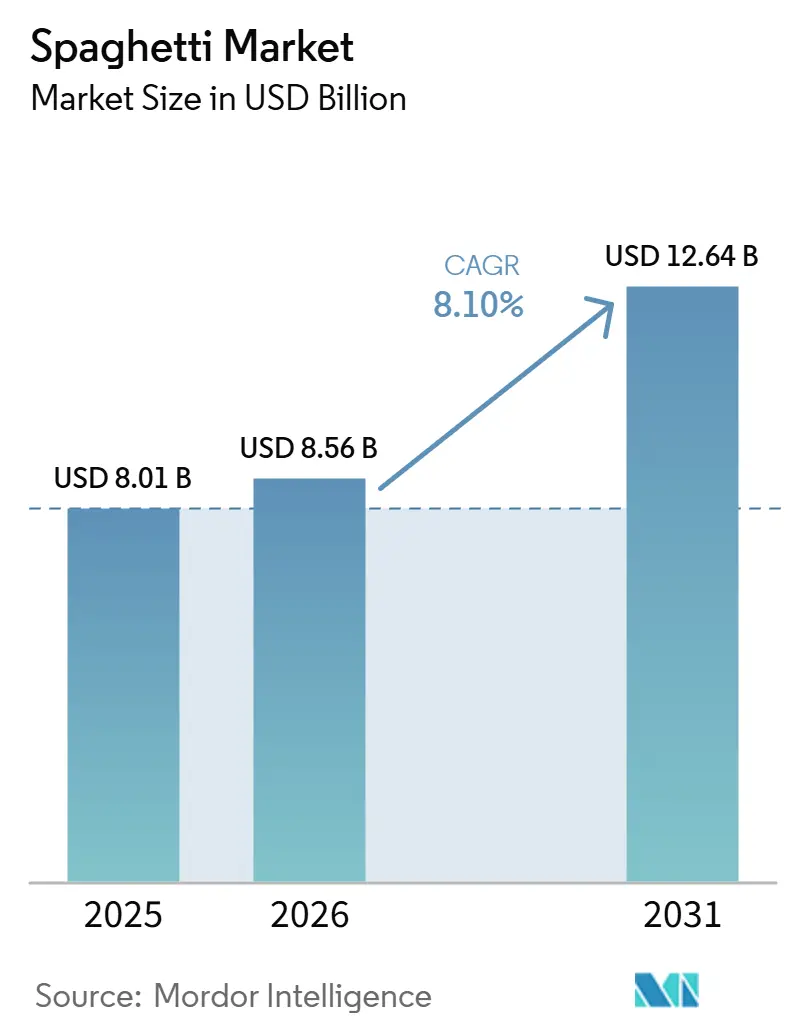
The spaghetti market size is projected to expand from USD 8.01 billion in 2025 and USD 8.56 billion in 2026 to USD 12.64 billion by 2031, registering a CAGR of 8.1% between 2026 and 2031. The spaghetti market is supported by demand through retail and foodservice channels, urban growth, and its role as an everyday meal staple. Convenience remains important because dual-income households and urban consumers need quick, affordable meals. Short cooking times, simple preparation, and ambient storage give spaghetti an advantage over many center-of-plate protein options. Retailers can stock the product without relying on refrigerated storage, while households can keep it available for planned meals and last-minute occasions. This value proposition spans income groups and can support demand when household budgets are constrained. Competition is shaped by private-label pressure in standard dried products, unstable durum wheat supplies, and investment in protein-enriched, organic, and channel-specific products. These conditions favor suppliers that can maintain dependable quality while offering formats suited to different purchase occasions.
Key Report Takeaways
- By product type, dried spaghetti held 82.3% category share in 2025, while frozen spaghetti is forecast to grow at a 9.2% CAGR through 2031.
- By raw material, durum wheat and semolina held 74.1% category share in 2025, while corn-based spaghetti is forecast to grow at an 8.8% CAGR through 2031.
- By category, conventional spaghetti held 88.7% of the spaghetti market share in 2025, while free-from spaghetti is forecast to grow at a 10.5% CAGR through 2031.
- By distribution channel, retail held 58.7% of the spaghetti market share in 2025, while foodservice and HoReCa are forecast to grow at a 9.5% CAGR through 2031.
- By geography, Europe held 36.8% of the spaghetti market share in 2025, while Asia-Pacific is forecast to grow at a 9.7% CAGR through 2031.
Note: Market size and forecast figures in this report are generated using Mordor Intelligence’s proprietary estimation framework, updated with the latest available data and insights as of January 2026.
Global Spaghetti Market Trends and Insights
Drivers Impact Analysis*
| Drivers | (~) % Impact on CAGR Forecast | Geographic Relevance | Impact Timeline |
|---|---|---|---|
| Rising Preference for Convenient Meals | +2.1% | Global, strongest in Asia-Pacific and North America | Short term (≤ 2 years) |
| Popularity of Italian Cuisine Worldwide | +1.6% | Global, with demand concentrated in North America and Asia-Pacific | Medium term (2-4 years) |
| Growth of Food Delivery and Online Ordering | +1.4% | Global, with the highest platform density in North America, China, and India | Short term (≤ 2 years) |
| Product Innovation in Healthier Variants | +1.1% | North America and Europe, expanding to Asia-Pacific | Medium term (2-4 years) |
| Rising Demand for Organic and Clean-Label Pasta | +0.8% | Europe and North America | Long term (≥ 4 years) |
| Influence of Social Media and Food Trends | +0.6% | Global, with the strongest activity in Gen Z-heavy markets | Short term (≤ 2 years) |
| Source: Mordor Intelligence | |||
Rising Preference for Convenient Meals
Convenience supports the spaghetti market because it reduces both cooking time and the skill needed for meal preparation. Manufacturers are using microwaveable and single-serve formats to reach working professionals and students who might otherwise choose meals prepared outside the home. Kraft Heinz launched Heinz Spaghetti Carbonara in the United Kingdom in 2024 as a canned, ready-to-heat product after identifying demand for a simpler carbonara preparation experience. The product shows that convenience innovation can remove preparation barriers, not only shorten cooking time. It also shows why suppliers are adjusting product form as well as package size when they seek to serve consumers with limited time and limited confidence in the kitchen. Spaghetti can appeal to consumers managing food-at-home budgets because its per-serving cost is lower than many quick-service protein alternatives. This can increase pantry purchases in price-sensitive emerging markets.
Popularity of Italian Cuisine Worldwide
Italian cuisine supports demand for the spaghetti market through restaurant menus and retail familiarity. Full-service Italian restaurants accounted for 19% of the worldwide full-service restaurant market in 2024. These operators buy spaghetti at scale and provide a steady outlet for suppliers. Their expansion into secondary cities in Asia and Latin America creates new routes to market. Restaurant meals can also introduce spaghetti preparation and usage occasions to first-generation consumers. That familiarity can make retail purchases easier because consumers recognize dishes, sauces, and preparation methods from foodservice settings. Italian pasta exports were approaching EUR 4 billion annually, supported by DOP and PGI certification systems that can support premium positioning in more than 100 export markets.
Growth of Food Delivery and Online Ordering
Food delivery has expanded the role of spaghetti from a home-cooked staple to a frequent restaurant delivery option. This has broadened the foodservice and HoReCa revenue base beyond traditional restaurant visits. Pasta-focused delivery kitchens can operate with lower overhead than full-service restaurants. Their model supports value-priced spaghetti dishes that compete with home cooking on price and speed. The channel also gives restaurant operators a way to serve areas beyond their immediate dining locations. In April 2026, TikTok Korea and GS25 launched a gochujang butter pasta retail product following the traction of a viral recipe. The move shows how digital food activity can shorten the path between consumer interest and retail placement.
Product Innovation in Healthier Variants
Protein enrichment has become a central product development area in the spaghetti market. Barilla added Protein+ Stars to its Protein+ range in January 2026. The product provides 17g of protein and 10g of fiber per serving through a blend of semolina, lentil, chickpea, and pea proteins. Pasta Rummo introduced Maxima in the United States in June 2025, an organic two-ingredient protein pasta range with 21g of protein per serving. These launches show that protein content is becoming relevant to household nutrition choices, not only to sports nutrition. Barilla and De Cecco were competing for protein pasta shelf space in 2025, reflecting the speed at which this product area has developed.
Restraints Impact Analysis*
| Restraint | (~) % Impact on CAGR Forecast | Geographic Relevance | Impact Timeline |
|---|---|---|---|
| Supply Chain Fragility in Grain Sourcing | -1.4% | Global, with acute exposure in Italy, Morocco, and North Africa | Short term (≤ 2 years) |
| Competition from Alternative Pasta Formats | -1.0% | North America and Europe, expanding to Asia-Pacific | Medium term (2-4 years) |
| Shift Toward Low-Carb and Specialty Diets | -0.8% | North America and Europe | Medium term (2-4 years) |
| Sustainability Concerns in Wheat Production and Packaging | -0.5% | Europe and North America | Long term (≥ 4 years) |
| Source: Mordor Intelligence | |||
Supply Chain Fragility in Grain Sourcing
Durum wheat sourcing created supply risks for the spaghetti market in 2025. Mexico produced less than 500,000 tonnes of durum in 2025/26, compared with 1.87 million tonnes in 2023/24, after severe drought in Sonora reduced dam levels to 15% capacity[1]Source: U.S. Department of Agriculture Foreign Agricultural Service, “Mexico Durum Wheat Moves From Exporter to Importer”, usda.gov.. The USDA Foreign Agricultural Service projected that Mexico would import 400,000 tonnes in 2025/26, its first net import position in more than 20 years. Canada’s 2025 harvest was forecast at 6.5 million tonnes, but wet conditions in Saskatchewan reduced the availability of high-protein No. 1 CWAD wheat used for consistent pasta texture. Italy depends on imported durum for more than 80% of EU incoming durum volumes in 2025/26, so drought in North Africa and quality issues in Canada can affect mill use. Codex Alimentarius standards restrict the ability to substitute lower-grade wheat without reformulating products.
Shift Toward Low-Carb and Specialty Diets
Low-carbohydrate and specialty diets can limit the volume growth of conventional spaghetti in North America and Western Europe. This pressure is strongest in mass retail dried pasta, where consumers can easily compare products. Shirataki, konjac, and cauliflower-based options have become more visible in mainstream supermarkets. Their presence can increase consumer attention to the carbohydrate content of conventional spaghetti. Protein-enriched and legume-based products can answer some nutrition concerns by offering a more balanced profile. They do not fully restore demand where consumers have made low-carbohydrate diets a regular habit.
*Our forecasts treat driver/restraint impacts as directional, not additive. The impact forecasts reflect baseline growth, mix effects, and variable interactions.
Segment Analysis
By Product Type: Dried Products Maintain Broad Retail Reach
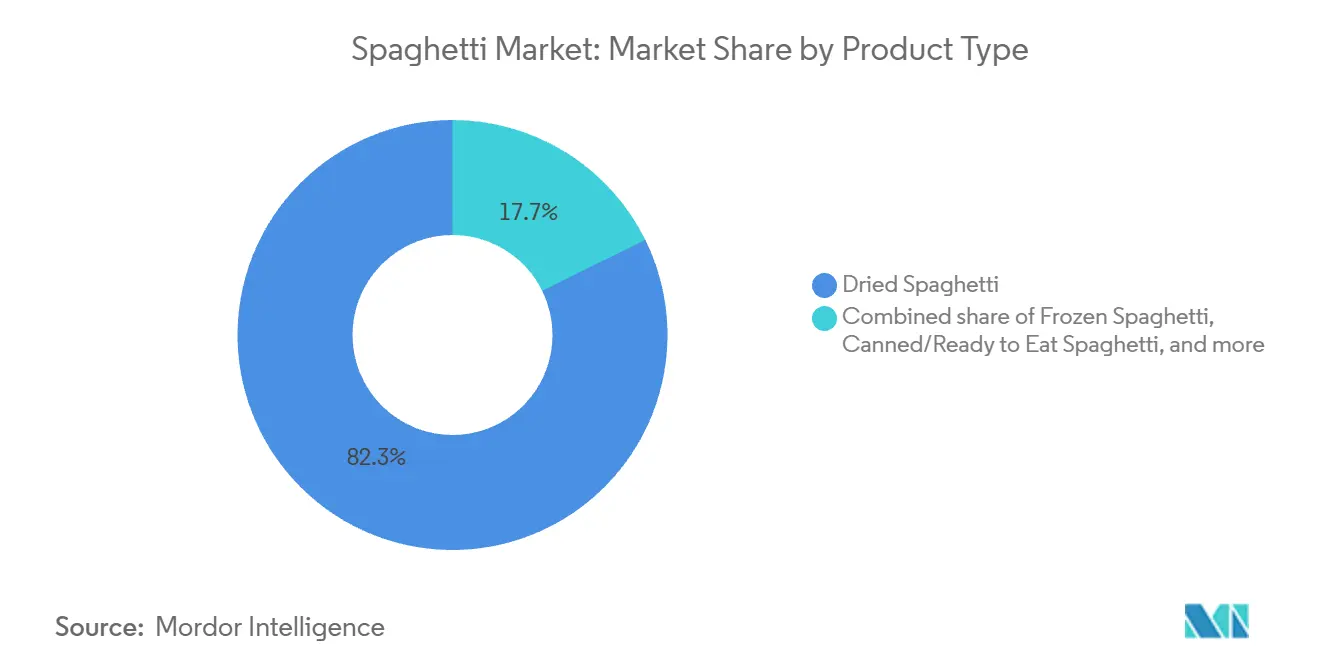
Dried spaghetti accounted for 82.3% of the spaghetti market size in 2025. Its position reflects an ambient shelf life of more than 24 months and a cooking process familiar to consumers. The format occupies the core pasta aisle across modern retail channels. Foodservice buyers also favor dried products for predictable inventory and low waste. This combination of storage flexibility and simple preparation helps preserve its wide consumer appeal. Fresh and refrigerated spaghetti remains concentrated in premium retail and specialty grocery. Its growth is limited in markets where cold-chain infrastructure is less developed.
Frozen spaghetti is forecast to expand at a 9.2% CAGR from 2026 to 2031. Cold-chain development and demand for portion-controlled meal kits support this pace. Frozen products allow suppliers to combine spaghetti with sauces, proteins, and premium cheeses. This format can therefore command higher prices than plain dried pasta. It is suited to consumers who want a more complete meal without preparing each element separately. EU hygiene requirements for frozen foods under Regulation (EC) No 853/2004 create operational requirements for manufacturers. These requirements can support established producers that already have suitable production systems.



By Raw Material: Durum Leads While Corn Builds Demand
Durum wheat and semolina represented 74.1% of the spaghetti market size in 2025. High-gluten semolina forms the gluten network associated with al dente texture. This gives durum-based products a strong place in traditional supply chains. The segment faces pressure from logistics costs, harvest variability, and changing durum price relationships. Whole wheat products serve consumers seeking fiber and gut health benefits. Rice-based products serve celiac and allergen-sensitive consumers in Europe and North America. Together, these alternatives give manufacturers options for addressing dietary preferences while durum remains the main raw material.
Corn-based spaghetti is forecast to grow at an 8.8% CAGR from 2026 to 2031. Its gluten-free and non-GMO positioning supports demand where allergen transparency guides purchase decisions. Its fiber content and lower glycemic index compared with refined durum pasta also appeal to wellness-focused consumers. This broadens demand beyond consumers with diagnosed gluten intolerance. It also gives retailers a product that can sit within both specialty pasta and wellness-focused assortments. Regulation (EU) 2018/848 raises transparency expectations for organic products and affects premium pasta development. The spaghetti industry is therefore balancing durable durum demand with investments in alternative grain products[2]Source: European Union, “Regulation (EU) 1169/2011 on Food Information to Consumers”, eur-lex.europa.eu..
By Category: Conventional Products Retain Scale Advantages
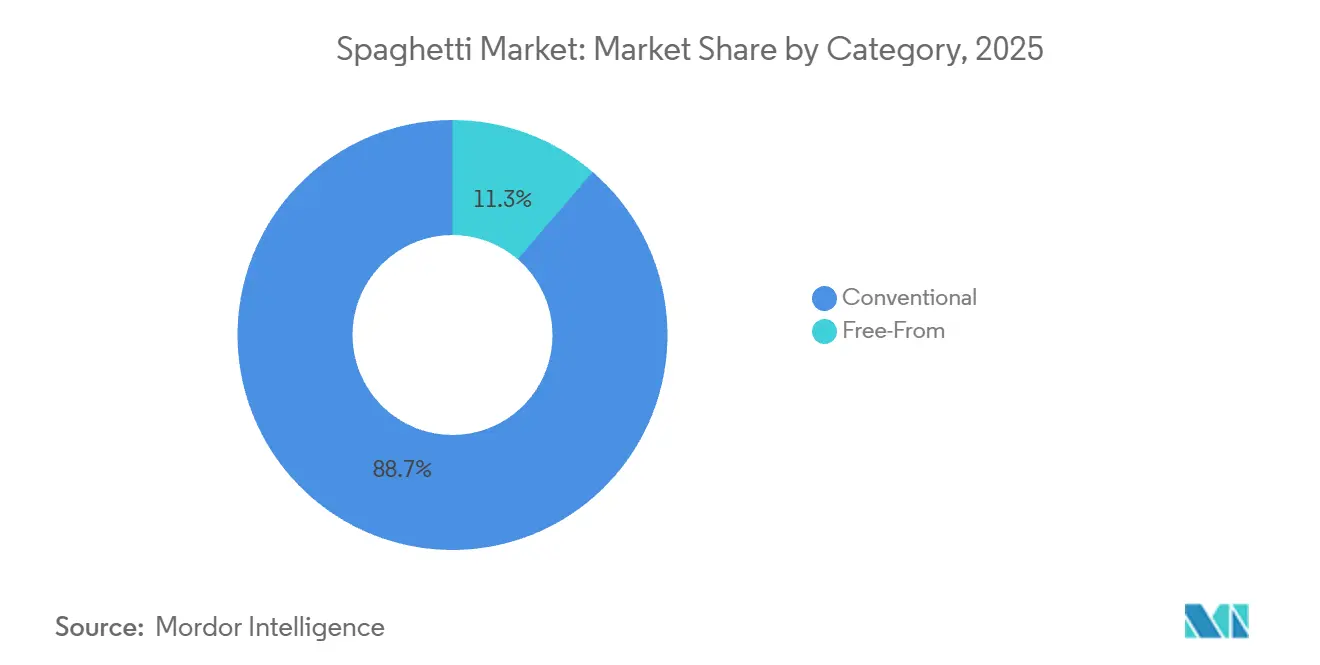
Conventional spaghetti held 88.7% category share in 2025. Consumers in this segment often prioritize cost per serving over specialty dietary claims. Large volumes help manufacturers spread research, distribution, and logistics costs across a broad base. This supports accessible retail prices. The category includes private-label dried spaghetti, premium bronze-die products, Italian-origin products, and protein-enriched offerings. These formats allow suppliers to serve different consumer preferences without moving away from the main conventional product base. Barilla obtained organic certification for its Al Bronzo line in May 2026, showing how premium credentials are also being added to conventional product ranges.
Free-from spaghetti is forecast to record a 10.5% CAGR from 2026 to 2031. Demand increasingly comes from wellness-focused consumers as well as consumers who avoid gluten for medical reasons. For these buyers, allergen-free labeling can communicate quality and transparency. Producers are adding nutrition claims to support premium pricing. The strategy allows a product to address dietary needs and broader nutrition preferences at the same time. EU Regulation 1169/2011 requires clear gluten declarations, including for wheat-starch products where gluten has been removed. This compliance framework shapes product development within the spaghetti market.
By Distribution Channel: Retail Leads as Foodservice Expands
Retail represented a 58.7% category share in 2025. Supermarkets and hypermarkets lead this channel because dried spaghetti is purchased frequently. Private-label competition is most intense in these outlets. Online retail is gaining relevance for premium, specialty, and free-from products. E-commerce provides broader product selection and supports subscription purchases. It can be particularly useful for products that require more shelf information than standard dried spaghetti. Convenience and grocery stores address same-day meal occasions in urban locations.
Foodservice and HoReCa is forecast to grow at a 9.5% CAGR from 2026 to 2031. Italian pasta-focused fast-casual chains are expanding into secondary cities across Asia and Latin America. Delivery platforms have increased the number of foodservice occasions and created recurring bulk demand. This demand can be more stable and higher margin than a retail shelf listing. It also gives producers a reason to develop pack sizes and product specifications that fit professional kitchens. Barilla signed a multiyear Formula 1 Official Pasta Partnership in April 2025, including Pasta Bars in F1 Paddock Club venues across 23 Grand Prix markets. Such activities combine brand visibility with foodservice access for the spaghetti market.
Geography Analysis
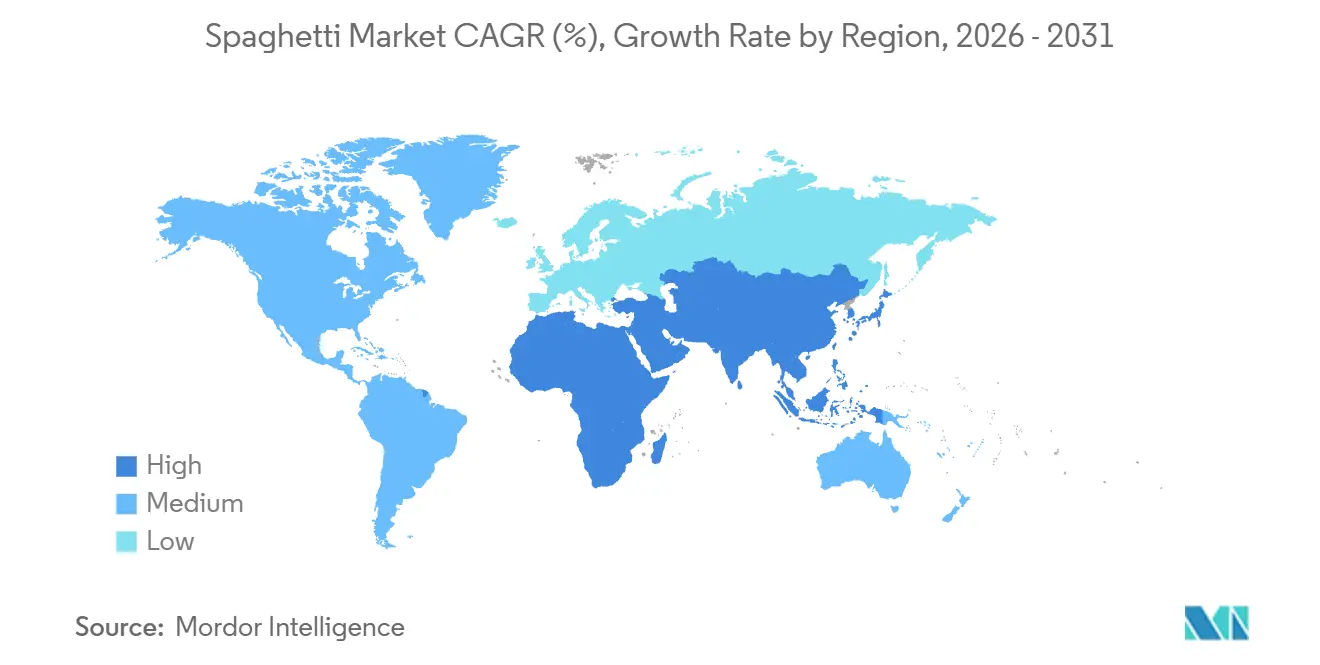
Europe accounted for 36.8% of the spaghetti market size in 2025. Italy remains the largest pasta producer and a demanding market for product quality. Italian durum production exceeded 4 million tonnes in 2025, but imports from Canada, Kazakhstan, and the United States remained necessary to serve domestic milling capacity. Germany, France, and the United Kingdom are important secondary consumption markets. Private-label products have significant shelf presence in Germany, the Netherlands, and Poland. This places pressure on branded margins while premium products expand. The regional market therefore combines established volume demand with a need for brands to show clear product differentiation.
Asia-Pacific is forecast to grow at a 9.7% CAGR from 2026 to 2031, the fastest rate among regions in the spaghetti market. India is an important volume opportunity as urban households broaden their meal choices. China accounted for 40.1% of the Asia-Pacific pasta and noodle market share in 2025, while urbanization reached 67.9%. Urban consumers are adding spaghetti to weekday meal routines. Food delivery and retail availability make this shift easier. These channels give suppliers several ways to reach consumers as demand moves beyond traditional home cooking. Premium product launches in Southeast Asia indicate interest in higher-value formats.
North America remains a large and structurally important area for the spaghetti market. Barilla announced a nearly USD 170 million expansion of its Avon, New York, manufacturing facility in May 2026. The project reflects continued confidence in U.S. volume demand. It also adds production and packaging capacity that can support the company’s ability to serve retail and foodservice customers. South America has established consumption in Brazil and Argentina. Morocco processed 910,000 tonnes of industrial semolina in 2024, while Turkey uses 1 million tonnes of durum annually for pasta and exports an average of 1.4 million tonnes of pasta each year. These countries remain important to supply conditions across the Middle East and Africa.

Competitive Landscape
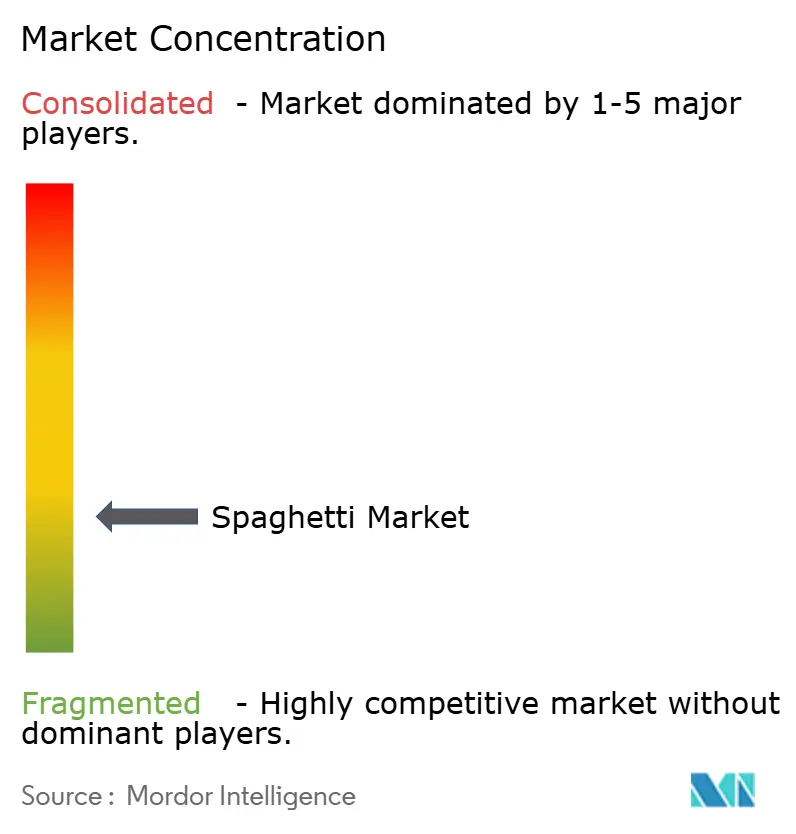
The spaghetti market remains fragmented, with no manufacturer holding a decisive global share. Barilla operates plants in Europe and North America and offers standard, organic, and high-protein products across price points. However, its strong position in the United States does not ensure similar strength in Southern Italy, where regional brands maintain strong consumer loyalty. This local competition limits global market concentration.
Rummo, De Cecco, Garofalo, and La Molisana use bronze-die extrusion, slow drying, and Italian grain sourcing to support premium positioning. De Cecco is set to introduce Protein Boost at the Summer Fancy Food Show in July 2026. The product provides 28 g of protein per serving through a durum wheat blend with pea flour, lentils, and fava beans. Barilla is expected to open its BITE research and development center in Parma in late 2025 to support formulation development across pasta, sauces, and bakery products. These developments show the value of product quality and formulation capability.
Post Holdings is expected to complete the USD 375 million sale of its 8th Avenue pasta business to Richardson Holdings in December 2025. The deal will transfer three US production facilities and 500 employees. It highlights the challenges faced by pasta manufacturers without strong brand equity or scale. Frozen convenience and high-protein nutrition remain less developed than standard dried products. Companies that meet EU allergen and novel food requirements gain an advantage in retail listings for free-from and functional products. The spaghetti market rewards suppliers that manage compliance, product quality, and channel-specific demand.
Spaghetti Industry Leaders
F.lli De Cecco di Filippo SpA
Barilla G. e R. Fratelli S.p.A.
Ebro Foods, S.A.
Nestlé S.A.
Pastificio Rana S.p.A.
- *Disclaimer: Major Players sorted in no particular order

Recent Industry Developments
- July 2026: Monte's Fine Foods expanded its artisanal pasta portfolio with the launch of three new organic pasta shapes, Stella, Bozzolo, and Conchiglia, made from organic durum semolina and water. While the launch does not introduce a new spaghetti variant, it strengthens the brand's premium pasta portfolio, which already includes organic spaghetti.
- July 2026: Chef Boyardee has expanded its canned pasta portfolio with the launch of a new high-protein Spaghetti & Meatballs variant, delivering 25g of protein per can. The product is designed to address growing consumer demand for convenient, protein-rich ready-to-eat meals while maintaining the brand's classic spaghetti offering.
- May 2026: Barilla announced a USD 170 million two-phase expansion of its manufacturing facility in Avon, New York. Phase One adds 1 production line, 3 packaging lines, and warehouse capacity. It is targeted for completion by March 2028 and will create more than 90 jobs.


Global Spaghetti Market Report Scope
| Dried Spaghetti |
| Fresh and Refrigerated Spaghetti |
| Frozen Spaghetti |
| Canned/Ready to Eat Spaghetti |
| Durum Wheat and Semolina |
| Whole Wheat |
| Rice-Based |
| Corn-Based |
| Others |
| Conventional |
| Free-From |
| Foodservice/HoReCa | |
| Retail | Supermarkets/Hypermarkets |
| Online Retail Stores | |
| Convenience/Grocery Stores | |
| Other Distribution Channels |
| North America | United States |
| Canada | |
| Mexico | |
| Rest of North America | |
| Europe | Germany |
| United Kingdom | |
| Italy | |
| France | |
| Spain | |
| Netherlands | |
| Poland | |
| Belgium | |
| Sweden | |
| Rest of Europe | |
| Asia-Pacific | China |
| India | |
| Japan | |
| Australia | |
| Indonesia | |
| South Korea | |
| Thailand | |
| Singapore | |
| Rest of Asia-Pacific | |
| South America | Brazil |
| Argentina | |
| Colombia | |
| Chile | |
| Peru | |
| Rest of South America | |
| Middle East and Africa | South Africa |
| Saudi Arabia | |
| United Arab Emirates | |
| Nigeria | |
| Egypt | |
| Morocco | |
| Turkey | |
| Rest of Middle East and Africa |
| By Product Type | Dried Spaghetti | |
| Fresh and Refrigerated Spaghetti | ||
| Frozen Spaghetti | ||
| Canned/Ready to Eat Spaghetti | ||
| By Raw Material | Durum Wheat and Semolina | |
| Whole Wheat | ||
| Rice-Based | ||
| Corn-Based | ||
| Others | ||
| By Category | Conventional | |
| Free-From | ||
| By Distribution Channel | Foodservice/HoReCa | |
| Retail | Supermarkets/Hypermarkets | |
| Online Retail Stores | ||
| Convenience/Grocery Stores | ||
| Other Distribution Channels | ||
| By Geography | North America | United States |
| Canada | ||
| Mexico | ||
| Rest of North America | ||
| Europe | Germany | |
| United Kingdom | ||
| Italy | ||
| France | ||
| Spain | ||
| Netherlands | ||
| Poland | ||
| Belgium | ||
| Sweden | ||
| Rest of Europe | ||
| Asia-Pacific | China | |
| India | ||
| Japan | ||
| Australia | ||
| Indonesia | ||
| South Korea | ||
| Thailand | ||
| Singapore | ||
| Rest of Asia-Pacific | ||
| South America | Brazil | |
| Argentina | ||
| Colombia | ||
| Chile | ||
| Peru | ||
| Rest of South America | ||
| Middle East and Africa | South Africa | |
| Saudi Arabia | ||
| United Arab Emirates | ||
| Nigeria | ||
| Egypt | ||
| Morocco | ||
| Turkey | ||
| Rest of Middle East and Africa | ||


Key Questions Answered in the Report
What is the projected value of the spaghetti category by 2031?
The spaghetti market is forecast to reach USD 12.64 billion by 2031, from USD 8.56 billion in 2026, at an 8.1% CAGR.
Which spaghetti product type has the largest share?
Dried spaghetti led with 82.3% share in 2025 because of its long ambient shelf life, broad retail availability, and foodservice suitability.
Which type of spaghetti is forecast to grow the fastest?
Frozen spaghetti is forecast to grow at a 9.2% CAGR through 2031, supported by cold-chain development and meal-kit demand.
Which region has the strongest projected growth?
Asia-Pacific is forecast to grow at a 9.7% CAGR through 2031 as urban consumers broaden weekday meal choices and retail access improves.
Page last updated on:





