
Sovereign Key Management Systems Software Market Size and Share
Market Overview
| Study Period | 2020 - 2031 |
|---|---|
| Market Size (2026) | USD 10.36 Billion |
| Market Size (2031) | USD 26.84 Billion |
| Growth Rate (2026 - 2031) | 20.97% CAGR |
| Fastest Growing Market | Asia-Pacific |
| Largest Market | North America |
| Market Concentration | Low |
Major Players *Disclaimer: Major Players sorted in no particular order Image © Mordor Intelligence. Reuse requires attribution under CC BY 4.0. | |
Sovereign Key Management Systems Software Market Analysis by Mordor Intelligence
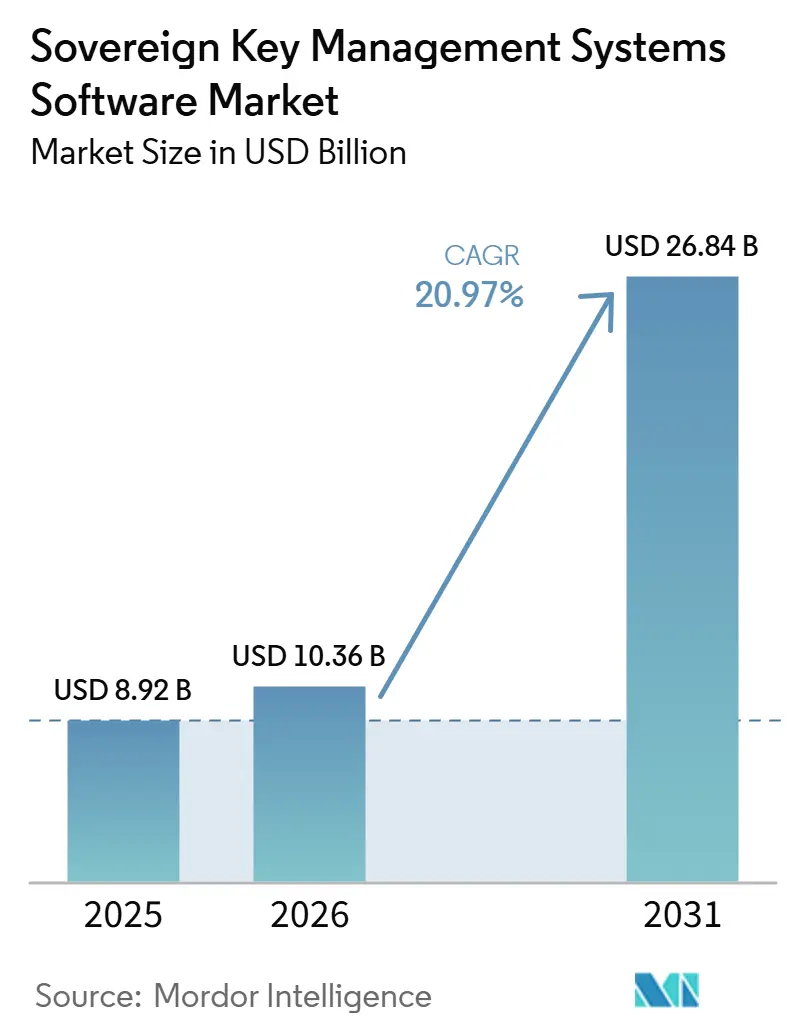
The Sovereign Key Management Systems Software Market size is projected to expand from USD 8.92 billion in 2025 and USD 10.36 billion in 2026 to USD 26.84 billion by 2031, registering a CAGR of 20.97% between 2026 and 2031. Data sovereignty rules, post-quantum cryptography requirements, and tighter control of encryption keys are changing procurement priorities across regulated organizations. Physical data residency alone is no longer sufficient when a cloud provider can access the keys that protect the data. Public-sector agencies and operators of critical infrastructure increasingly need technical proof that key custody stays under their control. This need favors platforms that support external key management, Hold Your Own Key configurations, and a clear path to quantum-safe cryptography. Competition is strongest in higher-value deployments where providers can combine key control, compliance evidence, and integration across cloud environments.
Key Report Takeaways
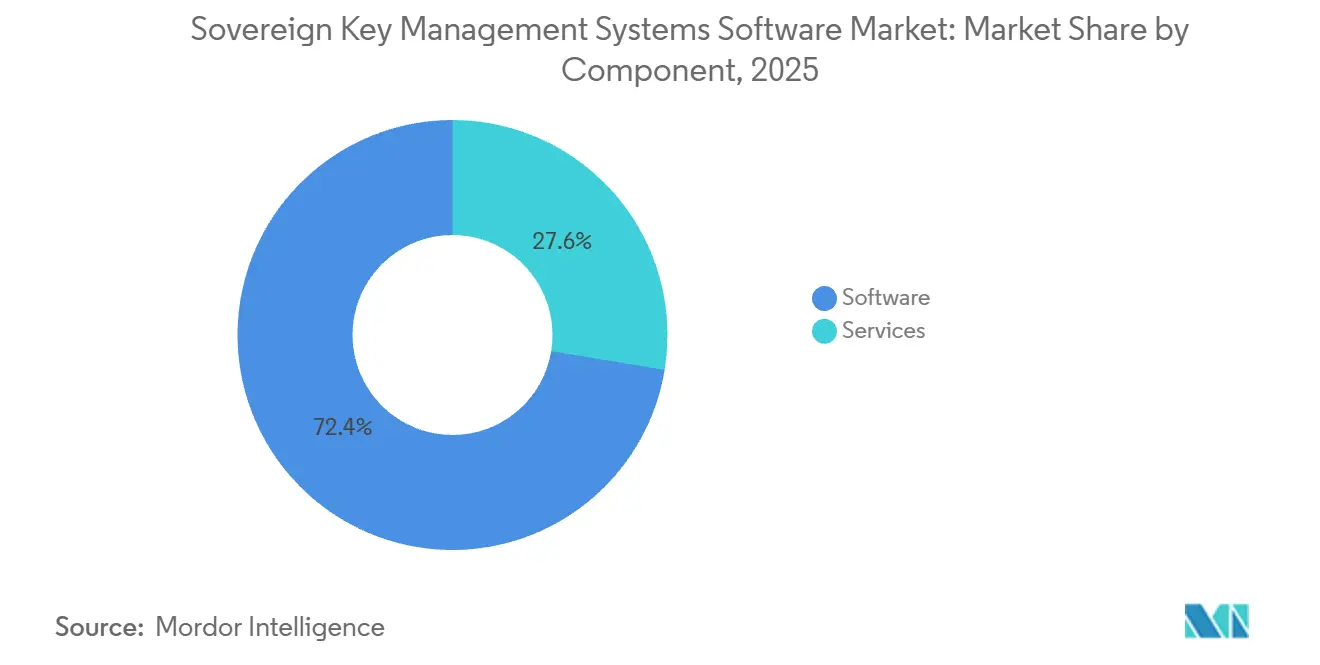
- By component, software held 72.41% of the Sovereign Key Management Systems Software Market share in 2025, while services are projected to expand at a 22.84% CAGR through 2031.
- By deployment model, cloud accounted for 68.19% of the 2025 Sovereign Key Management Systems Software Market revenue, while hybrid is projected to expand at a 21.63% CAGR through 2031.
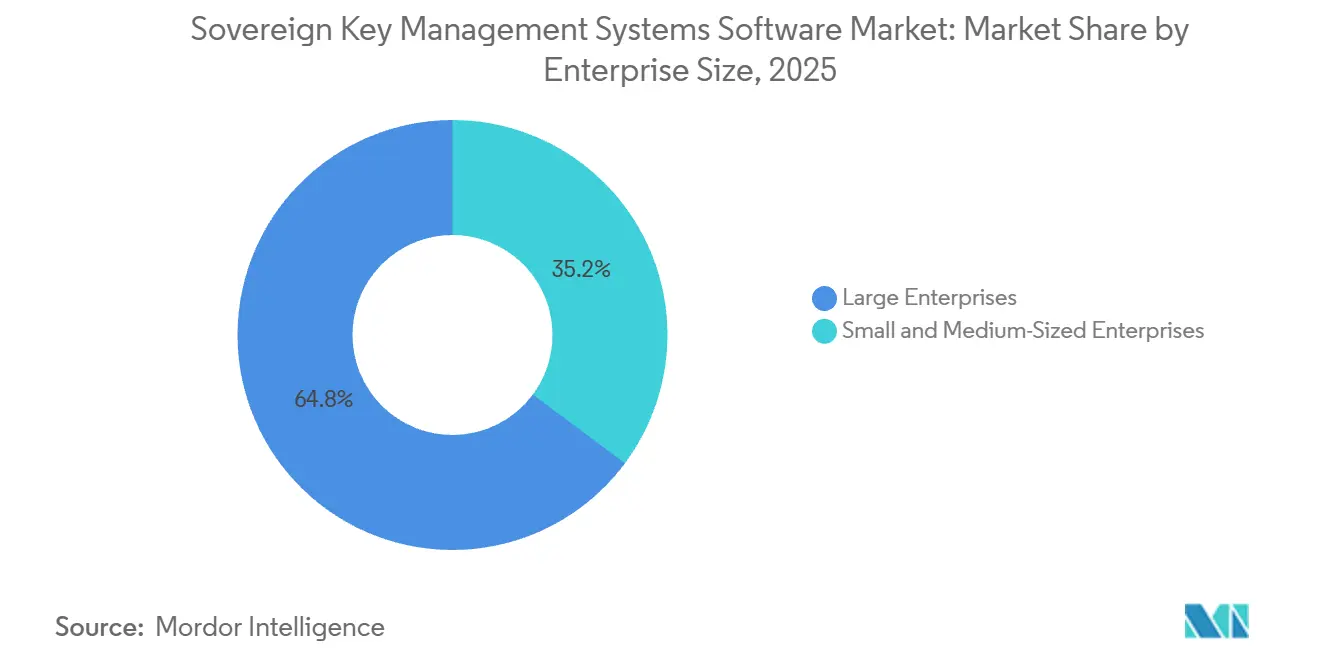
- By enterprise size, large enterprises held 64.83% of the 2025 Sovereign Key Management Systems Software Market revenue, while SMEs are projected to expand at a 22.14% CAGR through 2031.
- By end user, BFSI accounted for 26.42% of 2025 revenue, while healthcare and life sciences are projected to expand at a 21.38% CAGR through 2031.
- By geography, North America accounted for 34.62% of the 2025 Sovereign Key Management Systems Software Market revenue, while Asia-Pacific is projected to expand at a 22.91% CAGR through 2031.
Note: Market size and forecast figures in this report are generated using Mordor Intelligence’s proprietary estimation framework, updated with the latest available data and insights as of January 2026.
Global Sovereign Key Management Systems Software Market Trends and Insights
Drivers Impact Analysis*
| Driver | (~) % Impact on CAGR Forecast | Geographic Relevance | Impact Timeline |
|---|---|---|---|
| Data Sovereignty and Encryption Mandates | +4.8% | Global, strongest in EU, North America, and regulated Asia-Pacific sectors | Short term (≤ 2 years) |
| Rising Cost and Board-Level Impact of Data Breaches | +3.9% | Global | Short term (≤ 2 years) |
| Hybrid and Multicloud Expansion | +3.5% | Global, led by North America and Asia-Pacific, extending to Middle East and Africa | Medium term (2-4 years) |
| Post-Quantum Cryptography Readiness Programs | +2.9% | North America, EU, Japan, South Korea, and Singapore | Long term (≥ 4 years) |
| Sovereign Control for AI and Confidential Computing Workloads | +2.3% | North America and EU, with emerging Asia-Pacific demand | Medium term (2-4 years) |
| Cryptographic Control for Cross-Border SaaS and Digital Infrastructure | +1.8% | Global | Medium term (2-4 years) |
| Source: Mordor Intelligence | |||
Regulatory Mandates for Data Sovereignty and Encryption
France extended sovereign cloud hosting and key management obligations in April 2026 to state-administered groupings and their subcontractors. The decree requires encryption keys to remain outside the control of non-EU cloud providers. France's national cybersecurity strategy also committed investment to retain domestic control of cryptographic technologies across the data lifecycle. ANSSI issued version 3.00 of its cryptographic rules in March 2026, giving NIS2-regulated French entities a technical compliance baseline. These measures make sovereignty capabilities a practical requirement for vendors seeking public-sector and critical-infrastructure contracts in the Sovereign Key Management Systems Software Market.[1]National Institute of Standards and Technology, “Post-Quantum Cryptography,” Computer Security Resource Center, csrc.nist.gov France's SecNumCloud framework and Germany's C5 and C3A requirements also create market-access barriers for providers without Hold Your Own Key or external key management capabilities, because qualification evidence, legal jurisdiction, operational controls, and the separation between a cloud provider and a customer key environment can all be examined before a supplier enters a procurement process.
Rising Cost and Board-Level Impact of Data Breaches
IBM reported that the average cost of a data breach in the United States reached USD 10.22 million in 2025, while the global average was USD 4.44 million. The report linked the lower global average to faster containment supported by AI tools. Unapproved use of internet-based AI tools added USD 670,000 to the global average cost of a breach. The mean time to identify and contain a breach fell to 241 days, yet 97% of organizations reporting AI-related breaches lacked proper AI access controls. These findings place access governance and key control alongside detection as board-level priorities for the Sovereign Key Management Systems Software Market. Higher costs in jurisdictions with stronger regulatory enforcement can make investment in key governance more defensible than treating it as a narrow compliance expense, particularly when a board must weigh the cost of an isolated security control against the potential cost of a breach, notification obligations, customer disruption, legal exposure, and prolonged recovery work.
Hybrid and Multicloud Expansion
Utimaco reported that 90% of enterprises operated hybrid or multicloud strategies in 2026. Each provider can use different application interfaces, key lifecycles, and audit formats, which increases key sprawl. Hybrid deployments keep root key material in an on-premises hardware security module while cloud services handle daily encryption operations. LSEG data cited by Utimaco showed that 82% of financial services firms used hybrid or multicloud environments, while 44% still prioritized private cloud for sensitive data in 2025. This split supports demand for consistent policy enforcement, shared audit visibility, reliable ownership records, repeatable control procedures, and clear operational accountability across different environments in the Sovereign Key Management Systems Software Market.[2]Office of Management and Budget, “Execution of the Migration to Post-Quantum Cryptography,” The White House, whitehouse.gov Fragmented environments also make post-quantum migration harder because each isolated key management platform requires its own transition process, including reviews of key inventories, compatible algorithms, certificate dependencies, application integration, change windows, rollback procedures, and controls to verify that older cryptography has been removed upon completion of the transition.
Post-Quantum Cryptography Readiness Programs
NIST published FIPS 203, FIPS 204, and FIPS 205 in August 2024, establishing standards for post-quantum key establishment and digital signatures. The White House Office of Management and Budget directed federal agencies in June 2026 to ensure that key management and hardware security module platforms can manage classical and post-quantum keys. Agencies must submit migration plans within 120 days under the memorandum. Long-lived sensitive data faces a harvest-now-decrypt-later risk because attackers can collect encrypted data before quantum systems can break it. Research in 2026 found that delaying migration from 2026 to 2030 increased the expected fraction of a confidentiality window exposed to that risk from 0.37 to 0.54.[3]French Republic, “Décret n° 2026-272 du 14 avril 2026,” Légifrance, legifrance.gouv.fr The Sovereign Key Management Systems Software Market therefore benefits from demand for crypto-agile platforms that can inventory, store, and rotate multiple generations of keys, apply policies to different data-retention periods, support new signature and encapsulation algorithms, and provide a documented path from early assessment through full implementation.
Restraints Impact Analysis*
| Restraint | (~) % Impact on CAGR Forecast | Geographic Relevance | Impact Timeline |
|---|---|---|---|
| Limited Interoperability Across Key Management Ecosystems | -2.1% | Global | Medium term (2-4 years) |
| Shortage of Cryptographic Engineering and Key Governance Skills | -1.8% | Global, most acute in North America and Western Europe | Short term (≤ 2 years) |
| Sovereignty Versus Cloud Convenience Trade-Offs | -1.3% | Global, most pronounced among SMEs | Medium term (2-4 years) |
| Operational Complexity of Sovereign Kill-Switches and Multi-Party Control | -0.9% | Enterprise and government sectors globally | Long term (≥ 4 years) |
| Source: Mordor Intelligence | |||
Limited Interoperability Across Key Management Ecosystems
Enterprise teams in the Sovereign Key Management Systems Software Market often encounter incompatible application interfaces, key formats, and audit logs when using multiple cloud providers and on-premises hardware. The Key Management Interoperability Protocol provides a standards-based option, but its adoption remains uneven across older and newer platforms. Organizations with several proprietary systems may need custom integration layers, which add operating cost and audit risk. The same fragmentation complicates a move to post-quantum algorithms because each environment needs separate rotation and migration work.[4]Agence Nationale de la Sécurité des Systèmes d'Information, “Règles et Recommandations Concernant le Choix et le Dimensionnement des Mécanismes Cryptographiques,” ANSSI, cyber.gouv.fr It can also create lock-in at the key-custody layer, because moving protected data can require re-encryption with new keys. This constraint can delay broader deployment in the Sovereign Key Management Systems Software Market, especially for organizations with large, dispersed data estates, where separate business units may use different providers, support different applications, retain different audit records, and lack a single accountable team to coordinate changes to key ownership and encryption policy.
Shortage of Cryptographic Engineering and Key Governance Skills
The global cybersecurity workforce gap reached 4.8 million professionals in 2024. UK government data showed that cryptography and key security were among the least represented specialisms in the 2025 cybersecurity sector. It also found that 28% of cybersecurity businesses reported technical skills gaps. Organizations beginning post-quantum migration need applied cryptographers, PKI engineers, and hardware security module specialists simultaneously. Those without internal expertise may delay deployments or choose provider-managed models with lower sovereignty assurance. This shortage supports demand for managed operations, readiness assessments, and integration services within the Sovereign Key Management Systems Software Market, particularly when a deployment must link existing PKI, hardware security modules, cloud services, application teams, and compliance functions that have historically operated with separate responsibilities.
*Our forecasts treat driver/restraint impacts as directional, not additive. The impact forecasts reflect baseline growth, mix effects, and variable interactions.
Segment Analysis
By Component: Software Platforms Support Programmable Key Control
Software held 72.41% of the Sovereign Key Management Systems Software Market share in 2025. Its position reflects the need to express cryptographic policy as code across CI/CD pipelines, Kubernetes environments, and serverless workloads. Enterprise key management software, cloud key management and KMaaS, hardware security module management software, secrets and certificate lifecycle management software, and cryptographic posture management software form the principal product categories. Cryptographic posture management helps organizations discover key material across mixed environments. That visibility is a practical starting point for a post-quantum migration plan. In March 2026, Fortanix added multi-sourced quantum entropy to its Data Security Manager through partnerships with Qrypt and Quantum Dice. The development shows that quantum resilience is reaching the entropy layer and the key lifecycle, as entropy sources, generated keys, stored keys, rotation rules, and audit evidence can all influence whether a deployment meets a regulated customer’s stated assurance requirements.
Services are projected to expand at a 22.84% CAGR from 2026 to 2031. The Sovereign Key Management Systems Software Market size for services benefits from the shortage of specialized cryptographic staff. Key rotation scheduling, audit log verification, and post-quantum assessments increasingly require external assistance. Organizations that built key practices during the cloud-first period now face more demanding requirements for Hold Your Own Key deployments. Advisory, integration, and managed operations can reduce the burden of maintaining those capabilities in-house. Service providers can also help clients document controls for regulators and auditors. This creates growth opportunities where organizations need support without replacing existing hardware or software, especially where audit evidence, key ownership records, separation of duties, and documented rotation procedures must be maintained across several jurisdictions and business units.


By Deployment Model: Hybrid Balances Root Key Custody With Cloud Operations
Cloud deployment accounted for 68.19% of 2025 revenue. Cloud-native offerings integrate readily with provider infrastructure through managed and customer-managed key options. Their scale and ease of deployment have supported widespread adoption across enterprise workloads. However, cloud-only designs can conflict with requirements that key material remain outside a provider's access perimeter. Government, defense, and financial institutions continue to use on-premises hardware security modules when physical and legal control is essential. This leaves cloud deployments important but insufficient for every regulated workload. The Sovereign Key Management Systems Software Market continues to require models that align cloud operations with stricter custody requirements, particularly where compliance teams need to demonstrate who can authorize use of a key, where the root material is stored, and whether an infrastructure provider can gain access during routine service operations.
Hybrid deployment is projected to expand at a 21.63% CAGR from 2026 to 2031. It keeps root keys in an on-premises hardware security module while using cloud-based application interfaces for lifecycle activities. This design can meet residency requirements without giving up cloud-scale operations. In 2025, 44% of financial services firms still prioritized private cloud for sensitive data, according to LSEG data cited by Utimaco. Hybrid use, therefore, fits institutions that need a trusted local anchor and broader cloud connectivity. Fortanix described hybrid key management as an enterprise standard that requires unified visibility and consistent policy enforcement. The model addresses a practical divide between sovereignty needs and operational convenience, allowing teams to retain a legally controlled root of trust while using cloud interfaces for application-level encryption, key rotation, access approval, and reporting.
By Enterprise Size: Managed Delivery Broadens SME Adoption
Large enterprises held 64.83% of 2025 revenue. They generally have larger IT budgets, more mature cryptographic governance, and heavier exposure to sector-specific regulation. These organizations are central users of Hold Your Own Key, multicloud key federation, and post-quantum readiness assessments. Existing hardware security modules, PKI systems, and secrets management tools also give vendors a base for upgrades. Vendors can add software layers or managed services rather than require full replacement programs. BFSI, government, and healthcare organizations account for much of this established demand. Their compliance requirements continue to support complex deployments in the Sovereign Key Management Systems Software Market, where a customer may need separate authorities for key creation and recovery, documented approvals for privileged actions, and continuous records that can be produced during supervisory, internal audit, or incident-response reviews.
SMEs are projected to expand at a 22.14% CAGR from 2026 to 2031. Key management as a service hides much of the underlying cryptographic complexity behind application interfaces. This avoids the need to operate physical hardware security modules or employ dedicated cryptographic engineers. Healthcare providers, financial technology companies, and government contractors face many of the same frameworks as larger firms. HIPAA, PCI DSS 4.0.1, and NIS2 obligations can apply regardless of internal security staffing. Managed sovereign key services can therefore offer a realistic path to compliance. This delivery approach makes higher-assurance controls more accessible to smaller organizations, which can use managed operations for implementation, monitoring, policy updates, key recovery procedures, and readiness work rather than building a full cryptographic engineering function, while still retaining a clear record of data ownership, user responsibilities, key lifecycle status, and access-control decisions.
By End User: BFSI Leads, While Healthcare and Life Sciences Accelerate
BFSI held 26.42% of 2025 revenue. PCI DSS 4.0.1 key management provisions became fully enforceable in March 2025. They require documented key custodians, split knowledge for key-encrypting keys, and audit-ready lifecycle logs. Banks are also adopting digital asset custody systems that need hardware-backed key security. The remaining end-user groups comprise IT and telecommunications, automotive and transportation, retail and e-commerce, industrial manufacturing, and other end users. Their needs range from machine identity management in connected vehicles to classified-data key custody in public agencies. These use cases keep BFSI central to the Sovereign Key Management Systems Software Market, where institutional users need controls for payment data, sensitive customer records, digital assets, machine identities, and transaction systems that must remain available while access to cryptographic material is tightly limited.
Healthcare and life sciences are projected to expand at a 21.38% CAGR from 2026 to 2031. The HHS Office for Civil Rights proposed changes in December 2024 that would require covered entities and business associates to use encryption. The proposal also includes a 72-hour breach notification deadline. New cryptographic module deployments must be FIPS 140-3 validated by September 2026. This requirement creates a transition point for organizations using FIPS 140-2 validated modules. Industrial manufacturing, retail and e-commerce, and other end-users make up the remaining demand base. Other end-users include organizations that need controls to protect data without disrupting operational processes, maintenance workflows, research activity, user access, or the availability of systems that support daily operations.
Geography Analysis
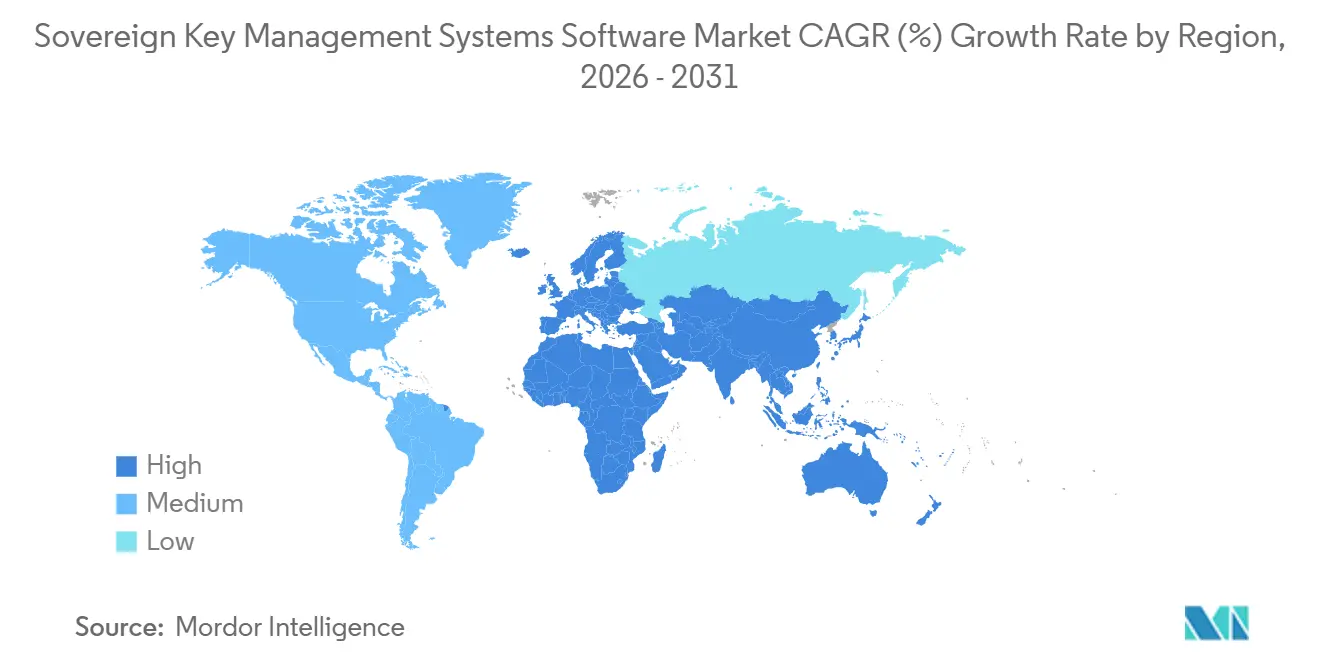
North America held 34.62% of the Sovereign Key Management Systems Software Market share in 2025. United States federal requirements, a concentration of cloud providers, and a large BFSI sector supported regional demand. The June 2026 Office of Management and Budget memorandum requires federal agencies to submit post-quantum migration plans within 120 days, creating near-term demand for platforms that manage classical and post-quantum keys together, preserve key history, coordinate certificate changes, maintain policy separation between workloads, and give federal teams a documented basis for assessing progress across agencies, applications, data classifications, and shared service environments. Canada and Mexico complement the United States in North America, while Brazil, Argentina, and the rest of South America are at an earlier stage, where digital banking, localization rules, and new cloud infrastructure are driving demand.
Europe has the most prescriptive regional framework for data sovereignty, with GDPR Article 44, NIS2, SecNumCloud, and Germany's C5 and C3A requirements shaping technical expectations for public-sector suppliers. In May 2026, Thales and Google Cloud announced a sovereign cloud offering in Germany designed to meet C5 and emerging C3A requirements. German financial entities faced an April 2026 registration deadline under national NIS2 implementation, while France published Decree n° 2026-272 that month and accelerated procurement after regulatory clarification. The United Kingdom, Spain, Russia, and the rest of Europe form a secondary tier alongside Germany and France, with UK demand shaped by cryptographic guidance and post-Brexit data adequacy considerations.
Asia-Pacific is projected to expand at a 22.91% CAGR from 2026 to 2031. Japan's sovereign cloud programs, India's enforcement of the Digital Personal Data Protection Act, and formal post-quantum guidance in South Korea and Singapore support this outlook. KDDI launched its Encryption Key Management Service for Google Cloud in July 2025, separating domestic key custody from Google Cloud infrastructure for Japanese organizations. NTT Data began trial availability of a quantum-resistant domestic service in Japan in April 2026, with commercial availability planned for October 2026. China, Japan, India, South Korea, Southeast Asia, and the rest of Asia-Pacific add potential demand as localization requirements develop, while the Middle East and Africa include Saudi Arabia, the United Arab Emirates, the rest of the Middle East, South Africa, Nigeria, and the rest of Africa.

Competitive Landscape
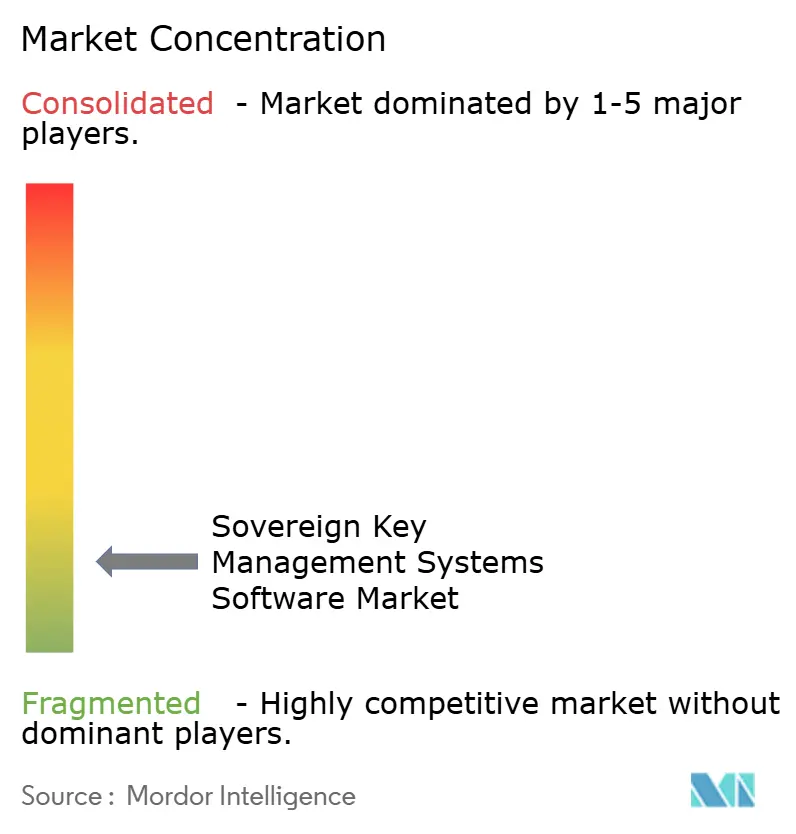
The Sovereign Key Management Systems Software Market is fragmented at the top tier. Thales has the broadest portfolio across enterprise key management, external cloud key management, hardware security modules, and sovereign cloud infrastructure. Entrust competes through PKI-integrated key management and machine identity capabilities, while Fortanix focuses on confidential computing and centralized governance. In 2026, Fortanix brought its Confidential AI platform to the Cisco Secure AI Factory, leveraging the NVIDIA ecosystem and attestation-gated key release for GPU-based AI inference workloads. Utimaco, Securosys, Keyfactor, and SSH Communications Security serve needs including machine identity, certificate lifecycle management, privileged access, and cryptographic controls.
Thales announced a joint post-quantum resilience program with IBM Consulting in 2026, combining cryptographic discovery, automated key inventory, and migration planning. It also introduced KMIP and CipherTrust Application Key Management for Oracle Transparent Data Encryption through its service platform in March 2026. In May 2026, the company and Google Cloud announced a sovereign cloud offering for Germany. These actions position the company in migration services, application key management, and regulated cloud deployments.
European specialists include eperi, Cosmian, and DuoKey, which provide cloud-agnostic encryption and customer-retained key custody. They serve regulated customers in Germany, France, and Switzerland, where local qualification rules can favor specialized providers. Akeyless provides a SaaS model for teams that want to manage secrets, certificates, and encryption keys through one platform. Managed Hold Your Own Key services for SMEs and automated post-quantum migration tooling remain open opportunities, with no provider showing clear leadership in inventory automation, algorithm agility testing, and Cryptographic Bill of Materials generation. The fragmented mid-tier gives smaller providers room to compete through targeted models, vertical expertise, and regional sovereignty requirements.
Sovereign Key Management Systems Software Industry Leaders
Thales S.A.
Entrust Corporation
Fortanix, Inc.
Utimaco IS GmbH
Securosys SA
- *Disclaimer: Major Players sorted in no particular order

Recent Industry Developments
- May 2026: Thales S.A. and Google Cloud announced a strategic partnership to establish a new European sovereign cloud solution in Germany, built on Thales's S3NS trusted cloud model from France and designed to meet Germany's C5 and emerging C3A regulatory requirements for sensitive public-sector and enterprise data. The offering entered preview in 2026, with general availability expected by end of 2026.
- May 2026: Microsoft announced the general availability of Azure Integrated HSM, delivering hardware-backed key protection for sovereign and regulated workloads on Azure. The launch extended hardware-rooted cryptographic isolation to confidential AI inference workloads, aligning with the growing requirement for sovereign key management in AI pipelines.
- April 2026: NTT Data Group began trial availability of a quantum-resistant domestic key management service on its OpenCanvas platform in Japan. The service managed the full encryption key lifecycle, generation, update, revocation, and destruction, entirely within Japan's domestic environment, targeting public-sector agencies, financial institutions, and large enterprises subject to Japan's economic security legislation. General commercial availability is planned for October 2026.
- April 2026: Fortanix Inc. announced multi-sourced quantum entropy for enterprise key generation within Fortanix Data Security Manager, integrating independent physics-based quantum entropy sources from Qrypt and Quantum Dice. The capability addressed compliance requirements mandating multiple entropy sources and extended zero-trust principles to the entropy layer, reducing the single-point-of-failure risk inherent in legacy HSM randomness architectures.


Global Sovereign Key Management Systems Software Market Report Scope
The sovereign key management systems software market refers to software solutions and services that provide organizations with exclusive, independent control over the lifecycle of their cryptographic keys. Unlike standard offerings, these systems ensure cryptographic independence, shielding encryption keys and underlying data from cloud providers, third-party vendors, and foreign entities. The market encompasses enterprise and cloud key management, hardware security module (HSM) management, secrets and certificate lifecycle management, and cryptographic posture management. Deployed across cloud, hybrid, or on-premises environments, these solutions are driven by data localization laws and geopolitical complexities. They primarily serve highly regulated industries, enabling them to achieve true cryptographic sovereignty, prevent unauthorized data exposure, and maintain rigorous compliance with regional data protection regulations.
The Sovereign Key Management Systems Software Market Report is Segmented by Component (Software (Enterprise Key Management Software, Cloud Key Management and KMaaS, Hardware Security Module (HSM) Management Software, Secrets and Certificate Lifecycle Management Software, and Cryptographic Posture Management Software), and Services), Deployment Model (Cloud, Hybrid, and On-Premises), Enterprise Size (Large Enterprises, and Small and Medium-Sized Enterprises), End User (IT and Telecommunication, BFSI, Automotive and Transportation, Healthcare and Life Sciences, Retail and E-Commerce, Industrial Manufacturing, and Other End-Users), and Geography (North America, South America, Europe, Asia-Pacific, and Middle East and Africa). The Market Forecasts are Provided in Terms of Value (USD).
| Software | Enterprise Key Management Software |
| Cloud Key Management and KMaaS | |
| Hardware Security Module (HSM) Management Software | |
| Secrets and Certificate Lifecycle Management Software | |
| Cryptographic Posture Management Software | |
| Other Softwares | |
| Services |
| Cloud |
| Hybrid |
| On-Premises |
| Large Enterprises |
| Small and Medium-Sized Enterprises |
| IT and Telecommunication |
| BFSI |
| Automotive and Transportation |
| Healthcare and Life Sciences |
| Retail and E-Commerce |
| Industrial Manufacturing |
| Other End Users |
| North America | United States | |
| Canada | ||
| Mexico | ||
| South America | Brazil | |
| Argentina | ||
| Rest of South America | ||
| Europe | Germany | |
| United Kingdom | ||
| France | ||
| Russia | ||
| Spain | ||
| Rest of Europe | ||
| Asia-Pacific | China | |
| Japan | ||
| India | ||
| South Korea | ||
| Southeast Asia | ||
| Rest of Asia-Pacific | ||
| Middle East and Africa | Middle East | Saudi Arabia |
| United Arab Emirates | ||
| Rest of Middle East | ||
| Africa | South Africa | |
| Nigeria | ||
| Rest of Africa | ||
| By Component | Software | Enterprise Key Management Software | |
| Cloud Key Management and KMaaS | |||
| Hardware Security Module (HSM) Management Software | |||
| Secrets and Certificate Lifecycle Management Software | |||
| Cryptographic Posture Management Software | |||
| Other Softwares | |||
| Services | |||
| By Deployment Model | Cloud | ||
| Hybrid | |||
| On-Premises | |||
| By Enterprise Size | Large Enterprises | ||
| Small and Medium-Sized Enterprises | |||
| By End-User | IT and Telecommunication | ||
| BFSI | |||
| Automotive and Transportation | |||
| Healthcare and Life Sciences | |||
| Retail and E-Commerce | |||
| Industrial Manufacturing | |||
| Other End Users | |||
| By Geography | North America | United States | |
| Canada | |||
| Mexico | |||
| South America | Brazil | ||
| Argentina | |||
| Rest of South America | |||
| Europe | Germany | ||
| United Kingdom | |||
| France | |||
| Russia | |||
| Spain | |||
| Rest of Europe | |||
| Asia-Pacific | China | ||
| Japan | |||
| India | |||
| South Korea | |||
| Southeast Asia | |||
| Rest of Asia-Pacific | |||
| Middle East and Africa | Middle East | Saudi Arabia | |
| United Arab Emirates | |||
| Rest of Middle East | |||
| Africa | South Africa | ||
| Nigeria | |||
| Rest of Africa | |||


Key Questions Answered in the Report
What is the size of the Sovereign Key Management Systems Software Market?
The Sovereign Key Management Systems Software Market is projected to reach USD 10.36 billion in 2026 and USD 26.84 billion by 2031, at a 20.97% CAGR.
Why are organizations adopting sovereign key management systems software?
Data sovereignty mandates and stricter key-custody expectations are making technical control of encryption keys more important for regulated workloads.
Which deployment model is expected to grow fastest?
Hybrid deployment is projected to expand at a 21.63% CAGR through 2031 because it combines on-premises root key custody with cloud operations.
Which key-control model has the highest projected growth?
Hold Your Own Key is projected to expand at a 26.43% CAGR through 2031 as users seek technical prevention of cloud-provider access.
Which application is projected to grow fastest?
Code signing and software supply-chain protection is projected to expand at a 27.18% CAGR through 2031.
Which region has the highest projected growth?
Asia-Pacific is projected to expand at a 22.91% CAGR through 2031, supported by sovereign cloud programs and data protection requirements.
Page last updated on:






