
Southeast Asia Wire and Cable Market Size and Share
Market Overview
| Study Period | 2020 - 2031 |
|---|---|
| Forecast Data Period | 2026 - 2031 |
| Base Year Market Size (2025) | USD 4.68 Billion |
| Market Size (2026) | USD 5.20 Billion |
| Market Size (2031) | USD 6.85 Billion |
| Growth Rate (2026 - 2031) | 5.67 % |
| Market Concentration | Medium |
Major Players *Disclaimer: Major Players sorted in no particular order Image © Mordor Intelligence. Reuse requires attribution under CC BY 4.0. | |
Southeast Asia Wire and Cable Market Analysis by Mordor Intelligence
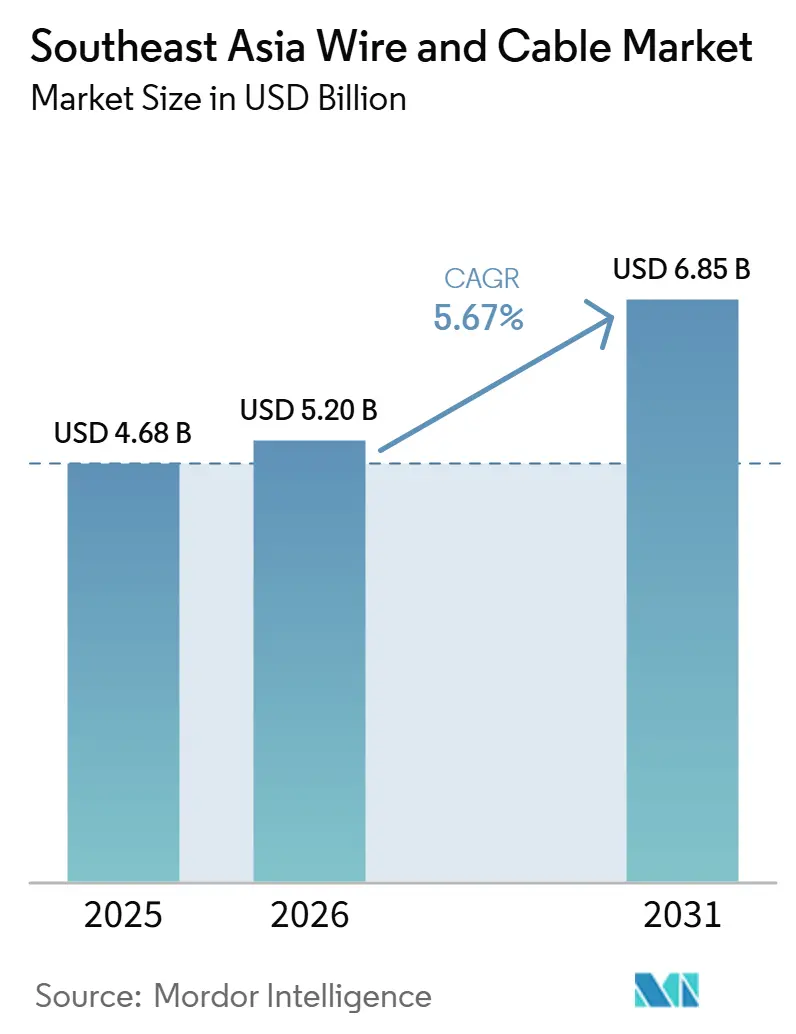
The Southeast Asia wire and cable market size was valued at USD 4.68 billion in 2025 and is estimated to grow from USD 5.20 billion in 2026 to reach USD 6.85 billion by 2031, at a CAGR of 5.67% during the forecast period (2026-2031). Regional cable consumption was forecast to reach 1.083 million tonnes of conductor equivalents in 2026, equal to 5% of global demand, as electrification and grid projects increased demand. The Southeast Asia wire and cable market is supported by urban and peri-urban electrification, the ASEAN Power Grid, and data center construction. These forces require more than fiber connections because large facilities also need medium- and high-voltage power links. Indonesia remains the largest country market, while Vietnam is positioned for faster expansion through grid, manufacturing, and digital infrastructure activity. Competition is strongest in high-voltage and submarine projects, where global suppliers compete with established local manufacturers in the distribution cable supply.
Key Report Takeaways
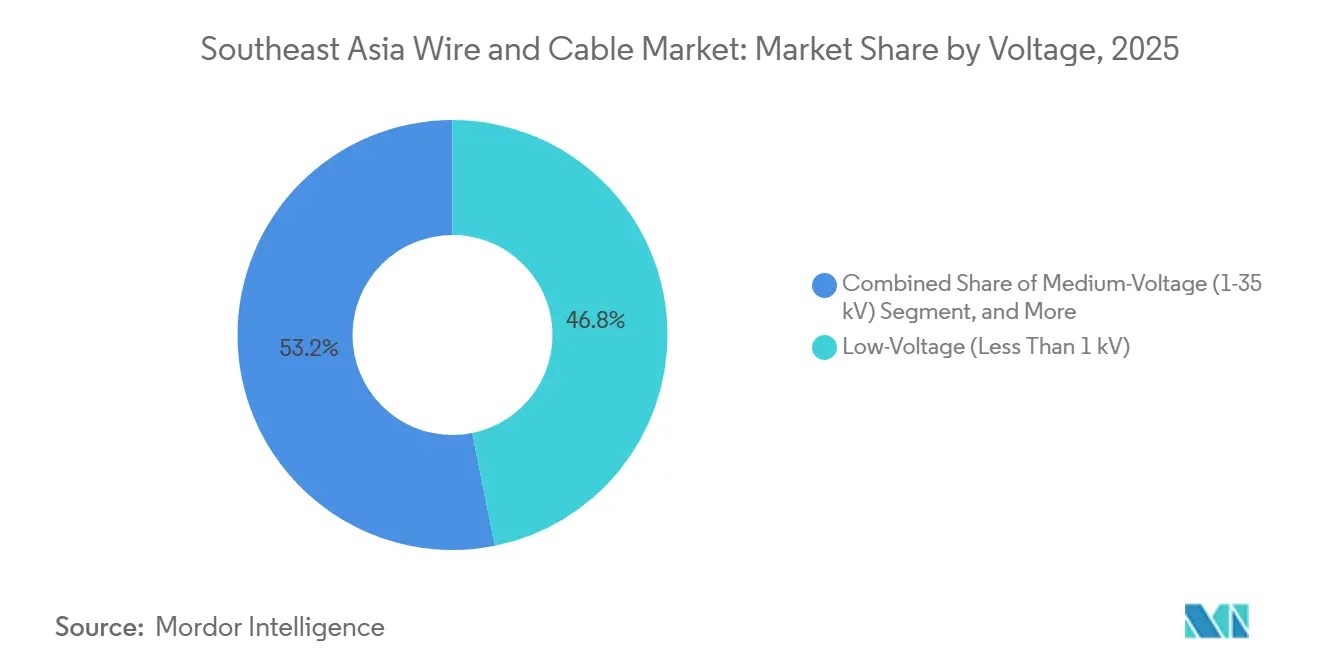
- By voltage, low-voltage (below 1 kV) cables held 46.84% of revenue share in the Southeast Asia wire and cable market in 2025, while extra- and high-voltage (above 35 kV) cables are projected to expand at a 7.06% CAGR through 2031.
- By cable type, power cables accounted for 68.76% of revenue share in the Southeast Asia wire and cable market in 2025, while fiber-optic cables are projected to expand at a 7.48% CAGR through 2031.
- By conductor material, copper held 57.18% of revenue share in the Southeast Asia wire and cable market in 2025, while optical glass/polymer is projected to expand at a 7.62% CAGR through 2031.
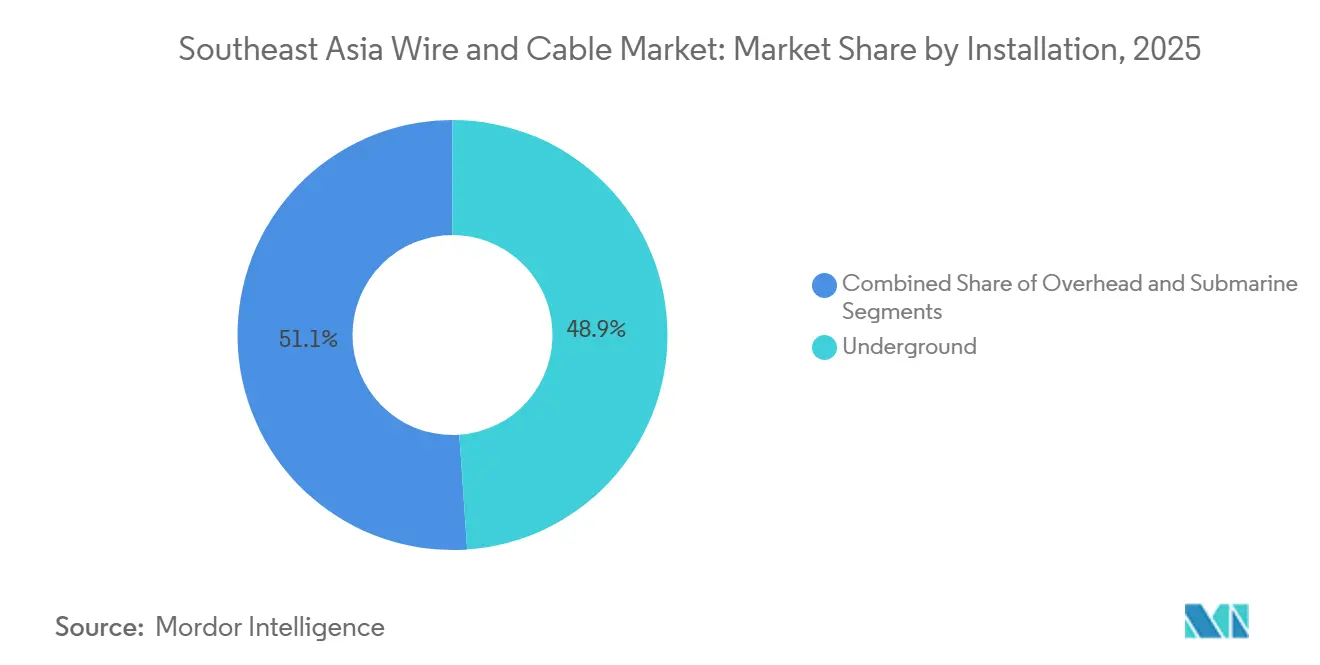
- By installation, underground cables held 48.91% of revenue share in the Southeast Asia wire and cable market in 2025 and are projected to expand at a 6.63% CAGR through 2031.
- By end-user vertical, power infrastructure (utilities and renewables) held 24.82% of revenue share in the Southeast Asia wire and cable market in 2025, while telecommunications and data centers are projected to expand at a 7.84% CAGR through 2031.
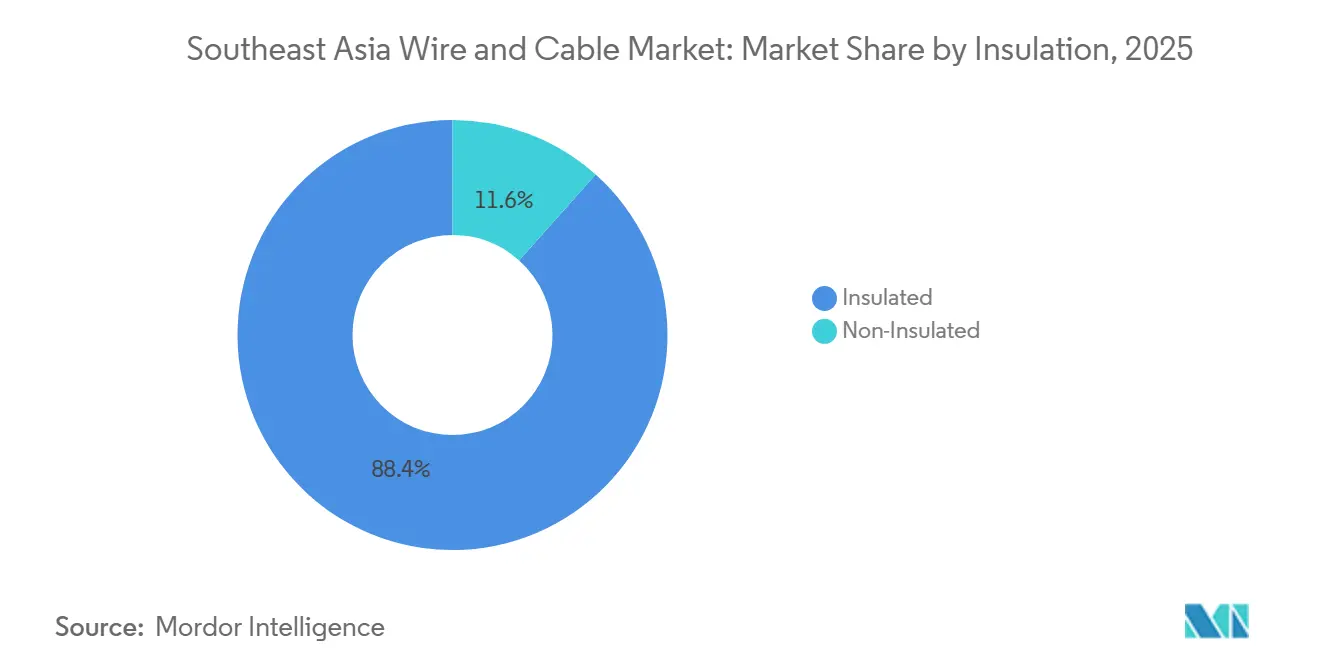
- By insulation, insulated cables held 88.40% of revenue share in the Southeast Asia wire and cable market in 2025 and are projected to expand at a 5.86% CAGR through 2031.
- By country, Indonesia held 31.86% of the revenue share in the Southeast Asia wire and cable market in 2025, while Vietnam is projected to expand at a 6.54% CAGR through 2031.
Note: Market size and forecast figures in this report are generated using Mordor Intelligence’s proprietary estimation framework, updated with the latest available data and insights as of January 2026.
Southeast Asia Wire and Cable Market Trends and Insights
Drivers Impact Analysis*
| Driver | (~) % Impact on CAGR Forecast | Geographic Relevance | Impact Timeline |
|---|---|---|---|
| ASEAN Power Grid Interconnector Build-Out | +1.8% | ASEAN-wide, concentrated in Indonesia, Vietnam, Malaysia, and Singapore | Medium term (2-4 years) |
| Data Center and Cloud Infrastructure Expansion | +1.5% | Singapore, Indonesia, Malaysia, Thailand, Vietnam | Short term (≤ 2 years) |
| Renewable Energy Integration and Grid Modernization | +1.3% | Indonesia, Vietnam, Thailand, with spillover to Malaysia | Medium term (2-4 years) |
| Urban Undergrounding and Climate-Resilient Network Construction | +1.0% | Indonesia, Vietnam, Thailand, with spillover to Malaysia and the Philippines | Medium term (2-4 years) |
| Manufacturing Relocation and Industrial Automation | +0.8% | Vietnam, Thailand, Malaysia, Indonesia | Short term (≤ 2 years) |
| Fiber-Optic Expansion for 5G and Cross-Border Connectivity | +0.6% | Indonesia, Vietnam, Thailand, with spillover to the Philippines and Malaysia | Short term (≤ 2 years) |
| Source: Mordor Intelligence | |||
ASEAN Power Grid Interconnector Build-Out
The ASEAN Power Grid Financing Initiative was launched in October 2025 by the Asian Development Bank, the World Bank, the ASEAN Secretariat, and the ASEAN Center for Energy. It brought together more than USD 12.5 billion in committed financing, including USD 10 billion from the Asian Development Bank over 10 years and USD 2.5 billion from the World Bank.[1]Asian Development Bank, “ADB and World Bank Back ASEAN Power Grid Financing Initiative,” Asian Development Bank, seads.adb.org The ASEAN Interconnection Masterplan Study III identified USD 764 billion in transmission and generation investment needed for a high-renewables grid by 2045. The International Energy Agency identified USD 27 billion in cross-border interconnection spending in its base case between 2025 and 2040. In 2025, ASEAN energy ministers identified subsea cables as a key building block for the regional grid. Individual high-voltage direct current (HVDC) subsea projects can exceed USD 1 billion and provide demand for the Southeast Asia wire and cable market.
Data Center and Cloud Infrastructure Expansion
Data center construction increases demand for power and optical cable systems across the Southeast Asia wire and cable market. AI-optimized facilities operate at 10-20 kW per rack, compared with 3-5 kW for legacy computing facilities. This higher power density increases the need for medium- and high-voltage cables within each data hall and at the grid connection. Digital Edge announced a USD 4.5 billion investment for a 500 MW AI-ready campus in Bekasi, Indonesia, in January 2026.[2]Digital Edge, “Digital Edge Invests USD 4.5B in Indonesia Campus,” Digital Edge, digitaledgedc.com AirTrunk announced MYR 12 billion (USD 2.7 billion) for 2 campuses in Johor Bahru.[3]AirTrunk, “AirTrunk Doubles Down in Malaysia with Two New Hyperscale Campuses in Johor Bahru,” AirTrunk, airtrunk.com Hyperscale operators also use 10-15-year power purchase agreements, which support phased site development and later cable upgrades.
Renewable Energy Integration and Grid Modernization
PT PLN’s 2025-2034 Electricity Supply Business Plan included 47,758 circuit-kilometers of new transmission lines and USD 24.0 billion to USD 34.48 billion in transmission investment. By March 2026, 353 of PLN’s 547 priority projects had entered procurement, 156 were under construction, and 64 were commissioned and operational. Solar and wind resources are often located far from large industrial centers, increasing the need for transmission links. Malaysia’s Tenaga Nasional Berhad raised its renewable energy investment plan to USD 9.8 billion under the National Energy Transition Roadmap. Clean energy investment in Southeast Asia exceeded USD 100 billion in 2025, and regional renewable capacity reached 120 GW in 2024. The International Energy Agency projected that capacity would nearly triple by 2035 under current policy settings.
Urban Undergrounding and Climate-Resilient Network Construction
Storm assessments in Vietnam and the Philippines found that underground networks returned to service 2-3 times faster than comparable overhead systems. This performance is shaping network investment decisions in coastal areas exposed to typhoons. Indonesia’s 2025-2034 plan included smart-grid deployment for 2026-2027 and identified the Jakarta Loop 500 kV project for underground installation. The Institute for Energy Economics and Financial Analysis reported that Indonesian transmission spending had averaged USD 1.4 billion annually since 2019, against an annual RUPTL requirement of USD 2.4 billion. Vietnam’s power demand was projected to grow by 10-12% annually through 2030. Taihan Cable Vina broke ground on a 400 kV cable plant in Vietnam in March 2026, adding regional production capability.
Restraints Impact Analysis*
| Restraint | (~) % Impact on CAGR Forecast | Geographic Relevance | Impact Timeline |
|---|---|---|---|
| Copper and Aluminum Price Volatility | -0.8% | Global, acutely felt in import-dependent Vietnam, Thailand, and Indonesia | Short term (≤ 2 years) |
| High Capital Requirements for Submarine and Extra-High-Voltage Projects | -0.5% | Indonesia, Singapore, Malaysia, and ASEAN-wide cross-border links | Long term (≥ 4 years) |
| Fragmented National Standards and Permitting Processes | -0.3% | ASEAN-wide, most acute in Indonesia and the Philippines | Medium term (2-4 years) |
| Counterfeit and Non-Compliant Cable Products | -0.2% | Indonesia, Vietnam, Thailand, with spillover to the Philippines | Medium term (2-4 years) |
| Source: Mordor Intelligence | |||
Copper and Aluminum Price Volatility
London Metal Exchange copper reached a record intraday price of USD 14,527.50 per tonne in January 2026. The copper-to-aluminum price ratio reached 4.3, exceeding the 3.5-4.0 range where cable buyers consider material substitution. Copper can account for 70-85% of cable production cost, exposing manufacturers to sharp changes in input costs. High metal prices create uncertainty for distribution network contracts and can delay final investment decisions. They can also lead developers to re-tender projects when quoted cable prices no longer fit project budgets. Reuters reported that Nexans expected global grid investment of EUR 10 trillion (USD 11.3 trillion) by 2030. Long-term grid investment, therefore, remains supportive, even as near-term pricing disruptions disrupt procurement.
High Capital Requirements for Submarine and Extra-High-Voltage Projects
ASEAN Power Grid submarine HVDC projects are expected to exceed USD 1 billion each. Their preparation period can extend 5-8 years from permitting to first power delivery. Financing constraints delay cable procurement packages that depend on major transmission projects. IEEFA found that PLN’s realized annual transmission spending averaged USD 1.4 billion since 2019, compared with an annual RUPTL requirement of USD 2.4 billion. Specialist cable-laying vessels and expertise in extra-high-voltage termination are limited to fewer than 10 qualified suppliers. IEC type-testing requirements for cables above 150 kV can add 12-24 months to procurement schedules.
*Our forecasts treat driver/restraint impacts as directional, not additive. The impact forecasts reflect baseline growth, mix effects, and variable interactions.
Segment Analysis
By Voltage: Low-Voltage Cables Lead While High-Voltage Capacity Expands
Low-voltage cables, below 1 kV, captured 46.84% of regional revenue in 2025. Residential wiring, commercial construction, and industrial park electrification supported this position in Indonesia, Vietnam, and the Philippines. These applications create recurring volume demand because they are used across buildings and manufacturing sites. Housing completions and industrial-zone construction, therefore, remain important for the segment. Medium-voltage cables, ranging from 1 to 35 kV, are used for distribution grid extensions and solar photovoltaic connections. They also support utility smart-grid programs in Thailand and Malaysia. Demand in these markets is linked to renewable capacity additions and distribution upgrades. Low-voltage products remain central to broad construction activity across the region.
Extra- and high-voltage cables, above 35 kV, are projected to expand at a 7.06% CAGR from 2026 to 2031. This is the fastest growth rate within the voltage categories. Indonesia’s 47,758 circuit-kilometer green supergrid program supports demand for these systems. Vietnam’s 400 kV expansion under the National Power Development Plan 8 also requires increased capacity for higher-voltage cables. ASEAN cross-border interconnection projects add another source of demand. Taihan Cable Vina began construction of Vietnam’s first 400 kV-class extra-high-voltage cable plant in March 2026. The plant is expected to reduce reliance on imported supplies for domestic projects. Regional production could also shorten lead times for future project awards.



By Cable Type: Power Cables Lead While Fiber-Optic Demand Increases
Power cables accounted for 68.76% of the Southeast Asia wire and cable market size in 2025. They are required across low-voltage building distribution and high-voltage bulk transmission. This broad application base supports their leading revenue position. Every major end-user group in the regional cable supply chain uses Power cables. This makes the category essential to the Southeast Asia wire and cable market. Coaxial and data cables serve commercial connectivity, cable television, and legacy corporate networks. Their growth is more limited where fiber replaces copper-based links in high-bandwidth applications. Signal and control cables support industrial automation, oil and gas facilities, and building management systems. Manufacturing development in Thailand’s Eastern Economic Corridor and Indonesia’s Special Economic Zones supports demand for these products.
Fiber-optic cables are projected to expand at a 7.48% CAGR from 2026 to 2031. Data center interconnects, 5G fronthaul, 5G backhaul, and submarine digital links support expansion across the Southeast Asia wire and cable market. The Nongsa-Changi subsea cable was landed in Batam in July 2026. It spans 50 km and has 24 fiber pairs. It was the first cable system to land at Nongsa Digital Park. The project strengthened Indonesia-Singapore connectivity ahead of the planned ASEAN Digital Economy Framework. Vietnam and the Philippines also recorded higher cable consumption alongside large digital infrastructure programs.
By Conductor Material: Copper Leads While Optical Glass/Polymer Grows Fastest
Copper held 57.18% of revenue in 2025 and led the conductor material categories. It remains the principal conductor for power cables, building wiring, and extra-high-voltage applications. Its conductivity and compact form support use in demanding technical performance applications. Copper is therefore important across transmission, distribution, and building systems. Aluminum is increasingly used in overhead distribution lines and selected underground feeder cables. Utilities use it where the cost per kilometer is a key specification factor. The January 2026 copper-to-aluminum ratio of 4.3 encouraged design-stage reviews of aluminum alternatives. Material choice now has a larger role in cable procurement decisions.
Optical glass/polymer is projected to expand at a 7.62% CAGR from 2026 to 2031. This is the fastest rate among conductor materials. Demand comes from 5G backhaul, data center links, and cross-border submarine digital infrastructure. Indonesia’s National Digital Connectivity Strategy and Vietnam’s Digital Infrastructure Strategy support the broad deployment of high-speed broadband. Prysmian introduced a regional power cable design with lower copper content and a smaller diameter. The design was intended to deliver equivalent power performance with less raw material exposure. Such product development affects material selection within the Southeast Asia wire and cable market.
By Installation: Underground Cables Form the Main Installation Base
Underground cables accounted for 48.91% of revenue in 2025 and led the installation categories, and are projected to expand at a CAGR of 6.63% through 2031. Dense urban corridors in Greater Jakarta, Ho Chi Minh City, and Bangkok limit the use of new overhead routes. Storm exposure also encourages utilities to consider undergrounding for existing medium-voltage feeders. Underground systems are particularly relevant where land access and urban safety requirements are strict. Overhead cables continue to serve rural electrification and outer-island connections. Their lower installation cost supports use where underground systems exceed available budgets. PLN’s 2025-2034 plan included both overhead and underground installations across Indonesia. Both approaches remain necessary across the Southeast Asia wire and cable market.
Submarine cables are the highest-value installation category, with individual contracts regularly exceeding USD 1 billion. Taihan Cable received a KRW 110 billion contract (USD 78.6 million) from SP PowerAssets. The contract covered a 400 kV underground transmission system in Singapore for the Indonesia-Singapore renewable energy corridor. The 600 MW Monsoon Wind Power Project between Laos and Vietnam entered operation in 2025. Its underground cable infrastructure showed that cross-border installations were moving from planning into operation. These installations require specialized engineering, long procurement cycles, and tested high-voltage systems.
By End-User Vertical: Power Infrastructure Leads While Data Centers Expand Fastest
Power infrastructure, including utilities and renewables, accounted for 24.82% of revenue in 2025. PLN’s RUPTL program, Vietnam’s National Power Development Plan 8, and Malaysia’s renewable expansion supported this leading position. The segment requires cables for generation connections, transmission routes, and distribution networks. Its demand is tied to large public and utility investment programs across the Southeast Asia wire and cable market. Residential and commercial construction also uses large volumes of low-voltage cable. Housing pipelines in Vietnam and Indonesia provide a continuing baseline demand. Oil and gas and petrochemical facilities add stable replacement demand in Indonesia and Malaysia. Their cable requirements are concentrated in offshore and onshore processing assets.
Telecommunications and data centers are projected to expand at a 7.84% CAGR from 2026 to 2031. AI infrastructure investment supports the Southeast Asia wire and cable market across all 6 countries covered in the study. Data centers use medium- and high-voltage cables for electrification, grid connections, and backup power systems. They also need high-fiber-count optical cables. Industrial manufacturing requires more control and power cables as automated production lines are installed. Thailand’s Thailand 4.0 strategy and Indonesia’s Making Indonesia 4.0 policy support greenfield factory construction. Automotive and mobility is an emerging demand area, led by electric vehicle battery and assembly plants in Thailand and Indonesia. These facilities require high-flex automotive wiring systems.
By Insulation: Insulated Cables Remain the Core Product Category
Insulated cables held 88.40% of regional revenue in 2025. This leading position reflects safety, thermal, and electrical performance needs across commercial, industrial, and utility applications. Cross-linked polyethylene, XLPE, is widely used for medium- and high-voltage power cables. It provides dielectric strength and thermal resistance under sustained operating temperatures. Vietnam’s National Power Development Plan 8 procurement and Indonesia’s RUPTL transmission projects commonly specify XLPE. This use supports the category’s broad presence in major grid programs. Insulated products also serve the large base of building, industrial, and distribution cable demand.
Insulated cables are projected to expand at a 5.86% CAGR from 2026 to 2031. This rate broadly follows the Southeast Asia wire and cable market outlook. Non-insulated cables remain important for bare aluminum overhead transmission conductors and grounding assemblies. These applications are used in long-span high-voltage corridors where insulation adds weight and cost. Low-smoke, zero-halogen (LSZH) cables are moving from premium applications toward standard procurement in Vietnamese and Singaporean data centers. They are also used in critical infrastructure tunnels. This creates a higher-value tier within insulated cables. Competition is therefore increasingly focused on insulation materials and performance characteristics.
Geography Analysis
Indonesia held 31.86% of the Southeast Asia wire and cable market share in 2025 and was the region’s largest national market. PLN’s 2025-2034 plan included 47,758 circuit-kilometers of new transmission lines and USD 24.0 billion to USD 34.48 billion in transmission investment. By March 2026, 353 of 547 priority projects had entered procurement, and 156 were under construction. Digital Edge committed USD 4.5 billion to its Bekasi campus, while STT GDC received IDR 8.8 trillion (USD 500 million) in financing for its Jakarta expansion. The USD 1 billion annual transmission spending gap identified by IEEFA could delay procurement unless financing improves.
Vietnam is projected to expand at a 6.54% CAGR through 2031, the fastest country rate in the Southeast Asia wire and cable market. Electrical wire and cable exports reached USD 3.6 billion in 2024. The National Power Development Plan 8 targets 56 GW of wind and solar capacity by 2030, requiring generation connections and reinforcement of 400 kV transmission. Viettel broke ground on a 140 MW hyperscale campus in Ho Chi Minh City in April 2025 and planned to reach up to 560 MW by 2030. Thailand and Malaysia provide steady, medium-voltage and industrial demand driven by manufacturing, electric vehicle, and data center activity.
Singapore is a premium procurement and engineering center for submarine power and optical cable systems. Its Energy Market Authority is developing a framework to import 6 GW of low-carbon electricity by 2035 via subsea cables. Keppel secured commitments for all 5 fiber pairs in the Bifrost system, extending more than 20,000 km, at an estimated SGD 1.7 billion (USD 1.27 billion). The rest of Southeast Asia includes the Philippines and smaller ASEAN economies, where inter-island links, rural electrification, and grid extension provide baseline demand.
Competitive Landscape
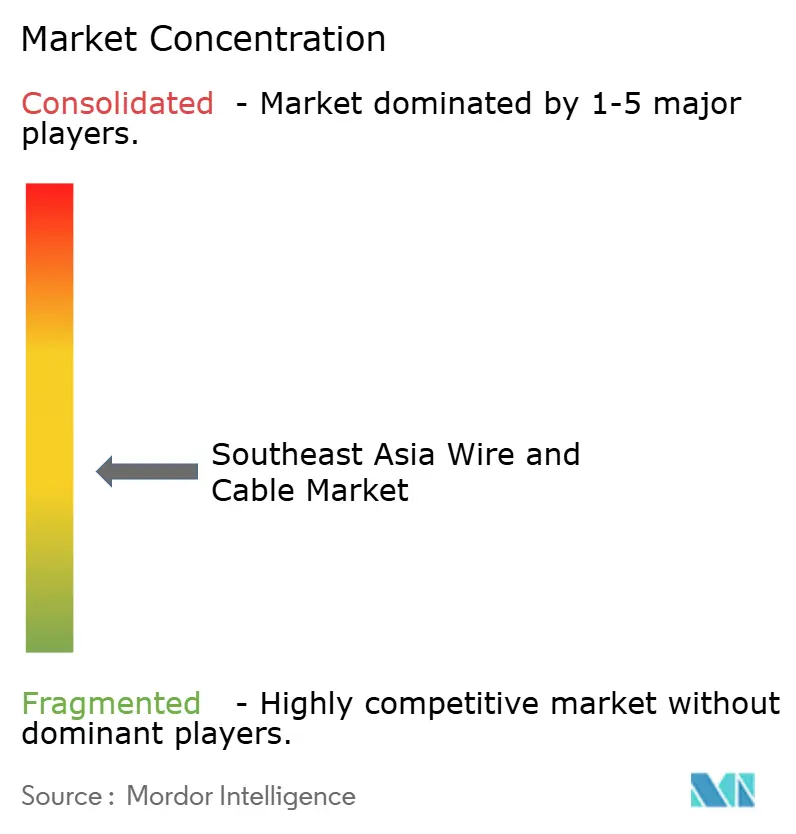
The Southeast Asia wire and cable market is moderately fragmented, with global, Japanese, Korean, and Chinese suppliers competing for high-voltage and submarine contracts. Domestic producers retain established positions in low- and medium-voltage distribution supply. Prysmian reported organic growth and margin expansion in the first quarter of 2026, and introduced a regional cable design that uses less copper and a smaller diameter. Prysmian also advanced a front-end engineering design study for the planned 1 GW Sarawak-Singapore power interconnector. This approach focuses competition on technical capability and installed cost.
LS Cable and System’s LS Eco Energy used its Hai Phong base to serve exports and aimed to reach USD 1 billion in annual revenue by 2030. PTSC and LS Eco Energy signed a joint development agreement in August 2025 for a high-voltage underground cable plant in Vietnam. Taihan Cable signed a memorandum of understanding with Newtecon in April 2026 to pursue Vietnamese energy infrastructure projects. These partnerships combine overseas cable capability with local project access. They also build manufacturing and delivery capacity close to large grid investments.
Hengtong Group and ZTT Group compete through pricing in standard power and fiber-optic cable categories. Fewer than 10 global manufacturers hold type-test certification for cables above 320 kV DC, limiting the number of qualified bidders for complex submarine projects. Smaller regional companies can compete in data center and smart-grid supply chains through fiber-optic products and advanced insulation compounds. No combined share for leading companies was provided, so a concentration score cannot be assigned under the required market-share method.
Southeast Asia Wire and Cable Industry Leaders
Prysmian S.p.A.
Nexans S.A.
PT KMI Wire and Cable Tbk
PT Voksel Electric Tbk
PT Jembo Cable Company Tbk
- *Disclaimer: Major Players sorted in no particular order

Recent Industry Developments
- July 2026: Southern Cable Group Bhd secured a MYR 404 million (USD 90.6 million), one-year extension of its long-term supply contract with Tenaga Nasional Bhd for low- and medium-voltage underground cables and conductors, running through August 2027, with an option to increase value by up to 30%. The award reflected TNB’s accelerating procurement of underground cables under the National Energy Transition Roadmap.
- July 2026: The Nongsa-Changi, NCC, subsea cable, co-developed by Telin and BW Digital, was landed at Nongsa Digital Park in Batam, Indonesia. It spans 50 km, comprises 24 fiber pairs, and was the first cable system to land at the park.
- March 2026: Taihan Cable Vina broke ground on a 400 kV extra-high-voltage cable plant in Dong Nai Province, Vietnam, with KRW 75 billion (USD 50.6 million) investment. Completion was expected in 2027, and the facility was expected to be Vietnam’s only plant capable of manufacturing 400 kV-class cables.


Southeast Asia Wire and Cable Market Report Scope
The Southeast Asia wire and cable market revenue is generated through the sale of low-, medium-, and high-voltage wires and cables, including power, fiber-optic, signal and control, and coaxial/data cables with copper, aluminum, or optical glass/polymer conductors, along with associated value-added products and installation-specific solutions for overhead, underground, and submarine network deployments.
The Southeast Asia wire and cable market report is segmented by voltage (extra- and high-voltage (greater than 35 kV), medium-voltage (1-35 kV), and low-voltage (less than 1 kV)), cable type (power cable, fiber-optic cable, signal and control cable, and coaxial and data cable), conductor material (copper, aluminum, and optical glass/polymer), installation (overhead, underground, and submarine), end-user vertical (residential construction, commercial construction, power infrastructure (utilities and renewables), telecommunications and data centers, oil and gas and petrochemicals, automotive and mobility, and industrial manufacturing), insulation (insulated and non-insulated), and country (Indonesia, Vietnam, Thailand, Malaysia, Singapore, and the rest of Southeast Asia). The market forecasts are provided in terms of value (USD).
| Extra- and High-Voltage (Greater Than 35 kV) |
| Medium-Voltage (1-35 kV) |
| Low-Voltage (Less Than 1 kV) |
| Power Cable |
| Fiber-Optic Cable |
| Signal and Control Cable |
| Coaxial and Data Cable |
| Copper |
| Aluminum |
| Optical Glass/Polymer |
| Overhead |
| Underground |
| Submarine |
| Residential Construction |
| Commercial Construction |
| Power Infrastructure (Utilities and Renewables) |
| Telecommunications and Data Centers |
| Oil and Gas and Petrochemicals |
| Automotive and Mobility |
| Industrial Manufacturing |
| Insulated |
| Non-Insulated |
| Indonesia |
| Vietnam |
| Thailand |
| Malaysia |
| Singapore |
| Rest of Southeast Asia |
| By Voltage | Extra- and High-Voltage (Greater Than 35 kV) |
| Medium-Voltage (1-35 kV) | |
| Low-Voltage (Less Than 1 kV) | |
| By Cable Type | Power Cable |
| Fiber-Optic Cable | |
| Signal and Control Cable | |
| Coaxial and Data Cable | |
| By Conductor Material | Copper |
| Aluminum | |
| Optical Glass/Polymer | |
| By Installation | Overhead |
| Underground | |
| Submarine | |
| By End-User Vertical | Residential Construction |
| Commercial Construction | |
| Power Infrastructure (Utilities and Renewables) | |
| Telecommunications and Data Centers | |
| Oil and Gas and Petrochemicals | |
| Automotive and Mobility | |
| Industrial Manufacturing | |
| By Insulation | Insulated |
| Non-Insulated | |
| By Country | Indonesia |
| Vietnam | |
| Thailand | |
| Malaysia | |
| Singapore | |
| Rest of Southeast Asia |


Key Questions Answered in the Report
What is the Southeast Asia wire and cable market size?
The Southeast Asia wire and cable market was valued at USD 4.68 billion in 2025, was estimated at USD 5.20 billion in 2026, and is forecast to reach USD 6.85 billion by 2031.
What growth rate is expected through 2031?
The regional cable sector is projected to grow at a 5.67% CAGR from 2026 to 2031.
Which voltage class held the largest revenue share?
Low-voltage cables held 46.84% of regional revenue in 2025, supported by construction and industrial electrification.
Which cable category is expected to grow fastest?
Fiber-optic cables are projected to expand at a 7.48% CAGR through 2031, supported by data centers, 5G, and subsea connectivity.
Which country leads regional demand?
Indonesia held 31.86% of regional revenue in 2025, supported by transmission development and large digital infrastructure projects.
Why are data centers important for regional cable demand?
AI-ready campuses require power cables for grid connections and backup systems, in addition to high-fiber-count optical cables.
Page last updated on:





