
Southeast Asia Commercial Wine Cooler Market Size and Share
Market Overview
| Study Period | 2021 - 2032 |
|---|---|
| Forecast Data Period | 2027 - 2032 |
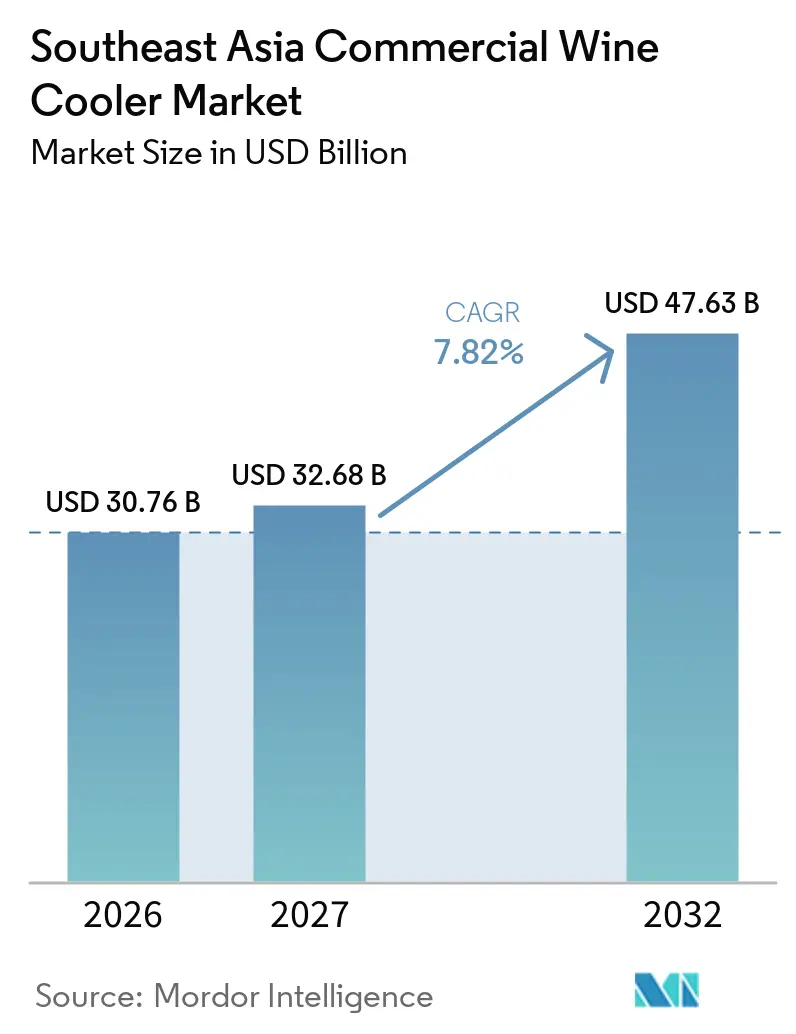
| Base Year Market Size (2026) | USD 30.76 Billion |
| Market Size (2027) | USD 32.68 Billion |
| Market Size (2032) | USD 47.63 Billion |
| Growth Rate (2027 - 2032) | 7.82 % |
| Market Concentration | Low |
Major Players *Disclaimer: Major Players sorted in no particular order Image © Mordor Intelligence. Reuse requires attribution under CC BY 4.0. | |
Southeast Asia Commercial Wine Cooler Market Analysis by Mordor Intelligence
The Southeast Asia commercial wine cooler market was USD 30.76 million in 2026 and is estimated to grow from USD 32.68 million in 2027 to reach USD 47.63 million by 2032, at a CAGR of 7.82% during the forecast period from 2027 to 2032. The Southeast Asia commercial wine cooler market is supported by premium wine service in restaurants, hotels, and specialist venues, where product display and stable storage conditions influence equipment selection. Australian wine exports to Southeast Asia reached USD 251 million in the 12 months ended September 2025, while export value per liter was USD 12.37 against a global average of USD 9.37, supporting the case for higher-value wine programs in the region[1]. Commercial buyers are also moving toward equipment that meets energy and refrigerant requirements, particularly in Singapore, Malaysia, and Vietnam. The Southeast Asia commercial wine cooler market therefore has room for suppliers that combine tropical-climate performance, compliant refrigerants, and dependable local servicing. Imports, installation costs, and wine’s smaller role in some national alcohol categories continue to limit adoption outside premium hospitality settings.
Key Report Takeaways
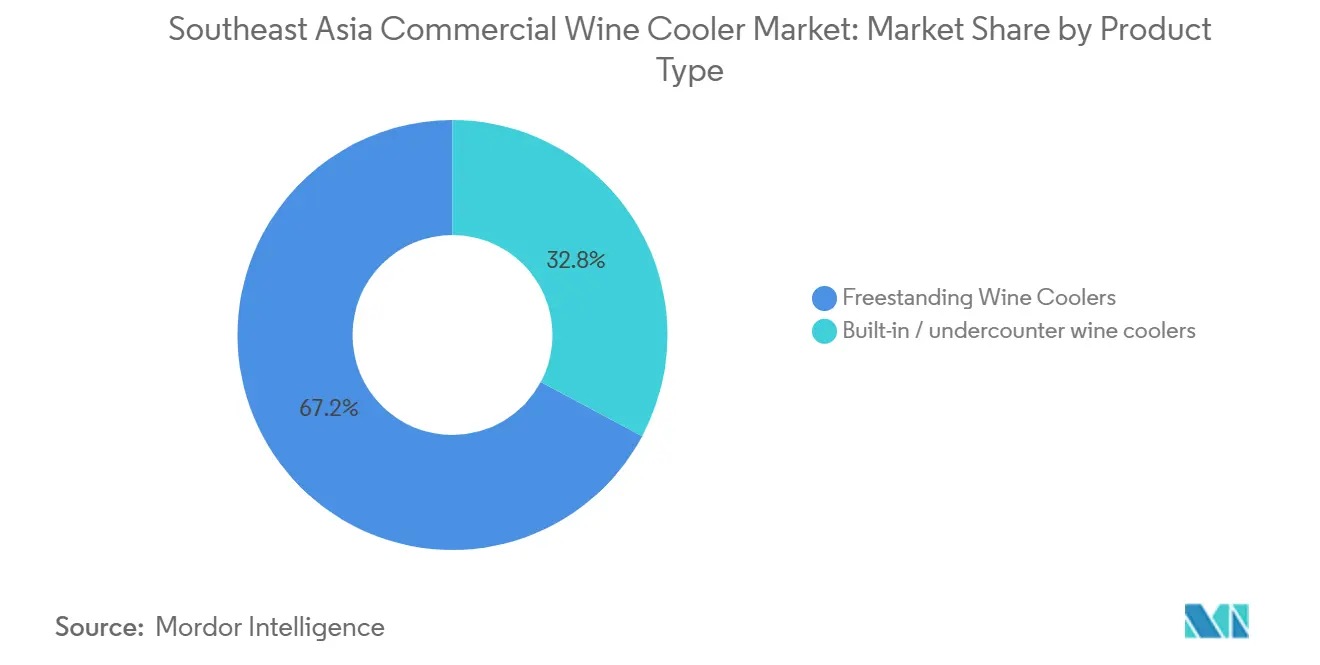
- By product type, freestanding wine coolers held 67.25% of the Southeast Asia commercial wine cooler market share in 2026, while built-in and undercounter models are projected to register the highest CAGR of 8.32% between 2027-2032.
- By capacity, up to 50-bottle units held 31.28% of the Southeast Asia commercial wine cooler market share in 2026, while above-200-bottle units are projected to record the highest CAGR of 8.71% between 2027-2032.
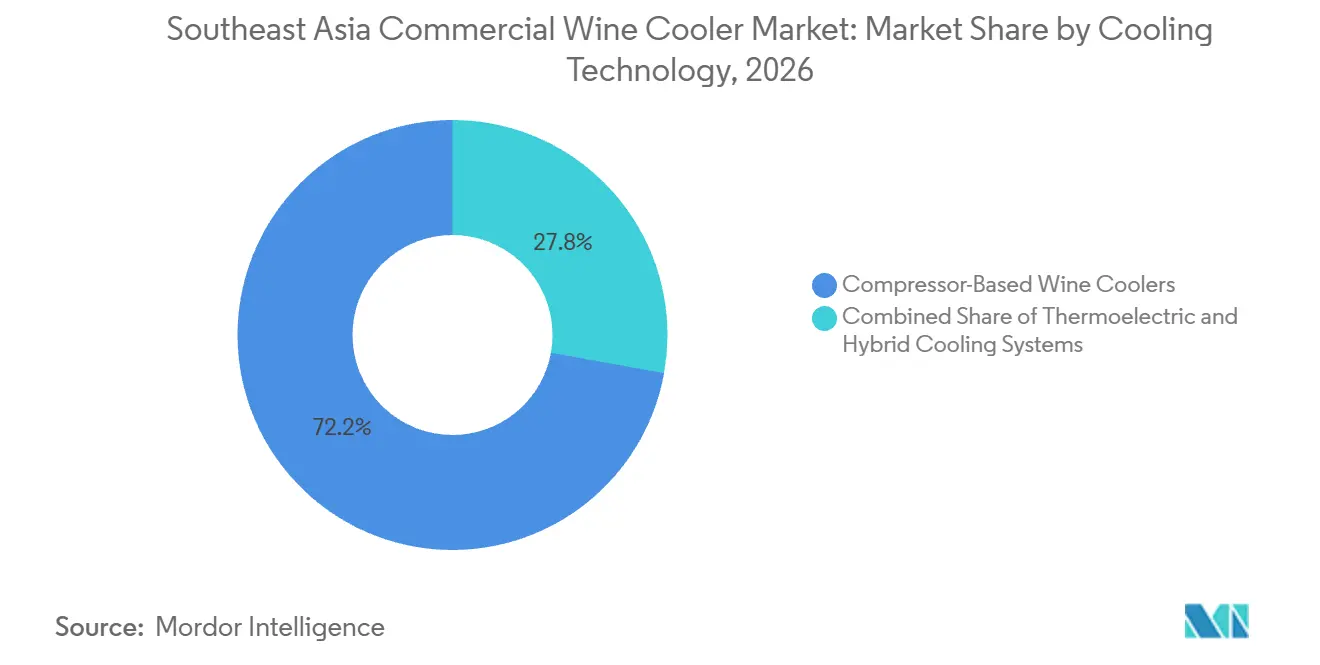
- By cooling technology, compressor-based wine coolers held 72.16% of the Southeast Asia commercial wine cooler market share in 2026, while hybrid systems are projected to register the highest CAGR of 8.65% between 2027-2032.
- By price range, mid-range units held 48.22% of the Southeast Asia commercial wine cooler market share in 2026, while premium units are projected to record the highest CAGR of 8.26% between 2027-2032.
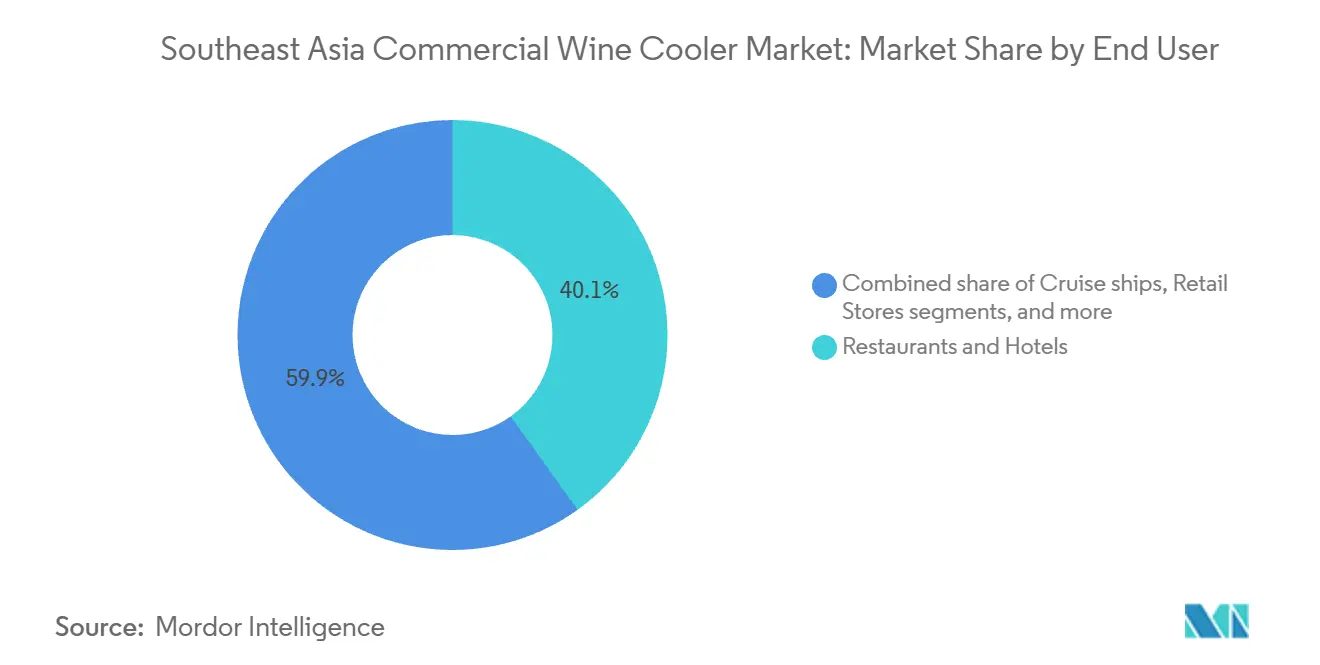
- By end user, restaurants and hotels held 40.11% of the Southeast Asia commercial wine cooler market share in 2026, while wineries and tasting rooms are projected to register the highest CAGR of 9.06% between 2027-2032.
- By distribution channel, dealers and distributors held 76.23% of the Southeast Asia commercial wine cooler market share in 2026, while direct sales are projected to record the highest CAGR of 8.44% between 2027-2032.
- By geography, Singapore held 24.66% of the Southeast Asia commercial wine cooler market share in 2026, while Vietnam is projected to register the highest CAGR of 9.35% between 2027-2032.
Note: Market numbers in this report are based on Mordor Intelligence's proprietary estimation framework, which combines nine months of actuals with Q4 projections for base year 2026.
Market Trends and Insights
Drivers Impact Analysis of Southeast Asia Commercial Wine Cooler Market*
| Driver | (~) % Impact on CAGR Forecast | Geographic Relevance | Impact Timeline |
|---|---|---|---|
| Premiumization of Wine and On-Trade Dining | +2.00% | Singapore, Thailand, Malaysia, urban Vietnam | Short term (≤ 2 years) |
| Tourism and Hospitality Recovery | +1.50% | Vietnam, Thailand, Indonesia, Philippines | Short term (≤ 2 years) |
| Growth of Premium Residential Interiors and Luxury Housing | +1.00% | Singapore, Thailand, Vietnam, Malaysia | Medium term (2-4 years) |
| Smart, Energy-Efficient, and Low-GWP Refrigeration Retrofits | +0.70% | Singapore, Malaysia, Vietnam | Medium term (2-4 years) |
| Tropical-Climate Wine Preservation Gap | +0.90% | All Southeast Asian markets | Long term (≥ 4 years) |
| Dual-Purpose Aging and Display Requirements in Glass-Front Venues | +0.50% | Singapore, Bangkok, Ho Chi Minh City | Medium term (2-4 years) |
| Source: Mordor Intelligence | |||
Premiumization of Wine and On-Trade Dining
Thailand’s still wine volume grew 5.10% in 2025, while sparkling wine volume increased 11.80%, and on-trade sales represented 34.90% of alcohol consumption[2]. This shift favors venues that protect wine quality while displaying bottles at service temperature. Michelin added 36 restaurants to its Singapore guide in 2025, taking the guide to 288 establishments. These venues make a practical customer base for multi-zone commercial cabinets. Wine-by-the-glass programs also need tighter temperature management and preservation features. The Southeast Asia commercial wine cooler market benefits when venues use wine service to support premium food and beverage margins.
Tourism and Hospitality Recovery
ASEAN international arrivals had recovered to 92% of pre-crisis levels by the end of June 2025, while Vietnam and Laos had already exceeded their 2019 volumes[3]. Hotel projects in Vietnam’s coastal destinations can specify wine cooling equipment during their initial fit-out. This process creates demand before a hotel opens rather than only when it replaces equipment. Singapore and Thailand retain a large base of upscale hotels that can support replacement purchases. Resort dining, cruise activity, and hotel cellar programs also need larger cabinets that serve several outlets. The Southeast Asia commercial wine cooler market gains from this broader hospitality recovery because wine storage becomes part of the operating infrastructure.
Smart, Energy-Efficient, and Low-GWP Refrigeration Retrofits
From April 2025, Singapore extended its Minimum Energy Performance Standards and Mandatory Energy Labelling Scheme to commercial storage refrigerators. Units sold in Singapore must achieve an Energy Efficiency Index of 95 or below when tested under ISO 2204[4]. By November 2025, nine Southeast Asian countries had ratified the Kigali Amendment, supporting the move away from high-global-warming-potential refrigerants. Innovative designs using R290 or R600a can better align with emerging procurement requirements. In September 2025, the ASEAN Centre for Energy launched its Regional Product Registration System Database Platform to support regional appliance compliance information. These changes create a stronger case for replacement of older equipment.
Tropical-Climate Wine Preservation Gap
High ambient temperatures make passive storage unsuitable for commercial wine programs across Southeast Asia. Thermoelectric units can cool only 15°C to 20°C below ambient temperature, which limits their effectiveness in hot conditions. Compressor systems offer more stable performance when venues must maintain wine service temperatures through the day. Coastal properties also face humidity and salt-air exposure that can increase component wear. This favors cabinets with stronger seals, coated components, and local service support. The Southeast Asia commercial wine cooler market is consequently less exposed to generic equipment that is not engineered for tropical deployment.
Restraints Impact Analysis of Southeast Asia Commercial Wine Cooler Market*
| Restraint | (~) % Impact on CAGR Forecast | Geographic Relevance | Impact Timeline |
|---|---|---|---|
| High Equipment, Import, and Installation Cost | -0.80% | Philippines, Vietnam, Indonesia, Thailand | Short term (≤ 2 years) |
| Energy Consumption and Refrigerant-Compliance Burden | -0.50% | Singapore, Malaysia, Vietnam | Medium term (2-4 years) |
| Humidity, Salt-Air, and Serviceability Complexity | -0.40% | Coastal Philippines, Vietnam, Indonesia, Thailand | Long term (≥ 4 years) |
| Wine’s Low Category Share Versus Beer and Spirits | -0.60% | Vietnam, Indonesia, Philippines, non-urban Thailand | Long term (≥ 4 years) |
| Source: Mordor Intelligence | |||
High Equipment, Import, and Installation Cost
Premium and large-capacity cabinets carry material import, freight, installation, and tropicalization costs. This makes dedicated equipment harder to justify for independent venues outside major cities. Wine represented 1% of alcohol consumption in Vietnam, compared with 91% for beer, which constrains the capital case for specialized storage in many venues. Older premises in Bangkok and Ho Chi Minh City can also require electrical or HVAC work before built-in units are installed. Small restaurants may therefore defer purchases even when they want to expand wine service. The Southeast Asia commercial wine cooler market remains most accessible where hospitality operators can spread equipment costs across high-value beverage sales.
Energy Consumption and Refrigerant-Compliance Burden
Tropical conditions increase the energy needed to maintain cabinet temperatures. Singapore’s April 2025 requirements include model registration and periodic certification requirements under the Energy Conservation Act. These requirements can lengthen entry processes for smaller manufacturers. Vietnam’s National Cooling Action Plan targets a 10% reduction in HFC consumption between 2024 and 2028. Suppliers must therefore fund product redesign and refrigerant transition work. The Southeast Asia commercial wine cooler market may see a slower rollout of older product platforms as compliance requirements widen.
*Our forecasts treat driver/restraint impacts as directional, not additive. The impact forecasts reflect baseline growth, mix effects, and variable interactions.
Southeast Asia Commercial Wine Cooler Market Segment Analysis
By Product Type:
Built-In Formats Drive Upscale Venue DifferentiationFreestanding wine coolers held 67.25% of the Southeast Asia commercial wine cooler market share in 2026. Their flexible placement and lower installation needs suit restaurants, wine bars, and specialty stores with leased premises. Operators in Bangkok, Kuala Lumpur, and Manila can position these cabinets without altering fixed cabinetry. This helps venue owners control fit-out costs and retain layout flexibility. Freestanding units also support incremental purchases when beverage menus expand. They remain a practical option for operators that need consistent refrigeration without a full bar redesign.
Built-in and undercounter models are projected to grow at an 8.32% CAGR from 2027 to 2032. This part of the Southeast Asia commercial wine cooler market size is supported by hotel bars and design-focused restaurants seeking integrated installations. In September 2025, Liebherr expanded its undercounter range with the UWpri 3672, a fully integrated model with dual temperature zones, vibration-damped wooden shelves, and a handle-free door system. Such features address both wine preservation and visible bar design. New fine-dining venues and resort projects can specify this equipment during construction. The choice increasingly reflects a venue’s intended experience as well as its storage needs.
By Capacity:
Large-Format Units Accelerate as Cellar Programs ScaleUp to 50-bottle units held 31.28% of the Southeast Asia commercial wine cooler market share in 2026. These cabinets suit small and mid-size restaurants that want a focused wine list without extensive cellar management. Boutique wine bars and specialist retailers also use them where floor space is limited. Their capacity works for properties that replenish stock frequently through local distributors. The segment supports the enormous number of smaller foodservice venues in the region. It also gives operators a lower-commitment entry point for a wine program.
Above-200-bottle units are projected to grow at an 8.71% CAGR through 2032. Hotels, cruise operators, and integrated resorts require larger equipment as they coordinate inventory across several restaurants. Marina Bay Sands offers more than 5,000 wines through its restaurant network, illustrating the scale of storage needed by major hospitality groups. Mid-capacity formats remain useful for established casual dining and specialty retail. Coastal destinations in Vietnam are also specifying larger units earlier in the fit-out cycle. This pattern gives the Southeast Asia commercial wine cooler market a higher-value installation base in resort locations.
By Cooling Technology:
Compressor Dominance Anchored by Tropical Climate DemandsCompressor-based units accounted for 72.16% of the Southeast Asia commercial wine cooler market share in 2026. They are designed to maintain target temperatures even when external heat loads remain high. This is important in markets where ambient temperatures regularly exceed 30°C. Thermoelectric systems have limited cooling capacity in these conditions. Restaurants managing expensive bottles or wine-by-the-glass programs need dependable temperature control. Compressor performance is therefore a functional requirement for a large share of commercial users.
Hybrid systems are forecast to grow at an 8.65% CAGR through 2032. They combine compressor reliability with features intended to reduce vibration at the bottle interface. The approach appeals to operators who want stable cooling and more careful long-term storage. Thermoelectric-only units still have a place in climate-controlled tasting rooms and service areas. Inverter-driven compressors can reduce noise and energy use through variable-speed operation. This narrows the traditional acoustic advantage of thermoelectric equipment. The Southeast Asia commercial wine cooler industry is likely to favor technologies that balance operating reliability and product care.

By Price Range:
Premium Tier Gains Ground as Hospitality UpgradesMid-range units accounted for 48.22% of the Southeast Asia commercial wine cooler market share in 2026. They serve hotel food-and-beverage outlets, restaurant chains, and specialty retailers that need dependable cooling across multiple locations. Brands in this category compete on performance, capacity, and total ownership costs. Compressor-based operation and basic temperature control meet many everyday commercial needs. These units provide a middle path between low-cost cabinets and bespoke European models. Their broad role makes the segment central to regional volume demand.
Premium units are projected to grow at an 8.26% CAGR between 2027 and 2032. High-volume hotels, cruise operators, and fine-dining groups value multi-zone control, UV-protective glass, and design integration. Wine value growth in Asia is concentrated in premium and higher price tiers through 2027, which supports investment in better storage conditions. Economy units remain relevant where wine menus are still developing. Singapore’s energy standards can place more pressure on basic models that do not meet efficiency requirements. This supports a gradual move toward compliant mid-range and premium systems in the Southeast Asia commercial wine cooler market.
By End User:
Restaurants Lead, Winery Tasting Rooms Accelerate FastestRestaurants and hotels held 40.11% of the Southeast Asia commercial wine cooler market share in 2026. Wine consumption is concentrated in dining and accommodation settings, where customer experience depends on service quality. Thailand’s on-trade channel represented 34.90% of alcohol sales in 2025. Hotel operators need equipment for restaurants, lounges, private dining rooms, and events. Restaurant groups also use visible cabinets to support sales of wine by the bottle and glass. This makes foodservice the largest practical application base for commercial wine cooling.
Wineries and tasting rooms are forecast to grow at a 9.06% CAGR through 2032. Vietnam’s Da Lat region and Thailand’s Khao Yai corridor are developing consumer-facing wine experiences. These locations need equipment that stores, displays, and serves wine under controlled conditions. Specialist wine bars add another source of demand for multi-zone display cabinets. Vitis Wine Bar, which opened in Singapore in 2025, focuses its list on Asian winemakers and shows the need for visible, service-ready wine storage. Retailers, event venues, and airline lounges add smaller but recurring replacement demand. The Southeast Asia commercial wine cooler market benefits as these formats widen the number of commercial use cases.
By Distribution Channel:
Direct Sales Disrupts Distributor DominanceDealers and distributors held 76.23% of the Southeast Asia commercial wine cooler market share in 2026. Commercial purchases often involve an interior designer, foodservice consultant, equipment installer, and local distributor. Local partners can advise on specifications, arrange delivery, and provide installation support. EuroCave works with Capital Marketing in Singapore and Malaysia, an example of an exclusive channel structure for these activities. This model remains important where buyers need site surveys and after-sales support. Distributor capability therefore remains a major factor in market access.
Direct sales are expected to grow at an 8.44% CAGR from 2027 to 2032. Manufacturers are building regional account teams and digital tools that allow hotel groups to assess models directly. Singapore’s compliance environment also makes manufacturer confirmation valuable to buyers seeking compliant equipment. Direct warranty registration and online configuration tools give suppliers a closer relationship with end users. Physical delivery may still be handled locally, even when specifications are managed centrally. This creates a divided model in which distributors provide logistics while manufacturers lead technical confirmation. The Southeast Asia commercial wine cooler market is becoming more direct in its commercial engagement without eliminating local distribution.
Geography Analysis
Singapore: The Region’s Wine Infrastructure Anchor
Singapore held 24.66% of the Southeast Asia commercial wine cooler market share in 2026. The city-state functions as a wine trade and re-export hub, which supports storage at bonded, retail, and hospitality facilities. Wine consumption reached 2.6 liters per capita, with bottles priced at SGD 70 (USD 54.50) and above representing 23% of the local wine category. Michelin’s 2025 Singapore guide covered 288 establishments, reinforcing the depth of the city’s premium dining base. Compliance factors are particularly important because commercial storage refrigerators sold from April 2025 must meet an Energy Efficiency Index of 95 or lower under ISO 22041. The regulatory influence favors efficient compressor systems and replacement of non-compliant units. Singapore’s role in regional trade also means its Southeast Asian commercial wine cooler market size supports demand beyond local consumption alone.
Vietnam: Southeast Asia’s Fastest-Growing Wine Cooler Opportunity
Vietnam is forecast to expand at a 9.35% CAGR between 2027 and 2032. It received 10.7 million international visitors in the first half of 2025, which was 21% higher than a year earlier. Tourism and hotel investment create demand in Ho Chi Minh City, Hanoi, Danang, Nha Trang, and Phu Quoc. Vietnam’s wine category is projected to reach USD 382.2 million by 2029 and grow at an 11.50% CAGR. The country has committed to reducing HFC consumption by 10% from 2024 to 2028 under Decision No. 4134. This compliance factor increases the appeal of new models using lower-global-warming-potential refrigerants. The Vietnam portion of the Southeast Asia commercial wine cooler market share is concentrated in its two largest cities, while coastal resort areas are becoming important equipment-buying centers.
Distinct Trajectories Across Remaining Markets
Thailand remains a high-volume hospitality destination, and sparkling wine consumption there rose 11.80% in 2025. Its 34.90% on-trade share supports a stable restaurant and hotel base for commercial equipment. Premium residential development in Phuket also supports structured storage procurement in high-end properties. Malaysia’s wine demand is concentrated among non-Muslim consumers, expatriates, and tourists, particularly in Kuala Lumpur and Penang. In September 2025, Australian wine exports to Malaysia reached 2.7 million liters in the 12 months, up 4%. The Philippines has demand in Metro Manila and Cebu, while Bali remains Indonesia’s principal high-capacity resort corridor. Cambodia, Myanmar, and Laos have smaller current demand but can develop as international hospitality brands enter capital cities. These varied conditions give the Southeast Asia commercial wine cooler market a combination of established and emerging procurement centers.
Competitive Landscape
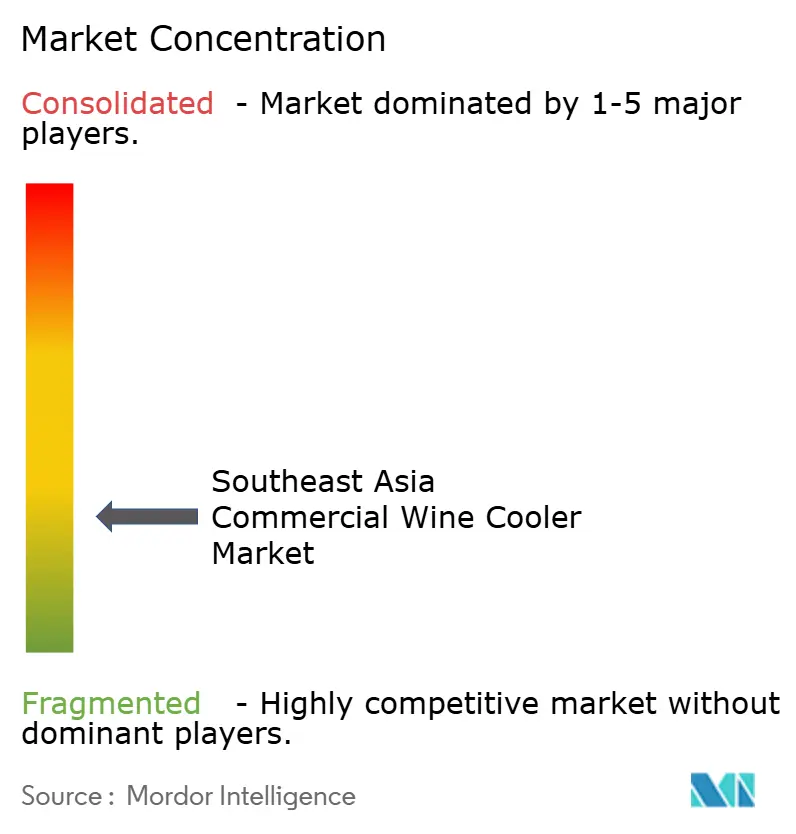
The Southeast Asia commercial wine cooler market is moderately fragmented. Global appliance groups compete with European wine-storage specialists and regional manufacturers. Haier has held the leading position in Asia-Pacific wine cooler sales for 15 consecutive years. Its broad appliance presence supports distribution in Thailand and Malaysia. Midea competes across price points with commercial display cabinets and energy-focused refrigeration technology. Samsung, LG, and Panasonic also use established regional service networks, especially in the mid-range category. No single supplier has a reported combined regional share that supports a more concentrated classification.
European specialists use controlled distribution to protect installation quality and after-sales service. EuroCave operates through Capital Marketing in Singapore and Malaysia and through Great Earth International in Bangkok. Liebherr expanded its undercounter portfolio in September 2025 with integrated wine equipment aimed at high-design bars and restaurants. It also extended its professional hospitality cooling offer in October 2025 with PIN-secured serving fridges, PowerChill capability, and SmartDeviceBox integration. These moves show how premium suppliers compete on precision, appearance, and operating controls. The principal opening remains in tropicalized cabinets for mid-scale independent restaurants and wine bars. This price band requires more performance than basic cabinets but remains below bespoke European installations.
Haier completed its acquisition of Carrier Commercial Refrigeration in February 2024, gaining commercial refrigeration technology and a wider service platform. The acquisition strengthened its ability to address commercial specification work alongside consumer channels. In May 2025, VIVANT entered Singapore with bespoke wine cellar and temperature-control installations, adding another specialist option for affluent hospitality customers. Smart cabinets with remote monitoring, maintenance alerts, and inventory connections are gaining attention from multi-property hotel groups. Refrigerant rules, energy performance, and digital controls are shaping selection alongside initial equipment cost. Suppliers that offer compliant hardware, diagnostic support, and local service can compete on lifetime operating value. The Southeast Asia commercial wine cooler market is therefore open to both large regional suppliers and focused premium specialists.
Southeast Asia Commercial Wine Cooler Industry Leaders
-
SANDEN INTERCOOL PUBLIC COMPANY LIMITED
-
Frigoglass S.A.I.C.
-
AB Electrolux
-
Liebherr
-
Haier Group Corporation
- *Disclaimer: Major Players sorted in no particular order
Southeast Asia Commercial Wine Cooler Market Companies Covered in this Report
- Frigoglass S.A.I.C.
- SANDEN INTERCOOL PUBLIC COMPANY LIMITED
- Electrolux AB
- Liebherr
- Haier Group Corporation
- AB Electrolux
- Midea Group
- Panasonic Holdings Corporation
- LG Electronics Inc.
- Samsung Electronics Co., Ltd.
- General Electric Company
- Frigel Firenze S.p.A.
- Hoshizaki Corporation
- The Middleby Corporation
- EuroCave SAS
- Vinotemp International Corporation
- Shenzhen VRBON Electrical Appliance Co., Ltd.
- Royal Sutan Agung
- NewAir
- EdgeStar
- Guangzhou LVNI Commercial Refrigeration Co., Ltd.
Recent Industry Developments in Southeast Asia Commercial Wine Cooler Market
- May 2026: Haier Smart Home launched the premium Horizon Collection refrigerator series in Vietnam. The launch marked the first Southeast Asian market in the global premium rollout. As of April 2026, Haier reported the highest overall brand share in Southeast Asia and year-on-year revenue growth of more than 40% in Vietnam and Malaysia.
- March 2026: Samsung Electronics launched the Infinite AI Wine Refrigerator. The 101-bottle built-in unit includes an AI Vision camera that identifies and records bottle labels, varietals, and vintages on the SmartThings AI Wine Manager platform. The product was the first mainstream wine cooler in Asia to include generative AI-based inventory management.
- October 2025: Liebherr-Hausgeräte expanded its professional hospitality cooling portfolio with PIN-secured wine-serving refrigerators, PowerChill rapid-cooling functionality, and digital SmartDeviceBox integration. These additions supported the company’s commercial hotel and catering product range across multiple temperature-zone configurations.
- September 2025: The ASEAN Centre for Energy launched the Regional Product Registration System database platform at prs.aseanenergy.org. The platform centralizes energy-efficiency compliance data for appliances, including commercial refrigerators, across all Association of Southeast Asian Nations member states. The platform supports cross-border recognition of compliant products and simplifies import procedures for commercial wine cooler suppliers.
Southeast Asia Commercial Wine Cooler Market Report Scope
Commercial wine coolers are specialized refrigeration units designed to store, age, and display wine at optimal temperatures in professional settings. The Southeast Asia commercial wine cooler market is segmented by product type, capacity, cooling technology, price range, end user, distribution channel, and geography. By product type, the market is segmented into freestanding wine coolers and built-in/undercounter wine coolers. By capacity, the market is segmented into up to 50 bottles, 51 to 100 bottles, 101 to 200 bottles, and above 200 bottles. By cooling technology, the market is segmented into compressor-based wine coolers, thermoelectric wine coolers, and hybrid cooling systems. By price range, the market is segmented into economy, mid-range, and premium. By end user, the market is segmented into restaurants and hotels; bars, pubs, and wine bars; cruise ships, event venues, and catering; retail stores and specialty shops; wineries and tasting rooms; and other commercial users. By distribution channel, the market is segmented into direct sales and dealers and distributors. By geography, the market is segmented into Malaysia, Philippines, Singapore, Thailand, Vietnam, Indonesia, and the Rest of Southeast Asia. The report offers the market size in value terms in USD for all the above-mentioned segments.
Segmentation Overview
| Freestanding Wine Coolers |
| Built-in / undercounter wine coolers |
| Up to 50 Bottles |
| 51 to 100 Bottles |
| 101 to 200 Bottles |
| Above 200 Bottles |
| Compressor-Based Wine Coolers |
| Thermoelectric Wine Coolers |
| Hybrid Cooling Systems |
| Economy |
| Mid-Range |
| Premium |
| Restaurants and Hotels |
| Bars, pubs and wine bars |
| Cruise ships, event venues and catering |
| Retail Stores and Specialty Shops |
| Wineries and Tasting Rooms |
| Other Commercial Users |
| Direct Sales |
| Dealers and Distributors |
| Malaysia |
| Philippines |
| Singapore |
| Thailand |
| Vietnam |
| Indonesia |
| Rest of South-East Asia |
| By Product Type | Freestanding Wine Coolers |
| Built-in / undercounter wine coolers | |
| By Capacity | Up to 50 Bottles |
| 51 to 100 Bottles | |
| 101 to 200 Bottles | |
| Above 200 Bottles | |
| By Cooling Technology | Compressor-Based Wine Coolers |
| Thermoelectric Wine Coolers | |
| Hybrid Cooling Systems | |
| By Price Range | Economy |
| Mid-Range | |
| Premium | |
| By End User | Restaurants and Hotels |
| Bars, pubs and wine bars | |
| Cruise ships, event venues and catering | |
| Retail Stores and Specialty Shops | |
| Wineries and Tasting Rooms | |
| Other Commercial Users | |
| By Distribution Channel | Direct Sales |
| Dealers and Distributors | |
| By Geography | Malaysia |
| Philippines | |
| Singapore | |
| Thailand | |
| Vietnam | |
| Indonesia | |
| Rest of South-East Asia |
Key Questions Answered in the Report
What is the projected value of the Southeast Asia commercial wine cooler market by 2032?
The Southeast Asia commercial wine cooler market is projected to reach USD 47.63 million by 2032, expanding at a 7.82% CAGR from 2027.
Which product type leads commercial wine cooler demand in Southeast Asia?
Freestanding wine coolers lead with a 67.25% share in 2026 because they offer flexible placement and lower installation needs.
Which commercial wine cooler format is growing fastest in Southeast Asia?
Built-in and undercounter models are projected to grow at an 8.32% CAGR between 2027 and 2032, supported by hotel and restaurant fit-outs.
Why do compressor wine coolers dominate in Southeast Asia?
Compressor-based units held a 72.16% share in 2026 because they provide dependable cooling in hot tropical conditions.
Which country has the strongest growth outlook for commercial wine coolers in Southeast Asia?
Vietnam is expected to expand at a 9.35% CAGR through 2032, supported by tourism, hotel development, and wine consumption growth.
How are energy rules changing commercial wine cooler procurement in Singapore?
From April 2025, commercial storage refrigerators must meet an Energy Efficiency Index of 95 or lower under ISO 22041.