
South Korea Premium Goods Logistics Market Size and Share
Market Overview
| Study Period | 2020 - 2031 |
|---|---|
| Forecast Data Period | 2026 - 2031 |
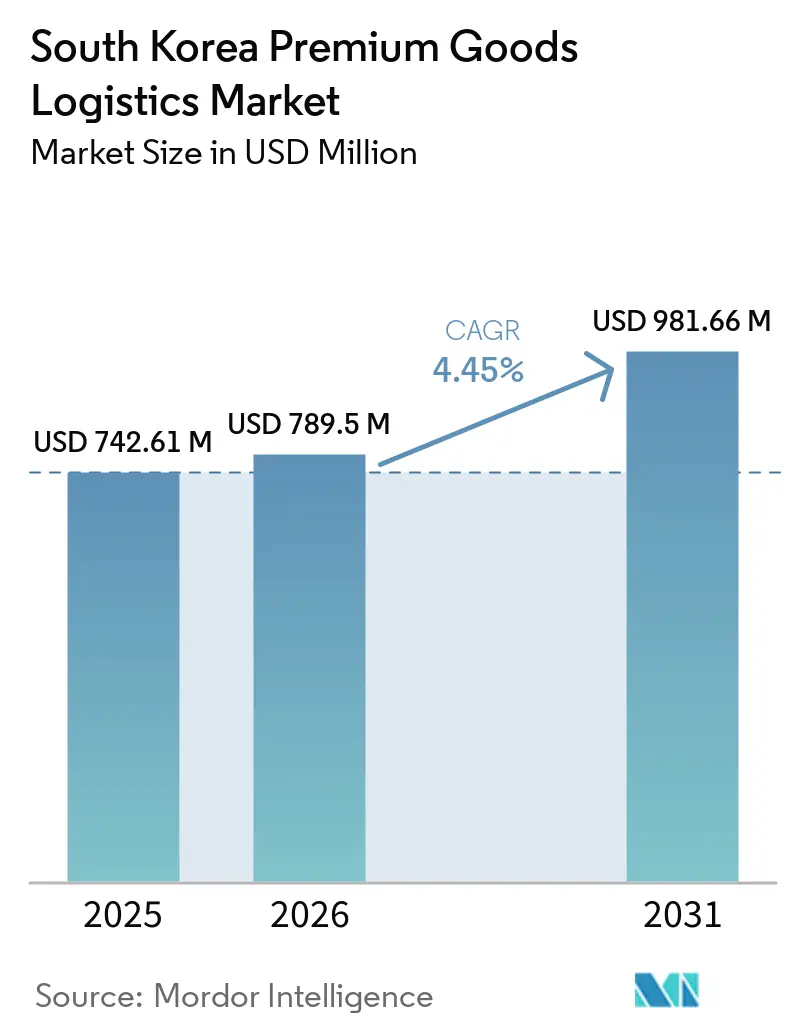
| Base Year Market Size (2025) | USD 742.61 Million |
| Market Size (2026) | USD 789.5 Million |
| Market Size (2031) | USD 981.66 Million |
| Growth Rate (2026 - 2031) | 4.45 % |
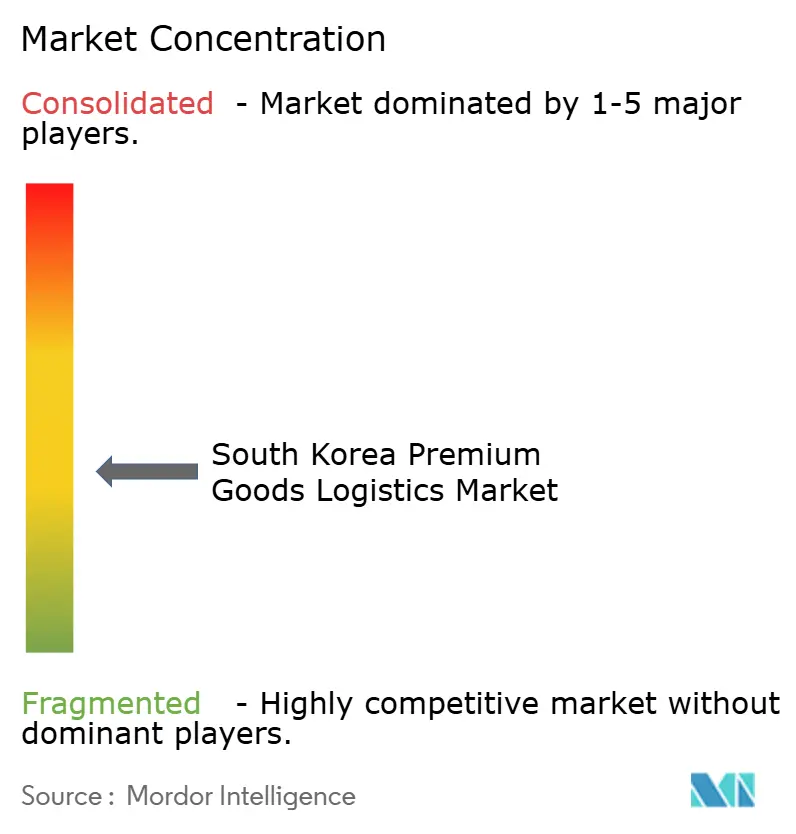
| Market Concentration | Medium |
Major Players *Disclaimer: Major Players sorted in no particular order Image © Mordor Intelligence. Reuse requires attribution under CC BY 4.0. | |
South Korea Premium Goods Logistics Market Analysis by Mordor Intelligence
The South Korea premium goods logistics market size was valued at USD 742.61 million in 2025 and is estimated to grow from USD 789.50 million in 2026 to reach USD 981.66 million by 2031, at a CAGR of 4.45% during the forecast period (2026-2031).
Premium shipments remain low-volume and high-value, so security, speed, insurance, and documented custody shape operator economics more strongly than parcel volumes. Luxury retail demand has supported shipment activity, particularly for watches and jewelry, while online channels have shortened the time between purchase and delivery. Incheon remains central to inbound and outbound premium flows, and the Seoul, Incheon, and Gyeonggi corridor concentrates the country’s key consumption and logistics activity. Operators are responding by expanding secure last-mile delivery, cross-border handling, returns processing, and verification services. The South Korea premium goods logistics market, therefore, offers the clearest opportunities to providers that can meet detailed brand requirements without relying on standard parcel networks.
Key Report Takeaways
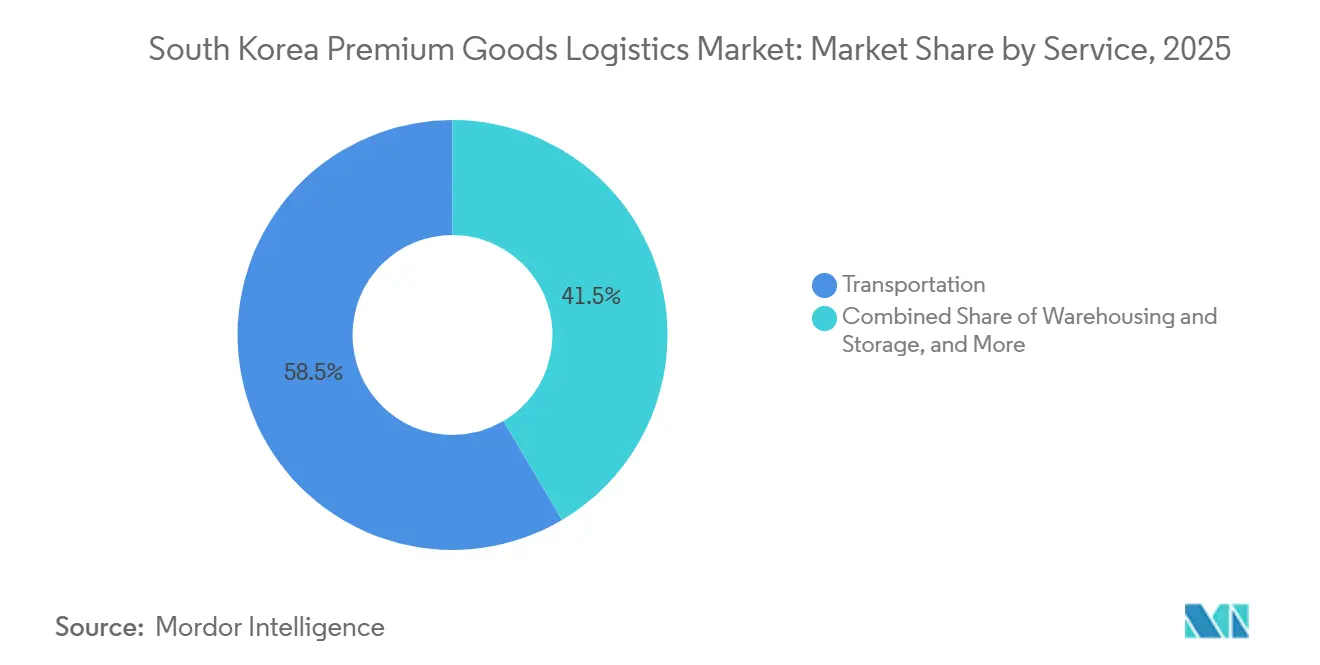
- By service, transportation held 58.50% of the South Korea premium goods logistics market share in 2025, while value-added services and others is forecast to grow at a 5.20% CAGR through 2031.
- By goods type, luxury fashion and accessories accounted for 34.55% of the South Korea premium goods logistics market size in 2025, while watches and jewelry is forecast to expand at a 5.35% CAGR through 2031.
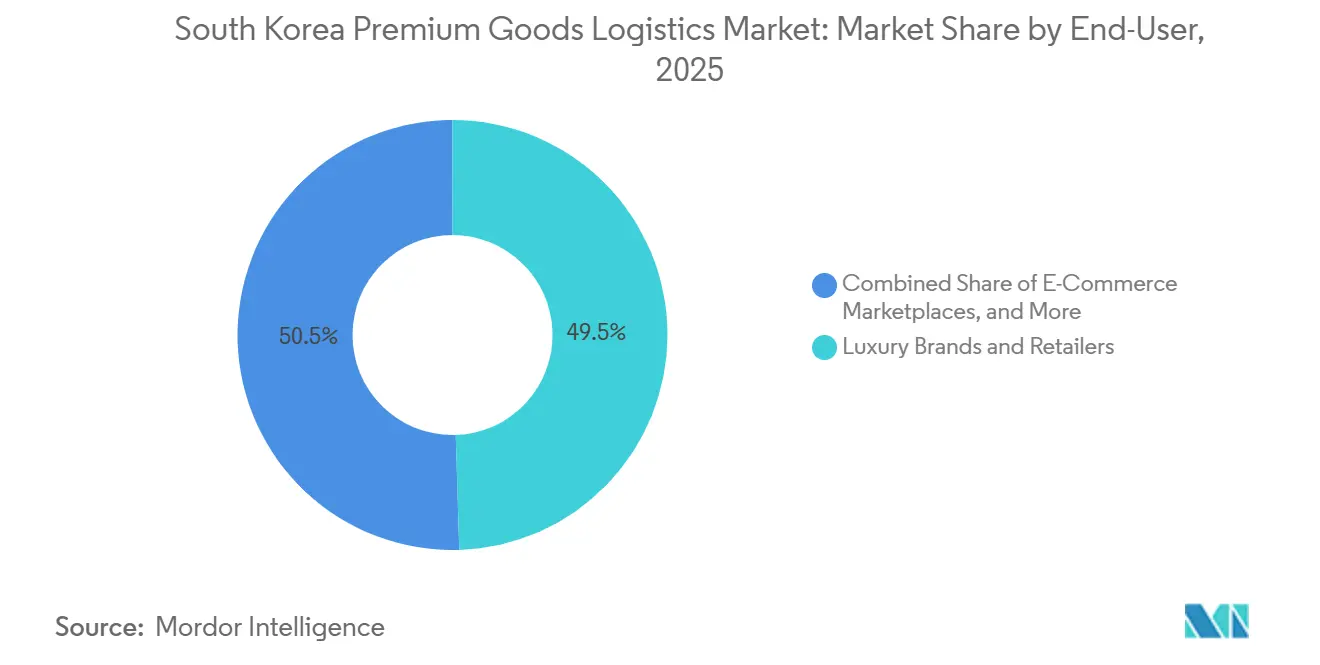
- By end user, luxury brands and retailers held 49.50% of the South Korea premium goods logistics market share in 2025, while e-commerce marketplaces recorded the highest projected CAGR at 6.85% through 2031.
- By destination, domestic flows represented 62.00% of the South Korea premium goods logistics market size in 2025, while international flows are projected to grow at a 4.90% CAGR through 2031.
Note: Market size and forecast figures in this report are generated using Mordor Intelligence’s proprietary estimation framework, updated with the latest available data and insights as of January 2026.
South Korea Premium Goods Logistics Market Trends and Insights
Drivers Impact Analysis*
| Driver | (~) % Impact on CAGR Forecast | Geographic Relevance | Impact Timeline |
|---|---|---|---|
| Growth of Luxury E-Commerce Fulfillment and Same-Day Delivery Demand | +1.4% | Seoul metropolitan area, Gyeonggi-Incheon corridor | Short term (≤ 2 years) |
| Rising Cross-Border Premium Shopping Flows Through Incheon Gateway | +1.0% | Incheon, with spill-over to Busan and Pyeongtaek ports | Medium term (2-4 years) |
| Rising Demand for High-Precision Appointment-Based White-Glove Delivery | +0.9% | Seoul, Gangnam and Yongsan districts, Suwon, Seongnam | Short term (≤ 2 years) |
| Expansion of Temperature-Controlled and Tamper-Evident Handling Standards | +0.8% | Global, anchored at Incheon Airport and logistics belts | Medium term (2-4 years) |
| High-Value Reverse Logistics for Returns, Repairs, and Authentication | +0.8% | Seoul metropolitan and major department-store clusters | Medium term (2-4 years) |
| Brand Demand for End-to-End Chain-of-Custody Visibility | +0.7% | Global, with primary gains at Seoul boutique and hub level | Long term (≥ 4 years) |
| Source: Mordor Intelligence | |||
Growth of Luxury E-Commerce Fulfillment and Same-Day Delivery Demand
South Korea’s domestic e-commerce sales reached USD 200 billion in 2025 and represented nearly half of all retail sales. The South Korea premium goods logistics market is being shaped by the movement of high-ticket purchases into quick-commerce channels[1]“South Korea eCommerce,” International Trade Administration, trade.gov . Swarovski’s sales through Baemin’s quick-commerce platform more than doubled in the second quarter of 2026 from the same period in 2025. The same report stated that jewelry priced above KRW 10 million (USD 0.69 million) was delivered within 2 hours in major Seoul districts. Standard parcel networks are not designed to handle goods at this value level with the security and proof-of-handoff that brands require. Logistics providers that invest in protected last-mile networks can address a service gap that price-led courier services cannot readily fill.
Rising Cross-Border Premium Shopping Flows Through Incheon Gateway
Incheon International Airport handled 2.95 million tons of cargo in 2025 and retained its position as the world’s 3rd-largest international cargo hub. Korea’s overseas direct purchases exceeded USD 6 billion in 2025, with fashion, beauty, and premium electronics among the leading categories by value. The sea and air route connecting Incheon Port and Incheon Airport carried volumes that increased 14.2% from January through July 2026 compared with the same months of 2025. The South Korea premium goods logistics market benefits from this mix of air speed and ocean freight cost efficiency for time-sensitive cross-border shipments. Returns also require secure customs, inspection, and reverse-flow processes at the gateway. Operators that build these functions into their Incheon operations can support brands across both inbound and outbound movements.
Brand Demand for End-to-End Chain-of-Custody Visibility
Luxury houses operating under Richemont and LVMH governance frameworks require detailed records from manufacturing through final handoff. This requirement is linked to voluntary traceability programs, anti-counterfeiting obligations, and scrutiny of parallel imports. Korea applied a 10% value-added tax and a 10% to 20% special excise tax to luxury goods imports[2]“South Korea Import Tariffs,” International Trade Administration, trade.gov . The regulatory framework makes accurate shipment records important for customs and product control. The South Korea premium goods logistics market is therefore placing more value on digital custody records that connect bonded warehouses, transport, and final delivery confirmation. Investment in IoT seals and RFID-enabled tote systems supports tamper detection and auditable handling across these movements.
Rising Demand for High-Precision Appointment-Based White-Glove Delivery
Luxury spending in Korea shifted from handbags toward fine jewelry and watches, which require more controlled delivery than typical doorstep shipments. Shinsegae Department Store’s South City branch reported a 146.3% increase in jewelry sales and an 85.3% increase in watch sales during the first 20 days of 2026 compared with the prior-year period. Brands handling these products require scheduled delivery windows, insurance-supported handoffs, and recipient authentication. The South Korea premium goods logistics market has consequently raised the importance of trained agents and secure vehicle fleets in Seoul’s Gangnam and Apgujeong districts. These delivery requirements resemble installation-adjacent handling rather than routine courier activity. Providers without dedicated staff and protected fleets risk losing brand-mandated routes to specialized operators.
Restraints Impact Analysis*
| Restraint | (~) % Impact on CAGR Forecast | Geographic Relevance | Impact Timeline |
|---|---|---|---|
| High Security, Insurance, and Compliance Cost Per Shipment | -0.6% | Global, concentrated in Seoul metropolitan and Incheon hub | Short term (≤ 2 years) |
| Limited Scale Economics in Fragmented Premium Brand Networks | -0.4% | National, highest impact in secondary cities outside Seoul | Medium term (2-4 years) |
| Sensitivity to Customs Delays and Documentation Complexity | -0.3% | Incheon Airport and Port, with downstream impact nationwide | Medium term (2-4 years) |
| Shortage of Specialized High-Value Cargo Handling Talent | -0.2% | National, acute in provincial fulfillment hubs | Long term (≥ 4 years) |
| Source: Mordor Intelligence | |||
High Security, Insurance, and Compliance Cost Per Shipment
Premium shipments carry costs that standard parcel economics cannot absorb. Security personnel, armored vehicles, tamper-evident packaging, insurance, and customs documentation increase the cost of each shipment. Korea’s 10% value-added tax and 10% to 20% special excise tax on luxury imports add to the landed cost of imported goods. These requirements raise the cost and complexity of insurance underwriting for higher-value products. Smaller luxury retailers and independent boutiques cannot spread fixed compliance costs across large shipment volumes. This constraint can keep some smaller operators in informal or semi-premium service channels instead of specialist networks.
Limited Scale Economics in Fragmented Premium Brand Networks
Fewer than 20 flagship department-store locations in greater Seoul concentrated much of Korea’s luxury retail activity. Premium delivery often involves single items sent to dispersed high-income households in Gangnam, Yongsan, and nearby suburbs. This structure differs from mass-market parcel operations, which can consolidate many items within a compact delivery area. Cost per premium delivery was 5 to 8 times higher than mass-market parcel delivery on a per-item basis. The South Korea premium goods logistics market has therefore faced limits on expansion outside the Seoul, Incheon, and Gyeonggi triangle. Smaller brands using several domestic providers can also encounter inconsistent service because no single specialist carrier has standardized service levels across all 17 administrative regions.
*Our forecasts treat driver/restraint impacts as directional, not additive. The impact forecasts reflect baseline growth, mix effects, and variable interactions.
Segment Analysis
By Service: Transportation Leads Revenue While Value-Added Services Expand
Transportation held 58.50% of the South Korea premium goods logistics market share in 2025, making it the leading service category in the market. Road transport supported same-day movements within the Seoul-Incheon metropolitan corridor. Air freight through Incheon handled the most time-sensitive and highest-value shipments, including fine watches and limited-edition fashion. Rail, sea, and inland waterways served supplementary roles in bulk redistribution and lower-urgency cross-regional flows. Transportation remained essential because every premium shipment requires protected movement between stores, hubs, airports, and final recipients[3]“Incheon Airport Recorded 2,954,684 Tons of Air Cargo in 2025,” Incheon International Airport Corporation, incheonairport.kr.
The segment, Value-added services and others, is forecast to grow at a 5.20% CAGR through 2031. The warehousing and storage segment was the 2nd-largest service category and supported bonded inventory management for brand houses with seasonal replenishment cycles. Biometric handoff records, delivery-stage authentication, bespoke packaging, gift wrapping, and GPS-based monitoring are increasingly included in contractual requirements. CJ Logistics signed a memorandum of understanding with Valex Special Logistics in March 2026 to develop an ultra-premium delivery model for luxury goods and precious metals. The planned model combined security-escorted vehicles with 100% in-person handoffs, showing why service capability is becoming more important within the South Korea premium goods logistics industry.



By Goods Type: Fashion and Accessories Lead While Watches and Jewelry Grow Fastest
Luxury fashion and accessories held 34.55% of the South Korea premium goods logistics market size in 2025, supported by strong spending on handbags and ready-to-wear products from LVMH, Chanel, and Hermes. Hermes Korea exceeded KRW 1 trillion (USD 693.92 million) in sales in 2025, while operating profit increased 14.5%. It is reported that French luxury houses collectively generated nearly KRW 5 trillion (USD 3.46 billion) in annual sales from a population of 51 million. Consumer electronics also remained significant because premium smartphones, audio products, and smart-home equipment can require certified delivery. Cosmetics and fragrances benefited from the K-beauty reverse-purchase trade, with higher online export sales.
The segment, watches and jewelry, is forecast to grow at a 5.35% CAGR from 2026 to 2031, the highest rate among goods categories. Korean luxury buyers shifted some spending from fashion into products viewed as holding asset value. Luxury jewelry sales at Shinsegae’s South City branch increased 200% in 2026 from the prior year, and Lotte Department Store reported a 65% increase in watches and jewelry sales during the first half of 2026. These products require secure transport, appointment delivery, and confirmation at receipt. Fine art, collectibles, premium spirits, and wine remained smaller categories, but each requires climate-stable or temperature-controlled handling and commands higher service fees.
By End User: Brand Houses Anchor Demand While Marketplaces Change Service Needs
Luxury brands and retailers held 49.50% of the South Korea premium goods logistics market share in 2025. Flagship brand houses set service specifications through long-term logistics panel agreements. They require dedicated account teams that understand brand-specific procedures and manage high-value shipments. Art galleries and auction houses formed a specialized group with demanding customs clearance requirements under Korea’s cultural goods import classification framework. Airports and duty-free operators also generated frequent replenishment movements around Incheon International Airport’s Terminal 1 and Terminal 2 retail zones.
E-commerce marketplaces are forecast to grow at a 6.85% CAGR from 2026 to 2031. Coupang’s R.Lux and Farfetch’s entry through Coupang’s infrastructure in June 2025 helped extend premium online retail access. Mobile-driven purchases accounted for 77% of South Korean e-commerce sales in 2025. Delivery speed, presentation, and returns handling have become central to the customer experience after online purchase in the South Korea premium goods logistics market. Platforms with integrated fulfillment capabilities, including Coupang through Rocket Delivery, hold an execution advantage over aggregators that depend on third-party carriers for high-value last-mile fulfillment.
By Destination: Domestic Activity Provides Volume While International Activity Adds Momentum
Domestic shipments represented 62.00% of the South Korea premium goods logistics market size in 2025. Department-store clusters, including Lotte Avenuel, Shinsegae, and Hyundai, supported frequent replenishment and delivery activity in Seoul. Gangnam and Apgujeong offered a premium delivery density that supported the domestic base of the South Korea premium goods logistics market. Coupang’s Rocket Delivery and broader same-day services raised expectations for delivery speed across price points. Premium operators have responded by improving the speed and precision of their last-mile networks.
International shipments are forecast to grow at a 4.90% CAGR from 2026 to 2031. UPS expanded its dedicated Incheon freight terminal to 4 times its previous size in April 2026, increasing annual import capacity from 27,000 metric tons to 190,000 metric tons. The project enabled same-day clearance for shipments arriving from Asia and Europe. Korea’s online reverse-direct-purchase exports are growing with K-fashion and K-beauty supporting export logistics demand. Customs documentation and clearance requirements restrained the rate of international expansion despite the underlying demand.
Geography Analysis
The Gyeonggi-Incheon logistics corridor led the South Korea premium goods logistics market through its airport, port, and metropolitan distribution links. Incheon International Airport handled 2.95 million tons of cargo in 2025 and was the world’s 3rd-largest international cargo hub. Air France-KLM Martinair Cargo launched a 3-times-weekly Amsterdam-Incheon cargo route in March 2026 using Boeing 747-400 freighters. Korean Air announced a renovation of Cargo Terminal 1 that was planned to target a 25% increase in annual throughput by September 2026.
Seoul is the country’s most important premium consumption area and its most demanding final-delivery environment in the South Korea premium goods logistics market. Gangnam-gu, Seocho-gu, and Mapo-gu have dense concentrations of luxury boutiques, auction houses, and VIP department-store destinations. Delivery providers must operate within congestion constraints and building-level access restrictions that are less common in suburban fulfillment locations. Luxury retail also expanded toward Seongsu, where pop-up activities and independent premium brands widened the relevant last-mile geography. Goods priced above KRW 10 million (USD 0.69 million) became available for 2-hour delivery in Seoul through quick-commerce services[4]“2025 Tourist Guidebook (ENG),” Seoul Metropolitan Government, english.seoul.go.kr..
Busan, Ulsan, and Gyeongnam play a secondary role but support international outbound movements. Incheon Port’s express shipment exports increased 46.9% in the first half of 2026, while the Incheon sea and air route rose 14.2% through July 2026. Central, Honam, Gangwon, and Jeju are served mainly through road-based extensions from the Seoul-Incheon hub. Jeju’s upscale resort economy supported white-glove demand for cosmetics, fine spirits, and art sold through island boutiques and duty-free outlets.
Competitive Landscape
The South Korea premium goods logistics market is moderately fragmented between domestic conglomerates with strong local coverage and global integrators with international network reach. CJ Logistics and Hanjin Transportation form the core domestic tier. CJ Logistics operated 732,397 square meters of fulfillment-center real estate as of March 2026. CJ Logistics also moved into ultra-premium service through its March 2026 agreement with Valex Special Logistics.
LX Pantos differentiated itself within the South Korea premium goods logistics market through intermodal sea-air handling in the Incheon corridor and its November 2025 joint venture with Sinotrans for Northeast Asia cross-border movements. Its March 2026 acquisition of a 109,000-square-meter logistics complex in Katowice, Poland, expanded its ability to serve Korean brands’ European distribution requirements. DSV strengthened the competitive field after completing its DB Schenker acquisition in April 2025. UPS also increased processing capability at Incheon through automated conveyors, customs-system integration, and X-ray imaging.
C2C secondhand luxury authentication and delivery remains a service area without a single national operator in the South Korea premium goods logistics market. Valex brought cash-in-transit security practices into luxury parcel delivery through its work with CJ Logistics. Quick-commerce providers also brought premium products into delivery windows of less than 2 hours in urban Seoul. A nationally recognized authentication-at-handoff network could establish a common service expectation across resale channels. The competitive position of operators will depend on whether they can combine product verification, protected transport, and reliable recipient documentation at scale.
South Korea Premium Goods Logistics Industry Leaders
CJ Logistics
Hanjin Transportation
LX Pantos
DHL Group
Kuehne+Nagel
- *Disclaimer: Major Players sorted in no particular order

Recent Industry Developments
- August 2026: Incheon Port Authority and Incheon International Airport Corporation jointly held an on-site briefing to accelerate sea and air combined transport volumes. Combined transport between the 2 hubs reached 23,303 tons from January to July 2026, up 14.2% year on year, reflecting growing demand for cost-efficient premium cross-border cargo movement.
- July 2026: FedEx signed a memorandum of understanding with Deliverbird Korea, a cross-border fulfillment specialist for K-culture goods. The agreement leveraged FedEx International Connect Plus (FICP) for date-definite delivery with end-to-end tracking, strengthening Korea's premium goods outbound logistics network to the United States and Europe.
- June 2026: Korean Air announced the renovation of Cargo Terminal 1 at Incheon International Airport, targeting a 25% increase in annual cargo handling capacity by September 2026. The upgrade introduced automated guided vehicles, driverless elevating transfer vehicles, cold-storage expansion, and AI-driven management systems, with a parallel terminal upgrade at JFK, New York, for high-value specialty cargo.
- June 2026: DHL Supply Chain Korea completed a new Health Logistics Hub in Icheon, Gyeonggi Province, spanning 10,000 square meters with temperature-controlled facilities ranging from minus 80 °C to 20 °C and cold-storage capacity for 1,300 pallets. The hub supported premium pharmaceutical and high-value healthcare cargo handling across the Asia-Pacific region.


South Korea Premium Goods Logistics Market Report Scope
| Transportation | Road |
| Rail | |
| Air | |
| Sea and Inland Waterways | |
| Warehousing and Storage | |
| Value-added Services |
| Luxury Fashion and Accessories |
| Watches and Jewelry |
| Consumer Electronics |
| Cosmetics and Fragrances |
| Fine Art and Collectibles |
| Premium Spirits and Wine |
| Other Premium Goods |
| Luxury Brands and Retailers |
| E-commerce Marketplaces |
| Art Galleries and Auction Houses |
| Airports and Duty-Free Operators |
| Corporate Gifting and Concierge Services |
| Others |
| Domestic |
| International |
| By Service | Transportation | Road |
| Rail | ||
| Air | ||
| Sea and Inland Waterways | ||
| Warehousing and Storage | ||
| Value-added Services | ||
| By Goods Type | Luxury Fashion and Accessories | |
| Watches and Jewelry | ||
| Consumer Electronics | ||
| Cosmetics and Fragrances | ||
| Fine Art and Collectibles | ||
| Premium Spirits and Wine | ||
| Other Premium Goods | ||
| By End User | Luxury Brands and Retailers | |
| E-commerce Marketplaces | ||
| Art Galleries and Auction Houses | ||
| Airports and Duty-Free Operators | ||
| Corporate Gifting and Concierge Services | ||
| Others | ||
| By Destination | Domestic | |
| International |


Key Questions Answered in the Report
What is the South Korea premium goods logistics market size?
The sector was valued at USD 742.61 million in 2025 and is estimated at USD 789.50 million in 2026. It is forecast to reach USD 981.66 million by 2031 at a 4.45% CAGR.
Which service leads premium goods logistics in South Korea?
Transportation led revenue with a 58.50% share in 2025. Road and air movements remain central to same-day and high-value delivery needs.
Which goods category is growing fastest in South Korea?
Watches and jewelry are projected to grow at a 5.35% CAGR through 2031. Demand shifted toward products that buyers viewed as holding asset value.
Why is Incheon important for high-value logistics?
Incheon International Airport handled 2.95 million tons of cargo in 2025 and served as the key gateway for premium imports, exports, and Sea&Air freight movements.
What is driving premium e-commerce delivery demand in Korea?
Mobile purchases accounted for 77% of South Korean e-commerce sales in 2025. Customers increasingly expect rapid delivery, secure handoff, and reliable returns processing for high-value products.
Which end users are expanding fastest?
E-commerce marketplaces are projected to record a 6.85% CAGR through 2031. Their fulfillment requirements place greater emphasis on delivery speed, packaging, and authentication.
Page last updated on:





