
South Korea Plastic Waste Management Services Market Size and Share
Market Overview
| Study Period | 2020 - 2031 |
|---|---|
| Forecast Data Period | 2026 - 2031 |
| Base Year Market Size (2025) | USD 1.08 Billion |
| Market Size (2026) | USD 1.13 Billion |
| Market Size (2031) | USD 1.47 Billion |
| Growth Rate (2026 - 2031) | 5.40 % |
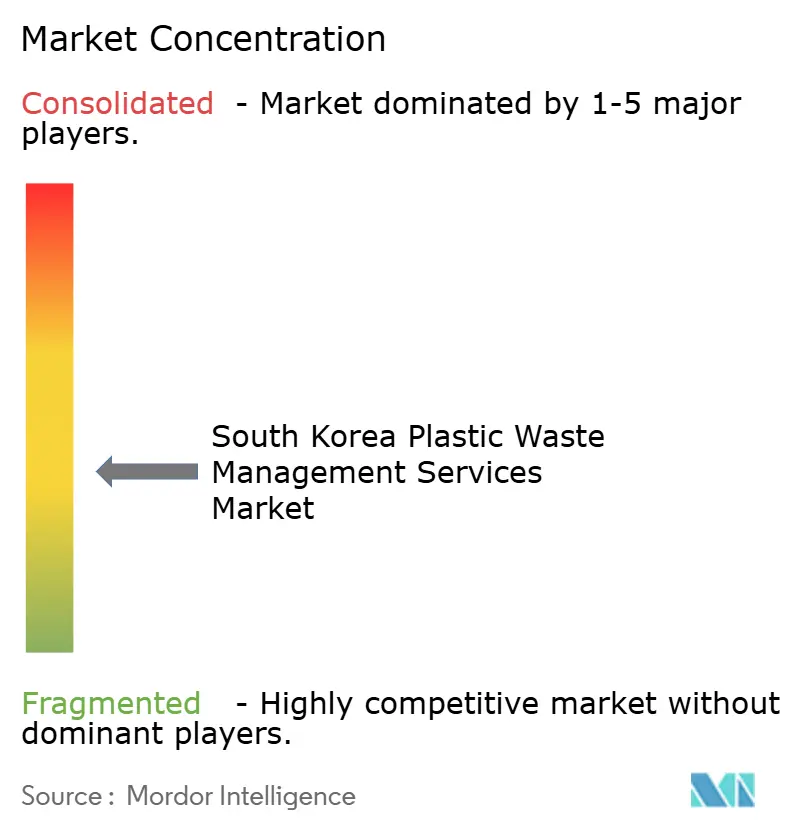
| Market Concentration | Medium |
Major Players *Disclaimer: Major Players sorted in no particular order Image © Mordor Intelligence. Reuse requires attribution under CC BY 4.0. | |
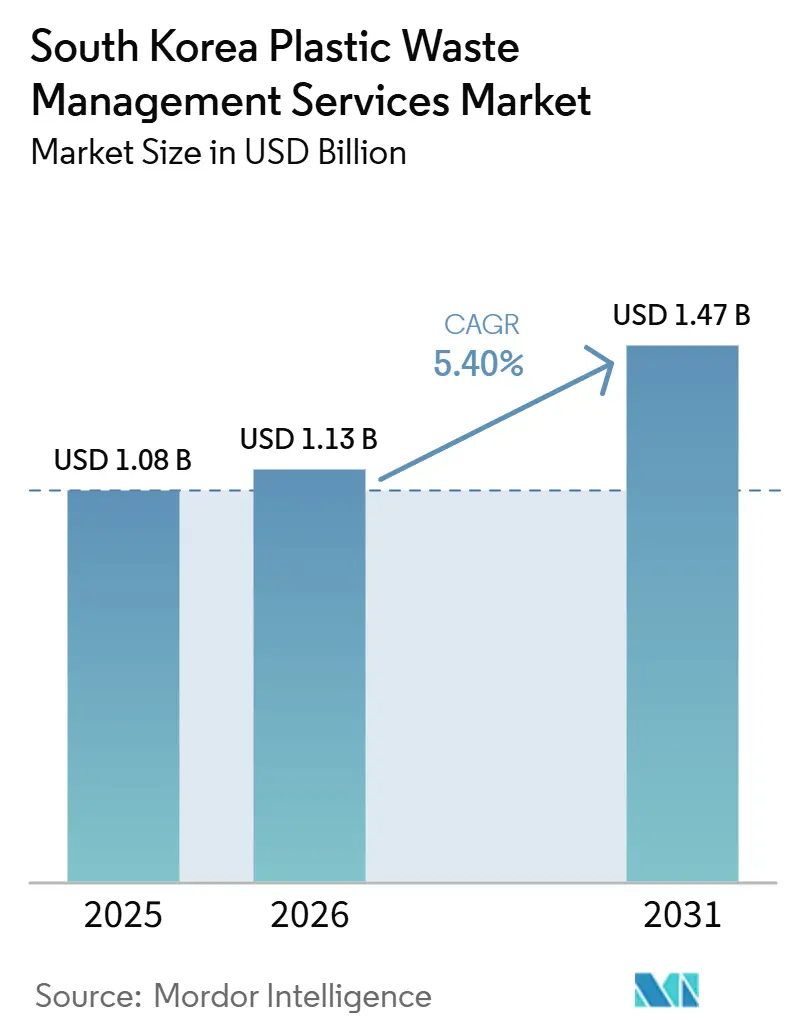
South Korea Plastic Waste Management Services Market Analysis by Mordor Intelligence
The South Korea Plastic Waste Management Services Market size is projected to be USD 1.08 billion in 2025, USD 1.13 billion in 2026, and reach USD 1.47 billion by 2031, growing at a CAGR of 5.40% from 2026 to 2031.
The Act on Promotion of Transition is shaping the market to a circular economy and society, which took effect on January 1, 2025, and shifted waste treatment into a more structured regulatory and industrial framework. Government planning now links waste reduction, recycled feedstock use, and treatment capacity expansion more directly than before, and the April 2026 plastic-free circular economy plan further aligns with that path with clear reduction and infrastructure targets. Demand conditions also remain favorable, as household and commercial plastic waste is projected to continue rising without intervention. At the same time, producer rules now create a stronger pull for certified recycled materials and better economics for upgraded sorting and recovery systems. The South Korea plastic waste management services market is also seeing increased investor interest as platform operators, recyclers, and technology providers build more integrated service chains for collection, sorting, treatment, and recycled feedstock production. At the same time, the pace of material recovery still faces limits from multi-layer flexible packaging, the established role of thermal recycling, and persistent facility capacity pressure in dense metropolitan areas.
Key Report Takeaways
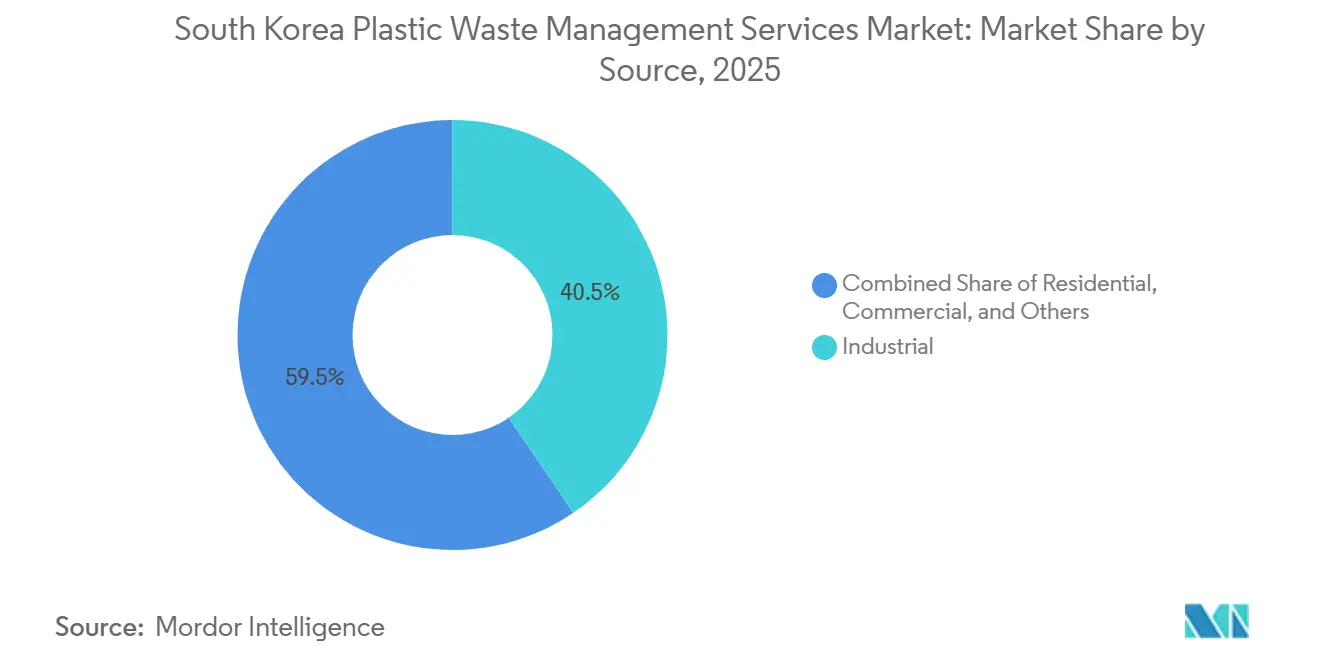
- By source, industrial waste accounted for 40.5% of the South Korea plastic waste management services market share in 2025, while commercial streams are projected to be the fastest-growing at a 6.20% CAGR through 2031.
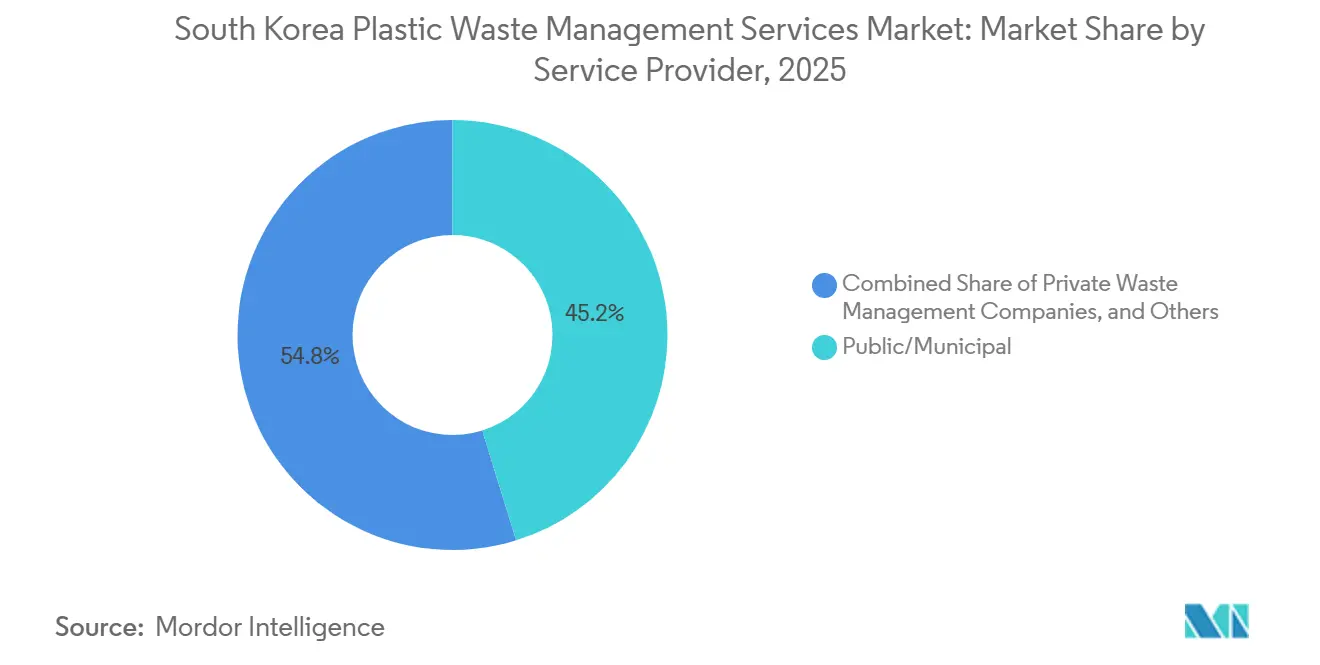
- By service provider, the public/municipal segment accounted for 45.20% of the South Korea plastic waste management services market size in 2025, and the private waste management companies segment is expected to register 6.30% CAGR through 2031.
- By service type, collection, transportation, sorting, and segregation accounted for 41.2% in 2025, while disposal/treatment registered 7.20% CAGR over 2026-2031.
Note: Market size and forecast figures in this report are generated using Mordor Intelligence’s proprietary estimation framework, updated with the latest available data and insights as of January 2026.
South Korea Plastic Waste Management Services Market Trends and Insights
Drivers Impact Analysis*
| Driver | (~) % Impact on CAGR Forecast | Geographic Relevance | Impact Timeline |
|---|---|---|---|
| Growing Industrial and Commercial Plastic Waste Generation | +1.2% | National, concentrated in Ulsan, Gyeonggi, and Incheon industrial corridors | Short term (≤ 2 years) |
| Stronger EPR Rules for Packaging and Consumer Goods | +0.9% | National, with early gains in Seoul, Incheon, and Gyeonggi industrial complex | Medium term (2-4 years) |
| Rising Investment in Advanced Waste Management Technologies | +0.9% | National, with capital concentration in Ulsan, Incheon, Saemangeum, and Seoul metro | Medium term (2-4 years) |
| Circular Economy and Resource Circulation Policies | +0.8% | National, with policy direction set in Sejong and applied across municipalities | Long term (≥ 4 years) |
| Expansion of Smart Waste Collection and AI-Based Sorting Infrastructure | +0.7% | National, with flagship deployments in Incheon, Daejeon, Seongnam, and Seoul | Medium term (2-4 years) |
| Expansion of Volume-Based Waste Fee System | +0.5% | National, with strongest uptake in Seoul, Busan, and metropolitan municipalities | Short term (≤ 2 years) |
| Source: Mordor Intelligence | |||
Growing Industrial and Commercial Plastic Waste Generation
Rising volumes of plastic waste from industrial and commercial activity continue to expand the addressable workload for formal service providers. Government projections show that household and commercial plastic waste could reach 10.12 million tons by 2030 without intervention, which keeps pressure on collection, transfer, sorting, and treatment systems across the country. The heaviest streams still come from petrochemicals, electronics packaging, automotive components, logistics, and retail distribution, which gives the South Korea plastic waste management services market a strong industrial base and a growing commercial layer. Commercial waste is expanding faster because parcel shipping and packaging intensity remain well above earlier norms, and private operators still have room to build more tailored services for offices, retail chains, and fulfillment networks. The April 2026 plan also targets a 30% reduction in virgin naphtha-derived plastic waste relative to the projected 2030 baseline, confirming that current volumes are high enough to require both source reduction and downstream processing upgrades simultaneously. Until those prevention measures take fuller effect, the South Korea Plastic waste management services market continues to gain from expanding tonnage that must be collected, documented, and treated through licensed channels.[1]Ministry of Climate, Energy and Environment, “Presidential Decree No. 34317, Enforcement Decree of the Act on the Promotion of Saving and Recycling of Resources,” Korean Law Information Research Center, elaw.klri.re.kr
Stronger EPR Rules for Packaging and Consumer Goods
South Korea’s EPR system is moving into a stricter phase that raises the value of verified recycling and better quality output. The 2025 amendment to the resource conservation and recycling framework requires manufacturers to incorporate minimum recycled material content, starting at 3% for most categories and 10% for PET bottles from 2026, with PET targets rising to 30% by 2030. This change is important because it shifts the market from a system focused mainly on recycling output obligations to one that also creates direct demand for recycled inputs, favoring operators that can deliver reliable purity and certification. The Korea Plastic Recycling Corporation continues to publish mandatory recycling categories and scope, which provides service providers with a clearer compliance framework and a more predictable demand base for recoverable materials.[2]Korea Plastic Recycling Corporation, “Packaging Material Subject to Mandatory Recycling, EPR Scope,” Korea Plastic Recycling Corporation, kprc21482.cafe24.comProof-of-recycling documentation and contribution fee calculations audited within the compliance system are already encouraging investment in upgraded sorting lines and certification-linked recovery capacity. The South Korea plastic waste management services market, therefore, benefits not only from higher recycling obligations but also from stronger monetization of certified tonnage.
Rising Investment in Advanced Waste Management Technologies
Capital deployment into advanced recycling and treatment technologies is raising the long-term value of better upstream waste handling. The South Korea plastic waste management services market is benefiting from projects that connect collection and segregation more directly to recycled feedstock production, rather than treating those steps as separate activities. SK Chemicals announced its Recycle Innovation Center in Ulsan in February 2025, adding pilot facilities for the chemical decomposition of waste plastics and the production of recycled BHET, signaling that feedstock control is becoming a strategic necessity for large material players. In November 2025, City Oil Field and Woori Technology opened the Wave Jeongeup plant with a low-temperature, non-combustion catalytic decomposition process for agricultural waste, vinyl, and mixed plastics, adding a new route for hard-to-process streams. Large integrated projects in Ulsan also show that advanced capacity is clustering near industrial feedstock sources, which improves operating logic for collection and transfer networks. As these facilities scale, the South Korea plastic waste management services market should see stronger demand for cleaner feedstock, tighter segregation standards, and more specialized contracts across the treatment chain.
Circular Economy and Resource Circulation Policies
South Korea’s shift from a linear waste model to a legally mandated circular framework is becoming a major driver of demand for plastic waste management services during the forecast period. The Act on Promotion of Transition to a Circular Economy and Society took effect on January 1, 2025, and replaced the earlier resource circulation framework with broader obligations across the product lifecycle. Under this framework, producers and importers are required to improve recyclability, calculate carbon footprints, and report circular economy indicators, while distributors are required to reduce single-use packaging and expand reusable packaging systems. The Act also created the Circular Resource Certification Program, which allows government-verified recycled inputs to be treated as circular resources instead of waste, reducing regulatory burdens for certified operators and creating a cost advantage over landfill- and incineration-based models. This policy direction was reinforced in April 2026 through the Plan to Promote the Transition to a Plastic-Free Circular Economy, which committed KRW 254 billion to the K-Circular Economy Reborn Project for 2027 to 2033, including support for AI sorting systems, continuous pyrolysis oil capacity, and preprocessing facilities for plastic films and agricultural vinyl. As compliance obligations now extend into retail and logistics, companies at the distribution stage are increasingly required to contract certified plastic waste management services, which is creating more stable demand across source, service provider, and service type categories through the forecast period.
Restraints Impact Analysis*
| Restraint | (~) % Impact on CAGR Forecast | Geographic Relevance | Impact Timeline |
|---|---|---|---|
| Rising Operational and Energy Costs | -0.7% | National, with the sharpest pressure on small and mid-sized recyclers | Medium term (2-4 years) |
| Reliance on Incineration and Waste-to-Energy | -0.6% | National, concentrated in metropolitan incineration corridors | Long term (≥ 4 years) |
| Limited Land Availability for Waste Treatment Facilities | -0.5% | Seoul metropolitan area, Incheon, and Gyeonggi Province | Long term (≥ 4 years) |
| Complex Multi-Layer and Flexible Plastic Packaging | -0.4% | National, most pronounced in urban commercial and e-commerce packaging streams | Medium term (2-4 years) |
| Source: Mordor Intelligence | |||
Rising Operational and Energy Costs
Rising collection, treatment, and energy costs are steadily putting pressure on the economics of plastic waste recycling in South Korea, reducing operator margins faster than EPR fee increases can offset. In 2024, national waste treatment costs reached KRW 5.683 trillion (USD 3.99 billion), while revenue recovered through the Volume-Based Waste Fee system and related charges was only KRW 1.510 trillion (USD 1.062 billion), leaving a budget self-sufficiency rate of 26.6%, down 1.9 percentage points from the prior year. Municipalities affected by direct-landfill restrictions are also paying KRW 140,000 to 160,000 per ton (USD 98.5–112.5 per ton) to private incinerators, compared with KRW 116,855 per ton (USD 82.19 per ton) for public landfills or less than KRW 120,000 per ton (USD 84.40 per ton) for public incineration, which is raising collection and disposal costs across the system. Energy and raw material inflation worsened pressure in 2026, as naphtha supply disruptions increased the cost of producing polyethylene bags used in the VBWF system and pushed contract prices higher. At the same time, the 2026 EPR contribution-fee adjustment was set at only 2.5%, which remained below the 8% to 10% rise in waste-plastic procurement costs reported by recyclers, leaving small and mid-sized operators especially exposed.
Reliance on Incineration & Waste-to-Energy for Plastic Waste Management
Thermal treatment still accounts for a large share of South Korea’s plastic waste system, slowing the transition toward deeper material recycling. Government data released showed that thermal recycling accounted for 29.5% of all plastic waste counted as recycled across household and industrial sources in 2023, indicating that reported recovery performance remains partly supported by incineration-linked treatment rather than material loop closure. The same review showed that removing thermal recycling from the calculation would materially lower headline recycling rates, which explains why the policy debate now centers on reclassification rather than capacity expansion. The OECD’s regional plastics outlook also places South Korea among the more incineration-intensive systems in East and Southeast Asia, showing that the issue is structural rather than temporary. A shift away from this model requires parallel investment in sorting quality, material recycling, landfill alternatives, and local treatment siting, which raises execution risk over several years. Because revisions to exclude thermal recycling from official statistics are expected later in the decade, the South Korea plastic waste management services market will likely continue to balance legacy incineration economics with newer recovery models during the forecast period.
*Our forecasts treat driver/restraint impacts as directional, not additive. The impact forecasts reflect baseline growth, mix effects, and variable interactions.
Segment Analysis
By Source: Industrial Volumes Drive the Revenue Base, but Commercial Streams Are Accelerating
Industrial sources accounted for the largest revenue, accounting 40.50% share in the South Korea plastic waste management services market in 2025, as the country’s petrochemical, manufacturing, electronics, and export packaging sectors generate dense, regular plastic waste streams. These industrial flows include industrial films, drums, mixed resins, and process-linked plastic residues that often require specialized handling and more structured contracts than household waste. That profile gives industrial waste a stronger revenue yield per ton for operators that can manage designated categories and deliver consistent treatment or recycling performance.
Commercial segment is the fastest-growing source stream, and it is projected to rise at a 6.2% CAGR through 2031 as parcel shipping, retail packaging, and office waste continue to expand. The South Korean plastic waste management services industry, therefore, relies on industrial-scale operations for current revenue while pursuing commercial growth to expand the future contract pool. Commercial expansion is being reinforced by the fact that household and commercial plastic waste is still projected to reach 10.12 million tons by 2030 without intervention, which maintains a large pipeline of service demand. Electronic tracking requirements under the waste management framework also improve contract pricing and route planning because industrial and commercial transfers are becoming more visible and easier to document within formal systems. That shift favors operators that can combine route optimization, source-stream analytics, and compliance reporting, rather than relying only on fixed collection schedules. Residential waste remains important because the VBWF structure preserves a steady municipal collection base. Still, its revenue intensity is lower than that of industrial and commercial waste because collection is more subsidized and standardized. Other sources, including institutional and agricultural streams, still account for a smaller share of the South Korea plastic waste management services market.



By Service Provider: Public Capacity Dominates, Private Momentum Reshapes the Ecosystem
Public and municipal entities held the largest service-provider position in 2025, accounting for 45.20% of the market share, as South Korea still assigns household waste collection responsibility primarily to public systems and has built a wide collection and treatment infrastructure across metropolitan and provincial governments. That installed base gives public operators the broadest physical footprint and the strongest presence in recurring household collection. The South Korea plastic waste management services market, however, is shifting toward a more active private sector, as industrial and commercial plastic waste often requires service models that public systems are not designed to handle.
Private waste management companies are projected to grow at a 6.3% CAGR through 2031, supported by rising commercial volumes, tighter compliance rules, and stronger demand for certified recycling outcomes. The South Korea plastic waste management services industry is also seeing deeper financial interest from investors that view waste platforms as regulated infrastructure with visible long-term demand. That shift is already visible in corporate activity, including EQT’s 2024 agreement to acquire KJ Environment and its affiliated companies to build a scaled waste-treatment platform in South Korea. Producer responsibility organizations remain a smaller segment in terms of direct service volume. Still, they play an essential role by validating recycled tonnage and channeling financial flows between producers and licensed recyclers under the EPR framework. The April 2025 legislative update also widened obligations on distributors to reduce single-use packaging and expand reusable formats, which increases the need for contracted service relationships with certified private operators. As a result, the South Korea plastic waste management services market is keeping its public base while moving toward a more layered operating model in which private firms capture a growing share of value-added and compliance-linked work.[3]Korea Trade-Investment Promotion Agency Ombudsman, “Enforcement Decree of the Act on the Promotion of Resource Conservation and Recycling,” KOTRA Ombudsman, ombudsman.kotra.or.kr
By Service Type: Disposal/Treatment Gains Momentum on Technology Upgrading
Collection, transportation, sorting, and segregation remained the largest revenue block in 2025, accounting for 41.20% of the market because urban density, frequent pickup cycles, and the movement of waste from distributed sources to centralized facilities make logistics a core cost and revenue center. That revenue base is especially strong in apartment-heavy cities where recurring collection schedules and transfer handling create a large operational footprint. The South Korea plastic waste management services market size for this service block is supported by municipal collection density and by the need to aggregate commercial and industrial waste before downstream processing. Smart systems are also improving this segment, with AI-based collection tools and sorting infrastructure being deployed in municipalities such as Daejeon, Incheon, and Seongnam to raise routing efficiency and material capture. Consulting, audit, and training services remain a smaller segment, but they are gaining relevance as compliance documentation, EPR audits, and circular reporting become more demanding.
Disposal and treatment is the fastest-growing service type and is projected to expand at a 7.2% CAGR through 2031, making it the strongest growth engine within the South Korea plastic waste management services market during the forecast period. That rise reflects the shift toward chemical recycling, pyrolysis, upgraded material recovery, and other treatment routes that better align with circular economy goals than simple thermal processing. Government policy is reinforcing this direction through the 2026 plastic-free circular economy plan, which supports the development of recycled feedstock processing facilities and broader technology deployment. Incineration and waste-to-energy still account for a substantial share of throughput by volume. Still, their regulatory status is under review as thermal recycling moves closer to exclusion from official recycling statistics. That pending change is likely to keep reshaping investment priorities across the South Korea plastic waste management services market as operators decide whether to modernize legacy assets or build more advanced recovery capacity.
Geography Analysis
The Seoul Capital Area held the largest geographic share of the South Korea plastic waste management services market in 2025 because it combines the country’s highest population density with its largest concentration of retail, logistics, and light manufacturing activity. Seoul, Incheon, and Gyeonggi Province together generate the largest waste volumes and therefore drive the heaviest demand for collection, transfer, sorting, and interim treatment services. This geography also carries the sharpest infrastructure pressure because the search for a successor metropolitan landfill site remained unresolved in 2025, despite repeated public bidding and special support offers. As direct landfill restrictions tighten in the capital region, more residual waste must pass through pre-treatment steps before final disposal, which raises the importance of sorting and treatment capacity close to the waste source. The South Korea plastic waste management services market share in this region remains high because no other domestic geography matches its combination of commercial density, municipal waste intensity, and service network dependence.
Industrial corridors outside the capital region form the second major geographic pillar of the market. Ulsan, Pohang, and the broader Gyeongnam belt generate high-intensity industrial plastic waste, which is often managed at private facilities near feedstock sources. Veolia Korea’s UNIKEN platform in Ulsan reflects this operating pattern through integrated industrial waste services, including landfilling, incineration, and the production of solid recovered fuel for industrial clients. These geographies are also attracting advanced recycling investment because large treatment assets work best when they can source material steadily from nearby industrial waste generators. The South Korea plastic waste management services market, therefore, follows two location logics simultaneously: one driven by population and municipal volume, and another by industrial feedstock concentration.
Jeju Island and other non-metropolitan regions still account for a smaller share of national demand, but they remain relevant as policy pushes for more uniform waste management standards nationwide. Regional infrastructure upgrades backed by national planning are intended to narrow service gaps between major cities and smaller municipalities, especially where collection systems, sorting quality, or treatment access remain weaker. This matters for the South Korea plastic waste management services market because a more even operating standard can improve collection quality and reduce leakage from low-capacity local systems. Even so, local execution will continue to vary because the starting base for infrastructure, land access, and waste composition is still uneven across regions.
Competitive Landscape
The South Korea plastic waste management services market shows moderate consolidation at the upper tier, with a limited set of scaled operators active across collection, sorting, recycling, and treatment. At the same time, a much broader group of regional and specialized firms remains active below them. This structure gives larger platforms an advantage in compliance management, route density, and capital access. Still, it does not eliminate space for focused operators in local collection, smart sorting, or niche recovery. Capital activity since 2025 confirms that investors see the sector as long-duration infrastructure supported by regulation and recurring waste flows. The South Korea plastic waste management services market is therefore consolidating at the top while still leaving room for regional execution differences and specialist service niches. Competition is increasingly defined by who can connect waste collection, purity control, recovery certification, and downstream feedstock sales in one coordinated chain.
SK Chemicals’ February 2025 decision to establish the Recycle Innovation Center in Ulsan signals another strategy: securing proprietary access to recycled feedstock and advancing into the production of chemically recycled materials. City Oil Field and Woori Technology’s Wave Jeongeup project demonstrates a third path: commercializing treatment routes for difficult, mixed plastic streams through differentiated process technology. These moves indicate that scale, feedstock control, and process capability are becoming the main strategic levers inside the South Korea Plastic Waste Management Services Market.
Global participants such as Veolia, SUEZ, TOMRA, and Remondis remain relevant. Still, their strength in South Korea rests more on technology, plant operation standards, and industrial contracts than on dominance in municipal collection networks. Domestic operators still hold an advantage in municipal relationships and local compliance navigation, especially where EPR-linked documentation and certified tonnage validation matter most. Operators aligned with the KPRC and related compliance structure can access stronger fee support and a clearer path to monetizing verified recycling outcomes. White space remains in agricultural film, non-PET flexible packaging, and other mixed plastic streams where existing incentives and current processing economics do not yet support full-scale commercialization.
South Korea Plastic Waste Management Services Industry Leaders
SK ecoplant
ECORBIT
CESCo Solutions
Veolia Environnement S.A.
KC Green Holdings
- *Disclaimer: Major Players sorted in no particular order

Recent Industry Developments
- July 2026: Korea's Ministry of Climate, Energy and Environment and the Korea Environmental Industry and Technology Institute are actively promoting overseas deployment of domestic plastic recycling technologies, with feasibility studies underway in Southeast Asia and the Middle East, signaling intent to export the service and technology model internationally as domestic regulations mature.
- April 2026: Incheon City deployed additional AI-based robotic sorting systems at its Northern and Southern recycling centers, aiming to achieve an overall plastic sorting rate of 75% in 2026. The city's December 2024 investment of KRW 582 million (USD 0.39 million) in 2 AI robots had already improved sorting efficiency by 1.5% over previous methods.
- December 2025: SK Chemicals announced the achievement of Korea's first fully vertically integrated chemical recycling value chain by completing a subsidiary capable of collecting and processing waste plastics into recycled feedstock for its own copolyester manufacturing, eliminating feedstock sourcing dependence on third-party collectors.


South Korea Plastic Waste Management Services Market Report Scope
The South Korea Plastic Waste Management Services Market Report is Segmented by Source (Residential, Commercial, Industrial, and Others), by Service Provider (Public/Municipal, Private Waste Management Companies, and Others), and by Service Type (Collection, Transportation, Sorting & Segregation, Disposal / Treatment, and Others). The Report Offers Market Size and Forecasts in Value (USD) for All the Above Segments.
| Residential |
| Commercial (retail, office, etc.) |
| Industrial |
| Others (institutional, agricultural, etc) |
| Public/Municipal |
| Private Waste Management Companies |
| Others - Producer Responsibility Organizations (PROs), etc. |
| Collection, Transportation, Sorting & Segregation | |
| Disposal / Treatment | Landfill |
| Recycling & Resource Recovery | |
| Incineration & Waste-to-Energy | |
| Others (Chemical Treatment, etc.) | |
| Others (Consulting, Audit & Training, etc.) |
| By Source | Residential | |
| Commercial (retail, office, etc.) | ||
| Industrial | ||
| Others (institutional, agricultural, etc) | ||
| By Service Provider | Public/Municipal | |
| Private Waste Management Companies | ||
| Others - Producer Responsibility Organizations (PROs), etc. | ||
| By Service Type | Collection, Transportation, Sorting & Segregation | |
| Disposal / Treatment | Landfill | |
| Recycling & Resource Recovery | ||
| Incineration & Waste-to-Energy | ||
| Others (Chemical Treatment, etc.) | ||
| Others (Consulting, Audit & Training, etc.) | ||


Key Questions Answered in the Report
What is the current outlook for plastic waste services in South Korea?
The South Korea plastic waste management services market was valued at USD 1.08 billion in 2025, USD 1.13 billion in 2026, and is forecast to reach USD 1.47 billion by 2031, at a 5.4% CAGR.
What is driving demand for waste collection and recycling services in South Korea?
Stronger circular-economy laws, tighter EPR rules, higher recycled-content requirements, and rising commercial plastic waste volumes are driving demand for formal collection, sorting, and treatment services.
Which source segment is growing the fastest in South Korea?
Commercial waste is the fastest-growing source segment, with a projected 6.2% CAGR through 2031, supported by retail, office, and e-commerce packaging volumes.
Which service area is growing the fastest through 2031?
Disposal and treatment is the fastest-growing service type, with a projected 7.2% CAGR, as the system moves toward chemical recycling, pyrolysis, and upgraded recovery routes.
Why are private operators gaining ground in South Korea?
Private waste management companies are projected to grow at a 6.3% CAGR because industrial and commercial waste streams require more specialized handling, compliance support, and certified recycling outcomes.
What are the main constraints on higher recycling rates in South Korea?
Multi-layer flexible packaging remains hard to recycle economically, and thermal recycling still plays a large role, which slows the shift toward deeper material recovery and keeps pressure on treatment economics.
Page last updated on:





