
South Korea Metal Forming Equipment Market Size and Share
Market Overview
| Study Period | 2020 - 2031 |
|---|---|
| Forecast Data Period | 2026 - 2031 |
| Base Year Market Size (2025) | USD 1.11 Billion |
| Market Size (2026) | USD 1.15 Billion |
| Market Size (2031) | USD 1.31 Billion |
| Growth Rate (2026 - 2031) | 2.64 % |
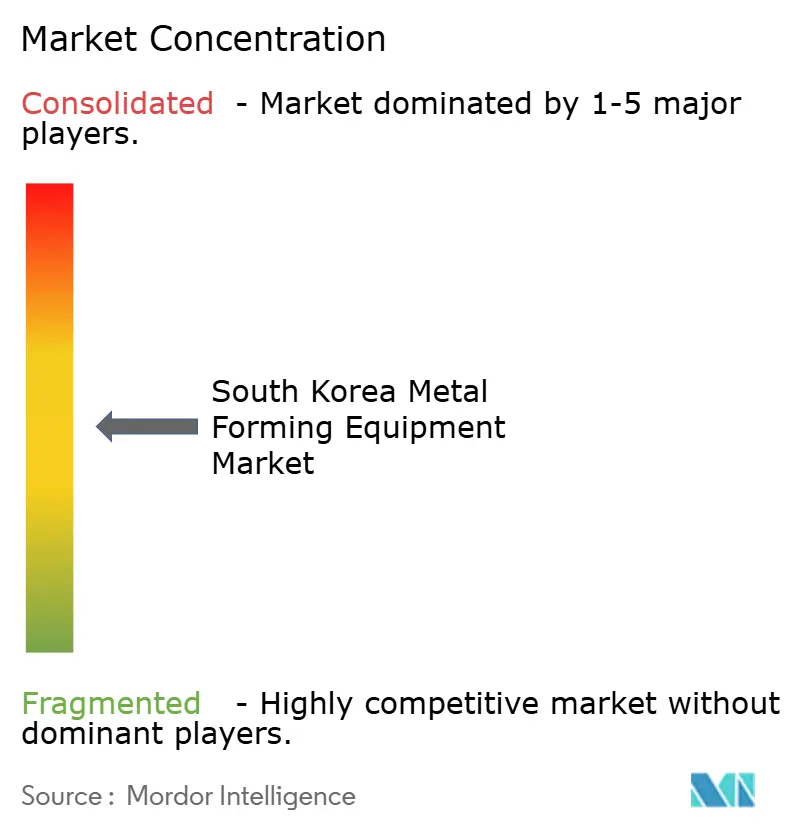
| Market Concentration | Medium |
Major Players *Disclaimer: Major Players sorted in no particular order Image © Mordor Intelligence. Reuse requires attribution under CC BY 4.0. | |
South Korea Metal Forming Equipment Market Analysis by Mordor Intelligence
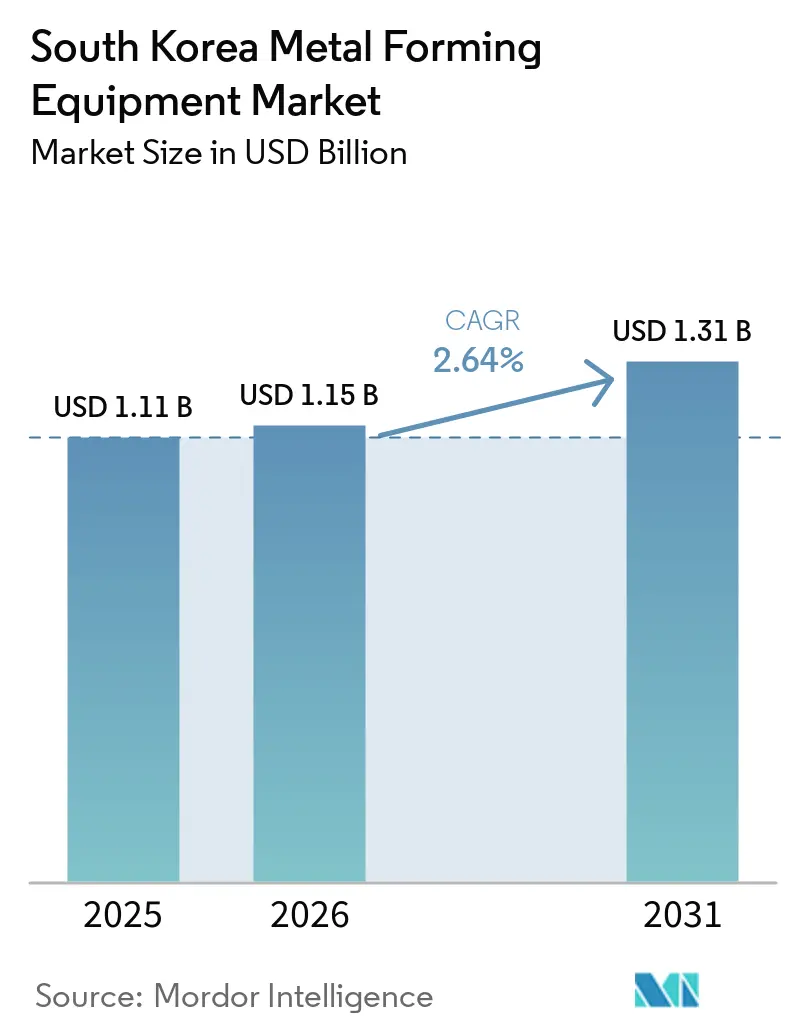
The South Korea Metal Forming Equipment Market size is projected to expand from USD 1.11 billion in 2025 and USD 1.15 billion in 2026 to USD 1.31 billion by 2031, registering a CAGR of 2.64% between 2026 and 2031.
The country’s integrated manufacturing base supports steady equipment demand across steel, automotive, electronics, and defense production. Buyers increasingly favor servo-driven and CNC-enabled systems that offer programmable motion and production data, rather than fixed-cam mechanical machines. This preference limits unit-volume expansion but raises the value of individual equipment orders and related service work. Domestic suppliers remain important in mechanical and forging presses, while Japanese and European specialists retain an advantage in high-precision servo and progressive-die applications. The South Korea metal forming equipment market also places greater value on local training, technical support, and long-term service contracts as experienced operators and technicians retire.
Key Report Takeaways
- By equipment type, press machines held 44% of the South Korea metal forming equipment market share in 2025, while servo presses recorded the highest projected CAGR at 5% through 2031.
- By forming process, stamping and punching held 34% of the South Korea metal forming equipment market size in 2025, while hydroforming recorded the highest projected CAGR at 4.8% through 2031.
- By material formed, carbon and low-alloy steel held 45% of the South Korea metal forming equipment market size in 2025, while aluminum and aluminum alloys recorded the highest projected CAGR at 4.5% through 2031.
- By end-use industry, automotive and transportation held 37% of the South Korea metal forming equipment market share in 2025, while aerospace and defense recorded the highest projected CAGR at 5.2% through 2031.
Note: Market size and forecast figures in this report are generated using Mordor Intelligence’s proprietary estimation framework, updated with the latest available data and insights as of January 2026.
South Korea Metal Forming Equipment Market Trends and Insights
Drivers Impact Analysis*
| Driver | (~) % Impact on CAGR Forecast | Geographic Relevance | Impact Timeline |
|---|---|---|---|
| Automotive Electrification and Lightweighting | +0.7% | Ulsan, Asan, Gwangmyeong, and Gyeonggi | Short term (≤ 2 years) |
| CNC, Robotics and Smart Factory Investment | +0.6% | Changwon, Gyeonggi, Gumi, and national programs | Medium term (2-4 years) |
| High-Strength Steel and Aluminum Component Production | +0.5% | Pohang, Gwangyang, and Changwon | Medium term (2-4 years) |
| Precision Manufacturing Demand from Electronics, Semiconductors and Aerospace | +0.4% | Gumi, Gyeonggi, Changwon, and Sacheon | Long term (≥ 4 years) |
| EV Battery Enclosure and Hydrogen-EV Component Re-Tooling | +0.3% | Cheonan, Gumi, and Ulsan | Medium term (2-4 years) |
| Replacement of Aging Press Lines Through Servo and Digital Retrofits | +0.2% | National industrial complexes with many SMEs | Short term (≤ 2 years) |
| Source: Mordor Intelligence | |||
Automotive Electrification and Lightweighting
South Korea’s automotive producers are investing in electric vehicle platforms, which creates demand for new and reconfigured forming equipment. POSCO announced in September 2026 that it would invest KRW 480 billion (USD 337.6 million) in an eighth continuous galvanizing line at Gwangyang. The line is expected to produce 450,000 tons of hot-dip galvanized steel each year for automotive outer panels from 2028. The investment supports a continuing need for steel-processing and forming capacity throughout the vehicle supply chain. Hyundai Steel introduced 1.2 GPa third-generation automotive steel plates in 2025 that reduced weight by 10% without compromising formability. These newer steels and the wider use of aluminum require new tooling, revised press settings, and faster cycle times. HAIMK completed a high-strength aluminum parts plant in Gumi in 2025 for crash boxes, side sills, and battery pack cases for 300,000 EVs each year. The South Korea metal forming equipment market, therefore, benefits from retooling needs that do not depend only on vehicle production volumes.
CNC, Robotics, and Smart Factory Investment
The Smart Manufacturing Innovation Initiative committed KRW 247.9 billion (USD 174.4 million) in government funding during 2025. The program has supported more than 32,000 projects at nearly 24,000 manufacturers since 2014, with 95% of the 2025 budget directed to smart-factory adoption.[1]Organisation for Economic Co-operation and Development, “Korea’s Smart Manufacturing Innovation Initiative,” OECD, oecd.org. Early adopters reported average productivity gains of 29% and unit-cost reductions of 35.2%. The initiative can fund up to 50% of project costs, reducing the immediate burden on smaller press shops that adopt CNC equipment and automated material handling. KERI opened an AI CNC Demonstration Center in Changwon with KRW 30 billion (USD 21.1 million) in investment, targeting 50% CNC localization in South Gyeongsang by 2030. KIMM’s K-CNC platform was validated across 8 commercial machine-tool models and supports 33 drive-system types. As eligibility favors digitally integrated operations, the South Korea metal forming equipment market gains an equipment-replacement channel beyond normal capital-spending plans.
High-Strength Steel and Aluminum Component Production
The shift toward advanced steel and aluminum changes equipment needs across the manufacturing supply chain. POSCO began a national project in June 2026 with Hyundai Motor and 8 other organizations to develop wide electrical steel with 6.5% silicon for high-efficiency EV motors. The material’s brittleness at processing temperatures requires different press configurations instead of minor adjustments to existing lines. SeAH Changwon Integrated Special Steel commissioned a 50-MN tube extrusion press in Changwon with an annual capacity of 35,000 tons for stainless and specialty alloy tubes. These materials require higher forming force, more durable tooling, and controlled processing conditions than conventional carbon steel. The Korea Institute of Industrial Technology identified the lack of domestic high-value aluminum plate production as a supply-chain issue in 2026.
Precision Manufacturing Demand from Electronics, Semiconductors and Aerospace
The aerospace and defense supply base is raising precision requirements in the South Korea metal forming equipment market. A government-backed aerospace parts research program had secured KRW 95.7 billion (USD 67.3 million) in manufacturing contracts by September 2026 for Airbus A320 and A330 and Boeing B737 and B787 structures. The program started in 2024 with a KRW 18.5 billion (USD 13.0 million) investment through 2028. SeAH Aerospace and Defense signed a long-term agreement with Airbus in July 2026 to supply high-strength aluminum alloys for fuselage and wing structures. Quality certification is now underway, and mass production is scheduled for 2028. Hanwha Aerospace’s Changwon engine facility tracks micro-defects down to 0.4 mm, which raises the precision expected from suppliers’ forming equipment. DYSS Dynamics supplied more than 13,000 precision-guided weapon parts by September 2026, reinforcing the requirement for tightly controlled production capability.
Restraints Impact Analysis*
| Restraint | (~) % Impact on CAGR Forecast | Geographic Relevance | Impact Timeline |
|---|---|---|---|
| High Capital Cost and Long Equipment Payback Periods | -0.5% | National, especially Gyeonggi, Gyeongnam, and Incheon SMEs | Short term (≤ 2 years) |
| Skilled Labor Shortages for Programming, Die Setting, and Maintenance | -0.4% | National, especially Changwon, Incheon, and mold and foundry complexes | Long term (≥ 4 years) |
| Volatile Steel, Aluminum, Servo-System, and Imported Component Costs | -0.3% | National export-oriented press shops | Medium term (2-4 years) |
| Mixed-Material EV Platforms and Tooling Changeover Risk | -0.2% | Ulsan, Asan, Gwangmyeong, and automotive supplier clusters | Medium term (2-4 years) |
| Source: Mordor Intelligence | |||
High Capital Cost and Long Equipment Payback Periods
Capital spending remains a barrier for smaller metal-forming businesses considering servo-electric equipment. The Smart Manufacturing Innovation Initiative requires SMEs to fund 40-50% of project costs, even under favorable matching arrangements. South Korea deployed KRW 570 billion (USD 400.9 million) in emergency financial support in September 2025 for steel and aluminum companies affected by United States tariffs. The support included low-interest loans and SME interest-rate subsidies, showing the limited liquidity buffers many manufacturers face. Training costs and tooling requalification add to the cost of a servo press upgrade, but are not always apparent in the procurement budget. Input-cost volatility for steel, aluminum, imported servo systems, and other components can further delay equipment decisions. Mixed-material vehicle platforms also raise the risk and cost of tooling changes. These factors leave advanced adoption concentrated among larger Tier-1 suppliers and conglomerate-affiliated plants.
Skilled Labor Shortages for Programming, Die Setting and Maintenance
The availability of technical workers is becoming a lasting limitation for the South Korea metal forming equipment market. The Ministry of Trade, Industry and Energy’s 2025 survey recorded industrial technology employment of 1,735,669, while unfilled positions rose 1.6% to 39,834. The shortage rate stayed at 2.2% for 5 consecutive years, showing that labor supply has not matched demand. A 2024 root-industry survey found that workers aged 50 and over made up 36.8% of 744,543 employees, while workers under 30 represented 10.3%. Technical and skilled roles accounted for 18,562 of 22,662 vacant root-industry positions in 2024. Korea is projected to face a workforce shortage exceeding 820,000 by 2033, including 123,000 manufacturing positions. The shortage is particularly difficult for servo-press programming, die setting, and maintenance, which are needed to achieve the productivity benefits promised by advanced systems.
*Our forecasts treat driver/restraint impacts as directional, not additive. The impact forecasts reflect baseline growth, mix effects, and variable interactions.
Segment Analysis
By Equipment Type: Servo Presses Raise Value in a Press-Dominated Market
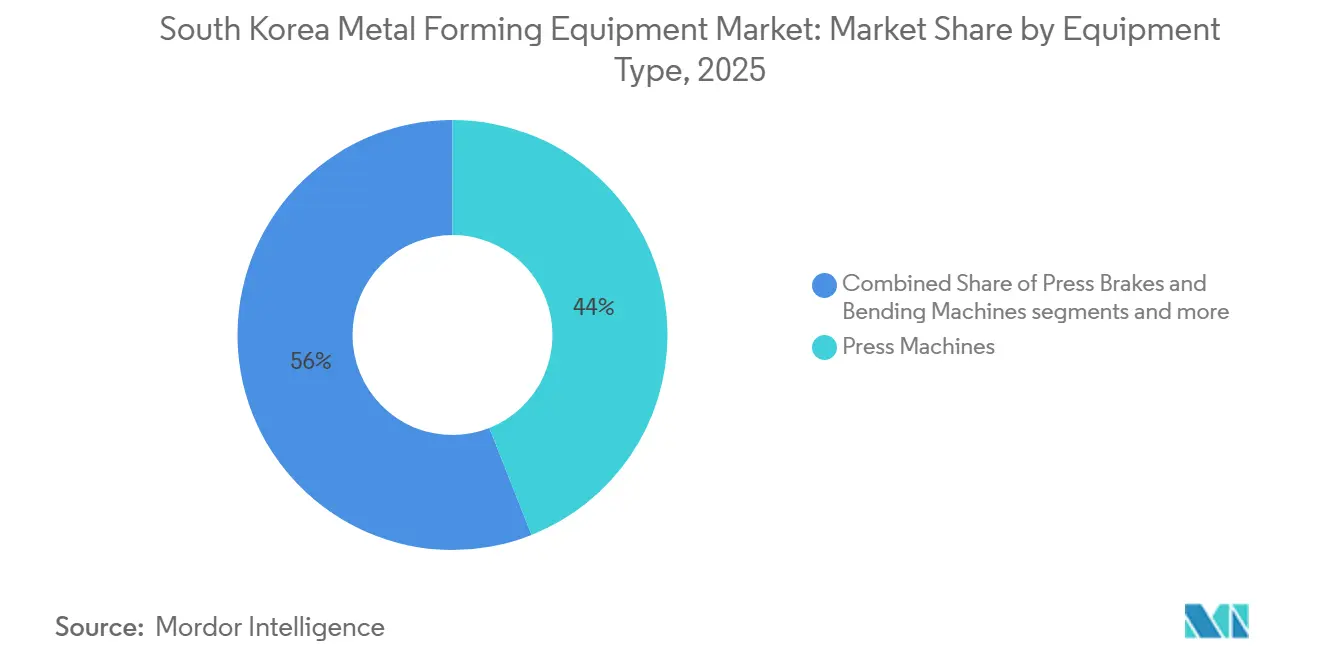
Press machines accounted for 44% of the South Korea metal forming equipment market size in 2025. Automotive producers use tandem and transfer stamping systems for high-volume body panels and structural parts. Servo presses are the fastest-growing press subcategory, with a forecast CAGR of 5% from 2026 to 2031. Their programmable motion profiles can reduce die wear during high-strength-steel forming. Servo systems can also reduce energy use by 30-50% compared with conventional mechanical presses. Industrial electricity rates were reported at KRW 182 per kWh (USD 128 per kWh) in August 2026. JNH Press shipped its JHSV-200 servo press in 2025, showing the commercial development of domestic servo products. Hydraulic presses remain important for forging, hydroforming, and deep drawing, where force needs vary across the stroke. The mix of applications means that suppliers need portfolios that address both production speed and controlled force delivery. Service capabilities also matter because equipment settings must be adapted as materials and component designs change.
Press brakes and bending machines form the second-largest equipment category. They serve fabricated metals, construction, and electronics enclosure production. Forging equipment maintains a stable role in applications needing a very high force. JNH Press is among 5 manufacturers globally to have developed an 8,000-ton press. This capability supports heavy-forging requirements in aerospace and defense. Hydroforming remains smaller in share but has a strong role in battery enclosures and chassis structures. It can form complex thin-walled tubes with fewer operations than stamped and welded assemblies. Extrusion presses are gaining strategic relevance as Korea seeks domestic capacity for high-value aluminum plates. The varied equipment base allows suppliers to serve both established fabrication work and newer lightweight component programs. Demand is therefore spread across replacement purchases and projects that require new production configurations.



By Forming Process: Hydroforming Grows While Stamping Supports Volume
Stamping and punching held 34% of the South Korea metal forming equipment market in 2025. Automotive and electronics suppliers have made long-term investments in progressive-die lines. Tooling switching costs help preserve the process’s central position. Hydroforming is the fastest-growing process at a forecast CAGR of 4.8% from 2026 to 2031. It can create complex, single-piece profiles that replace multi-part welded structures in EV chassis designs. This lowers part count, weld points, and vehicle mass. POSCO is developing technologies to bond 1.5 GPa ultra-high-strength steel with aluminum for vehicle bodies.[2]POSCO, “POSCO Partners With Hyundai Motor and 8 Organizations to Develop Next-Generation High-Efficiency Electrical Steel for EVs,” POSCO Newsroom, newsroom.posco.com. This supports demand for combined hydroforming and stamping investment. The transition does not remove stamping from the production base because high-volume panels still depend on established die systems. Instead, it increases the need for facilities that can manage several forming routes for different parts.
Deep drawing serves EV battery cans and motor housings. It is therefore closely linked to battery and electronics production activity. CNC press brakes and roll benders are widely used for construction, shipbuilding, and industrial structures. Forging supports drivetrain parts, landing gear, and defense components that require sustained high throughput. Extrusion is important for the domestic production of aerospace-grade aluminum and specialty steel tubes. SeAH Changwon’s 50-MN press line has 35,000 tons of annual specialty-alloy tube capacity. Process selection increasingly reflects material choice and component geometry. This makes flexible control systems and tooling support important across the South Korea metal forming equipment market. Production sites must also consider how quickly equipment can be adjusted for changing component requirements. That need supports demand for digital controls, local engineering assistance, and qualified tooling services.
By Material Formed: Aluminum Gains Ground While Steel Remains Central
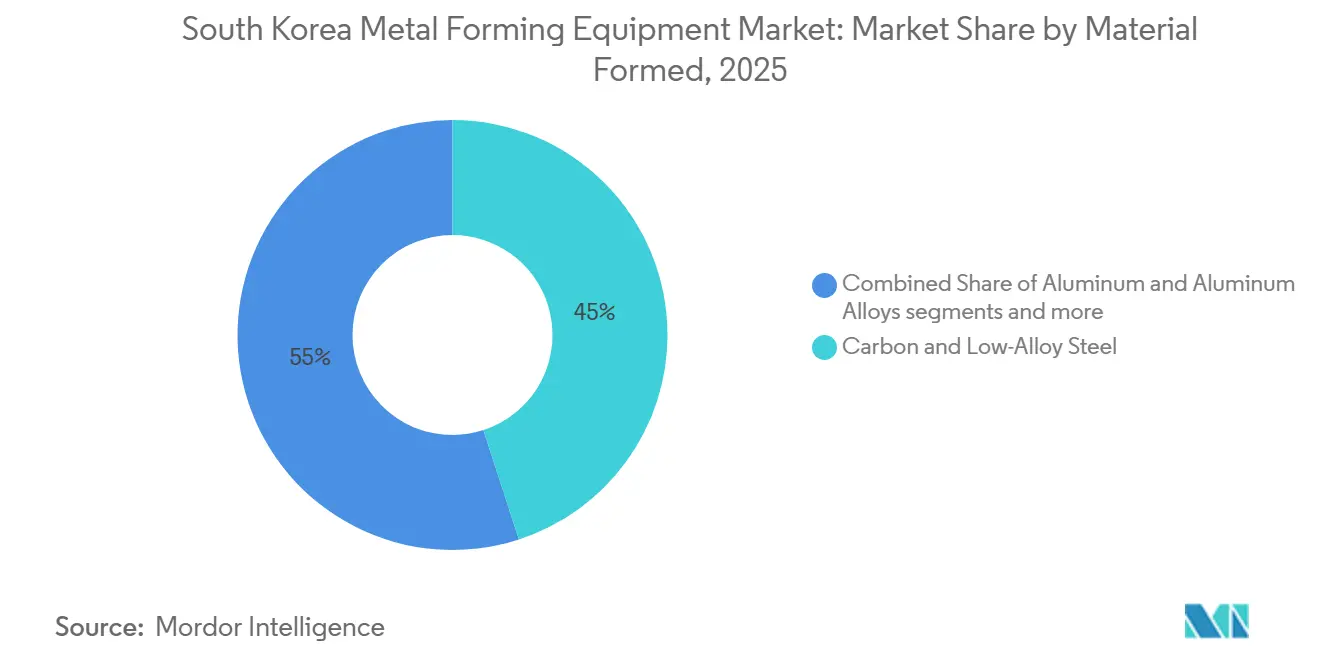
Carbon and low-alloy steel held 45% of the South Korea metal forming equipment market share in 2025. Steel remains integral to vehicle body structures, construction profiles, and industrial equipment frames. Hyundai Steel’s 1.2 GPa automotive plate reduced weight by 10% while retaining formability. POSCO’s project for 6.5% silicon electrical steel also supports demand for high-force processing equipment. Stainless steel maintains demand in food processing, medical uses, and energy infrastructure. Copper alloys support EV wiring harnesses and precision electronic connectors. These uses expand with battery and semiconductor supply chains. The continuing role of steel supports demand for existing high-force press capacity. At the same time, advanced grades require more careful control of tool condition and forming parameters.
Aluminum and aluminum alloys are the fastest-growing material category, at 4.5% CAGR from 2026 to 2031. HAIMK’s Gumi facility has the capacity for aluminum components used in 300,000 EVs each year. The project adds demand for fast and precise aluminum forming. Korea’s identified need for a 200,000-ton high-value aluminum plate line also highlights a gap in domestic capacity. The estimated KRW 300-400 billion (USD 211 million – 281.3 million) investment requirement points to demand for substantial extrusion and rolling equipment. Titanium, nickel, and other non-ferrous metals serve aerospace parts and hydrogen fuel-cell applications. POSCO International planned 10,000 tons per year of separator capacity by 2027, requiring high surface precision in thin metallic materials. Aluminum programs add different process needs alongside steel rather than replacing steel across all applications. Equipment suppliers must therefore support material-specific tooling and process knowledge.
By End-Use Industry: Aerospace Expands as Automotive Retools for EVs
Automotive and transportation accounted for 37% of the South Korea metal forming equipment market share in 2025. The segment includes body-panel and powertrain production, along with a distinct EV retooling cycle. Battery-electric architectures require larger battery enclosure panels and changed structural load paths. They also use a higher proportion of aluminum and ultra-high-strength steel. Each shift changes the required forming specifications from those used for combustion vehicles. Industrial machinery, metal fabrication, and electrical and electronics make up a broad mid-market. These buyers use standard-precision presses, press brakes, and roll-forming lines. Consumer appliances and construction provide replacement demand that follows building and household spending patterns. Automotive demand remains important because it links upstream material development with the needs of Tier-1 and Tier-2 component plants. This relationship reinforces the value of equipment that can manage regular design and material changes.
Aerospace and defense is the fastest-growing end-use segment, with a forecast CAGR of 5.2% through 2031. The government-backed aerospace program had secured KRW 95.7 billion (USD 67.3 million) in contracts for Airbus and Boeing structures by September 2026. SeAH Changwon increased research and development investment by 77% to KRW 32.6 billion (USD 22.9 million) over 2 years for nickel- and titanium-based specialty alloys. These materials require specialized high-temperature forging and extrusion equipment. Energy and power create additional demand through wind structures and hydrogen fuel-cell production. These applications use precision roll forming, hydroforming, and stamping of corrosion-resistant sheets. Medical and precision manufacturing remain small but require high per-unit investment for sub-10-micron tolerances. The South Korea metal forming equipment market consequently serves both high-volume production and specialized precision work. Aerospace orders increase the importance of dimensional control, material certification, and repeatable processing. This creates opportunities for suppliers that combine equipment with engineering and maintenance support over time.
Geography Analysis
The Ulsan-Gyeongnam corridor is the South Korea metal forming equipment market’s largest concentration of automotive forming demand. Hyundai Motor’s main assembly complex and a dense network of stamping, forging, and hydroforming suppliers operate in this belt. Changwon is also a center for high-specification machinery and defense production. KERI’s AI CNC Demonstration Center in Changwon received KRW 30 billion (USD 21.1 million) in investment. Hanwha Aerospace’s Changwon facility tracks defects down to 0.4 mm. SeAH Changwon operates a 50-MN specialty-alloy tube extrusion press line in the same industrial area. Suppliers with certified local service centers can respond more effectively to advanced-press users in this corridor.
The Seoul Metropolitan Area and Gyeonggi Province form an important center for electronics, semiconductors, and precision components. Demand in this area favors compact, high-precision presses, CNC press brakes, and wire and tube forming equipment. These systems support connector housings, motor cores, and metal enclosures used in semiconductor and consumer electronics production. The Smart Manufacturing Innovation Initiative’s KRW 247.9 billion (USD 174.4 million) 2025 budget supports digital equipment upgrades among smaller manufacturers. The program helps sustain the replacement of hydraulic equipment with servo systems. Technical support and control-system integration are important purchase considerations for this customer base.
Gumi has become a notable aluminum-forming location after HAIMK commissioned its EV aluminum-parts facility in 2025. The plant supports demand for equipment that can form crash structures and battery cases. Pohang and Gwangyang are principally upstream steel supply centers within the South Korea metal forming equipment market. POSCO’s KRW 480 billion (USD 337.6 million) galvanizing-line investment in Gwangyang supports additional regional steel-processing capacity. The line is expected to begin producing automotive sheet in 2028. Equipment requirements across these regions differ because automotive, electronics, aerospace, and steel applications need different press forces, tooling, and control capability.
Competitive Landscape
The South Korea metal forming equipment market exhibits a medium level of market concentration. Schuler AG, AIDA Engineering, Komatsu Industries, and TRUMPF compete in premium equipment categories. These suppliers use proprietary motion controls, digital services, and relationships with global automotive platforms. Their capabilities are particularly relevant in precision servo and progressive-die applications. TRUMPF Korea has operated since 1997 and integrates laser-punching and bending equipment into smart-factory systems. SIMPAC is a leading domestic participant in the mid-market tier. It has an annual production capacity above 1,200 units across mechanical, hydraulic, and servo presses. Its service network covers more than 40 countries, while its Seoul research center develops servo technology.[3]SIMPAC Corporation, “Overview, Korea’s Market Leader in Forming Technology,” SIMPAC, simpac.com.
JNH Press completed its second Siheung manufacturing plant in August 2025. The company holds 56 patents and has developed an 8,000-ton press. This provides a position in heavy forging applications relevant to aerospace and defense demand. Schuler AG and Feintool jointly developed an 8,800 kN HFA fineblanking system in January 2026 for automotive applications. The project illustrates the partnership-based research model that global suppliers use to maintain precision leadership. Domestic manufacturers have not replicated this approach at the same scale. The South Korea metal forming equipment market, therefore, combines established domestic capacity with foreign specialists in the most demanding equipment categories.
Opportunities are concentrated in AI-supported die monitoring, quality inspection, retrofits for aging mechanical presses, and compact flexible lines for SMEs. Chinese participants, including Yangli Group and Accurl CNC, are expanding distributor networks in Korea for lower-cost hydraulic and mechanical presses—their pricing places pressure on suppliers in commodity equipment categories. Korea’s safety requirements for press machinery create a barrier for suppliers without local certification experience. These requirements include dual-channel safety controls and physical guarding for press machinery. Safety verification is especially important in automotive procurement audits. Suppliers that provide local service, safety-compliant systems, and software-enabled maintenance can better protect their position.
South Korea Metal Forming Equipment Industry Leaders
SIMPAC
HYUNDAI WIA Corporation
JNH Press Co., Ltd.
HYODONG MACHINE CO., LTD
IDS Co., Ltd.
- *Disclaimer: Major Players sorted in no particular order

Recent Industry Developments
- September 2026: POSCO announced a KRW 480 billion (USD 337.6 million) investment to construct its 8th continuous galvanizing line at the Gwangyang integrated steel mill, targeting 450,000 tons per year of hot-dip galvanized automotive steel by 2028, expanding upstream forming capacity and sustaining regional equipment demand.
- August 2026: Primetals Technologies was awarded an 18-month contract to modernize KG Steel's pickling line and tandem cold rolling mill at Dangjin, replacing the basic automation system with the SIMATIC S7-1500 platform to enable future digital forming line upgrades.
- June 2026: POSCO, Hyundai Motor, and 8 partner organizations commenced a MOTIE-supported, KEIT-managed national R&D program to develop 6.5% silicon-content wide electrical steel for high-efficiency EV motors, requiring new press configurations due to the material's processing brittleness.


South Korea Metal Forming Equipment Market Report Scope
The South Korea Metal Forming Equipment Market is Segmented by Equipment Type (Press Machines, Press Brakes and Bending Machines, and More), by Forming Process (Stamping and Punching, Forging and More), by Material Formed (Carbon and Low-Alloy Steel, Stainless Steel, and More), by End-Use Industry (Automotive and Transportation, Aerospace and Defense, and More). The Market Forecasts are Provided in Terms of Value (USD).
| Press Machines | Mechanical Presses |
| Hydraulic Presses | |
| Servo Presses | |
| Other General-Purpose Presses | |
| Press Brakes and Bending Machines | Hydraulic Press Brakes |
| Servo / Electric Press Brakes | |
| Mechanical Press Brakes | |
| Other Bending Machines | |
| Forging Equipment | Forging Presses |
| Forging Hammers | |
| Upsetting and Heading Machines | |
| Other Forging Equipment | |
| Roll Forming and Plate/Profile Rolling Equipment | Roll Forming Machines |
| Plate Rolling Machines | |
| Section and Profile Rolling Machines | |
| Other Secondary Rolling/Forming Equipment | |
| Wire, Tube and Profile Forming Equipment | Wire and Bar Drawing/Forming Equipment |
| Tube Forming and Bending Equipment | |
| Profile Forming Equipment | |
| Extrusion Presses | |
| Hydroforming Equipment | |
| Other Metal Forming Equipment |
| Stamping and Punching |
| Deep Drawing |
| Bending |
| Forging |
| Rolling and Roll Forming |
| Extrusion |
| Hydroforming |
| Other Forming Processes |
| Carbon and Low-Alloy Steel |
| Stainless Steel |
| Aluminum and Aluminum Alloys |
| Copper and Copper Alloys |
| Titanium, Nickel and Other Non-Ferrous Metals |
| Other Materials |
| Automotive and Transportation |
| Aerospace and Defense |
| Industrial Machinery and Capital Equipment |
| Metal Products and Fabrication |
| Electrical and Electronics |
| Construction and Infrastructure |
| Energy and Power |
| Consumer Appliances and Durable Goods |
| Medical and Precision Manufacturing |
| Other End-Use Industries |
| By Equipment Type | Press Machines | Mechanical Presses |
| Hydraulic Presses | ||
| Servo Presses | ||
| Other General-Purpose Presses | ||
| Press Brakes and Bending Machines | Hydraulic Press Brakes | |
| Servo / Electric Press Brakes | ||
| Mechanical Press Brakes | ||
| Other Bending Machines | ||
| Forging Equipment | Forging Presses | |
| Forging Hammers | ||
| Upsetting and Heading Machines | ||
| Other Forging Equipment | ||
| Roll Forming and Plate/Profile Rolling Equipment | Roll Forming Machines | |
| Plate Rolling Machines | ||
| Section and Profile Rolling Machines | ||
| Other Secondary Rolling/Forming Equipment | ||
| Wire, Tube and Profile Forming Equipment | Wire and Bar Drawing/Forming Equipment | |
| Tube Forming and Bending Equipment | ||
| Profile Forming Equipment | ||
| Extrusion Presses | ||
| Hydroforming Equipment | ||
| Other Metal Forming Equipment | ||
| By Forming Process | Stamping and Punching | |
| Deep Drawing | ||
| Bending | ||
| Forging | ||
| Rolling and Roll Forming | ||
| Extrusion | ||
| Hydroforming | ||
| Other Forming Processes | ||
| By Material Formed | Carbon and Low-Alloy Steel | |
| Stainless Steel | ||
| Aluminum and Aluminum Alloys | ||
| Copper and Copper Alloys | ||
| Titanium, Nickel and Other Non-Ferrous Metals | ||
| Other Materials | ||
| By End-Use Industry | Automotive and Transportation | |
| Aerospace and Defense | ||
| Industrial Machinery and Capital Equipment | ||
| Metal Products and Fabrication | ||
| Electrical and Electronics | ||
| Construction and Infrastructure | ||
| Energy and Power | ||
| Consumer Appliances and Durable Goods | ||
| Medical and Precision Manufacturing | ||
| Other End-Use Industries | ||


Key Questions Answered in the Report
What is the forecast growth rate for South Korea metal forming equipment market?
The sector is forecast to grow at a 2.64% CAGR from 2026 to 2031, rising from USD 1.14 billion in 2026 to USD 1.31 billion by 2031.
Which equipment category holds the largest share in South Korea?
Press machines led with 44% share in 2025, supported by automotive stamping of body panels and structural components.
Which forming process is growing fastest in South Korea?
Hydroforming is forecast to grow at a 4.8% CAGR through 2031 because EV platforms need complex lightweight structural components.
What materials are creating demand for new forming systems?
Advanced high-strength steel and aluminum require revised tooling, higher forming force, and more controlled press settings.
Which end-use sector is expanding fastest for metal forming systems?
Aerospace and defense is forecast to grow at a 5.2% CAGR through 2031, supported by precision component programs and specialty-alloy work.
What limits the adoption of advanced press systems in South Korea?
High upfront costs, long payback periods, imported-component costs, and shortages of programmers, die setters, and maintenance workers slow adoption.
Page last updated on:





