
South Korea Insulin Infusion Pump Market Size and Share
Market Overview
| Study Period | 2021 - 2032 |
|---|---|
| Forecast Data Period | 2027 - 2032 |
| Historical Data Period | 2021 - 2025 |
| Base Year Market Size (2026) | USD 19.43 Million |
| Market Size (2027) | USD 20.21 Million |
| Market Size (2032) | USD 24.61 Million |
| Growth Rate (2027 - 2032) | 4.02 % |
Major Players *Disclaimer: Major Players sorted in no particular order Image © Mordor Intelligence. Reuse requires attribution under CC BY 4.0. | |
South Korea Insulin Infusion Pump Market Analysis by Mordor Intelligence
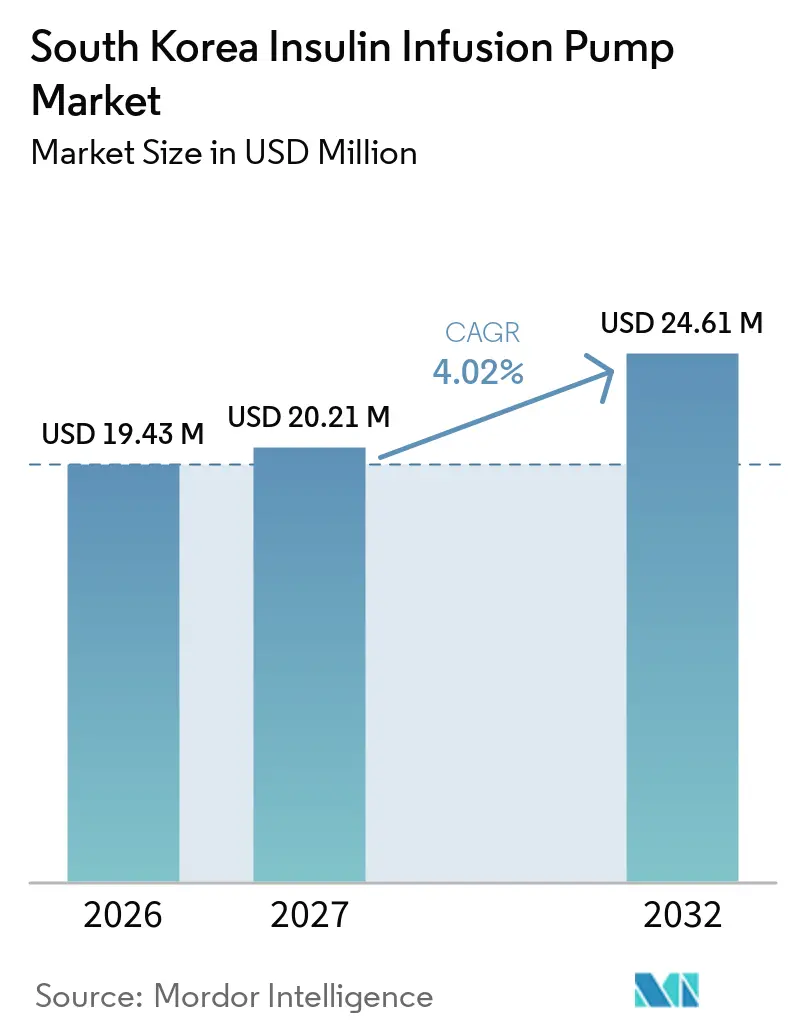
The South Korea Insulin Infusion Pump Market size is projected to be USD 19.43 million in 2026, USD 20.21 million in 2027, and reach USD 24.61 million by 2032, growing at a CAGR of 4.02% from 2027 to 2032.
Diabetes patients are more prone to experience complications if they become infected with a virus. Diabetes was found in 14.6% of H1N1 patients and 54.4% of Middle East respiratory syndrome (MERS-CoV) cases in a previous study. Diabetes, one of the most common comorbidities in COVID-19, was related to higher mortality and morbidity. Diabetes has also been listed as a potential risk factor by the World Health Organisation (WHO) and the Centres for Disease Control and Prevention (CDC). Diabetes, one of the most common comorbidities in COVID-19, has been related to higher mortality and morbidity. Diabetes has also been listed as a potential risk factor by the World Health Organisation (WHO) and the Centres for Disease Control and Prevention (CDC).
According to an academic group's datasheet, one in every seven Koreans over 30 has diabetes, although their illness detection and treatment rates remain poor. Diabetes is more common among adults in South Korea, and its economic cost exceeds general cancer. Diabetes complications or associated comorbidities, as well as hospitalization, incur significant costs. Controlling diabetic complications, using healthcare resources, and reducing the financial burden requires effective strategies. Increased understanding of the scope and specific components of the economic burden of diabetes in Korea is likely to motivate health officials to prioritize the prevention and management of the disease and to devote more healthcare resources to diabetes.
As a result of the reasons above, the studied market is expected to increase throughout the analysis period.
Note: Market numbers in this report are based on Mordor Intelligence's proprietary estimation framework, which combines nine months of actuals with Q4 projections for base year 2026.
South Korea Insulin Infusion Pump Market Trends and Insights
Insulin Pump is Expected to Witness Growth Over the Forecast Period
Insulin pump includes devices designed to administer insulin continuously or intermittently to help individuals manage diabetes effectively. These pumps replicate the insulin-delivery function of the pancreas and serve as an alternative to multiple daily injections or insulin pens. Insulin infusion pumps are primarily used by individuals with type 1 diabetes mellitus (T1DM) and can support near-physiological insulin delivery across different age groups. Remote-controlled pumps also allow parents or caregivers to pause insulin delivery or administer bolus doses from a distance while a child is playing or eating. The market is driven by the increasing prevalence of diabetes, greater awareness of advanced diabetes management solutions, growing adoption of remote monitoring and automated insulin delivery technologies, and favorable reimbursement coverage for eligible patients.
Insulin pumps have been utilized in Korean diabetic patients since the late 1970s and early 1980s. Two individuals utilized an insulin pump, according to a study of 33 kids hospitalized at the Department of Pediatrics at Seoul National University Hospital between 1967 and 1983. Although there was a little delay in introducing rigorous diabetic therapy in Korea, it appears to have followed the pattern seen elsewhere. According to a recent study, between 2010 and 2022, traditional insulin therapy declined from 33.9% to 9.0% in Korean children and adolescents with T1D, whereas MDI and insulin pumps grew from 63.9% and 2.1% to 77.0% and 14.0%, respectively. New technologies in the market are driving the insulin pump market in the forecast period, such as artificial pancreas systems that synchronize an insulin pump and continuous glucose monitor to deliver an almost completely hands-off approach to diabetes management and the newest one cleared by the FDA aims to make that goal even easier to achieve.
Rising diabetes prevalence in the country is anticipated to boost the market studied
Diabetes is more common among adults in South Korea, and its economic cost exceeds general cancer. Diabetes complications or associated comorbidities, as well as hospitalization, incur significant costs. Controlling diabetic complications, using healthcare resources, and reducing the financial burden requires effective strategies. Increased understanding of the scope and specific components of the economic burden of diabetes in Korea is likely to motivate health officials to prioritize the prevention and management of the disease and to devote more healthcare resources to diabetes.
Diabetic pharmaceuticals help people with diabetes stabilize and maintain their blood glucose levels. Diabetes drugs are commonly used to keep diabetes under control. Diabetes drugs are divided into numerous categories. Each medication class has a distinct mechanism of action for decreasing blood sugar. A drug may work by stimulating the pancreas to make and release more insulin, decreasing the liver's ability to generate and release sugar, suppressing the activity of intestinal enzymes that break down carbohydrates, and various other ways. It also increases insulin sensitivity in cells, lowering the kidneys' ability to absorb sugar and increasing the amount of sugar discharged in the urine. The prevalence of type-1 and type-2 diabetes in the adult South Korean population is high, as is the number of people who have not yet been diagnosed. Because of an aging population and an unhealthy lifestyle (the proportion of energy intake from carbs is higher in diabetes patients than in those without diabetes, while that from protein and fat is lower), the incidence of type 2 diabetes is predicted to climb significantly over the next few years. For type 2 diabetes patients, high-quality therapy, including accurate monitoring, risk factor reduction, and active self-management, is crucial for preventing complications.
As a consequence of the factors above, the investigated market is predicted to grow during the investigation.
Competitive Landscape
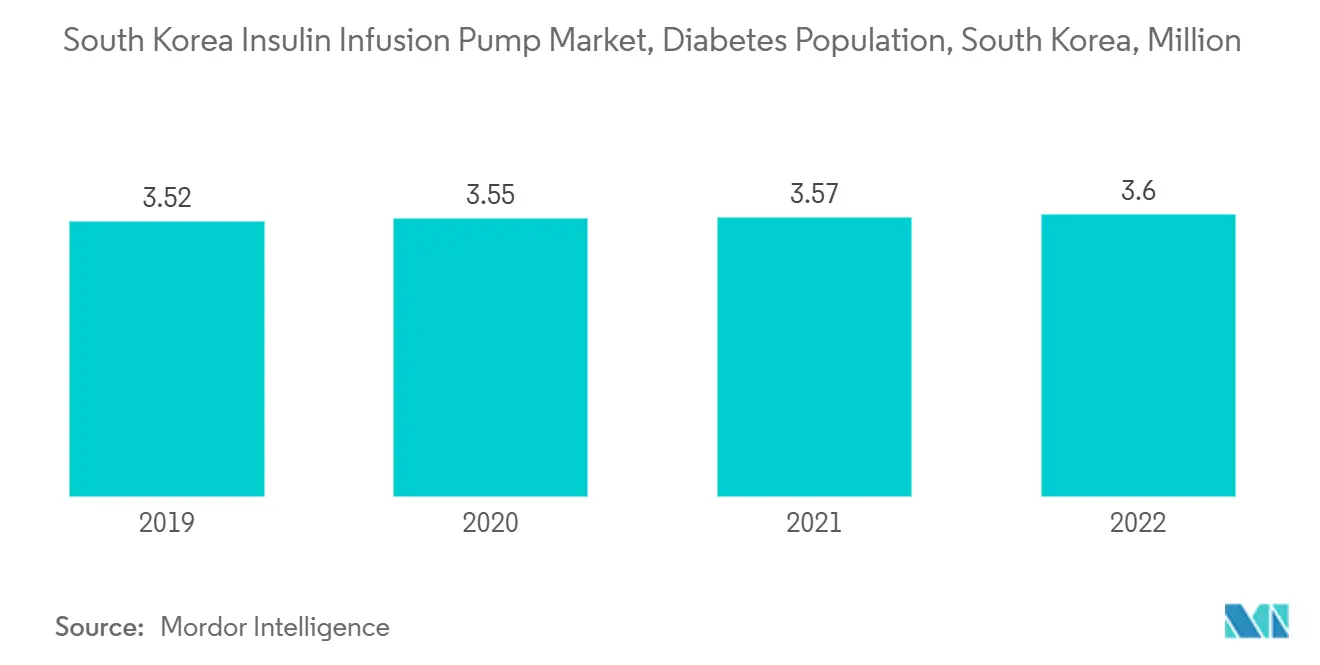
Due to the existence of only a few big businesses operating internationally and locally, the insulin infusion pump industry is concentrated. The competitive landscape includes examining a few well-known worldwide and local organizations, such as Medtronic PLC, Insulet Corporation, Ypsomed, Ascensia Diabetes Care, and Tandem Diabetes Care.
South Korea Insulin Infusion Pump Industry Leaders
-
Medtronics
-
Ascensia Diabetes Care
-
Insulet Corporation
-
Tandem Diabetes Care
-
Ypsomed
- *Disclaimer: Major Players sorted in no particular order
Recent Industry Developments
- May 2023: Medtronic agreed to buy EOFlow, a company based in South Korea that makes a tubeless, disposable insulin pump on a patch. The company will offer a public tender to acquire all of EOFlow's outstanding public shares for 971 billion South Korean won (USD 738 million). The purchase will likely allow Medtronic to compete with Insulet, which has gained market share with its tubeless insulin pumps, and Tandem Diabetes Care, which agreed to buy patch pump maker AMF Medical last year.
- May 2023: Tandem plotted the late 2023 launch of a slimmed-down insulin pump with Dexcom and Abbott CGM integrations.
South Korea Insulin Infusion Pump Market Report Scope
An insulin pump delivers insulin to control blood sugar and minimize hypoglycemia's effects. The pump comprises a pump reservoir like an insulin cartridge, a battery-operated pump, and a computer chip that allows the user to control the exact amount of insulin being delivered. The pump is attached to a thin plastic tube (an infusion set) with a soft cannula (or needle) at the end through which insulin passes. South Korea's insulin infusion pumps market is segmented by component (pump device, infusion set, and reservoir). The report offers the value (USD) and Volume (units) for the above segments.
| Insulin Pump Device |
| Infusion Set |
| Reservoir |
| Insulin Infusion Pump | Insulin Pump Device |
| Infusion Set | |
| Reservoir |
Key Questions Answered in the Report
How big is the South Korea Insulin Infusion Pump Market?
The South Korea Insulin Infusion Pump Market size is expected to reach USD 20.21 million in 2027 and grow at a CAGR of 4.02% to reach USD 24.61 million by 2032.
What is the current South Korea Insulin Infusion Pump Market size?
In 2026, the South Korea Insulin Infusion Pump Market size is expected to reach USD 19.43 million.
Who are the key players in South Korea Insulin Infusion Pump Market?
Medtronics, Ascensia Diabetes Care, Insulet Corporation, Tandem Diabetes Care and Ypsomed are the major companies operating in the South Korea Insulin Infusion Pump Market.
What years does this South Korea Insulin Infusion Pump Market cover, and what was the market size in 2025?
In 2025, the South Korea Insulin Infusion Pump Market size was estimated at USD 18.68 million. The report covers the South Korea Insulin Infusion Pump Market historical market size for years: 2021, 2022, 2023, 2024, and 2025. The report also forecasts the South Korea Insulin Infusion Pump Market size for years: 2027, 2028, 2029, 2030, 2031, and 2032.