
South Korea Intensive Care Unit (ICU) Beds Market Size and Share
Market Overview
| Study Period | 2020 - 2031 |
|---|---|
| Forecast Data Period | 2026 - 2031 |
| Base Year Market Size (2025) | USD 0.99 Million |
| Market Size (2026) | USD 1.04 Million |
| Market Size (2031) | USD 1.35 Million |
| Growth Rate (2026 - 2031) | 5.27 % |
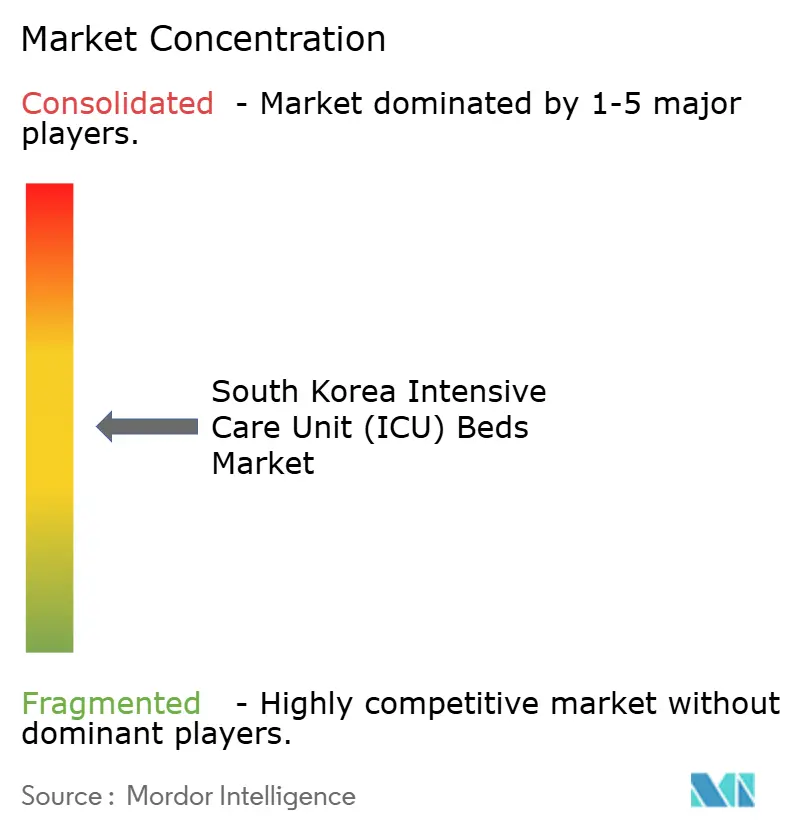
| Market Concentration | Medium |
Major Players *Disclaimer: Major Players sorted in no particular order Image © Mordor Intelligence. Reuse requires attribution under CC BY 4.0. | |
South Korea Intensive Care Unit (ICU) Beds Market Analysis by Mordor Intelligence
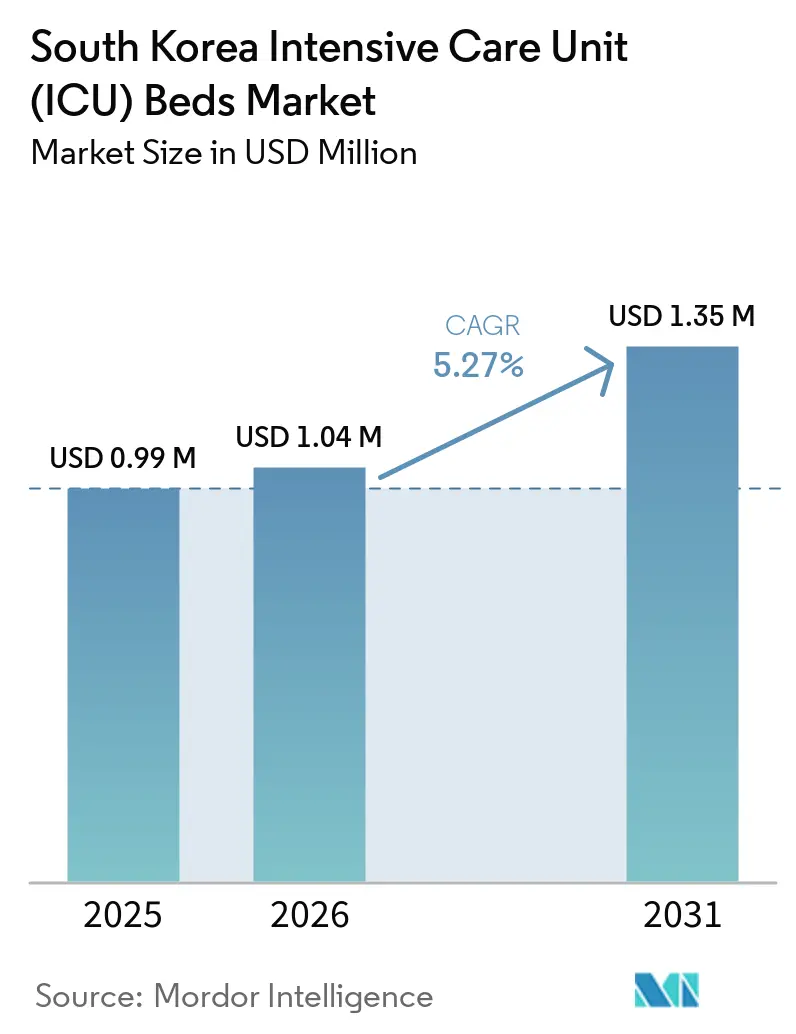
The South Korea Intensive Care Unit (ICU) Beds Market size is projected to be USD 0.99 million in 2025, USD 1.04 million in 2026, and reach USD 1.35 million by 2031, growing at a CAGR of 5.27% from 2026 to 2031. Several key factors are driving the growth of the ICU beds market in South Korea, including the rising prevalence of chronic illnesses, technological advancements in smart beds, and the expansion of healthcare facilities.
The significant burden of chronic conditions like cardiovascular diseases, diabetes, and respiratory diseases drives the need for advanced ICU infrastructure, subsequently fueling the demand for specialized ICU beds. For instance, an article published in the Journal of Korean Medical Science in December 2024 highlighted that about 100,000 new cases of ischemic stroke occur in South Korea each year. This highlights the growing demand for intensive care unit (ICU) beds in the country as healthcare facilities strive to accommodate the increasing number of stroke patients requiring critical care.
Government initiatives to integrate advanced technologies into ICU beds aim to enhance critical care infrastructure, improve patient outcomes, and optimize hospital efficiency, thereby fueling market growth. For instance, in December 2024, South Korea's Ministry of Health and Welfare planned to invest USD 1.7 million (KRW 2.5 billion) in a network of remote ICUs for regional hospitals by 2025. At the core of this system is an integrated control center that monitors the condition of patients in smaller hospitals' ICUs, utilizing an alarm system to identify deteriorating patients quickly. This 24/7 control center will track patient status, bed availability, and any abnormal symptoms. This development is expected to positively impact the South Korea ICU beds market by driving demand for advanced ICU infrastructure and related equipment. The integration of remote monitoring systems and enhanced patient care capabilities is likely to encourage further investments in ICU technologies, contributing to market growth during the forecast period.
Thus, the high prevalence of chronic diseases such as cardiovascular diseases, coupled with government initiatives to improve ICU facilities, is expected to significantly drive the growth of the South Korean ICU beds market. However, the discrepancy between ICU bed demand and supply, as well as the shortage of medical professionals, may hinder market expansion.
Note: Market size and forecast figures in this report are generated using Mordor Intelligence’s proprietary estimation framework, updated with the latest available data and insights as of January 2026.
South Korea Intensive Care Unit (ICU) Beds Market Trends and Insights
Beds Segment is Expected to Have Significant Growth in the Market Over the Forecast Period
South Korea's bed segment is experiencing substantial growth fueled by growing government healthcare investments. This surge is further propelled by an aging population and heightened emphasis on infection control. These factors underscore the crucial role of this segment in meeting the growing demand for advanced beds, particularly in intensive care units.
The increasing ICU bed occupancy rate in the country further elevates the need for advanced ICU beds. For instance, according to data published in the Yonsei Medical Journal in 2024, South Korea's ICU bed occupancy is projected to exceed capacity, reaching 102.7% in 2030 and 129.8% by 2040. This indicates a critical need for expansion in the ICU bed segment within South Korea's ICU beds market to address the growing demand and prevent severe shortages.
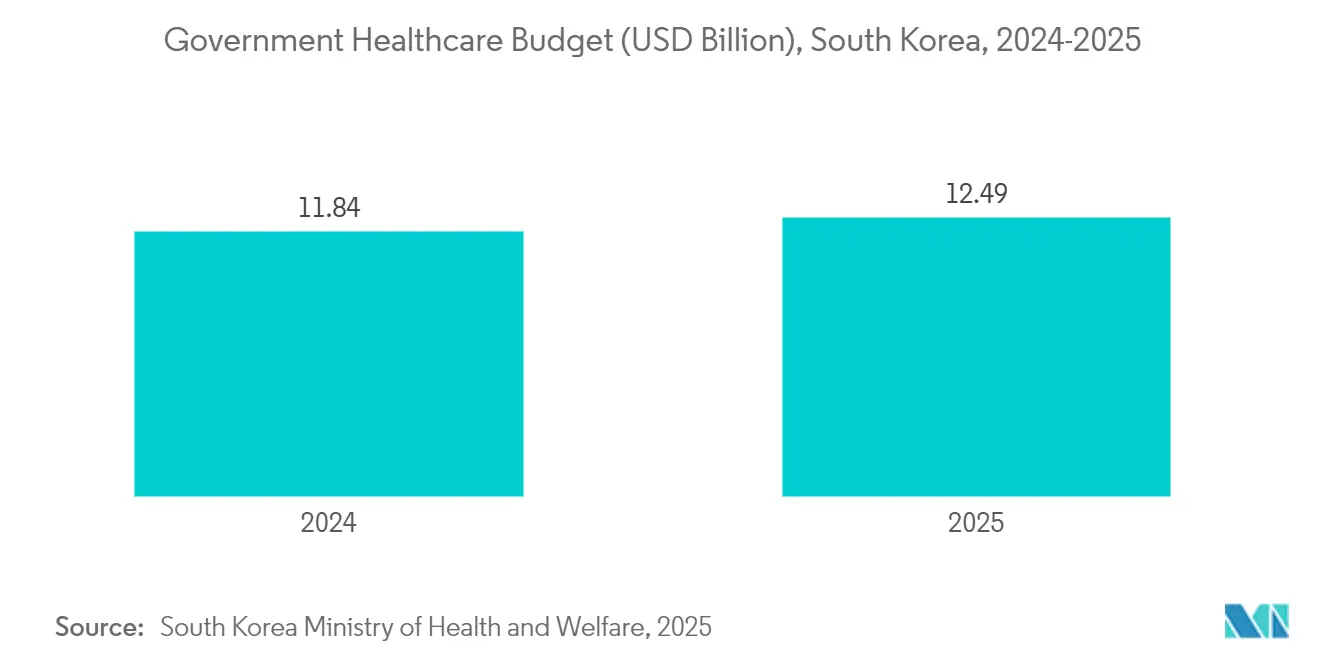
The increasing government investments to strengthen its healthcare system drive the demand for ICU beds. For instance, in August 2024, South Korea's Ministry of Health and Welfare reported a budget of USD 94.44 billion (KRW 125.65 trillion) for 2025, with USD 12.49 billion (KRW 18.41 trillion) allocated to healthcare. This represented a USD 642.1 million (KRW 946.3 billion) increase from 2024. Thus, the increased healthcare budget is expected to positively impact the ICU beds segment in South Korea, as investments in essential medical care and infrastructure are likely to drive demand for advanced ICU beds.
Thus, the beds segment growth is driven by increasing ICU bed occupancy rates and substantial government investments in healthcare infrastructure and essential medical care, positioning this segment as a critical area of focus to address the country's healthcare challenges.


Electric ICU Beds Segment is Expected to Have Fastest Growth in the Market Over the Forecast Period
Electronic ICU beds are specialized medical equipment designed to support critically ill patients who require intensive monitoring and treatment. These beds often feature advanced technologies such as electric adjustability, pressure redistribution systems, and integrated monitoring capabilities to enhance patient safety and comfort.
The segment's growth is driven by factors such as the increasing focus on infection control and the rising geriatric population. The growing emphasis on infection prevention and control (IPC) in hospitals and healthcare facilities is driving demand for electronic ICU beds, as they play a vital role in minimizing hospital-acquired infections (HAIs) and improving patient safety. Beds with fluid-resistant and non-porous components help reduce bacterial growth, supporting hospital infection control standards. For instance, in October 2024, the Korea Disease Control and Prevention Agency (KDCA) highlighted the critical role of IPC practices for healthcare personnel, patients, and visitors, aiming to minimize HAI risks and foster secure healthcare environments. The electronic ICU bed segment in South Korea is expected to witness steady growth, driven by the increasing emphasis on cost-effective and durable solutions for infection prevention in critical care environments.
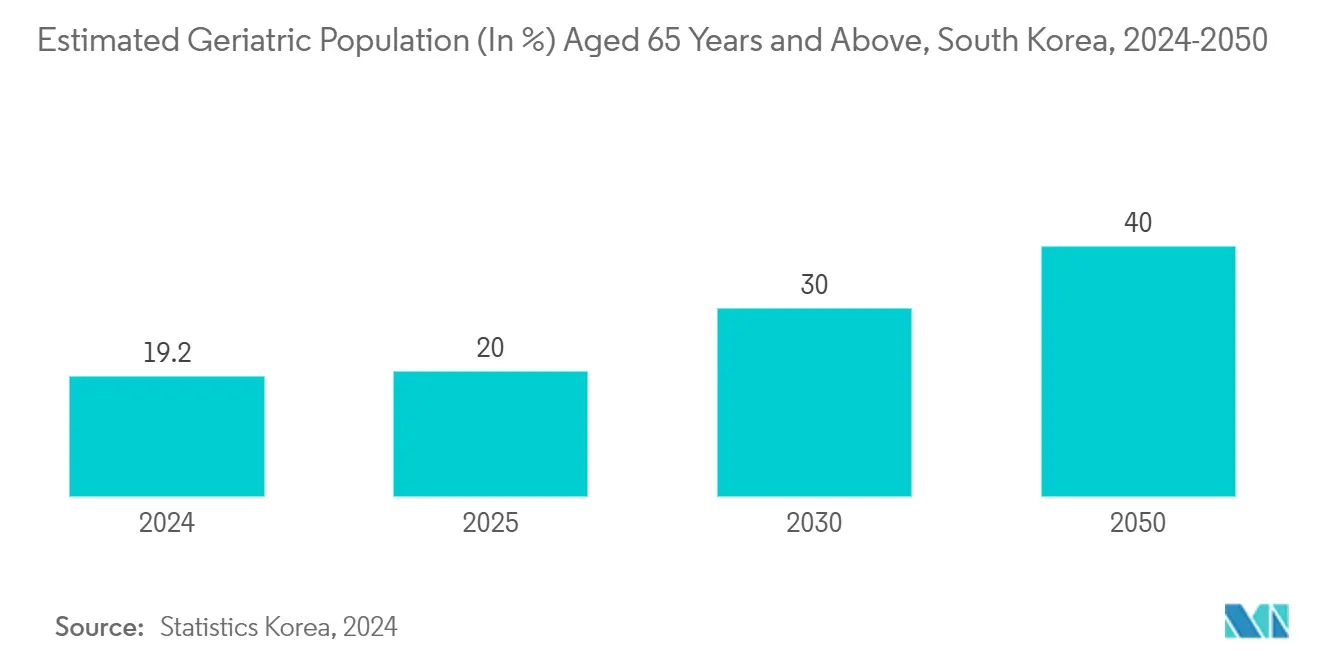
The growing elderly population in South Korea is also driving increased demand for intensive medical care, particularly ICU facilities equipped with advanced beds. For instance, in December 2024, the South Korean Ministry of the Interior and Safety reported that South Korea is classified as a "super-aged" society, with over 20% of its population aged 65 or older in 2024. This demographic shift is expected to drive significant demand in the electronic ICU bed segment within the South Korean market, as the aging population typically requires more intensive healthcare services.
Thus, the electronic ICU bed segment in South Korea is expected to experience sustained growth. This growth is driven by the increasing infection control measures and the rising demand for intensive care solutions due to the aging population.
Competitive Landscape
The ICU beds market in South Korea is semi-consolidated, with numerous local and international manufacturers supplying a wide range of products. The global market players are major suppliers of advanced ICU beds to hospitals and other healthcare providers in South Korea. Some of the key market players include Stryker Corporation, Linet Spol. S R.O., Baxter (Hil-Rom Holdings Inc., Getinge AB, and Paramount Bed Co. Ltd, among others.
South Korea Intensive Care Unit (ICU) Beds Industry Leaders
Stryker Corporation
Linet Spol. S R.O.
Baxter (Hil-Rom Holdings Inc.)
Getinge AB
Paramount Bed Co. Ltd
- *Disclaimer: Major Players sorted in no particular order

Recent Industry Developments
- December 2024: Korea University Anam Hospital inaugurated its "Emergency Intensive Care Unit 2," featuring 6 negative-pressure isolation rooms and 4 general intensive care rooms. This new unit is equipped with a state-of-the-art patient bed monitoring system and is expected to improve both patient care quality and medical staff efficiency. This development is expected to contribute positively to the growth of South Korea's ICU beds market, driven by increasing investments in advanced healthcare infrastructure and rising demand for critical care facilities.
- August 2024: Seoul National University Bundang Hospital (SNUBH) inaugurated Gyeonggi Province's first pediatric intensive care unit (PICU), offering expanded facilities, specialized personnel, and advanced equipment for focused and efficient care of critically ill children. Building on its existing 40-bed NICU and separate pediatric emergency room, SNUBH planned to bolster its specialized pediatric care system by recruiting more pediatric critical care physicians in 2025 and investing in further specialized medical equipment for children.


South Korea Intensive Care Unit (ICU) Beds Market Report Scope
According to the report's scope, ICU beds are specialized medical equipment designed to meet the unique needs of critically ill patients in intensive care units (ICUs). These beds offer advanced features designed to enhance patient comfort, safety, and the effectiveness of medical treatment.
The South Korea ICU beds market in the country. The South Korea ICU beds market is segmented by product type, which includes electric ICU Beds and manual ICU Beds. The report offers the market size in terms of both value (in USD) and volume (in units) for the above segments.
| Electric ICU Beds |
| Manual ICU Beds |
| By Product Type | Electric ICU Beds |
| Manual ICU Beds |


Key Questions Answered in the Report
How big is the South Korea ICU Beds Market?
The South Korea ICU Beds Market size is expected to reach USD 1.04 million in 2026 and grow at a CAGR of 5.27% to reach USD 1.35 million by 2031.
What is the current South Korea ICU Beds Market size?
In 2026, the South Korea ICU Beds Market size is expected to reach USD 1.04 million.
Who are the key players in South Korea ICU Beds Market?
Stryker Corporation, Linet Spol. S R.O., Baxter (Hil-Rom Holdings Inc.), Getinge AB and Paramount Bed Co. Ltd are the major companies operating in the South Korea ICU Beds Market.
What years does this South Korea ICU Beds Market cover, and what was the market size in 2025?
In 2025, the South Korea ICU Beds Market size was estimated at USD 0.99 million. The report covers the South Korea Intensive Care Unit Beds Market historical market size for years: 2019, 2020, 2021, 2022, 2023 and 2024. The report also forecasts the South Korea ICU Beds Market size for years: 2025, 2026, 2027, 2028, 2029 and 2030.
Page last updated on:


 Your data is secure and never sold or shared.


