
South Korea Dietary Supplements Market Size and Share
Market Overview
| Study Period | 2021 - 2031 |
|---|---|
| Forecast Data Period | 2026 - 2031 |
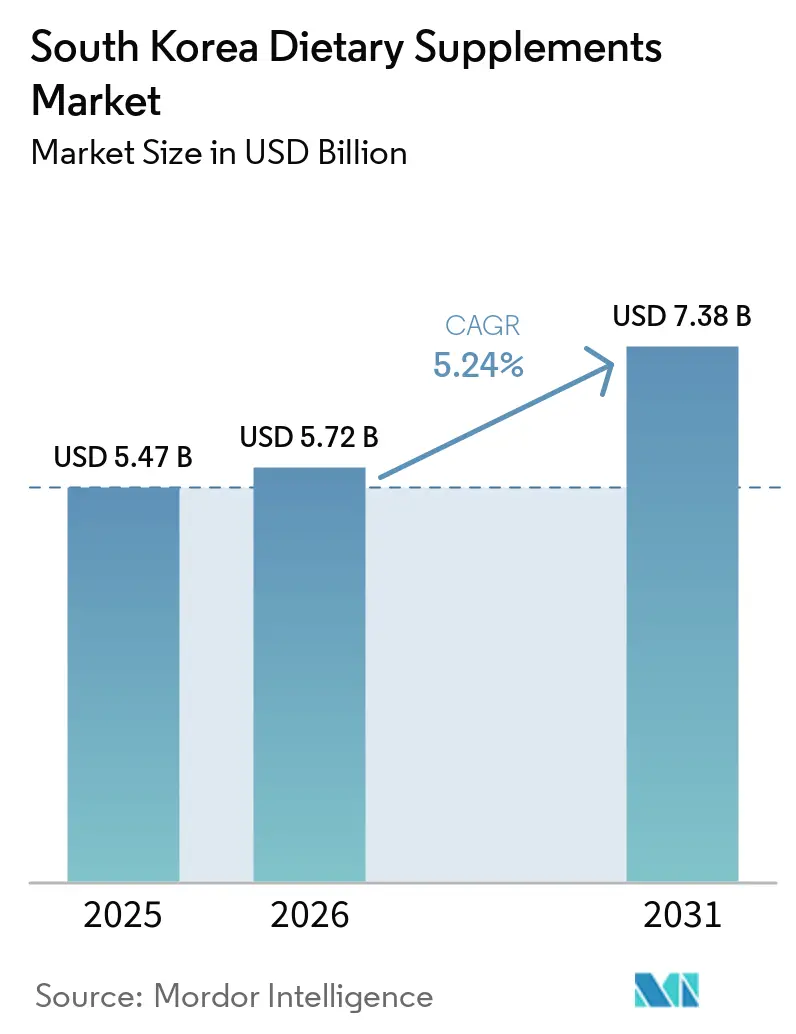
| Base Year Market Size (2025) | USD 5.47 Billion |
| Market Size (2026) | USD 5.72 Billion |
| Market Size (2031) | USD 7.38 Billion |
| Growth Rate (2026 - 2031) | 5.24 % |
| Market Concentration | Low |
Major Players
*Disclaimer: Major Players sorted in no particular order Image © Mordor Intelligence. Reuse requires attribution under CC BY 4.0. |
|
South Korea Dietary Supplements Market Analysis by Mordor Intelligence
The South Korean dietary supplements market size was valued at USD 5.47 billion in 2025 to Rapid Population Aging And Increasing Demand For Healthy Longevity Solutions
Rising Consumer Focus On Preventive Healthcare And Immune Health Management
Rising Demand For Beauty-From-Within Supplements
Expansion Of E-Commerce And Digital Health Platforms Improving Supplement Accessibility
Growing Demand For Clinically Supported Functional Ingredients
Increasing Popularity Of Personalized And Targeted NutritionUSD 5.72 billion in 2026, and is forecast to reach USD 7.38 billion by 2031 at a 5.24% CAGR over 2026-2031. According to data cited by Yonhap, the South Korean dietary supplements market is expected to be shaped primarily by the country’s aging population. By 2025, according to the Ministry of Interior and Safety, people aged 65 years and older are expected to account for 21.2% of the registered population, totaling 10.84 million individuals. The March 2025 rollout of the customized health functional food system is also expected to shift the South Korean dietary supplements market toward more personalized and premium products sold with guidance from pharmacists and nutritionists. The market is also shifting from legacy ingredients toward more clinically supported products, with vitamins and minerals leading current demand and prebiotic and probiotic supplements expected to record the fastest growth during the forecast period. Competition remains fragmented across more than 1,500 brands, and the market continues to reward companies that combine regulatory compliance, format innovation, and stronger evidence supporting functional claims.
Key Report Takeaways
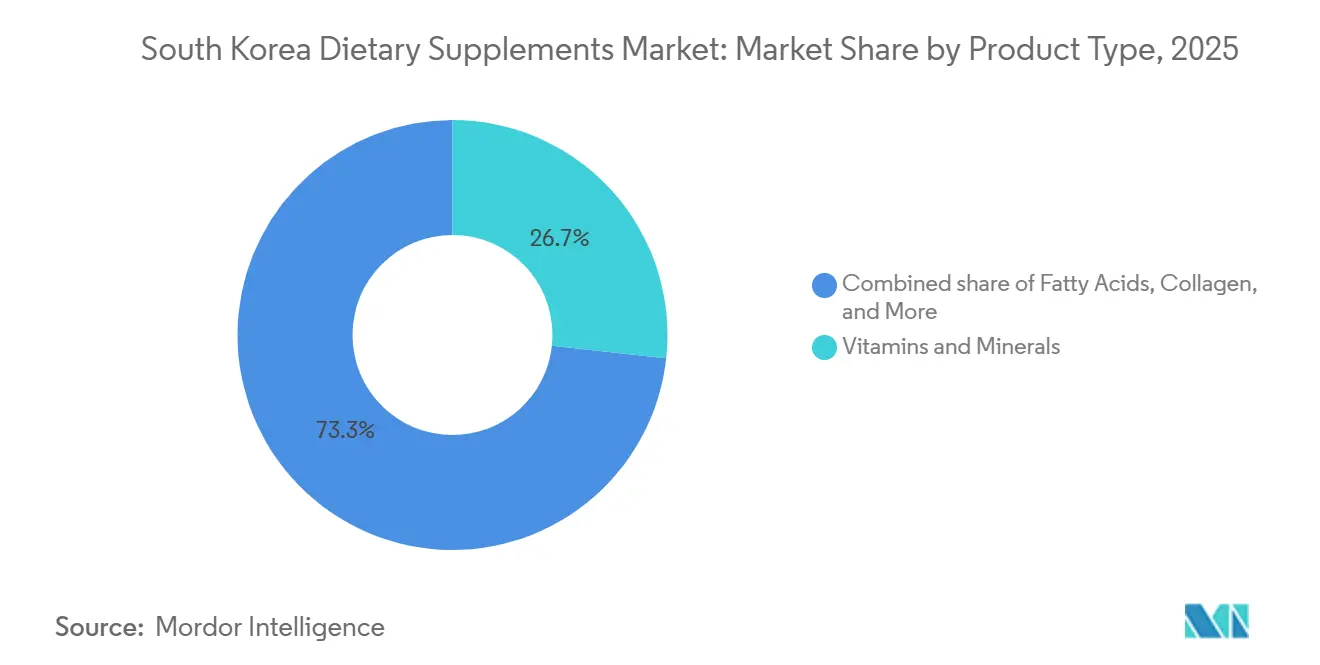
- By product type, vitamins and minerals led the South Korea dietary supplements market with a share of 26.72% in 2025, while prebiotic and probiotic supplements are anticipated to register the fastest CAGR of 7.13% during 2026-2031.
- By form, capsules and softgels retained a 33.42% share in 2025, whereas gummies are forecast to expand at a 6.88% CAGR through 2031.
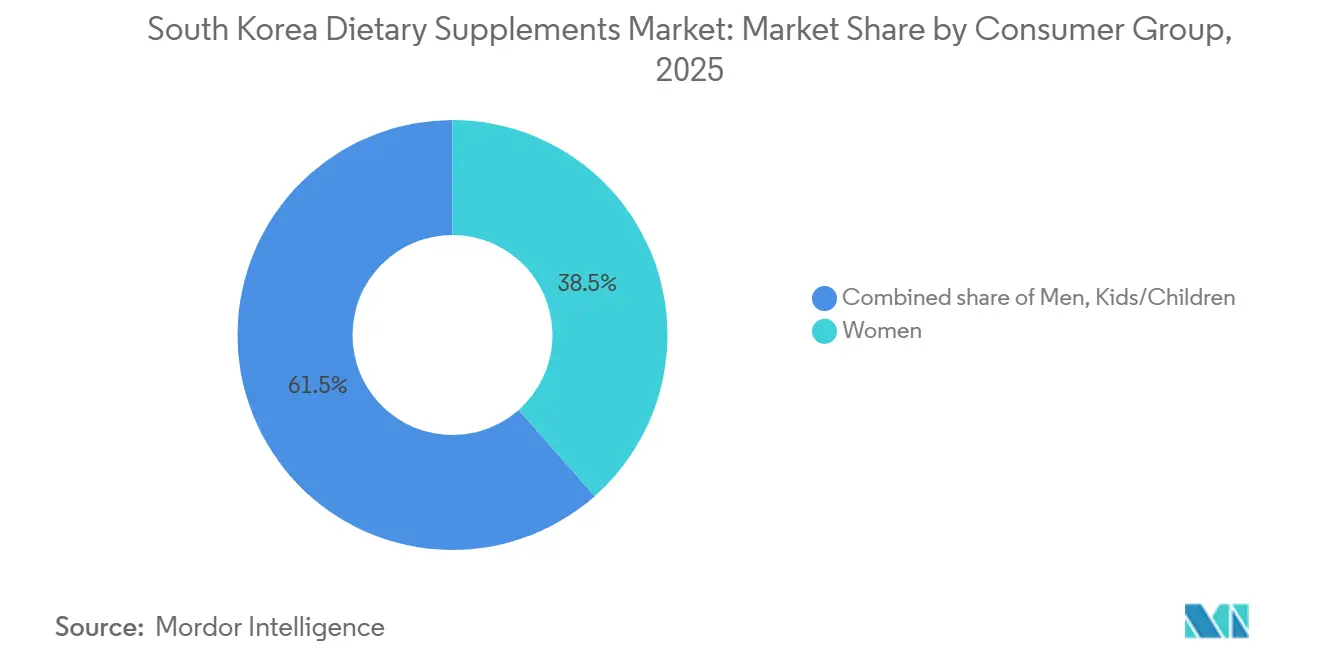
- By consumer group, women held 38.49% of 2025 revenue, but kids/children are expected to grow fastest at 6.67% through 2031.
- By distribution channel, pharmacy/drugstores led the vitamin supplements market with a share of 26.84% in 2025, while online retail channels are anticipated to register the fastest CAGR of 6.76% during 2026-2031.
Note: Market size and forecast figures in this report are generated using Mordor Intelligence’s proprietary estimation framework, updated with the latest available data and insights as of January 2026.
South Korea Dietary Supplements Market Trends and Insights
Drivers Impact Analysis*
| Driver | % Impact on CAGR Forecast | Geographic Relevance | Impact Timeline |
|---|---|---|---|
| Rapid Population Aging And Increasing Demand For Healthy Longevity Solutions | +1.4% | National, with elevated intensity outside the capital area (23.69% elderly ratio vs. 18.82% in the capital region) | Long term (≥ 4 years) |
| Rising Consumer Focus On Preventive Healthcare And Immune Health Management | +1.0% | National, with concentrated premium spend in Seoul and major metropolitan areas | Medium term (2–4 years) |
| Rising Demand For Beauty-From-Within Supplements | +0.8% | National; export spill-over to Southeast Asia and North America driven by K-health branding | Medium term (2–4 years) |
| Expansion Of E-Commerce And Digital Health Platforms Improving Supplement Accessibility | +0.7% | National; cross-border purchase driving import supplement demand via Coupang, Naver, and social-commerce platforms | Short term (≤ 2 years) |
| Growing Demand For Clinically Supported Functional Ingredients | +0.5% | National, with premium penetration in urban pharmacy and direct-to-consumer channels | Long term (≥ 4 years) |
| Increasing Popularity Of Personalized And Targeted Nutrition | +0.4% | National, Seoul-led adoption with early uptake among 30–45-year-old urban professionals | Medium term (2–4 years) |
| Source: Mordor Intelligence | |||
Rapid Population Aging and Increasing Demand for Healthy Longevity Solutions
South Korea’s elderly population is expected to reach 10.51 million in 2025, accounting for 20.3% of the total population, while the old-age dependency ratio is projected to increase from 29.3 in 2025 to 47.7 in 2035, according to XINHUANET in September 2025. This demographic shift is moving the South Korean dietary supplements market beyond routine vitamin consumption toward longer-term support for bone, cognitive, sleep, and cardiovascular health. Older consumers in the South Korea dietary supplements market also tend to show stronger brand loyalty and pay closer attention to recognized functional claims. This behavior supports premium positioning for products that meet higher compliance and evidence standards. According to the Food Safety Korea database (MFDS), South Korea is expected to have approved 489 health functional food ingredients by December 2025, comprising 96 standardized ingredients and 393 individually recognized functional ingredients [1]Source: National Library of Medicine, "Individually Recognized Functional Ingredients of Korean Health Functional Foods," pmc.ncbi.nlm.nih.gov . This indicates the continued diversification of supplement ingredients. As a result, brands with recognized ingredients are better positioned to capture higher average spending from aging households. The long runway for this demand is reinforced by the projected rise in the dependency ratio through the next decade.
Rising Consumer Focus on Preventive Healthcare and Immune Health Management
According to Health and Market, November 2025, South Korean households are expected to record an 83.6% supplement purchase rate in 2025, marking the fifth consecutive year at the highest level in the consumer survey. This trend indicates a broader shift across adult age groups from treatment-led spending to prevention-led spending. The consumer base is no longer concentrated among seniors, as adults in their 20s to 40s increasingly adopt regular supplement routines. Consumers often purchase immunity products alongside gut-health and skin-health products, supporting larger basket sizes and multi-product brand portfolios. Probiotics indicate that the overlap between immunity and gut health already has scale, as stated in a Nutraingredients Article in June 2026.
Rising Demand for Beauty-From-Within Supplements
Beauty-oriented ingestible products remain an important demand layer in the South Korean dietary supplements market, especially among younger female consumers active in digital commerce. Retail momentum in the category has been supported by stronger tourist purchases and higher exposure through beauty-led shopping environments. The result is a younger buyer profile than the broader supplement base, which gives brands a more effective route through short-form content and social commerce. Products with skin-related claims gain more traction when those claims are tied to recognized efficacy and cleaner regulatory positioning. This category also fits well with premium formats, because consumers often treat proof of performance as part of the value proposition. The category’s role is therefore larger than a niche beauty use case, since it also broadens entry points into the South Korea dietary supplements market.
Expansion of E-Commerce and Digital Health Platforms Improving Supplement Accessibility
Korea Health Functional Food Association consumer data indicates that 69.8% of supplement buyers are expected to use online channels as their primary purchase route in 2025, while open-market and social-commerce platforms are expected to account for 32.3% of online purchases. This channel mix lowers entry barriers for new products and expands product assortment without the shelf-space constraints of physical retail. It also supports auto-replenishment and subscription models, which can improve repeat purchases and customer retention. In July 2026, Amway states that to use South Korea as the launch market for its personalized gut health service and build more than 110,000 microbiome cases before expanding to Japan in 2026. This example highlights how digital infrastructure and consumers’ willingness to share health data make South Korea a practical test bed for personalized nutrition models. As recommendation tools, subscriptions, and loyalty systems converge, competitive advantage in the South Korea dietary supplements market is shifting from physical shelf access to data-driven customer management.
Restraints Impact Analysis*
| Restraint | (~) % Impact on CAGR Forecast | Geographic Relevance | Impact Timeline |
|---|---|---|---|
| Stringent Regulatory Approval and Compliance Requirements | -0.6% | National, acute for individually recognized ingredients needing clinical submissions | Long term (≥ 4 years) |
| Intense Market Competition and Product Saturation | -0.5% | National, with heavier pressure in mass-market vitamins, probiotics, and red ginseng | Short term (≤ 2 years) |
| Consumer Skepticism Toward Supplement Health Claims | -0.4% | National, amplified in urban markets with higher media literacy | Medium term (2-4 years) |
| Premium Product Pricing Limits Mass Adoption | -0.3% | National, with stronger drag in lower-income and rural segments | Medium term (2-4 years) |
| Source: Mordor Intelligence | |||
Stringent Regulatory Approval and Compliance Requirements
South Korea’s Health Functional Food Act requires companies marketing products as health functional foods to demonstrate ingredient safety and efficacy before receiving recognition. Partial amendments slated for 2025 are expected to change standards for several functional ingredients and add new raw material categories, increasing the need for reformulation and relabeling. Further proposed amendments in late 2025 are expected to add pressure on management standards and ingredient specifications. These developments may slow product launch timelines for some brands, but they also help preserve the level of trust that Korean consumers expect from regulated claims. In the South Korea dietary supplements market, companies that plan early for clinical substantiation and label compliance are likely to be better positioned than companies that rely only on aggressive promotion.
Intense Market Competition and Product Saturation
The market includes more than 1,500 active brands, maintaining high price pressure across vitamins, probiotics, red ginseng, and overlapping wellness categories. This crowding makes it harder for mid-tier brands to protect margins through standard promotions or broad distribution alone. Food groups such as Samyang Foods, Nongshim, and Pulmuone have increased competitive pressure by leveraging their existing production and retail strengths. Competition across categories now depends more on dosage format, concentration, and proprietary claims than on basic brand visibility. This shift makes it difficult for companies without distinctive scientific or manufacturing strengths to sustain long-term profitability. Therefore, the South Korea dietary supplements market continues to reward sharper differentiation, even as headline demand remains favorable.
*Our forecasts treat driver/restraint impacts as directional, not additive. The impact forecasts reflect baseline growth, mix effects, and variable interactions.
Segment Analysis
By Product Type: Vitamins Retain the Lead as Probiotics Reshape the Growth Curve
Vitamins and minerals account for 26.72% of the South Korean dietary supplements market size in 2025, making them the largest product type by current demand. In June 2026, South Korea's Ministry of Food and Drug Safety released production data indicating that vitamins and minerals are expected to remain the top-produced health functional food category for the second consecutive year in 2025. This performance aligns with the broad everyday use of multivitamins and minerals across age groups and income levels. The growth supports demand linked to cardiovascular, cognitive, and eye health, particularly among older consumers. As a result, the South Korea dietary supplements industry continues to derive current value from routine nutritional support, while adjacent functional categories strengthen their medical positioning.
Prebiotic and probiotic supplements are projected to expand at a CAGR of 7.13% within the South Korea dietary supplements market size through 2031, making them the fastest-growing product type. CJ Wellcare’s 2026 presentation on strain-specific prebiotic formulation, including data indicating up to 200-fold enhanced activity for CJLP133 in galactooligosaccharide environments, shows how growth is shifting toward clinically differentiated microbiome platforms. Collagen is also evolving into more sophisticated combinations with hyaluronic acid and antioxidants, aligning with premium consumer expectations. Vitamins and minerals are expected to lead exports followed by eicosapentaenoic acid and docosahexaenoic acid oils, indicating that domestic scale and export potential are reinforcing each other.



By Form: Capsules Anchor Volume as Gummies Attract a Younger Demographic
Capsules and softgels accounted for 33.42% of the market in 2025, maintaining their lead among delivery formats. These formats effectively support concentrated actives, such as omega-3 oils, fat-soluble vitamins, and probiotic blends, that require stronger protection. They also appeal to older consumers who prefer multiple functional ingredients in a single product rather than carrying multiple packs. Daewoong Pharmaceutical’s planned August 2025 launch of Haapssen, a 7-in-1 softgel using its X-GIS encapsulation technology, demonstrates how manufacturers are using the format to combine several actives in one unit. In the South Korea dietary supplements market, format leadership continues to favor products that simplify efficacy, dosage control, and routine adherence.
Gummies are projected to record a CAGR of 6.88% through 2031, making them the fastest-growing format in the South Korea dietary supplements market. Two user groups are driving this growth: children who need more palatable formats and adults aged 20 to 40 who value portability and habit formation. Chong Kun Dang’s April 2026 launch of Daily Wise, featuring seven gummy SKUs in seven-day pouches priced at KRW 1,000, demonstrates how low-ticket packs can expand access beyond premium channels. The launch also indicates that gummy manufacturing capabilities are becoming increasingly important for contract manufacturers and brand owners. Stable probiotic gummies and shelf-stable omega-3 gummies require more advanced technical execution than simple confectionery-style products. As a result, format competition in the South Korea dietary supplements market is increasingly linked to manufacturing capabilities rather than packaging appeal alone.
By Consumer Group: Women Drive Value, Kids Define the Growth Frontier
Women accounted for 38.49% of the South Korean dietary supplements market share in 2025, making them the largest consumer group by value. This share reflects their strong participation across immunity, beauty, bone health, and gut health applications, rather than dependence on a single category. Female consumers aged 25 to 45 also contribute significantly to online product discovery and subscription adoption, strengthening channel momentum through repeat purchases. Nu Skin Korea’s planned launch of LifePak Optimal in June 2026, formulated to Korean dietary intake standards with 13 vitamins and 9 minerals at 2,800 mg per day, highlights how brands are localizing products to build credibility and support daily use. This localization remains important in the South Korean dietary supplements market, as consumers often assess product relevance based on alignment with Korean dietary patterns and health expectations.
Men’s supplementation is expanding more selectively through condition-specific products rather than broad basket behavior. A prostate health launch scheduled for May 2026, based on the MFDS-recognized SHPro blend, shows how gender-specific science can support sharper positioning. Kids and children are forecast to register a 6.67% CAGR through 2031, even as the country continues to face a declining birth rate. This pattern reflects higher spending per child, as parents are willing to pay for immunity, cognition, and gut health products that are easier to administer and trust. CJ Wellcare’s YumGru children’s gummy line, introduced in 2024, also shows that brands are building dedicated product infrastructure around this group. The South Korea dietary supplements market is therefore broadening its age coverage even as total birth numbers remain under pressure. Growth in this segment depends less on population expansion and more on stronger per-child spending and stricter parental screening.
By Health Application: Immunity Outpaces General Wellness as the Fastest-Growing Focus
General health and wellness held 43.22% of the market in 2025, making it the largest application in the South Korea dietary supplements market. The segment includes daily multivitamin and mineral routines, which remain the backbone of repeat supplement use. Bone and joint products are gaining traction within this broad category, as population aging increases demand for calcium, vitamin D, glucosamine, and collagen combinations. Gastrointestinal and gut health products continue to expand as postbiotic and synbiotic concepts reach a wider consumer base through more varied formats. Skin, hair, and nail products are also becoming more visible as ingestible beauty moves closer to mainstream self-care retail. These trends indicate that general wellness continues to drive scale, even as more targeted functional needs grow faster around it.
Immunity enhancement is forecast to expand at a CAGR of 6.98% through 2031, making it the fastest-growing health application in the South Korea dietary supplements market. The category is evolving as brands move beyond positioning immunity as a single-purpose benefit. Companies increasingly combine immune claims with sleep, stress, and gut integrity support, enabling one product to address a broader range of consumer concerns. Amway Korea’s January 2026 launch of the AI-based myWellness LAB platform reflects this shift, as the platform uses microbiome and biomarker data to support more tailored healthy longevity routines. This approach increases the value of clinically differentiated probiotics and related ingredients. It also strengthens the role of digital ecosystems in guiding product choices within the South Korea dietary supplements market. As a result, immunity is becoming a broader platform for personalized daily management rather than only a seasonal or reactive purchase.
By Distribution Channel: Pharmacy Holds Share as Online Redefines the Access Model
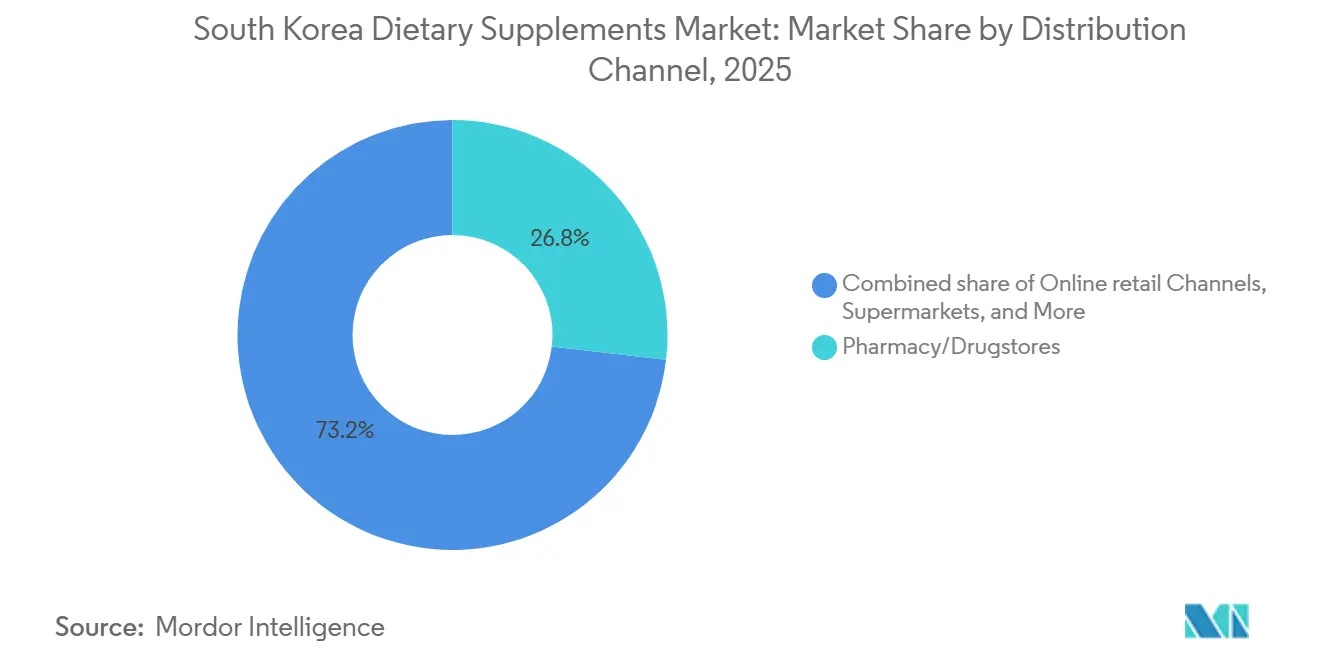
Pharmacies and drugstores accounted for 26.84% of sales in 2025, making them the largest channel in the South Korea dietary supplements market. The rollout of the customized health functional food framework in March 2025 is expected to strengthen pharmacies’ role as consultation points for more tailored supplement choices. Pharmacist guidance plays a critical role in product categories where recognized ingredients, dosage awareness, and trust influence purchase decisions. Supermarkets and hypermarkets continue to support routine and impulse-led multivitamin purchases. Other channels, including direct selling and TV home shopping, also remain relevant in loyalty-based brand systems. As a result, physical retail continues to matter, but its strongest advantage increasingly depends on guidance and trust rather than reach alone.
Online retail channels are forecast to grow at a CAGR of 6.76% through 2031, making them the fastest-growing route to market. Open-market and social-commerce platforms are especially important because they combine product discovery, price transparency, and frequent promotional cycles. Amway’s Korea-first personalized gut health rollout shows how companies use the country to test digital supplement models before wider regional expansion. Subscription delivery, recommendation tools, and loyalty programs help online channels retain repeat purchases in ways that offline competitors find harder to replicate. Therefore, the South Korea dietary supplements market is not moving online only for convenience. It is reorganizing channel power around data, personalization, and retention economics. Pharmacies continue to hold a strong position in trust-driven purchases, while online retail keeps expanding its advantage in scale, assortment, and routine replenishment.
Geography Analysis
The South Korea dietary supplements market remains a single national market, but demand intensity varies significantly across the country. The capital region recorded an elderly population share of 18.82% in 2025, below the national average of 21.21%, while the rest of the country averaged 23.69%. This indicates that the fastest-aging demand pockets are outside the capital area. As a result, provincial consumers play a more important role in long-term category growth than a Seoul-focused view would suggest. This trend helps explain the rising importance of bone health, cognition, sleep, and cardiovascular support products in provincial pharmacy and discount retail channels. It also indicates that national strategies that rely too heavily on metropolitan digital behavior may miss older consumers who continue to shop through local trust-based channels. Therefore, the South Korea dietary supplements market has a national legal boundary but a highly uneven regional demand profile.
According to an article published by NutraIngredients in June 2026, exports are adding another geographic layer to the category’s growth story. At the same time, products from the United States accounted for 43.4% of supplement imports in 2024, indicating that Korean consumers continue to assign strong credibility to premium international brands [2]Source: United States Department of Agriculture, "South Korea: Health Functional Food and Supplements," fas.usda.gov . Digital commerce makes the South Korea dietary supplements market less dependent on physical geography than many comparable consumer health categories.
Amway’s decision to launch personalized gut health services in South Korea before Japan reflects the country’s greater readiness for data-linked nutrition and digital care models. Korean food companies are also entering AI-linked nutrition platforms, with Daesang Wellife and Pulmuone developing more personalized systems for rollout in 2026. These developments position the South Korea dietary supplements market as a proving ground for precision nutrition models that combine product, data, and service layers.
Competitive Landscape
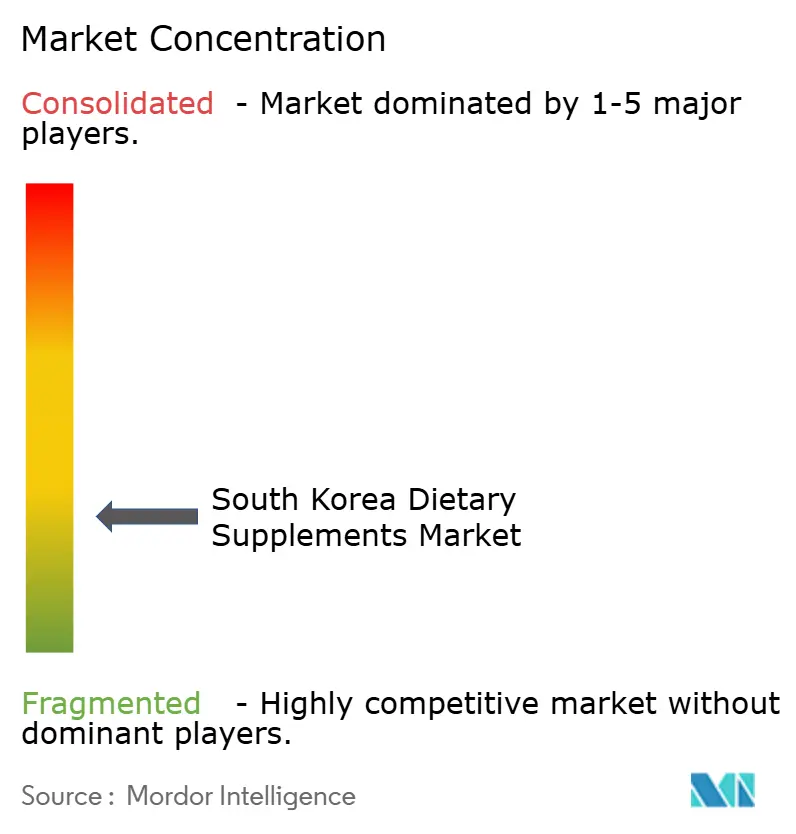
The South Korea dietary supplements market is highly fragmented, with domestic conglomerates, multinational sellers, specialized contract manufacturers, and food-sector entrants competing simultaneously. The company's performance indicates that legacy strength can remain effective when companies pair it with premium positioning and credible, recognizable ingredients. The next layer of competition is shifting toward clinical differentiation and personalization rather than broad media spending. In June 2026, CJ Wellcare advanced this strategy through strain-specific prebiotic research, a sleep-tech partnership with CirKadian, and the launch of a prostate health product based on the patented SHPro blend. These initiatives show how companies are building competitive advantages through recognized ingredients and application-specific science.
Novarex also broke ground on Osong Plant 2 in March 2026 to expand manufacturing capacity from KRW 500 billion to KRW 1 trillion. The United States Department of Commerce (International Trade Administration), using official data, reported that South Korea recognizes 28 nutrients, 69 functional ingredients, and 444 individually approved functional ingredients [3]Source: International Trade Administration, "South Korea Health Functional Food," trade.gov . This highlights the expansion of Korea's regulatory dietary supplement portfolio and opportunities for product innovation. Capacity expansion at this scale is significant because the South Korea dietary supplements market is increasingly influenced by companies that can manufacture for both domestic brands and export partners. It also strengthens South Korea’s role in contract production for premium and science-led supplement lines.
Food-sector entrants are further widening the competitive field by leveraging existing brand reach and production infrastructure in adjacent health categories. Samyang Foods’ SPINDLE line shows how companies are connecting metabolism research with functional product claims. As a result, competitive advantage is becoming more layered, with evidence, manufacturing capabilities, and digital capabilities all gaining importance. The South Korea dietary supplements market still offers opportunities for new brands, but the bar for long-term relevance is rising. Companies that combine compliant claims, scalable formats, and stronger customer data loops are better positioned than those relying only on shelf presence or discounting.
South Korea Dietary Supplements Industry Leaders
-
Amway Corporation
-
Kolmar BNH Co., Ltd
-
Novarex
-
SUHEUNG co., ltd.
-
Herbalife Nutrition Ltd.
- *Disclaimer: Major Players sorted in no particular order

Recent Industry Developments
- July 2026: Chong Kun Dang launched NURATEON, a dedicated health functional food research and development subsidiary, marking a strategic shift toward proprietary clinical-ingredient development as margins shrink in commoditized supplement categories. The company plans to cover the entire pharmaceutical research and development process, including analytical and formulation research as well as drug delivery system (DDS) research.
- July 2026: Amway Korea announced the expansion of its personalized gut health service to Japan. The service, co-developed with South Korean biotech company HEM Pharma and based on more than 110,000 accumulated microbiome cases, validates South Korea’s commercial viability as a launch market for personalized supplement platforms.
- July 2026: CJ WellCare has advanced male prostate health care in Korea with the launch of “Proliferous Chamdang Giulgi Premium.” The company developed the product by combining 20 years of know-how with technology from national institutions. CJ WellCare jointly developed the product with the Rural Development Administration as part of national research and applied a new material, the “Chamdang Guryonggi extraction complex,” which the Ministry of Food and Drug Safety recently recognized.
- June 2026: Nu Skin Korea launched LifePak Optimal, a multivitamin formulated to meet Korean dietary intake standards. The product contains 13 vitamins and 9 minerals at 2,800 mg per day and targets the growing market for nutritional products tailored to Korean dietary profiles.


South Korea Dietary Supplements Market Report Scope
Dietary supplements are products that supplement a normal diet by providing concentrated sources of nutrients or other bioactive ingredients, including vitamins, minerals, amino acids, botanicals, probiotics, enzymes, and other substances.
The South Korean dietary supplements market is segmented by product type, form, consumer group, health application, and distribution channel. By product type, the market is segmented into Vitamins and minerals, fatty acids, collagen, prebiotic and probiotic supplements, herbal supplements, and others. By form, the market is segmented into tablets, capsules and softgels, powders, gummies, liquids, and others. By consumer group, the market is segmented into Men, Women, and Kids/Children. By health application, the market is segmented into general health and wellness, immunity enhancement, skin, hair, and nail care, bone and joint health, gastrointestinal and gut health, energy and weight management, and other health applications. By distribution channel, the market is segmented into supermarkets/hypermarkets, pharmacy/drugstores, online retail channels, and other distribution channel. The Market Forecasts are Provided in Terms of Value (USD).
| Vitamins and Minerals |
| Fatty Acids |
| Collagen |
| Prebiotic and Probiotic Supplements |
| Herbal Supplements |
| Others |
| Tablets |
| Capsules and Softgels |
| Powders |
| Gummies |
| Liquids |
| Others |
| Men |
| Women |
| Kids/Children |
| General Health and Wellness |
| Immunity Enhancement |
| Skin, Hair, and Nail Care |
| Bone and Joint Health |
| Gastrointestinal and Gut Health |
| Energy and Weight Management |
| Other Health Applications |
| Supermarkets/Hypermarkets |
| Pharmacy/Drugstores |
| Online Retail Channels |
| Other Distribution Channel |
| By Product Type | Vitamins and Minerals |
| Fatty Acids | |
| Collagen | |
| Prebiotic and Probiotic Supplements | |
| Herbal Supplements | |
| Others | |
| By Form | Tablets |
| Capsules and Softgels | |
| Powders | |
| Gummies | |
| Liquids | |
| Others | |
| By Consumer Group | Men |
| Women | |
| Kids/Children | |
| Health Application | General Health and Wellness |
| Immunity Enhancement | |
| Skin, Hair, and Nail Care | |
| Bone and Joint Health | |
| Gastrointestinal and Gut Health | |
| Energy and Weight Management | |
| Other Health Applications | |
| By Distribution Channel | Supermarkets/Hypermarkets |
| Pharmacy/Drugstores | |
| Online Retail Channels | |
| Other Distribution Channel |


Key Questions Answered in the Report
What is the current and projected size of the South Korea dietary supplements market?
The South Korea dietary supplements market was valued at USD 5.47 billion in 2025 and is estimated to reach USD 5.72 billion in 2026. The market is further projected to grow to USD 7.38 billion by 2031, expanding at a CAGR of 5.24% during 2026–2031.
Which product type segment held the largest market share in 2025?
The Vitamins and Minerals segment held the largest share of the South Korea dietary supplements market in 2025, accounting for 26.72% of total market revenue.
Which form segment dominated the market in 2025?
Capsules and Softgels were the leading supplement form in 2025, capturing 33.42% of the market share.
What is the fastest-growing supplement form in South Korea?
The Gummies segment is expected to witness the highest growth among supplement forms, registering a CAGR of 6.88% during 2026–2031.
Which consumer group accounted for the largest share of the market in 2025?
The Women segment led the South Korea dietary supplements market in 2025, representing 38.49% of total sales.
Which health application segment held the largest market share in 2025?
General Health and Wellness was the largest health application segment, accounting for 43.22% of the market in 2025.
Page last updated on:





