
Market Overview
| Study Period | 2024 - 2031 |
|---|---|
| Forecast Data Period | 2026 - 2031 |
| Base Year Market Size (2025) | USD 325.20 Million |
| Market Size (2026) | USD 371.90 Million |
| Market Size (2031) | USD 800.10 Million |
| Growth Rate (2026 - 2031) | 16.55 % |
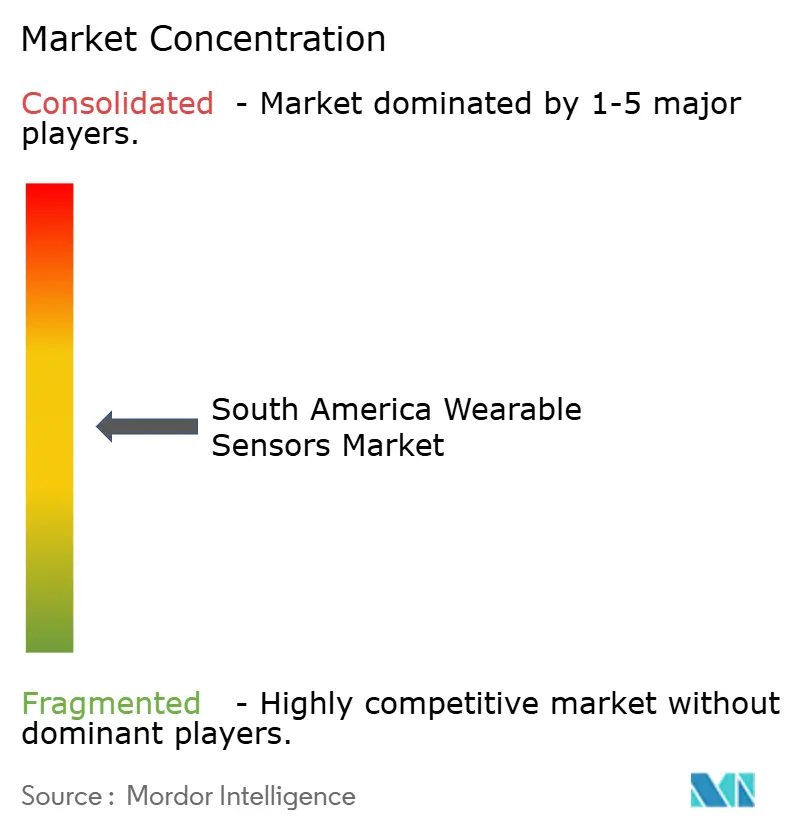
| Market Concentration | Medium |
Major Players *Disclaimer: Major Players sorted in no particular order Image © Mordor Intelligence. Reuse requires attribution under CC BY 4.0. | |
South America Wearable Sensors Market Analysis by Mordor Intelligence
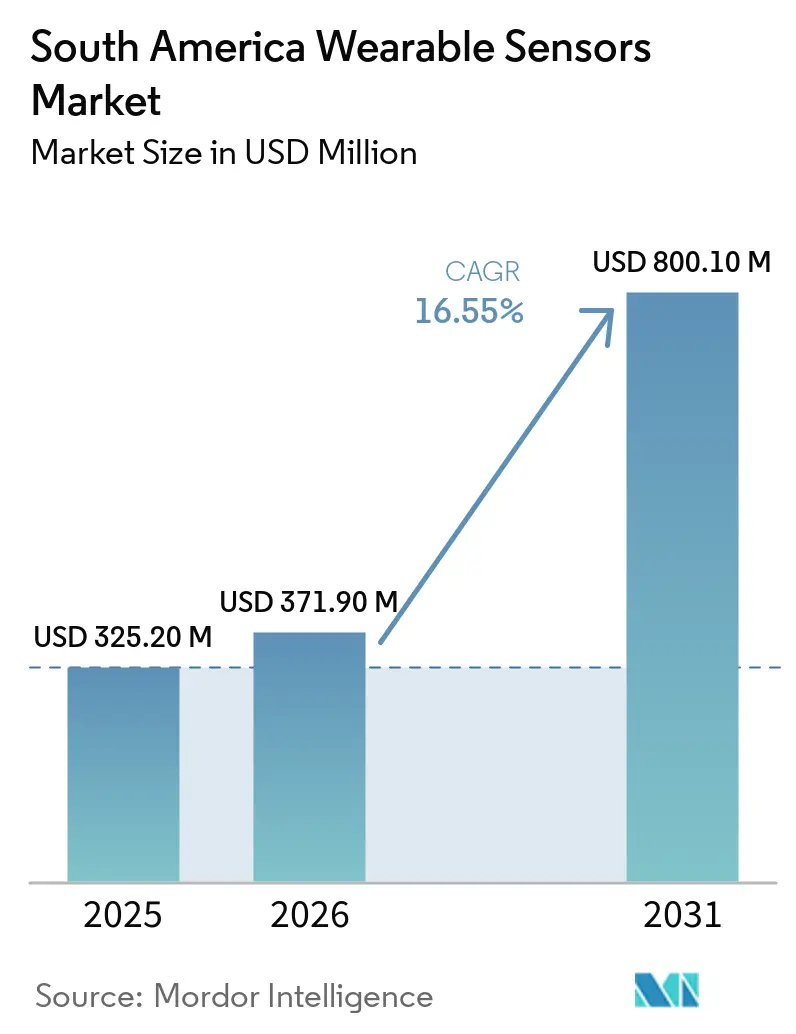
The South America Wearable Sensors Market size is projected to expand from USD 325.20 million in 2025 and USD 371.90 million in 2026 to USD 800.10 million by 2031, registering a CAGR of 16.55% between 2026 and 2031.
The wearable sensors market is shifting from basic activity tracking toward devices that support preventive care and routine health monitoring. Public telehealth programs and private healthcare providers are expanding channels for connected devices to reach patients. Improved mobile network coverage is also making continuous data transmission more practical in major urban areas. Device manufacturers are integrating additional sensors into smartwatches and patches, increasing the value proposition.
Key Report Takeaways
- By sensor type, health sensors held 32.00% of the South America wearable sensors market share in 2025, while biosensors are projected to expand at a CAGR of 22.50% through 2031.
- By technology, MEMS held 52.00% of the market share in 2025, while flexible and printed sensors are expected to expand at a CAGR of 24.50% through 2031.
- By device form factor, smartwatches accounted for 42.00% of the market share in 2025, while medical patches are projected to expand at a CAGR of 20.50% through 2031.
- By application, health and wellness accounted for 38.00% of the market share in 2025, while remote patient monitoring is expected to expand at a CAGR of 19.20% through 2031.
- By connectivity, Bluetooth Low Energy held 52.00% of the market share in 2025, while cellular connectivity, including LTE and 5G, is projected to expand at a CAGR of 22.00% through 2031.
- By geography, Brazil held 56.00% of the South America wearable sensors market share in 2025, while Colombia is expected to expand at a CAGR of 17.50% through 2031.
Note: Market size and forecast figures in this report are generated using Mordor Intelligence’s proprietary estimation framework, updated with the latest available data and insights as of January 2026.
Market Trends and Insights
Drivers Impact Analysis of South America Wearable Sensors Market*
| Driver | (~) % Impact on CAGR Forecast | Geographic Relevance | Impact Timeline |
|---|---|---|---|
| Connected Wearables for Preventive Health | 4.50% | Brazil and Colombia, with spillover to Argentina and Chile | Short term (≤ 2 years) |
| Remote Patient Monitoring and Telehealth Expansion | 3.80% | Brazil, with spillover to Colombia and Peru | Medium term (2-4 years) |
| Chronic Disease and Aging-Related Monitoring Needs | 3.20% | Brazil, Argentina, and Colombia | Long term (≥ 4 years) |
| Smartphone, 5G, and IoT Ecosystem Expansion | 2.50% | Brazil, Colombia, and the Rest of South America | Short term (≤ 2 years) |
| Lower MEMS and Sensor Component Costs | 1.50% | Global, with direct benefit to Brazil, Colombia, and Argentina | Medium term (2-4 years) |
| Brazil-Led Clinical Validation of AI-Enabled Wearables | 0.80% | Brazil, with emerging spillover to Colombia and Argentina | Medium term (2-4 years) |
| Source: Mordor Intelligence | |||
Rising Adoption of Connected Wearables for Preventive Health
Preventive health needs are supporting demand for connected monitoring devices in the South American wearable sensors market. Obesity in the Americas increased by 67.5%, and diabetes increased by 53.6% since 2000. The physical inactivity rate in South America stands at 35.6%, supporting the use of activity-tracking and health-alert devices[1]. These conditions increase the relevance of regular monitoring of activity, sleep, heart rate, and other health indicators for healthcare providers and users. Research by the Viva Bem Applied Research Center at UNICAMP found that smartwatch biosignal data could identify anxiety and stress states with more than 80% accuracy. Such research can increase the acceptance of wearable-generated data in clinical care pathways, extending its established role in consumer wellness.
Expansion of Remote Patient Monitoring and Telehealth
Brazil is establishing a clearer institutional pathway for remote monitoring within the South American wearable sensors market. Law No. 14,510 formalized telehealth in Brazil, while the SUS Digital Telessaúde program further integrated digital services into the public healthcare system[2]. The 2025 ICT in Health Survey is expected to report that 20% of Brazilian healthcare facilities use telemonitoring. In January 2026, the federal government will open Edital No. 1/2026 for IoT medical devices and telemedicine solutions under SUS Digital. This procurement channel can create more predictable demand for clinical devices than retail channels. It may also benefit suppliers that meet public procurement, clinical validation, and system-integration requirements.
Increasing Chronic Disease and Aging-Related Monitoring Needs
Chronic diseases and demographic changes are creating long-term demand for the South American wearable sensors market. In 2021, noncommunicable diseases caused 6 million deaths in the Americas, representing a 43% increase from 2000. Cardiovascular diseases and cancer accounted for more than half of these deaths, while nearly 40% occurred before the age of 70. InCor has initiated a clinical validation program involving 200 patients for an IoT-connected bracelet designed to identify cardiovascular risk before symptoms emerge. The regional population aged 70 years and older increased from 4.6% in 1980 to 7.8% in 2020 and is forecast to reach 17.4% by 2060. Rising life expectancy will increase demand for monitoring solutions that patients can use outside hospitals and clinics.
Smartphone, 5G, and IoT Ecosystem Expansion
Improving connectivity supports the more reliable use of wearable sensors for remote care across South America. In 2026, Nokia will expand its network modernization partnership with TIM Brasil to 14 additional states, covering 42% of Brazil’s population. The deployment will support enterprise applications, including healthcare IoT services. Cellular networks reduce device dependence on a nearby smartphone when transmitting alerts to care teams. This capability is particularly important for remote patient monitoring, where delayed data transmission can reduce a device’s practical value. It also encourages manufacturers to develop LTE- and 5G-enabled products alongside Bluetooth-based devices.
Restraints Impact Analysis of South America Wearable Sensors Market*
| Restraint | (~) % Impact on CAGR Forecast | Geographic Relevance | Impact Timeline |
|---|---|---|---|
| Device Affordability and Out-of-Pocket Purchase Barriers | -2.20% | Argentina, Colombia, Peru, and lower-income groups across Brazil | Medium term (2-4 years) |
| Fragmented Standards and Interoperability Constraints | -1.50% | Regional, particularly Brazil, Colombia, and Argentina | Medium term (2-4 years) |
| Reimbursement Gaps for Continuous Wearable Monitoring | -1.20% | Brazil, Colombia, Argentina, and the Rest of South America | Medium term (2-4 years) |
| Privacy, Cybersecurity, and Local Data-Governance Complexity | -0.80% | Brazil, with secondary impact across MERCOSUR | Long term (≥ 4 years) |
| Source: Mordor Intelligence | |||
Device Affordability and Out-of-Pocket Purchase Barriers
Affordability limits the adoption of clinical wearable devices in the South America wearable sensors market. Research on wearables in low- and middle-income countries identifies upfront device costs as a major barrier to adoption. Entry-level consumer devices are available for USD 25-60; however, they generally do not offer the medical-grade accuracy required for clinical applications. Devices equipped with validated optical biosensors or multichannel ECG capabilities typically retail for more than USD 150. Consequently, consumers and healthcare providers face different purchasing conditions for basic wellness products and clinical monitoring tools. Subscription-based monitoring models can distribute device costs over the duration of use rather than requiring an upfront payment.
Fragmented Standards and Interoperability Constraints
Fragmented regulatory frameworks and data systems increase the cost of institutional adoption in the South America wearable sensors market. Brazil, Colombia, and Argentina each maintain distinct medical device authorization pathways. Manufacturers must therefore address different documentation requirements, review timelines, and compliance standards across these countries. Health record systems also remain fragmented, making it difficult to integrate wearable data into existing clinical workflows. Brazil's National Data Protection Authority has identified cybersecurity risks associated with connected wearables and transparency in AI-driven diagnostics as priority concerns. These factors can delay clinical deployments, particularly for smaller companies with limited regulatory resources.
*Our forecasts treat driver/restraint impacts as directional, not additive. The impact forecasts reflect baseline growth, mix effects, and variable interactions.
South America Wearable Sensors Market Segment Analysis
By Sensor Type:
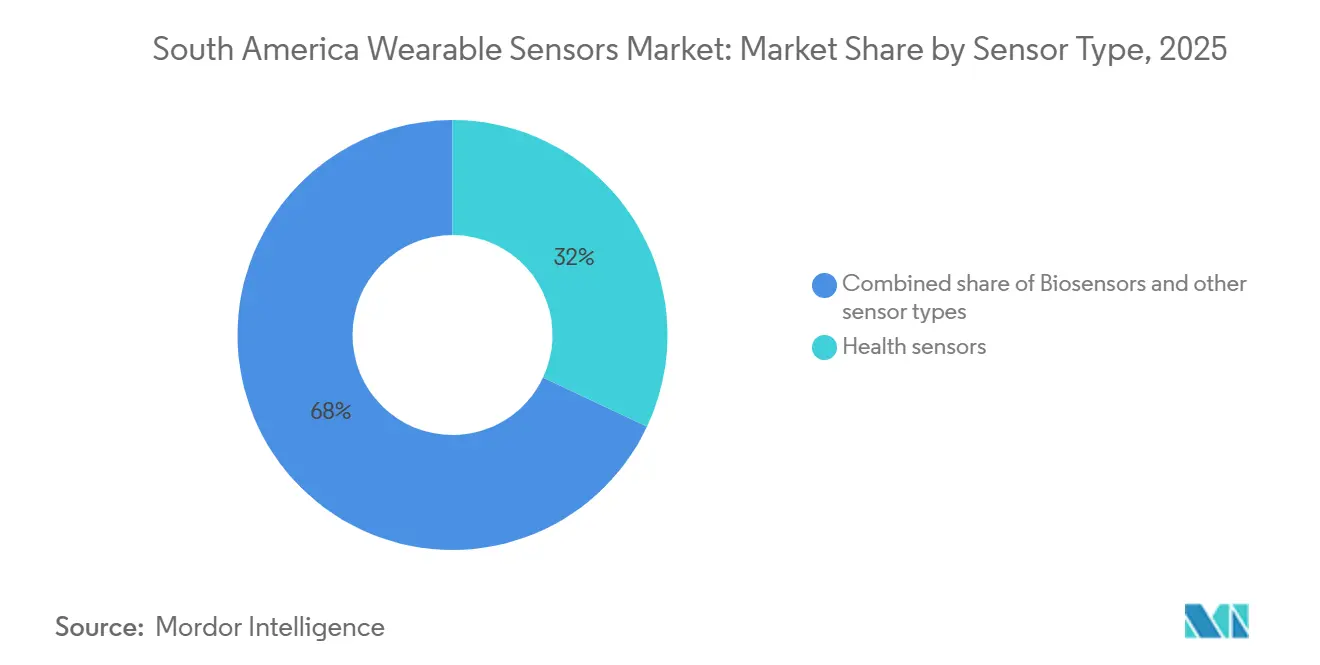
Health Sensors Lead, While Biosensors Extend Clinical ApplicationsHealth sensors are expected to account for 32.00% of the South America wearable sensors market by sensor type in 2025. Demand is supported by pulse oximetry, temperature measurement, and cardiovascular monitoring across consumer and clinical settings. These functions provide data that users and healthcare providers can apply to routine monitoring. The growing focus on noncommunicable disease management is also increasing interest in sensors that provide insights beyond basic wellness metrics. Biosensors are projected to expand at a CAGR of 22.50% from 2026 to 2031, supported by advances in electrochemical sensing and sweat-based biomarker detection. A 2026 study is expected to report an integrated flexible monitoring system with glucose sensitivity of 313.28 µA mm⁻¹ cm⁻² and limited signal drift over 30 hours[3]. Motion sensors remain important for activity classification and fall detection, functions that are becoming increasingly relevant as the region's older population expands. Optical sensors support photoplethysmography-based cardiovascular measurements in consumer watches. Their use has made heart-rate and blood-oxygen monitoring common in mid-range and premium devices. Other sensor types include pressure, temperature, and environmental sensors. These sensors have potential applications in occupational health settings serving agricultural and industrial workers. Global suppliers often address these requirements through general IoT product lines rather than dedicated wearable solutions, creating opportunities for devices designed for specific workplace conditions.

By Technology:
MEMS Retains Scale, While Flexible Sensors AdvanceMEMS is expected to account for 52.00% of the South America wearable sensors market by technology in 2025. The technology combines compact form factors, low power consumption, and manufacturing scale, making it suitable for high-volume wearable devices. STMicroelectronics is expected to integrate its LSM6DSV32X inertial module into Qualcomm's Snapdragon Wear Elite platform in March 2026. The module supports on-device machine-learning inference while operating at microamp-level current. Bosch Sensortec is also expected to introduce its BMI5 motion-sensor platform for wearable and hearable applications in 2026. These platform-level integrations can help suppliers reduce development timelines for device manufacturers while reinforcing MEMS as the standard technology for common motion-sensing functions. MEMS components suit watches and bands because they fit compact designs and operate with modest battery consumption. Their established production base also gives manufacturers access to components at the scale required for high-volume devices. These advantages are expected to support continued MEMS adoption in mainstream consumer products, even as alternative sensor formats gain traction in clinical applications. Flexible and printed sensors are projected to expand at a CAGR of 24.50% from 2026 to 2031. Their thin, conformal formats are suitable for skin-contact monitoring and disposable devices. A 2025 study is expected to report a flexible pressure sensor with sensitivity of 652.1 kPa⁻¹ and a response time of 36 milliseconds. These characteristics can support arterial pulse measurement in breathable wearable formats. CMOS sensors continue to support optical biosensing requirements in watches by providing the optical front end for photoplethysmography and SpO₂ measurements. Medical-grade packaging requires certification and can cost more than consumer-grade components, creating distinct supply conditions for clinical and wellness devices.
By Device Form Factor:
Smartwatches Lead, While Medical Patches Gain AdoptionSmartwatches are expected to account for 42.00% of the South America wearable sensors market by form factor in 2025. They combine health-monitoring capabilities with a device category that consumers already recognize and replace regularly. This broad functionality enables manufacturers to spread sensor costs across products that also address communication and lifestyle requirements. Samsung is expected to introduce the Galaxy Watch Ultra2 and Galaxy Watch9 in July 2026 with its BioActive sensor stack. The stack combines optical biosignal, electrical heart signal, and bioelectrical impedance analysis capabilities. The watches are also expected to include temperature, accelerometer, barometer, gyroscope, geomagnetic, and light sensors. Higher sensor density is becoming an important product differentiator in premium smartwatches. Medical patches are projected to expand at a CAGR of 20.50% from 2026 to 2031. They can support extended monitoring through disposable, skin-conformal formats, reducing the inconvenience of wearing a watch for older patients and clinical users. Patch designs are particularly useful when monitoring must continue for several days. InCor's 2026 validation program is expected to reflect growing interest in connected formats for cardiovascular monitoring. Fitness bands remain a lower-cost entry point for many users across the region. However, they face significant price competition from Chinese manufacturers. Their lower price points also limit the range and clinical grade of sensors they can incorporate.
By Application:
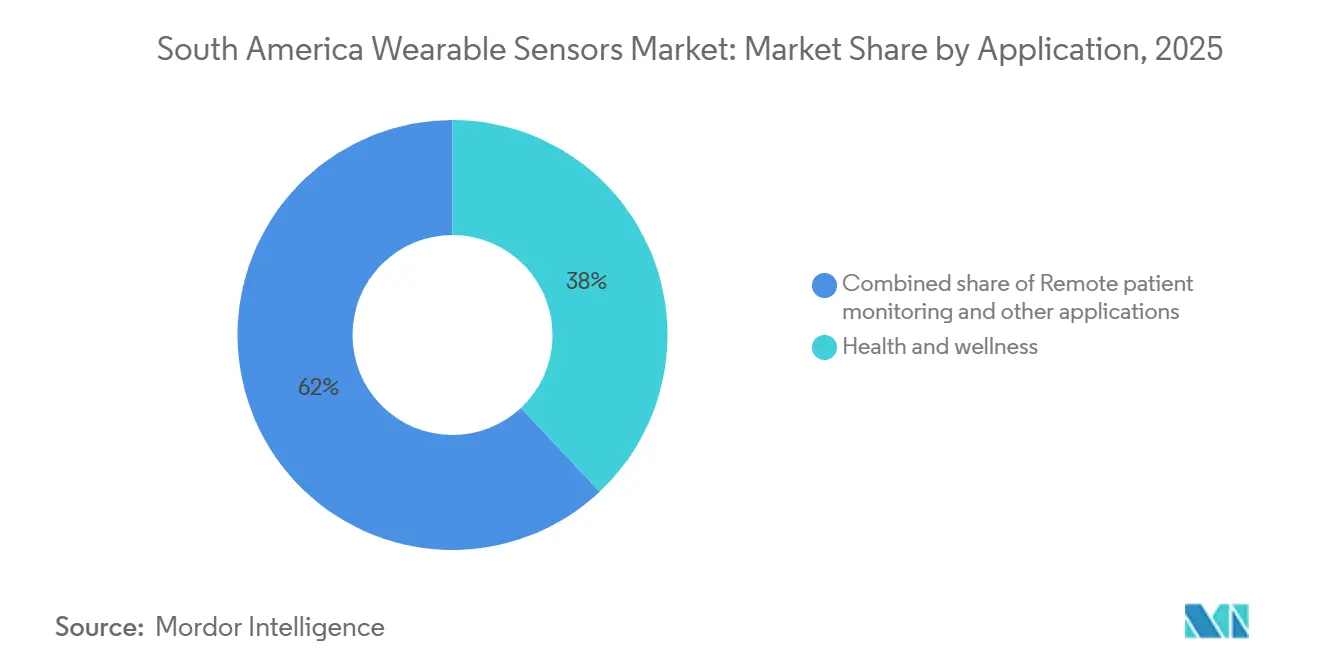
Health and Wellness Leads, While Remote Monitoring AcceleratesHealth and wellness is expected to account for 38.00% of the South America wearable sensors market by application in 2025. The segment includes fitness metrics, sleep tracking, and stress-management features used by urban consumers. It also includes programs that use consumer devices to collect health data at a population scale. The Viva Bem center at UNICAMP is using smartwatch data to develop models for Parkinson's disease and cardiovascular conditions. This work demonstrates how wellness devices can contribute data to broader health research. However, consumer adoption continues to depend on device affordability and user engagement. The segment is expected to remain the largest source of unit demand for wearable devices. Remote patient monitoring is projected to expand at a CAGR of 19.20% from 2026 to 2031. The segment is associated with Brazil's SUS Digital Telessaúde program and broader digital health activity in Colombia. Edital 1/2026 is expected to include IoT medical devices and telemedicine solutions within federal procurement for SUS Digital. Structured procurement can support demand for clinical-grade sensors and devices. Sports and fitness also remains important for users seeking performance data. Garmin is expected to introduce the fenix 9 and fenix 9 Pro in August 2026 with built-in LTE connectivity. Other applications include occupational health, elder care, and neonatal monitoring. Although these applications remain smaller, they can expand as providers seek monitoring solutions outside traditional care facilities.
By Connectivity:
Bluetooth Low Energy Leads, While Cellular Supports Remote CareBluetooth Low Energy is expected to account for 52.00% of the South America wearable sensors market by connectivity in 2025. It consumes little power and is compatible with a broad range of smartphones, making it suitable for fitness bands, basic watches, and consumer health monitors. These devices often transfer data when users open a companion application. Wi-Fi-enabled devices serve a smaller home-monitoring use case because they can upload data through a fixed network without requiring a paired smartphone. NFC is gaining relevance as watch manufacturers add contactless payment functions. Infineon is expected to introduce SECORA Connect X in 2026 for wearable payment products using Mastercard and Visa tokenization. Cellular connectivity, including LTE and 5G, is projected to expand at a CAGR of 22.00% from 2026 to 2031. Cellular devices can transmit biometric alerts without relying on proximity to a smartphone, making them important for remote patient monitoring in home and community settings. LTE-M and NB-IoT can support direct connectivity between wearable devices and clinical platforms. The South America wearable sensors industry may use these networks more frequently as operators expand coverage. ANT+ and proprietary systems remain relevant for performance sports, as cycling and triathlon users often depend on ANT+ connections among sensors, cycling computers, and training platforms. However, this category is expected to remain specialized compared with Bluetooth and cellular connectivity.
Geography Analysis
Brazil Wearable Sensors Market
Brazil accounted for 56.00% of the South America wearable sensors market share in 2025. The country has a more advanced ecosystem of clinical research, digital health policies, and network infrastructure than its regional peers. InCor launched a 200-patient clinical validation program for a connected cardiovascular monitoring bracelet in 2026. The Viva Bem Center at UNICAMP also demonstrated the detection of anxiety and stress using smartwatch biosignal data with accuracy exceeding 80%. SUS Digital Telessaúde provides a public health framework for telehealth services. Edital 1/2026 also establishes a procurement pathway for IoT medical devices and telemedicine solutions[4].
Colombia and Argentina Wearable Sensors Market
Colombia is projected to grow at a CAGR of 17.50% through 2031. The country’s urban centers are expanding the addressable base for connected health products and services. Improved network availability supports devices that use cellular connectivity for remote monitoring. Bogotá, Medellín, and Cali offer the strongest near-term consumer and provider base, while the country’s relatively young population supports longer-term device adoption. However, the South America wearable sensors market in Colombia will remain dependent on the pace of provider integration and insurance coverage. Argentina faces more immediate constraints from macroeconomic volatility and high import costs. Nevertheless, its private healthcare system and insurance coverage support demand among insured urban consumers.
South America Wearable Sensors Market
Chile, Peru, Ecuador, Bolivia, Uruguay, and Venezuela comprise the Rest of South America. Chile’s digitized healthcare system and aging population support demand for chronic disease monitoring. Peru has expanded telemedicine capacity through its healthcare system, while Uruguay benefits from high smartphone penetration and a health-conscious consumer base. These countries can adopt product and service models proven in Brazil and Colombia. However, limited distributor networks restrict access across several smaller markets, and lower purchasing power constrains the short-term adoption of premium clinical devices.
Competitive Landscape
The South America wearable sensors market exhibits moderate concentration at the component level. Component suppliers compete based on sensor accuracy, power efficiency, software support, and compatibility with major chipset platforms. Device brands use these components to differentiate their health, fitness, and communication features. This two-layer structure allows suppliers to exert significant influence without directly selling finished wearable devices to consumers. Semiconductor companies shape device capabilities by supplying motion, optical, analog, and secure-connectivity components selected for reference designs. Device brands, meanwhile, remain responsible for the user interface, service ecosystem, and presentation of sensor-derived information. Consequently, the South America wearable sensors market features competition among both component suppliers and consumer device brands. The relative importance of each layer varies by use case. Consumer smartwatches place greater emphasis on device brand strength and ecosystem integration, whereas clinical monitoring products prioritize validation, system integration, and service delivery.
STMicroelectronics, Bosch Sensortec, TDK Corporation, and NXP Semiconductors supply motion, sensing, and analog components for commercial wearable designs. Samsung, Apple, Huawei, and Garmin compete at the device level through sensor integration, software capabilities, and connected-device ecosystems. In March 2026, STMicroelectronics is expected to integrate its LSM6DSV32X inertial module and ST54L NFC controller into Qualcomm's Snapdragon Wear Elite platform. This type of platform validation can reduce development requirements for smartwatch manufacturers. Bosch Sensortec's BMI5 platform provides an additional motion-sensor option for wearable devices and hearables. Suppliers are increasingly integrating machine-learning capabilities and clinical measurement functions directly into sensor components. In January 2026, TDK is expected to introduce its SmartMotion edge-AI IMU suite for activity classification, gesture detection, and related applications. In May 2026, NXP is expected to introduce the NHS2634 analog front end for medical wearable biosensing applications. In July 2026, Infineon is expected to complete its acquisition of ams OSRAM's non-optical analog and mixed-signal sensor portfolio. The acquired portfolio is projected to generate EUR 230 million (USD 260 million) in revenue in 2026. The transaction is expected to expand Infineon's product portfolio for medical and industrial sensing applications.
South America Wearable Sensors Industry Leaders
-
STMicroelectronics
-
Bosch Sensortec GmbH (Robert Bosch GmbH)
-
TDK Corporation
-
Infineon Technologies AG
-
Samsung Electronics Co., Ltd.
- *Disclaimer: Major Players sorted in no particular order
South America Wearable Sensors Market Companies Covered in this Report
- STMicroelectronics
- Bosch Sensortec GmbH (Robert Bosch GmbH)
- TDK Corporation
- Infineon Technologies AG
- Texas Instruments Incorporated
- Analog Devices, Inc.
- NXP Semiconductors N.V.
- TE Connectivity Ltd.
- Panasonic Holdings Corporation
- Sensirion AG
- Knowles Corporation
- ams-OSRAM AG
- Murata Manufacturing Co., Ltd.
- Qualcomm Incorporated
- Samsung Electronics Co., Ltd.
- Apple Inc.
- Huawei Technologies Co., Ltd.
- Garmin Ltd.
- Valencell, Inc.
- Quoretech
- Xiaomi Corporation
Recent Industry Developments in South America Wearable Sensors Market
- August 2026: Garmin is expected to launch the fenix 9 and fenix 9 Pro multisport GPS smartwatches. The devices will feature built-in LTE and satellite connectivity, enabling direct voice, text, and SOS communication from the wrist. The fenix 9 Pro is expected to start at USD 1,099.99 and target premium athletic users in South America’s endurance sports communities, strengthening Garmin’s presence in the cellular wearable connectivity category. The devices will serve users who require performance tracking and independent wrist-based communication. This positioning will place the products above the price range of basic fitness bands and mass-market watches.
- July 2026: Samsung Electronics is expected to unveil the Galaxy Watch Ultra2 and Galaxy Watch9 at Galaxy Unpacked in London. Both models are expected to incorporate Samsung’s BioActive sensor stack, including optical biosignal, electrical heart signal, and bioelectrical impedance analysis sensors, along with accelerometer, gyroscope, barometer, temperature, geomagnetic, and light sensors. The launch will integrate a broad range of health and environmental sensing functions into premium consumer watches. It will also demonstrate how major device brands are combining multiple sensor technologies within a single wrist-worn device.
- July 2026: Infineon Technologies is expected to complete its acquisition of the non-optical analog and mixed-signal sensor portfolio from ams OSRAM Group. The portfolio is projected to generate EUR 230 million (USD 260 million) in revenue in 2026 and will strengthen Infineon’s medical wearable sensing portfolio under its Edge Systems division. The transaction is expected to be announced in February 2026 and will require the relevant regulatory approvals before completion. It will add non-optical analog and mixed-signal sensor products that can support medical and industrial wearable applications.
- June 2026: Infineon Technologies is expected to launch SECORA Connect X, a ready-to-integrate contactless payment solution for wearable devices that will support Mastercard MDES and Visa VTS card tokenization. The solution will enable contactless transactions through a compact integration approach for watch and wearable device designers. It will expand the role of wearables by adding payment functionality to products that also provide health and activity-tracking functions. The launch is expected to apply to South America and Europe, where brands are positioning watches as multifunctional personal devices.
- May 2026: NXP Semiconductors is expected to introduce the NHS2634 analog front end for medical wearables. This low-power, multichannel electrochemical device will support clinical biosensing in compact wearable formats. It will enable electrochemical sensor biasing and minute-current amplification in applications where device space and battery capacity are constrained. NXP will position the product for biosensor patches and continuous glucose monitoring devices, where precise signal handling is essential.
- May 2026: Nokia is expected to expand its 5G modernization partnership with TIM Brasil to 14 additional states, covering 42% of Brazil’s population. The network will support enterprise healthcare Internet of Things (IoT) applications and may enable clinical wearable data transmission in major metropolitan areas where providers require dependable connectivity. The partnership will expand the underlying network infrastructure for connected health services rather than directly introducing a consumer wearable product.
- March 2026: STMicroelectronics is expected to announce the integration of its LSM6DSV32X smart inertial module and ST54L NFC controller into Qualcomm’s Snapdragon Wear Elite platform. The reference design will combine on-device artificial intelligence (AI)-based motion inference with secure contactless services. It will provide original equipment manufacturers with a pre-validated component configuration for developing new smartwatch products. This approach can reduce product development time and support the integration of advanced sensing and NFC capabilities within a single platform.
- January 2026: TDK Corporation is expected to launch the InvenSense SmartMotion edge-AI IMU suite for wearables, IoT devices, earbuds, and smart glasses. The suite will include the ICM-45687 for wearables and IoT devices, the ICM-45606 for wireless earbuds, and the ICM-45685 for smart glasses. These sensors will support on-chip machine learning for activity classification, gesture detection, and spatial audio. Processing these functions at the sensor level can reduce reliance on host-processor power and support always-on monitoring.
South America Wearable Sensors Market Report Scope
The South America Wearable Sensors Report is Segmented by Sensor Type (Motion, Health, Optical, Biosensors), Technology (MEMS, CMOS, Flexible/Printed), Form Factor (Smartwatches, Fitness Bands, Medical Patches), Application (Health/Wellness, Remote Monitoring, Sports and Fitness), Connectivity (BLE, Wi-Fi, NFC, Cellular/5G, ANT+), and Geography (Brazil, Argentina, Colombia, Rest of South America). Forecasts are in Value (USD).
Segmentation Overview
By Sensor Type
| Motion Sensors |
| Health Sensors |
| Optical Sensors |
| Biosensors |
| Other Sensor Types |
Market Segmentation by Technology
| MEMS |
| CMOS |
| Flexible and Printed Sensors |
| Other Wearable Sensor Technologies |
Market Segmentation by Device Form Factor
| Smartwatches |
| Fitness Bands |
| Medical Patches |
| Other Device Form Factors |
Market Segmentation by Application
| Health and Wellness |
| Remote Patient Monitoring |
| Sports and Fitness |
| Other Applications |
Market Segmentation by Connectivity
| Bluetooth Low Energy |
| Wi-Fi |
| NFC |
| Cellular, Including LTE and 5G |
| ANT+ and Proprietary Connectivity |
Market Segmentation by Geography
| Brazil |
| Argentina |
| Colombia |
| Rest of South America |
| By Sensor Type | Motion Sensors |
| Health Sensors | |
| Optical Sensors | |
| Biosensors | |
| Other Sensor Types | |
| Market Segmentation by Technology | MEMS |
| CMOS | |
| Flexible and Printed Sensors | |
| Other Wearable Sensor Technologies | |
| Market Segmentation by Device Form Factor | Smartwatches |
| Fitness Bands | |
| Medical Patches | |
| Other Device Form Factors | |
| Market Segmentation by Application | Health and Wellness |
| Remote Patient Monitoring | |
| Sports and Fitness | |
| Other Applications | |
| Market Segmentation by Connectivity | Bluetooth Low Energy |
| Wi-Fi | |
| NFC | |
| Cellular, Including LTE and 5G | |
| ANT+ and Proprietary Connectivity | |
| Market Segmentation by Geography | Brazil |
| Argentina | |
| Colombia | |
| Rest of South America |
Key Questions Answered in the Report
What is the South America wearable sensors market size?
The South America wearable sensors market size is estimated at USD 371.9 million in 2026 and is projected to reach USD 800.1 million by 2031, at a CAGR of 16.55%.
Which sensor category leads wearable device demand in South America?
Health sensors led with 32.00% share in 2025. Biosensors are projected to expand at a CAGR of 22.50% through 2031.
Why are medical patches gaining adoption across South America?
Medical patches support longer wear periods and skin-conformal monitoring. They are projected to expand at a CAGR of 20.50% through 2031.
Which connectivity option is expanding fastest for wearable devices?
Cellular connectivity, including LTE and 5G, is projected to expand at a CAGR of 22.00% through 2031 because it supports direct remote monitoring.
Which country has the largest wearable sensor demand in South America?
Brazil held 56.00% of regional share in 2025, supported by clinical research, telehealth policy, and public procurement activity.
What limits wider use of clinical wearable devices in the region?
High upfront cost, reimbursement gaps, fragmented standards, and data-governance requirements limit access and provider adoption.