
Market Overview
| Study Period | 2021 - 2031 |
|---|---|
| Forecast Data Period | 2026 - 2031 |
| Base Year Market Size (2025) | USD 1.23 Billion |
| Market Size (2026) | USD 1.34 Billion |
| Market Size (2031) | USD 2.01 Billion |
| Growth Rate (2026 - 2031) | 8.50 % |
| Market Concentration | Medium |
Major Players *Disclaimer: Major Players sorted in no particular order Image © Mordor Intelligence. Reuse requires attribution under CC BY 4.0. | |
South America Travel Retail Market Analysis by Mordor Intelligence
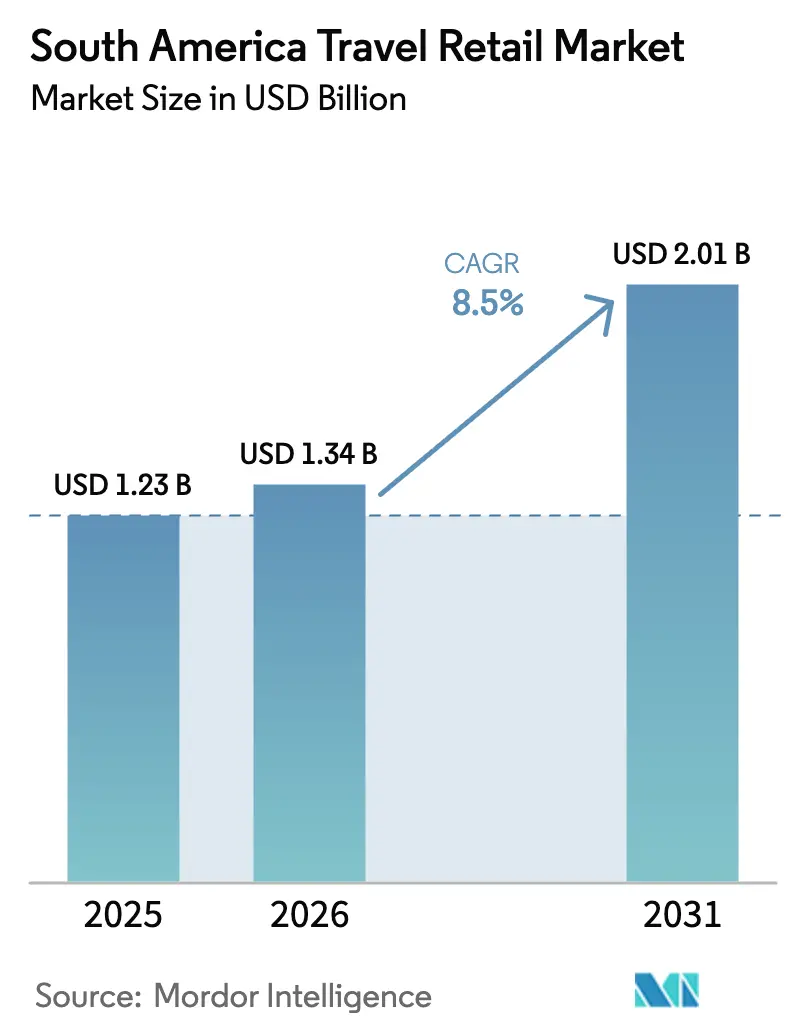
The South America travel retail market size is expected to grow from USD 1.23 billion in 2025 to USD 1.34 billion in 2026 and is forecast to reach USD 2.01 billion by 2031 at 8.50% CAGR over 2026-2031, signalling a recovery path supported by returning passenger volumes and structural upgrades in airport commercial zones. Operators are concentrating on premium beauty, curated spirits, and loyalty-led omnichannel journeys to raise conversion without heavy discounting, as digital tools like Reserve & Collect deliver higher average baskets and reduce stock-out risk. Airport authorities are embedding retail and dining deeper into terminal redesigns to improve dwell-time monetization and revenue resilience during demand swings, aligning concession formats with global best practices for risk sharing. The South America travel retail market is also drawing strength from targeted investments in Colombia, Chile, and Peru that expand retail footprints in tandem with airside capacity, which creates a synchronized runway for traffic and spending growth. Volatility in foreign exchange and selective category tightening, such as tobacco restrictions, remain headwinds, which are prompting a sharper focus on loyalty currencies, pricing discipline, and category diversification to protect margins in the South America travel retail market.
Key Report Takeaways
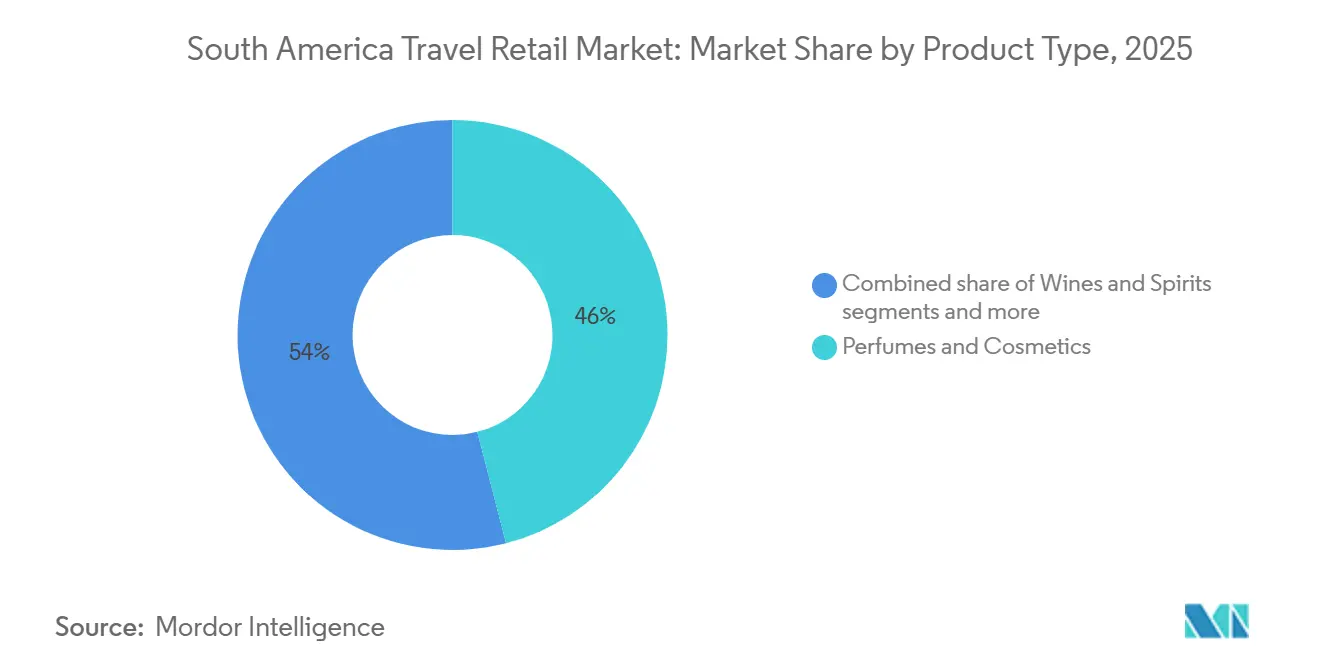
- By product type, Perfumes & Cosmetics led with 46% of the South America travel retail market size in 2025, while fashion & accessories is projected to record the fastest 2026-2031 CAGR at 9.05%.
- By distribution channel, airports accounted for 51% of the South America travel retail market size in 2025, reflecting the dominance of walkthrough formats and curated boutiques, while Online Pre-order & Click-and-Collect is projected to record the fastest 2026-2031 CAGR at 14.70%.
- By geography, Brazil held 35% of the South America travel retail market share in 2025, while Argentina recorded the fastest expected 2026–2031 CAGR at 9.98%.
Note: Market size and forecast figures in this report are generated using Mordor Intelligence’s proprietary estimation framework, updated with the latest available data and insights as of January 2026.
South America Travel Retail Market Trends and Insights
Drivers Impact Analysis*
| Driver | (~) % Impact on CAGR Forecast | Geographic Relevance | Impact Timeline |
|---|---|---|---|
| Air passenger recovery and connectivity expansion | +2.1% | Global, strongest in Brazil, Argentina, and Colombia | Short term (≤ 2 years) |
| Airport infrastructure expansion (new terminals, concessions) | +1.8% | Brazil, Mexico, Colombia, Chile | Medium term (2-4 years) |
| Omnichannel adoption (reserve & collect, AR try-on, airline pre-order) | +0.9% | Mexico, Brazil, and Panama hubs with digital infrastructure | Medium term (2-4 years) |
| Perfumes & cosmetics demand strength in South America travel retail | +1.6% | Brazil, Argentina, Mexico; airport-dominant | Short term (≤ 2 years) |
| Brazil's land-border free shop regime maturation | +1.3% | Brazil–Uruguay, Brazil–Argentina borders | Medium term (2-4 years) |
| Cruise deployment growth benefiting South America ports & onboard retail | +0.8% | Brazil, Colombia, Caribbean | Long term (≥ 4 years) |
| Source: Mordor Intelligence | |||
Air Passenger Recovery and Connectivity Expansion
Regional passenger volumes reached 477.3 million in 2025, a 3.8% year-on-year increase that restored critical footfall for airside retailers and set a favorable base for the South America travel retail market. [1]. Colombia’s aviation system continued to scale on a multiyear investment track, which supports sustained traffic gains that translate to higher retail capture in major hubs and secondary cities. The recovery in intra-regional connectivity is improving assortment relevance because route mix and traveler profiles are stabilizing, which allows operators to sharpen curation across beauty, spirits, and destination goods in the South America travel retail market. Airport and airline standardization initiatives elevate the importance of data sharing and slot management, which in turn helps smooth passenger flows through commercial areas and raises the effective window for conversion. The combination of improved traffic, better schedule reliability, and targeted merchandising forms a self-reinforcing cycle that sustains growth in the South America travel retail market as operators align staffing and inventory to peak periods.
Airport Infrastructure Expansion (New Terminals, Concessions)
Airports in Chile, Colombia, Mexico, and Peru are executing large capital programs that expand gates and commercial zones, which directly raises the ceiling for revenue capture per passenger in the South America travel retail market. Santiago’s Terminal 2 overhaul has already doubled capacity with modernized passenger flows, and a newly awarded 12-year duty-free concession will activate a larger retail footprint from 2026 [2]. Bogotá’s expansion is designed to lift terminal capacity and add significant commercial space, which encourages multi-format store strategies tailored to international and domestic flows within the South America travel retail market [3]. Lima’s flagship redevelopment includes extensive retail and dining zones that are being deployed in phases, which aligns space activation with traffic milestones and operator ramp-up in the South America travel retail market. Across these projects, concession frameworks are increasingly guided by global best practices that link investment commitment, risk-sharing mechanisms, and service-level obligations to passenger delivery and commercial performance.
Omnichannel Adoption (Reserve & Collect, AR Try-On, Airline Pre-Order)
Retailers are scaling Reserve & Collect and loyalty integrations that consistently deliver higher average baskets than purely walk-in transactions, which is raising revenue productivity in the South America travel retail market. Airline partnerships that allow mile redemption for duty-free goods extend purchasing power and reduce price sensitivity, which is particularly useful when travelers face foreign-exchange swings at the point of sale. Digital browsing before the trip and stock reservation on airport websites or operator apps smooths the in-terminal shopping journey and reduces friction that might otherwise lead to abandoned baskets in the South America travel retail market. Operators are also deploying personalized promotions based on travel history and past purchases through loyalty ecosystems, which lift conversion by matching offers to known preferences. The commercial impact is reinforced by store-associate tools and centrally managed pricing that support consistent execution across airport portfolios, which improves shopper trust and upselling in the South America travel retail market.
Cruise Deployment Growth Benefiting South America Ports & Onboard Retail
Cruise retailers and suppliers reported strong sales momentum in 2024 that continued into 2025, underpinned by new ship deliveries and upgraded port infrastructure that elevate spend potential for the South America travel retail market. Onboard retail is expanding through curated brand zones and exclusive merchandise that attract affluent travelers, which improves category mix and margin contribution. Luxury retail at sea continues to scale as premium cruise lines test boutique concepts that mirror top-tier airport stores, and this convergence feeds product and experience innovation back into airports in the South America travel retail market. Brazil approved a major terminal development in Santos in 2025 that is intended to accommodate larger ships and higher passenger throughput, which can support adjacent retail ecosystems and shore-excursion commerce. As South American ports deepen capacity and cruise itineraries diversify, onboard and portside retail play a larger role in cross-channel strategies for the South America travel retail market.
Restraints Impact Analysis*
| Restraint | (~) % Impact on CAGR Forecast | Geographic Relevance | Impact Timeline |
|---|---|---|---|
| FX volatility is eroding the price advantage and the basket size | -1.7% | Brazil, Argentina, Mexico, and the regional | Short term (≤ 2 years) |
| MAG/concession economics pressure during demand shocks | -0.9% | Mexico, Panama, and Colombia airport contracts | Medium term (2-4 years) |
| Mexico City slot caps and bilateral disputes are constraining capacity | -0.6% | Mexico AICM hub, US-Mexico routes | Medium term (2-4 years) |
| Tobacco regulation tightening risks to category sales | -0.5% | Mexico, Brazil, Chile | Long term (≥ 4 years) |
| Source: Mordor Intelligence | |||
FX Volatility Eroding Price Advantage and Basket Size
Foreign-exchange swings reduce perceived discounts when travelers convert USD-denominated prices into local currencies, which can delay or downsize purchases in the South America travel retail market. Currency instability in Argentina and policy transitions heightened sensitivity to imported goods pricing, which affects core categories such as premium beauty and spirits. Card-spend data show mixed discretionary trends across large markets during 2025, which underscores the need for targeted offers rather than broad markdowns to defend average ticket sizes in the South America travel retail market. Operators use loyalty currencies and payment flexibility to cushion exchange-rate shocks and to sustain engagement during adverse FX cycles, which spread risk across journeys and channels. Regional currency performance in 2025 benefited partly from global USD dynamics rather than fundamental local improvements, which suggests the South America travel retail market remains exposed to renewed volatility.
Tobacco Regulation Tightening Risk to Category Sales
Mexico enacted a constitutional ban on electronic nicotine delivery systems in 2025 after tightening public-place smoking rules in 2023, which reduced category salience and constrained assortment options for the South America travel retail market. Regional health authorities and legislatures continue to restrict marketing and product availability for tobacco and related categories, which shifts toward confectionery, alcohol, and beauty. Brazil’s regulators have maintained a restrictive stance toward new tobacco technologies, and tax scrutiny on large manufacturers increased in late 2024, which signals sustained pressure on traditional tobacco margins in the South America travel retail market. Chile implemented a distinct regulatory approach for nicotine vapor products in 2024, which created a test bed for category experimentation at Santiago while other markets move in a more restrictive direction. International policy guidance recommends higher specific excise taxes and minimum pricing to dampen consumption, which points to further pressure on duty-free tobacco economics through the decade.
*Our forecasts treat driver/restraint impacts as directional, not additive. The impact forecasts reflect baseline growth, mix effects, and variable interactions.
Segment Analysis
By Product Type: Perfumes & Cosmetics Anchor, Fashion Accelerates
Perfumes & Cosmetics accounted for 46% of the South America travel retail market share in 2025, which confirms beauty’s anchor role in walkthrough designs and assortment planning across leading airports. Operators are pairing flagship counters and personalized services with travel-exclusive sets to lift engagement, which strengthens category resilience during currency volatility in the South America travel retail market. Beauty activations in major hubs are complemented by loyalty-linked offers that boost conversion among frequent flyers, which extends the category’s lead over other segments. Prestige fragrance and skincare continue to attract a wide traveler base that spans genders and age cohorts, which keeps unit economics favorable relative to space allocation in the South America travel retail market. The South America travel retail industry is also expanding into adjacent beauty accessories and devices to diversify baskets while protecting price positioning against domestic retail.
Fashion & Accessories is gaining momentum and is projected to post a 9.05% CAGR in 2026–2031 through curated boutiques and designer-led activations that target millennial and Gen Z travelers, which makes it a priority for incremental space allocation in upcoming terminal programs. Category diversification includes watches, jewelry, and travel essentials that complement beauty and spirits gifting, which creates more balanced baskets in the South America travel retail market. Wines & Spirits continue to benefit from premiumization, and cruise-led learning on assortment and brand storytelling is migrating into airport formats that target high-value shoppers. Tobacco’s role has moderated due to regulatory tightening, which nudges operators to emphasize beauty, confectionery, and destination goods that face fewer policy constraints in the South America travel retail market. The South America travel retail industry relies on beauty as a stabilizer while scaling fashion and accessories as the next major growth layer, supported by loyalty and experiential retail.

By Distribution Channel: Airports Dominant, Digital Surges
Airports accounted for 51% of the South America travel retail market share in 2025. Walkthrough formats and premium boutique clusters in renovated terminals keep capturing long dwell times and lifting conversion. Santiago International Airport’s Terminal 2 program has doubled capacity and modernized commercial flows that route more travelers through retail zones. Bogotá El Dorado’s expansion roadmap adds sizable commercial areas alongside a capacity lift toward 73 million passengers, which raises airport-channel revenue potential. Operators are scaling Reserve & Collect and loyalty tie-ins that deliver higher average baskets and steadier conversion at the point of pickup.
The South America travel retail market size for Online Pre-order & Click-and-Collect is projected to expand at a 14.70% CAGR during 2026–2031. Club Avolta and airline-program integrations enable pre-trip discovery, mile redemption, and guaranteed pickup, which raises spend per transaction versus walk-in-only journeys. As terminal upgrades unlock more space, pre-order data helps operators plan allocation and staffing to reduce stockouts and wait times at collection counters. Cruise retailers and supply partners are transferring successful digital merchandising and exclusive-assortment playbooks from ships to airports to reinforce omnichannel adoption. Airport landlords are updating concession frameworks to balance fixed and variable rent, which supports sustained store investment that underpins omnichannel service quality across the distribution mix.
Geography Analysis
Brazil accounted for 35% of sales in 2025, giving it the largest national share in the South America travel retail market and confirming its central role in regional aviation and retail networks. Retail portfolios in Brazil balance duty-paid and duty-free formats to accommodate heavy domestic demand and international flows through key hubs. Store strategies emphasize beauty leadership and curated spirits, which sustain conversion during FX cycles that influence local purchasing power in the South America travel retail market. Operators are also testing innovations in border locations and secondary cities to spread risk and tap new shopper pools. The combined effect is a broad base that anchors the South America travel retail market while creating room for targeted experiments in format and assortment.
Argentina is projected to post an 9.98% CAGR in 2026–2031, with stabilization in 2025 improving conditions for premium-category purchases and loyalty-led promotions in airports. Macro-policy shifts and efforts to rebuild credibility have improved the environment for long-term planning, while risks tied to the monetary framework remain present, which require careful pricing and inventory decisions in the South America travel retail market. Beauty activations and brand takeovers in Buenos Aires are elevating the category’s profile and conversion, supported by integrated loyalty journeys. FX dynamics continue to influence the mix of purchases, so operators rely on value messaging and pre-order benefits to smooth shopper behavior in the South America travel retail market. The net effect is a recovery path that is fastest among major geographies when paired with stable policy execution and airline capacity expansion.
Mexico, Chile, Colombia, Peru, and Central America & the Caribbean form the balance of regional revenue with distinct growth drivers and constraints in the South America travel retail market. Mexico faces capacity and bilateral issues that limit near-term upside in its largest hub, which is prompting operators to lean into store renovations and loyalty strategies that raise per-passenger monetization. Chile’s Santiago Airport has doubled capacity with Terminal 2 and will activate a major new duty-free program from 2026, which sets the stage for premium brand deployment and higher capture in the South America travel retail market. Colombia’s Bogotá expansion features sizable retail zones within a broader capacity lift, which benefits multi-format planning for operators across international and domestic flows. Peru’s Lima flagship opening demonstrates how large-scale retail deployments reshape passenger experience and conversion, with a model that integrates duty-free retail and destination dining into a cohesive journey for the South America travel retail market.
Competitive Landscape
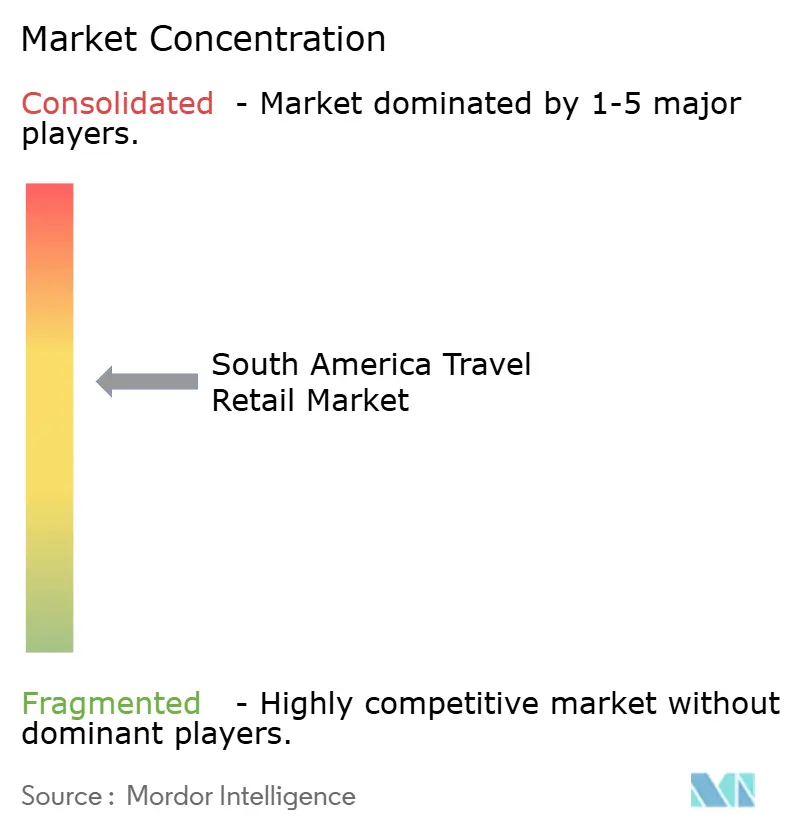
Competition is balanced between global multi-country portfolios and agile regional specialists, with a moderate concentration pattern that leaves room for share gains through airport tenders, border expansions, and cruise partnerships in the South America travel retail market. A leading global operator secured a 12-year duty-free concession in Santiago, effective 2026, and extended a multi-airport agreement in Mexico, which consolidates its presence across key gateways and builds a long runway for premium brand deployment. Cruise-specialized retailers and suppliers expanded aggressively with new ship launches and merchandise concepts, which created a transfer path for best practices from ships to airports in the South America travel retail market. Operators are investing in loyalty ecosystems, omnichannel tools, and analytics to refine promotions and stock allocation, which has become a core capability for sustaining margin and conversion. As tenders emphasize service standards and traffic-linked risk-sharing, better-capitalized portfolios will hold an advantage in bid rounds for the South America travel retail market.
Airport authorities are incorporating global concession guidance into contract structures to improve resilience during shocks and to align investment horizons with traffic cycles, which supports multi-year planning on both sides. Recent contract amendments in the region demonstrate movement toward per-passenger pricing and scheduled economic-equilibrium reviews, which help avoid cash burn for retailers and protect core airport services. Flagship openings and upgrades in Lima and Santiago set the blueprint for integrated retail and dining zones that increase dwell-time capture and enable sequential category targeting in the South America travel retail market. Brands are demanding standardized execution and data access in return for exclusive assortments and event marketing, which pushes operators to accelerate digital investments. The slope of share change will depend on the timing and scale of airport tenders and on operators’ ability to balance capital discipline with experiential retail in the South America travel retail market.
Category regulation, foreign exchange, and bilateral traffic constraints continue to shape portfolio choices, which reinforces the value of diversified exposure to airports, borders, and cruise networks in the South America travel retail market. Tobacco restrictions are pushing more space and marketing into beauty, spirits, and destination goods, and onboard retail learnings are enhancing airport merchandise curation and storytelling. FX and income dynamics vary across major markets, so loyalty-linked promotions and price-assurance tactics are being used to protect conversion without eroding margin in the South America travel retail market. The increased use of per-passenger clauses and shock triggers in contracts provides a more stable platform for sustained capex in stores, fixtures, and digital tools. Over the forecast period, competitive advantage will accrue to portfolios that can translate traffic growth into higher revenue per passenger through precise curation and seamless digital journeys in the South America travel retail market.
South America Travel Retail Industry Leaders
-
Avolta AG (Dufry)
-
Duty Free Americas
-
Motta Internacional (Attenza Duty Free)
-
Top Brands International (Luryx; Neutral by Luryx)
-
3Sixty Duty Free
- *Disclaimer: Major Players sorted in no particular order
Recent Industry Developments
- February 2026: Giromondo has expanded regionally with a new Dôme store at ZOFRI Mall in Iquique, Chile. Following its Caracas launch in June 2025, this Q2 2026 opening reflects its strategy to grow in South America’s travel retail and duty-free markets, including free-trade zones.
- January 2026: Corporación América Airports announced that its subsidiary, Ecogal, amended the Seymour Airport concession agreement in Galápagos, Ecuador. The amendment addresses COVID-19 impacts, incorporating adjusted airport charges, extended concession terms, and rescheduled investments, following a comprehensive review with government authorities and the granting entity.
- June 2025: Avolta secured a 12-year duty-free concession at Santiago de Chile Airport, awarded by the Directorate General of Civil Aviation (DGAC) and the National Customs Service. Starting in Q3 2026, it includes two walkthrough duty-free stores and last-minute outlets, enhancing Avolta’s longstanding presence in Chile.
- June 2025: Lagardère Travel Retail opened new commercial spaces at Jorge Chávez International Airport’s new terminal in Lima, Peru, after two years of construction. The development includes 4,000m² of retail space and a 3,300m² dining area, branded “Nación Sazón – The Land of Flavours.”
South America Travel Retail Market Report Scope
Travel retail refers to the sale of goods, often duty-free, to travelers in secure transit areas such as airports, cruise ships, border stores, and train stations. It primarily includes luxury items, electronics, alcohol, and tobacco, serving as a key revenue stream for airports.
The South America travel retail market report is segmented by product type (perfumes & cosmetics, wines & spirits, tobacco, fashion & accessories, confectionery & fine foods, watches & jewelry, electronics & gadgets, local artisanal & destination goods), distribution channel (airports, airlines inflight retail, border stores land, cruise & seaports, downtown & hotel shops, online pre-order & click-and-collect), and geography (Mexico, Brazil, Argentina, Chile, Colombia, Peru, Rest of South America). The market forecasts are provided in terms of value (USD).
By Product Type
| Perfumes & Cosmetics |
| Wines & Spirits |
| Tobacco |
| Fashion & Accessories |
| Confectionery & Fine Foods |
| Watches & Jewelry |
| Electronics & Gadgets |
| Local Artisanal & Destination Goods |
By Distribution Channel
| Airports |
| Airlines (Inflight Retail) |
| Border Stores (Land) |
| Cruise & Seaports |
| Downtown & Hotel Shops |
| Online Pre-order & Click-and-Collect |
By Geography
| Mexico |
| Brazil |
| Argentina |
| Chile |
| Colombia |
| Peru |
| Rest of South America |
| By Product Type | Perfumes & Cosmetics |
| Wines & Spirits | |
| Tobacco | |
| Fashion & Accessories | |
| Confectionery & Fine Foods | |
| Watches & Jewelry | |
| Electronics & Gadgets | |
| Local Artisanal & Destination Goods | |
| By Distribution Channel | Airports |
| Airlines (Inflight Retail) | |
| Border Stores (Land) | |
| Cruise & Seaports | |
| Downtown & Hotel Shops | |
| Online Pre-order & Click-and-Collect | |
| By Geography | Mexico |
| Brazil | |
| Argentina | |
| Chile | |
| Colombia | |
| Peru | |
| Rest of South America |
Key Questions Answered in the Report
What is the current size and growth outlook for the South America travel retail market?
The South America travel retail market size was USD 1.23 billion in 2025 and is projected to reach USD 2.01 billion by 2031 at an 8.5% CAGR.
Which product category leads sales across South America travel retail?
Perfumes & Cosmetics led 2025 revenue with a 46% share, driven by premium brand activations and travel-exclusive sets.
Which channels are most important for South America travel retail growth?
Airports remain the primary channel at 51% of 2025 sales, while Reserve & Collect and loyalty integration increase average baskets from pre-trip to in-terminal.
Which countries are most influential in South America travel retail?
Brazil held 35% of sales in 2025, while Argentina is projected to be the fastest growing through 2031 with an expected 9.98% CAGR.
What risks could slow South America's travel retail performance?
Key risks include FX volatility that compresses value perception, tobacco regulation that restricts assortment, and capacity or bilateral limits that can suppress throughput in major hubs.
Which infrastructure projects will shape the next wave of South America travel retail?
Santiago’s Terminal 2 program and concession activation from 2026, Bogotá’s capacity and retail expansion, and Lima’s flagship rollout will expand commercial space and improve dwell-time capture.