
Market Overview
| Study Period | 2021 - 2031 |
|---|---|
| Forecast Data Period | 2026 - 2031 |
| Base Year Market Size (2025) | USD 110.11 Billion |
| Market Size (2026) | USD 117.05 Billion |
| Market Size (2031) | USD 158.86 Billion |
| Growth Rate (2026 - 2031) | 6.30 % |
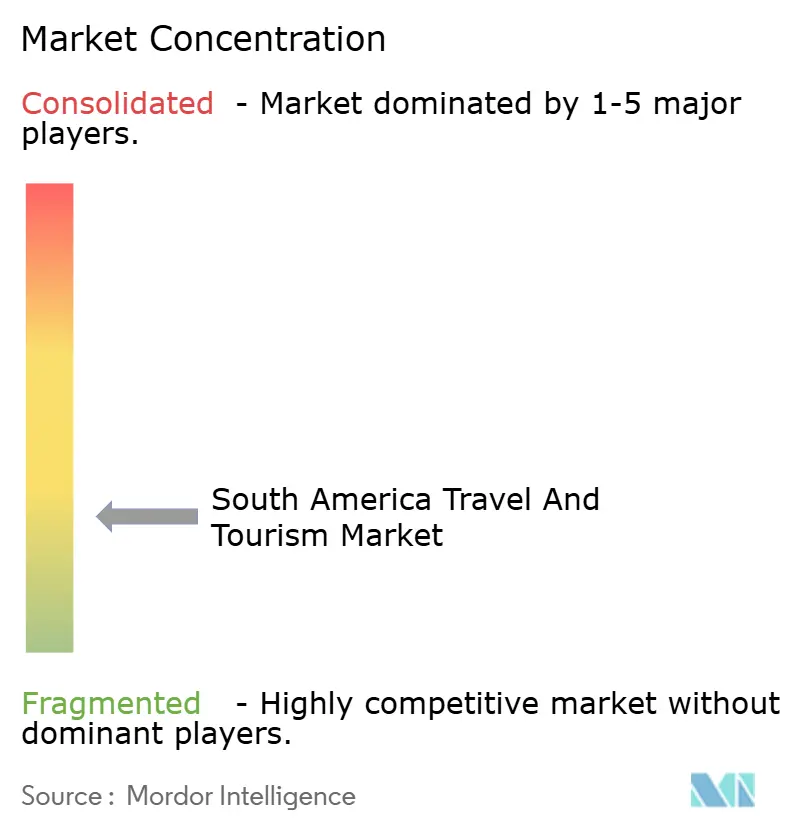
| Market Concentration | Low |
Major Players *Disclaimer: Major Players sorted in no particular order Image © Mordor Intelligence. Reuse requires attribution under CC BY 4.0. | |
South America Travel and Tourism Market Analysis by Mordor Intelligence
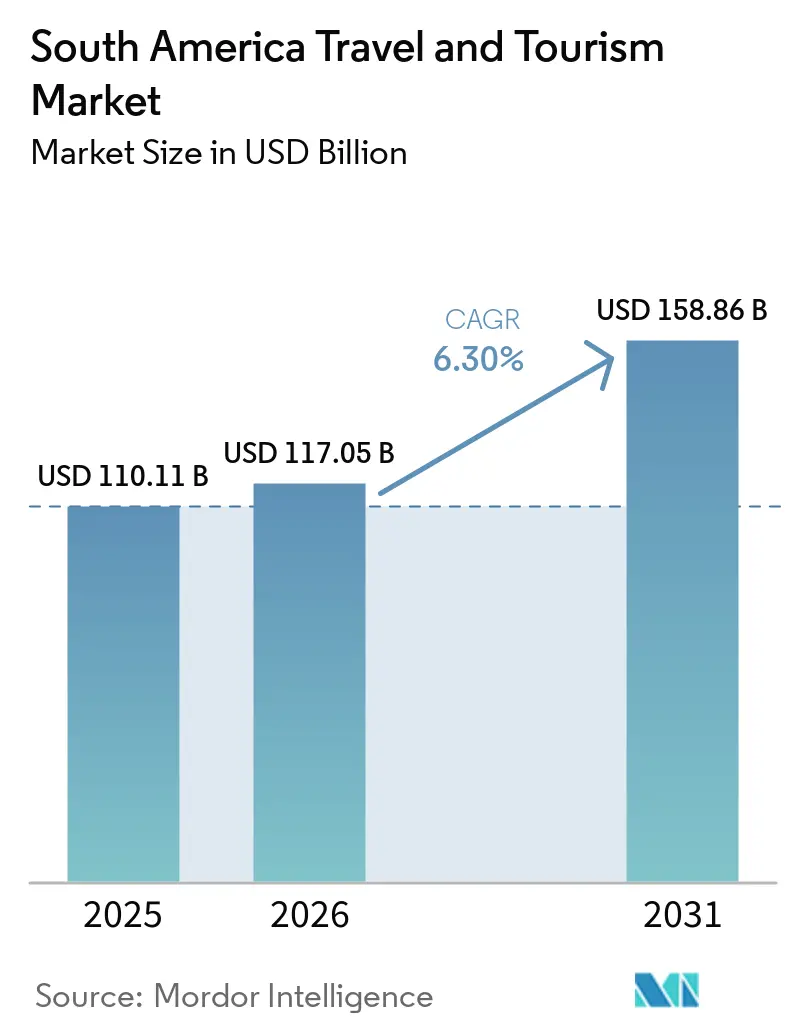
The South America Travel And Tourism Market size is projected to be USD 110.11 billion in 2025, USD 117.05 billion in 2026, and reach USD 158.86 billion by 2031, growing at a CAGR of 6.30% from 2026 to 2031.
Solid domestic travel in Brazil and Mexico underpins stable demand, while the online channel continues to expand its lead as mobile-first booking becomes mainstream. Low-cost carrier capacity and new-generation narrowbodies are widening intra-regional and long-haul connectivity and reshaping price points for leisure and VFR segments. Airport and border automation reduces friction at key hubs and lifts throughput without proportional capex, with biometric deployments scaling across major gateways. Visa policies and currency conditions influence cross-border travel decisions, while event-led catalysts, such as the 2026 FIFA World Cup in Mexico, are spurring infrastructure upgrades that will have multi-year effects on the South America Travel and Tourism market.
Key Report Takeaways
- By tourist type, domestic travel held 59.70% of the South America Travel and Tourism market size in 2025, while inbound international is projected to record the fastest 2026-2031 CAGR at 4.40%.
- By purpose of travel, leisure led with 84.50% of the South America Travel and Tourism market in 2025, and medical and wellness is forecast to expand at a 14.90% CAGR through 2031.
- By booking channel, online channels accounted for 52.00% of the South America Travel and Tourism market size in 2025, with a 10.01% projected CAGR through 2031.
- By geography, Brazil held 23.20% of the South America Travel and Tourism market share in 2025, and Colombia is projected to register the steepest 2026-2031 CAGR at 9.03%.
Note: Market size and forecast figures in this report are generated using Mordor Intelligence’s proprietary estimation framework, updated with the latest available data and insights as of January 2026.
Market Trends and Insights
Drivers Impact Analysis of South America Travel and Tourism Market*
| Driver | (~) % Impact on CAGR Forecast | Geographic Relevance | Impact Timeline |
|---|---|---|---|
| Online booking penetration exceeds 50% (mobile-led) | +1.2% | Brazil and Mexico lead, strong in São Paulo, Bogotá, and Mexico City | Medium term (2-4 years) |
| Low-cost carriers and A321XLR expand intra-regional and long-haul connectivity | +1.5% | Brazil, Mexico, Chile, and Colombia corridors to North America and Europe | Long term (≥ 4 years) |
| Robust domestic travel base in Brazil and Mexico stabilizes demand | +1.0% | Brazil and Mexico's domestic networks, secondary-city additions | Short term (≤ 2 years) |
| International tourism recovery to pre-pandemic levels boosts inbound | +1.3% | Broad-based inbound gains across South America | Medium term (2-4 years) |
| Biometric border/airport automation accelerates throughput and reduces friction | +0.7% | Lima and São Paulo as reference deployments, scalable region-wide | Medium term (2-4 years) |
| Installment/BNPL financing raises conversion and average order value online | +1.0% | Region-wide adoption, strong in Brazil, Mexico, Argentina | Short term (≤ 2 years) |
| Source: Mordor Intelligence | |||
Online Booking Penetration Exceeds 50% in 2025 (Mobile-Led)
Mobile-first behavior has pushed digital bookings beyond the halfway mark in South America, and the trend is durable as device penetration and payment rails mature. OTA consolidation signals the value of regional scale, with Prosus acquiring Despegar in 2025 to connect travel with food delivery and events ecosystems that reach over 100 million users, a move designed to convert multi-vertical traffic into travel transactions at lower acquisition cost[1]. Payment’s infrastructure is another catalyst, as real-time disbursements, instant refunds, and tokenized credentials reduce abandonment and increase trust in online checkout flows, particularly for air travel. Contactless and digital wallets are now embedded in travel purchase journeys across the region, and they are expected to scale further around event spikes and cross-border traffic associated with 2026 sports mega-events [2]. As airlines enhance direct channels with loyalty-linked offers and post-booking self-service, suppliers continue to steer customers to their apps, which compresses service costs and deepens their customer data advantage over intermediaries. The South America Travel and Tourism market benefits, such as mobile booking, flexible payments, and AI-powered servicing, expand the active traveler base and lift conversion across both short-haul and long-haul itineraries.
Low-Cost Carriers and A321XLR Expand Intra-Regional and Long-Haul Connectivity
Low-cost carriers have increased their share of regional capacity, reshaping price elasticity and stimulating discretionary travel across short- and medium-haul routes. OAG data indicates that low-cost carriers (LCCs) have materially expanded their presence in the region, while new entrants such as JetSMART Colombia have captured share quickly by serving key domestic trunk routes vacated by failed operators. Fleet modernization is amplifying these gains, with South America ordering up to 74 Embraer E195-E2 aircraft to densify regional connectivity and reach underserved city pairs with lower trip costs per seat [3]. The Abra Group, parent to Avianca and GOL, expanded its Airbus order book to support long-haul Americas–Europe growth and more efficient short-haul networks, which should widen itinerary choice for leisure, VFR, and MICE travel. Strategic joint ventures also matter because shared networks and aligned schedules compress connection times and extend reach without duplicative capex, as the Delta–LATAM partnership illustrates with multi-year increases in flows between North and South America. As narrowbodies with extended range deploy over the medium term, thinner long-haul routes can become viable nonstop offerings, which directly supports the South America Travel and Tourism market by reducing travel times and enabling secondary-city links to North America and Europe. A denser web of fares and frequencies then feeds demand into both online and direct channels, reinforcing the structural shift toward digital distribution.
Robust Domestic Travel Base in Brazil and Mexico Stabilizes Demand
Brazil and Mexico anchor regional demand because their large domestic networks provide countercyclical ballast when external shocks affect international flows. Airlines are expanding seats on core and secondary routes, with South America adding new daily domestic flights that connect industrial centers with leisure destinations and support redistribution of visitor flows beyond the largest metros [4]. Domestic-focused additions often rely on smaller-gauge aircraft, which offer better economics on mid-density routes, allowing carriers to protect yields while stimulating traffic through lower trip costs, consistent with the E2 regional jet orders South America has secured. Stadium, airport, and hotel upgrades tied to the 2026 FIFA World Cup in Mexico will strengthen feeder traffic patterns between host cities and major hubs and will leave infrastructure legacies that lift throughput beyond the event window. Hotel brands are bringing new properties online in key secondary markets, diversifying room supply and introducing new concepts aimed at younger and wellness-oriented travelers. The South America Travel and Tourism market, therefore, benefits from domestic seats, improved last-mile hospitality supply, and public-event catalysts that consolidate demand into repeatable patterns across seasons.
International Tourism Recovery to Pre-Pandemic Levels Boosts Inbound
Inbound travel has returned to growth across multiple destinations, and several countries report higher volumes than in the early recovery years as currency shifts and new routes improve affordability and access. Peru recorded a year-end total of 4.16 million international visitors in 2025, aided by improvements in air gateway efficiency that reduced airport wait times and enhanced transit experiences. Colombia’s air traffic and foreign visitor arrivals have been on an upward trajectory as network carriers invest in fleet, lounges, and premium products that appeal to both business and leisure travelers. Joint venture partners increased seat supply between North America and South America, which improved fare competition and added new city-pair options for inbound flows. Event catalysts in 2026 are likely to lift short-term arrivals to Mexico’s host cities, and they are expected to leave technology, payment, and mobility upgrades that sustain higher utilization after the event. Airports that embed automated border control, biometric boarding, and touchless passenger journeys also tend to improve repeat-visit intent by compressing queues and improving the perceived quality of arrival and departure experiences.
Restraints Impact Analysis of South America Travel and Tourism Market*
| Restraint | (~) % Impact on CAGR Forecast | Geographic Relevance | Impact Timeline |
|---|---|---|---|
| Extreme weather, drought, wildfires, and sargassum disrupt key destinations | -0.8% | Chile and Argentina wildfires, Caribbean sargassum, Amazon and Pantanal drought | Medium term (2-4 years) |
| Visa policy shifts (e.g., Brazil e-visa reinstatement) add inbound friction | -0.5% | Brazil inbound from the United States, Canada, and Australia | Short term (≤ 2 years) |
| Water scarcity and utility constraints cap capacity in hotspots | -0.3% | Mexican Caribbean and drought-prone coastal corridors | Long term (≥ 4 years) |
| Payment/FX rules (e.g., Argentina card-installment limits) suppress outbound | -0.4% | Argentina outbound travel | Short term (≤ 2 years) |
| Source: Mordor Intelligence | |||
Extreme Weather, Drought, Wildfires, and Sargassum Disrupt Key Destinations
A warmer climate is raising the likelihood and severity of fire weather in parts of Chile and Argentina, and recent events have had direct impacts on communities, infrastructure, and tourist areas. Attribution work shows that human-induced climate change has increased the likelihood of such extremes and reduced rainfall during critical fire seasons, prolonging drought and heightening ignition risk across large areas. Regions like the Pantanal and Amazon have also experienced severe droughts that disrupt river transport and tourism products that depend on navigable waterways, with knock-on effects on power and logistics systems. Scientific analysis points to much larger burned areas in a warming world, underscoring that these hazards are not transient and that return periods for severe seasons are shortening. Sargassum blooms, a separate coastal phenomenon, degrade beach quality and affect visitor satisfaction when landings are heavy, potentially suppressing bookings for beach-focused travel during peak months. Destination stakeholders are investing in adaptation measures like early warning systems, clean-up logistics, and environmental certifications to mitigate disruption, yet cost and execution challenges persist across jurisdictions. The South America Travel and Tourism market, therefore, faces a recurring climate-related drag that requires resilience investments and coordinated responses to protect demand and operations.
Visa Policy Shifts (e.g., Brazil E-Visa Reinstatement) Add Inbound Friction
Policy changes that alter entry requirements can affect short-notice travel and create planning friction for repeat visitors. Brazil reinstated visa requirements for United States, Canadian, and Australian nationals in 2025, using an e-visa model that simplifies application logistics but introduces a new step that did not exist during the prior exemption period. The policy applies during a period when the country is also expanding airport biometrics and adding new domestic connectivity, which partially offsets friction by improving the on-the-ground experience and route choice. Neighboring countries that maintain visa-free access for these source markets could capture share at the margin for leisure trips that are more price and convenience-sensitive. The medium-term effect depends on reciprocity negotiations and traveler familiarity with digital visa processes, which tend to normalize over time. For the South America Travel and Tourism market, clear communication and streamlined digital journeys help reduce perceived barriers and sustain inbound demand as policy baselines change.
*Our forecasts treat driver/restraint impacts as directional, not additive. The impact forecasts reflect baseline growth, mix effects, and variable interactions.
South America Travel and Tourism Market Segment Analysis
By Tourist Type:
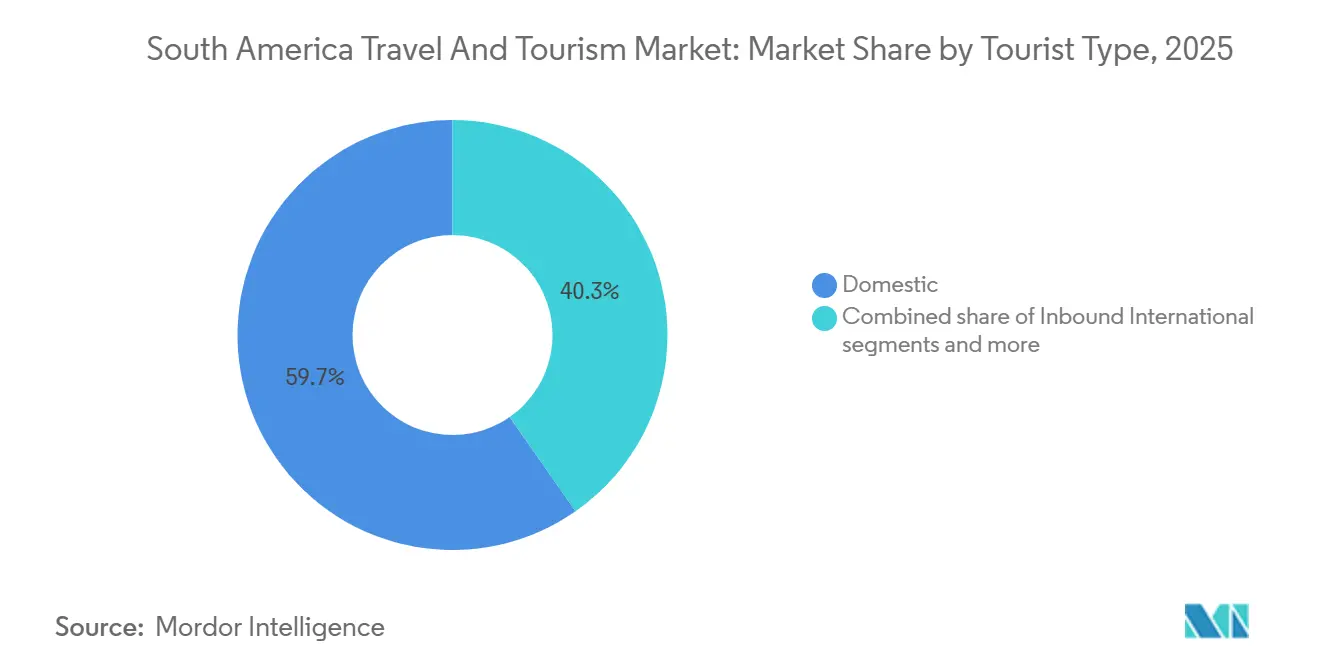
Domestic Foundations Meet Inbound MomentumDomestic travelers accounted for 59.70% of the South America Travel and Tourism market share in 2025, underscoring how home-market demand underpins resilience and supports capacity additions across Brazil and Mexico. Within the South America Travel and Tourism market, network carriers have added new domestic routes connecting industrial hubs with beach and cultural destinations, improving load factor balance across weekdays and weekends and across cabin classes. The same fundamentals that support domestic volumes, including rising wallet share for travel among younger demographics and the normalization of digital self-service, also lift the value of loyalty ecosystems for suppliers that steer bookings to direct channels. Inbound international volumes are recovering and diversifying by source market as network and low-cost carriers expand connectivity and as border automation reduces friction at major gateways. The South America Travel and Tourism market should continue to see domestic strength coexist with inbound gains as airlines optimize aircraft mix and schedules to match daypart and seasonal patterns across city pairs.
Inbound international is projected to post the fastest 2026-2031 growth at a 4.40% CAGR, supported by new long-haul and mid-haul routes and better transit experiences. Peru’s year-end 2025 inbound total and its large-scale deployment of ABC eGates demonstrate how technology improvements and targeted marketing help recapture international flows and smooth airport peaks. Mexico’s event calendar and stadium upgrades around the 2026 FIFA World Cup add a multi-city pull for inbound fans and corporate hospitality, which feeds both hotel and short-haul air segments before and after match days. Low-cost carriers are capturing more intra-regional leisure traffic as they expand frequencies and add cross-border city pairs, thereby improving price transparency and stimulating budget-conscious segments that would otherwise defer travel. With domestic share still dominant, airlines can balance their fleets and crews across domestic and international rosters to manage volatility and protect utilization, keeping the South America Travel and Tourism market on a steady growth path.

By Purpose of Travel:
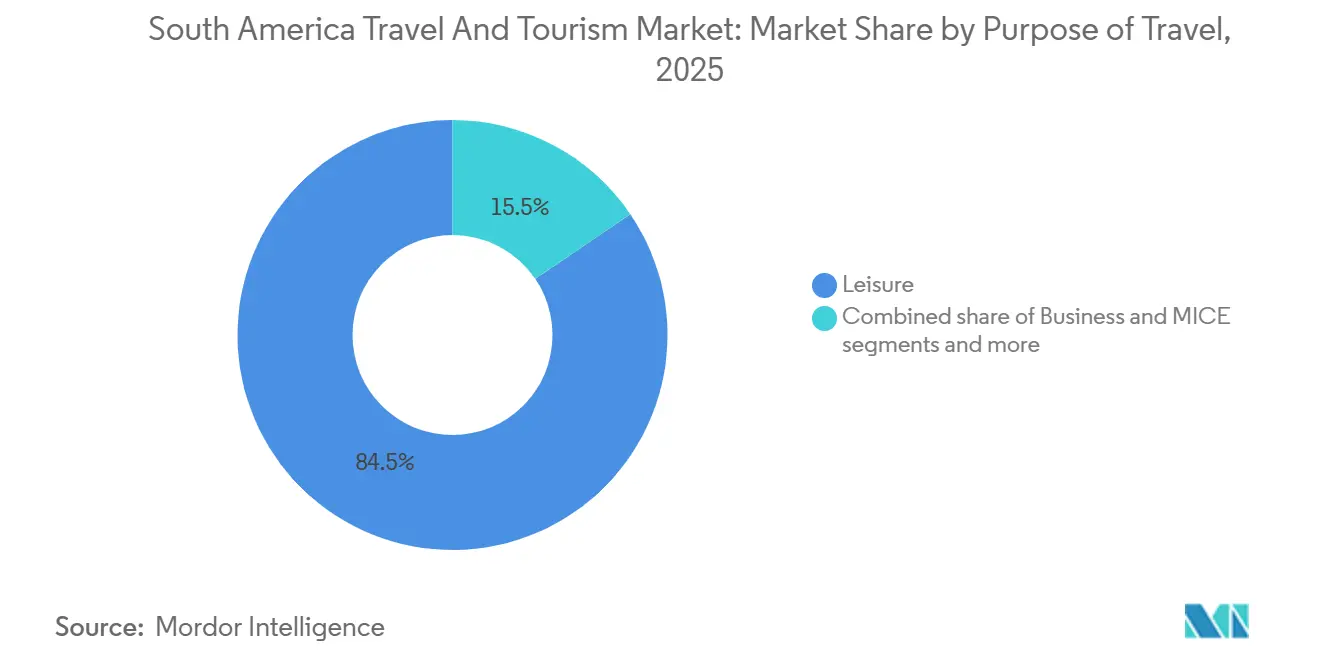
Leisure Dominance, Medical Wellness BreakoutLeisure accounted for 84.50% of spending in 2025, reflecting the region’s strong mix of beaches, nature, and cultural attractions that continue to draw repeat visitors. Suppliers have introduced new premium and lifestyle hotel products in major and secondary cities to meet evolving tastes, including a pipeline of 2026 openings in Mexico and Brazil across luxury and select-service flags. Airlines are refreshing products to appeal to higher-yield leisure travelers as well, with expanded premium seating, lounge renovations, and in-flight service upgrades across regional and long-haul routes. Major events in 2026 will support leisure itineraries that blend matches with local experiences, while digital wallets and contactless payments are making in-destination spend easier for international visitors. As hotel inventory diversifies and airlines expand seasonal capacity, the South America Travel and Tourism market maintains a favorable mix of price points and experiences for leisure segments.
Medical and wellness is the standout performer within the purpose mix and is forecast to grow at a 14.90% CAGR through 2031, supported by cost differentials, care quality, and proximity to the United States. Within the South America Travel and Tourism market, this segment is expected to grow as cross-border care pathways mature and destinations showcase integrated recovery and wellness services near tourism corridors. Airlines and hotels are tailoring services for medical and wellness travelers, including flexible change policies and quiet recovery spaces, which support higher ancillary revenue. The broader MICE segment also complements medical congresses and specialty conferences that use upgraded venues in major cities, which boosts premium ADRs during shoulder seasons. Improved airport processing through biometrics reduces total journey stress for patients and companions and improves the perceived reliability of cross-border medical trips. These dynamics should support a steady rise in wellness and procedure-linked travel as payers and providers expand cross-border partnerships.
By Booking Channel:
Digital Ascendancy Reshapes DistributionOnline channels captured 52.00% of bookings in 2025, and they are projected to grow at a 10.01% CAGR through 2031 as mobile-led discovery and checkout become the norm for more travelers. In the South American travel and Tourism market, online platforms benefited from enhanced payment options and trust-building features such as instant refunds and secure tokenization, which reduced abandonment and accelerated repeat purchases. Prosus’s 2025 acquisition of Despegar illustrates how scale in marketplaces can be leveraged across adjacent verticals to increase lifetime value and reduce marketing friction.
Airlines are also expanding their direct channels by integrating loyalty benefits, dynamic offers, and improved post-booking management into their apps and websites, which shifts share from intermediaries in repeat customer segments. Buy now pay later options, now visible across both OTA and supplier-direct checkouts, are lifting conversion and average order values by allowing travelers to spread payments over several months. As mobile wallets and contactless payments become ubiquitous across hotels and attractions in 2026, the South America Travel and Tourism market should see faster gains in digital share in secondary cities and resort corridors.
Geography Analysis
Brazil Travel and Tourism Market
Brazil holds the largest share of the South American Travel and Tourism market at 23.20% in 2025, and its airports and airlines are investing to support higher volumes and better experiences. São Paulo’s Guarulhos deployed dozens of biometric eGates in Terminal 3 in December 2025, processing passengers in seconds and boosting throughput at peak times, with a second phase set to expand in early 2026. South America is also tightening the domestic network with new daily routes that add nearly 300,000 seats annually, improving connectivity between Brasília, Belo Horizonte, and key business and leisure cities. Brazil’s e-visa reinstatement for United States, Canadian, and Australian nationals adds an application step but leverages digital processing designed to keep friction manageable for frequent travelers and event visitors. New hotel projects in secondary cities are expanding the room inventory, helping disperse demand from gateway metros and supporting regional tourism economies. These upgrades and route additions are improving the balance between capacity and service quality, a combination that supports steady growth in the South America Travel and Tourism market.
Mexico Travel and Tourism Market
Mexico’s position is reinforced by an event-driven infrastructure cycle and a wave of brand openings that diversify its hospitality landscape. The 2026 World Cup is catalyzing airport- and venue-adjacent upgrades across Mexico City, Guadalajara, and Monterrey, while hospitality investors expand room supply in coastal and cultural destinations. Accor’s 2026 pipeline includes flags in Mexico City and Caribbean destinations that add lifestyle- and wellness-centric offerings, complementing the luxury pipeline from other brands for 2026. Low-cost carriers are adding routes linking United States cities to Mexican secondary airports ahead of the event window, spreading arrivals across a wider geographic footprint and reducing pressure on the largest gateways. As digital wallets and contactless acceptance expand at attractions and restaurants, the in-destination spend environment continues to improve for cross-border visitors. Mexico’s combination of capacity additions and product diversity keeps it central to the South America Travel and Tourism market’s growth profile through 2031.
Colombia Travel and Tourism Market
Colombia is set to post the fastest CAGR at 9.03% through 2031 and has strengthened its proposition through network and product investments that draw higher-spend segments. Avianca’s 2025 program expanded premium seating and lounge experiences and prepared for the rollout of Business Class on dozens of domestic and regional routes from early 2026, which raises the appeal for corporate and premium leisure travelers. New luxury hotels, including Four Seasons Cartagena, anchor the city as a cultural and culinary destination and signal investor confidence in the durability of demand. Air traffic data show steady gains across domestic and international segments, reflecting both new route announcements and stronger load factors as demand broadens beyond traditional gateways. With airport terminals implementing process improvements and with airlines adding seats and services, Colombia’s ecosystem is positioned to support sustained high growth within the South American travel and tourism market.
Competitive Landscape
The South America Travel and Tourism market is characterized by a balance between regional legacy groups and fast-scaling low-cost carriers, with OTAs and supplier-direct digital channels competing for customer ownership. LATAM Airlines operates the largest network, accounting for an estimated 21% of regional capacity, and has expanded domestic and regional connectivity with smaller-gauge aircraft orders that improve trip economics on mid-density routes. The Abra Group secured additional Airbus orders to expand long-haul and short-haul capabilities across Avianca and GOL, reflecting a commitment to modern, fuel-efficient fleets that help manage unit costs and environmental performance. JetSMART Colombia quickly captured market share in the domestic market by serving high-demand routes with efficient A320neo aircraft, a model that underscores the opportunity in markets that had seen capacity exits. Strategic airline partnerships extend reach without duplicative assets, and the Delta–LATAM joint venture has supported consistent traffic growth between North and South America, with additional city pairs planned. These moves illustrate why competitive intensity varies by country and by route, with frequency and network breadth central to defensibility on core city pairs.
Digital distribution is consolidating, and airlines and hotels are investing to improve the value proposition of their direct channels. Prosus’s acquisition of Despegar integrates travel with complementary verticals in South America and amplifies the cross-sell potential of a large multi-vertical user base. Airlines are upgrading products and lounges and introducing paid premium options on domestic and regional flights, which helps capture higher yields and improve loyalty economics. Hotel groups are also ramping up pipeline across the region, including lifestyle and wellness concepts in Mexico City and the Caribbean that appeal to younger and premium travelers. As direct channels benefit from loyalty-linked offers and better after-sales tools, intermediaries compete on breadth, local supply aggregation, and flexible payments, with BNPL and wallets now table stakes for conversion. The South America Travel and Tourism market dynamics show margin pressure in commoditized segments balanced by premiumization in business cabins, wellness resorts, and branded experiences.
Cruise and hub-and-spoke carriers are deepening their strategic footprints in South America, which diversifies traveler choices and routes. MSC Cruises expanded homeporting in the Americas and is increasing Southern Caribbean operations, supported by new office investments that consolidate teams and reinforce long-term commitment to the region. Copa Airlines continues to execute its Hub of the Americas model from Panama City, connecting dozens of cities across the hemisphere and adding new routes that link South America with tourist corridors in Mexico and the Caribbean. As aviation analytics providers note, on-time performance at Tocumen and other regional hubs remains a competitive asset that supports connections and protects passenger experience. These strategic moves, across air and sea, broaden the menu of itineraries and segment offerings that underpin the South America Travel and Tourism market through the forecast period.
South America Travel and Tourism Industry Leaders
-
LATAM Airlines Group S.A.
-
GOL Linhas Aéreas Inteligentes S.A.
-
Aeroméxico (Grupo Aeroméxico)
-
Accor (South America)
-
Despegar.com Corp. (Despegar/Decolar)
- *Disclaimer: Major Players sorted in no particular order
South America Travel and Tourism Market Companies Covered in this Report
- LATAM Airlines Group S.A.
- Avianca Group International Limited
- GOL Linhas Aéreas Inteligentes S.A.
- Azul Linhas Aéreas Brasileiras S.A.
- Aeroméxico (Grupo Aeroméxico)
- Volaris (Controladora Vuela Compañía de Aviación)
- Viva Aerobus (Grupo Viva Aerobus)
- Copa Airlines (Copa Holdings)
- Aerolíneas Argentinas
- Despegar.com Corp. (Despegar/Decolar)
- CVC Corp (CVC Viagens, Submarino Viagens)
- PriceTravel Holding
- Accor (South America)
- Grupo Posadas, S.A.B. de C.V.
- Marriott International, Inc.
- Hilton Worldwide Holdings Inc.
- Meliá Hotels International
- Iberostar Hotels & Resorts
- Grupo Posadas
- MSC Cruises
- Royal Caribbean Group
- Localiza Rent a Car S.A.
Recent Industry Developments in South America Travel and Tourism Market
- January 2026: MSC Cruises opened its new North American headquarters in downtown Miami, consolidating over 400 personnel and reinforcing its long-term growth plan for the Americas with expected hundreds of millions of dollars in annual direct economic impact to Miami-Dade.
- December 2025: São Paulo Guarulhos completed Phase 1 biometric eGate deployment in Terminal 3 with 42 SITA lanes processing passengers in under 10 seconds, and Phase 2 added more gates in Feb 2026 to handle higher inbound volumes.
- November 2025: Miami International Airport launched the largest single deployment of CBP’s Enhanced Passenger Processing in the United States, installing 12 biometric face pods that verify travelers in seconds and improve peak-hour flows at one of the top gateways to South America.
- September 2025: LATAM Airlines agreed to acquire up to 74 Embraer E195-E2 regional jets, including 24 firm deliveries starting in the second half of 2026 and 50 options, to densify South American connectivity and improve unit economics on mid-density routes.
South America Travel and Tourism Market Report Scope
Travel and tourism involve individuals traveling outside their usual environment for leisure, business, or other purposes, typically for up to one year. It encompasses services such as transportation, accommodation, tours, and attractions.
The South America travel and tourism market report is segmented by tourist type (domestic, inbound international, outbound international), purpose of travel (leisure, business & mice, visiting friends & relatives, medical & wellness), booking channel (online and offline), and geography (Mexico, Brazil, Argentina, Chile, Colombia, Peru, Central America & Caribbean, Rest of Latin America). The market forecasts are provided in terms of value (USD).
Segmentation Overview
By Tourist Type
| Domestic |
| Inbound International |
| Outbound International |
By Purpose of Travel
| Leisure |
| Business & MICE |
| Visiting Friends & Relatives (VFR) |
| Medical & Wellness |
By Booking Channel
| Online (OTAs, supplier-direct) |
| Offline (retail agencies, call centers) |
By Geography
| Mexico |
| Brazil |
| Argentina |
| Chile |
| Colombia |
| Peru |
| Rest of South America |
| By Tourist Type | Domestic |
| Inbound International | |
| Outbound International | |
| By Purpose of Travel | Leisure |
| Business & MICE | |
| Visiting Friends & Relatives (VFR) | |
| Medical & Wellness | |
| By Booking Channel | Online (OTAs, supplier-direct) |
| Offline (retail agencies, call centers) | |
| By Geography | Mexico |
| Brazil | |
| Argentina | |
| Chile | |
| Colombia | |
| Peru | |
| Rest of South America |
Key Questions Answered in the Report
What is the South America Travel and Tourism market growth outlook through 2031?
The sector is projected to expand from USD 117.05 billion in 2026 to USD 158.86 billion by 2031 at a 6.30% CAGR, supported by domestic resilience, gains in digital bookings, and expanding airline connectivity.
Which segments lead to demand within the South America Travel and Tourism market?
Leisure holds the largest share at 84.50%, while medical and wellness is the fastest-growing purpose segment with a 14.90% CAGR through 2031, and online booking channels lead with a 52.00% share.
How are technology upgrades shaping traveler experience in South America?
Major hubs such as Lima and São Paulo deployed biometric and automated border control systems that cut wait times and increase peak-hour throughput, thereby improving satisfaction and connection reliability.
How are technology upgrades shaping traveler experience in South America?
Brazil reinstated e-visas for United States, Canadian, and Australian citizens in 2025, adding an application step but using a digital process designed to minimize friction to a minimum for frequent travelers.
Which countries are expected to grow fastest in the region?
Colombia is projected to record the steepest 2026-2031 CAGR at 9.03%, driven by network investment, premium product upgrades, and new luxury hotel openings that broaden appeal.
How is airline strategy evolving in the South American Travel and Tourism market?
Carriers are modernizing fleets, increasing LCC frequencies, expanding joint ventures, and enhancing direct bookings with loyalty benefits and flexible payment options, thereby raising conversion and yields.