
South America Rigid Bulk Packaging Market Size and Share
Market Overview
| Study Period | 2020 - 2031 |
|---|---|
| Forecast Data Period | 2026 - 2031 |
| Base Year Market Size (2025) | USD 5.16 Billion |
| Market Size (2026) | USD 5.31 Billion |
| Market Size (2031) | USD 6.12 Billion |
| Growth Rate (2026 - 2031) | 2.88 % |
| Market Concentration | Medium |
Major Players *Disclaimer: Major Players sorted in no particular order Image © Mordor Intelligence. Reuse requires attribution under CC BY 4.0. | |
South America Rigid Bulk Packaging Market Analysis by Mordor Intelligence
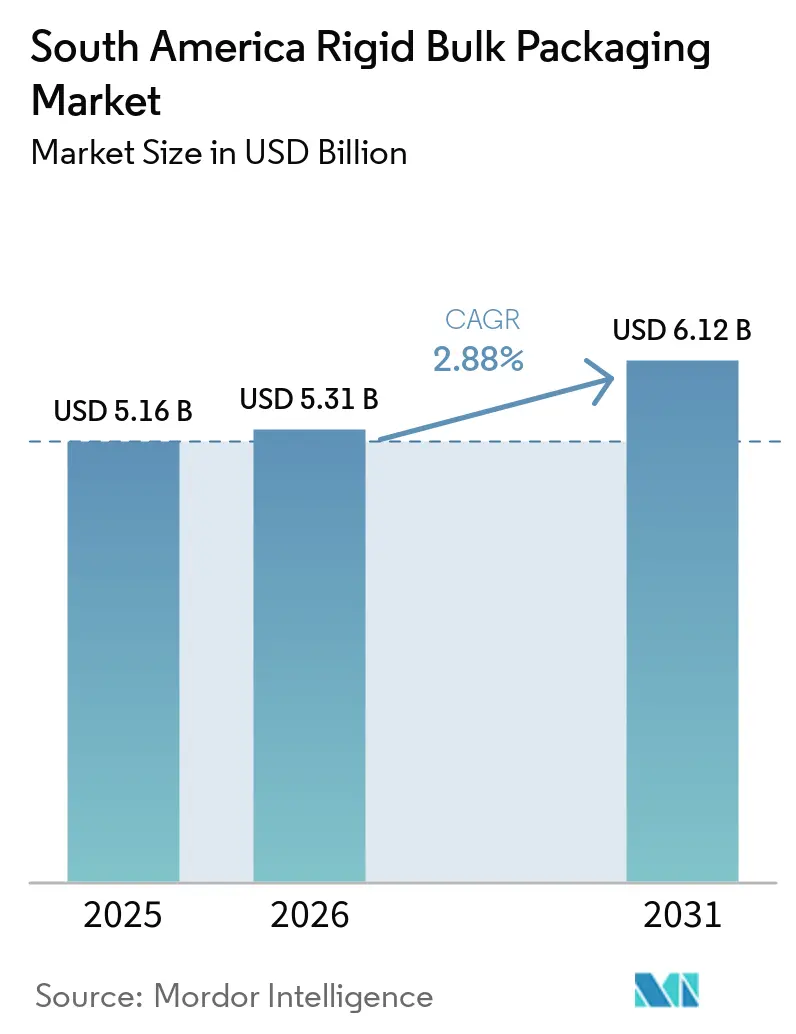
The South America rigid bulk packaging market size was valued at USD 5.16 billion in 2025 and estimated to expand from USD 5.31 billion in 2026 to reach USD 6.12 billion by 2031, at a CAGR of 2.88% during the forecast period (2026-2031). Agricultural exports, chemical production, and pharmaceutical supply chains support demand for rigid containers across the region. Brazil remains the main pricing and technology center because its industrial corridors and export ports handle major volumes of chemicals, agrochemicals, and food products. Packaging suppliers are focusing on certified containers, recycled-content designs, and reconditioning networks as customers place more weight on compliance and total ownership cost. Trade facilitation between Brazil and Argentina can reduce documentation delays for industrial cargo and improve the flow of bulk shipments. Resin price volatility remains a material risk because it increases costs for new drums and IBCs while making reconditioned containers more attractive.
Key Report Takeaways
- By material, plastic held 50.24% of South America's rigid bulk packaging market revenue in 2025, and is projected to expand at a 3.12% CAGR through 2031.
- By product, industrial bulk containers held 31.36% of revenue in 2025 and are projected to expand at a 3.11% CAGR through 2031.
- By end-user industry, industrial applications accounted for 32.26% of revenue in 2025, while food is projected to expand at a 3.47% CAGR through 2031.
- By capacity, the 500-to-1,000-liter range held 39.38% of revenue in 2025, while above-1,000-liter containers are projected to expand at a 3.44% CAGR through 2031.
- By content, liquid products accounted for 55.33% of revenue in 2025, and are projected to expand at a 3.27% CAGR through 2031.
- By container lifecycle, new containers held 42.17% of revenue in 2025, while reusable multi-trip containers are projected to expand at a 3.18% CAGR through 2031.
- By certification and compliance, UN-certified containers accounted for 34.42% of revenue in 2025, while pharmaceutical-grade containers are projected to expand at a 3.29% CAGR through 2031.
- By geography, Brazil held 58.21% of regional revenue in 2025, while Colombia is projected to expand at a 3.46% CAGR through 2031.
Note: Market size and forecast figures in this report are generated using Mordor Intelligence’s proprietary estimation framework, updated with the latest available data and insights as of January 2026.
Market Trends and Insights
Drivers Impact Analysis of South America Rigid Bulk Packaging Market*
| Driver | (~) % Impact on CAGR Forecast | Geographic Relevance | Impact Timeline |
|---|---|---|---|
| Expansion of Agricultural and Agrochemical Exports | +0.7% | Brazil and Argentina, with spillover to Colombia and Chile | Short term (≤ 2 years) |
| Growth of Chemical and Petrochemical Manufacturing | +0.6% | Brazil, especially São Paulo and Camaçari, and Argentina | Medium term (2-4 years) |
| Rising Demand for Reusable and Reconditioned Containers | +0.5% | Global, concentrated in Brazil and Colombia | Medium term (2-4 years) |
| Growth of Food, Beverage, and Pharmaceutical Bulk Logistics | +0.4% | Brazil, Colombia, and Argentina | Medium term (2-4 years) |
| Cross-Border Trade and Logistics Modernization | +0.3% | Argentina and Brazil, extending to Paraguay and Uruguay | Medium term (2-4 years) |
| Adoption of Smart Tracking and Container Fleet Management | +0.2% | Brazil, Chile, and Argentina | Long term (≥ 4 years) |
| Source: Mordor Intelligence | |||
Expansion of Agricultural and Agrochemical Exports
Brazil and Argentina are major agrochemical users and agricultural exporters, which sustains demand for UN-certified drums, jerrycans, and composite IBCs across farming, storage, blending, and export operations. Export requirements in Europe and Asia-Pacific are shaping container specifications for suppliers in the South America rigid bulk packaging market, especially when products travel through long international supply chains. These requirements make packaging upgrades part of routine export compliance rather than a discretionary purchase by individual buyers. In October 2025, Greif and Syngenta launched a lightweight IMB jerrycan in Brazil, designed to meet international agrochemical transport requirements.[1] The product supports the integration of a substantial proportion of post-consumer recycled content. Global crop-protection companies are raising the specification standard for local suppliers, which favors manufacturers with validated barrier technologies and documented product performance, established quality controls, compatible recycled-content options, and the ability to support the same specifications through recurring export shipments.
Growth of Chemical and Petrochemical Manufacturing
Brazil’s chemical production increased significantly in the first quarter of 2026 compared with end-2025 levels. The recovery supports higher demand for drums and IBCs used in chemical storage, domestic distribution, export loading, and customer delivery. Presiq provides substantial annual incentives and aims to raise domestic chemical capacity utilization from current levels to substantially higher levels by 2029. Higher utilization would increase packaging throughput in Brazil’s major chemical production corridors and improve the need for recurring container supply. Imports accounted for nearly half of Brazil’s apparent chemical consumption in 2025, and imported specialty chemicals typically use new certified containers.[2] A stronger domestic production base would support reconditioned formats and reward suppliers in the South America rigid bulk packaging market with closed-loop collection and reconditioning capabilities, since these suppliers can collect used containers, inspect their condition, and return suitable units to industrial customers without relying only on new resin-based production.
Rising Demand for Reusable and Reconditioned Containers
Purchasing decisions increasingly compare reusable IBCs and reconditioned drums by total ownership cost rather than purchase price alone. Mauser Packaging Solutions reconditions a large volume of IBCs and drums annually through an extensive network of facilities across multiple countries, including Brazil. This scale demonstrates the importance of collection, cleaning, inspection, return transport, and reliable redeployment networks for industrial users. SCHÜTZ uses a significant share of in-house recycled content in the middle layer of Green Layer IBC inner bottles, PE drums, and jerrycans. Brazil’s Federal Decree, issued in 2025, requires large producers to use a minimum share of post-consumer recycled content in plastic packaging from January 2026.[3] Producers with multilayer extrusion and established recovery networks are better positioned to meet this requirement and serve the South America rigid bulk packaging market, because they can manage recycled material quality, maintain structural performance, and provide customers with evidence that the packaging meets relevant content and transport expectations.
Growth of Food, Beverage, and Pharmaceutical Bulk Logistics
Food is projected to expand at the highest rate through 2031 among end-user industries. Brazilian and Colombian food processors are shifting from smaller drums to large-capacity IBCs for bulk ingredient exports, internal transfers, and larger shipment batches. Larger containers can help exporters access volume-based freight rates without a proportional increase in container cost or handling activity. ANVISA issued an RDC in July 2025, establishing risk-based good manufacturing and distribution practice certification for facilities handling active pharmaceutical ingredients, biologics, and medical devices. This regulatory framework supports demand for compliant pharmaceutical containers in the South America rigid bulk packaging market. Beverage concentrates, syrups, and edible oils also provide a stable demand for food-contact-compliant IBC configurations, particularly when processors need repeat supply, controlled product handling, and container systems that are suitable for established food production and distribution processes.
Restraints Impact Analysis of South America Rigid Bulk Packaging Market*
| Restraint | (~) % Impact on CAGR Forecast | Geographic Relevance | Impact Timeline |
|---|---|---|---|
| Resin, Steel, and Exchange-Rate Volatility | -0.4% | Brazil, followed by Argentina, Colombia, and Chile | Short term (≤ 2 years) |
| Uneven Transport and Storage Infrastructure | -0.3% | Inland Brazil, northern Argentina, and rural Colombia | Medium term (2-4 years) |
| Fragmented Packaging Compliance Requirements | -0.2% | National requirements, with uneven enforcement in Bolivia, Peru, and Ecuador | Medium term (2-4 years) |
| High Cost of Reverse Logistics and Container Reconditioning | -0.2% | Brazil, with Argentina as a secondary market | Medium term (2-4 years) |
| Source: Mordor Intelligence | |||
Resin, Steel, and Exchange-Rate Volatility
Input-cost volatility is the most immediate restraint on the South America rigid bulk packaging market. Brazilian polyethylene spot prices increased by more than 50% in early 2026 after duties of USD 199.04 per tonne on U.S.-origin polyethylene were finalized in March 2026. Resin-dependent manufacturers of drums and IBCs therefore face higher material costs and greater pressure when setting contract prices. Imports represented 49% of Brazil’s apparent chemical consumption in 2025, so currency depreciation can raise the cost of imported resin. Steel packaging is also exposed to global coil price movements and exchange-rate pressure in Argentina. Cost inflation raises new-container prices but also reinforces the financial case for reconditioned alternatives, supporting vertically integrated suppliers with their own collection and processing capacity, documented inspection procedures, and the ability to serve customers seeking lower replacement costs without compromising established performance requirements.
Uneven Transport and Storage Infrastructure
Transport and storage capacity limits expansion beyond port-adjacent industrial corridors. Logistics work efficiently along the São Paulo-Santos and Curitiba-Paranaguá routes, while inland freight to Mato Grosso and Colombia’s Andean valleys carries higher handling, transport, and delivery costs. Greif has identified high-capacity packaging handling infrastructure as a persistent regional constraint. Containers above 1,000 liters are most exposed because their deployment depends on road quality, bridge capacity, lifting equipment, and storage floor strength. ANTT proposed measures in April 2026 to streamline Authorized Economic Operator designations at MERCOSUR land crossings. These measures can reduce paperwork delays, but physical infrastructure needs will continue to limit large-format container use in inland areas of the South America rigid bulk packaging market, where difficult access, less capable storage sites, and longer travel distances can diminish the efficiency gains that large-capacity containers provide near major industrial corridors.
*Our forecasts treat driver/restraint impacts as directional, not additive. The impact forecasts reflect baseline growth, mix effects, and variable interactions.
South America Rigid Bulk Packaging Market Segment Analysis
By Material:
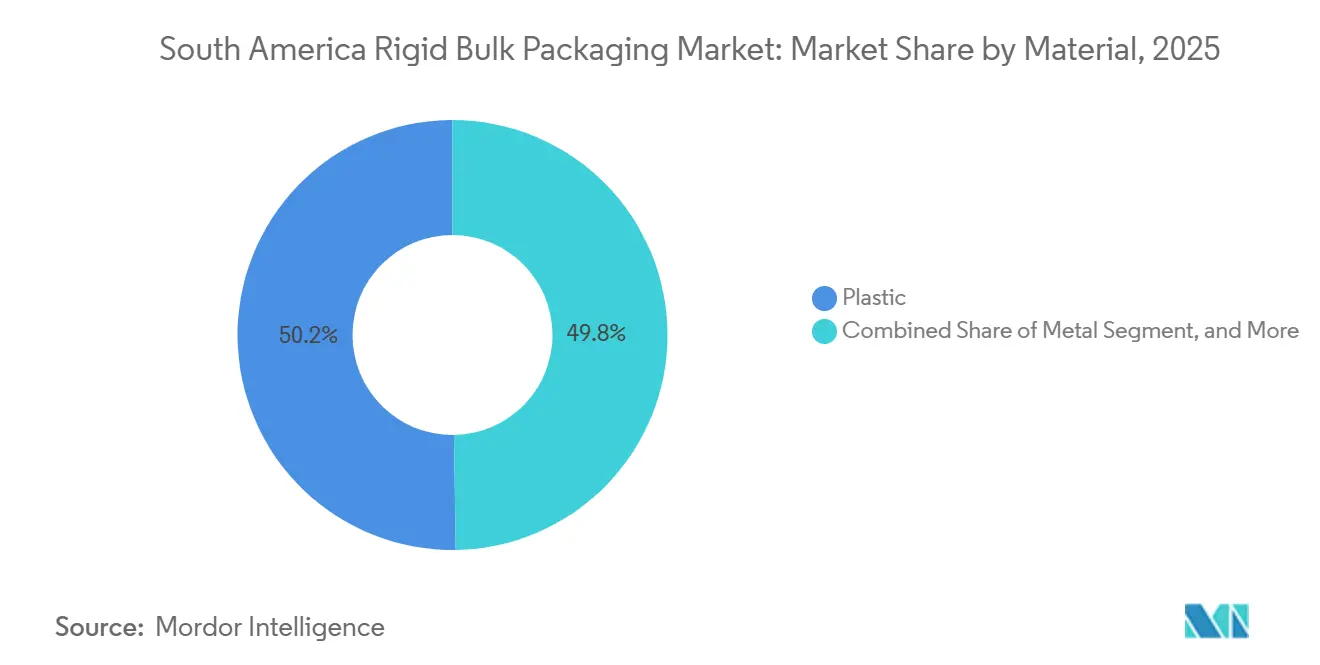
Plastic Leads as Circular Compliance Changes ProcurementPlastic held 50.24% of South America rigid bulk packaging market revenue in 2025 and are projected to expand at a 3.12% CAGR through 2031. HDPE provides chemical resistance, a low-weight profile, and broad suitability for liquid agrochemicals, petrochemicals, food ingredients, and hazardous products. This range of applications supports plastic demand across the region’s main manufacturing sites, agricultural areas, warehouses, and export routes, while plastic formats allow producers to supply drums, jerrycans, IBC inner bottles, and pails with related processing methods. Metal remains important for hazardous goods that require the mechanical strength, pressure resistance, and certified integrity of steel drums. These needs are especially relevant where temperature, cargo classification, and destination-market rules are demanding.
Wood has a smaller role in pallet-integrated agricultural bulk boxes in Argentina’s grain corridor, where it serves particular solid-product handling needs and is used where the logistics system is suited to those configurations. Other materials address specialized requirements, including fiber-composite drums for dry chemical powders and applications where product compatibility, product protection, or a defined handling process matters more than format scale. Brazil’s decree, issued in 2025, requires large producers to incorporate recycled content into plastic packaging from January 2026. The requirement changes material sourcing, quality control, procurement planning, and product design for companies serving the region’s largest national market. Smaller producers without multilayer extrusion capacity face higher compliance pressure than global suppliers with established circular production systems, so the South America rigid bulk packaging market favors material suppliers that can meet both performance and recycled-content requirements.

By Product:
IBCs Support Industrial Bulk LogisticsIndustrial bulk containers held 31.36% of revenue in 2025 and are projected to expand at a 3.11% CAGR through 2031. This combination reflects the central role of IBCs in liquid chemical and agrochemical handling across factories, distribution centers, ports, and customer sites. IBCs offer standardized capacity, stackability, and compatibility with export logistics for high-volume liquid shipments, with no close substitute for many bulk liquid applications that need secure containment and efficient handling. Drums remain important in hazardous goods exports where certified steel and plastic formats are required by destination-market standards. Their role is therefore durable in regulated, smaller-volume, and specialized shipments.
Agrochemical and petrochemical exporters increasingly standardize on 1,000-liter composite IBCs as a common export unit because the format provides familiar handling procedures across production sites, warehouses, ports, and receiving locations. The format reduces logistics cost per liter, fits ISO shipping containers, supports pooling programs across repeat trade routes, and helps customers manage a large number of shipments with a consistent container configuration. Pails remain relevant for specialty chemicals and food products that need controlled dosing, batch segregation, more manageable volumes, or direct handling by plant operators. Bulk boxes and other formats serve solid agricultural products where paper-composite alternatives can compete on cost, while drums retain uses that need certified or smaller-volume transport. Chemical companies with global logistics systems are making IBC specifications more common among South American suppliers, which narrows the use of alternative formats and gives the South America rigid bulk packaging market a stable base in industrial logistics.
By End-User Industry:
Food Shows the Fastest ExpansionThe industrial segment accounted for 32.26% of South America rigid bulk packaging market revenue in 2025. Chemical, petrochemical, and mining logistics sustain this demand because rigid containers are needed to move, store, and manage materials across long supply chains. Industrial buyers also place high value on certification, availability, and containers that can withstand frequent handling, while food is projected to expand at a 3.47% CAGR through 2031. Brazilian and Colombian processors are moving from smaller drums to larger IBCs for bulk ingredient exports and interfacility transfers. This transition helps them use volume-based transoceanic freight arrangements while improving load utilization.
Pharmaceutical and chemical customers add a growing source of demand as local drug manufacturing and active ingredient production expand, and these customers often require clear quality practices and reliable packaging availability. Brazil’s certification framework for regulated health products supports the need for compliant packaging. Beverage logistics for concentrates, syrups, and edible oils adds stable demand within Brazil’s domestic processing chains, particularly where food-contact compliance and repeat supply are important. Food processors can increase revenue per shipment by moving to larger formats even when their product volumes do not change, because each shipment can carry more product in a standardized format. This format consolidation is a central source of demand for the South America rigid bulk packaging industry and also broadens the customer base for suppliers serving the South America rigid bulk packaging market.
By Capacity:
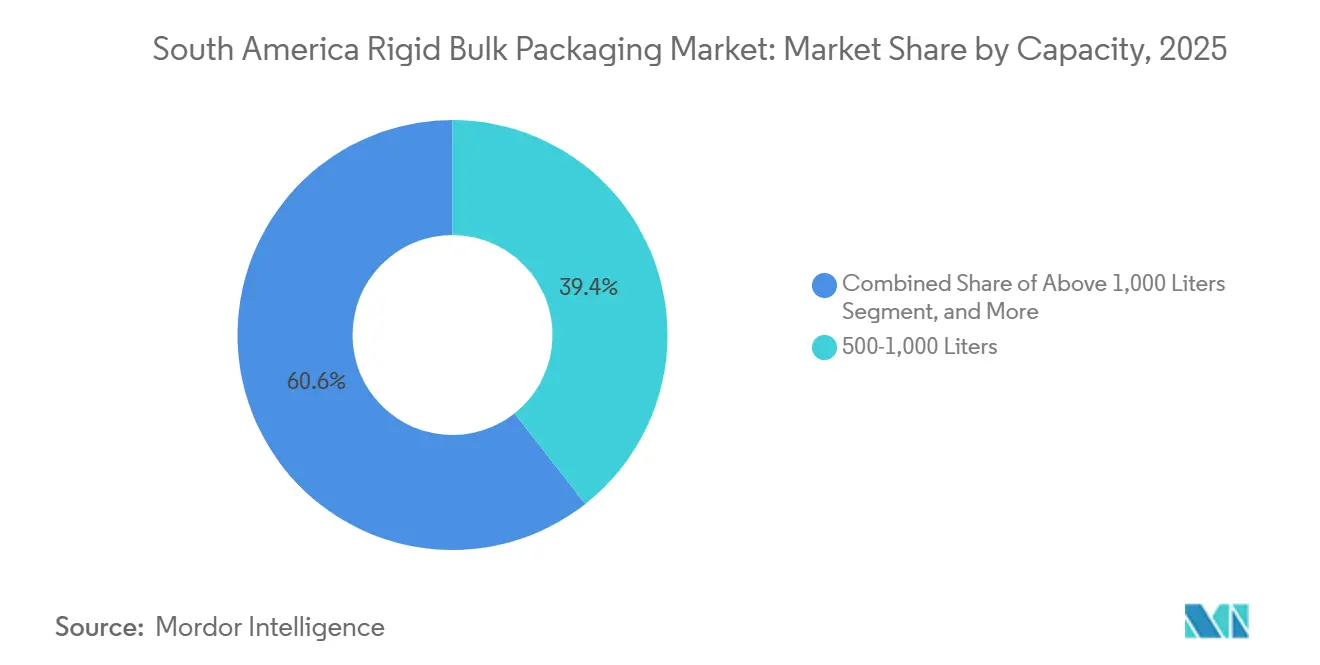
Larger Formats Gain MomentumThe 500-to-1,000-liter bracket held 39.38% of revenue in 2025. Standard composite IBCs are widely used in chemical and agrochemical applications, which supports the position of this capacity range in established industrial supply chains, and these containers combine a practical fill volume with familiar loading, storage, and transport practices. Above-1,000-liter containers are projected to expand at a 3.44% CAGR through 2031. Large exporters are adopting these formats to reduce handling frequency and use ISO-container space more efficiently. The capacity segment is particularly relevant for transoceanic freight routes that serve chemical and agricultural export flows.
Containers up to 500 liters remain important for pharmaceuticals and specialty chemicals, where batch traceability, product segregation, smaller volumes, and individual handling needs support single-trip or limited-trip formats. Initial demand for the largest capacity tier is concentrated near Brazil’s Camaçari complex and Argentina’s Bahía Blanca corridor, where chemical production, freight access, and industrial handling facilities are already established. Wider inland adoption depends on better roads, storage sites, lifting equipment, loading practices, and handling infrastructure that can manage the weight and size of larger containers. Buyers in well-served industrial clusters can use regional pooling hubs rather than send the largest containers into weaker transport networks. This approach allows the South America rigid bulk packaging market to serve major exporters without relying on universal inland infrastructure, while keeping the largest formats close to the routes where their logistics benefits are clearest.
By Content:
Liquid Products Set the Demand ProfileLiquid products accounted for 55.33% of South America rigid bulk packaging market revenue in 2025, and are projected to expand at a 3.27% CAGR through 2031. The region ships liquid chemicals, agrochemicals, edible oils, liquid food ingredients, and petroleum derivatives in significant volumes through domestic and export supply chains. Composite IBCs are a preferred format for many of these bulk liquid movements because they combine standardized capacity with effective storage and handling. Their use links liquid-product logistics closely to demand for rigid bulk packaging, while liquid applications also require attention to valves, liners, seals, and compatibility with the specific product carried. This concentration gives liquid applications a central role in the regional demand profile.
Solid-content packaging serves powder agrochemicals, mineral concentrates, and dry food ingredients, where product density, moisture protection, and handling characteristics influence the container choice. Bulk boxes and fiber drums can compete with rigid plastic containers in these uses, particularly when product density and cost are more important than liquid containment or a fully enclosed IBC format. Semi-solid products remain the smallest category but have relevance for gels, pastes, and wax-based products in food and personal care exports, which require containers that retain integrity during temperature changes and transport. Higher-viscosity exports such as resins, adhesives, and polymer intermediates create demand for IBCs with application-specific valves, liner configurations, and product-contact components. These requirements create practical product differentiation within the South America rigid bulk packaging market because buyers can select container features that better match the filling, discharge, and transport needs of the product.
By Container Lifecycle:
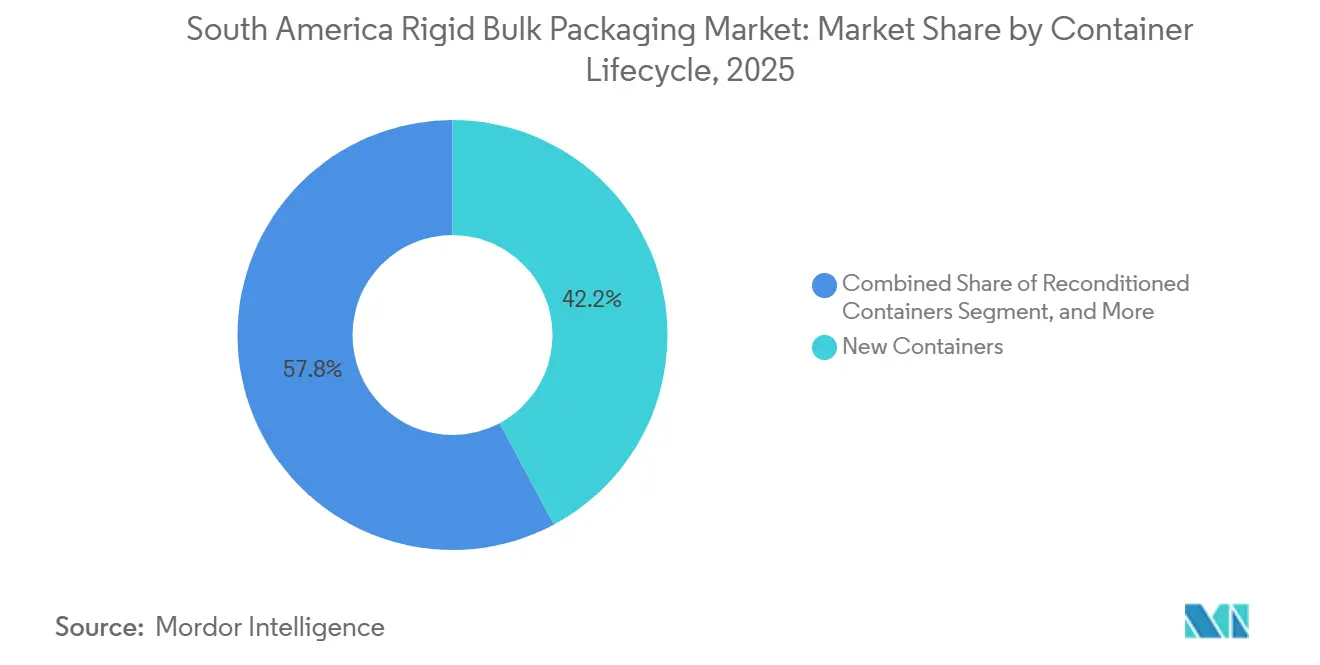
Reusable Formats Change Purchasing DecisionsNew containers accounted for 42.17% of revenue in 2025. Pharmaceutical, food-grade, and hazardous goods shipments often require first-use certification or new packaging under buyer specifications, limiting the scope for reconditioned units. Reusable multi-trip containers are projected to expand at a 3.18% CAGR through 2031. Large chemical and food companies use closed-loop supply agreements to lower container costs per trip, reduce waste-management needs, and improve supply continuity. The lifecycle choice is becoming more closely tied to return logistics, product sensitivity, and compliance requirements, so suppliers must support both new and reusable formats for customers with different risk profiles.
Mauser Packaging Solutions operates a reconditioning network that processes more than 10 million IBCs and drums each year across 19 countries, including Brazil. This scale demonstrates the role of collection, inspection, cleaning, testing, and reconditioning in the South America rigid bulk packaging market, especially for customers with regular return flows. Reconditioned units are widely used in chemical and industrial applications where contamination histories and UN performance ratings are accepted, while single-trip containers remain relevant where return freight exceeds residual container value or international routes do not support economical returns. This is particularly important for one-way shipments from Paranaguá and Santos to Asia-Pacific destinations, where containers may not return to the original supply chain. Lifecycle choices consequently differ by cargo type, destination, product sensitivity, customer requirements, and the availability of reverse logistics.
By Certification and Compliance:
UN Certification Supports Hazardous Goods TradeUN-certified containers held 34.42% of revenue in 2025. South America exports classified dangerous goods by road, sea, and multimodal routes, which requires certified transport packaging and reliable supporting documentation. In Brazil, ANTT Resolution 5998/22 requires nationally certified inspection documents for domestic dangerous goods containers. International consignments follow requirements such as the IMDG Code and ADR 2025 standards. These rules set a minimum technical standard for procurement by chemical exporters and logistics providers and support demand for proven drum and IBC designs across regulated trade routes.
Pharmaceutical-grade containers are projected to expand at a 3.29% CAGR through 2031. Brazil’s growing biologics and generic drug production, alongside RDC 982/2025, supports demand for these compliant formats. Food-contact-compliant containers are also gaining relevance among Brazilian and Colombian processors that serve domestic and export customers and need consistent food-grade handling. Non-hazardous industrial units remain high-volume products for mining, construction chemicals, and lubricants, where lower compliance requirements and intense regional competition keep prices under pressure. Suppliers nevertheless need stable quality systems because industrial customers value dependable supply, consistent specifications, and packaging that performs reliably in routine distribution.
Geography Analysis
Brazil Rigid Bulk Packaging Market
Brazil held 58.21% of the South America rigid bulk packaging market share in 2025. It is the region’s main production and demand center across major materials, container types, end uses, and logistics routes. Brazil’s chemical sector is among the world’s largest by revenue and represents a significant share of national GDP, according to Abiquim. This scale supports demand for certified plastic and steel drums, composite IBCs, and large containers around São Paulo and Camaçari, where production, distribution, and export activity are closely linked.
Central-Western and Southern Brazil Rigid Bulk Packaging Market
Agricultural exports from Mato Grosso, Goiás, and Paraná also support demand for smaller certified containers that can travel by road to Paranaguá and Santos. Presiq aims to raise Brazil’s chemical capacity utilization from current levels to near-full capacity by 2029. Greater utilization would increase container demand from the chemical sector and support recurring purchases from producers, distributors, and logistics firms. Brazil’s reverse logistics system also requires plastic packaging recovery targets, beginning in 2026 and increasing over time through 2040. These requirements support investment in recycled-content container designs and collection systems.
South America Rigid Bulk Packaging Market
Suppliers with established circular systems are better positioned than local producers that lack comparable infrastructure or multilayer processing capability. Colombia is projected to expand at a 3.46% CAGR through 2031, the highest among the geographic segments. Pharmaceutical capacity additions near Bogotá and Medellín, food and beverage exports, and logistics investment support this outlook. Colombia’s Resolution 803 of 2024 established collection, recovery, and recycled-content requirements for plastic packaging. Argentina remains a major agricultural export contributor despite currency pressure, with drums and IBCs used for agrochemicals, edible oils, and wine supply chains, while Chile, Peru, and Ecuador form a smaller demand pool with differing compliance systems that can limit adoption of premium certified formats across the South America rigid bulk packaging market.
Competitive Landscape
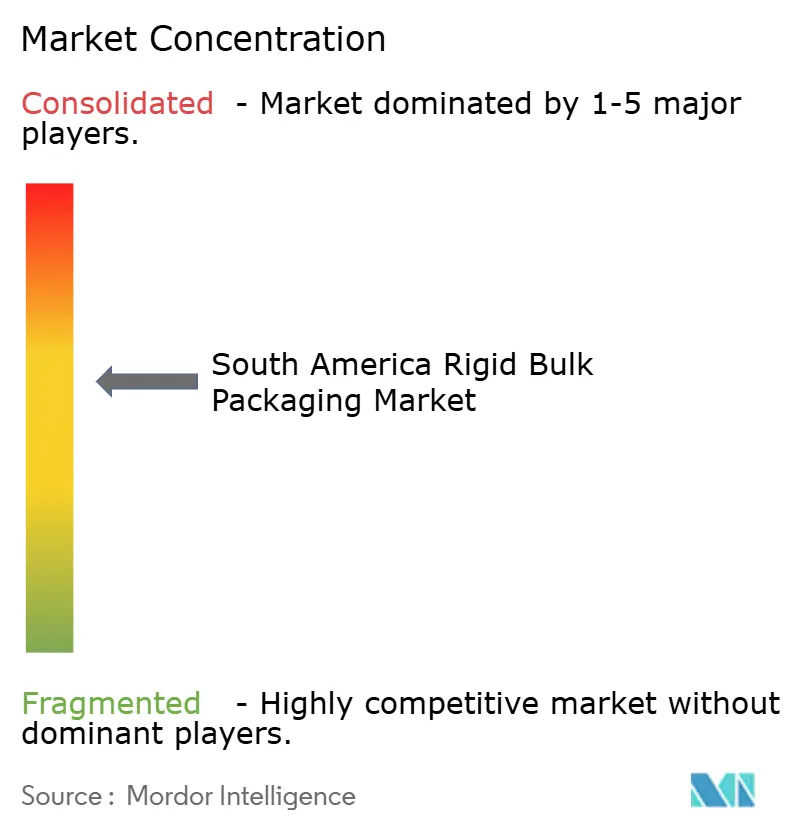
The South America rigid bulk packaging market has a moderate level of concentration. Global manufacturers have production and reconditioning operations in Brazil, while regional suppliers compete in commodity drums and bulk boxes that serve domestic volume requirements. Certification capabilities and circular infrastructure increasingly influence supplier selection, particularly for export-oriented chemical and agrochemical customers. Companies that can provide new UN-certified containers, reconditioning services, and recycled-content IBC options can support multi-year contracts and respond to customer requirements across the product lifecycle, from initial selection and technical qualification through collection, replacement, and the management of used containers, while meeting customer needs for certification, recycled content, traceability, dependable return arrangements, and consistent supply across multiple facilities, cargo types, and destination markets.
These exporters face sustainability requirements from European and North American customers and need suppliers that can document container performance. Greif presented its IMB, EcoEx, and Plasma SiOx barrier technologies at Interpack 2026 for food, agrochemical, and specialty chemical applications. The company also introduced the Greif Green Tool, which supports lifecycle assessment against packaging compliance requirements. SCHÜTZ has positioned Green Layer products with 30% recycled content for IBC inner bottles, PE drums, and jerrycans. These actions respond to recycled-content requirements that can affect South American exporters serving Europe.
Pharmaceutical-grade IBC pooling remains less developed in South America, where many pharmaceutical manufacturers still buy new containers for each batch and have limited access to established return systems, while fleet technology is becoming a differentiator for large export accounts that need better control of high-value or sensitive bulk cargo. Brazil’s Porto 4.0 initiative and Chile’s Smart Customs program are connecting container data with port and customs systems, and SCHÄFER’s Smart LOG system uses sensors in IBCs to provide fill-level, temperature, and location data to connected enterprise systems. The data can support restocking, loss reduction, and quality alerts, while regional competitors are building collection-first reconditioning networks under Brazil’s reverse logistics framework, focusing on container collection, inspection, customer relationships, and return coverage before committing capital to new manufacturing capacity. This approach can create pressure in the reconditioned-container tier, particularly where customers prioritize availability and cost control, but global suppliers retain advantages in validated technology and large-scale service systems. The South America rigid bulk packaging market concentration score is 5 out of 10 because the draft identifies moderate concentration but does not provide a combined market share for the leading companies.
South America Rigid Bulk Packaging Industry Leaders
-
Greif Inc.
-
Mauser Packaging Solutions
-
ALPLA Group
-
SCHÜTZ GmbH & Co. KGaA
-
ORBIS Corporation
- *Disclaimer: Major Players sorted in no particular order
South America Rigid Bulk Packaging Market Companies Covered in this Report
- Greif Inc.
- Mauser Packaging Solutions
- ALPLA Group
- SCHUTZ GmbH & Co. KGaA
- ORBIS Corporation
- Berry Global Inc.
- Rheem Chilena SpA
- Monoflo International
- The Cary Company
- Bison IBC Ltd
- Schoeller Allibert
- Unipac Embalagens Ltda.
- Plastipak Packaging, Inc.
- Nefab Group
- Brambles Limited
- Valgroup
- JCR Embalagens
- Grupo Igles
- Brasilata S.A. Embalagens Metalicas
- Fabritam S.A.
- Time Technoplast Ltd.
- Rehrig Pacific Company
Recent Industry Developments in South America Rigid Bulk Packaging Market
- June 2026: Stahl signed an agreement to acquire the packaging coatings portfolio of Weilburger Coatings in Brazil, marking the next milestone in Stahl's regional packaging coatings growth strategy; the company plans to progressively insource the product portfolio at its own Brazilian site during 2026, strengthening its position in food, beverage, and industrial packaging markets across South America.
- May 2026: SCHÜTZ GmbH and Co. KGaA presented its complete Green Layer packaging series, IBC inner bottles, PE drums, and the newly launched SC2 jerrycan range, at Interpack 2026; all Green Layer products incorporate 30% in-house recycled content in the middle layer of a three-layer extrusion construction, maintaining UN-certified performance standards and positioning ahead of the EU Packaging and Packaging Waste Regulation's minimum recycled-content mandate from 2030.
- May 2026: Greif exhibited its barrier technology portfolio, IMB, EcoEx, and Plasma SiOx, at Interpack 2026, affirming commercial-scale validation across food, agrochemical, and specialty chemical markets; the company concurrently launched its Greif Green Tool ISO-based lifecycle calculator, allowing customers to quantify packaging carbon footprints against PPWR compliance timelines.
- February 2026: The MERCOSUR Trade Facilitation Agreement, CMC Decision 29/19, entered into force for Argentina and Brazil, introducing harmonized single-window electronic documentation, Authorized Economic Operator programs, and coordinated border controls at bilateral crossing points including Paso de los Libres-Uruguaiana.
South America Rigid Bulk Packaging Market Report Scope
South America Rigid Bulk Packaging Market refers to the production and supply of durable, large-format containers for storing and transporting substantial quantities of liquids, powders, granules, and semi-solid products. It includes rigid intermediate bulk containers, drums, barrels, pails, jerry cans, bulk boxes, crates, and other reusable or single-use industrial containers.
The South America Rigid Bulk Packaging Market Report is Segmented by Material (Plastic, Metal, and Wood, and Other Materials), Product (Industrial Bulk Containers, Drums, Pails, and Bulk Boxes, and Other Products), End-User Industry (Food, Beverage, Industrial, and Pharmaceutical and Chemical, and Other End-user Industries), Capacity (Up to 500 Liters, 500-1,000 Liters, and Above 1,000 Liters), Content (Liquid, Solid, and Semi-Solids), Container Lifecycle (New Containers, Reconditioned Containers, Reusable Multi-Trip Containers, and Single-Trip Containers), Certification and Compliance (UN-Certified Containers, Food-Contact-Compliant Containers, Pharmaceutical-Grade Containers, and Non-Hazardous Industrial Containers), and Geography (Brazil, Argentina, Colombia, and Rest of South America). The Market Forecasts are Provided in Terms of Value (USD).
Segmentation Overview
| Plastic |
| Metal |
| Wood |
| Other Materials |
| Industrial Bulk Containers |
| Drums |
| Pails |
| Bulk Boxes |
| Other Products |
| Food |
| Beverage |
| Industrial |
| Pharmaceutical and Chemical |
| Other End-user Industries |
| Up to 500 Liters |
| 500-1,000 Liters |
| Above 1,000 Liters |
| Liquid |
| Solid |
| Semi-Solids |
| New Containers |
| Reconditioned Containers |
| Reusable Multi-Trip Containers |
| Single-Trip Containers |
| UN-Certified Containers |
| Food-Contact-Compliant Containers |
| Pharmaceutical-Grade Containers |
| Non-Hazardous Industrial Containers |
| Brazil |
| Argentina |
| Colombia |
| Rest of South America |
| By Material | Plastic |
| Metal | |
| Wood | |
| Other Materials | |
| By Product | Industrial Bulk Containers |
| Drums | |
| Pails | |
| Bulk Boxes | |
| Other Products | |
| By End-user Industry | Food |
| Beverage | |
| Industrial | |
| Pharmaceutical and Chemical | |
| Other End-user Industries | |
| By Capacity | Up to 500 Liters |
| 500-1,000 Liters | |
| Above 1,000 Liters | |
| By Content | Liquid |
| Solid | |
| Semi-Solids | |
| By Container Lifecycle | New Containers |
| Reconditioned Containers | |
| Reusable Multi-Trip Containers | |
| Single-Trip Containers | |
| By Certification and Compliance | UN-Certified Containers |
| Food-Contact-Compliant Containers | |
| Pharmaceutical-Grade Containers | |
| Non-Hazardous Industrial Containers | |
| By Geography | Brazil |
| Argentina | |
| Colombia | |
| Rest of South America |
Key Questions Answered in the Report
What is the South America rigid bulk packaging market size?
The South America rigid bulk packaging market was estimated at USD 5.31 billion in 2026 and is forecast to reach USD 6.12 billion by 2031 at a 2.88% CAGR. The outlook reflects demand from agricultural exports, chemical production, food logistics, and regulated pharmaceutical supply chains, which together support recurring demand for containers that meet handling, transport, and compliance needs across the region.
Which material leads demand for rigid bulk packaging in South America?
Plastic led with 50.24% of revenue in 2025 because it is widely used for liquid chemicals, agrochemicals, and food products. Its chemical resistance and suitability for drums, pails, jerrycans, and IBC components support use across many industrial applications, including liquid storage, industrial distribution, export preparation, and food ingredient handling.
Which end-user application is expanding fastest in South America?
Food is projected to expand at a 3.47% CAGR through 2031 as processors use larger IBCs for export logistics. The shift from smaller containers supports more efficient freight arrangements for bulk ingredients and allows processors to align container selection more closely with larger export shipment sizes.
Why are reusable IBCs becoming more important?
Reusable multi-trip containers are projected to expand at a 3.18% CAGR through 2031 because closed-loop programs can reduce per-trip container costs and support recovery requirements. Their suitability depends on return logistics, accepted quality histories, the requirements of each cargo flow, and access to inspection and reconditioning services that can return containers to use.
Which country has the largest demand for rigid bulk containers?
Brazil held 58.21% of regional revenue in 2025, supported by chemical production, agrochemical logistics, and export corridors. Its industrial corridors and ports make it the primary center for packaging supply, reconditioning activity, and compliance-led product development in the South America rigid bulk packaging market.
What is driving demand for UN-certified containers?
Hazardous goods exports by road, maritime, and multimodal routes require containers that meet transport and inspection requirements. Chemical exporters and logistics providers use certified formats to meet technical standards across regulated routes, where inspection documentation, product protection, and container performance remain essential purchasing considerations.