
South America Public Safety Market Size and Share
Market Overview
| Study Period | 2020 - 2031 |
|---|---|
| Forecast Data Period | 2026 - 2031 |
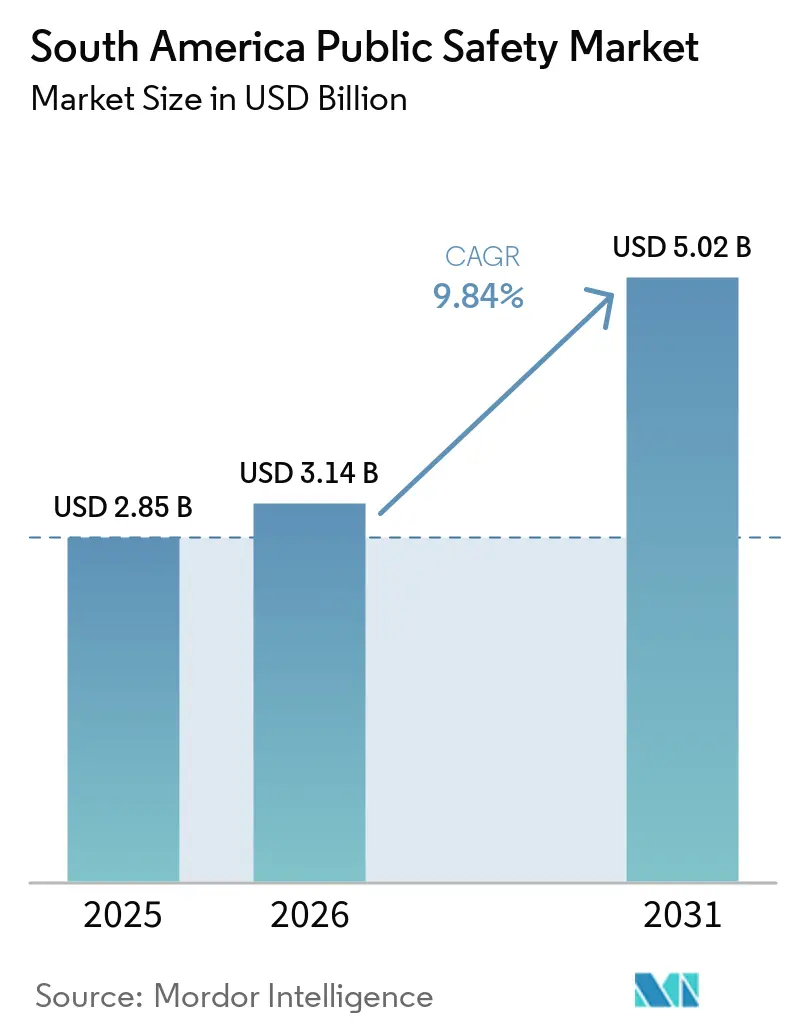
| Base Year Market Size (2025) | USD 2.85 Billion |
| Market Size (2026) | USD 3.14 Billion |
| Market Size (2031) | USD 5.02 Billion |
| Growth Rate (2026 - 2031) | 9.84 % |
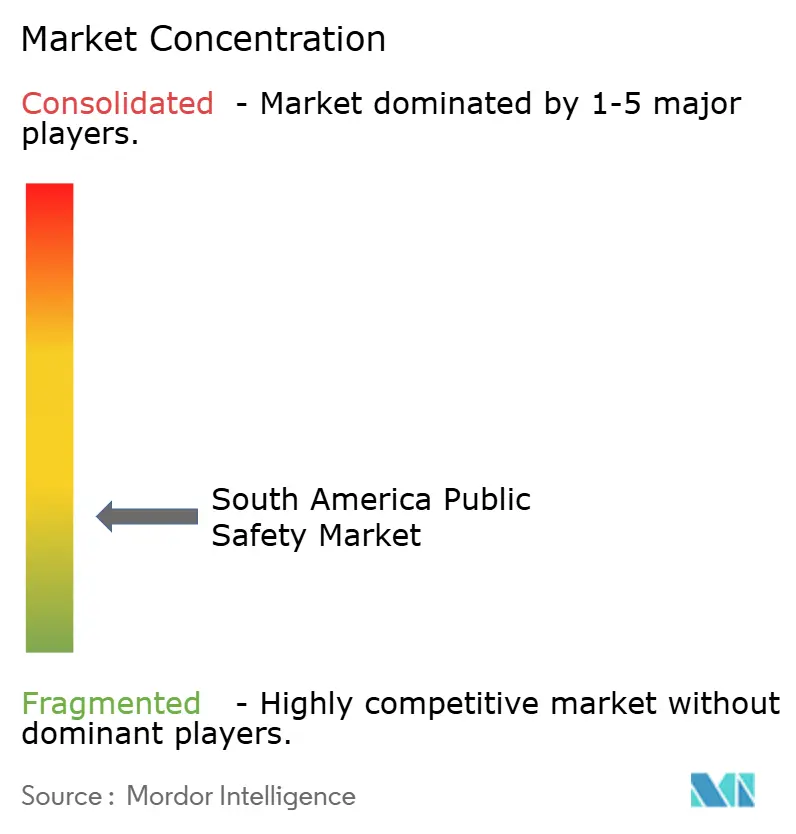
| Market Concentration | Low |
Major Players *Disclaimer: Major Players sorted in no particular order Image © Mordor Intelligence. Reuse requires attribution under CC BY 4.0. | |
South America Public Safety Market Analysis by Mordor Intelligence
The South America Public Safety Market size was valued at USD 2.85 billion in 2025 and is estimated to grow from USD 3.14 billion in 2026 to reach USD 5.02 billion by 2031, at a CAGR of 9.84% during the forecast period (2026-2031). Governments are prioritizing integrated surveillance, critical communications, and analytics as organized crime and disaster risks place greater pressure on public services. Brazil, Colombia, and Argentina are directing spending toward systems that connect agencies instead of separate patrol and guard programs. Large city projects are increasing the need for platforms that can combine video, dispatch, data management, and field communications. Vendors are responding with managed services, local partnerships, and language-specific analytics tools. Currency volatility remains a constraint because imported hardware and software raise costs and can extend tender timelines.
Key Report Takeaways
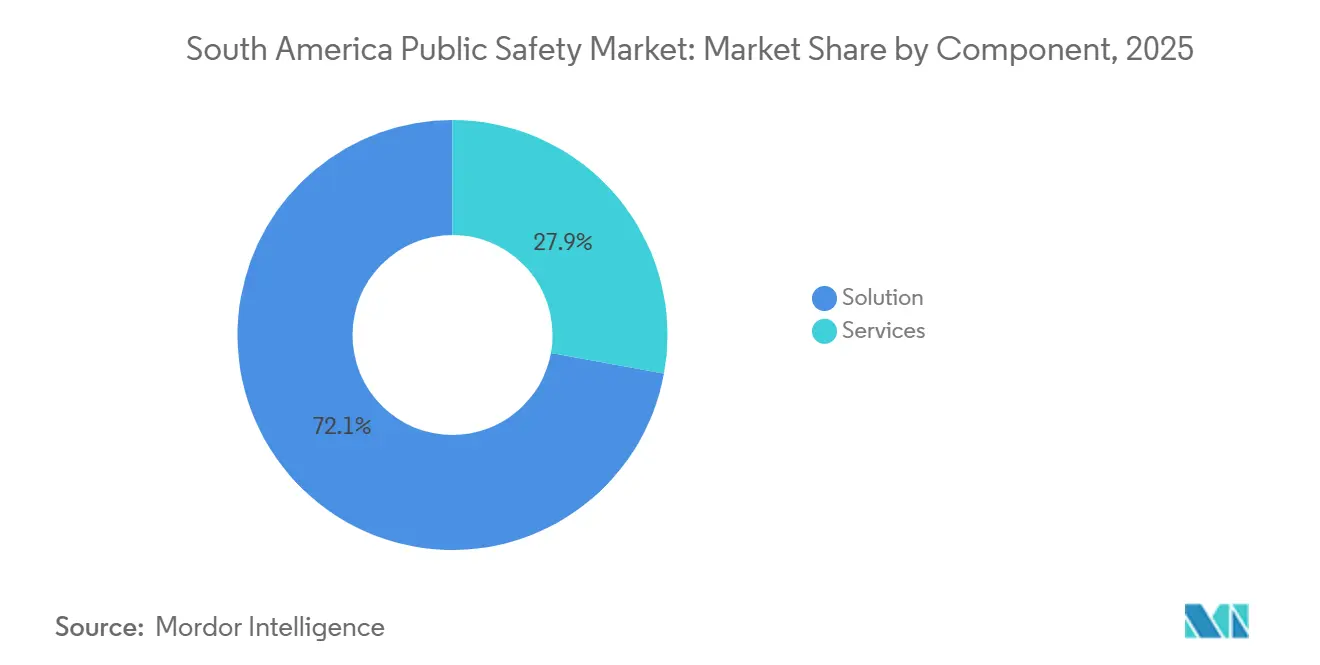
- By component, solutions held 72.13% of the South America Public Safety Market share in 2025, while services are forecast to grow at an 11.23% CAGR through 2031.
- By deployment type, on-premise systems accounted for 61.84% of the South America Public Safety Market share in 2025, while cloud deployment is forecast to grow at a 10.91% CAGR through 2031.
- By end-user vertical, law enforcement held 48.27% of the South America Public Safety Market share in 2025, while transportation and critical infrastructure operators are forecast to grow at an 11.47% CAGR through 2031.
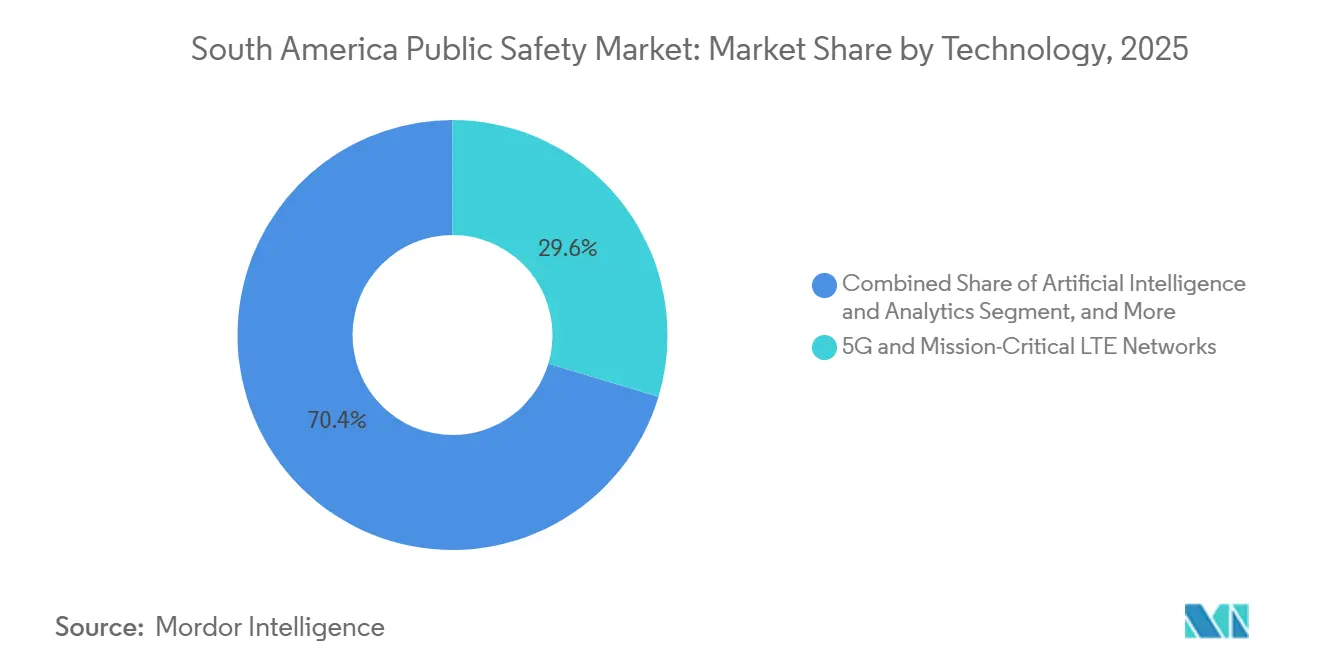
- By technology, 5G and mission-critical LTE networks held 29.63% of the South America Public Safety Market share in 2025, while AI and predictive analytics are forecast to grow at an 11.14% CAGR through 2031.
- By agency type, municipal and local agencies held 46.18% of the South America Public Safety Market share in 2025, while federal and national agencies are forecast to grow at a 10.67% CAGR through 2031.
- By geography, Brazil held 42.39% of the South America Public Safety Market share in 2025, while Colombia is forecast to grow at an 11.82% CAGR through 2031.
Note: Market size and forecast figures in this report are generated using Mordor Intelligence’s proprietary estimation framework, updated with the latest available data and insights as of January 2026.
Market Trends and Insights
Drivers Impact Analysis of South America Public Safety Market*
| Driver | (~) % Impact on CAGR Forecast | Geographic Relevance | Impact Timeline |
|---|---|---|---|
| Urban Crime Concentration and Integrated City Surveillance | +3.0% | Brazil, Colombia, Argentina, Chile, and Venezuela | Short term (≤ 2 years) |
| Climate-Related Disaster Exposure and Emergency Response Modernization | +1.8% | Brazil, Argentina, Colombia, and Chile | Medium term (2-4 years) |
| Mission-Critical Broadband Migration and Interoperable Communications | +1.5% | Brazil, Colombia, and Argentina | Medium term (2-4 years) |
| Brazil-Led Smart-City and Critical-Infrastructure Digitization | +1.3% | Brazil, Colombia, and Chile | Short term (≤ 2 years) |
| Fragmented Agency Data and Demand for Federated Public Safety Platforms | +0.8% | Brazil, Colombia, and Peru | Long term (≥ 4 years) |
| Local-Language AI and Edge Analytics Reducing Connectivity Dependence | +0.6% | Brazil, Colombia, Peru, and Chile | Long term (≥ 4 years) |
| Source: Mordor Intelligence | |||
Urban Crime Concentration and Integrated City Surveillance Investment
High crime density in major cities is creating direct demand for the South America Public Safety Market. São Paulo operates Smart Sampa, which uses 50,000 cameras supported by AI analytics, expanding the operating base for connected urban surveillance. Rio de Janeiro launched the Sentinela tender in January 2026 for 200,000 cameras across the state, valued at BRL 2 billion (USD 345 million). Coverage in one municipality can shift crime toward nearby areas without comparable systems. This makes shared platforms and multi-jurisdiction contracts more relevant than isolated city deployments. It also supports managed service agreements that can cover operations, connectivity, and technical support.
Climate-Related Disaster Exposure and Emergency Response Modernization
Floods, droughts, wildfires, and El Niño cycles are reshaping emergency-response procurement in the South America Public Safety Market. Brazil announced BRL 9.8 billion (USD 1.7 billion) through 2035 for disaster medicine infrastructure, with bases to be added in Salvador, Porto Alegre, and Rio de Janeiro in 2026, and 5 more planned for 2027.[1] The World Bank approved support in July 2026 for flood resilience in Santa Catarina, including early-warning systems linked to civil defense agencies. The World Meteorological Organization is developing a regional severe weather forecasting program for the La Plata Basin in 2026. Agencies, therefore, need command systems that can coordinate different hazards through a common interface. This favors platforms that combine alerts, dispatch, response coordination, and information sharing.[2]
Mission-Critical Broadband Migration and Interoperable Communications
Migration from legacy radio systems to broadband communications supports long-term spending in the South America Public Safety Market. Motorola Solutions was selected in June 2025 by Brazil’s Band Administration Entity to connect the Brazilian Army, Federal Highway Patrol, and Distrito Federal Military Police through a private 4G network using WAVE PTX.[3] The platform connects P25, TETRA, and DMR systems and reduces fragmentation between existing radio networks. San Luis Province in Argentina implemented a TETRA system for its Provincial Police in March 2025, covering San Luis, Villa Mercedes, and Merlo. Shared video, location, and group calling can improve coordination between agencies without requiring similar increases in headcount. This makes it easier to justify interoperability when public budgets are constrained.
Brazil-Led Smart-City and Critical Infrastructure Digitization
Brazil’s smart-city programs are raising demand for integrated platforms within the South America Public Safety Market. Rio Grande do Sul launched RS Atento in April 2026, committing BRL 199.6 million (USD 34.5 million) through 2027 across 23 cities. The program combines AI cameras, license-plate readers, and real-time alerts for public safety and school monitoring. Goiás deployed 564 AI-enabled cameras across 9 municipalities in 2025 through a BRL 34.9 million (USD 6 million) 60-month managed service contract. Such contracts include installation, training, connectivity, and support rather than a one-time equipment purchase. This approach helps explain why managed services are gaining importance in the South America Public Safety Market.
Restraints Impact Analysis of South America Public Safety Market*
| Restraint | (~) % Impact on CAGR Forecast | Geographic Relevance | Impact Timeline |
|---|---|---|---|
| Municipal Budget Volatility and Long Public Procurement Cycles | -1.5% | Argentina, Venezuela, and smaller Brazilian municipalities | Short term (≤ 2 years) |
| Import-Cost Exposure from Currency Volatility and Local-Content Requirements | -0.9% | Argentina, Venezuela, Brazil, Colombia, and Chile | Medium term (2-4 years) |
| Fragmented Spectrum, Standards, and Agency Interoperability | -0.7% | Brazil, Colombia, and Peru | Long term (≥ 4 years) |
| Evidence-Chain, Privacy, and Facial Recognition Governance Gaps | -0.5% | Brazil, Argentina, and Colombia | Medium term (2-4 years) |
| Source: Mordor Intelligence | |||
Municipal Budget Volatility and Long Public Procurement Cycles
Municipal fiscal instability is a major restraint on the South America Public Safety Market. In Brazil, city tenders can be reviewed by state courts of accounts and may be suspended during the procurement process. In August 2026, the São José dos Campos court suspended a security services tender, after which the municipality issued an emergency contract worth BRL 45.3 million, equivalent to USD 7.8 million. Argentina’s fiscal constraints and currency instability can similarly delay multiyear equipment tenders. Mid-sized municipalities often lack the specialized staff required to manage complex technical procurement. Managed service providers can benefit once a relationship is established because they can support both delivery and procurement execution.
Import-Cost Exposure from Currency Volatility and Local-Content Requirements
Imported cameras, radios, rugged devices, and biometric readers expose the South America Public Safety Market to exchange-rate pressure. Many hardware-intensive systems are priced in USD, so local currency depreciation increases the cost to public buyers. Brazil can require locally assembled content in government contracts, which narrows the eligible vendor pool. Argentina’s capital controls and import licensing rules can delay customs clearance and make payment collection less certain for suppliers. Agencies with federal funding and more stable currencies can proceed with advanced procurements more easily than smaller municipal buyers. The difference can widen the capability gap between national programs and local public safety operations.
*Our forecasts treat driver/restraint impacts as directional, not additive. The impact forecasts reflect baseline growth, mix effects, and variable interactions.
South America Public Safety Market Segment Analysis
By Component:
Managed Services Change Security ProcurementSolutions held 72.13% of the South America Public Safety Market share in 2025. This category includes surveillance and analytics systems, critical communications, biometric security and authentication, emergency and disaster management platforms, and incident and evidence management software. Early-warning expansion supports demand for emergency systems, while body-camera programs create a need for connected evidence management. Buyers increasingly evaluate these tools as integrated operational systems rather than separate products.
Services are forecast to grow at an 11.23% CAGR from 2026 to 2031. Five-year contracts can move procurement risk from a public buyer to the supplier while giving smaller municipalities access to advanced platforms. Paraná piloted Axon Body 4 cameras with simultaneous translation, GPS, and live streaming in 2025, with 1,400 units planned for near-term police deployment.[4] The project connects body-worn cameras to evidence management and analytics. This integration supports bundled contracts where the operating service matters as much as the device.
By Deployment Type:
On-Premise Retains the Lead as Cloud ExpandsOn-premise systems accounted for 61.84% of the South America Public Safety Market share in 2025. Law enforcement agencies retain local installations for classified information and for operations that cannot depend on uninterrupted external connectivity. Mission-critical command functions require continuity even when network access is disrupted. Hybrid systems provide a middle path by keeping sensitive workloads locally while moving historical analysis and reporting to cloud environments. This structure allows agencies to modernize without moving every function at once.
Cloud deployment is forecast to grow at a 10.91% CAGR from 2026 to 2031. It provides greater scale for cross-agency information correlation and allows dispersed teams to access systems remotely. Rio de Janeiro’s CIVITAS uses the IRIS engine to assess time, location, incident type, and behavioral patterns for crime hotspot analysis. Brazil’s data protection requirements affect vendor selection and favor providers with suitable local infrastructure. The South America Public Safety Market, therefore, continues to support hybrid adoption rather than a full replacement of on-premise systems.
By End-User Vertical:
Transportation and Critical Infrastructure Gain MomentumLaw enforcement held 48.27% of the South America Public Safety Market share in 2025. Police agencies continue to purchase body cameras, license-plate recognition, video analytics, digital evidence tools, and dispatch networks. Firefighting and emergency medical services are receiving more attention through climate-response programs. Brazil expanded the National Force of the Unified Health System operations to 3 major cities in 2026. Disaster and rescue authorities are also incorporating early-warning tools into national planning.
Transportation and critical infrastructure operators are forecast to grow at an 11.47% CAGR from 2026 to 2031. Lima’s Jorge Chávez International Airport deployed biometric scanning through 21 digital kiosks, enabling real-time matching against international alert databases. Peru’s National Citizen Security Plan 2026 to 2028 links biometric immigration management with organized crime prevention. Ports, railways, airports, and pipeline operators are becoming recurring buyers as security requirements are integrated into infrastructure operations. This extends the South America Public Safety Market beyond conventional police procurement.
By Technology:
AI and Predictive Analytics Increase Data Use5G and mission-critical LTE networks held 29.63% of the South America Public Safety Market share in 2025. The WAVE PTX project in Brazil connects P25, TETRA, and DMR radio systems through a private 4G backbone. IoT sensors, cloud and edge computing, and big data and GIS analytics provide supporting layers for these networks. GIS crime mapping helps municipalities integrate live camera feeds with historical incident data. Integrated communications remain necessary for joint operations across agencies.
AI and predictive analytics are forecast to grow at an 11.14% CAGR from 2026 to 2031. Colombia’s National Police reported a 31% reduction in operating costs and a 49% reduction in response time after deploying an AI prediction system on AWS. Chile’s prosecution service licensed the HeredIA ecosystem in 2025, reducing case analysis time from 30 days to 1 day across more than 30 major investigations. The Inter-American Development Bank is supporting AI-assisted programs for organized crime investigations in Chile, Ecuador, and Peru. These programs add funding channels beyond traditional government tenders.

By Agency Type:
Federal Programs Support Platform ConsolidationMunicipal and local agencies held 46.18% of the South America Public Safety Market share in 2025. This reflects decentralized public safety funding in Brazil, Colombia, and Argentina. Individual municipal contracts may be small, but cameras, body-worn devices, and dispatch platforms purchased across many cities create the largest institutional revenue pool. State and provincial bodies often procure broader managed service agreements. They also coordinate the integration of surveillance across several municipalities.
Federal and national agencies are forecast to grow at a 10.67% CAGR from 2026 to 2031. These programs can align radio standards, biometric databases, and video information across local and state agencies. Colombia’s C5i approach uses command centers to coordinate at the municipal, departmental, and national levels. In May 2026, Seguritech signed a contract for Medellín’s C5i center, with investment exceeding COP 205,000 million, equivalent to USD 48.8 million. Consolidated platforms can generate recurring maintenance and licensing revenue across public administrations.
Geography Analysis
Brazil Public Safety Market
Brazil held 42.39% of the South America Public Safety Market share in 2025. São Paulo’s Muralha Paulista program integrated 94,000 public and private cameras, including 20,000 license-plate readers and 7,000 facial-recognition devices, across 604 municipalities. Smart Sampa’s 50,000 AI-enhanced cameras add another large urban operating base. Motorola Solutions’ federal network project is expected to encourage state and municipal police agencies to procure compatible terminals. Data protection obligations and equipment standards affect vendor eligibility and cloud adoption in Brazil.
Colombia Public Safety Market
Colombia is forecast to grow at an 11.82% CAGR from 2026 to 2031. Bogotá’s C4 integrates 13,000 public and private cameras, and its AI platform can review hours of video in minutes. Valle del Cauca committed COP 120,000 million, equivalent to USD 28.6 million, in February 2026 for its emergency management center across 42 municipalities. Atlántico announced COP 148,000 million (USD 35.2 million) for AI-enabled surveillance across 18 municipalities in April 2026. City-scale command centers and shared infrastructure are supporting Colombia’s faster growth profile.
South America Public Safety Market
Argentina is consolidating TETRA and P25 communications at the provincial level and is developing national security AI capacity. Chile is advancing biometric border management and AI-based investigation tools, while Venezuela’s fiscal position limits technology purchases and increases reliance on cooperation programs and existing equipment. Peru, Bolivia, Ecuador, Uruguay, and Paraguay continue to invest in municipal surveillance and biometric border management, with Lima’s airport deployment providing an example of integrated immigration security in the South America Public Safety Market.
Competitive Landscape
The South America Public Safety Market is fragmented at the technology vendor level. Motorola Solutions, Axon Enterprise, L3Harris Technologies, and Hytera Communications hold leading positions in critical communications and body-worn camera categories. Motorola Solutions’ federal network selection in Brazil and provincial contract in Argentina demonstrate the advantage of established integration capabilities and agency relationships. Rohde and Schwarz and Riedel Communications operate in specialist communications categories, while Getac Technology and Panasonic Connect supply rugged computing equipment for officers in the field.
Axon presented its integrated public safety ecosystem, including Axon Body 4, Axon Fleet 3, and cloud evidence management, at COP International 2026 in São Paulo. The offering links devices, analytics, and evidence management in a single platform. Regional integrators such as Seguritech compete by offering managed service delivery, local regulatory expertise, and Spanish- and Portuguese-language AI capabilities. Seguritech’s Medellín C5i project combines AI video surveillance, traffic control, drone monitoring, and information management. Mid-sized municipalities, body-camera evidence management outside Brazil and Colombia, and emergency medical services remain underserved.
Satellite-enabled push-to-talk providers are also entering the South America Public Safety Market. TASSTA and Servicio Satelital demonstrated encrypted agency communications in Argentina that can operate when terrestrial networks fail. This model can be relevant for remote incidents and disaster response. Standards-based compliance in broadband push-to-talk systems favors vendors with established technical capabilities. Buyers are therefore balancing new service models with the reliability and interoperability requirements of established platforms.
South America Public Safety Industry Leaders
-
Motorola Solutions, Inc.
-
Cisco Systems, Inc.
-
L3Harris Technologies, Inc.
-
Hexagon AB
-
IBM Corporation
- *Disclaimer: Major Players sorted in no particular order
South America Public Safety Market Companies Covered in this Report
- Motorola Solutions, Inc.
- Cisco Systems, Inc.
- L3Harris Technologies, Inc.
- Hexagon AB
- IBM Corporation
- JVCKENWOOD Corporation
- Sonim Technologies, Inc.
- Getac Technology Corporation
- Panasonic Connect Co., Ltd.
- Reveal Media Limited
- Digital Ally, Inc.
- Utility, Inc.
- PRO-VISION Video Systems
- Safe Fleet Holdings LLC
- Zetron, Inc.
- Riedel Communications GmbH & Co. KG
- Rohde & Schwarz GmbH & Co. KG
- BK Technologies Corporation
- Silvus Technologies, Inc.
- Persistent Systems, LLC
- Sogeti S.A.
Recent Industry Developments in South America Public Safety Market
- July 2026: The World Bank approved a project to build flood resilience in Brazil’s Santa Catarina state, financing river improvement works and expansion of early-warning systems integrated with civil defense agencies across the Itajaí Valley.
- July 2026: The World Meteorological Organization initiated development of South America’s first Regional Severe Weather Forecasting Programme for the La Plata Basin, covering Brazil, Argentina, and 3 other nations, with a pre-operational phase expected in 2027.
- April 2026: The Government of Rio Grande do Sul launched the RS Atento monitoring program, committing BRL 199.6 million, equivalent to USD 34.5 million, through 2027 across 23 cities and deploying AI cameras, license-plate readers, and real-time alert integration.
- February 2026: The Government of Valle del Cauca committed COP 120,000 million (USD 28.6 million) to expand its emergency management center across 42 municipalities.
South America Public Safety Market Report Scope
The South America public safety market refers to integrated solutions and services designed to protect citizens, manage emergencies, and maintain law and order across the region. It encompasses critical communication networks, surveillance systems, biometric authentication, and AI- and IoT-enabled disaster management platforms supported by 5G technologies. Deployed via on-premises, cloud, or hybrid models, these technologies serve federal, state, and local agencies by enhancing incident response, securing critical infrastructure, and improving overall public safety operations.
The South America Public Safety Market Report is Segmented by Component (Solution (Critical Communication Network, Surveillance and Analytics Systems, Biometric Security and Authentication Systems, Emergency and Disaster Management Platforms, and Incident and Evidence Management Software) and Services (Professional Services and Managed Services)), Deployment Type (On-Premise, Cloud, and Hybrid), End-User Vertical (Law Enforcement Agencies, Firefighting Departments, Emergency Medical Services, Transportation and Critical Infrastructure Operators, Disaster and Rescue Management Authorities, and Other End-User Verticals), Technology (Artificial Intelligence and Predictive Analytics, Internet of Things Sensors and Gateways, Cloud and Edge Computing, Big-Data and GIS Analytics, and 5G and Mission-Critical LTE Networks), Agency Type (Federal / National, State and Provincial, and Municipal / Local), and Geography (Brazil, Argentina, Colombia, Chile, Venezuela, and Rest of South America). The Market Forecasts are Provided in Terms of Value (USD).
Segmentation Overview
| Solution | Critical Communication Network |
| Surveillance and Analytics Systems | |
| Biometric Security and Authentication Systems | |
| Emergency and Disaster Management Platforms | |
| Incident and Evidence Management Software | |
| Services | Professional Services |
| Managed Services |
| On-Premise |
| Cloud |
| Hybrid |
| Law Enforcement Agencies |
| Firefighting Departments |
| Emergency Medical Services |
| Transportation and Critical Infrastructure Operators |
| Disaster and Rescue Management Authorities |
| Other End-User Verticals |
| Artificial Intelligence and Predictive Analytics |
| Internet of Things Sensors and Gateways |
| Cloud and Edge Computing |
| Big-Data and GIS Analytics |
| 5G and Mission-Critical LTE Networks |
| Federal / National |
| State and Provincial |
| Municipal / Local |
| Brazil |
| Argentina |
| Colombia |
| Chile |
| Rest of South America |
| By Component | Solution | Critical Communication Network |
| Surveillance and Analytics Systems | ||
| Biometric Security and Authentication Systems | ||
| Emergency and Disaster Management Platforms | ||
| Incident and Evidence Management Software | ||
| Services | Professional Services | |
| Managed Services | ||
| By Deployment Type | On-Premise | |
| Cloud | ||
| Hybrid | ||
| By End-User Vertical | Law Enforcement Agencies | |
| Firefighting Departments | ||
| Emergency Medical Services | ||
| Transportation and Critical Infrastructure Operators | ||
| Disaster and Rescue Management Authorities | ||
| Other End-User Verticals | ||
| By Technology | Artificial Intelligence and Predictive Analytics | |
| Internet of Things Sensors and Gateways | ||
| Cloud and Edge Computing | ||
| Big-Data and GIS Analytics | ||
| 5G and Mission-Critical LTE Networks | ||
| By Agency Type | Federal / National | |
| State and Provincial | ||
| Municipal / Local | ||
| By Geography | Brazil | |
| Argentina | ||
| Colombia | ||
| Chile | ||
| Rest of South America | ||
Key Questions Answered in the Report
What is the South America Public Safety Market size?
The South America Public Safety Market was valued at USD 2.85 billion in 2025 and is estimated at USD 3.14 billion in 2026. It is forecast to reach USD 5.02 billion by 2031 at a 9.84% CAGR.
What is driving demand for public safety systems in South America?
Urban surveillance investment, disaster-response modernization, interoperable broadband communications, and smart-city programs are increasing demand.
Which component is growing fastest in the South America Public Safety Market?
Services is forecast to grow at an 11.23% CAGR through 2031 as agencies seek contracts that include operations, connectivity, and technical support.
Which technology is growing fastest across South American public safety agencies?
AI and predictive analytics is forecast to grow at an 11.14% CAGR through 2031, supported by crime analysis and investigation use cases.
Which country is growing fastest in public safety spending?
Colombia is forecast to grow at an 11.82% CAGR through 2031, supported by command-center investment and connected city infrastructure.
Why do on-premise systems remain important for public safety agencies?
On-premise systems held 61.84% share in 2025 because agencies need control over classified information and resilient operations during connectivity disruptions.