
Market Overview
| Study Period | 2020 - 2031 |
|---|---|
| Forecast Data Period | 2026 - 2031 |
| Base Year Market Size (2025) | USD 1.84 Billion |
| Market Size (2026) | USD 1.98 Billion |
| Market Size (2031) | USD 2.88 Billion |
| Growth Rate (2026 - 2031) | 7.78 % |
| Market Concentration | Low |
Major Players *Disclaimer: Major Players sorted in no particular order Image © Mordor Intelligence. Reuse requires attribution under CC BY 4.0. | |
South America Prefab Wood Buildings Market Analysis by Mordor Intelligence
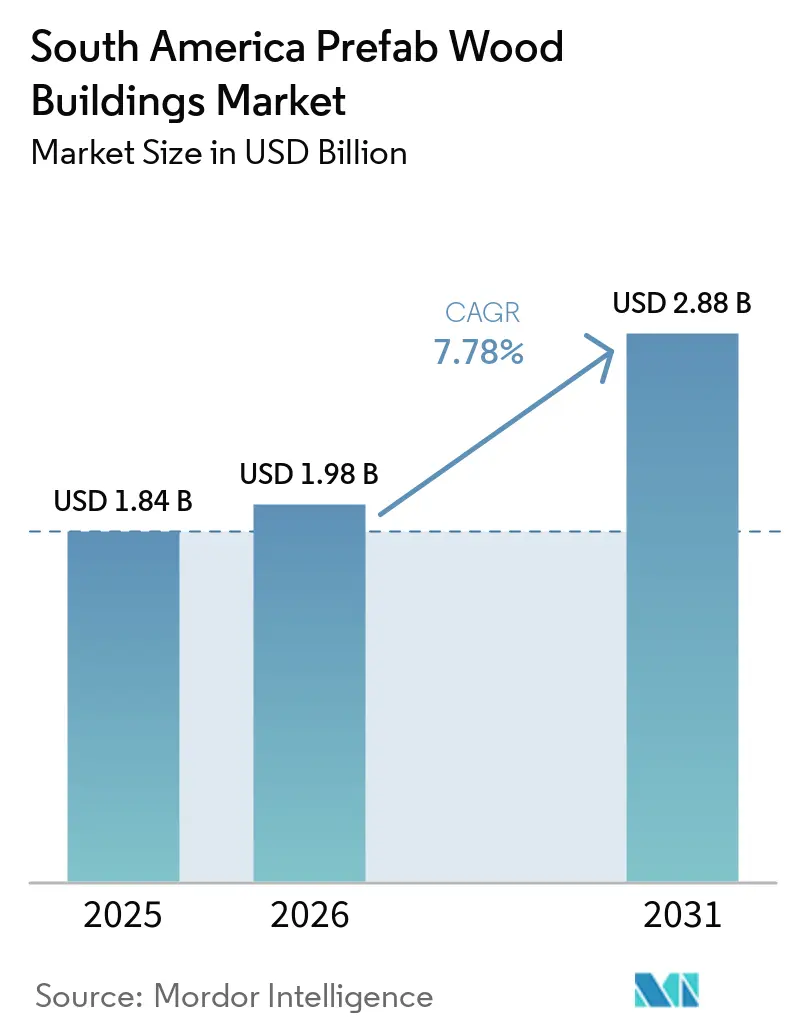
The South America Prefab Wood Buildings Market size is expected to increase from USD 1.84 billion in 2025 to USD 1.98 billion in 2026 and reach USD 2.88 billion by 2031, growing at a CAGR of 7.78% over 2026-2031.
The South America prefab wood buildings market is supported by urgent housing needs, pressure to reduce construction emissions, and the need to shorten project schedules. Developers and public agencies are moving toward factory-made timber systems because they reduce work at the building site and support more consistent quality control. National standards in Chile and Brazil are improving the approval path for engineered timber projects. The South America prefab wood buildings market also benefits from plantation forests and growing manufacturing capacity in Brazil, Uruguay, Chile, and Argentina. Progress will depend on structural timber supply, installer training, and more consistent fire and seismic requirements across national codes.
Key Report Takeaways
- By panel systems, cross-laminated timber (CLT) panels held 42% of the South America prefab wood buildings market share in 2025, while dowel-laminated timber (DLT) panels are forecast to grow at an 8.2% CAGR through 2031.
- By application, multi-family residential held 38% of the South America prefab wood buildings market size in 2025, while hospitality is forecast to grow at an 8.5% CAGR through 2031.
- By country, Brazil held 41% of the South America prefab wood buildings market share in 2025, while Colombia is forecast to grow at an 8.1% CAGR through 2031.
Note: Market size and forecast figures in this report are generated using Mordor Intelligence’s proprietary estimation framework, updated with the latest available data and insights as of January 2026.
Market Trends and Insights
Drivers Impact Analysis of South America Prefab Wood Buildings Market*
| Drivers | (~) % Impact on CAGR Forecast | Geographic Relevance | Impact Timeline |
|---|---|---|---|
| Housing Deficits and Rapid Housing Delivery Drive Prefab Wood Demand | +2.2% | Brazil, Chile, Colombia, Argentina | Short term (≤ 2 years) |
| Sustainability Requirements Increase Demand for Low-Carbon Buildings | +1.5% | Chile, Brazil, Colombia | Medium term (2-4 years) |
| Industrialized and Off-Site Construction Accelerates Market Adoption | +1.2% | Brazil, Chile, Colombia, Uruguay | Medium term (2-4 years) |
| Certified Plantation Timber Supply Supports Prefab Wood Production | +0.9% | Brazil, Uruguay, Chile, Argentina | Medium term (2-4 years) |
| Government Support for Industrialized Social Housing Boosts Demand | +0.8% | Brazil, Chile, Colombia, Argentina | Short term (≤ 2 years) |
| BIM, CNC Fabrication, and Digital Assembly Improve Construction Efficiency | +0.5% | Brazil, Chile, Uruguay | Long term (≥ 4 years) |
| Source: Mordor Intelligence | |||
Housing Deficits and Rapid Housing Delivery Drive Prefab Wood Demand
South America’s housing shortage continues to support demand for panelized construction. Brazil had a shortfall of 5 million to 6 million homes, mainly in urban areas where conventional masonry projects can take 8 months or more[1]. Timber-frame assemblies can be delivered much faster when components arrive ready for installation. Chile’s housing deficit affected 7.9% of households, while its industrialized housing program had 36 approved suppliers in 2026[2]. Panel systems can also reduce dependence on heavy equipment and large onsite crews. This makes the South America prefab wood buildings market relevant to remote, peri-urban, and rural projects where conventional construction is harder to coordinate.
Sustainability Requirements Increase Demand for Low-Carbon Buildings
Material selection is receiving more attention as developers address building-related emissions. Brazil enacted Law No. 15.042 in December 2024, which requires emissions reporting for companies with annual emissions above 10,000 tons and reduction measures above 25,000 tons. Chile’s 2025 Nationally Determined Contribution included a National Timber Construction Strategy that is to be developed by 2028. A Brazilian scientific study found that wood-framed buildings generated 4.85 kg CO₂/m² compared with 35.22 kg CO₂/m² for masonry equivalents[3]. CLT and glulam can therefore serve as structural materials while retaining biogenic carbon in the building fabric. These conditions support the South America prefab wood buildings market, where public and private buyers place more weight on lifecycle emissions.
Industrialized and Off-Site Construction Accelerates Market Adoption
Factory production shifts a large share of work away from the construction site and into controlled manufacturing environments. Patagual Home reported that its Chilean modular wood process could deliver buildings up to 4 times faster than traditional methods, with capacity for up to 4,000 housing units annually. Standardized components can reduce rework and improve coordination between design, fabrication, and assembly teams. Building Information Modeling can further support accurate connection details and material scheduling. Chilean research programs are working on human-robot collaboration for prefabricated housing, which may strengthen production precision over time. The South America prefab wood buildings market will favor producers that secure stable multi-family and hospitality order books to keep factories well utilized.
Certified Plantation Timber Supply Supports Prefab Wood Production
Planted forests give the region an important raw material base for engineered wood products. Arboreal uses Forest Stewardship Council chain-of-custody certified plantations in Uruguay and integrates forest supply with CLT panel manufacturing. Brazil also has a large pine and eucalyptus plantation base, while Corrientes in Argentina has 500,000 hectares of planted forest. Argentina’s first industrial CLT facility is being developed at Gobernador Virasoro, which links local forest resources with a new engineered wood supply channel. Certification is increasingly important for institutional buyers who need traceability in procurement. This supports established producers in the South America prefab wood buildings market that can document fiber origin and product quality.
Restraints Impact Analysis of South America Prefab Wood Buildings Market*
| Restraints | (~) % Impact on CAGR Forecast | Geographic Relevance | Impact Timeline |
|---|---|---|---|
| Fragmented Timber Codes and Certification Requirements Delay Project Approvals | -1.0% | Argentina, Colombia | Medium term (2-4 years) |
| Limited Structural-Grade Timber and Skilled Installers Constrain Market Growth | -0.9% | Brazil, Argentina, Colombia | Long term (≥ 4 years) |
| Seismic, Fire, Moisture, and Termite Concerns Limit Adoption | -0.7% | Colombia, Chile, Brazil | Medium term (2-4 years) |
| Cross-Border Logistics Costs Increase Prefabricated Component Expenses | -0.5% | Rest of South America and cross-border projects | Short term (≤ 2 years) |
| Source: Mordor Intelligence | |||
Fragmented Timber Codes and Certification Requirements Delay Project Approvals
Separate national rules for structural design, fire safety, and seismic performance create added work for manufacturers. Chile approved NCh3732/1 and NCh3732/2 in March 2026, giving the country dedicated standards for CLT manufacturing, verification, and property declaration. A structural design code for CLT was still under development, which limited confidence in some multi-story specifications. Chile also had a shortage of structural timber suppliers, with 10% of formal value-chain companies producing structural timber and under 1% holding Madera Aserrada Estructural certification. Specialist installation requires skills in connections, moisture control, and vibration management. These gaps can delay projects and restrict the South America prefab wood buildings market outside established production centers.
Limited Structural-Grade Timber and Skilled Installers Constrain Market Growth
Buyers continue to assess fire, moisture, termite, and seismic performance before selecting timber systems. These concerns become more important in areas exposed to seismic risk or humid conditions. Product testing, certified design, and trained installation teams can reduce these concerns, but these capabilities remain uneven across the region. Long-distance movement of prefabricated panels can also weaken the cost advantage of factory construction. Logistics premiums are most difficult for projects located more than 400 km from a manufacturing hub. The South America prefab wood buildings market will require regional production networks to serve more dispersed demand effectively.
*Our forecasts treat driver/restraint impacts as directional, not additive. The impact forecasts reflect baseline growth, mix effects, and variable interactions.
South America Prefab Wood Buildings Market Segment Analysis
By Panel Systems:
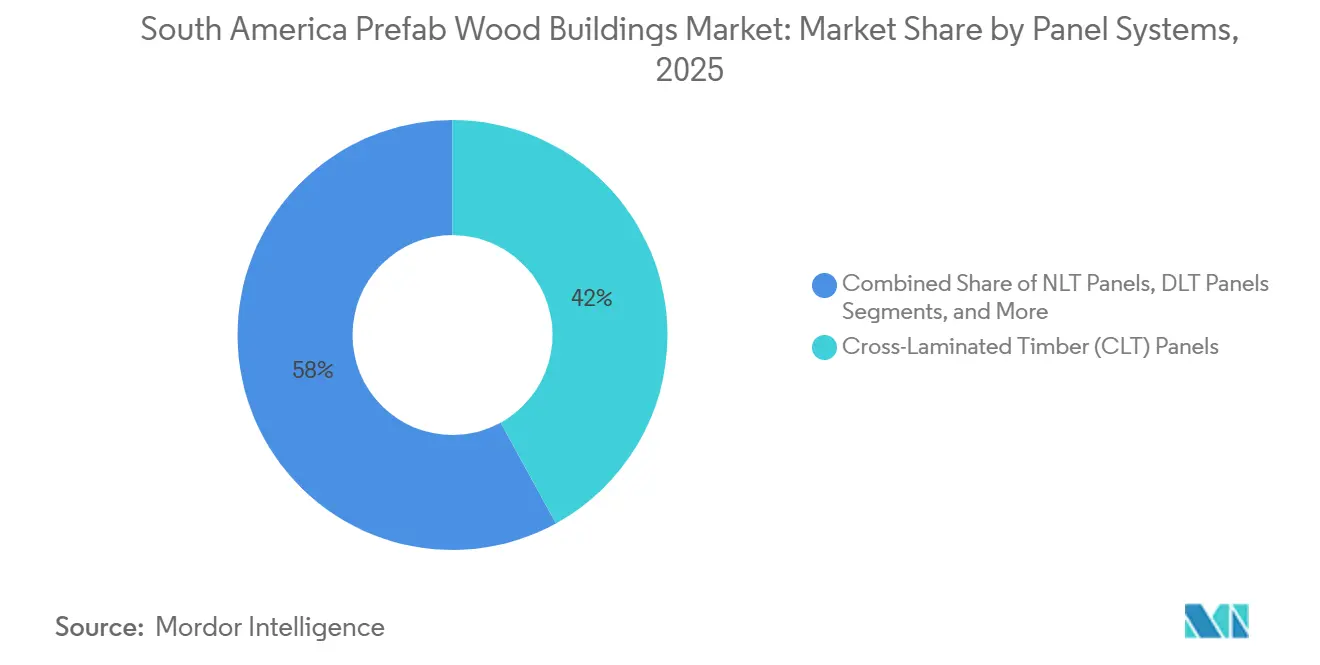
Cross-Laminated Timber (CLT) Panels Leads Market Share While Dowel-Laminated Timber (DLT) Panels Gains Design MomentumCross-laminated timber (CLT) panels held 42% of regional prefab wood buildings revenue in 2025. Existing supply infrastructure in Brazil and Uruguay helped CLT establish an early lead over other panel formats. Urbem’s facility in Almirante Tamandaré and Arboreal’s operation in Tacuarembó focused investment on mass-timber production. CLT panels can perform as walls, floors, and roofs, which support multi-story residential and commercial applications. Urbem supplied nearly 700 m³ of CLT for Open Mall Praça Pitiguari in Atibaia, São Paulo. The project showed that a large timber structure could be assembled without a structural concrete pour. CLT also offers a standardized format for design teams that need predictable panel dimensions and connection details. This established supply base supports its continued role in the South America prefab wood buildings market.
Dowel-laminated timber (DLT) panels are forecast to grow at an 8.2% CAGR through 2031. The segment appeals to hospitality and single-family projects where exposed timber is part of the building design. Its mechanical assembly avoids both glue and nails. This can reduce concerns about volatile organic compounds during installation and make later material reuse simpler. Nail-Laminated Timber and Glue-Laminated Timber continue to serve complementary roles in floors, columns, and beams. Research supported by Uruguay’s Agencia Nacional de Investigación e Innovación confirmed the structural viability of local pine for NLT, DLT, and composite panels in residential programs. Chile’s new CLT standards and Brazil’s structural wood requirements can improve confidence across related engineered wood systems.

By Application:
Multi-Family Housing Drives Volume While Hospitality Adds ValueMulti-family residential accounted for 38% of regional prefab wood buildings revenue in 2025. Affordable housing programs in Brazil and Chile support this position because they need faster handover and stronger quality control. Chile’s ECOIMAD Building in La Araucanía was a 100% wood, multi-story modular social housing prototype. It included 3 apartments of 60 m² each. The project was manufactured in 6 weeks and assembled onsite in 8 hours. Such projects show how factory production can serve high-density housing rather than only detached homes. Single-family residential remains relevant in peri-urban and Patagonian locations where timber panels offer schedule and labor advantages.
Hospitality is forecast to grow at an 8.5% CAGR through 2031. Resorts and hotels can use visible timber as part of their guest experience while also reducing site disruption in environmentally sensitive locations. Urbem supplied mass-timber components for the Rosewood Ranfaru resort in the Maldives during 2025. That project gave a South American supplier an international reference in a high-specification hospitality application. The office segment also gained a useful demonstration project through Enkel Group’s Arboleda Building in Montevideo. The building used 291 m³ of CLT and 199 m³ of glulam and was assembled in 6 weeks through a Building Information Modeling coordinated process. These projects broaden the application base for the South America prefab wood buildings market.
Geography Analysis
Brazil Prefab Wood Buildings Market
Brazil held 41% of the regional prefab wood buildings revenue in 2025. The country combines a plantation forest estate exceeding 9.5 million hectares of pine and eucalyptus with a growing engineered wood manufacturing base, and its housing deficit creates demand for faster construction methods in major urban centers. São Paulo hosts key engineering and production activities, while Bahia and Pernambuco are becoming secondary manufacturing locations as regional production can reduce the freight burden on large prefabricated components. Brazil’s rules for light wood-frame construction and mass-timber fire safety give developers clearer approval parameters. This makes Brazil the most important volume center in the South America prefab wood buildings market.
Chile and Colombia Prefab Wood Buildings Market
Chile and Colombia have different roles in the regional outlook. Chile’s housing deficit affected 7.9% of households, and its timber construction value chain included 5,519 formal companies, while the March 2026 approval of NCh3732/1 and NCh3732/2 improved the country’s framework for CLT manufacturing and verification. Colombia’s 8.1% CAGR reflects a smaller starting base and reconstruction-related demand. Export growth from Chile to Colombia indicates a developing cross-border supply relationship, although Colombia still needs stronger local manufacturing capacity and more consistent code approval processes. These conditions create room for suppliers that can meet seismic and delivery requirements.
Argentina and Uruguay Prefab Wood Buildings Market
Argentina and Uruguay shape supply patterns beyond their domestic shares. Argentina’s Corrientes province has 500,000 hectares of planted forest and is hosting the country’s first industrial CLT facility, which links forestry resources with a future structural timber processing capability. Uruguay operates as a technology and supply reference through Arboreal’s certified forest and mass-timber operations, while Enkel Group’s Montevideo office project demonstrates hybrid CLT and glulam systems. The Rest of South America remains at an early stage, but cross-border contracts can extend demand beyond the main national markets.
Competitive Landscape
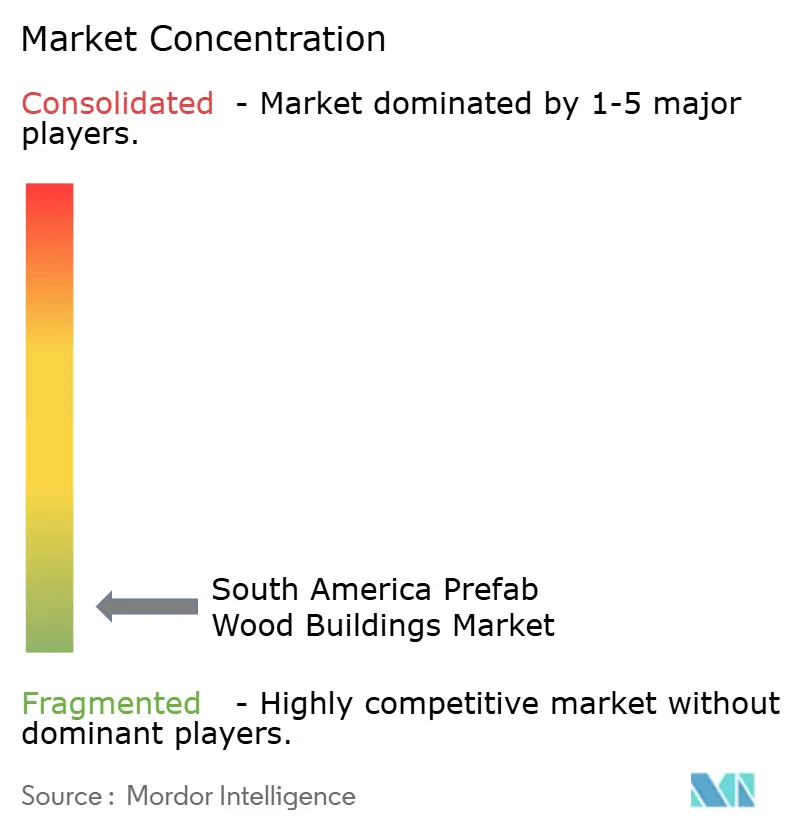
The South America prefab wood buildings market is fragmented, and no company holds a dominant position across all panel systems, applications, and countries. Competition includes vertically integrated producers, specialized modular builders, and firms using digital design and assembly tools. Arboreal, Urbem, and CrossLam Brasil represent producers with mass-timber capabilities and links to forestry, manufacturing, engineering, or installation. At the same time, Patagual Home, Enkel Group, and Timbau Estruturas focus on defined national markets or project types. Certified supply chains are becoming more important in public and institutional procurement, which favors companies that can document forest origin, structural performance, and manufacturing controls. Fragmentation leaves room for local specialists who understand national codes and customer needs.
Leading companies are expanding into applications that combine higher project value with visible reference projects. Urbem supplied components for the Rosewood Ranfaru resort, giving the company a high-specification hospitality reference beyond South America, and it also participated in the Open Mall Praça Pitiguari project in Brazil. Arboreal integrates certified plantation supply with CLT manufacturing in Uruguay. Patagual Home uses industrialized modular production to target repeatable housing delivery in Chile. These moves show that production scale and credible project references are both important in the South America prefab wood buildings market.
Open areas remain in structural timber grading, DLT manufacturing, and regional delivery networks. Argentina’s new CLT facility is intended to build domestic capacity where industrial structural grading had been limited. At the same time, Enkel Group’s Arboleda Building provided a commercial office example for Uruguay using coordinated CLT and glulam assembly. Smaller companies can compete through local code knowledge, customized design, shorter delivery distances, and digital fabrication that improves precision. The competitive structure is likely to remain diverse because building codes and logistics differ by country, so the South America prefab wood buildings market rewards both scale and local execution capability.
South America Prefab Wood Buildings Industry Leaders
-
Arboreal
-
Niuform
-
CrossLam Brasil
-
Urbem
-
Rewood
- *Disclaimer: Major Players sorted in no particular order
South America Prefab Wood Buildings Market Companies Covered in this Report
- Arboreal
- Niuform
- CrossLam Brasil
- Urbem
- Rewood
- Enkel Group
- Noah Tech Brasil
- Timbau Estruturas
- ITA Engenharia em Madeira
- Delrei Brasil
- Novak CLT
- VMD
- Green Magic Homes
- Modulbox
- Techno Fast
- Patagual Home
- KaiaSul Wood
- Masslam
- Casas Brazil
- BrasilCasas
Recent Industry Developments in South America Prefab Wood Buildings Market
- June 2026: Corrientes provincial government officially announced the Cambium Build CLT plant at Gobernador Virasoro as Argentina's first industrial-scale mass timber facility, with the provincial governor and industry minister attending the launch ceremony. The project represents an investment of more than USD 20 million.
- March 2026: Chile's Instituto Nacional de Normalización approved NCh3732/1 and NCh3732/2, the country's first national standards for CLT manufacturing, quality verification, and structural-property declaration. The standards resolved a major regulatory barrier to institutional procurement of mass timber in Chile.
- January 2026: Corporación de Fomento a la Producción, with financing from the Inter-American Development Bank, launched Chile's Sustainable Construction Support Program targeting timber construction industrialization. The program addresses capital access, workforce training, regulatory updates, and small and medium enterprise integration.
South America Prefab Wood Buildings Market Report Scope
Segmentation Overview
By Panel Systems
| Cross-Laminated Timber (CLT) Panels |
| Nail-Laminated Timber (NLT) Panels |
| Dowel-Laminated Timber (DLT) Panels |
| Glue-Laminated Timber (GLT) Columns and Beams |
By Application
| Single Family Residential |
| Multi-Family Residential |
| Office |
| Hospitality |
By Country
| Brazil |
| Argentina |
| Colombia |
| Chile |
| Rest of South America |
| By Panel Systems | Cross-Laminated Timber (CLT) Panels |
| Nail-Laminated Timber (NLT) Panels | |
| Dowel-Laminated Timber (DLT) Panels | |
| Glue-Laminated Timber (GLT) Columns and Beams | |
| By Application | Single Family Residential |
| Multi-Family Residential | |
| Office | |
| Hospitality | |
| By Country | Brazil |
| Argentina | |
| Colombia | |
| Chile | |
| Rest of South America |
Key Questions Answered in the Report
What is driving demand for prefab wood buildings in South America?
Housing shortages, shorter construction schedules, and lower-emission material requirements are supporting demand. Public housing programs and factory-built panel systems can reduce onsite labor needs while giving developers a more predictable construction sequence. The sector is forecast to grow at a 7.8% CAGR from 2026 to 2031.
Which panel system leads prefab wood construction in South America?
Cross-laminated timber (CLT) panels led with 42% share in 2025. Its use across walls, floors, and roofs supports residential and commercial projects, while existing production capacity in Brazil and Uruguay supports broader availability. Dowel-laminated timber (DLT) panels are the fastest-growing panel type at an 8.2% CAGR.
Which application is expanding fastest through 2031?
Hospitality is forecast to grow at an 8.5% CAGR through 2031. Resorts and hotels use timber to reduce site disruption and add visible wood finishes, especially where construction must respond to sensitive landscapes and guest experience requirements.
Which country has the largest demand base for prefab wood buildings?
Brazil held 41% share in 2025. Its forest resources, housing needs, manufacturing base, and developing regulatory framework support its leading position. The country also provides the region’s largest volume opportunity for suppliers serving multi-family and public housing projects.
Which country is forecast to grow fastest in the region?
Colombia is forecast to grow at an 8.1% CAGR through 2031. Reconstruction demand and growing cross-border supply are supporting its expansion. The country offers an opening for suppliers that can address seismic requirements, deliver panelized systems, and develop local service capability.
What limits the wider adoption of engineered wood systems?
Fragmented codes, limited structural-grade timber, installer shortages, and long-distance logistics costs can delay or raise project costs. Fire, moisture, termite, and seismic questions also require tested designs, certified products, and trained teams before buyers commit to larger timber projects.