
South America IP Camera Market Size and Share
Market Overview
| Study Period | 2020 - 2031 |
|---|---|
| Forecast Data Period | 2026 - 2031 |
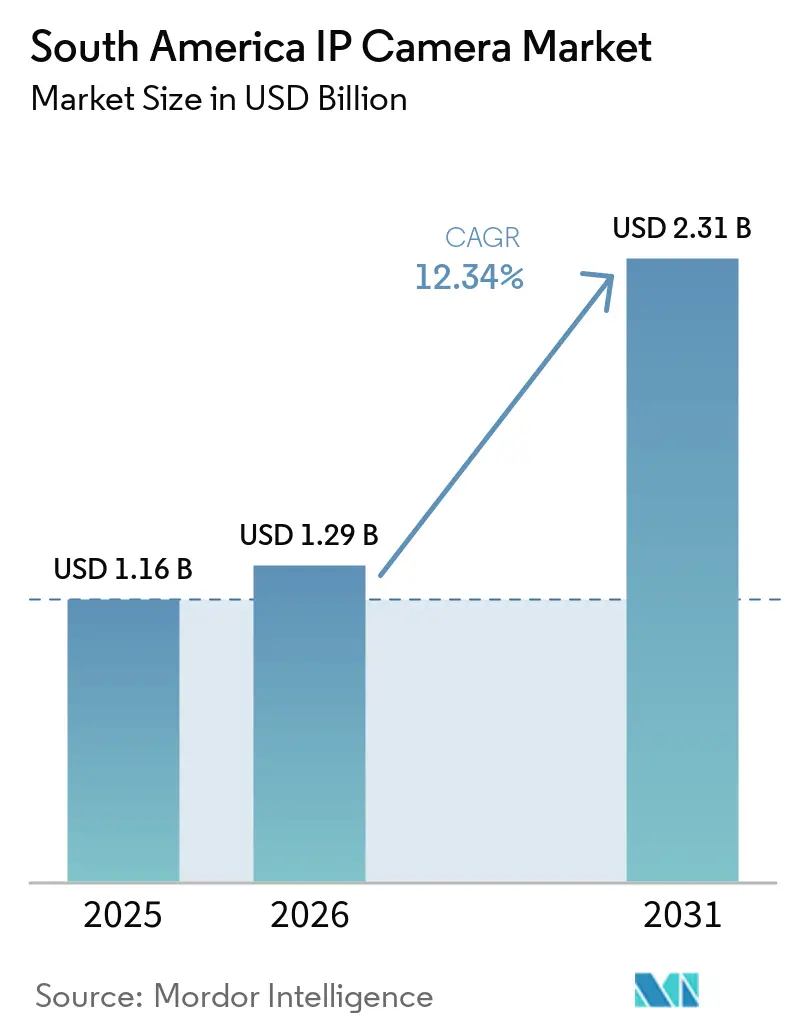
| Base Year Market Size (2025) | USD 1.16 Million |
| Market Size (2026) | USD 1.29 Million |
| Market Size (2031) | USD 2.31 Million |
| Growth Rate (2026 - 2031) | 12.34 % |
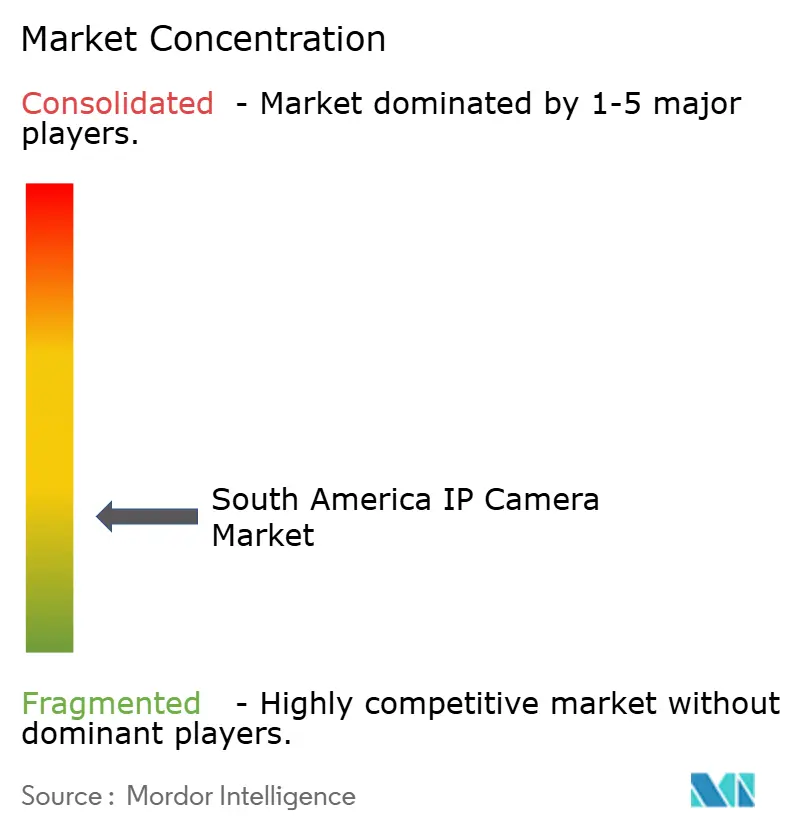
| Market Concentration | Low |
Major Players *Disclaimer: Major Players sorted in no particular order Image © Mordor Intelligence. Reuse requires attribution under CC BY 4.0. | |
South America IP Camera Market Analysis by Mordor Intelligence
The South America IP camera market size was valued at USD 1.16 million in 2025 and is estimated to expand to USD 2.31 million by 2031, at a CAGR of 12.34% during the forecast period 2026-2031. Public security spending is moving toward connected cameras, analytics, and command centers, which support larger and more integrated procurement programs. Lower hardware and edge-processing costs are making networked surveillance more practical for cities and commercial sites with limited budgets. Smart-city programs are also extending demand beyond capital cities to transport corridors, ports, and secondary municipalities. Vendors that combine cameras, video management software, analytics, and local installation support are better positioned for complex public tenders. Data protection rules, import costs, and a shortage of qualified integrators outside major cities may slow deployment in some areas. These factors can delay implementation even when a city or commercial operator has identified a clear operational need for more capable surveillance systems.
Key Report Takeaways
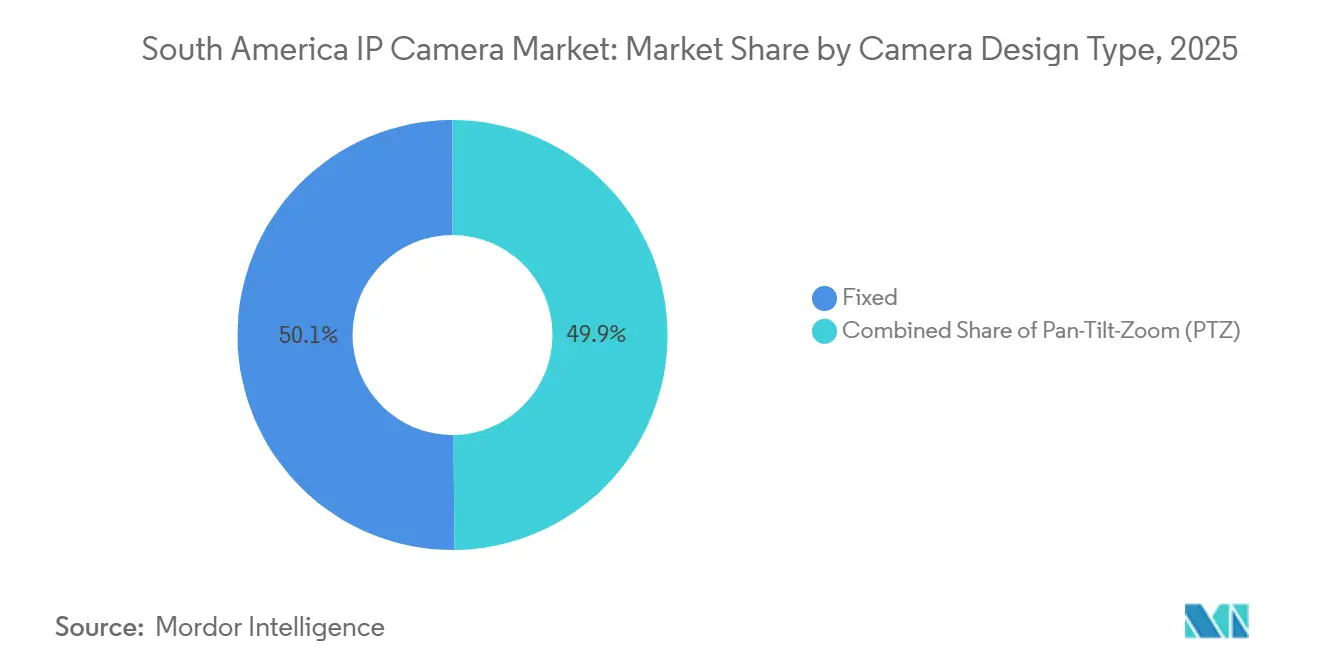
- By camera design type, fixed cameras held 50.14% of the South America IP camera market share in 2025, while PTZ cameras are projected to expand at a CAGR of 12.82% through 2031.
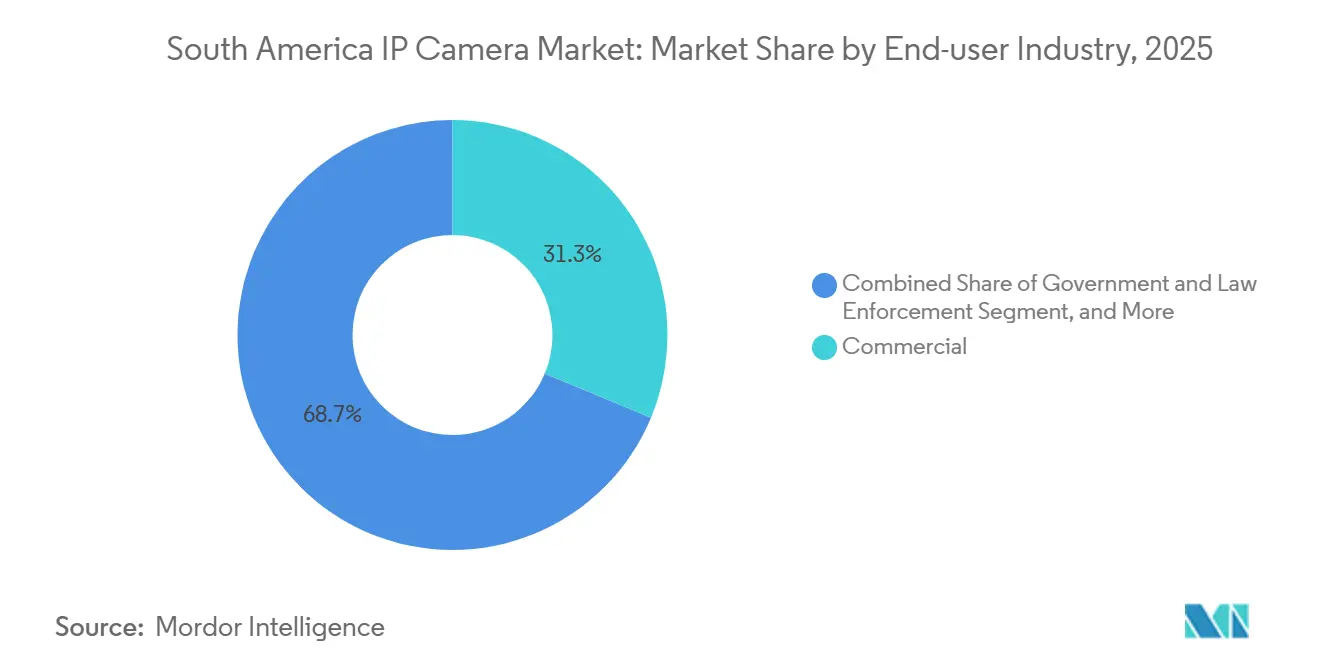
- By end-user industry, commercial users accounted for 31.28% of the South America IP camera market share in 2025, while government and law enforcement are expected to record the highest CAGR of 12.91% through 2031.
- By connection type, distributed systems commanded 64.43% of the South America IP camera market size in 2025 and are projected to advance at a CAGR of 12.66% through 2031.
- By offering, hardware represented 82.31% of revenue in 2025, while services are expected to expand at a CAGR of 12.78% through 2031.
- By resolution, Full HD cameras held 44.26% of revenue in 2025, while ultra-high definition and 4K cameras are projected to expand at a CAGR of 12.82% through 2031.
- By deployment mode, on-premises systems accounted for 52.66% of revenue in 2025, while cloud-based systems are expected to record a CAGR of 13.11% through 2031.
- By geography, Brazil captured 46.53% of the South America IP camera market in 2025, while Colombia is projected to expand at a CAGR of 12.94% through 2031.
Note: Market size and forecast figures in this report are generated using Mordor Intelligence’s proprietary estimation framework, updated with the latest available data and insights as of January 2026.
Market Trends and Insights
Drivers Impact Analysis of South America IP Camera Market*
| Driver | (~) % Impact on CAGR Forecast | Geographic Relevance | Impact Timeline |
|---|---|---|---|
| Rising Public Safety and Urban Surveillance Investment | +3.2% | National, with primary demand in Brazil and Colombia and concentrated gains in São Paulo, Rio de Janeiro, Medellín, and Bogotá | Short term (≤ 2 years) |
| Analog to IP Replacement Across Existing Installations | +2.6% | Regional, with Brazil, Argentina, and Chile as primary markets and urban-led adoption in Peru and Colombia | Medium term (2-4 years) |
| Expansion of Smart City and Transport Monitoring Programs | +2.1% | National, concentrated in Brazil and Colombia with spillover to Chile and Peru | Medium term (2-4 years) |
| Falling Camera, Storage, and Edge Processing Costs | +1.8% | Global, with faster uptake in lower-income South American markets | Short term (≤ 2 years) |
| Cloud Managed Surveillance for Distributed Sites | +1.5% | Brazil and Colombia are primary markets, with emerging use in Chile and Argentina | Medium term (2-4 years) |
| Localized Analytics for Unreliable Connectivity | +1.0% | Peru, Colombia’s interior regions, and the rest of South America | Long term (≥ 4 years) |
| Source: Mordor Intelligence | |||
Rising Public Safety and Urban Surveillance Investment
Government procurement is a major source of volume for the South America IP camera market, especially where cities are replacing separate monitoring tools with shared control-room systems. Rio de Janeiro state launched Programa Sentinela in January 2026, involving a major procurement of AI cameras across municipalities and control centers, according to O GLOBO. The scale of the program supports demand for cameras, analytics, network infrastructure, data storage, field installation, and command-center services. Medellín’s C5i command center was under construction as of July 2026 and includes AI video analytics, drone monitoring, license-plate readers, and a dedicated data center.[1] These projects favor suppliers that can support integrated systems instead of single-device sales and coordinate several technology layers. Framework agreements may also raise the qualification requirements for vendors seeking public-sector contracts, including local implementation and continuing service capacity.
Analog to IP Replacement Across Existing Installations
Existing analog installations create a long replacement cycle for the South America IP camera market, particularly in industrial facilities, commercial buildings, and smaller municipal sites. Usiminas upgraded its Cubatão facility from analog to IP using an encoder chassis that retained existing coaxial cable runs, reducing the need for full rewiring at a large industrial site.[2] This approach can reduce disruption, preserve earlier cabling investments, and shorten the transition for facilities with legacy equipment. The Brazilian electronic security sector is also increasing its use of AI, which links camera replacement with demand for analytics capability. As conversion kits become more available, hardware pricing may face pressure in routine replacement projects that need limited physical changes. Software licenses, system integration, analytics configuration, and service agreements could therefore carry more value in the South America IP camera market.
Expansion of Smart City and Transport Monitoring Programs
Smart-city programs are broadening the addressable base for the South America IP camera market, shifting demand from isolated projects toward connected urban networks. São Paulo operates an extensive Smart Sampa camera network and plans to expand coverage further through a platform that accepts public and private feeds. Bogotá’s C4 integrates a large network of public and private cameras and continues to add multi-sensor, panoramic cameras. These systems provide reference models for cities planning wider surveillance coverage and shared operational information. Transport facilities add a separate demand stream through security, safety, and compliance needs across ports, roads, rail corridors, and other critical locations. Ferroport uses Axis Communications cameras at the Port of Açu for continuous perimeter surveillance under applicable port-security rules.
Falling Camera, Storage, and Edge Processing Costs
Lower equipment and processing costs are opening the South America IP camera market to budget-constrained municipalities that had previously delayed larger networked deployments. IP cameras with embedded AI have become more accessible as global chipset volumes have increased and local buyers compare lifecycle costs. Paranaguá replaced a limited analog camera network with a substantially larger IP camera network that included AI analytics and reported a significant reduction in annual operating costs per camera. The case shows that deployment decisions depend on operating costs as well as hardware prices, and not simply on the number of devices purchased. Lower-cost systems can move smaller cities from limited pilot programs to broader procurement plans. The result is a wider customer base for the South America IP camera market, especially where municipal operating budgets are constrained.
Restraints Impact Analysis of South America IP Camera Market*
| Restraint | (~) % Impact on CAGR Forecast | Geographic Relevance | Impact Timeline |
|---|---|---|---|
| Privacy, Cybersecurity, and Data Sovereignty Exposure | -2.8% | Regional, with Brazil as the primary focus and growing regulatory influence in Chile and Peru | Medium term (2-4 years) |
| High Installation and Maintenance Costs | -2.2% | Peru, Colombia’s interior regions, the rest of South America, and secondary cities nationally | Short term (≤ 2 years) |
| Import Duties, Currency Volatility, and Tax Complexity | -1.7% | Regional, including Brazil’s tax complexity, Argentina’s import restrictions, and Colombia’s tariff changes | Medium term (2-4 years) |
| Shortage of Certified Integrators Outside Major Cities | -1.3% | Peru, Colombia’s interior regions, and Argentina’s secondary cities | Long term (≥ 4 years) |
| Source: Mordor Intelligence | |||
Privacy, Cybersecurity, and Data Sovereignty Exposure
Privacy compliance is a material procurement issue in the South America IP camera market. Brazil’s LGPD treats biometric data, including facial images, as sensitive personal data and requires a legal basis for processing. Chile’s data-protection law introduced new obligations that are scheduled to enter into force in the coming years, while Peru issued rules that restrict real-time biometric surveillance in public spaces. Different country rules require vendors to adapt system configurations, data retention practices, and access controls. Cybersecurity has become equally important because connected cameras can provide an entry point into wider corporate networks. CrowdStrike reported a notable year-over-year increase in ransomware attacks in South America, with Brazil the most affected country. This places greater attention on device credentials, network segmentation, software updates, and clear responsibility for managing connected cameras after installation.
High Installation and Maintenance Costs
The total installed cost of IP systems remains a restraint for the South America IP camera market. Costs include structured cabling, power-over-Ethernet switches, network capacity, storage, commissioning, and ongoing maintenance. The Inter-American Development Bank and the Organization of American States identified persistent cybersecurity and IT infrastructure gaps across Latin America and the Caribbean in 2025. These gaps can limit the readiness of local governments and smaller operators for networked surveillance platforms. Long-term maintenance commitments may create budget problems when suppliers offer low initial hardware prices but limited service support. Subscription-based services can improve budget predictability for multi-site commercial operators, even where total contract costs exceed a comparable on-premises system. This option can be useful when buyers need to spread spending across operating budgets while retaining access to upgrades, support, and centralized management functions.
*Our forecasts treat driver/restraint impacts as directional, not additive. The impact forecasts reflect baseline growth, mix effects, and variable interactions.
South America IP Camera Market Segment Analysis
By Camera Design Type:
Fixed Cameras Retain Volume Leadership While PTZ Use ExpandsFixed cameras held 50.14% of the South America IP camera market share in 2025 because static perimeter, entrance, corridor, retail, banking, and residential applications require large installation volumes. Their simple operating model makes them suitable for sites where coverage areas and viewing angles remain stable. PTZ cameras are projected to expand at a CAGR of 12.82% through 2031 as police, transit operators, and perimeter-security teams need redirectable optics. A PTZ device can cover areas that could otherwise require several fixed cameras in command-center applications. Hanwha Vision deployed nearly 2,000 AI cameras in Lima’s Santiago de Surco district in August 2025, including license-plate recognition and 360-degree multi-sensor capabilities. The deployment shows that active and wide-area coverage can be used alongside conventional fixed camera networks. It also illustrates how municipalities can combine several camera formats when a single design cannot provide both constant coverage and flexible views of changing activity.
Varifocal cameras remain relevant for commercial building managers that need adjustable focal lengths without the cost of fully motorized movement. The South America IP camera market therefore includes a practical middle tier between fixed and PTZ designs. AI-enabled tracking is increasing the importance of software compatibility for PTZ installations. São Paulo’s Smart Sampa platform and Rio de Janeiro’s CIVITAS program illustrate how major public systems are adopting analytics-driven monitoring architectures. Tracking performance depends on the camera, video management system, and analytics platform working together. This can make certified integrations more important in public tenders and can limit opportunities for suppliers with weak software partnerships. It also gives buyers a practical reason to assess the reliability of analytics, camera control, alerting, and operator workflows together rather than selecting devices on technical specifications alone.

By End-user Industry:
Commercial Users Lead Across Diverse SitesCommercial users held 31.28% of the South America IP camera market share in 2025, supported by banking, retail, healthcare, education, and real estate deployments. Banking networks require standardized coverage across branches, while retailers are increasingly using video systems for loss prevention and operational visibility. A.C. Camargo Cancer Center installed a large number of Axis Communications cameras across multiple buildings in São Paulo and reported substantial cost savings over a multi-year period. The case shows how a large healthcare installation can support security operations, patient safety, and incident response. Healthcare sites need coverage across buildings, care units, public areas, entrances, and parking locations, making coordinated monitoring a useful operational capability. Dahua Technology deployed integrated retail functions at Carrefour Brazil, including people counting, intelligent search, and electronic article surveillance. Residential demand remains smaller but benefits from lower camera prices and smartphone-managed services.
Government and law enforcement are projected to be the fastest-growing end-user group at a CAGR of 12.91% through 2031. Large public programs require cameras, analytics, emergency-system integration, and command-center operations. Industrial sites also contribute to the South America IP camera market because manufacturing plants, logistics hubs, ports, and mines operate large and complex facilities. Usiminas’ Cubatão upgrade demonstrates the systems-integration needs associated with industrial modernization. Education and real estate are at earlier stages of adoption but can use the same cloud, analytics, and cost improvements that are increasing commercial adoption. These uses broaden the customer base beyond public-security procurement. They also give installers and integrators opportunities to provide different system designs for sites with distinct operating hours, security risks, connectivity conditions, and requirements for remote oversight.
Geography Analysis
Brazil IP Camera Market
Brazil captured 46.53% of the South America IP camera market share in 2025, supported by extensive programs in São Paulo and Rio de Janeiro. Rio de Janeiro substantially increased the CIVITAS intelligence center budget and expanded its camera deployment plans. The city operated an extensive network of monitoring devices and planned to add a significant number of super-cameras. Brazil’s LGPD shapes municipal biometric-data handling and favors suppliers with controlled processing and data-protection features. Smart Sampa operated a large camera network and planned further expansion, confirming Brazil as the principal source of regional demand.
Colombia and Peru IP Camera Market
Colombia is projected to be the fastest-growing geography at a CAGR of 12.94% through 2031. Medellín’s C5i center is under development and is designed to include analytics, drone monitoring, license-plate readers, and a data center. Atlántico approved a regional security program covering multiple municipalities, including PTZ cameras, fixed cameras, and license-plate readers. Peru remains a smaller market, but Lima’s Santiago de Surco district deployed Hanwha Vision AI cameras. Peru’s limits on real-time biometric surveillance affect how vendors configure AI systems for government use.
South America IP Camera Market
Argentina and Chile contribute demand through Buenos Aires, Santiago, and infrastructure sectors such as mining, oil and gas, and port logistics. Axis Communications reopened its Buenos Aires office as an experience center in 2025, focusing on mining, oil and gas, and critical infrastructure. Chile’s data-protection law enters into force in December 2026, prompting organizations to review surveillance-data processing. Ecuador, Bolivia, Paraguay, Uruguay, and Venezuela have smaller markets with urban-security needs that are likely to follow regional procurement models as local requirements develop.
Competitive Landscape
The South America IP camera market has many active vendors, although the installed hardware base is influenced by large global suppliers. Hikvision and Dahua compete through broad portfolios, competitive pricing, and established regional distribution. Axis Communications differentiates through cybersecurity architecture, image quality, and a certified partner ecosystem. Intelbras holds a distinct position as a major Brazilian manufacturer and benefits from production in the Manaus Free Trade Zone. Its planned factory expansion is intended to strengthen security equipment production capacity.[3]
Hanwha Vision is pursuing public-sector opportunities through AI-enabled products and regional partner engagement. Its recent Lima deployment demonstrates its ability to support large municipal projects. Dahua deployed StarMap AI software in São Paulo’s Muralha Paulista public-security program, supporting real-time tracking, forensic analysis, and data correlation. This approach connects a software platform to public-sector operations and may support continuing hardware demand. Qualcomm and Claro Empresas also signaled interest in combining connectivity, local processing, and enterprise surveillance functions through Smart View.
Competition is active in smaller municipal procurements, where local distribution, certified installation capacity, and procurement compliance can matter as much as product specifications. Video management suppliers such as Genetec and Milestone help customers manage mixed camera fleets. Thermal specialists such as Teledyne FLIR serve perimeter and industrial uses where visible-light cameras may not meet operational needs. Opportunities remain in video surveillance as a service, edge analytics, and mid-sized city projects, but no combined market share was provided to support a precise concentration assessment.
South America IP Camera Industry Leaders
-
Hangzhou Hikvision Digital Technology Co., Ltd.
-
Zhejiang Dahua Technology Co., Ltd.
-
Intelbras S.A.
-
Axis Communications AB
-
Robert Bosch GmbH
- *Disclaimer: Major Players sorted in no particular order
South America IP Camera Market Companies Covered in this Report
- Hangzhou Hikvision Digital Technology Co., Ltd.
- Zhejiang Dahua Technology Co., Ltd.
- Intelbras S.A.
- Axis Communications AB
- Robert Bosch GmbH
- Hanwha Vision Co., Ltd.
- Honeywell International Inc.
- Panasonic Holdings Corporation
- Sony Group Corporation
- Motorola Solutions, Inc.
- VIVOTEK Inc.
- Zhejiang Uniview Technologies Co., Ltd.
- Tiandy Technologies Co., Ltd.
- Teledyne FLIR LLC
- Pelco, Inc.
- Genetec Inc.
- Eagle Eye Networks, Inc.
- Milestone Systems A/S
- Johnson Controls International plc
- Schneider Electric SE
Recent Industry Developments in South America IP Camera Market
- August 2026: Intelbras S.A. advances plans to expand production at its Zona Franca de Manaus facility, with the new factory slated for mid-2027 commissioning. The expansion leverages Brazil's Tributary Reform tax incentives and is designed to scale manufacturing capacity for IP camera and CCTV security monitoring equipment, strengthening Intelbras's domestic cost advantage in public-sector procurement.
- July 2026: Rio de Janeiro City Hall confirmed the CIVITAS expansion targeting 20,000 smart cameras by 2028, up from 10,000 monitoring devices active in early 2026. The network will process facial recognition, license-plate analytics, and real-time alerts shared across municipal, state, and federal security agencies, and the center currently issues approximately 160 alerts in real time and performs over 6.1 million daily license-plate reads.
- May 2026: Seguritech signed a contract with Medellín city government to construct and operate Colombia's first C5i command center, integrating AI video surveillance, traffic control, license-plate readers, IoT sensors, fiber-optic networks, drone surveillance, and counter-drone defense capabilities under the company's proprietary SAIMON Tech AI platform.
- April 2026: Colombia's Atlántico Department approved a COP 148 billion (approximately USD 34 million) AI video surveillance program covering 18 municipalities outside Barranquilla, encompassing 411 surveillance devices including 120 PTZ cameras, 151 fixed cameras, and 140 automatic license-plate readers with advanced AI analytics.
South America IP Camera Market Report Scope
South America IP Camera Market refers to the sale, installation, and deployment of digital surveillance cameras that transmit and receive video data through Internet Protocol networks. It includes fixed, dome, bullet, pan-tilt-zoom, varifocal, thermal, wireless, PoE, and AI-enabled network cameras.
The South America IP Camera Market Report is Segmented by Camera Design (Fixed, Pan-Tilt-Zoom (PTZ), and Varifocal), End-user Industry (Residential, Commercial, Industrial, and Government and Law Enforcement), and Geography (Brazil, Argentina, Chile, Colombia, Peru, and Rest of South America). The Market Forecasts are Provided in Terms of Volume (Units).
Segmentation Overview
| Fixed |
| Pan-Tilt-Zoom (PTZ) |
| Varifocal |
| Residential |
| Commercial |
| Industrial |
| Government and Law Enforcement |
| Brazil |
| Argentina |
| Chile |
| Colombia |
| Peru |
| Rest of South America |
| By Camera Design Type | Fixed |
| Pan-Tilt-Zoom (PTZ) | |
| Varifocal | |
| By End-user Industry | Residential |
| Commercial | |
| Industrial | |
| Government and Law Enforcement | |
| By Geography | Brazil |
| Argentina | |
| Chile | |
| Colombia | |
| Peru | |
| Rest of South America |
Key Questions Answered in the Report
What is the South America IP camera market size?
The South America IP camera market size was USD 1.16 million in 2025 and is estimated to reach USD 2.31 million by 2031 at a CAGR of 12.34%. The estimate reflects demand across cameras, related systems, supporting software, installation work, and managed services across public and commercial users. It also reflects the greater role of connected security platforms that combine image capture, analytics, storage, and remote management.
What is driving demand for IP cameras in South America?
Public-security procurement, analog-to-IP replacement, smart-city programs, and lower edge-processing costs are supporting demand. Large municipal programs also require networks, analytics, and operating support. Commercial demand comes from banking, retail, healthcare, industrial sites, and other operators that need more consistent visibility across multiple facilities.
Which country leads regional IP camera demand?
Brazil led with 46.53% of 2025 revenue, supported by deployments in São Paulo and Rio de Janeiro. The CIVITAS and Smart Sampa programs show the scale of current public-sector demand. Brazil also has a large installed base that can support replacement activity in commercial, industrial, and public locations.
Which South American country is expected to expand fastest?
Colombia is projected to record the highest country CAGR of 12.94% through 2031. Medellín’s C5i project and Atlántico’s multijurisdictional program support this outlook. These programs combine cameras with control centers, analytics, license-plate readers, and associated security infrastructure, which broadens the required supplier capabilities.