
Market Overview
| Study Period | 2021 - 2031 |
|---|---|
| Forecast Data Period | 2026 - 2031 |
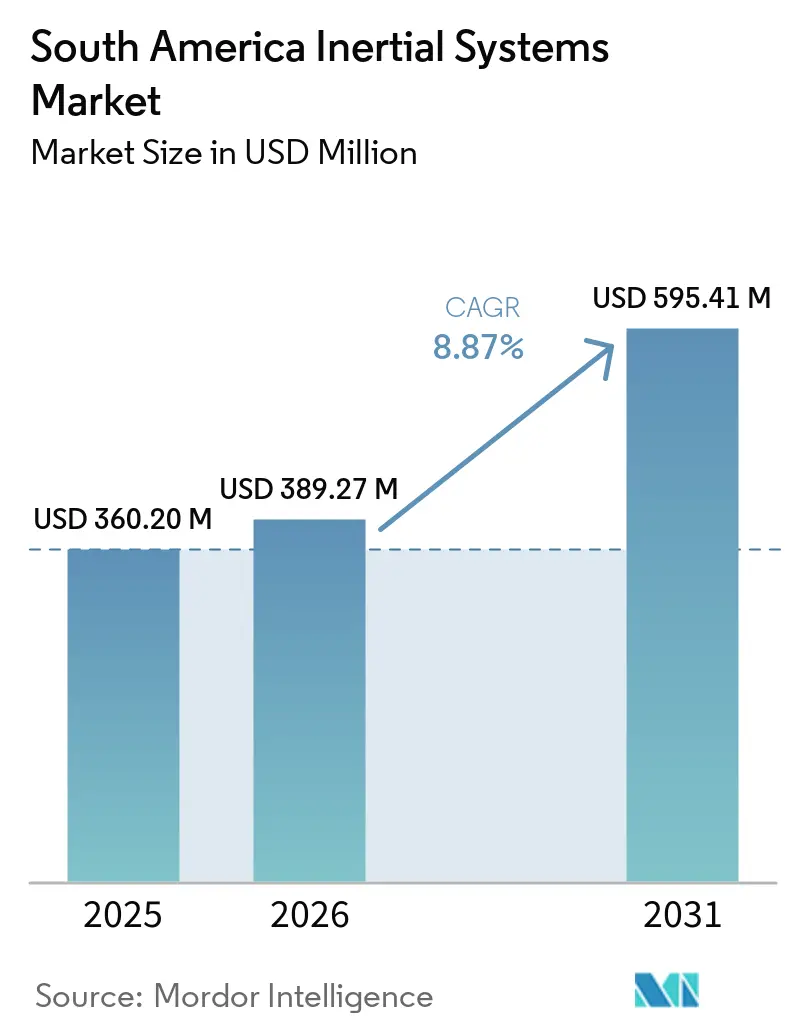
| Base Year Market Size (2025) | USD 360.20 Million |
| Market Size (2026) | USD 389.27 Million |
| Market Size (2031) | USD 595.41 Million |
| Growth Rate (2026 - 2031) | 8.87 % |
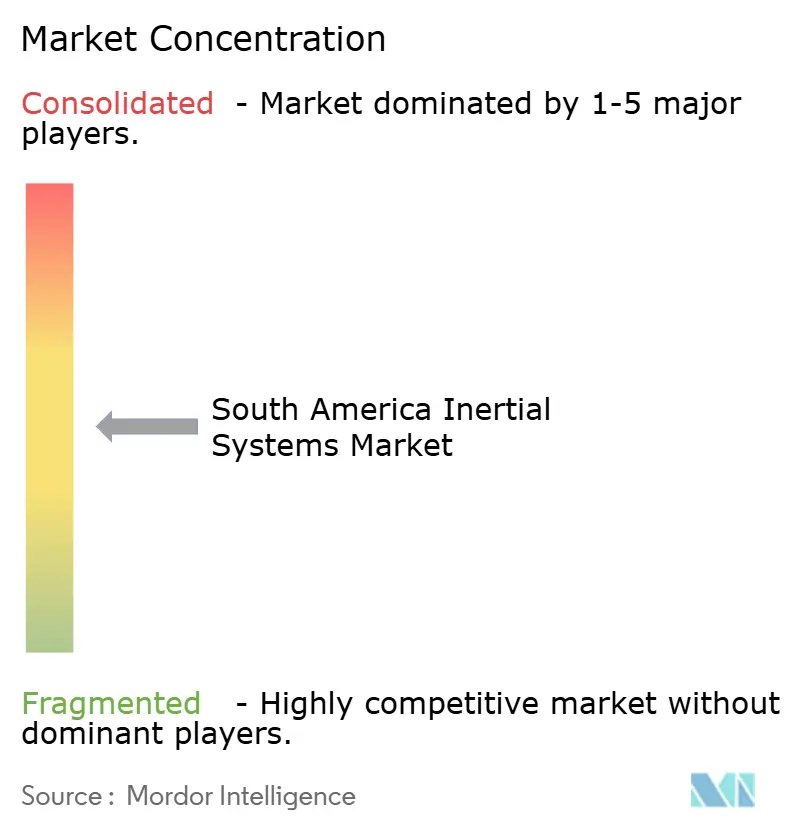
| Market Concentration | Medium |
Major Players *Disclaimer: Major Players sorted in no particular order Image © Mordor Intelligence. Reuse requires attribution under CC BY 4.0. | |
South America Inertial Systems Market Analysis by Mordor Intelligence
The South America Inertial Systems Market size is expected to increase from USD 360.20 million in 2025 to USD 389.27 million in 2026 and reach USD 595.41 million by 2031, growing at a CAGR of 8.87% over 2026-2031.
Defense modernization in Brazil, Argentina, and Colombia supports demand for navigation-grade equipment in aircraft, naval platforms, and guided weapons. Procurement of Western platforms also creates later demand for replacement and support cycles, because these platforms require qualified avionics components over long operating lives. Unmanned vehicles, offshore energy work, and mining automation widen the use of lower-cost and application-specific sensors. The South America inertial systems market remains dependent on imported high-grade hardware, which leaves procurement exposed to export controls, exchange-rate changes, and extended certification processes. Competition differs by tier, with a small group of qualified international sensor suppliers serving precision applications and local integrators competing for assembly and platform work.
Key Report Takeaways
- By component, IMUs held 33.81% of the South America inertial systems market share in 2025 and are projected to expand at a 10.13% CAGR through 2031.
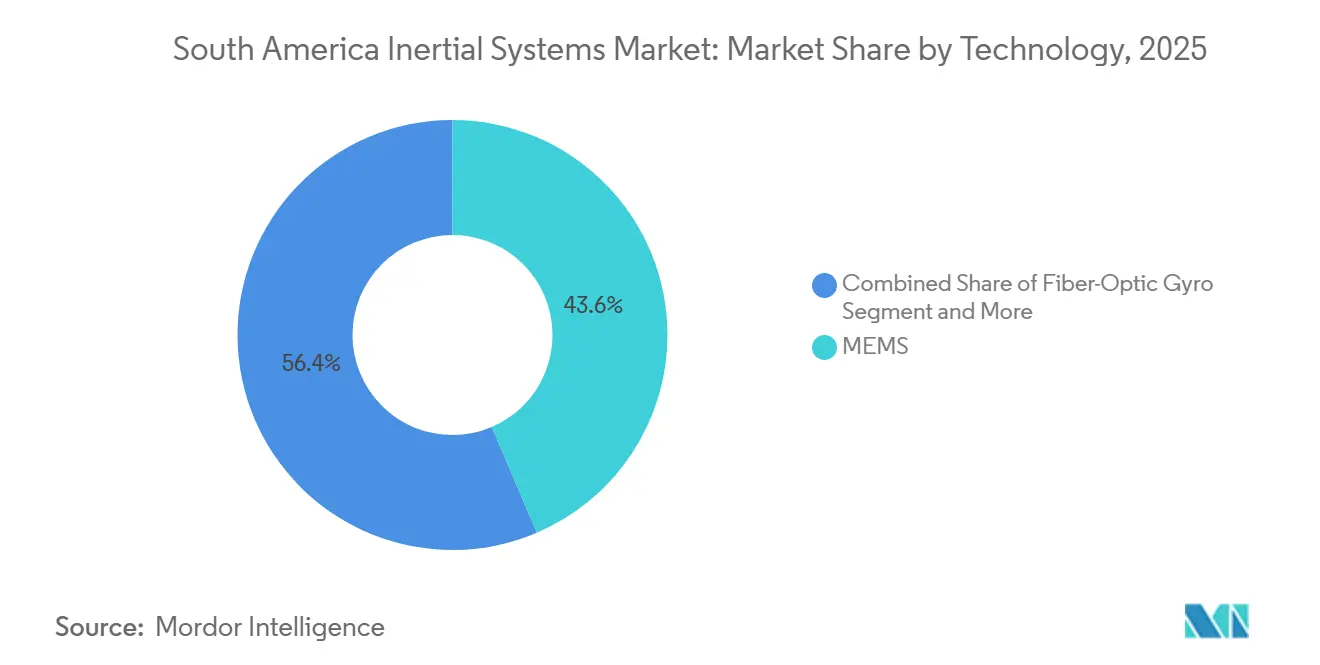
- By technology, MEMS accounted for 43.58% of the South America inertial systems market share in 2025, while HRG technology is projected to expand at a 10.69% CAGR through 2031.
- By application, Aerospace and Defense accounted for 40.31% of demand in 2025, while the Industrial segment is projected to expand at a 10.27% CAGR through 2031.
- By country, Brazil accounted for 52.61% of regional demand in 2025 and is projected to expand at a 9.61% CAGR through 2031.
Note: Market size and forecast figures in this report are generated using Mordor Intelligence’s proprietary estimation framework, updated with the latest available data and insights as of January 2026.
South America Inertial Systems Market Trends and Insights
Drivers Impact Analysis*
| Driver | (~) % Impact on CAGR Forecast | Geographic Relevance | Impact Timeline |
|---|---|---|---|
| Defense and Aerospace Platform Modernization | +2.2% | Brazil, Argentina, and Colombia | Medium term (2-4 years) |
| Expansion of UAV, UGV, and UUV Deployment | +1.9% | Brazil, Argentina, and Colombia | Short term (≤ 2 years) |
| GNSS-Denied Navigation and Anti-Jam Requirements | +1.5% | Brazil and Argentina, with regional spillover | Medium term (2-4 years) |
| Oil, Gas, and Mining Automation | +1.2% | Brazil, Argentina, and Peru | Medium term (2-4 years) |
| MEMS Miniaturization and Lower System Cost | +0.8% | All South American countries | Long term (≥ 4 years) |
| Localized Defense-Electronics Integration in Brazil | +0.4% | Brazil, with spillover to Argentina and Colombia | Medium term (2-4 years) |
| Source: Mordor Intelligence | |||
Defense and Aerospace Platform Modernization
Platform modernization in Brazil, Argentina, and Colombia supports sustained demand within the South America inertial systems market. Brazil’s Tamandaré-class frigate program covers 4 vessels scheduled for delivery through 2029, and its first frigate entered service with an integrated navigation and bridge system in February 2026. Each vessel requires navigation integration at the platform level, which supports demand for inertial equipment during installation, qualification, and service. Argentina’s F-16 modernization program introduces embedded GPS and inertial navigation requirements that are consistent with NATO-aligned avionics standards. The concurrent modernization of fighter aircraft, frigates, and helicopters gives suppliers several long-duration program opportunities instead of a single procurement cycle. This mix also supports replacement demand after the original platform deliveries are complete.
Expansion of UAV, UGV, and UUV Deployment
The expansion of unmanned air, ground, and subsea systems increases demand for compact sensors that can withstand shock and operate with calibrated performance profiles. The South America inertial systems market benefits because unmanned platforms use inertial inputs for stabilization, guidance, attitude reference, and position estimation. Brazil conducted the first confirmed flight of the Albatroz Vortex jet-powered UAV in January 2026 under a cooperation arrangement involving the Ministry of Defense and the Air Force. Argentina publicly demonstrated a UGV with a gyrostabilized weapon turret and first-person-view drone deployment capability in May 2026. These programs show that regional procurement is extending beyond conventional crewed platforms into several unmanned domains. Their requirements favor smaller and more cost-efficient systems while maintaining reliable field performance.
GNSS-Denied Navigation and Anti-Jam Requirements
Electronic warfare concerns are raising demand for navigation systems that remain functional when satellite signals are jammed, spoofed, or unavailable. This requirement is relevant to the South America inertial systems market because inertial navigation provides an independent source of position and movement data. Northrop Grumman delivered the first production EGI-M airborne navigation unit in April 2026, and the system is designed to provide verified positioning, navigation, and timing information in GPS-jammed conditions[1]Northrop Grumman Corporation, “Northrop Grumman Delivers Resilient Airborne Navigation System Resistant to GPS Jamming,” Northrop Grumman, news.northropgrumman.com.. The delivery shows that resilient inertial technology is being fielded for platforms that follow United States defense standards. Regional defense buyers seeking compatible capabilities can place more emphasis on sensor accuracy, robustness, and integration assurance. The requirement also strengthens the case for higher-grade products in aircraft, naval, and guided-weapon applications.
Oil, Gas, and Mining Automation
Deepwater oil fields off Brazil, the Vaca Muerta formation in Argentina, and mining operations in the Andes create demanding settings for inertial navigation. The South America inertial systems market gains from these activities because reliable position and heading information is needed when satellite coverage is constrained, or the environment limits conventional navigation methods. Exail Technologies secured a July 2025 contract to provide 30 Quadrans AHRS units for Petrobras-operated floating production, storage, and offloading units off Brazil’s coast. The units have stated heading accuracy of 0.23° seclat RMS and are intended for platform-stability monitoring during subsea construction work. Offshore programs, therefore, support recurring demand for AHRS and INS equipment as field development continues. Mining automation creates a related need for navigation in tunnels, pits, and remote operating areas.
Restraints Impact Analysis*
| Restraint | (~) % Impact on CAGR Forecast | Geographic Relevance | Impact Timeline |
|---|---|---|---|
| Import Dependence for High-Grade Inertial Components | -0.5% | South America-wide | Long term (≥ 4 years) |
| Long Qualification and Certification Cycles | -0.4% | Brazil, Argentina, and Colombia | Medium term (2-4 years) |
| Integration, Calibration, and Drift-Compensation Complexity | -0.3% | Industrial and automotive applications across South America | Medium term (2-4 years) |
| Currency Volatility and Uneven Defense Procurement | -0.3% | Argentina, Brazil, and Colombia | Medium term (2-4 years) |
| Source: Mordor Intelligence | |||
Import Dependence for High-Grade Inertial Components
South America has limited domestic capacity for accelerometers and gyroscopes that meet navigation-grade and strategic-grade accuracy requirements. The South America inertial systems market, therefore, relies on a concentrated group of internationally qualified manufacturers for military aircraft, ship navigation, and precision-guided weapons. Export controls can restrict the availability of these products and complicate delivery planning for regional programs. The International Traffic in Arms Regulations establish controls for defense articles and related technical data, which can affect cross-border supply arrangements[2]U.S. Government Publishing Office, “International Traffic in Arms Regulations,” Electronic Code of Federal Regulations, ecfr.gov.. Import dependence also raises local procurement costs when contracts are denominated in foreign currencies. Brazil’s work on a domestic SNI-GNSS system points to a longer-term effort to develop local capability, but high-grade component demand remains externally sourced in the near term.
Long Qualification and Certification Cycles
Defense and aviation inertial systems require extensive qualification before they can be fitted to operational platforms. The South America inertial systems market faces added timing risk because selection, testing, certification, and platform approval can take 18 to 36 months. This delay can separate an initial procurement decision from invoiced orders and makes supplier capacity planning more difficult. Airborne systems must also meet demanding software and hardware assurance requirements, which increase the engineering burden for smaller regional integrators. Established suppliers can compete more effectively when they hold previously qualified technical packages and established documentation. These processes can slow adoption even where underlying platform requirements are clear.
*Our forecasts treat driver/restraint impacts as directional, not additive. The impact forecasts reflect baseline growth, mix effects, and variable interactions.
Segment Analysis
By Component: IMUs Lead Demand Across Platform and Application Requirements
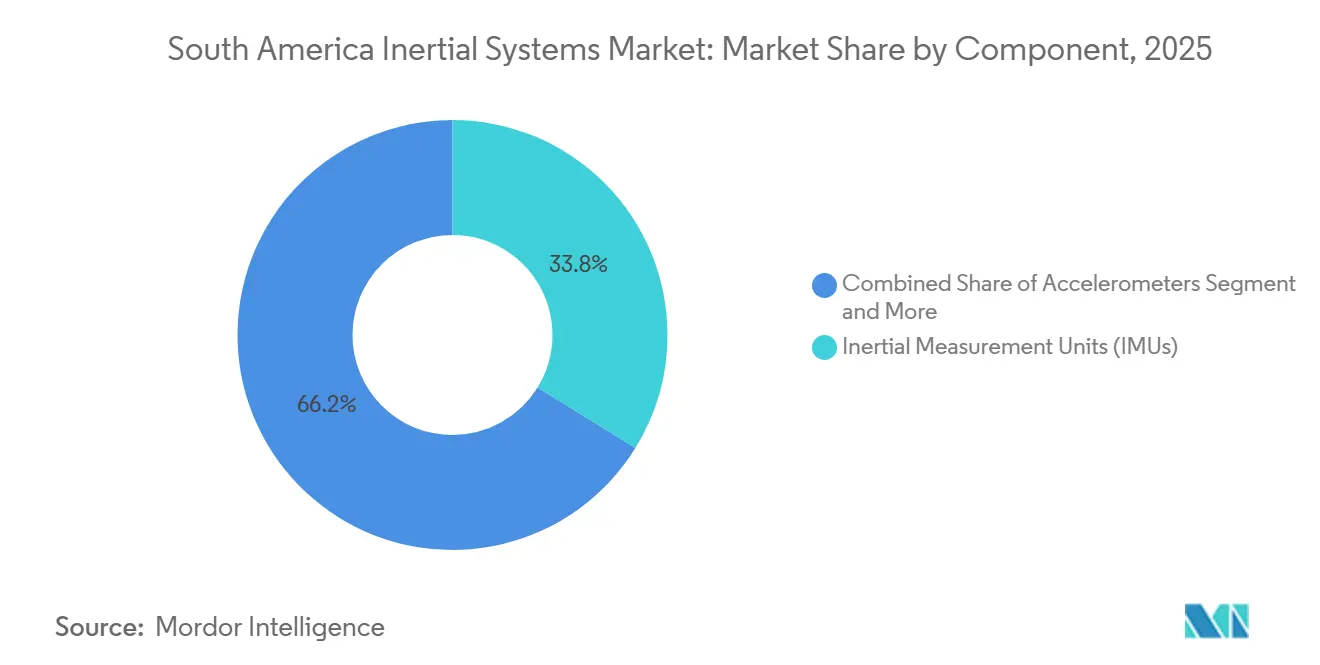
IMUs held 33.81% of the South America inertial systems market share in 2025 and are projected to expand at a 10.13% CAGR between 2026 and 2031. This position reflects their use in navigation, stabilization, and guided-weapon guidance across defense and civil applications. Brazil’s serial production of the MANSUP anti-ship missile and MAX 1.2 AC anti-tank missile at SIATT’s Caçapava facility supports demand for guidance subsystems. SIATT expanded its production capability through a new 6,000 m² facility in São José dos Campos in September 2025, with research laboratories and lines for MANSUP, MAX 1.2 AC, and SisGAAz systems. IMUs also serve offshore energy, UAV, space-launch, and industrial navigation functions. Their use across several platforms makes the component less dependent on any one procurement program.
Accelerometers and gyroscopes provide the basic sensing inputs used in IMUs and more complex inertial assemblies. Their demand is linked to the production rate of IMUs and inertial navigation systems rather than to a single end use. Magnetometers retain a focused role in heading-reference applications across maritime and mining operations. AHRS equipment has gained support in offshore oil and gas work, as shown by Exail’s contract for 30 Quadrans AHRS units for Petrobras-operated FPSOs. Inclinometers and navigation computers add revenue through autonomous and remotely operated industrial systems. The component mix gives the South America inertial systems industry exposure to high-precision defense programs and larger-volume commercial uses. Local integration requirements can favor suppliers that combine sensor capability with engineering support.



By Technology: MEMS Supports Volume While HRG Serves High-Precision Uses
MEMS accounted for 43.58% of the South America inertial systems market size in 2025, supported by consumer electronics, lower-tier defense, automotive, and industrial applications. The technology’s cost efficiency and compact form support broad use where navigation-grade accuracy is not required. A 2025 scientific review described the split between consumer-grade miniaturization and tactical-grade precision in MEMS inertial sensor development. Bosch introduced the SMI330 with a 3.0×2.5 mm LGA footprint that was 44% smaller than its predecessor and with an operating temperature range extending to 125°C. These characteristics support use in automotive and industrial equipment operating in harsh conditions. MEMS miniaturization also helps regional manufacturers and integrators manage system weight, footprint, and cost.
HRG technology is projected to expand at a 10.69% CAGR between 2026 and 2031, the highest rate among the listed technologies. Its demand is linked to military and aerospace applications that require stable solid-state performance in GNSS-denied environments and during long service lives. Safran announced in June 2026 that it would invest EUR 120 million (USD 132 million) to increase HRG production at its Montluçon facility from 10,000 to 30,000 units a year by 2032. The project includes 10,500 m² of additional capacity and 500 jobs. Safran also selected its SkyNaute HRG-based solution for Eve Air Mobility eVTOL aircraft, showing use beyond traditional defense platforms. FOG, RLG, vibrating gyro, and mechanical INS technologies remain relevant where their particular accuracy, redundancy, or legacy-platform characteristics meet a specific operational need.
By Application: Aerospace and Defense Leads While Industrial Demand Accelerates
Aerospace and Defense accounted for 40.31% of demand in 2025, making it the largest application within the South America inertial systems market. Fighter modernization, frigate programs, helicopters, guided weapons, and unmanned systems drive the need for qualified inertial equipment. Brazil’s procurement programs combine domestic production, foreign platforms, and local system integration. Colombia’s acquisition of 17 Gripen E aircraft, with deliveries running from 2026 to 2032, adds new avionics and inertial navigation integration requirements. The South America inertial systems industry also serves civil aviation platforms, including the eVTOL aircraft supported by the Safran SkyNaute selection. These applications value traceability, reliability, and documented performance under demanding operating conditions.
The Industrial segment is projected to expand at a 10.27% CAGR between 2026 and 2031, the highest rate among the listed applications. Automation in oil and gas, subsea inspection, underground mining, and autonomous ground logistics supports this outlook. Advanced Navigation introduced its Chimera Land sensor in February 2026 for underground mining environments where GPS is unavailable, and the product is designed to work with inertial navigation systems in unmapped tunnels[3]Advanced Navigation, “Chimera Land, A New Navigation Technology for Underground Mining,” International Mining, im-mining.com.. Energy and Infrastructure demand is anchored by Brazil’s FPSO fleet and the need for recurring AHRS and INS procurement during pre-salt development. Land and Transportation, Consumer Electronics, and Automotive applications add demand through IMU-fused positioning and locally assembled electronics. Medical use remains small, but miniaturized inertial sensing can support future surgical-robotics applications.
Geography Analysis
Brazil accounted for 52.61% of the South America inertial systems market size in 2025 and is projected to expand at a 9.61% CAGR through 2031. Its position reflects the region’s largest defense budget, a developed defense-industrial base, offshore oil production, and active UAV programs. The Tamandaré frigate program, Gripen E activity at Embraer’s Gavião Peixoto facility, guided-weapon production, and Petrobras FPSO operations create a varied demand base. Brazil also has domestic space navigation activity through the SNI-GNSS program. The Agência Espacial Brasileira confirmed in June 2026 that the system had completed flight validation aboard an Innospace rocket.
Argentina is the second-largest country market and has demand linked to F-16 avionics modernization and expanding unmanned-system activity. The F-16 program brings inertial and embedded GPS requirements associated with modern combat-aircraft avionics. Argentina also demonstrated a UGV with a gyrostabilized turret and drone deployment capability in 2026. Currency volatility can interrupt purchases of USD-denominated inertial components and may cause actual order timing to differ from announced procurement plans. Its demand base, therefore, combines clear strategic requirements with execution risk in imported hardware procurement.
Colombia and the Rest of South America form a smaller but developing demand group. Colombia’s Gripen E procurement adds a multi-year source of avionics integration work from 2026 to 2032. The country’s Dragom drone program and its participation in the Spanish-Colombian SIRTAP UAS program indicate a need for local integration skills. Peru, Chile, and Ecuador contribute through mining automation and periodic defense procurement. Smaller markets remain more dependent on imported industrial equipment and platforms supplied through larger regional programs.
Competitive Landscape
The South America inertial systems market is moderately fragmented in high-precision sensor hardware and more fragmented in system integration. Safran Electronics and Defense, Northrop Grumman, Honeywell International, Thales Group, and Analog Devices are among the suppliers serving the high-precision sensor supply chain. Their products are generally supplied through direct defense sales, local partners, or licensed production arrangements. The South America inertial systems market favors suppliers that can meet technical qualification requirements and support local integration. At the platform level, AEL Sistemas and SIATT compete alongside multinational subsidiaries and specialist navigation firms. Local-content policies increase the value of domestic assembly and engineering capacity.
Foreign suppliers have increasingly used technology transfer and local assembly to improve access to regional programs. SIATT’s partnership with EDGE Group and AEL Sistemas’ memorandum of understanding with Diehl Defense show this approach. SIATT’s September 2025 facility expansion added laboratories and production lines in Brazil, strengthening its role in guided weapons and surveillance systems. Safran’s selection to supply 2 SkyNaute HRG-based systems for each Eve eVTOL aircraft demonstrates its position in next-generation civil aviation. Northrop Grumman’s EGI-M delivery provides a further example of a supplier advancing inertial navigation for GPS-jammed environments.
Opportunities are clearest in medium-grade MEMS-based IMUs for autonomous vehicles and in subsea solutions for Brazil’s deepwater energy infrastructure. No South American manufacturer is identified as supplying a full sensor stack at scale for autonomous unmanned vehicles. Exail has an early position in offshore applications because of the certification requirements attached to this work. Brazilian firms supported through the Agência Espacial Brasileira technology-order mechanism are building domestic technical capability. HORUSEYE TECH validated the SNI-GNSS system in a 2025 rocket flight, which supports its future role in tactical-drone and autonomous-vehicle applications. The competitive structure preserves pricing power in navigation-grade systems while placing pressure on margins for standard commercial components.
South America Inertial Systems Industry Leaders
Honeywell International Inc.
STMicroelectronics N.V.
Robert Bosch GmbH
Thales Group
Collins Aerospace
- *Disclaimer: Major Players sorted in no particular order

Recent Industry Developments
- July 2026: Safran Electronics and Defense was selected by Eve Air Mobility, an Embraer subsidiary, to supply 2 SkyNaute HRG-based inertial navigation systems per eVTOL aircraft. The selection was announced at Farnborough on July 22, 2026.
- June 2026: Safran Electronics and Defense announced a EUR 120 million (USD 132 million) investment to increase HRG production from 10,000 to 30,000 units annually at its Montluçon facility by 2032. The project adds 10,500 m² and 500 jobs.
- April 2026: Northrop Grumman delivered the first production unit of its EGI-M airborne navigation system on April 17, 2026. The system provides verified positioning, navigation, and timing in GPS-jammed environments through Blended Navigation Assurance.
- February 2025: iNGage announced its creation to develop inertial MEMS sensors. The initiative added a supplier focused on MEMS technology for compact inertial sensing applications.


South America Inertial Systems Market Report Scope
Inertial systems are self-contained navigation, tracking, and motion-sensing architectures. They calculate the position, orientation, velocity, and acceleration of a moving object without requiring external references or signal sources. These systems function by continuously measuring the physical forces of motion. They process these measurements using onboard computers to track a vehicle or device in real-time.
The South America Inertial Systems Market Report is Segmented by Component (Accelerometers, Gyroscopes, Inertial Measurement Units [IMUs], Magnetometers, Attitude Heading and Reference Systems, Other Components), Technology (MEMS, Fiber-Optic Gyro, Ring Laser Gyro, Vibrating Gyro, Hemispherical Resonator Gyro, Mechanical Inertial Navigational Systems), Applications (Aerospace and Defense, Energy and Infrastructure, Consumer Electronics, Industrial, Automotive, Medical, Land and Transportation, Other Applications), Country (Brazil, Argentina, Colombia, and Rest of South America). The Market Forecasts are Provided in Terms of Value (USD).
By Component
| Accelerometers |
| Gyroscopes |
| Inertial Measurement Units (IMUs) |
| Magnetometers |
| Attitude Heading and Reference Systems |
| Other Components |
By Technology
| MEMS |
| Fiber-Optic Gyro |
| Ring Laser Gyro |
| Vibrating Gyro |
| Hemispherical Resonator Gyro |
| Mechanical Inertial Navigational Systems |
By Applications
| Aerospace and Defense |
| Energy and Infrastructure |
| Consumer Electronics |
| Industrial |
| Automotive |
| Medical |
| Land and Transportation |
| Other Applications |
By Country
| Brazil |
| Argentina |
| Colombia |
| Rest of South America |
| By Component | Accelerometers |
| Gyroscopes | |
| Inertial Measurement Units (IMUs) | |
| Magnetometers | |
| Attitude Heading and Reference Systems | |
| Other Components | |
| By Technology | MEMS |
| Fiber-Optic Gyro | |
| Ring Laser Gyro | |
| Vibrating Gyro | |
| Hemispherical Resonator Gyro | |
| Mechanical Inertial Navigational Systems | |
| By Applications | Aerospace and Defense |
| Energy and Infrastructure | |
| Consumer Electronics | |
| Industrial | |
| Automotive | |
| Medical | |
| Land and Transportation | |
| Other Applications | |
| By Country | Brazil |
| Argentina | |
| Colombia | |
| Rest of South America |


Key Questions Answered in the Report
What is the South America inertial systems market size?
The South America inertial systems market size was USD 389.20 million in 2026 and is estimated to reach USD 595.41 million by 2031 at an 8.87% CAGR. The forecast reflects demand across defense, industrial, and navigation applications.
Which component leads demand in South America?
IMUs led the component category with a 33.81% share in 2025 and are projected to expand at a 10.13% CAGR through 2031. Their use spans navigation, stabilization, guided weapons, offshore energy, and unmanned systems.
Why is Brazil important for inertial systems suppliers?
Brazil accounted for 52.61% of regional demand in 2025, supported by defense programs, offshore energy, UAV activity, and space-navigation development. It also has the broadest local industrial and integration base in the region.
Which technology is expanding fastest in the region?
HRG technology is projected to expand at a 10.69% CAGR through 2031, driven by defense and aerospace uses in GNSS-denied environments. Safran’s planned production expansion indicates supplier support for this technology.
What applications are increasing demand for inertial systems?
Aerospace and Defense led demand in 2025, while industrial automation in oil and gas, mining, subsea work, and logistics is projected to expand fastest. These applications depend on reliable navigation and orientation data in difficult operating conditions.
What limits procurement of high-grade inertial equipment?
Import dependence, export controls, currency volatility, and 18- to 36-month qualification processes can delay purchases and platform integration. These issues are most important for high-precision aircraft, naval, and guided-weapon systems.
Page last updated on:





