
South America Incident Response Services Market Size and Share
Market Overview
| Study Period | 2020 - 2031 |
|---|---|
| Forecast Data Period | 2026 - 2031 |
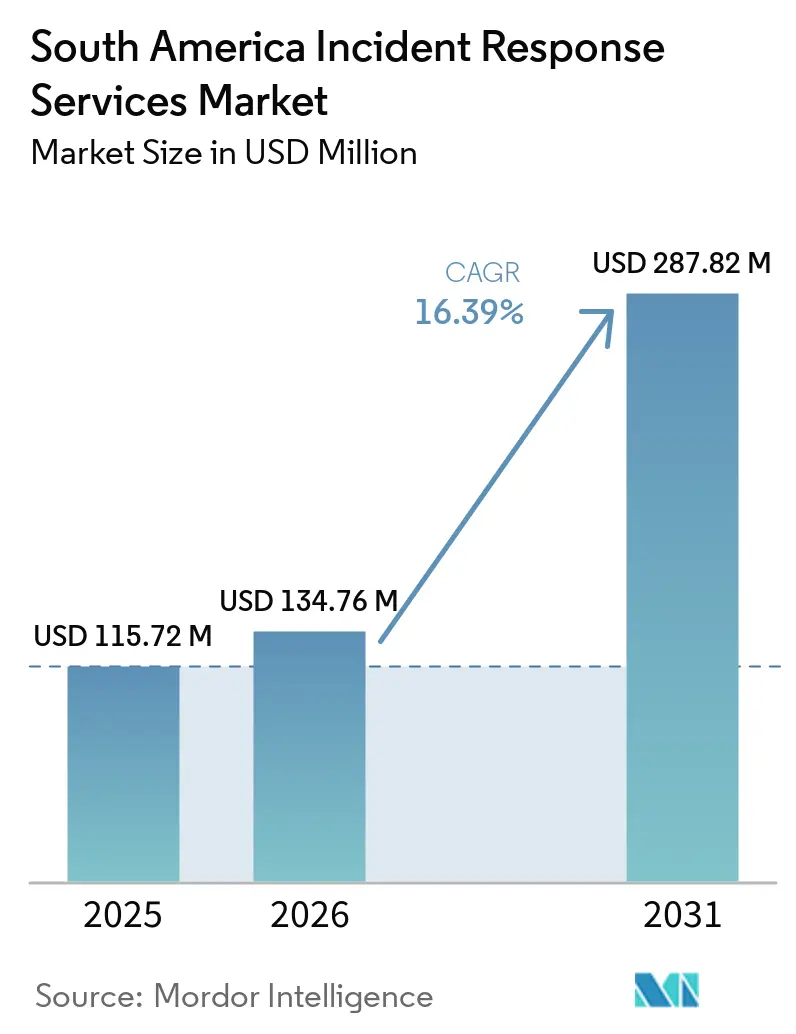
| Base Year Market Size (2025) | USD 115.72 Million |
| Market Size (2026) | USD 134.76 Million |
| Market Size (2031) | USD 287.82 Million |
| Growth Rate (2026 - 2031) | 16.39 % |
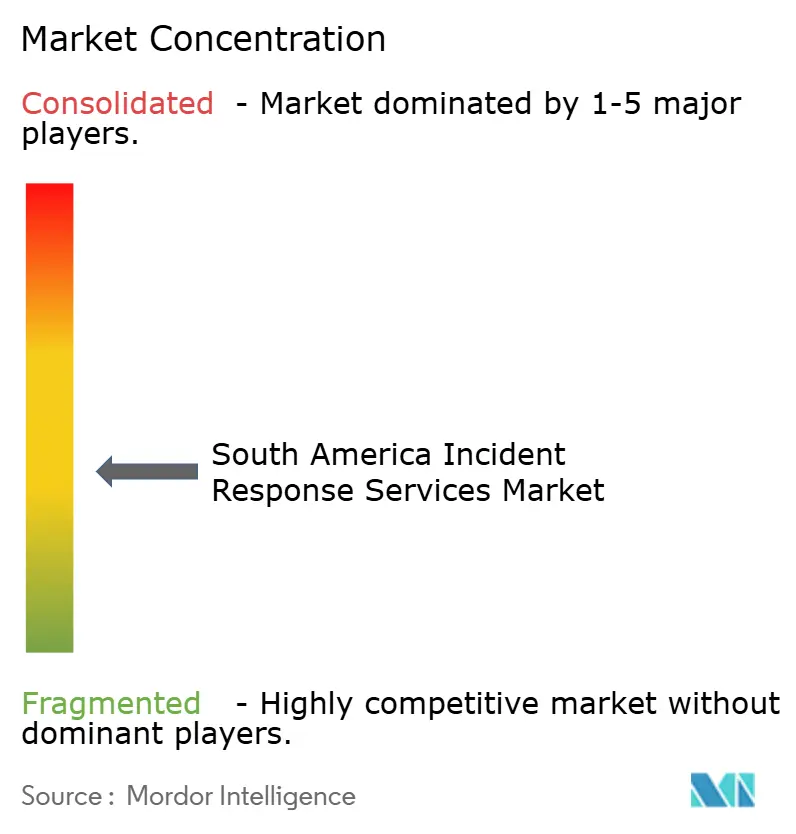
| Market Concentration | Medium |
Major Players *Disclaimer: Major Players sorted in no particular order Image © Mordor Intelligence. Reuse requires attribution under CC BY 4.0. | |
South America Incident Response Services Market Analysis by Mordor Intelligence
The South America incident response services market size was valued at USD 115.72 million in 2025 and estimated to expand from USD 134.76 million in 2026 to reach USD 287.82 million by 2031, at a CAGR of 16.39% during the forecast period (2026-2031). The South America incident response services market is supported by more frequent ransomware events, business email compromise, and data breaches across critical sectors. Breach reporting rules in Brazil are making timely investigation, containment, and notification more important for regulated organizations. Cloud migration is adding operational complexity because companies must investigate activity across on-premises and cloud environments. Buyers are also shifting toward providers that can support continuous monitoring and rapid response when internal security teams lack specialist capacity. These conditions favor firms that combine local regulatory knowledge with scalable technical delivery.
Key Report Takeaways
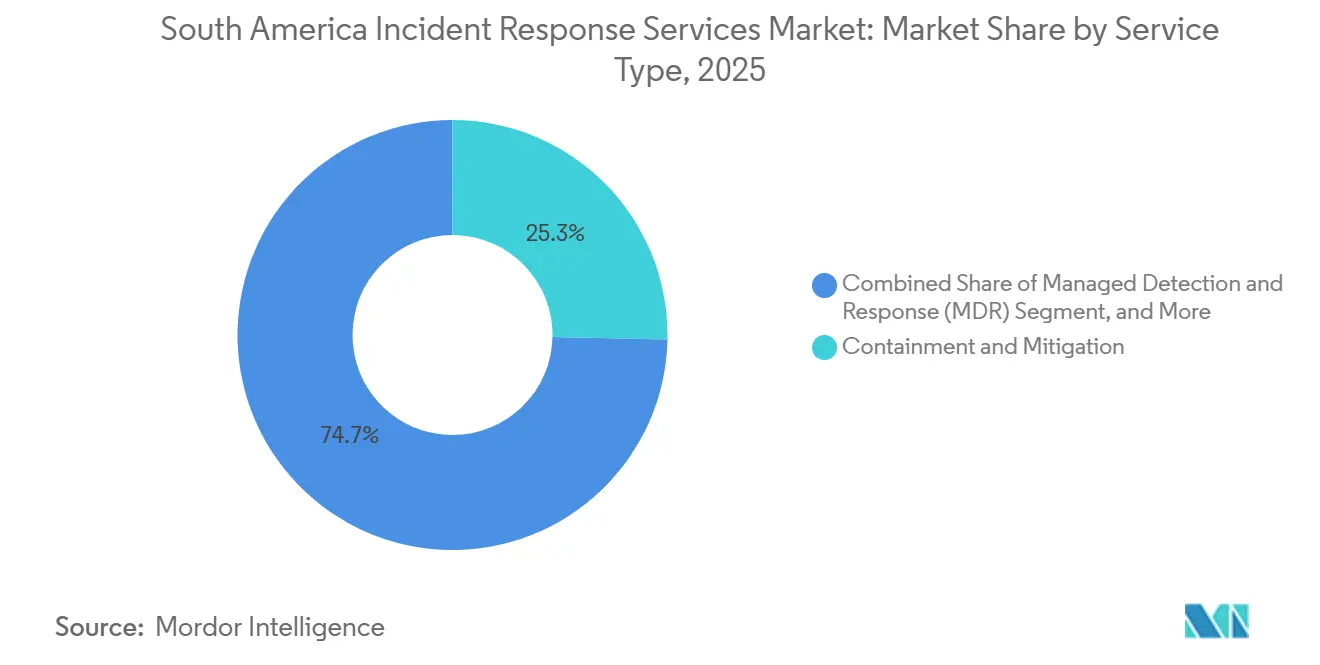
- By service type, Containment and Mitigation held 25.33% of the South America incident response services market share in 2025, while Managed Detection and Response is projected to expand at a 16.88% CAGR through 2031.
- By deployment mode, On-Premises held 40.49% of revenue in 2025, while Cloud-Based deployment is projected to expand at a 16.92% CAGR through 2031.
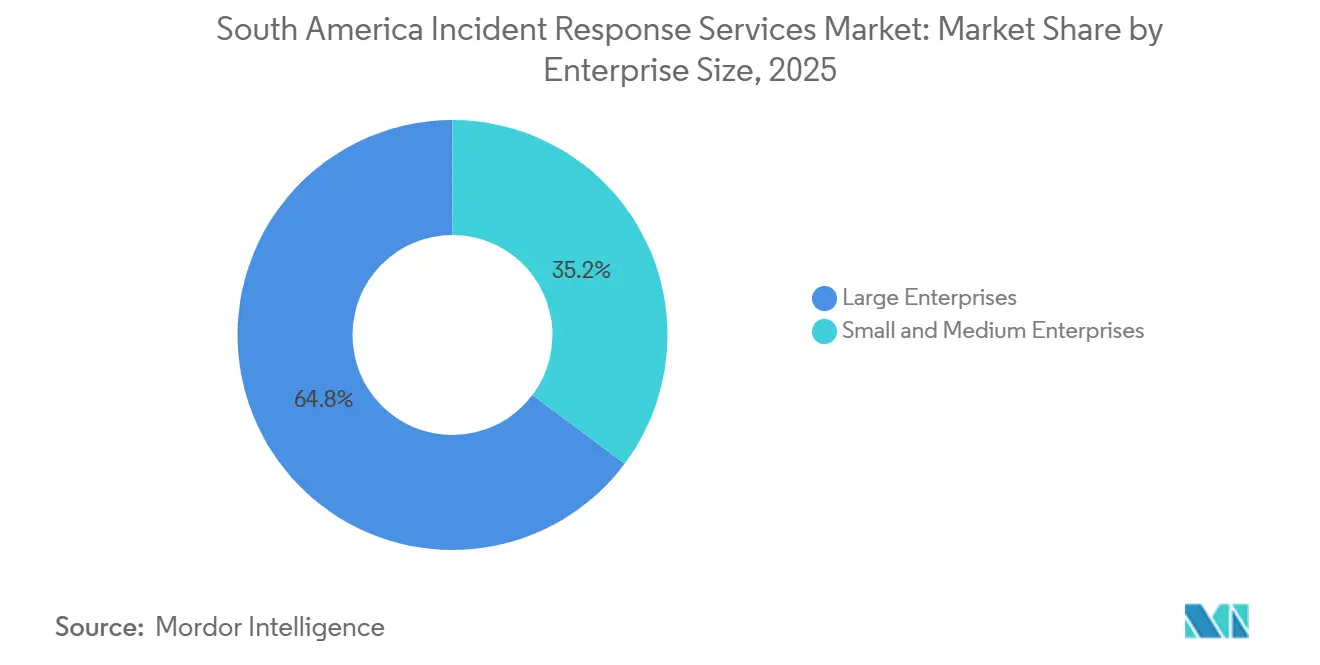
- By enterprise size, Large Enterprises accounted for 64.77% of revenue in 2025, while Small and Medium Enterprises are projected to expand at a 17.12% CAGR through 2031.
- By end-user industry, BFSI held 22.63% of revenue in 2025, while Healthcare and Life Sciences is projected to expand at a 17.16% CAGR through 2031.
- By geography, Brazil accounted for 41.37% of revenue in 2025, while Argentina is projected to expand at a 17.22% CAGR through 2031.
Note: Market size and forecast figures in this report are generated using Mordor Intelligence’s proprietary estimation framework, updated with the latest available data and insights as of January 2026.
Market Trends and Insights
Drivers Impact Analysis of South America Incident Response Services Market*
| Driver | (~) % Impact on CAGR Forecast | Geographic Relevance | Impact Timeline |
|---|---|---|---|
| Escalating Ransomware, Business Email Compromise, and Data Breach Exposure | +4.8% | Brazil, Argentina, Rest of South America | Short term (≤ 2 years) |
| Mandatory Incident Reporting and Privacy Enforcement | +3.5% | Brazil, Argentina, Rest of South America | Medium term (2-4 years) |
| Cloud Migration and Hybrid-Environment Complexity | +2.9% | Brazil, Argentina, Chile, Colombia | Medium term (2-4 years) |
| Cybersecurity Skills Shortages and 24/7 Monitoring Requirements | +2.2% | Brazil, Argentina, Rest of South America | Long term (≥ 4 years) |
| Concentration of Digital Commerce and Financial Services in Brazil | +1.5% | Brazil, with spillover to Argentina | Short term (≤ 2 years) |
| Evidence-Grade Response for Cross-Border Investigations | +0.9% | Brazil-Argentina corridor, wider South America | Long term (≥ 4 years) |
| Source: Mordor Intelligence | |||
Escalating Ransomware, Business Email Compromise, and Data Breach Exposure
South America faced sustained ransomware pressure in 2025, which increased demand for rapid technical containment. Kaspersky reported that a significant share of organizations in the region experienced ransomware attacks in 2025, with Brazil representing a major source of regional exposure. CrowdStrike stated that AI-enabled cyberattacks in Brazil increased substantially during the first half of 2026. The disclosure linked generative AI to credible Portuguese-language social engineering campaigns that can be carried out at scale. CrowdStrike reported that a substantial share of exploited vulnerabilities in 2025 involved zero-day attacks. Its report also found that cloud intrusions increased significantly during 2025, making the South America incident response services market more dependent on specialized forensic and containment capabilities. [1]
Mandatory Incident Reporting and Privacy Enforcement
Brazil's ANPD Resolution CD/ANPD No. 15 requires controllers to notify the authority and affected individuals within 3 business days after confirming a security incident. The rule places a defined operating deadline around investigation, evidence collection, customer communication, and documented decisions by the affected organization. It also turns incident response into a compliance issue rather than a discretionary security service that can be postponed after a serious event occurs. Organizations that cannot document an incident quickly must rely on internal teams or external providers with established workflows. Argentina introduced a parallel policy direction through Decree 941/2025, which established its National Cybersecurity Centre and became operational in January 2026. A May 2026 executive decree also required public administration bodies to document incident response plans within 180 days.[2]
Cloud Migration and Hybrid-Environment Complexity
Most organizations in South America's major economies had reached advanced cloud adoption stages in 2025. Surveyed cloud adopters identified cybersecurity as the critical challenge. This gap matters because an investigation can involve cloud identities, applications, endpoints, legacy systems, and third-party connections at the same time. Cisco found that only a small share of Brazilian companies had reached mature cloud security readiness in 2025. Brazil's data-residency obligations and central bank requirements add local control expectations for regulated organizations. CrowdStrike recorded a substantial increase in nation-state cloud targeting during 2025, which reinforces the need for multicloud forensic capability in the South America incident response services market.[3]
Cybersecurity Skills Shortages and 24/7 Monitoring Requirements
Brazil faces a significant shortage of qualified information security professionals, which limits the depth of in-house response teams. The constraint is particularly difficult for organizations that need monitoring outside normal business hours. Cisco found that a substantial share of Brazilian respondents viewed the shortage of qualified professionals as a major challenge. The report also indicated that many respondents had numerous unfilled positions. Providers must still compete for the same experienced analysts, especially those who can operate in Portuguese and interpret current threat intelligence during critical incidents. The gap, therefore, supports outsourced monitoring while also limiting the pace at which local delivery capacity can expand.
Restraints Impact Analysis of South America Incident Response Services Market*
| Restraint | (~) % Impact on CAGR Forecast | Geographic Relevance | Impact Timeline |
|---|---|---|---|
| Shortage of Specialized Incident Responders | -2.0% | Brazil, Argentina, Rest of South America | Long term (≥ 4 years) |
| Budget Constraints Among SMEs | -1.6% | Brazil, Argentina, Rest of South America | Medium term (2-4 years) |
| Fragmented Regulatory and Notification Requirements | -1.1% | Brazil-Argentina corridor, Chile, Colombia, Peru | Long term (≥ 4 years) |
| Cross-Border Data Transfer and Evidence-Localization Friction | -0.8% | Brazil-Argentina corridor, wider South America | Long term (≥ 4 years) |
| Source: Mordor Intelligence | |||
Shortage of Specialized Incident Responders
The shortage that encourages external service use also restricts provider staffing. Brazil's significant shortage of qualified cybersecurity professionals makes it difficult to scale local incident response teams quickly. Providers can import expertise, but this raises cost and operational complexity. They can also build training pipelines, although these programs take time to produce experienced responders. The gap is most visible in managed detection and response, where analysts need current threat intelligence and Portuguese-language capabilities. Limited availability can reduce responsiveness and coverage for firms serving Brazil's mid-market.
Budget Constraints Among SMEs
Small and medium enterprises face a difficult tradeoff between recurring preparedness costs and potentially severe recovery costs. Brazil had a large number of active businesses in mid-2024, most of which were micro or small enterprises. Many smaller firms have limited security staffing and cannot fund enterprise-style retainers that cover continuous monitoring, detailed analysis, and specialized forensic work. This keeps a portion of demand reactive, even when firms fall within LGPD obligations and face similar notification expectations after a material incident. Subscription-based packaging can lower the initial cost for these buyers. The South America incident response services market, therefore, depends on providers matching service scope and pricing to smaller organizations
*Our forecasts treat driver/restraint impacts as directional, not additive. The impact forecasts reflect baseline growth, mix effects, and variable interactions.
South America Incident Response Services Market Segment Analysis
By Service Type:
Containment Leads Demand, While MDR Supports Future ExpansionContainment and Mitigation held 25.33% of the South America incident response services market share in 2025. This service addresses immediate network isolation, credential changes, and interruption of lateral movement after a breach affects business operations. Its leading position reflects the operational need to stop active ransomware events quickly. Financial institutions require this capability because payment-system incidents can affect several organizations at once and require coordinated technical decisions. The June 2025 C&M Software breach disrupted 6 financial institutions and raised the need for coordinated response arrangements. Remediation and Recovery supports restoration and hardening after the immediate event. Digital Forensics and Analytics helps organizations prepare evidence and meet notification requirements. Other service types include readiness work, tabletop exercises, threat hunting, and advisory retainers that help clients prepare before an incident is confirmed.
Managed Detection and Response is projected to expand at a 16.88% CAGR through 2031. The service combines continuous monitoring with an organized response process that can assess alerts before an intrusion spreads across connected systems. CrowdStrike reported that average breakout time fell to 29 minutes in 2025. One confirmed intrusion was completed in 27 seconds. These timelines leave little room for a response model that depends only on manual escalation, disconnected tools, and limited out-of-hours staffing. Buyers are placing more weight on stable providers and transparent service-level agreements that define responsibility, escalation, and response expectations. That preference indicates a move toward defined response outcomes. MDR is therefore central to the South America incident response services market as response windows become shorter.

By Deployment Mode:
On-Premises Remains Established, While Cloud-Based Delivery ExpandsOn-Premises deployment held 40.49% of the South America incident response services market size in 2025. Financial institutions often prefer dedicated infrastructure with verifiable tenant isolation, particularly where transaction data and investigation records require close control. Government entities also retain legacy environments where cloud migration is limited by security classifications. Brazil's LGPD rules and Banco Central expectations reinforce this preference in regulated activities. The model gives organizations closer control over incident data and investigation records. It can also support internal requirements around data location, system access, and the retention of evidence during a formal investigation. Hybrid deployment serves organizations that manage cloud and on-premises exposures together. These mixed environments require responders to connect evidence across different systems.
Cloud-Based deployment is projected to expand at a 16.92% CAGR through 2031. Capacity additions in São Paulo have helped organizations address local data-residency needs while supporting workloads that require lower-latency operational access. Cloud delivery can also support consumption-based commercial arrangements. This is relevant in an environment where buyers seek lower upfront commitments and more flexibility when incident volumes change. However, cloud security readiness did not keep pace with workload migration in Brazil during 2025. Cisco's readiness findings show why organizations may depend on outside response capability. Providers must investigate activity across cloud workloads without weakening local control requirements. This makes cloud-based delivery an important route into the South America incident response services market.
By Enterprise Size:
Large Enterprises Sustain Revenue, While SMEs Add New DemandLarge Enterprises accounted for 64.77% of 2025 revenue. These buyers face broader attack surfaces and greater regulatory exposure than smaller firms, including more users, systems, suppliers, and sensitive records. They also have the budgets needed for multiyear incident response retainers. BFSI, government, and healthcare account for a large portion of contracted work. Brazilian financial institutions faced repeated attacks involving payment infrastructure during 2025 and 2026. This has made incident response a continuing operating requirement for many institutions. Large organizations also need providers that can coordinate legal, technical, and communications work during incidents that involve regulated operations and affected customers. Their purchasing behavior supports a stable base for the South America incident response services market.
Small and Medium Enterprises are projected to expand at a 17.12% CAGR through 2031. Digital commerce and LGPD obligations are extending security needs to smaller firms. Brazil's business base provides a large potential customer pool for service providers that can offer simpler contracts and accessible technical support. Many of these firms cannot absorb the capital cost of internal response infrastructure. Managed security models can reduce cybersecurity spending by up to 25%, according to an IDC study commissioned by IBM. Subscription offerings can therefore make response services more accessible. Providers still need to offer clear scopes that suit smaller budgets while setting realistic expectations for monitoring, containment, and post-incident recovery. The segment's progress will depend on packaging that balances affordability with adequate response coverage.
By End-User Industry:
BFSI Leads Current Spending, While Healthcare and Life Sciences AcceleratesBFSI held 22.63% of end-user revenue in 2025. The sector has continuous monitoring obligations and is a frequent target for payment-related attacks involving critical transaction systems and customer information. Brazil's Central Bank reported a significant number of relevant cybersecurity incidents among financial institutions, marking a notable increase from the previous year. CrowdStrike also identified intrusions into Brazilian financial institutions during the study period. Government and Defense, IT and Telecom, Industrial Manufacturing, Energy and Utilities, and Retail and E-Commerce represent the remaining demand base. Government and Defense gained importance following confirmed attacks on Brazilian civil defense systems, which highlighted the response needs of public institutions. The South America incident response services market size for BFSI is supported by the need for continuous readiness.
Healthcare and Life Sciences are projected to expand at a 17.16% CAGR through 2031. Health information has a sensitive status under the LGPD, which raises the consequences of a breach for patients, providers, and organizations handling clinical records. Brazilian healthcare organizations experienced cyberattacks at a rate well above the global healthcare benchmark in 2025. A MedicSolution incident exposed a substantial volume of patient files. A subsequent attack on ISAC leaked data from a large number of patients and triggered an ANPD investigation. These events increase the value of pre-contracted investigation and notification support, especially when care delivery and large patient datasets are affected. Providers must help healthcare organizations preserve evidence while limiting service disruption.
Geography Analysis
Brazil Incident Response Services Market
Brazil accounted for 41.37% of regional revenue in 2025, making it the region's largest demand center for the South America incident response services market. Its digital financial services are widely used and heavily targeted, which increases the need for ongoing preparation and coordinated response. Kaspersky recorded a substantial volume of ransomware attempts in Brazil during 2025, while Pix reported multiple official data breach disclosures during the first part of 2026. Brazil also has the region's most developed compliance framework, where ANPD Resolution CD/ANPD No. 15 and Banco Central requirements shape security practices in financial services. These requirements make evidence collection, notification, and technical containment important parts of a service engagement.
Argentina Incident Response Services Market
Argentina is projected to expand at a 17.22% CAGR through 2031, starting from a lower 2025 base relative to its digital economy and threat exposure. Its National Cybersecurity Center became operational under a national decree, and a subsequent decree required public bodies to document incident response plans within a specified timeframe. Central Bank communication and securities commission regulations added cybersecurity expectations for financial organizations, creating a government procurement cycle with defined compliance deadlines. The Oldelval ransomware event and a campaign affecting multiple government entities demonstrated that threats extend across critical infrastructure and public agencies. Regional providers can use common delivery processes where Brazilian and Argentine financial requirements align.
Andean South America Incident Response Services Market
The Rest of South America includes Chile, Colombia, Peru, and Ecuador, and it represents a fragmented but expanding part of the South America incident response services market. Chile and Colombia recorded high volumes of ransomware attempts, while their governments advanced cybersecurity strategies for critical infrastructure and financial operators. Argentina's ratification of the Budapest Convention provides a framework for cross-border digital evidence cooperation. The Inter-American Development Bank identified incident response as a priority investment area for Organization of American States member countries, supporting public procurement and preparedness across smaller economies.
Competitive Landscape
The South America incident response services market has a global platform tier and a more fragmented local tier. IBM, CrowdStrike, Cisco, Palo Alto Networks, Deloitte, KPMG, Ernst and Young, and Accenture compete in the premium segment through offerings that combine threat intelligence, detection, forensic analysis, and managed response. Larger buyers often value this breadth because incidents can involve many systems, business functions, regulators, and affected customers. IBM and Palo Alto Networks published research in January 2025 that identified platform consolidation as a way to reduce cybersecurity complexity. This approach positions integrated response services as a way to simplify security operations.
CrowdStrike expanded its collaboration with IBM in March 2026, integrating Charlotte AI with IBM's Autonomous Threat Operations Machine, or ATOM. The arrangement supports machine-speed investigation and containment within managed threat detection and response, showing how platform providers are extending capabilities through alliances. Cisco and Palo Alto Networks also benefit from integrated technology portfolios and established enterprise relationships. These firms can position incident response alongside broader security programs for clients with complex operating environments. Their scale can make it harder for point-solution providers to compete for complex enterprise work.
Strongit Tecnologia Ltda. and STW Brasil Tecnologia Ltda. compete through LGPD knowledge, Portuguese-language support, and proximity to local clients. Strongit extends its MDR offering beyond alert delivery into threat hunting and containment, which can be relevant for SMEs and government bodies with data-sovereignty requirements. Healthcare and SME customers remain difficult to serve at scale because they need simpler pricing and suitable service packages. The South America incident response services market has room for providers that can combine local delivery with standards-based cloud operations and consumption-priced, LGPD-compliant MDR.
South America Incident Response Services Industry Leaders
-
IBM Corporation
-
Cisco Systems, Inc.
-
Deloitte Touche Tohmatsu Limited
-
KPMG International Cooperative
-
CrowdStrike Holdings, Inc.
- *Disclaimer: Major Players sorted in no particular order
South America Incident Response Services Market Companies Covered in this Report
- IBM Corporation
- Cisco Systems, Inc.
- Deloitte Touche Tohmatsu Limited
- KPMG International Cooperative
- CrowdStrike Holdings, Inc.
- Ernst & Young Global Limited
- Broadcom Inc.
- SentinelOne, Inc.
- LogRhythm, Inc.
- Check Point Software Technologies Ltd.
- Optiv Security Inc.
- Aon plc
- Fortinet, Inc.
- Palo Alto Networks, Inc.
- Rapid7, Inc.
- Secureworks Corp.
- Trustwave Holdings, Inc.
- Accenture plc
- STW Brasil Tecnologia Ltda.
- Stronit Tecnologia Ltda.
- KRYPTUS Seguranca da Informacao S.A.
Recent Industry Developments in South America Incident Response Services Market
- August 2026: CrowdStrike's vice president for South America confirmed in Folha de São Paulo on August 9, 2026, that AI-enabled cyberattacks in Brazil increased 89% in the first half of 2026 compared with the same period in 2025. Brazil recorded 123 ransomware incidents through midyear, and HOLLOW PANDA conducted confirmed intrusions into Brazilian financial institutions.
- May 2026: Brazil's Central Bank issued the 4th official Pix data breach communication of 2026. The incident involved Credifit Sociedade de Crédito Direto, where data linked to 46 Pix keys was compromised because of internal system failures.
- March 2026: CrowdStrike and IBM announced an expanded collaboration that integrated Charlotte AI with IBM's Autonomous Threat Operations Machine for machine-speed investigation and containment. The arrangement extended managed Threat Detection and Response globally, including South America.
- March 2026: BTG Pactual activated incident response protocols on March 22, 2026, following a cyberattack that diverted BRL 100 million (USD 18.2 million) from the bank's Pix reserve account. The bank recovered BRL 73 million (USD 13.3 million) and restored Pix operations within 24 hours through coordinated response with Banco Central do Brasil.
South America Incident Response Services Market Report Scope
South America Video Surveillance Market refers to the ecosystem of hardware, software, and services used to capture, transmit, store, and analyze video footage for security, safety, and operational monitoring across the region. It includes analog, IP, and hybrid cameras; DVRs, NVRs, and storage; video management software; video analytics; monitors; and related infrastructure and services.
The South America Incident Response Services Market Report is Segmented by Service Type (Containment and Mitigation, Remediation and Recovery, Digital Forensics and Analytics, and Managed Detection and Response (MDR), and Other Service Types), Deployment Mode (On-Premises, Cloud-Based, and Hybrid), Enterprise Size (Small and Medium Enterprises, and Large Enterprises), End-User Industry (BFSI, Government and Defense, IT and Telecom, Healthcare and Life Sciences, Industrial, Manufacturing, Energy and Utilities, Retail and E-Commerce, and Other End-User Industries), and Geography (Brazil, Argentina, and Rest of South America). The Market Forecasts are Provided in Terms of Value (USD).
Segmentation Overview
| Containment and Mitigation |
| Remediation and Recovery |
| Digital Forensics and Analytics |
| Managed Detection and Response (MDR) |
| Other Service Types |
| On-Premises |
| Cloud-Based |
| Hybrid |
| Small and Medium Enterprises |
| Large Enterprises |
| BFSI |
| Government and Defense |
| IT and Telecom |
| Healthcare and Life Sciences |
| Industrial Manufacturing |
| Energy and Utilities |
| Retail and E-Commerce |
| Other End-User Industries |
| Brazil |
| Argentina |
| Rest of South America |
| By Service Type | Containment and Mitigation |
| Remediation and Recovery | |
| Digital Forensics and Analytics | |
| Managed Detection and Response (MDR) | |
| Other Service Types | |
| By Deployment Mode | On-Premises |
| Cloud-Based | |
| Hybrid | |
| By Enterprise Size | Small and Medium Enterprises |
| Large Enterprises | |
| By End-User Industry | BFSI |
| Government and Defense | |
| IT and Telecom | |
| Healthcare and Life Sciences | |
| Industrial Manufacturing | |
| Energy and Utilities | |
| Retail and E-Commerce | |
| Other End-User Industries | |
| By Geography | Brazil |
| Argentina | |
| Rest of South America |
Key Questions Answered in the Report
What is the size of the South America incident response services market?
The market was valued at USD 115.72 million in 2025 and is estimated at USD 134.76 million in 2026. It is forecast to reach USD 287.82 million by 2031 at a 16.39% CAGR. These figures cover incident response services across the defined service, deployment, enterprise, end-user, and geographic categories in the South America incident response services market.
What is driving demand for incident response services in South America?
Ransomware exposure, breach reporting rules, cloud complexity, and limited specialist staffing are increasing the need for external response support. These factors require organizations to contain an event, collect reliable evidence, restore operations, and meet notification deadlines without delay.
Which service type leads demand in South America?
Containment and Mitigation led with 25.33% of revenue in 2025 because organizations need immediate support during active incidents. The service is used for network isolation, credential changes, and interruption of lateral movement before an attack causes further disruption.
Which deployment model is expanding fastest?
Cloud-Based deployment is projected to expand at a 16.92% CAGR through 2031 as organizations need support across expanding cloud workloads. This model can support consumption-based arrangements, although providers must still meet data-residency and investigation requirements.
Which customer group has the strongest forecast expansion?
Small and Medium Enterprises are projected to expand at a 17.12% CAGR through 2031 as subscription-based offerings lower access barriers. Their adoption will depend on service packages that provide meaningful monitoring and response coverage within constrained security budgets.
Which country has the highest forecast expansion?
Argentina is projected to expand at a 17.22% CAGR through 2031, supported by new government response planning requirements and financial-sector rules. The National Cybersecurity Centre and documented response-plan requirement provide defined operational and procurement drivers for public organizations.