
South America Fitness Ring Market Size and Share
Market Overview
| Study Period | 2018 - 2031 |
|---|---|
| Forecast Data Period | 2026 - 2031 |
| Base Year Market Size (2025) | USD 33.19 Million |
| Market Size (2026) | USD 35.21 Million |
| Market Size (2031) | USD 47.66 Million |
| Growth Rate (2026 - 2031) | 6.24 % |
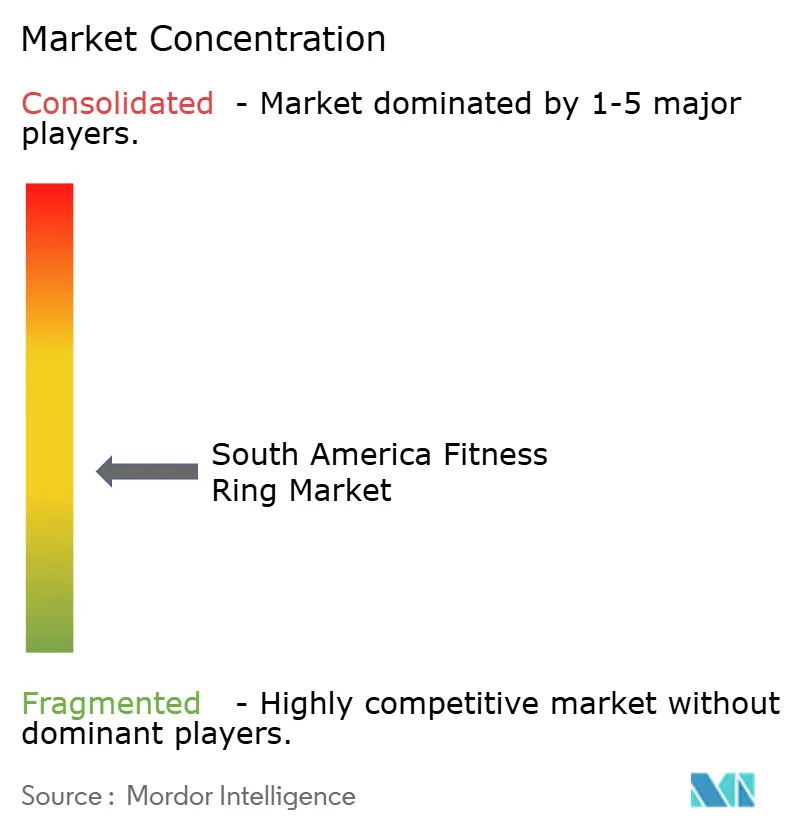
| Market Concentration | Medium |
Major Players *Disclaimer: Major Players sorted in no particular order Image © Mordor Intelligence. Reuse requires attribution under CC BY 4.0. | |
South America Fitness Ring Market Analysis by Mordor Intelligence
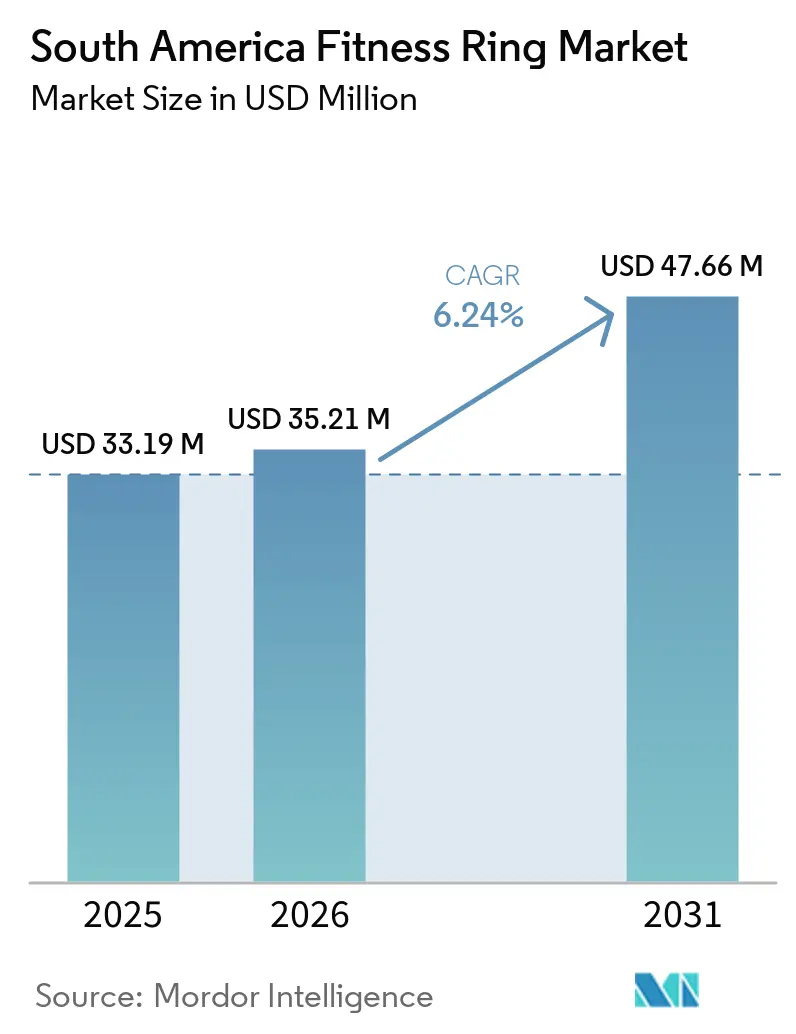
The South America fitness ring market size was valued at USD 33.19 million in 2025 and is estimated to expand from USD 35.21 million in 2026 to reach USD 47.66 million by 2031, at a CAGR of 6.24% during the forecast period (2026-2031). Demand is moving toward rings that support continuous monitoring of sleep, recovery, heart rate, and other health measures. Brazil provides the region's broadest base of connected consumers and the strongest retail presence for established wearable brands. Corporate wellness programs are creating an additional route to adoption as employers seek measurable ways to support employee well-being. Payment-enabled products also give banks and payment providers a reason to distribute rings through their own customer platforms. The South America fitness ring market is therefore shaped by the interaction among consumer wellness demand, mobile connectivity, retail access, and participation in the payment ecosystem.
Key Report Takeaways
- By product type, smart fitness rings held 67.58% share of the South America fitness ring market in 2025 and are projected to expand at a 7.98% CAGR through 2031.
- By technology, Bluetooth-enabled rings held 71.95% of the segment in 2025, while NFC-enabled rings are projected to expand at a 7.78% CAGR through 2031.
- By application, health and wellness monitoring accounted for 63.88% share of the South America fitness ring market in 2025, while contactless payments are projected to expand at a 7.73% CAGR through 2031.
- By distribution channel, online retail held 64.62% share of the South America fitness ring market in 2025, while offline retail is projected to expand at a 7.83% CAGR through 2031.
- By end user, individual consumers held 57.84% of the segment in 2025, while corporate wellness programs are projected to expand at a 7.43% CAGR through 2031.
- By country, Brazil held 61.00% of the South America fitness ring market in 2025 and is projected to expand at a 7.05% CAGR through 2031.
Note: Market size and forecast figures in this report are generated using Mordor Intelligence’s proprietary estimation framework, updated with the latest available data and insights as of January 2026.
South America Fitness Ring Market Trends and Insights
Drivers Impact Analysis*
| Driver | (~) % Impact on CAGR Forecast | Geographic Relevance | Impact Timeline |
|---|---|---|---|
| Brazil-Led Smart Ring Retail Availability | +1.8% | Brazil, with spillover to Chile and Colombia | Short term (≤ 2 years) |
| Fitness, Recovery, and Sleep-Tracking Use Cases | +1.5% | Brazil, Argentina, and Chile | Medium term (2-4 years) |
| Smartphone and Digital-Health Ecosystem Compatibility | +1.2% | Brazil and regional markets | Medium term (2-4 years) |
| Corporate Wellness and Sports-Performance Pilots | +0.9% | Brazil, Colombia, and Chile | Medium term (2-4 years) |
| Local-Language Health Coaching and Data Interpretation | +0.6% | Brazil, Argentina, Colombia, and Chile | Long term (≥ 4 years) |
| Brazil-to-Andean Omnichannel Retail Replication | +0.5% | Chile, Colombia, and Peru | Long term (≥ 4 years) |
| Source: Mordor Intelligence | |||
Brazil-Led Smart Ring Retail Availability
Brazil's retail rollout has created the clearest commercial entry point for the South America fitness ring market because it combines established electronics stores, direct digital channels, and a consumer base familiar with connected devices. Premium devices have reached consumers through authorized stores and direct online channels, giving buyers a choice in how they assess fit, compare product functions, understand setup requirements, and purchase a new category. Samsung's Galaxy Ring availability in Brazil established a mainstream reference point for smart ring retail in the region. Formal product approval requirements also favor brands that can support compliant listings, authentic products, warranty coverage, and after-sales service rather than relying on uncertain gray-market supply. Inter introduced the Inter Ring through its Super App in June 2026, linking passive NFC payments, account-based services, airport lounge access, and compatible smart-lock authentication in a lower-priced format. This model provides retailers in Chile, Colombia, and Peru with a practical example of how ring distribution can extend beyond conventional consumer electronics channels while preserving existing customer relationships through a banking platform.
Fitness, Recovery, and Sleep-Tracking Use Cases
Fitness rings are increasingly assessed on their ability to support continuous health and recovery tracking rather than simple activity counts, which changes what consumers expect from the device and its companion application. This change supports demand for products that combine sleep data, heart rate measurements, readiness information, and longer-term health patterns into a single discreet device that can remain in use throughout work, rest, and exercise. The category's value proposition is strongest for users who want monitoring during work, rest, and exercise without wearing a watch or actively recording each activity. RingConn introduced Gen 3 in May 2026 with vascular health insights, vibration alerts, and sleep apnea pattern detection, demonstrating the continuing addition of health-focused functions. These capabilities support the South America fitness ring market by enabling consumers to connect recovery measures to everyday fitness routines, sleep habits, and personal decisions about training intensity. They also give corporate wellness buyers a clearer reason to consider rings as part of an employee health offering, especially when participation is voluntary and individual information remains under the employee's control.
Smartphone and Digital-Health Ecosystem Compatibility
A fitness ring has greater practical value when its companion app works with the health platforms already used on a person's smartphone, avoiding the need for separate behavior or a second set of health records. Bluetooth-enabled products can maintain a regular connection to mobile applications, allowing health data to flow into dashboards with minimal user effort and limited disruption to routine. Brazil's 74.9 million internet-connected households in 2025 provide a large base for connected device use, app downloads, and ongoing data synchronization.[1] Compatibility with Android health platforms is particularly relevant in Brazil, Colombia, and Argentina because it can broaden the set of users who can connect a ring to an existing device without switching their mobile ecosystem. The South America fitness ring market can also benefit from Portuguese and Spanish health guidance that makes app outputs easier to use, understand, and apply to daily choices. Local-language coaching can make recovery and sleep information more accessible to users who do not engage with English-only interfaces or who find technical health dashboards difficult to interpret.
Corporate Wellness and Sports-Performance Pilots
Corporate wellness spending is providing an institutional path for rings alongside direct consumer sales, as employers can introduce voluntary wellness tools through existing benefits or health-support programs. Brazilian employers increased per-employee spending on wellness initiatives by 10.3% in 2025, excluding medical and dental plans. Brazil's NR-1 requirements place greater emphasis on the identification and management of psychosocial occupational risks, establishing a formal framework in which employers can consider measurable wellness support.[2] Rings can fit these programs because they offer an unobtrusive form factor, support personal wellness tracking, and do not require the visible use of a workplace-installed monitoring device. Sky Labs stated that its CART BP pro ring had been prescribed more than 250,000 times across 1,920 hospitals and clinics in South Korea.[3] That institutional example provides employers, healthcare providers, and sports organizations with a reference for the potential use of ring-based monitoring within structured programs, while reminding buyers that health use requires careful consent and data governance practices.
Restraints Impact Analysis*
| Restraint | (~) % Impact on CAGR Forecast | Geographic Relevance | Impact Timeline |
|---|---|---|---|
| Imported Product Prices and Currency Volatility | -1.6% | Brazil, Argentina, Colombia, Chile, and Peru | Short term (≤ 2 years) |
| Biometric Data Privacy and Cybersecurity Exposure | -1.1% | Brazil, with regional spillover | Medium term (2-4 years) |
| Local Sizing, Service, and Warranty Gaps | -0.8% | Brazil, Argentina, and the Rest of South America | Medium term (2-4 years) |
| Medical-Claim Ambiguity for Health Algorithms | -0.5% | Brazil, Chile, Colombia, and Argentina | Long term (≥ 4 years) |
| Source: Mordor Intelligence | |||
Imported Product Prices and Currency Volatility
Imported devices remain exposed to exchange-rate movements, duties, certification costs, logistics expenses, and retail margins, which can carry global production costs directly into local consumer prices. These factors can make premium rings harder to afford when local currencies weaken against the USD or EUR, particularly where buyers must pay a substantial upfront price for unfamiliar hardware. The issue is most pronounced in Argentina, where currency depreciation can quickly change the local price of imported consumer electronics and make replacement or upgrade decisions harder to justify. Entry-level products may therefore attract buyers who cannot justify the cost of advanced health-monitoring devices, although they may not offer the same depth of biometric tracking. The South America fitness ring market also faces a service challenge when a high-priced device does not meet user expectations, since an unfavorable first experience can delay future upgrades and weaken confidence in the category. Lower-cost NFC products can improve access and extend payment use cases, but they do not necessarily offer the full biometric functions, app features, or service support available in premium smart rings.
Biometric Data Privacy and Cybersecurity Exposure
Health and biometric data receive heightened protection under Brazil's LGPD, which classifies them as sensitive personal data and raises expectations for consent, data handling, and information security. The ANPD's 2025-2026 Regulatory Agenda signals continuing attention to the governance of personal data and emerging technologies, making privacy readiness important to connected-device suppliers. Privacy-aware consumers may postpone a purchase when they do not understand how a ring app collects, shares, retains, or interprets sensitive information drawn from sleep, stress, and health patterns. Employers also need a clear separation between employee wellness information and decisions concerning insurance, employment, performance, or any other workplace outcome. The South America fitness ring market will require transparent consent practices, limited data collection, reliable security controls, and understandable user notices to build trust across consumer and institutional channels. Stronger compliance processes may impose costs on suppliers, but they can also support more credible corporate and healthcare partnerships and reduce uncertainty for users considering a connected health product.
*Our forecasts treat driver/restraint impacts as directional, not additive. The impact forecasts reflect baseline growth, mix effects, and variable interactions.
Segment Analysis
By Product Type: Smart Rings Lead as Basic Devices Support Entry-Level Demand
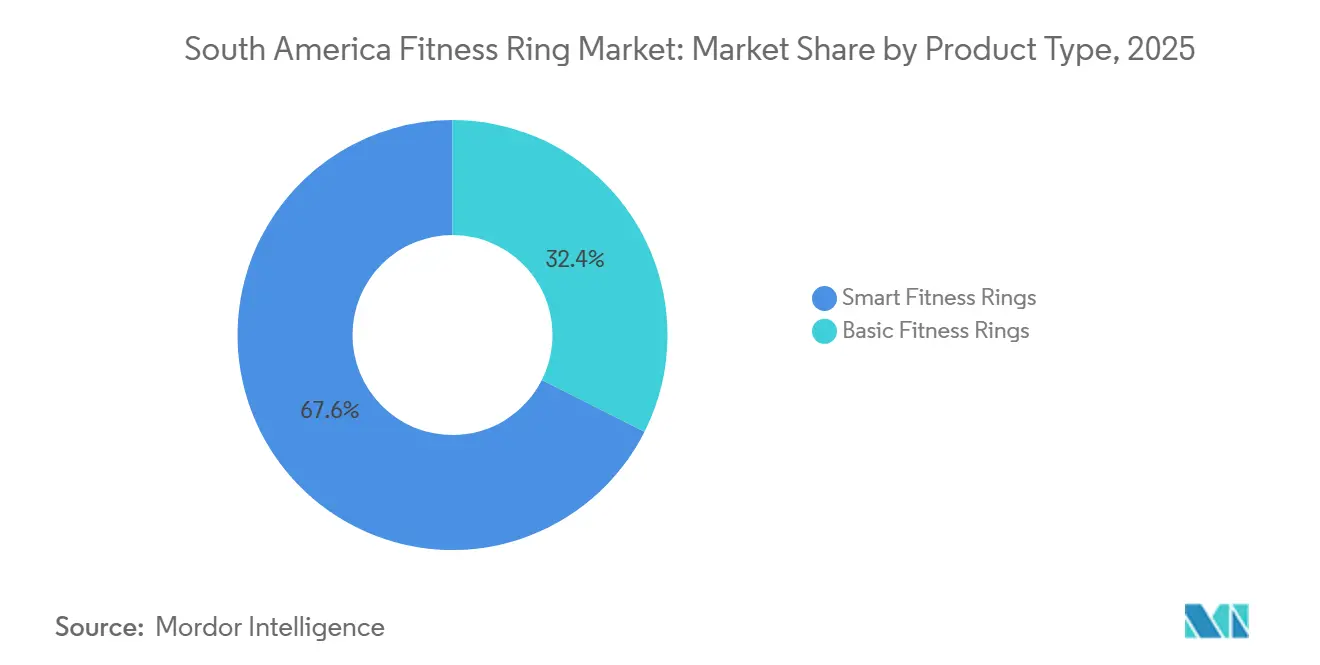
Smart fitness rings held 67.58% of the South America fitness ring market share by product type in 2025 and are projected to expand at a 7.98% CAGR through 2031. Their lead reflects the shift from simple activity tracking toward products that combine sleep, heart rate, blood oxygen, skin temperature, and recovery features. Consumers are placing more value on devices that collect multiple health metrics without changing their daily routines. Smart rings also give providers a stronger basis for subscription services, app-based guidance, and corporate wellness offerings. The higher specifications of these devices enhance their appeal to urban professionals and users who already own smartphones and other connected health products.
Basic fitness rings remain relevant where household budgets limit the purchase of premium hardware. They provide a lower-cost way for consumers to try ring-based tracking before considering a more advanced device. This role is important in Argentina and Peru, where imported products can become less affordable when exchange rates move sharply. Basic rings can therefore help broaden awareness of the category, even when they offer fewer measures than smart products. The South America fitness ring industry benefits from this two-tier structure because entry-level devices can introduce users to the form factor while smart rings provide a future upgrade path.
By Technology: Bluetooth Supports Monitoring While NFC Adds Payment Functions
Bluetooth-enabled rings held 71.95% of the technology segment in 2025, supported by their compatibility with smartphone-based health applications. Bluetooth Low Energy supports continuous data transfer without the battery demands associated with older connection standards. This makes Bluetooth useful for sleep, recovery, heart rate, and other monitoring functions that depend on regular synchronization with a companion app. Bluetooth is therefore the core technology for the health-monitoring use cases that currently shape most demand. It also enables users to view data through existing mobile health dashboards rather than a separate screen on the ring.
NFC-enabled rings are projected to expand at a 7.78% CAGR through 2031, making them the fastest technology category in the South America fitness ring market. NFC allows a passive ring to support payments, access control, and selected authentication functions after activation. Inter's June 2026 launch showed how a bank can distribute a payment ring through its own customer application. This approach can bring financial institutions into the ring ecosystem and reduce reliance on consumer electronics stores alone. Devices that combine Bluetooth health monitoring and NFC payment capabilities may command premium prices because they combine two distinct uses into a single product.
By Application: Health Monitoring Leads While Payments Offer Faster Expansion
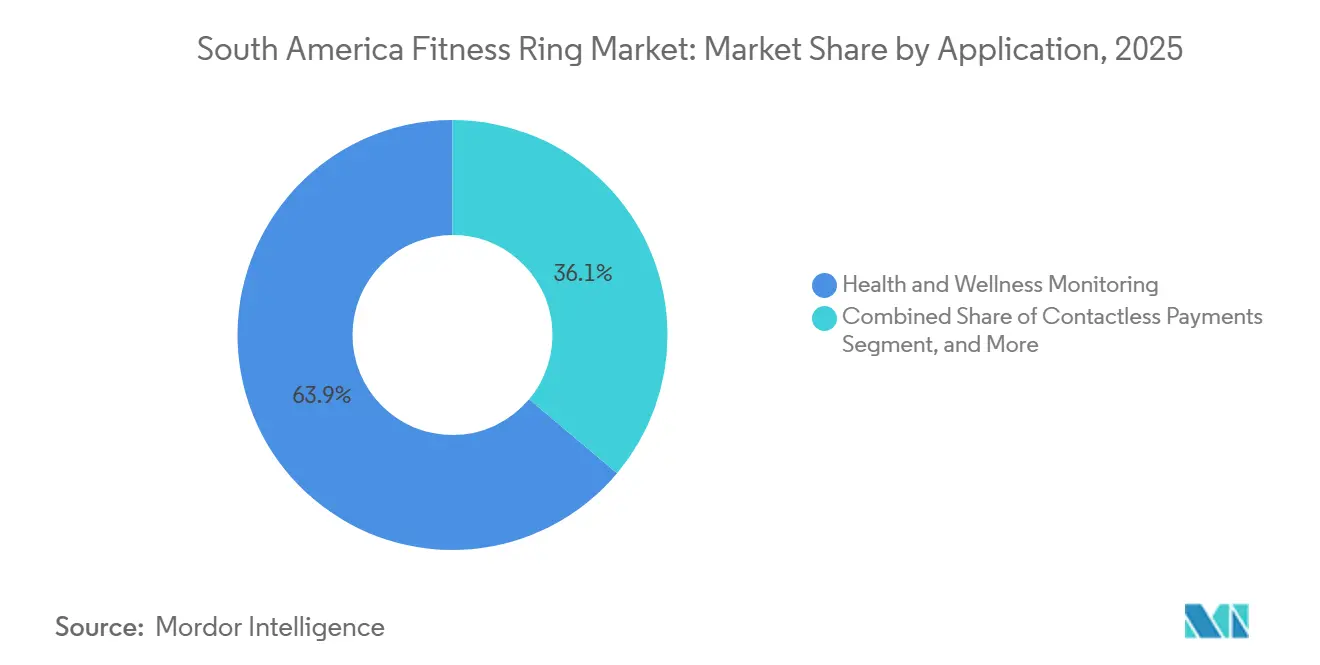
Health and wellness monitoring accounted for 63.88% share of the South America fitness ring market in 2025. Sleep scoring, recovery information, and passive heart rate tracking remain central reasons consumers use a ring. These functions suit users who want personal health monitoring available day and night. Health monitoring also aligns with the interests of gym users, wellness-focused professionals, and organizations considering employee health programs. The 2025 demand base for health and wellness monitoring remains anchored in these personal and institutional needs, rather than in one-time transactional functions.
Contactless payments are projected to expand at a 7.73% CAGR through 2031, the fastest application category. A ring used for payments can provide an additional reason to purchase the device, especially for customers who value a screen-free payment credential. Inter stated that its NFC Ring can operate independently of a smartphone after activation. Banking distribution can make payment rings visible to existing account holders without waiting for a hardware brand to build a large retail network. This channel could shorten the adoption curve for contactless payment rings in Brazil and serve as a model for other South American markets.

By Distribution Channel: Online Retail Leads While Stores Support Product Trial
Online retail accounted for 64.62% of the distribution channel segment in 2025, underscoring the importance of e-commerce for consumer electronics across Brazil and Chile. A single certified inventory hub can serve a broad customer base and help suppliers reach markets without extensive physical-store coverage. Brazil's large base of internet-connected households makes this approach particularly relevant. Online retail also gives buyers access to product details, compatibility information, and delivery options before committing to a premium device. These advantages make digital channels a practical starting point for brands entering the South America fitness ring market.
Offline retail is projected to expand at a 7.83% CAGR through 2031, outpacing online channels. Physical stores address issues that are difficult to resolve through product pages, including ring sizing, material feel, and a live view of the companion application. Buyers may be more comfortable making a higher-value purchase after trying the product in person. Authorized retail also provides a visible setting for explaining setup, warranty, and service terms. The South America fitness ring industry can therefore benefit from an omnichannel model in which stores support first purchase decisions and online channels support broader reach and later purchases.
By End User: Individual Consumers Lead While Corporate Programs Gain Momentum
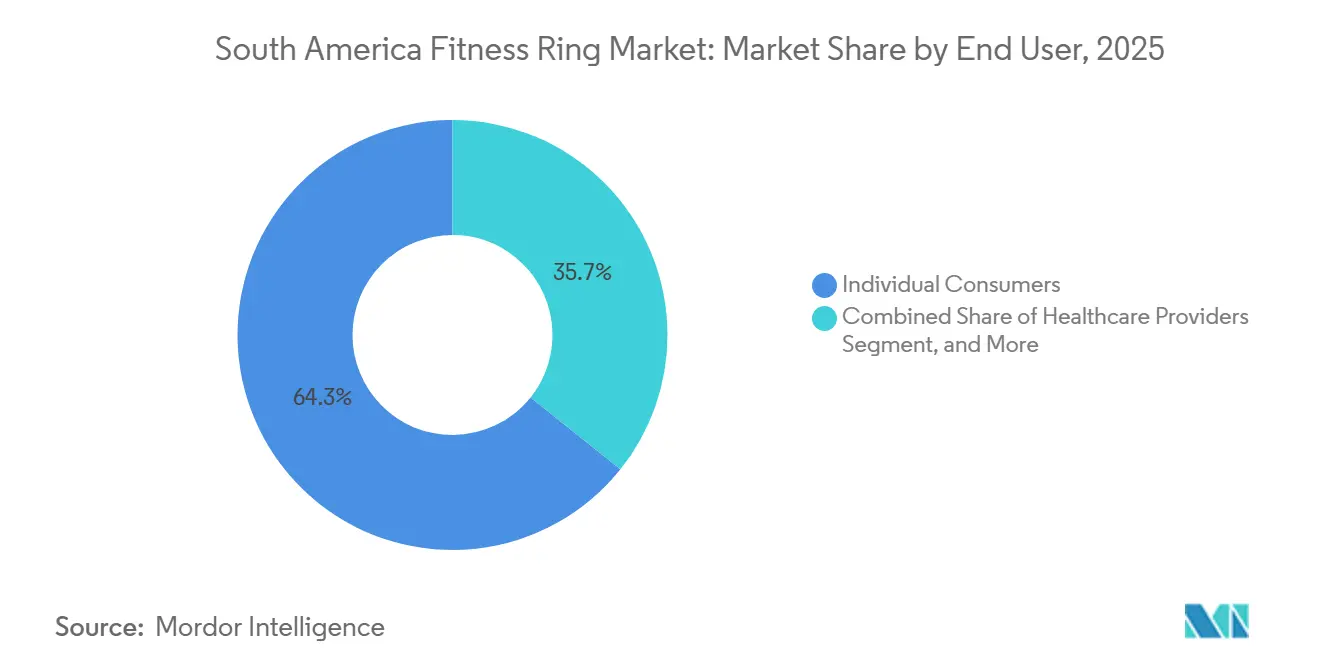
Individual consumers held 57.84% of the end-user segment in 2025. Personal health, sleep, and fitness monitoring remain the main reasons for purchase in this group. Demand is concentrated among urban consumers who use smartphones regularly and are familiar with connected wellness products. These buyers often view a ring as a discreet alternative to a wrist-worn device. Their purchasing decisions are influenced by product features, app compatibility, local pricing, and confidence in data privacy.
Corporate wellness programs are projected to expand at a 7.43% CAGR through 2031. Employers can use wellness programs to encourage voluntary participation in health and recovery activities while avoiding intrusive monitoring practices. The 2025 increase in Brazilian employer wellness spending indicates support for more structured employee health offerings. The South America fitness ring market size for corporate wellness programs may be strengthened when organizations establish clear consent processes and keep employee data separate from personnel decisions. Health providers could also become an important adjacent user group as ring-based devices gain greater clinical relevance.
Geography Analysis
Brazil held 61.00% of the South America fitness ring market share in 2025 and is projected to expand at a 7.05% CAGR through 2031. Its position reflects the combination of established consumer electronics retail, a large connected household base, familiar mobile payment behavior, and the arrival of payment-linked ring offerings. Samsung serves as an international consumer electronics reference point, while Inter has introduced a domestic financial-services distribution channel through its Super App. Lity also introduced the Lity Connect Ring in Brazil in November 2025, indicating interest from domestic consumer electronics suppliers in an accessible category position. Brazil's connected household base supports the app use, product discovery, customer service, and synchronization needed for health-tracking products.
Argentina ranks second in the country mix and has consumer interest in smart wearable products, but exchange-rate pressures make purchasing imported rings less predictable for many households. Periods of peso depreciation can make imported devices less accessible and encourage consumers to consider lower-specification alternatives, postpone upgrades, or seek lower entry prices. Chile and Colombia provide the strongest next opportunities in the Andean region because each can support a combination of online discovery, authorized retail, and early institutional demand. Chile has conditions that support the adoption of premium connected devices, while Colombia offers potential for employer-led health technology programs in its major urban centers. Both markets are likely to draw on retail methods first established in Brazil, including online availability, physical product trials, and clear local support for sizing, setup, and warranty questions.
Peru and the Rest of South America remain earlier-stage locations for fitness ring adoption. Peru has a growing urban audience for smartphone-connected wellness products, although import costs and limited localized distribution still constrain access to premium hardware. Ecuador, Uruguay, Bolivia, Paraguay, and Venezuela have different levels of digital readiness, disposable income, and retailer capacity, so their adoption paths will not be uniform. Regional online distribution can help suppliers serve these markets from hubs in Brazil or Chile, and stronger logistics links are expected to improve availability in Peru, Ecuador, and Uruguay during the forecast period.
Competitive Landscape
The South America fitness ring market includes global device brands, domestic consumer electronics suppliers, and financial institutions that are using ring products as payment credentials. Competition is shaped by product capability, app integration, authorized distribution, price, product approval, service quality, and compliance with data rules. Oura has expanded availability into selected international markets, but its March 2026 announcement did not include South America. That absence leaves room for brands that already have local retail relationships, local service capabilities, or an alternative route to customers through a financial services platform. Samsung's wider device ecosystem gives it a recognizable position in connected consumer electronics, while regional channels can influence how quickly products reach buyers and how well they are supported after purchase.
Inter made a notable strategic move by introducing the Inter Ring through its Super App in June 2026. The company tied the product to contactless payments, airport lounge access, and compatible smart-lock authentication, showing how a financial institution can control both the customer relationship and the distribution route. Lity made another strategic move with the November 2025 launch of the Lity Connect Ring in Brazil, which was positioned as an accessible health and activity-monitoring product. These launches show that regional competition is not limited to global hardware suppliers, because a bank-led payment product and a domestic accessible device can address customers who may not buy a premium health ring. Strong after-sales support, including sizing, warranty, reliable software updates, and accessible explanations of data use, can be as important as new sensor features while the category develops.
Clinical validation can create another area of competition as rings move closer to healthcare and employer use cases. Movano Health received FDA 510(k) clearance in December 2024 for the pulse oximeter integrated in its EvieMED Ring. Otsuka Pharmaceutical also formed a partnership with Sky Labs for its CART BP pro ring-type blood pressure monitoring platform in February 2026. These actions show why clinical credibility, transparent data governance, and effective partnerships can matter to future procurement by health providers and sports organizations.
South America Fitness Ring Industry Leaders
-
Oura Health Oy
-
Samsung Electronics Co., Ltd.
-
Ultrahuman Healthcare Private Limited
-
RingConn LLC
-
Circular SAS
- *Disclaimer: Major Players sorted in no particular order
Recent Industry Developments
- July 2026: Sky Labs Inc. presented its CART BP pro blood pressure monitoring ring at the 9th Digital Biomarkers in Clinical Trials conference in Basel, Switzerland, showcasing its data platform as a candidate endpoint measurement tool for pharmaceutical drug trials.
- June 2026: Inter Pagamentos Ltda. launched the Inter Ring at BRL 485 (USD 84) and Inter Wristband at BRL 349 (USD 61) exclusively for eligible Brazilian account holders through the Inter Super App. Operating on passive NFC with no battery or screen, both devices function independently from a smartphone after activation for contactless payments, airport lounge access, and NFC-compatible smart-lock authentication.
- May 2026: RingConn LLC officially launched the Gen 3 smart ring globally on May 29 at USD 349 with no mandatory subscription, introducing vascular health insights, smart vibration health alerts, and sleep apnea pattern detection. The Gen 3 generated over USD 10 million in pre-order sales within 20 days of opening.
- February 2026: Otsuka Pharmaceutical entered into a strategic partnership agreement with Sky Labs Inc. for the CART BP pro ring-type blood pressure monitoring platform. The device had crossed 150,000 cumulative prescriptions within its first year at South Korean hospitals under national health insurance reimbursement.
South America Fitness Ring Market Report Scope
The South America Fitness Ring Market Report is Segmented by Product Type (Basic Fitness Rings, Smart Fitness Rings), Technology (Bluetooth-Enabled Rings, NFC-Enabled Rings), Application (Health and Wellness Monitoring, Contactless Payments, Sports and Athlete Recovery, Smart Home and Device Control), Distribution Channel (Online Retail, Offline Retail), End User (Individual Consumers, Corporate Wellness Programs, Healthcare Providers), and Geography (Brazil, Argentina, Chile, Colombia, Peru, Rest of South America). The Market Forecasts are Provided in Terms of Value (USD).
| Basic Fitness Rings |
| Smart Fitness Rings |
| Bluetooth-Enabled Rings |
| NFC-Enabled Rings |
| Health and Wellness Monitoring |
| Contactless Payments |
| Sports and Athlete Recovery |
| Smart Home and Device Control |
| Online Retail |
| Offline Retail |
| Individual Consumers |
| Corporate Wellness Programs |
| Healthcare Providers |
| Brazil |
| Argentina |
| Chile |
| Colombia |
| Rest of South America |
| By Product Type | Basic Fitness Rings |
| Smart Fitness Rings | |
| By Technology | Bluetooth-Enabled Rings |
| NFC-Enabled Rings | |
| By Application | Health and Wellness Monitoring |
| Contactless Payments | |
| Sports and Athlete Recovery | |
| Smart Home and Device Control | |
| By Distribution Channel | Online Retail |
| Offline Retail | |
| By End User | Individual Consumers |
| Corporate Wellness Programs | |
| Healthcare Providers | |
| By Country | Brazil |
| Argentina | |
| Chile | |
| Colombia | |
| Rest of South America |
Key Questions Answered in the Report
What is the South America fitness ring market size?
The South America fitness ring market size is estimated to expand from USD 35.21 million in 2026 to USD 47.66 million by 2031, at a 6.24% CAGR.
Which product category leads demand for fitness rings in South America?
Smart fitness rings led by product type with 67.58% of the segment in 2025 and are projected to expand at a 7.98% CAGR through 2031.
Why are NFC-enabled fitness rings gaining adoption?
NFC-enabled rings support contactless payments and access functions, and the segment is projected to expand at a 7.78% CAGR through 2031.
Which country is the leading South American destination for fitness rings?
Brazil held 61.00% of the regional total in 2025 and is projected to expand at a 7.05% CAGR through 2031.
What role do corporate wellness programs play in fitness ring adoption?
Corporate wellness programs are projected to expand at a 7.43% CAGR through 2031 as employers seek voluntary and measurable wellness tools.