
South America Farm Implements Market Size and Share
Market Overview
| Study Period | 2021 - 2031 |
|---|---|
| Forecast Data Period | 2026 - 2031 |
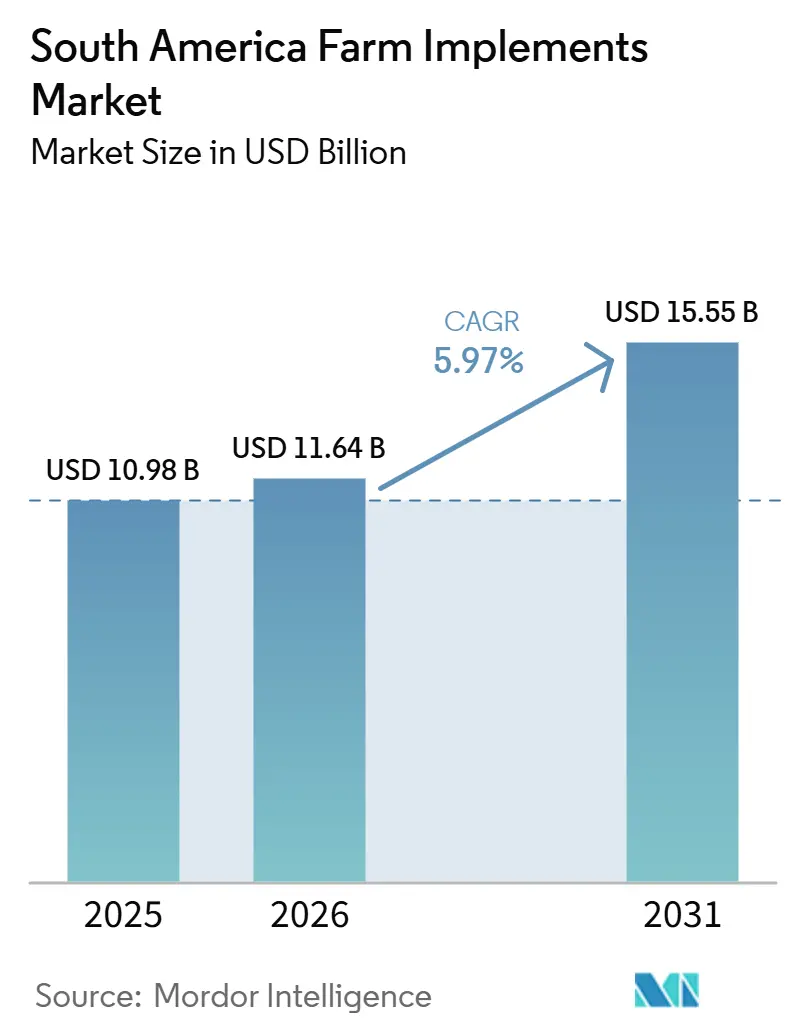
| Base Year Market Size (2025) | USD 10.98 Billion |
| Market Size (2026) | USD 11.64 Billion |
| Market Size (2031) | USD 15.55 Billion |
| Growth Rate (2026 - 2031) | 5.97 % |
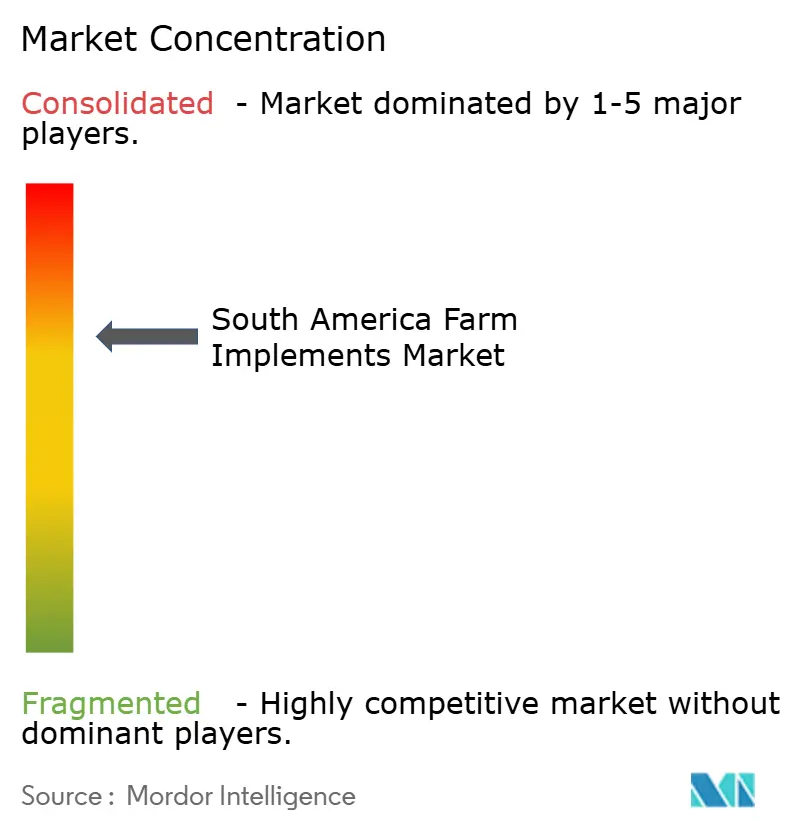
| Market Concentration | Medium |
Major Players
*Disclaimer: Major Players sorted in no particular order Image © Mordor Intelligence. Reuse requires attribution under CC BY 4.0. |
|
South America Farm Implements Market Analysis by Mordor Intelligence
The South America farm implements market was valued at USD 10.98 billion in 2025, estimated at USD 11.64 billion in 2026, and is forecasted to reach USD 15.55 billion by 2031, at a CAGR of 5.97% during the forecast period from 2026 to 2031. Brazil's large soybean and corn production base continues to support purchases of tractors, harvesters, and attachments, while rural credit remains important for farm investment. The region has greater scope for mechanization and farmland development compared to mature North American and European farming regions. Large commercial farms are upgrading fleets, while smaller operators rely more on subsidized finance, rental fleets, and contractor services. Equipment suppliers are responding with local manufacturing, precision functions, and stronger spare parts support. Credit constraints, volatile farm income, and smaller landholdings will continue to create uneven demand across the region.
Key Report Takeaways
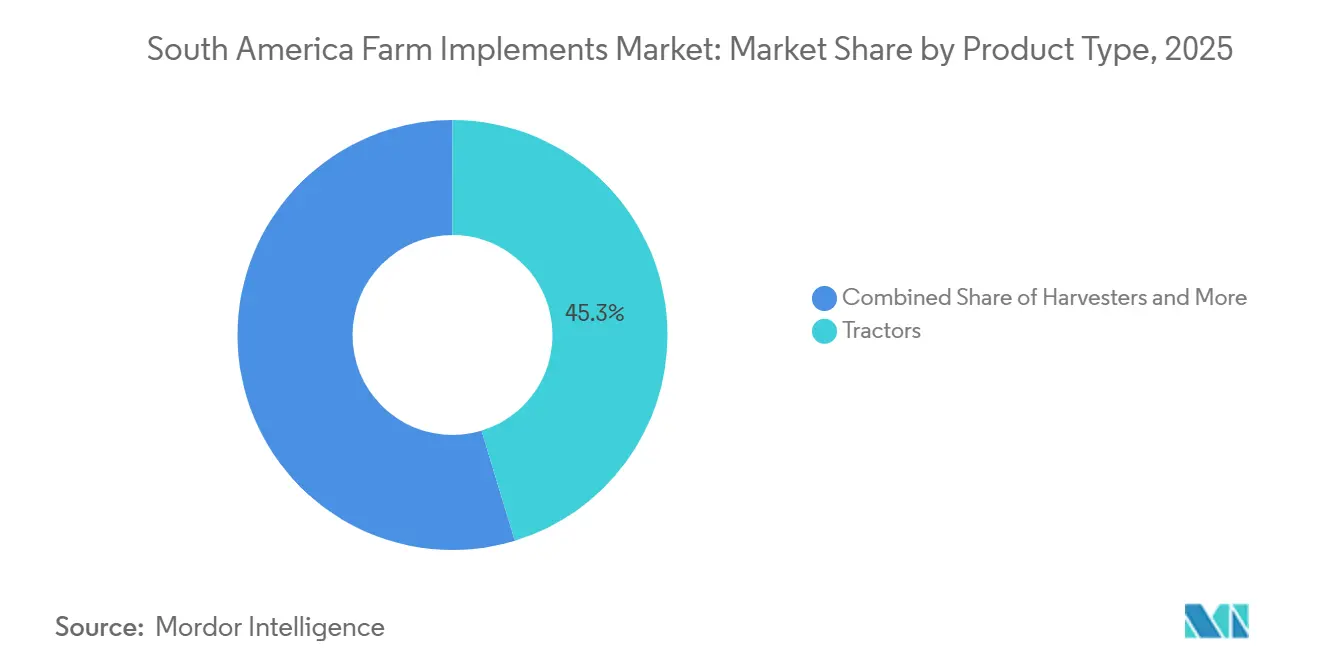
- By product type, tractors are the largest segment and held 45.3% of the South America farm implements market share in 2025, while precision and autonomous implements are the fastest-growing segment and are forecasted to expand at a 12.5% CAGR between 2026 and 2031.
- By mode of operation, powered implements are the largest segment and held 78.2% of regional revenue in 2025, while powered implements are also the fastest-growing segment and are forecasted to expand at a 6.8% CAGR between 2026 and 2031.
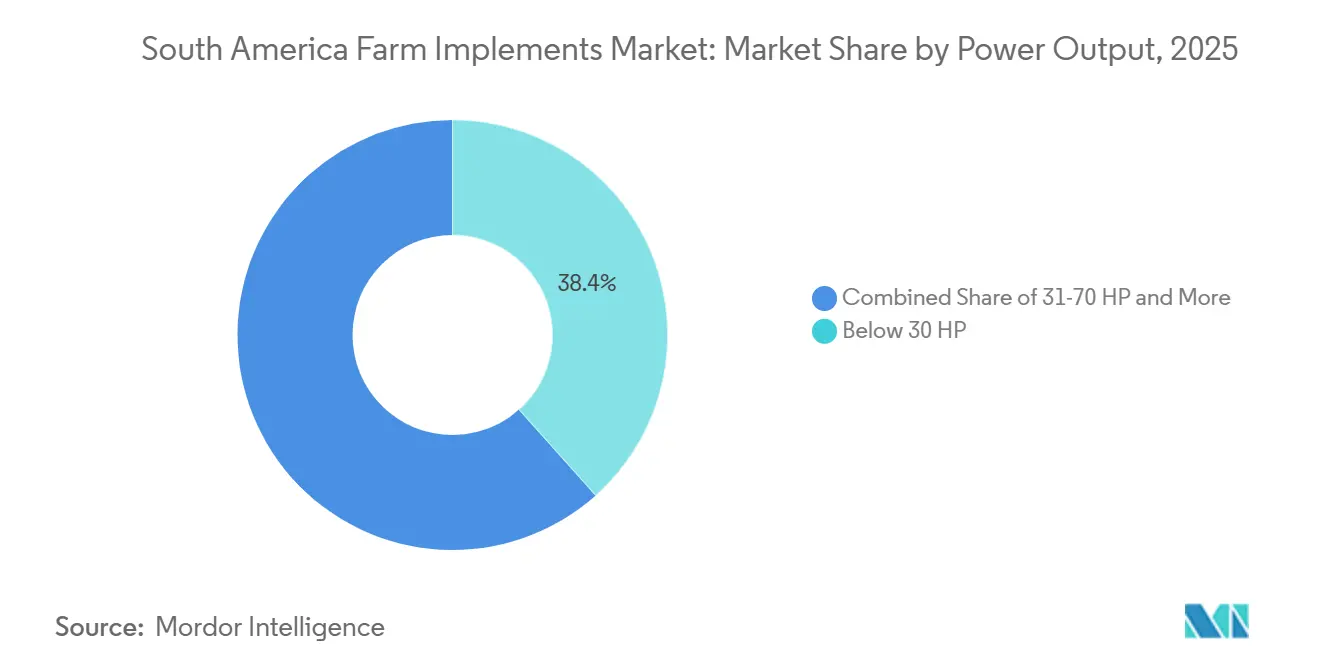
- By power output, below 30 horsepower (HP) is the largest segment and held 38.4% by unit volume in 2025, while above 130 HP is the fastest-growing segment and is forecasted to expand at a 7.5% CAGR between 2026 and 2031.
Note: Market size and forecast figures in this report are generated using Mordor Intelligence’s proprietary estimation framework, updated with the latest available data and insights as of January 2026.
Market Trends and Insights
Drivers Impact Analysis of South America Farm Implements Market*
| Driver | (~) % Impact on CAGR Forecast | Geographic Relevance | Impact Timeline |
|---|---|---|---|
| Labor scarcity and rising mechanization intensity | +0.8% | Brazil, Chile, Argentina, Rest of South America | Short term (≤ 2 years) |
| Public credit and mechanization subsidies | +1.1% | Brazil, Argentina, South America-wide | Medium term (2-4 years) |
| Expansion of medium-horsepower tractor and implement fleets | +0.7% | Brazil, Argentina, Paraguay, Colombia | Medium term (2-4 years) |
| Contract farming, custom hiring, and dealer-led rental services | +0.6% | Brazil, Argentina, Rest of South America | Short term (≤ 2 years) |
| Precision agriculture and input-optimization adoption | +0.9% | Brazil Center-West and Matopiba, Argentina Pampas | Long term (≥ 4 years) |
| Regional manufacturing and Mercosur-linked supply localization | +0.5% | Brazil, Argentina, Mercosur bloc | Long term (≥ 4 years) |
| Source: Mordor Intelligence | |||
Labor Scarcity and Rising Mechanization Intensity
Labor shortages across South America's agricultural sector are accelerating the adoption of mechanized farm implements. Rural-to-urban migration, an aging agricultural workforce, and declining availability of seasonal labor are increasing the reliance on machinery for field operations across major agricultural economies, including Brazil, Argentina, and Chile. The impact is particularly evident in labor-intensive crops such as sugarcane, fruits, coffee, and horticultural products, where timely planting, crop protection, and harvesting are critical to maintaining productivity. As a result, growers are increasingly investing in farm implements that improve operational efficiency, reduce dependence on manual labor, and ensure field operations are completed within narrow seasonal windows. These structural labor constraints continue to support long-term demand for farm implements across the South America farm implements market.
Public Credit and Mechanization Subsidies
Brazil launched Plano Safra 2025-2026 with BRL 89 billion (USD 17.18 billion) in rural credit for family farming. The program supports machinery purchases by producers who may not qualify for conventional commercial lending[1]Source: Agencia Brasil, "25/26 Crop Plan provides for R$ 89 billion for family farming," agenciabrasil.ebc.com.br. Its financing structure helps farmers replace basic equipment and purchase smaller implements suited to their acreage and operational needs. The National Program for Strengthening Family Farming (PRONAF) supports this route to mechanization and broadens the potential customer base. For suppliers in the South America farm implements market, public financing links demand growth with local production and dealer access. This trend highlights the importance of public financing programs in expanding access to mechanization, supporting broader adoption of farm implements across the South America farm implements market.
Precision Agriculture and Input-Optimization Adoption
The adoption of precision agriculture technologies is increasing across South America as farmers seek to improve operational efficiency and optimize input use. Guidance systems, automatic section control, and variable-rate application technologies are being integrated into farm operations to reduce input overlaps and improve the placement of seeds, fertilizers, and crop protection products. Retrofitting existing machinery with precision agriculture technologies is also providing a cost-effective pathway for growers to modernize operations without replacing entire equipment fleets. This trend is driving demand for precision controllers, sensors, compatible implements, and after-sales support while strengthening the adoption of advanced farm equipment. As a result, precision agriculture is becoming an important driver of growth in the South America farm implements market.
Contract Farming, Custom Hiring, and Dealer-Led Rental Services
Harvester rental and custom hiring services are expanding across South America, improving access to advanced harvesting equipment for producers with smaller landholdings or limited investment capacity. By deploying machinery across multiple farms during peak harvest periods, contractors and equipment-sharing providers improve machinery utilization while reducing ownership costs for individual producers. This operating model is increasing demand for reliable, durable equipment equipped with telematics and supported by comprehensive after-sales services. In response, manufacturers are adapting their sales and service strategies to meet the requirements of both individual farmers and commercial fleet operators. As a result, the market is benefiting from broader equipment adoption through rental and custom hiring models, particularly in regions where direct machinery ownership remains limited.
Restraints Impact Analysis of South America Farm Implements Market*
| Restraint | (~) % Impact on CAGR Forecast | Geographic Relevance | Impact Timeline |
|---|---|---|---|
| High upfront cost and interest-rate sensitivity | -1% | Brazil, Argentina, South America-wide | Short term (≤ 2 years) |
| Fragmented holdings and low equipment utilization | -0.7% | Rest of South America, Paraguay, smaller Andean economies | Long term (≥ 4 years) |
| Commodity-price and farm-income volatility | -0.9% | Argentina, Brazil, Paraguay | Medium term (2-4 years) |
| Import, currency, and component-cost exposure | -0.8% | Argentina, Brazil, Rest of South America | Medium term (2-4 years) |
| Source: Mordor Intelligence | |||
High Upfront Cost and Interest-Rate Sensitivity
According to Banco Central do Brasil data, Brazil's enterprise rural-credit disbursements declined 12% in the 2025/2026 crop plan[2]Source: News Release, "Boletim de Desempenho-Crédito Rural — Julho/2025 a Junho/2026 (Safra Fechada)," www.gov.br. Tighter lending conditions can delay fleet replacement, particularly for smaller and mid-sized operations. Higher collateral requirements and farm debt make unsupported borrowing harder to secure. The gap between commercial and subsidized financing rates determines whether many producers can make equipment purchases. This exposes suppliers to shifts in lending conditions and the availability of government-backed programs. The South America farm implements market will remain sensitive to financing costs, as machinery represents a high-value farm investment.
Commodity-Price and Farm-Income Volatility
Agricultural machinery demand in Paraguay is closely linked to farm income, particularly in soybean-producing regions. Strong commodity price cycles often accelerate equipment purchases, while weaker farm incomes can lead to reduced demand and higher dealer inventories. Across the region, equipment affordability is also influenced by fluctuations in crop revenues and currency movements, creating uncertainty in purchasing decisions. As a result, dealers must carefully manage inventory levels and financing strategies during periods of uneven demand. These cyclical factors reduce the predictability of the South America farm implements market from one agricultural season to the next.
*Our forecasts treat driver/restraint impacts as directional, not additive. The impact forecasts reflect baseline growth, mix effects, and variable interactions.
South America Farm Implements Market Segment Analysis
By Product Type:
Tractors Lead While Precision Implements Shape Future DemandTractors accounted for 45.3% of the South America farm implements market in 2025. They remain central to planting, tillage, spraying, transport, and other field activities across commercial farms. Dealers commonly bundle tractor and attachment financing, making the tractor a key component of broader equipment purchases. Replacement activity in Brazil and commercial farming operations in Argentina continue to support this category. Harvesters also held a significant share, with Argentina recording stronger combined sales in 2025 as producers renewed their fleets. Soil-preparation equipment, planting and seeding equipment, irrigation equipment, and crop-protection implements serve the main stages of field production. Haying and forage equipment supports livestock and dairy operations where reliable feed preparation is essential. These product groups provide suppliers with multiple entry points into farm accounts with varying crop and acreage requirements.
Precision and autonomous implements are the fastest-growing product category in the South America farm implements market, forecast to expand at a 12.5% CAGR between 2026 and 2031. This growth is driven by demand for GPS guidance, variable-rate application, section control, and connected machinery. These functions help farms manage inputs more efficiently and improve operational consistency. Grupo Jacto commercially launched Brazil's first autonomous sprayer at Agrishow 2026, marking the entry of autonomous equipment into commercial use. Growth opportunities exist in both newly manufactured equipment and add-on technology for existing fleets. European precision suppliers may gain greater market access as the Mercosur-European Union trade framework moves into implementation. Brazil's Manual de Crédito Rural (MCR) rules continue to support local manufacturing or partnerships when equipment is purchased using equalized rural credit. Product suppliers therefore require both advanced technology capabilities and local service infrastructure.



By Mode of Operation:
Powered Implements Hold Most Value While Unpowered Tools Retain a Practical RolePowered implements accounted for 78.2% of the South America farm implements market size in 2025 and are forecasted to expand at a 6.8% CAGR between 2026 and 2031. Planting, spraying, and harvesting across large row-crop farms often require power take-off (PTO) equipment and integrated mechanical systems. Higher equipment value reflects the need for drivetrains, controls, electronic systems, and precision functions. Larger farms in Brazil's Matopiba region and Argentina's Pampas are upgrading to equipment that links with tractor management systems, supporting sales of software-enabled planters, sprayers, harvesting attachments, and related components. In February 2025, AGCO AGCO Corporation opened its Reman Transmissions Center of Excellence in Jundiaí, São Paulo, Brazil, with a USD 3.2 million investment[3]Source: News Release, "AGCO Announces Expansions in Jundiaí (SP) with a Focus on Sustainability and Workforce Development," news.agcocorp.com. The facility indicates that remanufacturing and aftermarket support are becoming more relevant for powered equipment users, as these services can extend equipment life and lower operating costs for farmers and contractors.
Unpowered implements include tillage tools, disc harrows, rollers, and passive seeders. They are important for smaller farms that prioritize lower purchase costs and easier maintenance. They also suit no-till and minimum-till practices that require specialized tools for soil engagement without complex power systems. Paraguay, Colombia, and Bolivia generate demand where conservation agriculture and varied field conditions support the use of these tools. Contract operators also use unpowered equipment when they need simple, reliable attachments that can be moved quickly between jobs. The segment does not have the same revenue concentration as powered equipment, but it retains a wide user base. Its role is particularly relevant where farm infrastructure, financing, or technical service is limited. The South America farm implements market requires both powered and unpowered offerings, given the wide variation in farm structures across the region.
By Power Output:
High-HP Equipment Expands While Compact Equipment Supports Farm AccessThe below 30 HP category was the largest power-output segment by unit volume, holding a 38.4% share in 2025. Compact tractors and light implements are well-suited to smaller holdings in Brazil, Colombia, Peru, and Ecuador, as their size matches local land conditions and makes them more accessible to family farms. The 31-70 HP range is a key target for PRONAF Mais Alimentos financing, as it supports basic farm mechanization. The 71-130 HP category serves mid-sized commercial farms and is an important competitive area for both domestic and multinational suppliers. In this range, local manufacturers can compete through pricing, dealer coverage, and parts availability. Equipment financed through equalized rural credit must meet Manual de Crédito Rural (MCR) requirements. Overall, the South America farm implements market spans compact, mid-range, and high-output needs rather than being concentrated in a single power band.
The above 130 HP category is the fastest-growing power-output segment in the South America farm implements market, forecast to grow at a 7.5% CAGR from 2026 to 2031. Large farms in Brazil's Center-West rely on high-output machinery for soybean and corn rotations that require rapid field completion. These units carry higher selling prices and often include more advanced automation and sensor systems. In August 2025, Deere & Company began local production of S7 harvesters at Granadero Baigorria, Santa Fe, Argentina. The line ranges from 334 HP to 617 HP, supporting local availability of high-capacity harvesting machinery. Local production can reduce dependence on imported equipment and improve parts access. CNH Industrial Brasil also received Banco Nacional de Desenvolvimento Econômico e Social (BNDES) financing in 2026 for projects covering electronic architecture, automation, and sensor systems, supporting the development of higher-value equipment designed for large-scale operations.
Geography Analysis
Brazil Farm Implements Market
Brazil held 56.6% of the South America farm implements market share in 2025 and is forecast to expand at a 6.22% CAGR between 2026 and 2031. Its position is supported by new agricultural areas in Matopiba regions and more intensive farming in the Center-West, Southeast, and South regions. Brazil's agribusiness sector is a key driver of the country's export economy, supported by a large agricultural production base, well-established farm machinery manufacturing, extensive dealer networks, and government-backed financing programs. These structural advantages create a favorable environment for farm mechanization and sustained demand for agricultural equipment across the country.
Argentina Farm Implements Market
Argentina recorded strong agricultural machinery sales during the year. Producers focused more on productivity-enhancing attachments as tractor sales softened. Deere & Company's S7 production in Santa Fe strengthens Argentina's role as a manufacturing base for the Mercosur region. The Mercosur-European Union trade framework may affect import costs, while local manufacturing remains an important counterweight to direct imports.
Broader South America Farm Implements Market
Paraguay's outlook depends on soybean area expansion and public support for organized producer groups. Colombia offers potential for mid-range tractors and crop-protection equipment, as its mechanization levels remain low. Chile, Uruguay, and Bolivia contribute further demand across horticulture, livestock, precision grain farming, and frontier agriculture. These country-level differences support demand across multiple crop systems and farm sizes.
Competitive Landscape
The South America farm implements market is moderately concentrated, with Deere & Company, CNH Industrial N.V., AGCO Corporation, Mahindra & Mahindra Ltd., and Kubota Corporation collectively holding a major share in 2025. Key suppliers compete through local production, financing support, precision systems, and dealer networks. Their scale allows them to serve large commercial farms that require a broad equipment portfolio and dependable maintenance support. Domestic specialists remain competitive in product niches and in areas where service response time is critical. Competition is concentrated but not limited to multinational manufacturers.
Grupo Jacto and Stara S/A Indústria de Implementos Agrícolas are significant Brazilian competitors in sprayers, planters, and precision equipment. Grupo Jacto launched an autonomous sprayer in May 2026, strengthening its position in connected crop-protection equipment. Stara opened a parts distribution center in Goiás, Brazil in June 2026, improving service coverage in Brazil's Center-West production area. These developments indicate that local suppliers are investing in technology and customer support. Mid-sized farms remain an important customer segment, given their need for practical technology and reliable after-sales support.
New Holland announced an investment of more than BRL 100 million (USD 19.7 million) at its Curitiba, Brazil facility in April 2026 for Draper FD2 harvesting platforms. AGCO's 2025 investment at its Jundiaí, Brazil facility focused on remanufactured transmissions, workforce training, and local support. Horsch announced a BRL 200 million (USD 39.4 million) investment in a Curitiba factory in 2025 for soil-preparation, planting, and precision equipment. These investments expand local availability and intensify competition in specialized machinery categories.
South America Farm Implements Industry Leaders
-
Deere & Company
-
CNH Industrial N.V. (Exor N.V.)
-
AGCO Corporation
-
Mahindra and Mahindra Ltd.
-
Kubota Corporation
- *Disclaimer: Major Players sorted in no particular order
South America Farm Implements Market Companies Covered in this Report
- Deere & Company
- CNH Industrial N.V. (Exor N.V.)
- AGCO Corporation
- Mahindra and Mahindra Ltd.
- Kubota Corporation
- CLAAS KGaA mbH
- J.C. Bamford Excavators Ltd.
- LS Mtron Ltd. (LS Holdings Co., Ltd.)
- Maquinas Agricolas Jacto S.A. (Grupo Jacto)
- Stara S/A Industria de Implementos Agricolas
- Marchesan Implementos e Maquinas Agricolas TATU S.A.
- Agrale S.A.
- Valmont Industries, Inc.
- Lindsay Corporation
- Metalfor S.A.

Recent Industry Developments in South America Farm Implements Market
- May 2026: Grupo Jacto commercially launched Brazil’s first autonomous sprayer and the Hover 500 two-row sugarcane harvester at Agrishow 2026 in Ribeirão Preto, Brazil. The autonomous sprayer can operate for up to 16 hours continuously and serves the precision crop-protection segment. The Hover 500 gives Jacto a two-row sugarcane harvester offering in Brazil.
- April 2026: Brazil’s government launched MOVE Brasil agricultural machinery with BRL 10 billion (USD 1.93 billion) in credit lines for tractors, sprayers, harvesters, and implements, managed by Financier of Studies and Projects (Finep). Agricultural cooperatives gained direct access to development-finance machinery credit under the program. This widened the potential buyer base for subsidized equipment in Brazil.
- August 2025: Deere & Company started local manufacturing of the S7 harvester series at its Granadero Baigorria, Santa Fe, Argentina facility. The 4-model line covers 334-617 HP and includes Predictive Ground Speed Automation (GSA), Harvest Setting Automation, and Operations Center connectivity.


South America Farm Implements Market Report Scope
Farm implements are task-specific tools, attachments, or machines used for agricultural work such as soil preparation, planting, crop care, irrigation, material handling, and harvesting.
The South America Farm Implements Market Report is Segmented by Product Type (Tractors, Harvesters, Soil Preparation and Cultivation Equipment, Irrigation and Crop-Protection Implements, and More), by Mode of Operation (Powered Implements and Unpowered Implements), by Power Output (<30 HP, 31–70 HP, 71–130 HP, and Above 130 HP), and by Geography (Brazil, Argentina, and More). The Market Forecasts are Provided in Terms of Value (USD).
| Tractors |
| Harvesters |
| Soil Preparation and Cultivation Equipment |
| Planting, Seeding, and Fertilizing Equipment |
| Irrigation and Crop-Protection Implements |
| Precision and Autonomous Implements |
| Haying and Forage Equipment |
| Other Implements |
| Powered Implements |
| Unpowered Implements |
| Below 30 HP |
| 31-70 HP |
| 71-130 HP |
| Above 130 HP |
| Brazil |
| Argentina |
| Rest of South America |
| By Product Type | Tractors |
| Harvesters | |
| Soil Preparation and Cultivation Equipment | |
| Planting, Seeding, and Fertilizing Equipment | |
| Irrigation and Crop-Protection Implements | |
| Precision and Autonomous Implements | |
| Haying and Forage Equipment | |
| Other Implements | |
| By Mode of Operation | Powered Implements |
| Unpowered Implements | |
| By Power Output | Below 30 HP |
| 31-70 HP | |
| 71-130 HP | |
| Above 130 HP | |
| By Geography | Brazil |
| Argentina | |
| Rest of South America |


Key Questions Answered in the Report
What is the forecasted value of the South America farm implements market by 2031?
The South America farm implements market is forecasted to reach USD 15.55 billion by 2031. The forecast reflects continued equipment demand from large crop farms, local manufacturing investment, public-credit support, and a growing need for mechanized field work.
Which product category led South American farm implement sales in 2025?
Tractors led product demand with 45.3% revenue share in 2025. They remain central to planting, tillage, spraying, transport, and other farm activities, and they are often financed together with attachments in broader equipment purchases.
Why is demand for precision farm equipment increasing in South America?
Producers are adopting guidance, section-control, and variable-rate tools to improve input use and field operations. The opportunity includes newly manufactured machines as well as retrofit systems for existing tractors, sprayers, and planting equipment.
How do rural credit programs affect equipment purchases?
Subsidized credit can help family and smaller commercial farms buy tractors and implements when conventional lending is costly or limited. These programs also favor local production where national-content rules apply to financed machinery.
Page last updated on:


 Your data is secure and never sold or shared.


