
South America Data Center Fire Protection and Life Safety Market Size and Share
Market Overview
| Study Period | 2021 - 2032 |
|---|---|
| Forecast Data Period | 2027 - 2032 |
| Base Year Market Size (2026) | USD 96.5 Million |
| Market Size (2027) | USD 111.46 Million |
| Market Size (2032) | USD 223.04 Million |
| Growth Rate (2027 - 2032) | 14.89 % |
| Market Concentration | Medium |
Major Players *Disclaimer: Major Players sorted in no particular order Image © Mordor Intelligence. Reuse requires attribution under CC BY 4.0. | |
South America Data Center Fire Protection and Life Safety Market Analysis by Mordor Intelligence
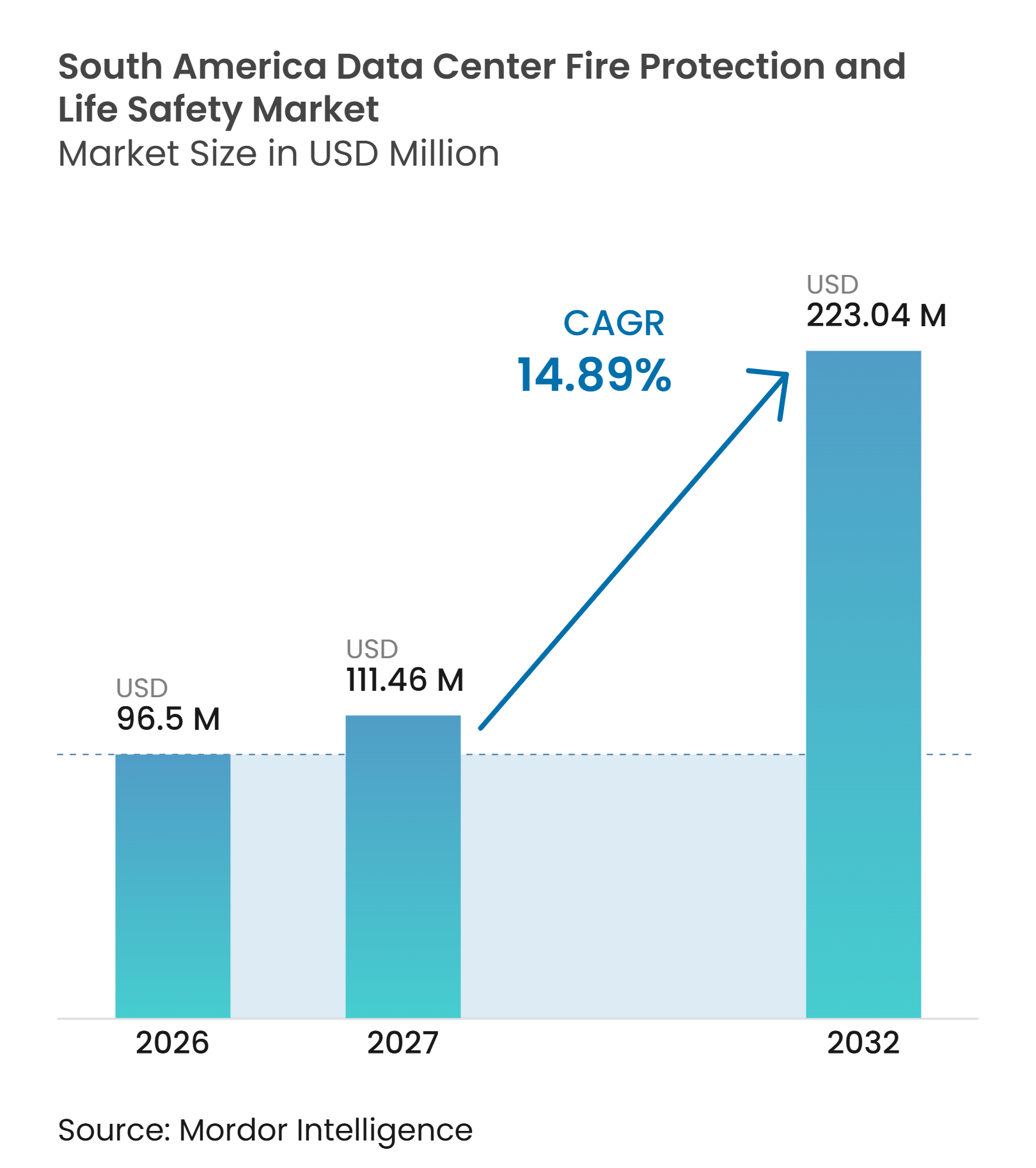
The South America data center fire protection and life safety market size is projected to expand from USD 96.50 million in 2026 to USD 223.04 million by 2032, registering a CAGR of 14.89% between 2027 to 2032. The South America data center fire protection and life safety market is supported by new colocation construction and the retrofit needs created by higher-density computing. AI racks place more electrical load in a small area, which raises the need for detection, suppression, and monitoring that can work together. Lithium-ion battery systems also require designs that address thermal runaway and possible reignition. Suppliers are responding with water mist, oxygen-reduction systems, aspirating detection, and integrated control platforms. The South America data center fire protection and life safety market also faces uneven capital access, water constraints, and a limited pool of specialized commissioning engineers.
Key Report Takeaways
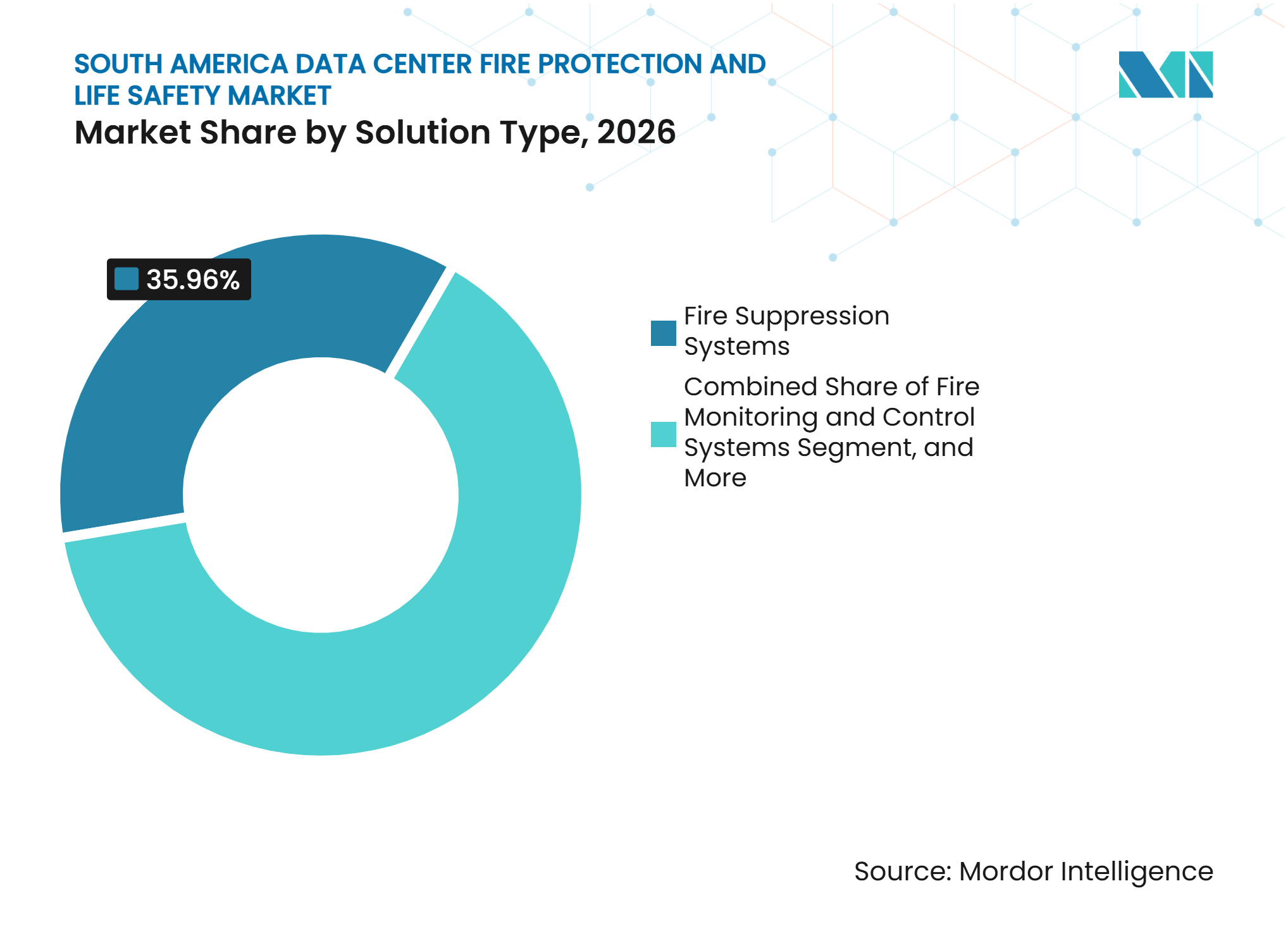
- By solution type, Fire Suppression Systems held 35.96% of the South America data center fire protection and life safety market share in 2026, while Fire Monitoring and Control Systems are projected to expand at a 15.85% CAGR through 2032.
- By fire protection technology, Clean Agent Suppression accounted for 24.97% of the South America data center fire protection and life safety market share in 2026, while Other Fire Protection Technologies are projected to expand at a 15.78% CAGR through 2032.
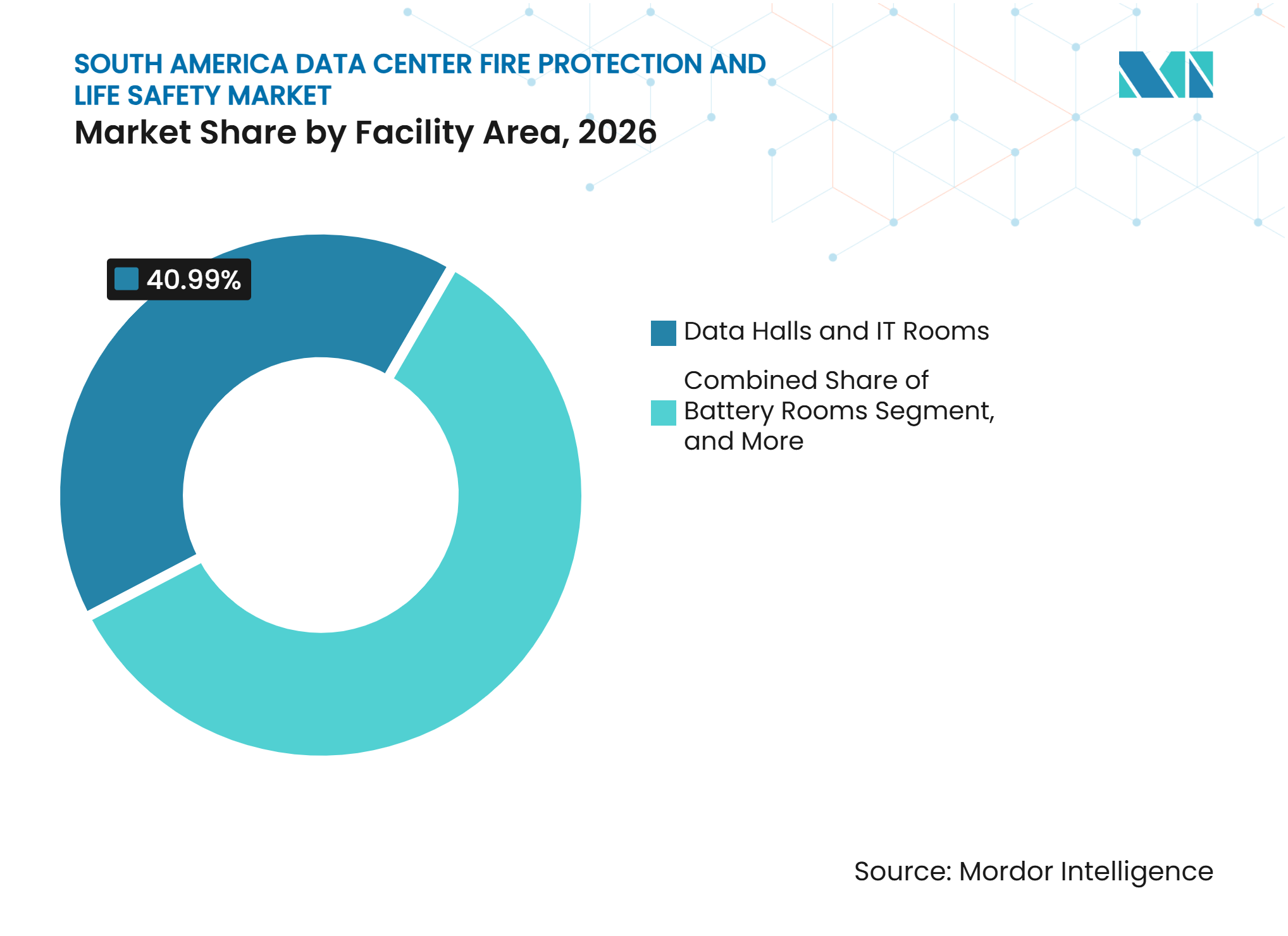
- By facility area, Data Halls and IT Rooms accounted for 40.99% of the South America data center fire protection and life safety market size in 2026, while Battery Rooms are projected to expand at a 15.61% CAGR through 2032.
- By data center size, Large Data Centers held 34.97% of revenue in 2026, while Hyperscale Data Centers are projected to expand at a 16.82% CAGR through 2032.
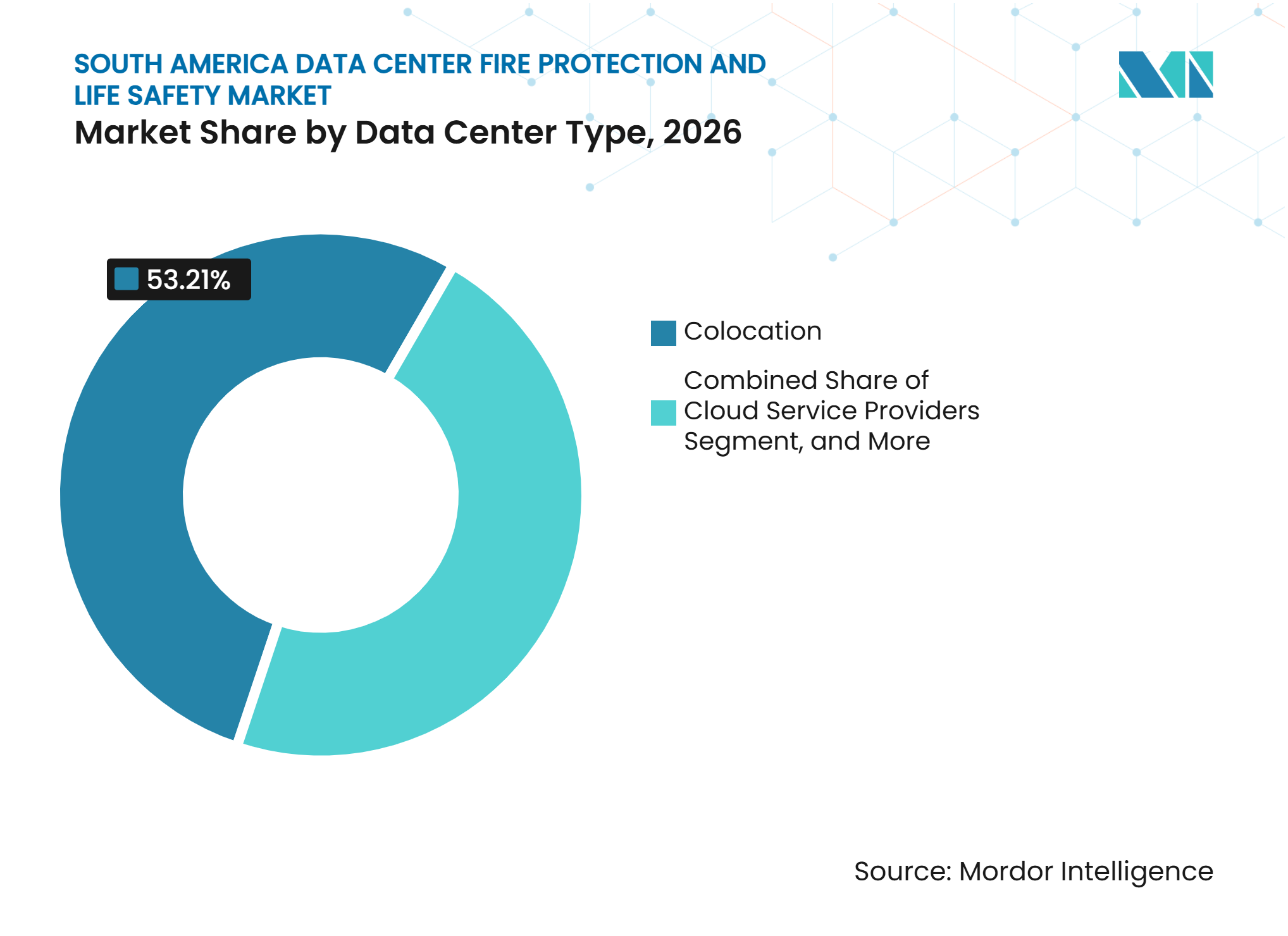
- By data center type, Colocation Data Centers held 53.21% of revenue in 2026, while Cloud Service Providers are projected to expand at a 16.89% CAGR through 2032.
- By geography, Brazil held 72.12% of revenue in 2026, while Argentina is projected to expand at a 16.85% CAGR through 2032.
Note: Market numbers in this report are based on Mordor Intelligence's proprietary estimation framework, which combines nine months of actuals with Q4 projections for base year 2026.
Market Trends and Insights
Drivers Impact Analysis of South America Data Center Fire Protection and Life Safety Market*
| Driver | (~) % Impact on CAGR Forecast | Geographic Relevance | Impact Timeline |
|---|---|---|---|
| Expansion of Colocation and Hyperscale Capacity | +4% | Brazil, Argentina, Chile | Short term (≤ 2 years) |
| Rising Cost of Data Center Outages | +2.8% | Global, with high exposure in Brazil and Argentina | Medium term (2-4 years) |
| AI and GPU Rack Density Expansion | +2.5% | Global, including South America secondary hubs | Short term (≤ 2 years) |
| Adoption of Early-Warning and Intelligent Detection | +1.6% | Global, Brazil, Chile, and Colombia | Medium term (2-4 years) |
| Lithium-Ion Battery Off-Gas Hazards | +1.2% | Global, Brazil, and Argentina | Short term (≤ 2 years) |
| Expansion Into Power-Rich Coastal and Secondary Hubs | +0.9% | Brazil Northeast and Campinas corridor, Argentina Patagonia | Long term (≥ 4 years) |
| Source: Mordor Intelligence | |||
Expansion of Colocation and Hyperscale Data Center Capacity
The South America data center fire protection and life safety market is closely tied to the construction of colocation and hyperscale sites. New facilities need detection, suppression, alarm, monitoring, emergency notification, and acceptance testing before servers can operate. The installation scope extends from white spaces to UPS rooms, battery rooms, cable routes, and supporting mechanical areas. Expansion also creates recurring demand for system design, installation, testing, inspection, and maintenance after commissioning. Existing halls are being changed for denser AI workloads, and those changes can require upgrades to earlier detection and suppression designs. This creates work beyond new construction because mixed generations of equipment, altered airflow, and higher electrical loads can require different protection arrangements.
Rising Cost of Data Center Outages
A fire-related outage can create costs beyond damaged equipment, including lost service, recovery activity, contractual exposure, and reputational loss. Power failures remain an important cause of material data center outages, which makes electrical fire prevention a priority for operators. AI workloads add pressure because interrupted training jobs can require substantial rework and renewed use of expensive computing capacity. Inference outages can also create service-level penalties for colocation tenants that rely on always-available digital services. Operators are therefore assessing detection speed, suppression reliability, and recovery procedures as connected parts of business continuity. These risks make the South America data center fire protection and life safety market more relevant to operational risk management, rather than only code compliance.
AI and GPU Rack Density Expansion
The South America data center fire protection and life safety market is being shaped by the shift to AI-grade computing. Schneider Electric reported that NVIDIA GPU rack density increased from 25 kW in 2022 to 132 kW for GB200 deployments in 2025, while a future VR200 configuration could reach 240 kW per rack.[1] Legrand stated that AI GPU racks can reach 80 kW and increase arc-flash risk through higher electrical current loads. Systems specified for conventional racks cannot simply be extended to higher-density racks because heat release, smoke conditions, electrical fault conditions, and agent volumes change. This affects the sizing of detection zones, suppression systems, and power shutdown sequences. Retrofitting older cloud-oriented halls therefore creates a parallel source of demand alongside new sites.
Adoption of Early-Warning and Intelligent Detection
Aspirating smoke detection is becoming more important where high airflow can limit the effectiveness of conventional ceiling detectors. WAGNER Group stated that its aspirating systems can provide sensitivity up to 2,000 times higher than conventional point detectors.[2] Sampling at several elevations can identify smoke below raised floors, in containment areas, around cable routes, and within changing airflow paths. Johnson Controls notes that aspirating systems can be linked to remote monitoring software, which supports lightly staffed facilities. Remote visibility can help facility teams examine early warnings before a developing event affects critical hardware. This capability supports wider use of early-warning systems in newer South American data center locations.
Restraints Impact Analysis of South America Data Center Fire Protection and Life Safety Market*
| Restraint | (~) % Impact on CAGR Forecast | Geographic Relevance | Impact Timeline |
|---|---|---|---|
| High Upfront Cost of Advanced Suppression and Detection | -1.2% | South America, particularly smaller markets | Medium term (2-4 years) |
| Shortage of Specialized Fire-Safety Engineering and Commissioning Talent | -0.9% | Global, acute in South America | Long term (≥ 4 years) |
| Water Stress and Cooling-System Interactions | -0.6% | Brazil, including São Paulo and the Northeast, and Chile | Medium term (2-4 years) |
| Cross-Border Accreditation and Permitting Fragmentation | -0.4% | Brazil, Chile, and Argentina | Long term (≥ 4 years) |
| Source: Mordor Intelligence | |||
High Upfront Cost of Advanced Suppression and Detection Systems
Advanced detection, clean-agent systems, water mist systems, and integrated monitoring platforms require substantial capital at the start of a project. Marioff states that fire protection can represent 1% of total data center build cost, although the expenditure varies with the selected design and site conditions.[3] Large operators can spread this cost across major campuses and use established procurement channels. Smaller colocation and enterprise operators face higher costs for imported agents, specialist hardware, and commissioning services. Cost pressure can encourage phased upgrades, even where older systems need adaptation for AI equipment or lithium-ion batteries. This creates a divide between facilities able to use global practices and facilities that defer upgrades.
Shortage of Specialized Fire-Safety Engineering and Commissioning Talent
The South America data center fire protection and life safety market requires engineers who understand both suppression design and high-voltage power systems. NFPA identified AI data center infrastructure as a source of fire protection challenges that the existing engineering pipeline may not be prepared to meet. The shortage is especially relevant for lithium-ion UPS systems deployed at multi-megawatt scale and for sites that need complex interlocks. Designers and commissioning teams must verify the sequence between detection, suppression, HVAC controls, and power isolation. Commissioning may take longer when experienced specialists are unavailable. The constraint can raise delivery costs and extend project schedules as facilities become more complex.
*Our forecasts treat driver/restraint impacts as directional, not additive. The impact forecasts reflect baseline growth, mix effects, and variable interactions.
South America Data Center Fire Protection and Life Safety Market Segment Analysis
By Solution Type:
Fire Suppression Anchors Revenue, Monitoring AcceleratesFire Suppression Systems held 35.96% of the South America data center fire protection and life safety market share in 2026. The segment includes clean agents, inert gas, and water mist systems for different fire conditions in data halls, UPS rooms, battery rooms, cable spaces, and mechanical areas. Operators prefer residue-free systems in spaces with high-value electronic equipment because post-discharge cleanup can interrupt service and delay recovery. Fire Detection and Alarm Systems remain important as operators add aspirating detection and analytics to reduce unwanted alarms in demanding airflow conditions. Emergency Notification and Evacuation Systems are also being adjusted for sites with fewer on-site personnel and automated operating models. These systems must connect clearly with suppression controls so that people, equipment, and critical processes receive the appropriate response.
Fire Monitoring and Control Systems are projected to expand at a 15.85% CAGR through 2032. Operators are adopting central command tools that bring detection input, suppression status, HVAC interlocks, power controls, and emergency communications into one view. Johnson Controls launched the Simplex Incident Manager and Autocall Fire Site Administrator workstations in August 2026, supporting up to 250,000 devices across 687 fire alarm control units. Such platforms allow remote facility teams to monitor a wider network of sites and verify system status across large campuses. The approach treats fire safety as part of the broader operating environment rather than as a stand-alone building function. Inspection, testing, and maintenance services also benefit because critical systems require documented and recurring verification.



By Fire Protection Technology:
Clean Agent Suppression Leads, Emerging Solutions AccelerateClean Agent Suppression accounted for 24.97% of the South America data center fire protection and life safety market share in 2026. Halocarbon agents and lower-global-warming-potential alternatives remove heat without leaving residue, which supports their use in data halls containing sensitive electronics. Aspirating Smoke Detection is widely used in high-airflow white spaces where smoke may not reach a ceiling detector quickly or consistently. Inert gas systems are also used in server rooms where occupancy conditions allow their use and a chemical-residue-free discharge is needed. Each technology needs to be matched with room volume, occupancy, equipment layout, and the likely source of ignition. These requirements support a varied technology mix across a single data center campus.
Other Fire Protection Technologies are projected to expand at a 15.78% CAGR through 2032. The category includes oxygen-reduction systems, hybrid agent-water designs, water mist systems, and AI-integrated multi-sensor platforms. FM Global revised Data Sheet 5-32 in July 2026 and advised against clean-agent suppression for rack-mounted lithium-ion battery units above 20 kWh. Marioff reports that high-pressure water mist can use 90% less water than traditional sprinklers. These factors support interest in systems that can manage battery fires, minimize water discharge, and fit dense equipment layouts. The outcome is a wider evaluation of protection options for high-density and battery-related environments.
By Facility Area:
Data Halls Drive Demand, Battery Rooms Advance RapidlyData Halls and IT Rooms accounted for 40.99% of the South America data center fire protection and life safety market size in 2026. These rooms contain concentrated computing equipment and require coordinated detection, suppression, pre-action controls, and clear shutdown procedures. Higher-density deployments require multiple protection zones and designs that prevent accidental discharge while enabling a prompt response to confirmed events. Electrical and UPS Rooms also attract significant spending because arc-flash events are a known ignition risk and power systems operate at higher loads. Cooling and Mechanical Rooms need more attention as immersion cooling fluids and glycol-based media change the hazard profile. The resulting design process must account for how a fire event in one room can affect connected systems across the facility.
Battery Rooms are projected to expand at a 15.61% CAGR through 2032. The shift from lead-acid batteries to lithium-ion UPS equipment increases the need for controls that address thermal runaway, off-gas detection, and possible reignition. The ITU and Huawei 2025 white paper recommends remote battery placement or dedicated rooms next to external walls, and it recommends water-based suppression for dedicated battery rooms. This guidance favors water mist and wet-pipe designs in applications where clean agents may not manage the full battery fire scenario. Battery protection also needs to work with detection, ventilation, isolation, and emergency response procedures. Administrative areas receive less intensive protection, although broader monitoring systems are extending coverage across campuses.

By Data Center Size:
Large Facilities Anchor Revenue, Hyperscale Sets the PaceLarge Data Centers held 34.97% of the South America data center fire protection and life safety market share in 2026. These facilities support enterprise, wholesale colocation, and cloud-serving configurations across the region. Their requirements differ by tenant model because shared sites must meet the standards of operators, customers, insurers, and local authorities. Medium-sized sites continue to serve local data sovereignty needs in Chile, Colombia, and Peru, where requirements are decided site by site. Small sites for financial services and telecommunications often use standardized modular protection packages to reduce engineering complexity. Together, these facility types create demand for systems that can be adapted to different capacity levels without compromising basic protection.
Hyperscale Data Centers are projected to expand at a 16.82% CAGR through 2032. These sites are designed for large AI training environments and require coordinated multi-zone suppression, power shutdown, HVAC interlocks, and detailed commissioning. UL Solutions updated UL 2755 in 2025 to support integrated assessment of prefabricated modular data center systems, helping address fire safety assessment needs for modular deployment. Faster deployment does not remove the need for detailed commissioning or documentation. Instead, it increases the need to assess how protection, cooling, power, and control systems work together before a facility is placed in service. This favors suppliers that can support a coordinated design and verification process.
By Data Center Type:
Colocation Captures Revenue, Cloud Providers ExpandColocation Data Centers held 53.21% of the South America data center fire protection and life safety market share in 2026. Multi-tenant facilities must meet operator standards, tenant requirements, insurer expectations, and local fire codes at the same time. Financial services and health care tenants can impose more detailed requirements for suppression, notification, testing, and documented maintenance. This raises the complexity of design and testing across shared halls, where one protection strategy must accommodate different customer needs. Enterprise and edge sites have lower shares but continue to support needs for data sovereignty, latency, and operational control. Their smaller scale does not eliminate the need for dependable detection, suppression, and monitoring.
Cloud Service Providers are projected to expand at a 16.89% CAGR through 2032. Automated facilities need systems that can detect and respond without relying on a staff member to assess the event at the site. This makes reliable interlocks, remote status visibility, tested suppression sequences, and clear alarm escalation central to the facility design. Brazil's REDATA framework links tax incentives with renewable energy sourcing and water-use limits for participating data center operators. That policy setting increases the value of designs that reduce water use while maintaining protection. The South America data center fire protection and life safety market can therefore benefit from the move toward low-water suppression options and integrated control systems.
Geography Analysis
Brazil
Brazil held 72.12% of the South America data center fire protection and life safety market share in 2026. Its large data center footprint and regional construction activity support demand for complete protection systems. ABNT NBR 17240 guides the design, installation, commissioning, and maintenance of fire detection and alarm systems. ABNT NBR 10897:2025 provides updated requirements for automatic sprinkler systems. A 2025 study in Architecture, Structures and Construction found that 13 of Brazil's 27 states had updated fire safety standards during the preceding 4 years, which adds complexity for operators with projects in several states. São Paulo water stress also supports interest in water mist and closed-loop options. A 2025 study in Cambridge Prisms: Water estimated the annual water footprint of the metropolitan AI data center cluster at 16.1 million m³.
Argentina
Argentina is projected to expand at a 16.85% CAGR through 2032. The expected investment pipeline has created a need for early engagement between data center developers and fire protection suppliers. In October 2025, OpenAI and Sur Energy signed a letter of intent for the USD 25 billion Stargate Argentina project, which targets 500 MW in Patagonia under the RIGI incentive framework. Existing demand remains centered on Buenos Aires, while remote projects would need highly automated detection and suppression designs. The scale of planned AI facilities may also place greater attention on whether existing IRAM standards address the needs of very large sites. Vendors that establish commissioning and maintenance capacity before construction begins can be better positioned to serve remote facilities.
Chile, Colombia, Peru, And Emerging Markets
Chile, Colombia, and Peru add regional demand through different data center investment patterns. In Chile, new colocation facilities are incorporating fire-water storage and sprinkler infrastructure at the design stage. Colombia's Bogotá activity is linked to financial services and fintech workloads, which supports demand for monitoring and detection in staffed environments. Peru's Lima cluster can benefit from technical alignment with Chile, including cross-border transfer of engineering practices. Ecuador, Uruguay, and Paraguay remain earlier-stage locations where edge and enterprise sites are beginning to establish basic site-level requirements. Across these markets, the South America data center fire protection and life safety market can benefit from modular solutions that suit smaller facilities. Regulatory influence, local permitting, and the availability of trained contractors will shape how quickly this demand becomes installed capacity.
Competitive Landscape
Market Concentration
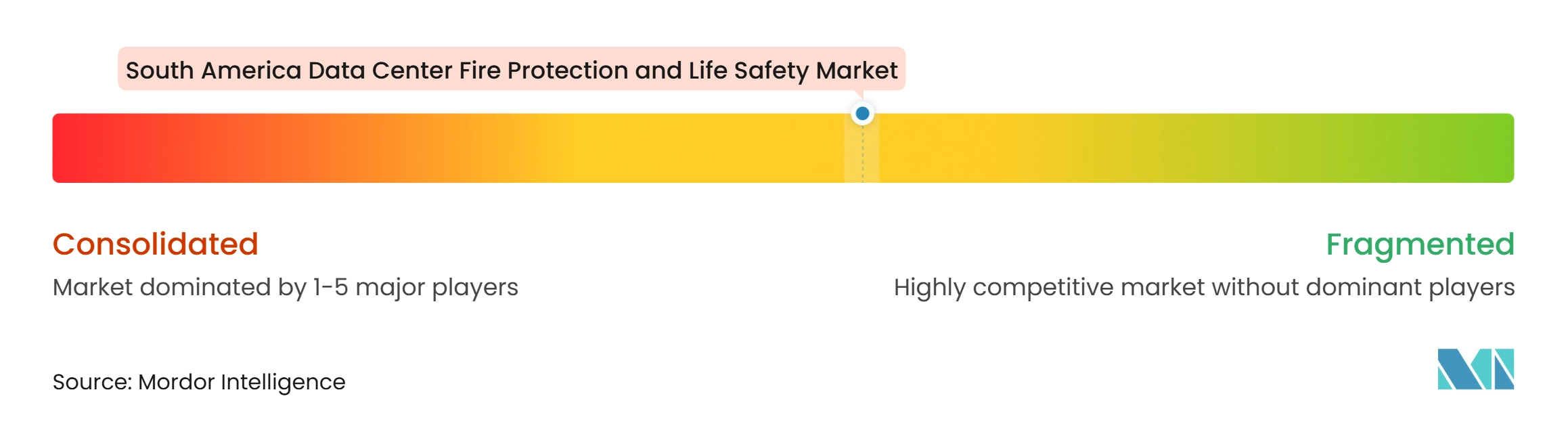
The South America data center fire protection and life safety market has moderate consolidation among global suppliers. Johnson Controls, Siemens, and Honeywell provide portfolios that combine detection, suppression, monitoring, and life safety functions. WAGNER Group, Marioff, and SEVO Systems compete through specialist expertise in aspirating detection, high-pressure water mist, and oxygen-reduction systems. Suppliers increasingly combine physical fire protection with building management tools to reduce integration work for operators. This approach can make switching providers more difficult after a site adopts a single control environment.
Johnson Controls launched its Simplex Incident Manager workstation in August 2026, giving operators a single view across up to 687 fire alarm control units and 250,000 devices. KiddeFenwal launched NATURA Micro in January 2026 with acoustic nozzle enhancements for sound-sensitive IT environments. UL Solutions introduced testing and certification services for immersion cooling fluids under UL 2417 in June 2025. These moves reflect greater attention to integrated monitoring, battery risks, and liquid-cooling hazards. Compliance with ABNT NBR ISO/IEC 22237-6:2025 and ABNT NBR 10897:2025 can also influence supplier qualification in Brazil.
Inspection, testing, and maintenance providers serve a separate need because operators require independent verification for insurers and compliance bodies. Testing and certification remain important as AI facilities introduce new power equipment, battery systems, and cooling arrangements. Regional contractors can compete through local response capability and familiarity with country-level codes. Global suppliers retain an advantage where projects require integrated systems and specialist engineering support. The competitive structure remains consistent with a market concentration score of 5 because the input identifies moderate global-tier concentration but provides no combined market-share figure for leading suppliers.
South America Data Center Fire Protection and Life Safety Industry Leaders
-
Johnson Controls International plc
-
Siemens AG
-
Honeywell International Inc.
-
Carrier Global Corporation
-
Kidde Global Solutions
- *Disclaimer: Major Players sorted in no particular order
South America Data Center Fire Protection and Life Safety Market Companies Covered in this Report
- Johnson Controls International plc
- Siemens AG
- Honeywell International Inc.
- Carrier Global Corporation
- Robert Bosch GmbH
- Kidde Global Solutions
- Fike Corporation
- Hochiki Corporation
- Minimax Viking GmbH
- Victaulic Company
- Securiton AG
- SEVO Systems, Inc.
- The Chemours Company
- WAGNER Group GmbH
- Marioff Corporation Oy
- Halton Group
- Encore Fire Protection, Inc.
- Bureau Veritas SA
- SGS SA
- UL Solutions Inc.
Recent Industry Developments in South America Data Center Fire Protection and Life Safety Market
- August 2026: Johnson Controls launched the Simplex Incident Manager and Autocall Fire Site Administrator fire safety workstations. The release provided enterprise-scale monitoring and a cybersecurity-focused architecture for mission-critical facilities. The platforms support up to 250,000 devices and connect 687 fire alarm control units. The capability addresses the need for command visibility across expanding hyperscale data center campuses.
- July 2026: FM Global revised Data Sheet 5-32 to advise against clean-agent fire suppression for rack-mounted lithium-ion battery units exceeding 20 kWh. The guidance has direct implications for fire protection design at colocation and hyperscale sites deploying distributed lithium-ion UPS systems. It directs more attention toward water mist and wet-pipe alternatives for battery-room applications.
- June 2026: UL Solutions completed one year since the launch a testing and certification service for immersion cooling fluids under UL 2417. The service addresses autoignition temperature, flash point, and dielectric breakdown voltage risks associated with next-generation liquid cooling. The testing is relevant to hyperscale operators transitioning to immersion cooling as rack density exceeds air-cooling thresholds.
- January 2026: KiddeFenwal launched NATURA Micro, a compact inert gas fire suppression system for high-value small-scale assets such as AI server enclosures. The launch included acoustic nozzle enhancements for sound-sensitive IT environments. It also included a same-day cylinder refill program intended to limit system downtime following a discharge event.
South America Data Center Fire Protection and Life Safety Market Report Scope
The South America Data Center Fire Protection and Life Safety Market comprises the products, systems, software, and services designed to detect, prevent, suppress, monitor, and manage fire and life-safety risks within data center environments across countries such as Brazil, Argentina, Chile, Colombia, and Peru.
The South America Data Center Fire Protection and Life Safety Market is Segmented by Solution Type (Fire Detection and Alarm Systems, Fire Suppression Systems, Emergency Notification and Evacuation Systems, Fire Monitoring and Control Systems, and Inspection, Testing, and Maintenance Services), by Fire Protection Technology (Smoke and Heat Detection, Aspirating Smoke Detection, Clean Agent Suppression, Inert Gas Suppression, Water-Based Suppression, and Other Fire Protection Technologies), by Facility Area (Data Halls and IT Rooms, Electrical and UPS Rooms, Battery Rooms, Cooling and Mechanical Rooms, and Administrative and Support Areas), by Data Center Size (Small, Medium, Large, and Hyperscale), by Data Center Type (Colocation, Cloud Service Providers, and Enterprise and Edge), and by Geography (Brazil, Argentina, and Rest of South America). The Market Forecasts are Provided in Terms of Value (USD).
Segmentation Overview
| Fire Detection and Alarm Systems |
| Fire Suppression Systems |
| Emergency Notification and Evacuation Systems |
| Fire Monitoring and Control Systems |
| Inspection, Testing, and Maintenance Services |
| Smoke and Heat Detection |
| Aspirating Smoke Detection |
| Clean Agent Suppression |
| Inert Gas Suppression |
| Water-Based Suppression |
| Other Fire Protection Technologies |
| Data Halls and IT Rooms |
| Electrical and UPS Rooms |
| Battery Rooms |
| Cooling and Mechanical Rooms |
| Administrative and Support Areas |
| Small |
| Medium |
| Large |
| Hyperscale |
| Colocation |
| Cloud Service Providers |
| Enterprise and Edge |
| Brazil |
| Argentina |
| Rest of South America |
| By Solution Type | Fire Detection and Alarm Systems |
| Fire Suppression Systems | |
| Emergency Notification and Evacuation Systems | |
| Fire Monitoring and Control Systems | |
| Inspection, Testing, and Maintenance Services | |
| By Fire Protection Technology | Smoke and Heat Detection |
| Aspirating Smoke Detection | |
| Clean Agent Suppression | |
| Inert Gas Suppression | |
| Water-Based Suppression | |
| Other Fire Protection Technologies | |
| By Facility Area | Data Halls and IT Rooms |
| Electrical and UPS Rooms | |
| Battery Rooms | |
| Cooling and Mechanical Rooms | |
| Administrative and Support Areas | |
| By Data Center Size | Small |
| Medium | |
| Large | |
| Hyperscale | |
| By Data Center Type | Colocation |
| Cloud Service Providers | |
| Enterprise and Edge | |
| By Geography | Brazil |
| Argentina | |
| Rest of South America |
Key Questions Answered in the Report
What is the size of the South America data center fire protection and life safety market?
The market size is USD 96.50 million in 2026 and is projected to reach USD 223.04 million by 2032. The forecast period CAGR is 14.89% from 2027 to 2032.
What is driving demand for fire protection in South American data centers?
Colocation construction, higher AI rack densities, lithium-ion UPS adoption, and the need to limit costly outages are the main demand factors. These conditions increase the need for detection, suppression, monitoring, and tested operating procedures.
Which solution type has the largest share in 2026?
Fire Suppression Systems lead with 35.96% of revenue in 2026. The segment includes clean agents, inert gas, and water mist systems used in data halls, UPS rooms, battery rooms, and other facility areas.
Which data center area is expanding fastest for fire protection systems?
Battery Rooms are projected to expand at a 15.61% CAGR through 2032. The shift to lithium-ion UPS equipment increases the need for protection that addresses thermal runaway and potential reignition.
Why are water mist systems gaining attention in data centers?
Water mist can reduce water discharge compared with conventional sprinklers and can address lithium-ion battery hazards where clean agents may be unsuitable. FM Global has also advised against clean agents for rack-mounted lithium-ion battery units above 20 kWh.
Which country leads regional spending on data center fire protection and life safety?
Brazil leads with 72.12% of revenue in 2026, supported by its large data center footprint and construction activity. National standards and water constraints also shape the selection of fire detection and suppression systems.