
South America Data Center Climate Risk and Resilience Market Size and Share
Market Overview
| Study Period | 2021 - 2032 |
|---|---|
| Forecast Data Period | 2027 - 2032 |
| Base Year Market Size (2026) | USD 112.34 Million |
| Market Size (2027) | USD 126.68 Million |
| Market Size (2032) | USD 232.82 Million |
| Growth Rate (2027 - 2032) | 12.94 % |
| Market Concentration | Medium |
Major Players *Disclaimer: Major Players sorted in no particular order Image © Mordor Intelligence. Reuse requires attribution under CC BY 4.0. | |
South America Data Center Climate Risk and Resilience Market Analysis by Mordor Intelligence
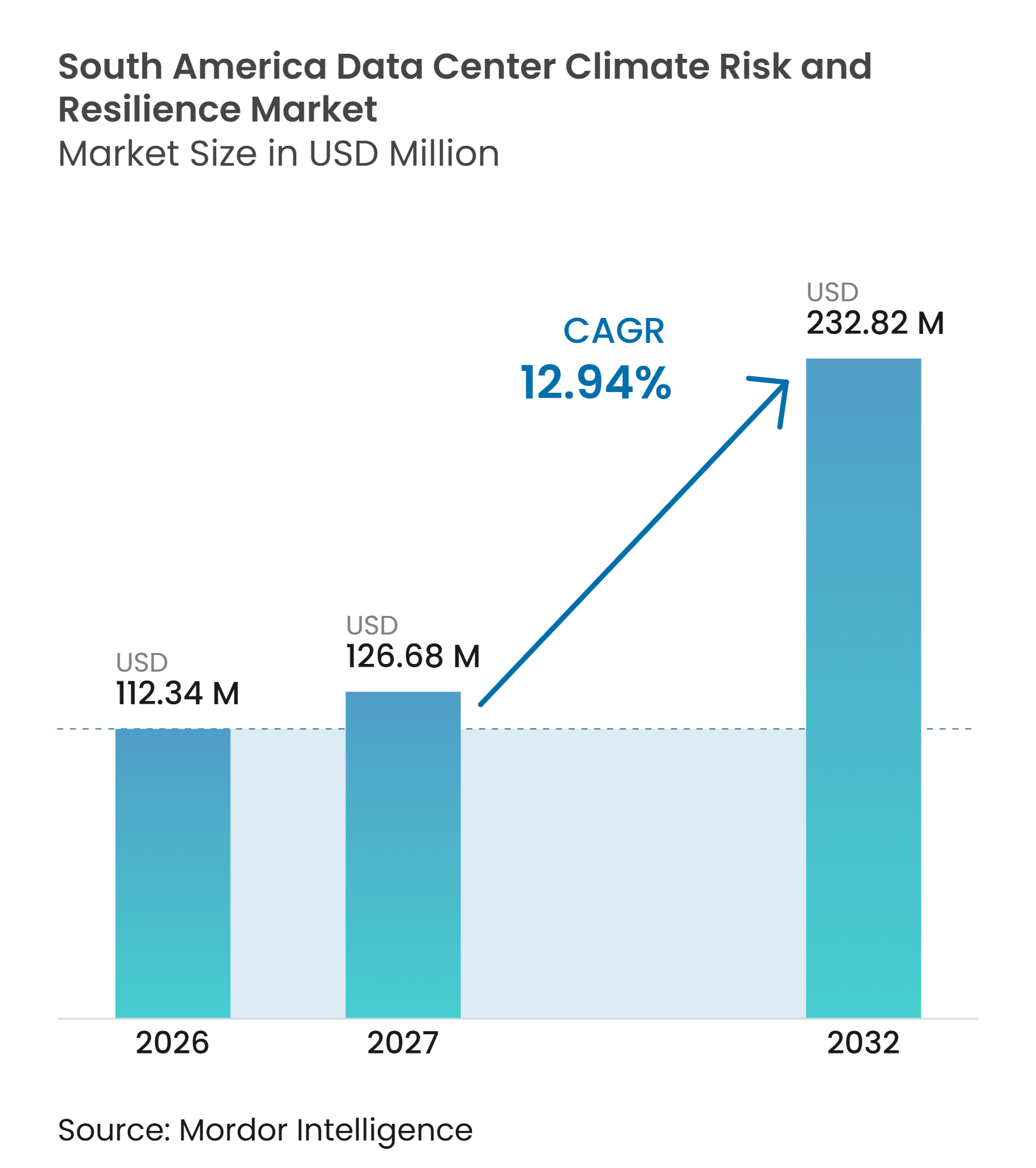
The South America Data Center Climate Risk and Resilience Market size is expected to increase from USD 112.34 million in 2026 to USD 126.68 million in 2027 and reach USD 232.82 million by 2032, growing at a CAGR of 12.94% over 2027-2032. Growth reflects a shift from responding to individual incidents toward managing physical climate risk as a regular part of data center planning and operations. AI workloads are increasing cooling and power requirements, making flood, heat, water, and grid disruptions more consequential for operators. Environmental rules and water-use expectations are also making resilience measures part of project design rather than a later add-on. The South America data center climate risk and resilience market is therefore moving from periodic reviews toward continuous monitoring, stress testing, and documented adaptation plans. This shift creates room for providers that can combine site analysis, engineering design, operating data, and compliance support.
Key Report Takeaways
- By solution type, Climate Risk Assessment and Analytics held 31.74% of the South America data center climate risk and resilience market share in 2026, while Climate Risk Monitoring and Early Warning is projected to expand at a 13.24% CAGR through 2032.
- By climate hazard, Flooding and Sea-Level Rise accounted for 28.39% share in 2026, while Compound and Multi-Hazard Events are projected to grow at a 13.18% CAGR through 2032.
- By assessment method, Historical Hazard Analysis held 32.86% share in 2026, while Climate Stress Testing is expected to advance at a 13.29% CAGR through 2032.
- By resilience strategy, Flood, Fire, and Severe Weather Protection accounted for 26.47% share in 2026, while Power Supply and Grid Resilience is forecast to grow at a 13.22% CAGR through 2032.
- By service type, Climate Risk Consulting held 34.92% share in 2026, while Monitoring and Early Warning Services are projected to expand at a 13.36% CAGR through 2032.
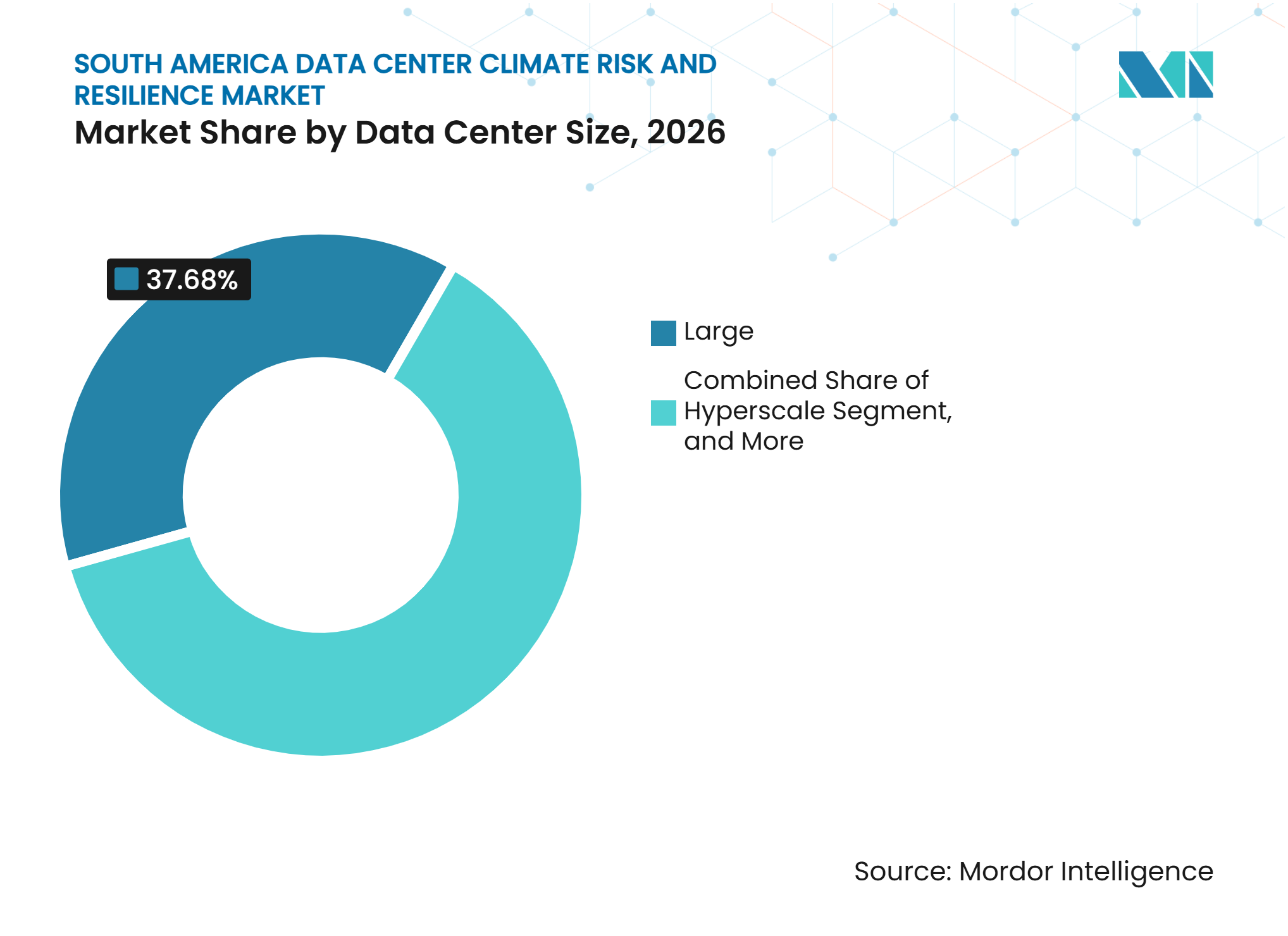
- By data center size, Large Data Centers accounted for 37.68% share in 2026, while Hyperscale Data Centers are expected to grow at a 13.27% CAGR through 2032.
- By data center type, Colocation Facilities held 44.53% share in 2026, while Cloud Service Providers are forecast to expand at a 13.38% CAGR through 2032.
- By geography, Brazil accounted for 54.12% share in 2026, while Argentina is projected to record a 13.32% CAGR through 2032.
Note: Market numbers in this report are based on Mordor Intelligence's proprietary estimation framework, which combines nine months of actuals with Q4 projections for base year 2026.
Market Trends and Insights
Drivers Impact Analysis of South America Data Center Climate Risk and Resilience Market*
| Driver | (~) % Impact on CAGR Forecast | Geographic Relevance | Impact Timeline |
|---|---|---|---|
| Hyperscale and AI Workload Expansion | +2.8% | Brazil, Chile, Argentina, Colombia | Short term (≤ 2 years) |
| Cloud, Colocation, and Digital Infrastructure Investment | +2.4% | Brazil, Chile, Colombia, Peru | Short term (≤ 2 years) |
| Water-Efficient Cooling Mandates and Sustainability Reporting | +1.6% | Brazil, Chile, with spillover to Argentina and Colombia | Medium term (2-4 years) |
| Climate-Adjusted Site Selection and Insurance Requirements | +1.4% | Global, with early gains in São Paulo, Santiago, Buenos Aires | Medium term (2-4 years) |
| Flood, Heat, and Seismic Resilience Retrofits in Existing Facilities | +1.0% | Brazil, Argentina, Colombia | Medium term (2-4 years) |
| Local Engineering and Service-Capability Expansion | +0.7% | Brazil, Chile | Long term (≥ 4 years) |
| Source: Mordor Intelligence | |||
Hyperscale and AI Workload Expansion
The growth of AI computing is increasing the cost of climate-related cooling or power failure across the South America data center climate risk and resilience market. Higher-density systems need more dependable thermal management than conventional installations. South America added 184 MW of colocation capacity in 2025, while total installed capacity reached 1,105 MW by year-end. AI racks that exceed 150 kW increase the operational consequences of a cooling interruption. Scala Data Centers received authorization for a 5-GW power connection for its AI City campus in Eldorado do Sul, where severe flooding occurred in May 2024. This overlap between large new campuses and exposed locations is bringing climate stress testing into earlier project decisions.
Cloud, Colocation, and Digital Infrastructure Investment
Large capital commitments are making documented climate risk work more important to the South America data center climate risk and resilience market. Tecto Data Centers announced in April 2026 that it would invest USD 2 billion through 2028 in 5 Brazilian data centers. ODATA's Colombian development involved USD 1.3 billion and 144 MW of critical capacity, with the initial phases expected to operate in the second half of 2026. Financing decisions now need evidence on long-term water, flood, heat, and power conditions. The Institute of the Americas identifies coordinated planning among municipalities, utilities, and developers as necessary for sustainable data center development in South America. This makes climate consulting and adaptation planning part of the broader investment process.
Water-Efficient Cooling Mandates and Sustainability Reporting
Water management rules are turning cooling design into a commercial issue for the South America data center climate risk and resilience market. Brazil's Legislative Bill PL 5003/2025 proposes water-impact assessments and annual public disclosure of water use for data center installations. These requirements would increase demand for mapping, adaptation planning, and audit support. Chilean scrutiny of groundwater use has also pushed developers to reconsider water-intensive cooling approaches. Closed-loop cooling is becoming more relevant because it can reduce water demand, but it also changes the facility's power and flood-risk profiles. Water-efficient equipment and clear operating disclosures can therefore influence both permitting and site acceptance.
Climate-Adjusted Site Selection and Insurance Requirements
Climate-adjusted site selection is reshaping how developers and insurers assess new facilities in the South America data center climate risk and resilience market. Historical weather records remain useful, but they do not fully represent future flood, heat, drought, or compound-risk conditions. A peer-reviewed study found that combining flood, heat, water stress, and grid reliability can change data center site rankings. This supports the use of physical risk assessment and geospatial analysis before land and equipment decisions are finalized. Formal scenario analysis also provides lenders with a clearer basis for assessing asset durability. It can reduce the risk that a low-cost site will lead to higher operating and insurance costs later.
Restraints Impact Analysis of South America Data Center Climate Risk and Resilience Market*
| Restraint | (~) % Impact on CAGR Forecast | Geographic Relevance | Impact Timeline |
|---|---|---|---|
| High Upfront Cost of Advanced Resilience Systems | -1.8% | South America-wide, especially second-tier markets | Medium term (2-4 years) |
| Water, Grid, and Site-Infrastructure Constraints | -1.5% | Chile, Peru, Colombia, Argentina | Short term (≤ 2 years) |
| Limited Skilled Workforce for Liquid Cooling and Climate Analytics | -0.8% | Argentina, Colombia, Peru | Long term (≥ 4 years) |
| Permitting, Land-Use, and Community Acceptance Delays | -0.5% | Chile, Brazil, coastal and ecologically sensitive sites | Medium term (2-4 years) |
| Source: Mordor Intelligence | |||
High Upfront Cost of Advanced Resilience Systems
Advanced resilience systems can limit adoption across the South America data center climate risk and resilience market, especially among smaller operators. Full adaptation programs can require significant investment in building design, flood protection, cooling, backup power, sensors, and operational processes. This spending is harder to absorb in secondary locations where client demand and margins are lower. Operators in flood-prone and coastal areas may face the greatest need for protection yet have the least available capital. The result is a gap between the facilities that most need improvement and those that can invest earliest. Modular upgrades and phased engineering work can help reduce this barrier.
Water, Grid, and Site-Infrastructure Constraints
Water scarcity and grid limitations restrict viable expansion sites in the South America data center climate risk and resilience market. Drought conditions can raise scrutiny of water-based cooling, particularly in Lima and Santiago. The Institute of the Americas notes that drought cycles are increasing attention to water use in Peru's data center planning.[1] Chile's grid operator projected data center electricity demand of 2,360 MW by 2032. These limits can delay projects and increase the need for grid resilience, alternative cooling systems, and careful site selection. They also make coordination with utilities and public authorities necessary before capacity is committed.
*Our forecasts treat driver/restraint impacts as directional, not additive. The impact forecasts reflect baseline growth, mix effects, and variable interactions.
South America Data Center Climate Risk and Resilience Market Segment Analysis
By Solution Type:
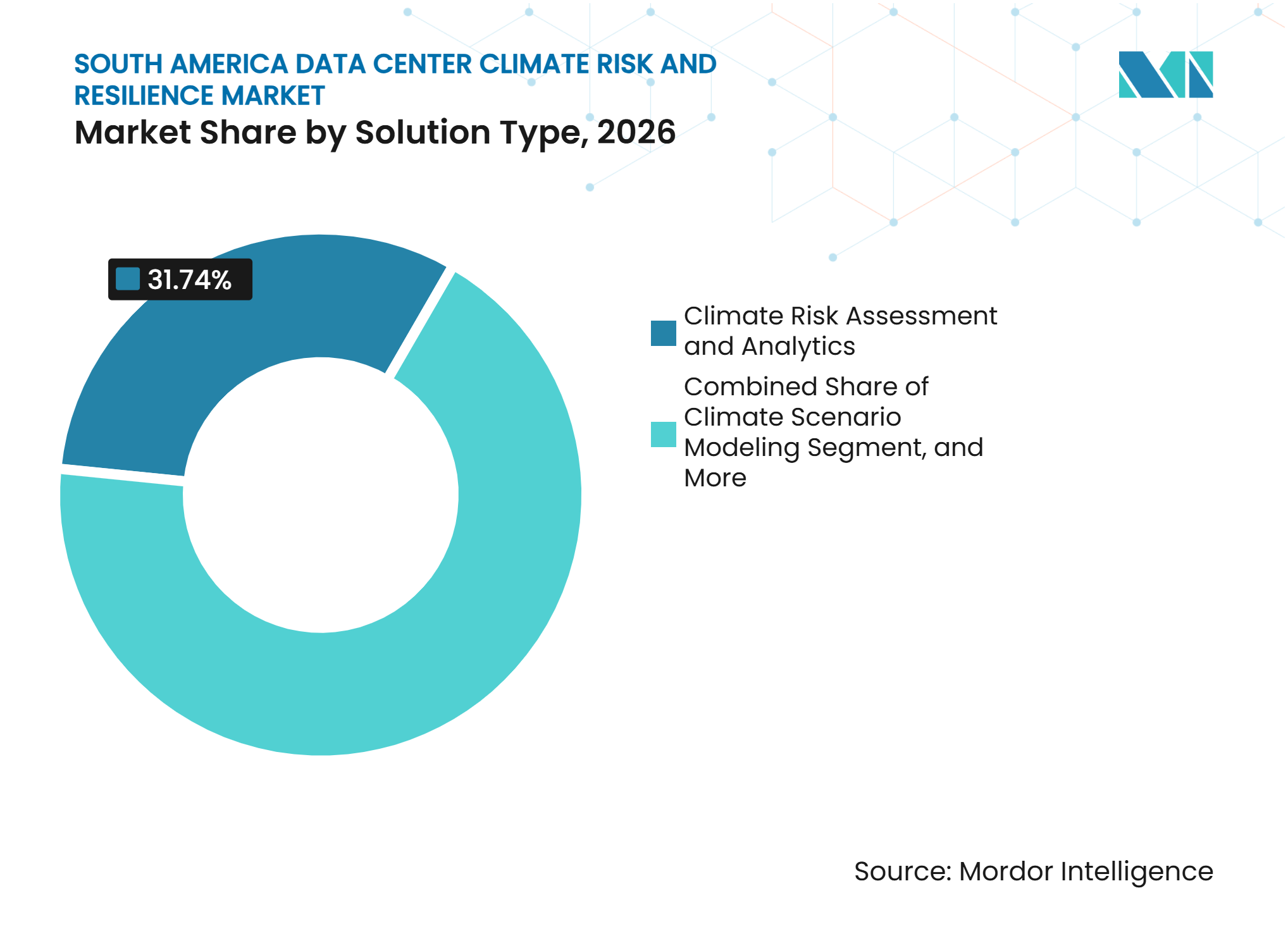
Analytics Leads While Real-Time Monitoring Gains UseClimate Risk Assessment and Analytics held a 31.74% share in 2026 because developers and asset managers often need a structured view of risk before releasing capital. The South America data center climate risk and resilience market size for this segment is supported by its role at the beginning of project planning. Scenario modeling, climate mapping, and adaptation planning usually follow the initial assessment. These offerings help translate a broad climate question into choices on location, building design, equipment, insurance, and operating controls.
Climate Risk Monitoring and Early Warning is projected to record a 13.24% CAGR through 2032. Operators are moving from occasional reports to systems that track changing local conditions and provide time to respond. A 2025 research paper found that integrating real-time hazard data with machine learning can strengthen data center siting and operating decisions. The segment benefits when monitoring is linked to practical procedures for flood preparation, thermal alerts, and power continuity. Its adoption is likely to be strongest where facilities cannot tolerate a narrow warning window.



By Climate Hazard:
Flooding Leads While Compound Events Gain AttentionFlooding and Sea-Level Rise accounted for 28.39% of the total in 2026, making it the largest climate hazard category. Its leading position reflects operational exposure in major urban corridors and river basins where failures can affect connected systems beyond the affected building. Flood barriers, elevated equipment, drainage improvements, and site-level modeling are becoming more common in resilience plans for new and existing campuses. Heat, drought, wind, wildfire, and smoke risks remain important because their effects vary across the region.
Compound and Multi-Hazard Events are projected to grow at a 13.18% CAGR through 2032. This category accounts for the fact that floods, heat, water availability, and grid disruptions can occur together rather than separately. The South America data center climate risk and resilience industry is consequently placing more value on assessments that show interactions between hazards. A multi-hazard review can help operators avoid designs that solve one risk while increasing another. It is particularly relevant for projects that rely on water-intensive cooling or constrained local power systems.
By Assessment Method:
Historical Analysis Remains Established While Stress Testing ExpandsHistorical Hazard Analysis held a 32.86% share in 2026 because multi-year weather records still support many entry-level financing and insurance reviews. The method provides a starting point for measuring exposure at existing facilities. It can identify prior flood, storm, wildfire, and temperature patterns around a site. However, its limits are clearer when expected climate conditions differ from historical patterns.
Climate Stress Testing is projected to expand at a 13.29% CAGR through 2032. The method tests how an asset might perform under different climate conditions and disruption scenarios. It is useful for lenders, boards, and operators that need to understand potential consequences before approving major spending. Physical vulnerability assessment, scenario analysis, and geospatial mapping can supply the inputs for this work. The South America data center climate risk and resilience market benefits as organizations seek evidence that is more forward-looking than a historical review alone can provide.
By Resilience Strategy:
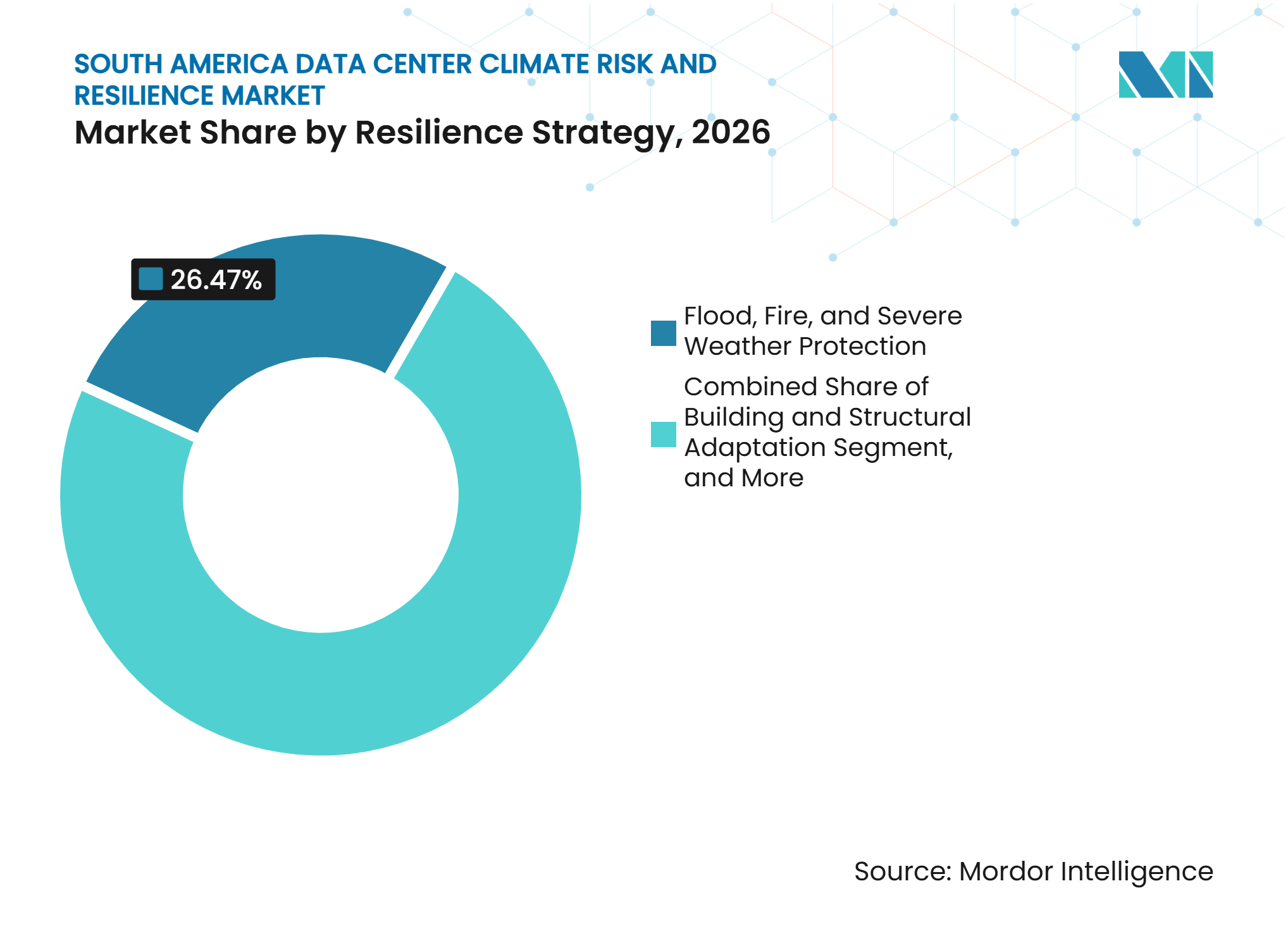
Physical Protection Leads While Grid Resilience AcceleratesFlood, Fire, and Severe Weather Protection accounted for a 26.47% share in 2026. The segment includes barriers, elevated placement of critical equipment, structural improvements, and procedures that reduce damage during severe events. It is a visible, direct response to the risks that can disrupt operations or damage expensive equipment. The strategy also supports tenant confidence when shared facilities need to demonstrate continuity measures.
Power Supply and Grid Resilience is forecast to grow at a 13.22% CAGR through 2032. The U.S. International Trade Administration reported that Brazil's data center power demand could approach 13.2 GW by 2035, from 707 MW in 2023.[2] This creates demand for planning that considers grid availability, backup systems, and the relationship between cooling loads and power reliability. The South America data center climate risk and resilience market will favor solutions that connect power resilience with thermal, water, and site risks. Integrated planning can be more effective than separate upgrades that overlook dependencies.

By Service Type:
Consulting Leads While Continuous Services ExpandClimate Risk Consulting held a 34.92% share in 2026 because many operators start with an expert review before selecting equipment or construction measures. Consulting can support discussions with insurers, lenders, executives, and technical teams. It also helps translate varied environmental risks into a practical investment sequence. Engineering design, adaptation planning, and disclosure support commonly follow the consulting engagement.
Monitoring and Early Warning Services are projected to record a 13.36% CAGR through 2032. Continuous services become more valuable when operators need updates on flood, heat, or grid conditions before an event affects operations. Vertiv's liquid-cooling services portfolio shows that suppliers are expanding their role beyond equipment delivery to include lifecycle services. Service providers that combine alerts with response guidance can become more relevant to clients. This model can also help operators maintain consistent documentation over time.
By Data Center Size:
Large Facilities Lead While Hyperscale Capacity ExpandsLarge Data Centers held a 37.68% share in 2026. These facilities often host multiple tenants and critical enterprise workloads, so a climate-related outage can affect several client agreements simultaneously. Their scale supports spending on formal risk documentation and tailored engineering measures. Small and Medium Data Centers continue to drive demand for more standardized, lower-cost resilience services.
Hyperscale Data Centers are expected to grow at a 13.27% CAGR through 2032. New development activity in greater São Paulo, Campinas, and Argentina is reducing the time between site selection and physical design decisions. Larger campuses also bring greater cooling and power requirements, which increases the value of combined technical and climate expertise. The South America data center climate risk and resilience industry can benefit when services are coordinated rather than purchased in separate stages. Integrated work can help prevent gaps between site assessment, equipment selection, and operating plans.
By Data Center Type:
Colocation Leads While Cloud Providers AccelerateColocation Facilities held a 44.53% share in 2026. Multi-tenant facilities face stronger contractual pressure to avoid downtime and provide documented resilience measures. They can use climate preparation to support client retention and service assurance. Enterprise and edge facilities have different priorities, but multinational clients are encouraging more formal climate reviews across regional operations.
Cloud Service Providers are projected to grow at a 13.38% CAGR through 2032. Their expansion is linked to hyperscale investment in Brazil and Chile and to an active development pipeline in Argentina. The South America data center climate risk and resilience market presents a clear opportunity to support cloud providers before greenfield sites enter detailed design. This includes examining water, flood, heat, grid, and seismic conditions together. Earlier assessment can reduce the risk of costly redesigns once a project has advanced.
Geography Analysis
Brazil
Brazil held 54.12% of the South America data center climate risk and resilience market share in 2026. The Brazilian Association of Data Centers reported 612 MW of operational capacity at mid-2025, with São Paulo accounting for 493 MW. The concentration of facilities around São Paulo and Rio de Janeiro increases exposure to urban flooding and intensive cooling and power demand. Brazil's proposed PL 5003/2025 would introduce water-impact licensing and annual disclosure obligations for data center installations. REDATA links fiscal incentives to water-use efficiency, so lower-water cooling and documented adaptation measures are increasingly important for new projects.
Argentina
Argentina is projected to record a 13.32% CAGR through 2032. CABASE reported 32 MW of operational capacity across 13 Argentine data centers in 2025. Its development pipeline makes forward-looking analysis more relevant than simple reviews of existing sites. Planned facilities in Patagonia add cold-weather and seismic conditions that require tailored site, grid, cooling, and building decisions.
Chile, Colombia, and Peru
Chile faces a water-governance shift after an environmental court ruling blocked groundwater use in a planned Santiago project. Chile's projected data center electricity demand of 2,360 MW by 2032 underscores the need to prioritize grid resilience alongside water and heat management. Colombia is advancing through ODATA's Cundinamarca campus, which brings flood and soil-movement factors into larger project workflows.[3] Peru combines water stress and seismic exposure, while drought cycles are increasing scrutiny of evaporative cooling in Lima. Across these countries, the South America data center climate risk and resilience market size is shaped by different local hazard patterns and compliance requirements.
Competitive Landscape
Market Concentration
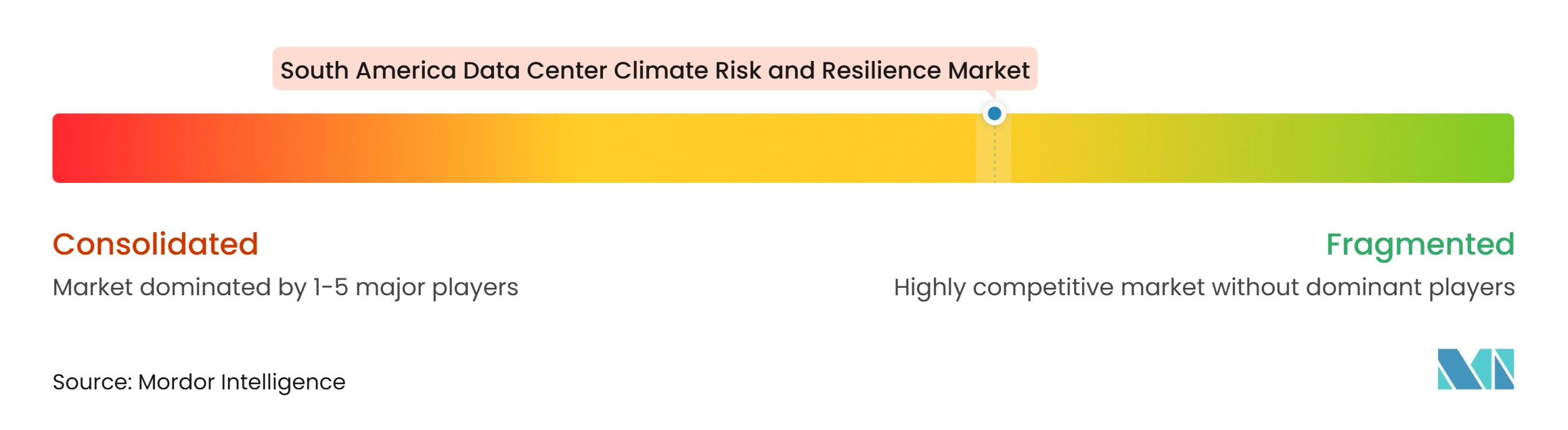
The South America data center climate risk and resilience market remains moderately fragmented. Vertiv and Schneider Electric compete across power, thermal management, and supporting services. Specialist suppliers such as Submer Technologies, LiquidStack, Iceotope Technologies, and Green Revolution Cooling focus on liquid and immersion cooling options. This mix gives operators multiple paths to address high-density computing and water constraints. It also means that no single supplier currently combines climate scenario modeling, physical adaptation design, and continuous monitoring into a single managed offering.
Vertiv launched a liquid-cooling services portfolio in February 2025, expanding its role to include commissioning, fluid management, and ongoing support.[4] In September 2026, the company formalized a distribution partnership with ISECOM in Argentina to broaden access to its portfolio of power, cooling, and IT infrastructure. Schneider Electric introduced an integrated liquid cooling portfolio with Motivair in September 2025, covering cooling distribution units, rear-door heat exchangers, chillers, and cold plates. These moves show that larger vendors are seeking longer relationships that extend beyond a single equipment purchase.
Johnson Controls launched its YORK YDAM air-cooled magnetic-bearing centrifugal chiller in February 2026 for high-density facilities that need zero-water cooling. It also published thermal management reference designs for gigawatt-scale AI data centers that included dry-cooler configurations. ODATA implemented DeltaFlow liquid cooling at its SP04 campus in Brazil in September 2026 through a partnership with Munters. Brazil's water-use requirements and Chilean permitting conditions favor suppliers that can demonstrate efficient cooling, dependable power, and evidence-based operating controls. Competitive advantage will depend on linking climate information to practical facility changes and ongoing service support.
South America Data Center Climate Risk and Resilience Industry Leaders
-
Vertiv Holdings Co
-
Schneider Electric SE
-
STULZ GmbH
-
Rittal GmbH & Co. KG
-
Johnson Controls International plc
- *Disclaimer: Major Players sorted in no particular order
South America Data Center Climate Risk and Resilience Market Companies Covered in this Report
- Vertiv Holdings Co
- Schneider Electric SE
- STULZ GmbH
- Rittal GmbH & Co. KG
- Johnson Controls International plc
- Munters Group AB
- Daikin Industries, Ltd.
- Mitsubishi Electric Corporation
- Alfa Laval AB
- Carrier Global Corporation
- Trane Technologies plc
- Modine Manufacturing Company
- Motivair Corporation
- CoolIT Systems Inc.
- LiquidStack Inc.
- Submer Technologies S.L.
- Iceotope Technologies Limited
- Green Revolution Cooling, Inc.
- Asperitas B.V.
- Delta Electronics, Inc.
- Huawei Technologies Co., Ltd.
Recent Industry Developments in South America Data Center Climate Risk and Resilience Market
- September 2026: ODATA, an Aligned Data Centers company, implemented DeltaFlow™ liquid cooling technology, developed in partnership with Munters, at its SP04 campus in Brazil with a combined investment of USD 630 million across Brazilian and Mexican sites. Munters commenced manufacturing DeltaFlow units at its Araucária, Paraná facility for future ODATA deployments in Chile and Colombia.
- September 2026: Vertiv formalized a distribution partnership with ISECOM in Argentina, extending its power, cooling, and IT infrastructure portfolio across Buenos Aires, Córdoba, Rosario, and Mendoza to serve the Southern Cone's growing hyperscale and colocation pipeline.
- July 2026: Green Capital, Poland, signed a memorandum of understanding with Schneider Electric, Wärtsilä, Envision Energy, and Ore Energy for the Atlas GigaHub AI data center campus in Trelew, Chubut, Argentina, targeting 300 MW in the first phase with an estimated investment of USD 3-5 billion and an ultimate target of 3,000 MW IT capacity.
- May 2026: Iceotope Technologies raised USD 26 million in a Series B round led by Two Seas Capital and Barclays Climate Ventures, directed toward scaling precision liquid cooling for AI and edge data center environments.
South America Data Center Climate Risk and Resilience Market Report Scope
The South America data center climate risk and resilience market encompasses solutions and services that help data center operators assess, mitigate, and adapt to climate-related risks, including extreme weather events, flooding, heatwaves, water scarcity, and power disruptions. These offerings support business continuity, infrastructure reliability, and operational resilience across data centers in the region.
The South America Data Center Climate Risk and Resilience Market Report is Segmented by Solution Type (Climate Risk Assessment and Analytics, Climate Scenario Modeling, Climate Risk Mapping and Geospatial Analysis, Climate Adaptation and Resilience Planning, Climate Risk Monitoring and Early Warning, and Climate Risk Advisory and Engineering Services), Climate Hazard (Extreme Heat and Heatwaves, Flooding and Sea-Level Rise, Hurricanes, Cyclones, and Severe Windstorms, Wildfires and Smoke Exposure, Drought and Water Scarcity, Extreme Cold, Ice, and Snow Events, and Compound and Multi-Hazard Events), Assessment Method (Historical Hazard Analysis, Forward-Looking Climate Scenario Analysis, Physical Risk and Vulnerability Assessment, Geographic and Geospatial Risk Mapping, Climate Stress Testing, and Financial and Asset-Level Climate Risk Quantification), Resilience Strategy (Site Selection and Climate-Informed Planning, Building and Structural Adaptation, Cooling and Thermal Resilience, Water Availability and Conservation Measures, Power Supply and Grid Resilience, Flood, Fire, and Severe Weather Protection, and Multi-Hazard Adaptation Planning), Service Type (Climate Risk Consulting, Climate Engineering and Design, Climate Adaptation Planning, Monitoring and Early Warning Services, and Risk Auditing and Disclosure Support), Data Center Size (Small, Medium, Large, and Hyperscale), Data Center Type (Colocation, Cloud Service Providers (CSPs), and Enterprise and Edge), and Geography (Brazil, Chile, Argentina, Colombia, Peru, and Rest of South America). The Market Forecasts are Provided in Terms of Value (USD).
Segmentation Overview
| Climate Risk Assessment and Analytics |
| Climate Scenario Modeling |
| Climate Risk Mapping and Geospatial Analysis |
| Climate Adaptation and Resilience Planning |
| Climate Risk Monitoring and Early Warning |
| Climate Risk Advisory and Engineering Services |
| Extreme Heat and Heatwaves |
| Flooding and Sea-Level Rise |
| Hurricanes, Cyclones, and Severe Windstorms |
| Wildfires and Smoke Exposure |
| Drought and Water Scarcity |
| Extreme Cold, Ice, and Snow Events |
| Compound and Multi-Hazard Events |
| Historical Hazard Analysis |
| Forward-Looking Climate Scenario Analysis |
| Physical Risk and Vulnerability Assessment |
| Geographic and Geospatial Risk Mapping |
| Climate Stress Testing |
| Financial and Asset-Level Climate Risk Quantification |
| Site Selection and Climate-Informed Planning |
| Building and Structural Adaptation |
| Cooling and Thermal Resilience |
| Water Availability and Conservation Measures |
| Power Supply and Grid Resilience |
| Flood, Fire, and Severe Weather Protection |
| Multi-Hazard Adaptation Planning |
| Climate Risk Consulting |
| Climate Engineering and Design |
| Climate Adaptation Planning |
| Monitoring and Early Warning Services |
| Risk Auditing and Disclosure Support |
| Small |
| Medium |
| Large |
| Hyperscale |
| Colocation |
| Cloud Service Providers (CSPs) |
| Enterprise and Edge |
| Brazil |
| Chile |
| Argentina |
| Colombia |
| Peru |
| Rest of South America |
| By Solution Type | Climate Risk Assessment and Analytics |
| Climate Scenario Modeling | |
| Climate Risk Mapping and Geospatial Analysis | |
| Climate Adaptation and Resilience Planning | |
| Climate Risk Monitoring and Early Warning | |
| Climate Risk Advisory and Engineering Services | |
| By Climate Hazard | Extreme Heat and Heatwaves |
| Flooding and Sea-Level Rise | |
| Hurricanes, Cyclones, and Severe Windstorms | |
| Wildfires and Smoke Exposure | |
| Drought and Water Scarcity | |
| Extreme Cold, Ice, and Snow Events | |
| Compound and Multi-Hazard Events | |
| By Assessment Method | Historical Hazard Analysis |
| Forward-Looking Climate Scenario Analysis | |
| Physical Risk and Vulnerability Assessment | |
| Geographic and Geospatial Risk Mapping | |
| Climate Stress Testing | |
| Financial and Asset-Level Climate Risk Quantification | |
| By Resilience Strategy | Site Selection and Climate-Informed Planning |
| Building and Structural Adaptation | |
| Cooling and Thermal Resilience | |
| Water Availability and Conservation Measures | |
| Power Supply and Grid Resilience | |
| Flood, Fire, and Severe Weather Protection | |
| Multi-Hazard Adaptation Planning | |
| By Service Type | Climate Risk Consulting |
| Climate Engineering and Design | |
| Climate Adaptation Planning | |
| Monitoring and Early Warning Services | |
| Risk Auditing and Disclosure Support | |
| By Data Center Size | Small |
| Medium | |
| Large | |
| Hyperscale | |
| By Data Center Type | Colocation |
| Cloud Service Providers (CSPs) | |
| Enterprise and Edge | |
| By Geography | Brazil |
| Chile | |
| Argentina | |
| Colombia | |
| Peru | |
| Rest of South America |
Key Questions Answered in the Report
What is the size of the South America data center climate risk and resilience market?
The market is projected to increase from USD 112.34 million in 2026 to USD 232.82 million by 2032, at a 12.94% CAGR from 2027.
What is driving investment in data center climate resilience in South America?
AI computing, new cloud capacity, water-use rules, flood exposure, and grid constraints are increasing demand for risk assessment, resilient cooling, and operating controls.
Which solution category leads demand for climate resilience services?
Climate Risk Assessment and Analytics led with 31.74% share in 2026 because it supports financing, site selection, and early design decisions.
Which data center segment is expanding most quickly?
Cloud Service Providers are projected to grow at a 13.38% CAGR through 2032 as hyperscale and cloud investment expands across Brazil, Chile, and Argentina.
Why is water management important for South American data centers?
Water constraints and regulatory expectations are increasing the use of closed-loop and air-cooled designs, especially in Brazil, Chile, and Peru.
Which country offers the largest opportunity for climate resilience providers?
Brazil held 54.12% share in 2026 because it has the region's largest operational base and growing requirements for water-efficient, climate-aware infrastructure.