
Market Overview
| Study Period | 2020 - 2031 |
|---|---|
| Forecast Data Period | 2026 - 2031 |
| Base Year Market Size (2025) | USD 1.56 Billion |
| Market Size (2026) | USD 1.64 Billion |
| Market Size (2031) | USD 2.16 Billion |
| Growth Rate (2026 - 2031) | 5.67 % |
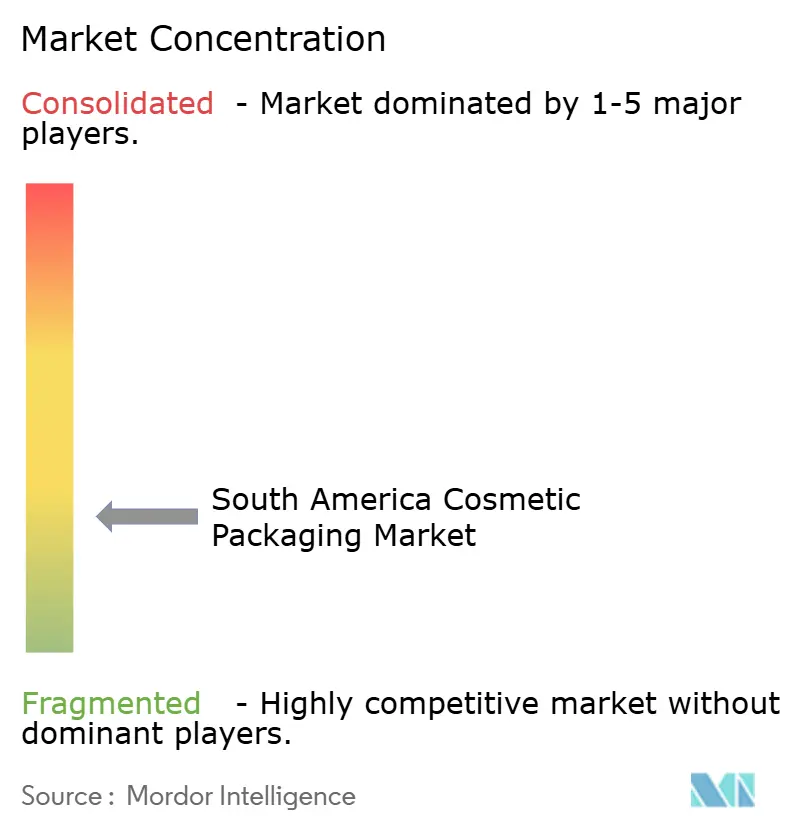
| Market Concentration | Low |
Major Players *Disclaimer: Major Players sorted in no particular order Image © Mordor Intelligence. Reuse requires attribution under CC BY 4.0. | |
South America Cosmetic Packaging Market Analysis by Mordor Intelligence
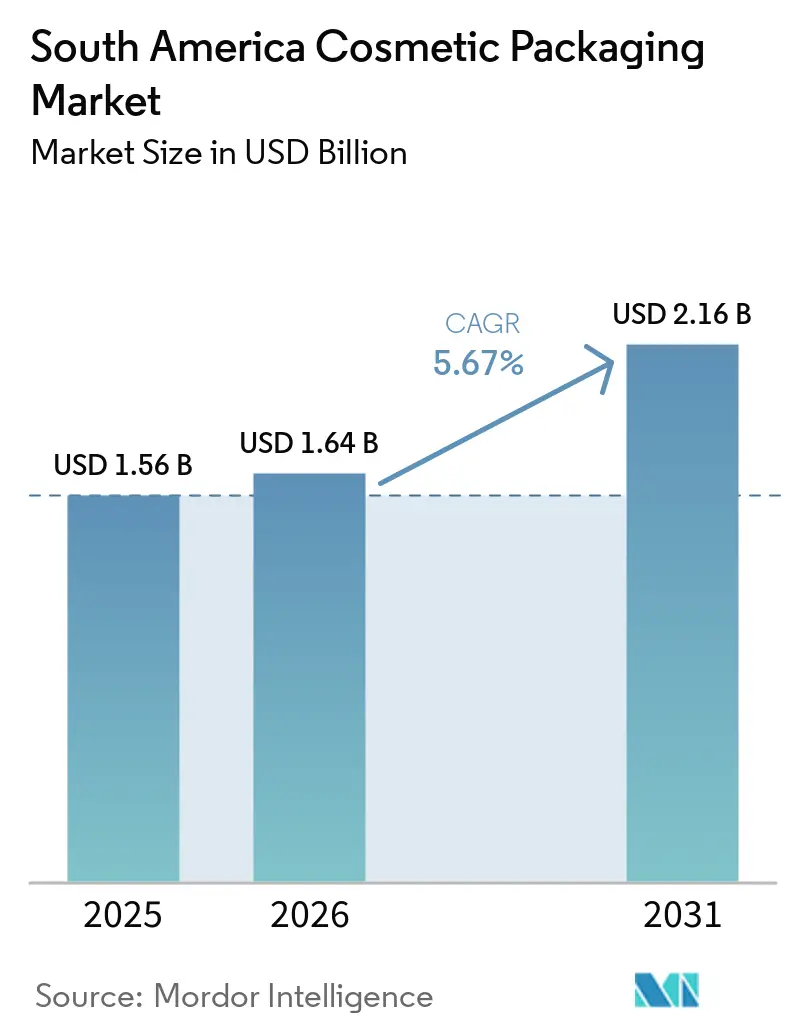
The South America cosmetic packaging market size was valued at USD 1.56 billion in 2025 and is estimated to expand from USD 1.64 billion in 2026 to reach USD 2.16 billion by 2031, at a CAGR of 5.67% during the forecast period (2026-2031). Premium beauty demand is raising requirements for glass, airless dispensing, decoration, and refillable packs across the region. E-commerce is also changing pack design because products need to remain intact through shipment while presenting well in digital retail. New reverse-logistics and recycled-content requirements in Brazil are shifting supplier decisions toward materials, documentation, and traceability systems that support compliance. These changes create opportunities for converters that can produce locally, manage smaller production runs, and offer packaging formats with stronger sustainable-material credentials. The South America cosmetic packaging market, therefore, combines steady demand from established beauty categories with a shift toward higher-value formats and more complex supplier capabilities.
Key Report Takeaways
- By material type, plastics held 58.82% of the South America cosmetic packaging market share in 2025, while glass is projected to expand at a 6.94% CAGR through 2031.
- By product type, bottles and jars accounted for 39.74% of the South America cosmetic packaging market in 2025, while flexible sachets and pouches are expected to expand at a 6.78% CAGR through 2031.
- By dispensing mechanism, pump-based dispensing held 28.63% of the South America cosmetic packaging market share in 2025, while stick and twist-up formats are projected to expand at a 7.01% CAGR through 2031.
- By cosmetic type, skin care accounted for 43.73% of the South America cosmetic packaging market share in 2025, while color cosmetics is expected to expand at a 6.88% CAGR through 2031.
- By country, Brazil held 43.62% of the South America cosmetic packaging market in 2025, while Argentina is projected to expand at a 6.98% CAGR through 2031.
Note: Market size and forecast figures in this report are generated using Mordor Intelligence’s proprietary estimation framework, updated with the latest available data and insights as of January 2026.
Market Trends and Insights
Drivers Impact Analysis of South America Cosmetic Packaging Market*
| Driver | (~) % Impact on CAGR Forecast | Geographic Relevance | Impact Timeline |
|---|---|---|---|
| Premium and Masstige Beauty Consumption | +1.2% | Brazil, Argentina, Chile | Short term (≤ 2 years) |
| E-Commerce-Friendly Lightweight Formats | +1.0% | Brazil, Colombia, Argentina | Short term (≤ 2 years) |
| Refillable and Reusable Delivery Systems | +0.8% | Brazil, Chile, Rest of South America | Medium term (2-4 years) |
| Authentication-Enabled Smart Packaging | +0.6% | Brazil, São Paulo corridor, Colombia | Medium term (2-4 years) |
| Carbon-Label-Ready Packaging Demand | +0.4% | Brazil, Chile, Colombia | Long term (≥ 4 years) |
| Localized Small-Batch Packaging for Indie Beauty Brands | +0.3% | Brazil, Argentina, Colombia | Medium term (2-4 years) |
| Source: Mordor Intelligence | |||
Premium and Masstige Beauty Consumption
The South America cosmetic packaging market is benefiting from greater demand for premium and masstige beauty products in Brazil, Argentina, and Chile, where brands are changing packaging requirements early in product development. The regional premium beauty segment is projected to expand at a notable CAGR through 2031. Higher retail prices raise demand for materials, decoration, and dispensing systems that make a product feel differentiated at the point of sale and reinforce product quality in a crowded retail environment. Suppliers are consequently receiving more requests for glass, laminated metal, airless dispensers, and refillable designs, which require closer coordination among brand, design, and production teams. Brazil's premium beauty segment is projected to expand at a significant CAGR through 2031, supporting demand for these higher-specification formats. The masstige tier broadens the customer base for value-added packaging by bringing premium features to more accessible price points.
E-Commerce-Friendly Lightweight Formats
Digital beauty retail is changing how brands evaluate packaging before a product enters production, because online fulfillment adds shipping and presentation requirements to the usual shelf-display criteria. The region's beauty and personal care e-commerce channel expanded at a significant CAGR during the 5 years through 2024, making delivery durability a central design consideration. Brands need packaging that withstands parcel handling while maintaining an appearance suited to online product pages, sampling programs, and unboxing. Aptar Beauty launched the Sierra, Moda, and Luna airless packs in April 2025, with local production in Colombia, Argentina, Brazil, and Mexico. The company designed the formats for ISTA-6 e-commerce protocols and included recycle-ready PP and PCR-capable components.[1] This approach supports faster supply to regional brands and makes lightweight, delivery-ready formats more practical for the South America cosmetic packaging market.
Refillable and Reusable Delivery Systems
Refillable formats are becoming more relevant as collection systems, policy requirements, and brand sustainability commitments evolve together, shifting refillability from a voluntary feature to a design and operational consideration. Brazil's Mãos Pro Futuro program recovered more than 200,000 tons of post-consumer packaging in 2025 and had accumulated more than 1.5 million tons since 2013. The program covered more than 150 municipalities and worked with 230 picker cooperatives, providing brands with a broader reverse-logistics base for circular packaging programs.[2] Refillable designs can help brands meet policy expectations and present a more durable sustainability proposition to consumers who assess packaging alongside formula and price. Existing high-speed filling lines, however, are not always designed for refill systems, so converters and brand owners may need to invest in equipment changes, testing, and more coordinated component specifications. This creates demand for suppliers that can combine pack design, filling-line compatibility, and compliance support.
Authentication-Enabled Smart Packaging
Connected packaging is gaining attention in markets where premium cosmetics face counterfeiting and product diversion risks, particularly where brand trust depends on product authenticity across several retail channels. Authentication and anti-counterfeiting were cited by most of respondents as the leading reason for connected packaging adoption in a 2026 survey. In Brazil and Colombia, this can make NFC, RFID, and serialized labels a risk-control tool instead of a purely promotional feature, with value for both brand owners and distribution partners. Sleever and Avery Dennison launched INVENTRA in February 2026 as an RFID-integrated shrink sleeve label for item-level identification, anti-counterfeiting, compliance tracking, and circularity information. These formats can also record authentication events and distribution activity, which may support loyalty programs, product verification, and visibility across retail channels. The South America cosmetic packaging market can therefore reward suppliers that pair physical components with traceability functions.
Restraints Impact Analysis of South America Cosmetic Packaging Market*
| Restraint | (~) % Impact on CAGR Forecast | Geographic Relevance | Impact Timeline |
|---|---|---|---|
| Recycled-Resin Price Volatility | -0.9% | Brazil, Colombia, Argentina | Short term (≤ 2 years) |
| Plastic Packaging Regulation and Compliance Costs | -0.7% | Brazil, national level, spill-over to Chile and Colombia | Medium term (2-4 years) |
| Filling-Line Incompatibility of Novel Biomaterials | -0.4% | Brazil, Argentina | Medium term (2-4 years) |
| Reverse-Logistics and Collection Gaps | -0.3% | Rest of South America, Colombia, Peru | Long term (≥ 4 years) |
| Source: Mordor Intelligence | |||
Recycled-Resin Price Volatility
Recycled-resin costs can limit the pace at which converters adopt higher recycled content, even when brand owners have committed to more sustainable material specifications. In mid-2026, recycled PET premiums tracked 20-30% above virgin-resin parity, and normalization was not expected before 2027. South American converters that need post-consumer recycled resin can face higher procurement costs, especially when imported resin is needed to meet quality, consistency, or volume requirements. Those costs can reduce converter margins or raise prices for brand owners serving price-sensitive consumers and competing in mass beauty categories. Limited domestic recycling capacity also exposes buyers to freight costs and pricing conditions in North American and European supply markets. The resulting price gap can slow voluntary adoption of recycled materials beyond mandatory requirements.
Plastic Packaging Regulation and Compliance Costs
Brazil's plastic packaging rules are creating a multiyear compliance burden for manufacturers, importers, distributors, and retailers, including cosmetic packaging suppliers, who need to adjust their sourcing and reporting processes. Federal Decree No. 12,688/2025 set recovery targets beginning at 32% in 2026 and increasing to 50% by 2040. The decree also requires at least 22% recycled content in 2026, rising to 40% by 2040, and allows fines of up to BRL 50 million (USD 8.7 million) for noncompliance.[3] Documentation, traceability, and enrollment obligations add operating costs that smaller converters may find difficult to absorb without passing some of the burden through to customers. Brazil's ANVISA and ABIHPEC framework also shapes compliance expectations for sustainable and premium packaging categories. Related notification rules in Colombia and bloc-level requirements can increase the burden for suppliers operating across more than 1 country.
*Our forecasts treat driver/restraint impacts as directional, not additive. The impact forecasts reflect baseline growth, mix effects, and variable interactions.
South America Cosmetic Packaging Market Segment Analysis
By Material Type:
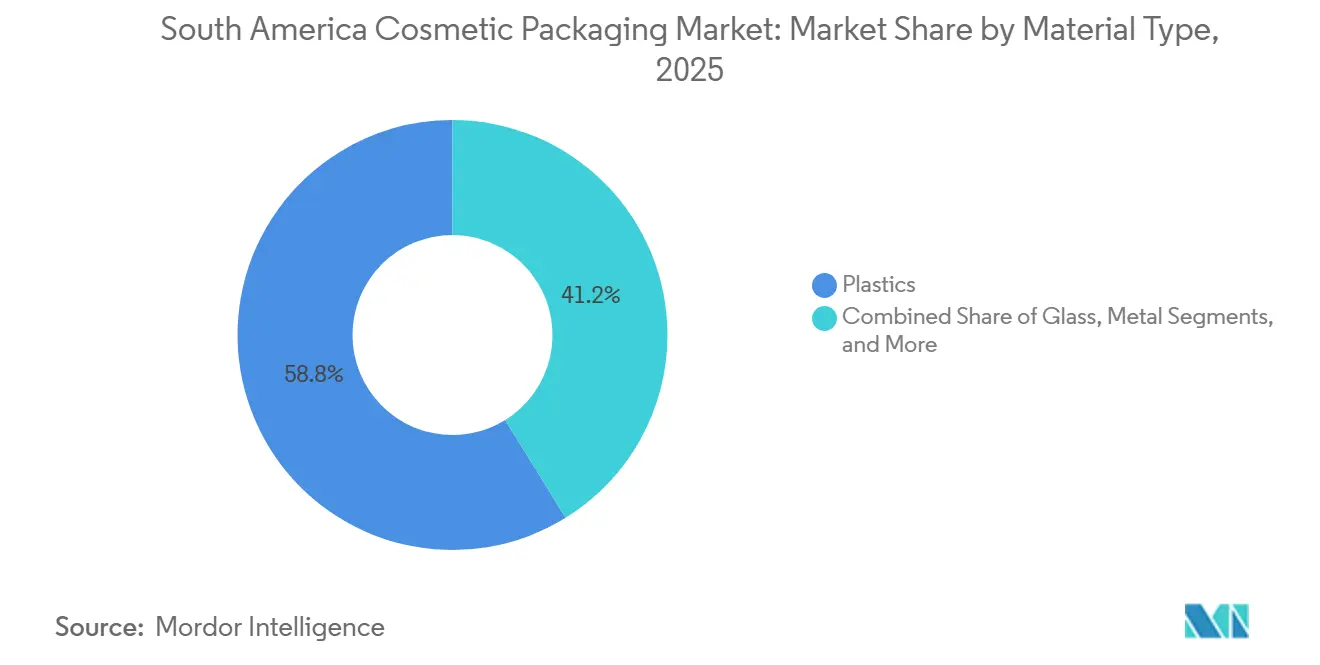
Glass Gains From Premium Beauty DemandPlastics held 58.82% of the South America cosmetic packaging market share in 2025, supported by cost efficiency, processing flexibility, and established converter capacity in Brazil and Colombia. PET is widely used because it offers clarity and suits a range of formats, from shampoo bottles to serum containers. Its recyclability profile also makes PET relevant as brands respond to material and regulatory requirements. PP and PE remain common in caps, tubes, and flexible liners because they offer favorable cost-to-weight performance. Paper and paperboard are increasingly used for folding cartons, especially by independent brands working with Brazilian converters.
Glass is projected to expand at a 6.94% CAGR through 2031, the fastest rate among material types in the South America cosmetic packaging market. Its position reflects demand for premium presentation and packaging that supports circular design claims. Glass is particularly suited to fragrance, serums, body oils, and other products where weight, clarity, and tactile quality are part of product positioning. Gerresheimer presented high post-consumer recycled-content glass, lightweight formats, and refillable solutions for natural cosmetics at BIOFACH 2026. Even so, premium brands can use glass to combine higher-value design with reuse and recycled-content objectives.

By Product Type:
Sachets and Pouches Add FlexibilityBottles and jars accounted for 39.74% of the South America cosmetic packaging market size in 2025, as they remain central to skin care, hair care, and fragrance applications. Serums, facial creams, conditioners, and lotion products continue to support demand for these formats. In premium price tiers, brands are increasingly using airless bottles, glass jars, and more elaborate closures. Folding cartons provide outer packaging for refill systems and premium gift sets. Corrugated transit boxes are also becoming increasingly important as online retail drives demand for compact, certified, and resilient shipping packaging.
Flexible sachets and pouches are projected to expand at a 6.78% CAGR through 2031, the fastest rate within product types. These formats serve online sample fulfillment, travel use, refill systems, and lower entry-price strategies in Colombia and Peru. Flexible formats also meet the needs of brands entering Tier 2 and Tier 3 cities, where purchase sizes are smaller. The InvPack single-dose machine, used across South America since 2025, showed the regional availability of flexible single-dose cosmetic filling capabilities. The South America cosmetic packaging industry can use these formats to balance convenience, cost, and delivery performance.
By Dispensing Mechanism:
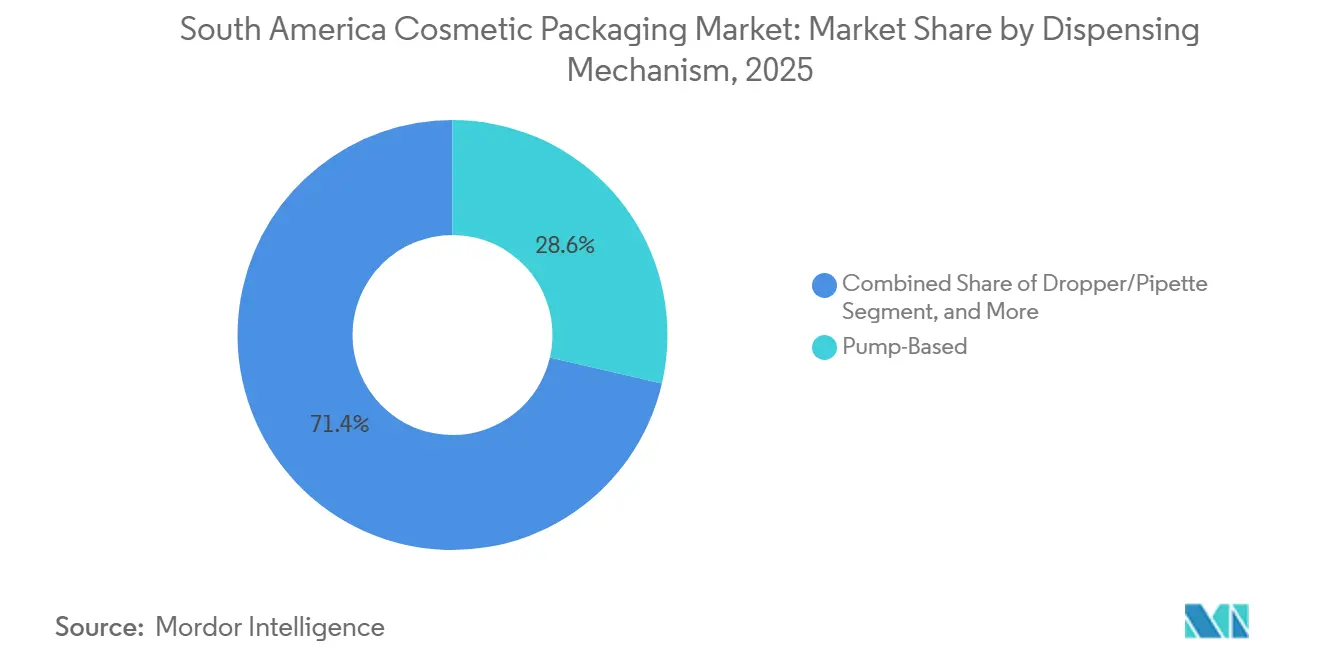
Portable Formats Support Color CosmeticsPump-based dispensing held 28.63% of the market in 2025, reflecting its established use in skin care lotions, foundation, and hair treatments. Airless pump systems are important for formulas containing retinol, vitamin C, and niacinamide because they can help preserve product stability. They also support more precise dispensing, which is relevant for products with premium or active-ingredient positioning. Jar and scoop formats remain common in premium face cream products, where the packaging is part of the user experience. Refillable pump systems may add further demand as brands extend circular packaging programs.
Stick and twist-up formats are expected to expand at a 7.01% CAGR through 2031, supported by portable color cosmetics and multifunctional products. Lip balms, solid foundations, blush sticks, and multi-use color products commonly use these mechanisms. It combines controlled application with a convenient, compact pack. It also supports products that use an integrated applicator instead of a separate tool. The South America cosmetic packaging market is consequently seeing dispensing choices move closer to each product's intended application and use occasion.
By Cosmetic Type:
Skin Care Sets Packaging RequirementsSkin care held 43.73% of the market value in 2025 and guided much of the demand for premium dispensers, glass, and airless packaging in South America. Facial care products, including serums, moisturizers, and SPF products, require accurate dosing, product protection, and more polished primary packaging. Body care is a large-volume category, although premium offerings also use pump lotion systems and glass body oil bottles. Online beauty sales have strengthened the need for leak-resistant packaging that performs well in digital product presentation. Its range of formulations favors suppliers with expertise in pumps, closures, and barrier performance.
Color cosmetics is projected to expand at a 6.88% CAGR through 2031, making it the fastest-moving cosmetic type in the South America cosmetic packaging market. The category expanded in the first half of 2025, while fashion-house beauty extensions increased notably. These products use precision components such as lip-liner twist-ups, mascara wands, compact cases, and magnetic eyeshadow palettes. Such components require closer tolerances and more complex assembly than standard bottles. Fragrance accounted for most of total beauty sales in the first half of 2025 and continued to support demand for glass flacons, metal closures, and branded cartons.
Geography Analysis
Brazil Cosmetic Packaging Market
Brazil accounted for 43.62% of the South America cosmetic packaging market in 2025, supported by its role as a regional manufacturing and logistics center. Mãos Pro Futuro recovered more than 200,000 tons of post-consumer packaging in 2025, bringing the total to more than 1.5 million tons since 2013. The program covered more than 150 municipalities and included more than 6,500 pickers across 230 cooperatives. This infrastructure supports the direction of Brazil's reverse-logistics policy, although collection gaps remain outside major metropolitan areas..
Argentina and Chile Cosmetic Packaging Market
Argentina is projected to expand at a 6.98% CAGR through 2031, the fastest rate among the countries discussed in the South America cosmetic packaging market. Fragrance and skin care premiumization are shifting demand toward glass, premium closures, and airless dispensers. The market offers a demand pipeline for suppliers capable of managing import complexity and foreign-exchange constraints. Chile remains a stable mid-sized market where modern retail supports demand for mid-premium plastic and glass formats.
South America Cosmetic Packaging Market
Peru, Bolivia, Ecuador, Uruguay, and other countries in the region represent smaller demand centers that are often supplied from Brazil and Colombia. Across these countries, natural and Amazonian-ingredient cosmetics support demand for amber glass droppers, paperboard cartons, and refillable jars. Independent South American brands are also seeking short-run and small-batch solutions that reflect local identity. Regional converters may be well placed to meet those requirements because they can respond to smaller orders and changing designs.
Competitive Landscape
The South America cosmetic packaging market is moderately fragmented, with multinational suppliers competing alongside regional converters. Albéa, AptarGroup, Amcor, and Gerresheimer form part of the multinational supplier group. Wheaton Brasil Vidros, TUBAPLAS, Simex SAS, and Induvases SAS serve regional brand owners with local production and design capabilities. Regional suppliers can offer speed, pricing flexibility, and smaller order quantities. Multinational suppliers are expanding regional production and supply networks to narrow these advantages.
Albéa agreed to acquire Amfora Packaging in August 2025, gaining access to operations in Colombia and Peru through the supply base created from Bogotá-based Intecplast and Lima-based Pieriplast. The transaction expanded Albéa's access to customers in the region for color cosmetics, skin care, personal care, and fragrance packaging. Aptar's local-for-local manufacturing approach used facilities in Colombia, Argentina, Brazil, and Mexico to supply regional brands with the Sierra, Moda, and Luna airless portfolio. Amcor completed its acquisition of Berry Global in April 2025, creating a larger global consumer and healthcare packaging company with a stated target of USD 650 million in pre-tax synergies by fiscal year-end 2028. These moves make scale, local production, and a wider technology base more important competitive tools.
Sustainable materials, reuse, and traceability features are helping suppliers move beyond standard packaging components. Sleever and Avery Dennison's INVENTRA label combines item identification, anti-counterfeiting, compliance tracking, and circularity data in 1 component. Gerresheimer's BIOFACH 2026 portfolio highlighted lightweight, refillable, and high-post-consumer-recycled-content glass options for natural cosmetics. Opportunities remain in mono-material dispensing systems, locally sourced biomaterial packaging, and refillable primary packs that meet Brazilian regulatory requirements.
South America Cosmetic Packaging Industry Leaders
-
Albéa SA
-
AptarGroup Inc.
-
Amcor Group GmbH
-
Silgan Holdings Inc.
-
DS Smith PLC
- *Disclaimer: Major Players sorted in no particular order
South America Cosmetic Packaging Market Companies Covered in this Report
- Albea SA
- AptarGroup Inc.
- Amcor plc
- Silgan Holdings Inc.
- DS Smith PLC
- Graham Packaging LP
- Quadpack Industries SA
- Libo Cosmetics Co. Ltd
- Gerresheimer AG
- Ball Corporation
- Verescence France SA
- Cosmopak Ltd
- Raepak Ltd
- Rieke Corporation
- Huhtamaki Oyj
- ALPLA Werke Alwin Lehner GmbH
- HCP Packaging Co. Ltd
- Wheaton Brasil Vidros S.A.
- Thomriss Industria e Comercio Ltda.
- C-Pack Creative Packaging S.A.
- Simex S.A.S.
- SOINCO S.A.S.
- TUBAPLAS S.A.
- Ibratec Artes Graficas Ltda.
- Brasilata S.A.
Recent Industry Developments in South America Cosmetic Packaging Market
- July 2026: Gerresheimer started operations at a new plant in Zhenjiang Dagang, China, doubling its production capacity for primary pharmaceutical glass packaging. Separately, the company continued advancing the planned divestment of its Moulded Glass business unit, which generated revenues of EUR 735 million (USD 794 million) in fiscal year 2024, with an adjusted EBITDA margin of 20%, as part of its transformation toward its drug delivery platform.
- February 2026: Sleever and Avery Dennison launched INVENTRA at Paris Packaging Week, an RFID-integrated shrink sleeve label enabling item-level digital identification, anti-counterfeiting, regulatory compliance, and circularity tracking in a single cosmetic packaging component, designed to support digital product passport requirements.
- February 2026: Gerresheimer presented sustainable glass packaging solutions for organic food and natural cosmetics at BIOFACH 2026 (February 10-13, 2026), showcasing high post-consumer recycled glass, lightweight designs, and refillable packaging for the natural beauty segment.
- January 2026: Brazil's ANVISA opened Public Consultations No. 1,380 and No. 1,381/2026 (January 20, 2026), proposing a controlled framework for the reuse and portioning of cosmetic, personal hygiene, and fragrance packaging, a landmark regulatory move that could reshape refillable packaging economics in Brazil's beauty sector.
South America Cosmetic Packaging Market Report Scope
The South America Cosmetic Packaging Market is Segmented by Material (Plastics, Glass, Metal, and Paper and Paperboard), Product Type (Bottles and Jars. Tubes and Sticks. Folding Cartons, Corrugated Transit Boxes, Flexible Sachets and Pouches, and Other Product Types), Dispensing Mechanism (Pump-Based, Dropper / Pipette, Spray / Mist, Stick / Twist-Up, and Jar / Scoop), Cosmetic Type (Hair Care, Color Cosmetics, Perfumes and Fragrances, and Other Cosmetics Type), and Geography (Brazil, Argentina, Chile, Colombia, Peru, Rest of South America). The Market Forecasts are Provided in Terms of Value (USD).
Segmentation Overview
By Material Type
| Plastics | Polyethylene Terephthalate (PET) |
| Polypropylene (PP) | |
| Polyethylene (PE) | |
| Other Plastics | |
| Glass | |
| Metal | |
| Paper and Paperboard |
By Product Type
| Bottles and Jars |
| Tubes and Sticks |
| Folding Cartons |
| Corrugated Transit Boxes |
| Flexible Sachets and Pouches |
| Other Product Type |
By Dispensing Mechanism
| Pump-Based |
| Dropper / Pipette |
| Spray / Mist |
| Stick / Twist-Up |
| Jar / Scoop |
By Cosmetic Type
| Skin Care | Facial Care |
| Body Care | |
| Hair Care | |
| Color Cosmetics | |
| Perfumes and Fragrances | |
| Other Cosmetics Type |
By Country
| Brazil |
| Argentina |
| Chile |
| Colombia |
| Peru |
| Rest of South America |
| By Material Type | Plastics | Polyethylene Terephthalate (PET) |
| Polypropylene (PP) | ||
| Polyethylene (PE) | ||
| Other Plastics | ||
| Glass | ||
| Metal | ||
| Paper and Paperboard | ||
| By Product Type | Bottles and Jars | |
| Tubes and Sticks | ||
| Folding Cartons | ||
| Corrugated Transit Boxes | ||
| Flexible Sachets and Pouches | ||
| Other Product Type | ||
| By Dispensing Mechanism | Pump-Based | |
| Dropper / Pipette | ||
| Spray / Mist | ||
| Stick / Twist-Up | ||
| Jar / Scoop | ||
| By Cosmetic Type | Skin Care | Facial Care |
| Body Care | ||
| Hair Care | ||
| Color Cosmetics | ||
| Perfumes and Fragrances | ||
| Other Cosmetics Type | ||
| By Country | Brazil | |
| Argentina | ||
| Chile | ||
| Colombia | ||
| Peru | ||
| Rest of South America | ||
Key Questions Answered in the Report
What is the size of the South America cosmetic packaging market?
The South America cosmetic packaging market was estimated at USD 1.64 billion in 2026 and is forecast to reach USD 2.16 billion by 2031, at a CAGR of 5.67%. The outlook reflects demand for more specialized beauty packs, locally supplied components, better design, and the wider regional shift toward sustainable materials, reuse systems, and traceability.
Which material leads cosmetic packaging demand in South America?
Plastics led with a 58.82% share in 2025 because of their cost efficiency, flexibility, and established converter capacity. PET, PP, and PE support a range of bottles, caps, tubes, liners, and other everyday cosmetic formats.
Which cosmetic packaging material is expanding fastest in South America?
Glass is projected to expand at a 6.94% CAGR through 2031, supported by premium beauty demand and circular packaging positioning. It is particularly relevant in fragrance, serum, body-oil, and other products where presentation and product protection are important.
Which packaging format is expected to expand fastest?
Flexible sachets and pouches are projected to expand at a 6.78% CAGR through 2031, supported by sampling, travel use, refills, and smaller purchase sizes. They give brands a practical option for online fulfillment and entry-price product strategies.
Which country has the largest demand for cosmetic packaging in South America?
Brazil held 43.62% of regional demand in 2025, supported by its manufacturing base, consumer scale, and reverse-logistics infrastructure. Its regulations and collection programs also influence material specifications and supplier operating practices across the region.