
South America Clothing and Footwear Technical Textile Market Size and Share
Market Overview
| Study Period | 2021 - 2032 |
|---|---|
| Forecast Data Period | 2027 - 2032 |
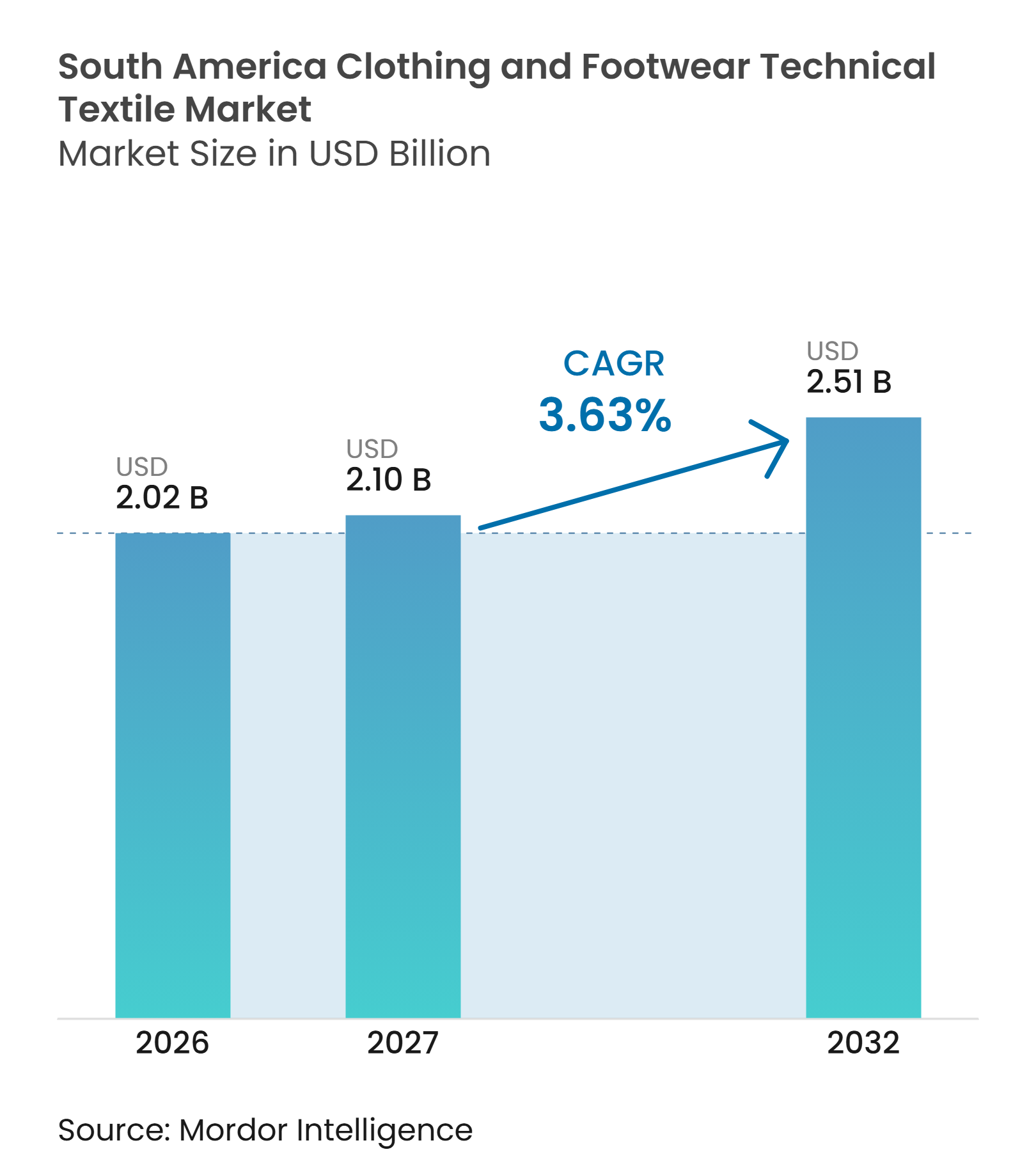
| Base Year Market Size (2026) | USD 2.02 Billion |
| Market Size (2027) | USD 2.10 Billion |
| Market Size (2032) | USD 2.51 Billion |
| Growth Rate (2027 - 2032) | 3.63 % |
| Market Concentration | Medium |
Major Players *Disclaimer: Major Players sorted in no particular order Image © Mordor Intelligence. Reuse requires attribution under CC BY 4.0. | |
South America Clothing and Footwear Technical Textile Market Analysis by Mordor Intelligence
The South America Clothing And Footwear Technical Textile Market size is expected to grow from USD 2.02 billion in 2026 to USD 2.10 billion in 2027 and is forecast to reach USD 2.51 billion by 2032 at 3.63% CAGR over 2027-2032.
The South America clothing and footwear technical textile market covers interlinings, threads, garment tapes, closure components, labels, footwear textiles, and insulation materials used in clothing and footwear. Demand is moving beyond sportswear because performance attributes such as stretch, moisture management, durability, and protection are increasingly built into everyday apparel and footwear, which raises demand for moisture-management fabrics, elastic tapes, reinforced footwear uppers, and protective textile constructions. Higher technical content increases the importance of material qualification, product development support, and engineered trims, allowing suppliers to compete on performance rather than volume alone. Brazil remains the center of regional demand because its conventional textile and footwear supply chains span fiber, fabric, garment, and shoe production. Import pressure and currency changes continue to limit investment by smaller converters, but safety requirements, activewear demand, and recycled-material programs support the regional market.
Key Report Takeaways
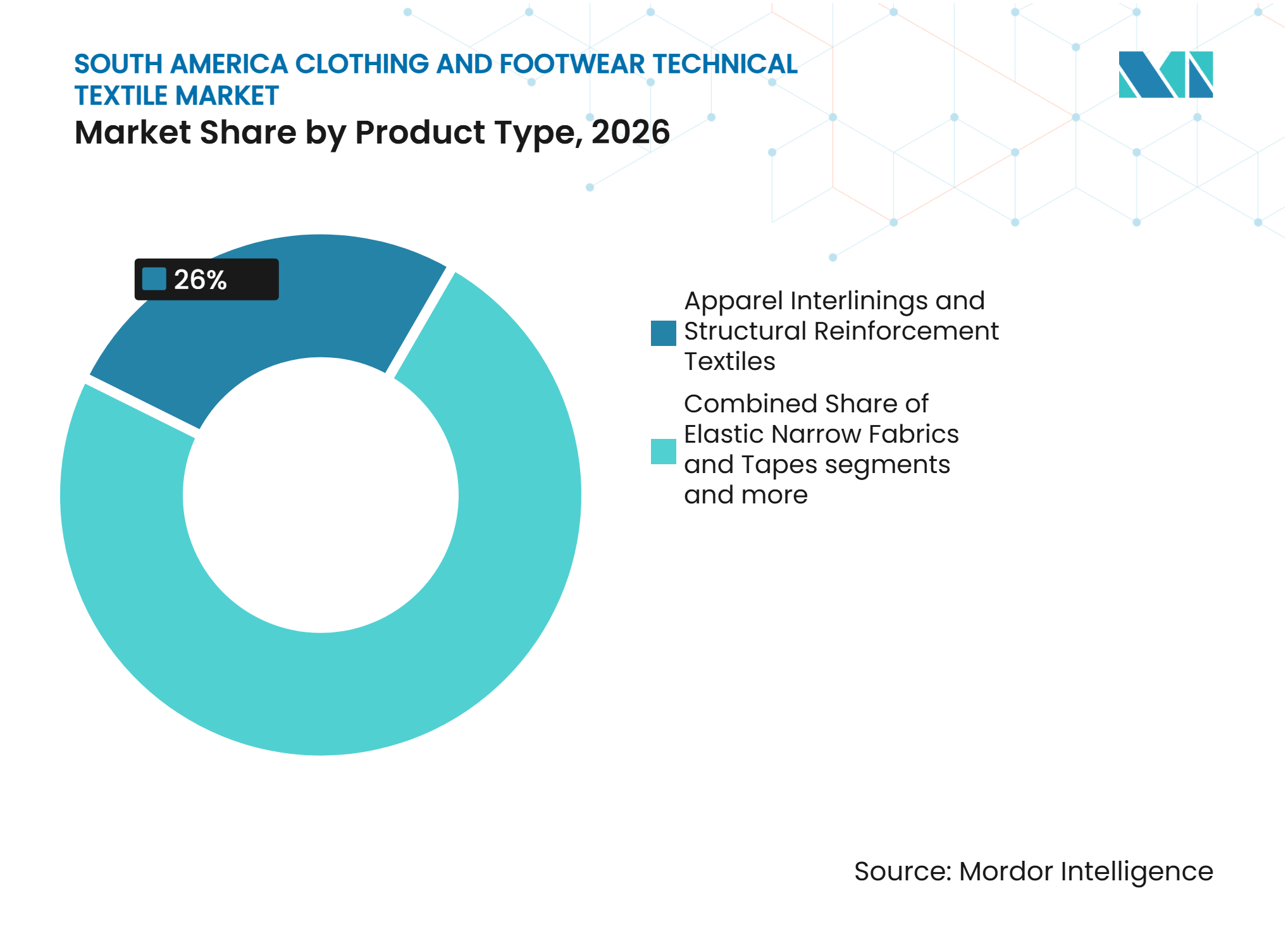
- By product type, apparel interlinings and structural reinforcement textiles accounted for 26.0% of the South America clothing and footwear technical textile market size in 2026, while elastic narrow fabrics and tapes are forecast to grow at a 5.7% CAGR through 2032.
- By material type, polyester accounted for 42.0% of South America clothing and footwear technical textile market share in 2026, while elastane and other elastomeric fibers are forecast to grow at a 5.8% CAGR through 2032.
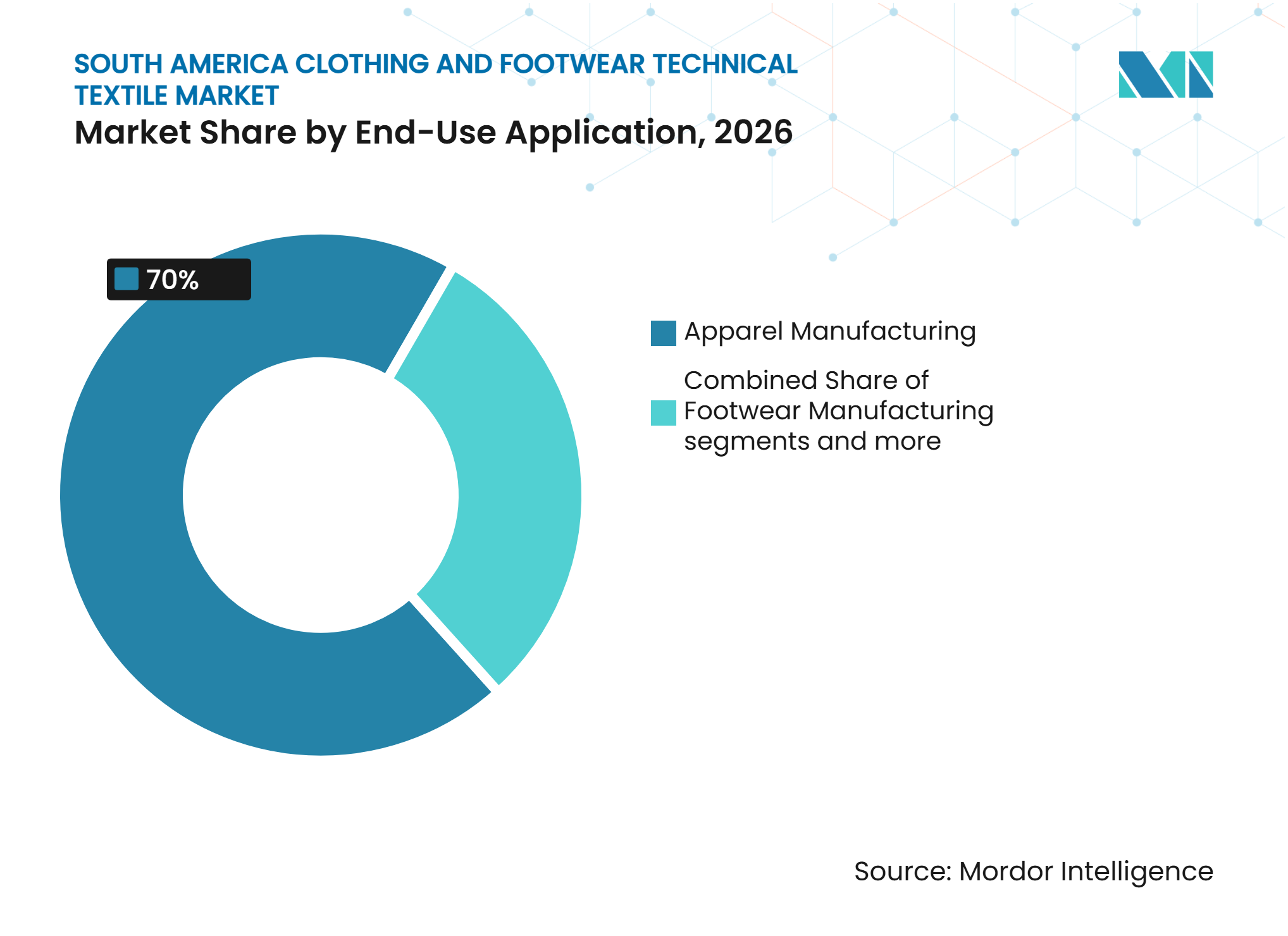
- By end-use application, apparel manufacturing accounted for 70.0% of the regional market in 2026, while athletic and performance footwear is forecast to grow at a 6.1% CAGR through 2032.
- By geography, Brazil accounted for 62.0% of the regional market in 2026, while Colombia is forecast to grow at a 5.3% CAGR through 2032.
Note: Market numbers in this report are based on Mordor Intelligence's proprietary estimation framework, which combines nine months of actuals with Q4 projections for base year 2026.
Market Trends and Insights
Drivers Impact Analysis of South America Clothing and Footwear Technical Textile Market*
| Driver | (~) % Impact on CAGR Forecast | Geographic Relevance | Impact Timeline |
|---|---|---|---|
| Growth of Performance Sportswear and Activewear | +0.8% | Brazil, Colombia, Chile | Short term (≤ 2 years) |
| Expansion of Safety and Protective Workwear | +0.7% | Chile, Peru, Brazil, Colombia | Medium term (2-4 years) |
| Demand for Lightweight and Durable Footwear Components | +0.6% | Brazil, Colombia, Chile | Medium term (2-4 years) |
| Sustainability and Recycled-Material Adoption | +0.4% | Brazil, Colombia, Peru | Long term (≥ 4 years) |
| Regional Nearshoring and Shorter Product Development Cycles | +0.3% | Colombia, Peru, Northeast Brazil | Short term (≤ 2 years) |
| Technical Textiles Embedded in Everyday Apparel | +0.2% | Brazil, Chile, Colombia | Medium term (2-4 years) |
| Source: Mordor Intelligence | |||
Growth of Performance Sportswear and Activewear
Performance apparel is expanding demand for elastic narrow fabrics, moisture-managing mesh, compression materials, and related trims. Colombia’s activewear and sportswear sales grew 6.3% in the fourth quarter of 2025, and Inexmoda expected the category to approach 7% growth in 2026.[1] Demand growth is also increasing the use of stretch fabrics, moisture-management materials, and compression components in mainstream apparel. Suppliers therefore need materials that deliver controlled stretch and retain performance after repeated use. Sports footwear producers are using knitted uppers, advanced foams, and carbon-fiber plate systems, which also raises demand for specialized textile components. As these functions move from premium sports products into routine activewear and casual clothing, demand is rising for elastomeric components and performance-oriented knitted materials in mass-market apparel.
Expansion of Safety and Protective Workwear
Industrial employers are raising demand for protective garments in mining, construction, oil and gas, and infrastructure work. Brazil’s personal protective equipment sector, a broader category that also includes gloves and other products, reached BRL 21.1 billion (USD 3.8 billion) in 2025, and clothing, footwear, and gloves represented more than 70% of the total. The industry association highlighted gaps in consistent PPE usage among Brazilian workers, indicating room for wider adoption of protective practices. This favors fabrics and components that support heat resistance, flame resistance, cut resistance, and durable construction. Protective workwear also requires reliable labels, tapes, closures, and reinforcement materials, so gains extend beyond the fabric itself. Technical textile demand has a more stable industrial base when compliance programs become part of procurement standards.
Demand for Lightweight and Durable Footwear Components
Footwear brands are using lighter constructions while maintaining the durability consumers expect from performance and everyday shoes. This supports demand for knitted upper materials, mesh linings, reinforcement textiles, toe-puff materials, and lighter foam-compatible components. ITM introduced 3 ECOFIO fabrics made from recycled polyamide for footwear uppers and accessories in 2025. The launch shows that footwear material suppliers are addressing durability, weight, and recycled-content requirements in one product offer. Lighter components increase the need to maintain abrasion resistance, structural integrity, and durability while reducing material weight. This moves competition toward material engineering, faster sampling, and closer development work with shoe manufacturers.
Sustainability and Recycled-Material Adoption
Recycled fibers are gaining importance among suppliers serving export-oriented apparel and footwear brands, particularly where customers specify recycled-content targets. ITM’s ECOFIO range uses recycled polyamide in footwear applications, adding a regional option for brands seeking recycled technical mesh. Protela reported that it had reused 131,828 m³ of treated process water by September 2025 through its water-management program. Such programs show that environmental performance is becoming part of production capability rather than a communications exercise. Recycled inputs also require stronger traceability, supplier records, and quality controls. Larger producers with recognized recycled-content documentation may therefore gain an advantage over smaller suppliers that cannot maintain these systems.
Restraints Impact Analysis of South America Clothing and Footwear Technical Textile Market*
| Restraint | (~) % Impact on CAGR Forecast | Geographic Relevance | Impact Timeline |
|---|---|---|---|
| Import Dependence for Specialty Fibers and Chemicals | -0.5% | MERCOSUR and Andean markets | Long term (≥ 4 years) |
| Limited Access to Advanced Testing and Finishing Equipment | -0.4% | Paraguay, Bolivia, Uruguay, Brazil, Peru | Medium term (2-4 years) |
| Fragmented SME Manufacturing Base | -0.3% | Peru, Colombia, Northeast Brazil | Long term (≥ 4 years) |
| Volatile Exchange Rates and Stop-Start Procurement | -0.2% | Argentina and MERCOSUR markets | Short term (≤ 2 years) |
| Source: Mordor Intelligence | |||
Import Dependence for Specialty Fibers and Chemicals
Adhesive systems and finishing chemicals are also largely imported; these upstream inputs influence production costs and supply-chain competitiveness but are not treated as market segments. ABINT reported that Brazilian imports of nonwovens and technical textiles increased 28% in 2025, with China supplying more than 80% of the volume.[2] This dependence exposes converters to freight costs, currency changes, and longer replenishment cycles. Lower-priced imports can also reduce the incentive for local producers to invest in import-substitution capacity. Suppliers that do not have scale or strong customer relationships are more exposed to price competition. Consequently, exchange-rate fluctuations and freight-cost increases can raise procurement costs and disrupt component availability.
Limited Access to Advanced Testing and Finishing Equipment
Many smaller converters lack access to advanced testing, specialized finishing lines, and equipment required for performance verification. ABINT identified laboratory access, certification-ready machinery, and the cost of specialized equipment as barriers for Brazilian technical textile producers.[3] The gap is wider in smaller markets and outside the main industrial centers. Without testing capacity, manufacturers struggle to validate heat resistance, durability, adhesive bonding, or other product requirements requested by buyers. This limits participation in certified workwear and performance footwear supply chains to manufacturers with adequate testing and validation capabilities. It also directs orders toward integrated producers and imported components, limiting the ability of small firms to move into higher-value technical applications.
*Our forecasts treat driver/restraint impacts as directional, not additive. The impact forecasts reflect baseline growth, mix effects, and variable interactions.
South America Clothing and Footwear Technical Textile Market Segment Analysis
By Product Type:
Interlinings Lead While Elastic Components Support GrowthApparel interlinings and structural reinforcement textiles accounted for 26.0% of the regional market in 2026. These materials are used in formalwear, tailored garments, outerwear, and other products that need shape retention or reinforcement. Woven, knitted, and nonwoven interlinings depend on controlled bonding and finishing processes. This makes their performance harder to replace with basic fabrics. Freudenberg Performance Materials has operated in Brazil since 1985, showing the long-standing role of specialized interlining supply in the region. The company’s first sustainability report is a company-level initiative documenting its environmental and social performance.
Elastic narrow fabrics and tapes are forecast to grow at a 5.7% CAGR through 2032. Demand is supported by activewear, lingerie, shapewear, and compression garments. Colombia’s established shapewear cluster gives the region a concentrated base of demand for elastomeric tapes and narrow fabrics. Sewing threads are a separate functional component that benefits as sportswear assembly grows. Printed compression technologies can reduce some sewing needs, but they raise the performance requirements for the fabrics that remain. Labels, badges, non-elastic tapes, closures, and footwear components form the remaining product categories and are necessary inputs for functional clothing and footwear.



By Material Type:
Polyester Retains Scale While Elastomeric Fibers ExpandPolyester accounted for 42.0% of the regional market in 2026. Its position reflects broad use in interlinings, mesh footwear uppers, linings, and nonwoven constructions. Polyester offers cost competitiveness, dimensional stability, and compatibility with common textile bonding processes. These features keep it relevant in both value-focused and technical applications. Recycled polyester programs increase the range of products that can use polyester without changing its role as the leading base material. This supports continued demand across apparel and footwear production.
Elastane and other elastomeric fibers are forecast to grow at a 5.8% CAGR through 2032. They are used where compression, fit, recovery, and movement are important performance requirements. FitSense technology, presented by Protela with The LYCRA Company at Colombiatex 2026, applies localized compression through printing rather than conventional stitching. Polyamide remains useful in performance footwear and sportswear because of its abrasion resistance, while recycled nylon is gaining attention through product releases such as ECOFIO. Cotton and regenerated cellulosic fibers continue to serve innerwear and casual garments that require comfort and moisture management. Polypropylene, acrylic, modacrylic, and specialty synthetics continue to serve narrower uses, including insulation and protective clothing.
By End-Use Application:
Apparel Supplies the Broadest Demand BaseApparel manufacturing accounted for 70.0% of the regional market in 2026. The segment uses a wide range of inputs, including interlinings, threads, trims, labels, narrow fabrics, and reinforcement materials. Sportswear and athleisure require higher technical content because they combine stretch, moisture management, UV protection, and compression. Brazil’s fabric production increased 6.8% between January and November 2025, and industry reporting highlighted the role of technical textiles in supporting output. Innerwear, lingerie, and shapewear also support demand for elastomeric materials in Colombia. Formalwear and tailored clothing continue to support interlining volumes in Brazil and Argentina.
Athletic and performance footwear is forecast to grow at a 6.1% CAGR through 2032. Running and sports shoes increasingly use knitted uppers, engineered heel counters, textile toe-puffs, and mesh linings. These changes increase the number of textile functions within each pair. Casual footwear also uses lightweight nonwoven components, while occupational footwear requires materials that meet protection needs. Footwear producers are therefore important buyers for technical textiles even where apparel remains the larger end-use segment. Accessories and other specialized applications represent a smaller area of demand. They are relevant only where they incorporate technical textile components such as branded trims, reinforcement materials, and protective textile components.

Geography Analysis
Brazil: The Regional Production Anchor
Brazil accounted for 62.0% of the regional market in 2026. The country has the region’s largest and most integrated textile and footwear manufacturing base, although it remains dependent on imports for selected specialty materials and advanced technical textile inputs. Yarn and fabric production totaled BRL 76.6 billion (USD 13.7 billion) in 2025, which shows the scale of the local conventional textile customer base for interlinings, mesh, threads, labels, and tapes. Footwear production hubs in Rio Grande do Sul, Ceará, and Bahia are especially important for technical upper materials and reinforcement components. Import competition is strong, with Chinese suppliers accounting for more than 80% of Brazil’s nonwoven and technical textile import volume in 2025. This puts pressure on locally made commodity items. It also creates a stronger case for domestic firms to focus on speed, quality control, recycled content, and application support.
Colombia
Colombia is forecast to advance at a 5.3% CAGR through 2032. Shorter development cycles and dependable delivery for export programs support the country’s position in apparel nearshoring. Colombia’s fashion exports, a category broader than clothing and footwear, reached USD 836.7 million in the first 10 months of 2025, with knitted and crocheted goods increasing 22.4%. These product groups typically require stretch fabrics, elastic components, and functional trims to support fit and performance requirements. The country’s sportswear and shapewear base also supports demand for compression materials. Local textile producers are investing in resource management, as shown by Protela’s reported reuse of treated process water. These capabilities can strengthen Colombian suppliers’ competitiveness in export-oriented sourcing programs requiring shorter lead times and documented environmental performance.
Argentina, Chile, Peru, Uruguay, Paraguay, and the Rest of South America
Argentina remains an important production market, but rising apparel imports reduce the demand available to domestic clothtech converters. Import-duty changes in 2025 contributed to a sharp increase in imported apparel volume and placed further pressure on local manufacturing. Chile’s technical textile demand is linked to performance apparel, protective clothing, footwear components, and industrial workwear for mining and other industrial activity. Peru has an export-oriented apparel base and is working to increase its presence in specialized sportswear. PROMPERÚ brought 6 companies to the Functional Fabric Fair in Orlando in 2026 and reported more than USD 9 million in business opportunities, which reflects export promotion and the internationalization of Peru’s specialized textile industry. Paraguay is positioned as a lower-cost location for protective garment manufacturing, although verified evidence of production investment or capacity expansion is limited. Uruguay and the smaller regional markets remain modest in scale, but they provide selective opportunities in industrial safety, regional trade, and specialized apparel supply.
Competitive Landscape
Market Concentration
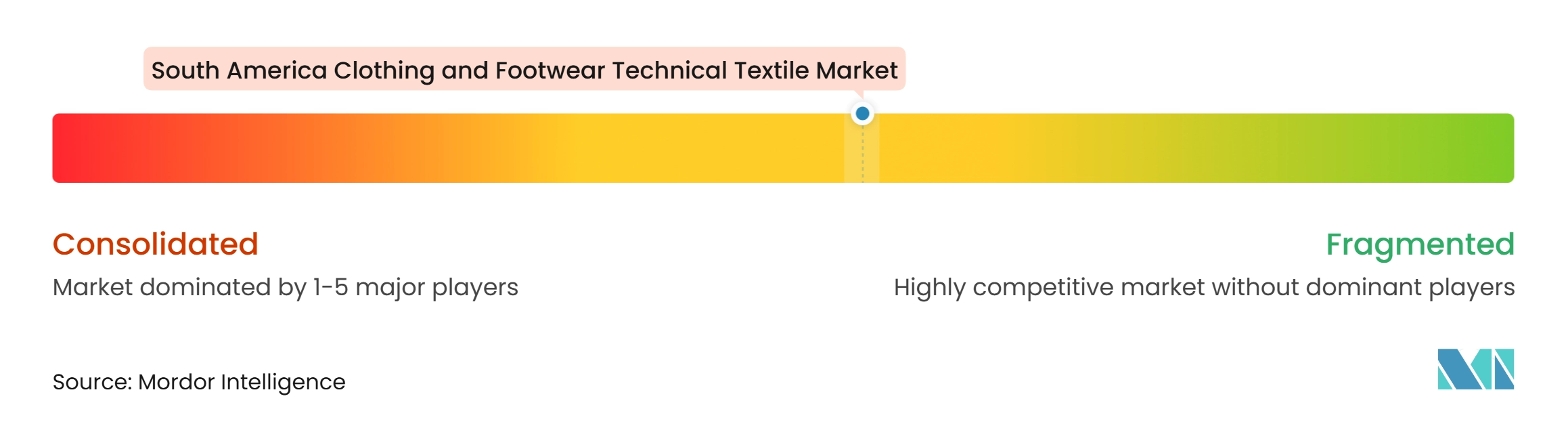
The South America clothing and footwear technical textile market exhibits a medium level of market concentration. Freudenberg Performance Materials, Toray Industries, and Teijin Limited serve high-performance interlining and engineered-fiber requirements. Their advantages come from established development capabilities, quality systems, and broad technical portfolios. Freudenberg’s 2025 sustainability report covered its global production network and showed the growing importance of disclosure in material sourcing. Domestic footwear manufacturers have a different role because they increasingly seek control over the availability and quality of textile components.
Vulcabras, Alpargatas, and Grendene shape competition through their scale in Brazilian footwear. Their sourcing decisions affect suppliers of mesh, knitted uppers, foam-compatible textiles, labels, and reinforcement components. These companies seek stronger supply reliability, shorter production cycles, and clearer product differentiation. This creates pressure for independent suppliers to offer responsive development support and dependable quality. ITM’s release of recycled nylon textile products is an example of a supplier using material development to meet footwear customer requirements.
Market opportunities remain in recycled-input processing, testing services, traceability tools, and performance materials for local footwear and apparel programs. Smaller converters face financial and operating pressure when they compete with imported products and suppliers with more advanced equipment. This reinforces the value of certifications, repeatable quality, and shorter development cycles. Brands increasingly require documented recycled content and dependable technical performance rather than only lower prices. Suppliers that can combine testing, material development, and flexible regional service are better placed to defend margins. The competitive environment is therefore likely to favor firms that concentrate on higher-value applications rather than broad commodity volume.
South America Clothing and Footwear Technical Textile Industry Leaders
-
Freudenberg Performance Materials
-
Grendene S.A.
-
Vulcabras S.A.
-
Teijin Limited
-
Toray Industries, Inc.
- *Disclaimer: Major Players sorted in no particular order
South America Clothing and Footwear Technical Textile Market Companies Covered in this Report
- ITM - Indústrias Têxteis Milagre
- Brisa Indústria de Tecidos Tecnológicos S.A.
- Texneo
- Pettenati S.A. Indústria Têxtil
- Vicunha Têxtil S.A.
- Santista Têxtil Ltda.
- Santista Argentina S.A.
- Protela S.A.
- Freudenberg Performance Materials
- Ober S.A.
- HUESKER Ltda.
- Ahlstrom
- Alpargatas S.A.I.C.
- Grendene S.A.
- Vulcabras S.A.
- DuPont de Nemours, Inc.
- Teijin Limited
- Toray Industries, Inc.
- Kolon Industries, Inc.
- DSM-Firmenich AG
- Hexcel Corporation
- Owens Corning
- Spradling International, Inc.
Recent Industry Developments in South America Clothing and Footwear Technical Textile Market
- January 2026: PROMPERÚ led 6 Peruvian companies to the Functional Fabric Fair in Orlando to promote specialized sportswear offerings in international markets.
- September 2025: Freudenberg Performance Materials published its first sustainability report, covering environmental and social performance across its global operations. FREUDENBERG PERFORMANCE MATERIALS
- May 2025: ITM, Indústrias Têxteis Milagre, released 3 new fabrics under its ECOFIO sustainable series, all produced from recycled polyamide for footwear upper and accessories applications.
South America Clothing and Footwear Technical Textile Market Report Scope
The South America Clothing and Footwear Technical Textile Market is Segmented by Product Type (Elastic Narrow Fabrics and Tapes, Footwear Technical Textile Components, and More), by Material Type (Polyester, Polyamide, Cotton, and More), by End-Use (Apparel Manufacturing, Footwear Manufacturing, and More), and by Geography (Brazil, Argentina, Colombia, and More). The Market Forecasts are Provided in Terms of Value (USD).
Segmentation Overview
| Apparel Interlinings and Structural Reinforcement Textiles |
| Specialized Sewing and Embroidery Threads |
| Elastic Narrow Fabrics and Tapes |
| Non-Elastic Functional Garment Tapes and Trims |
| Textile Fastening and Closure Components |
| Textile Labels, Badges, and Identification Components |
| Footwear Technical Textile Components |
| Garment Insulation and Specialty Functional Textile Components |
| Umbrella and Other Functional Accessory Textiles |
| Polyester |
| Polyamide |
| Cotton |
| Elastane and Other Elastomeric Fibers |
| Polypropylene and Other Polyolefins |
| Regenerated Cellulosic Fibers |
| Acrylic and Modacrylic Fibers |
| Other Specialty Synthetic Fibers |
| Other Materials |
| Apparel Manufacturing | Formalwear and Tailored Apparel |
| Casualwear and Everyday Clothing | |
| Innerwear, Lingerie, and Shapewear | |
| Outerwear and Functional Clothing | |
| Sportswear and Athleisure Apparel Components | |
| Other Apparel Manufacturing | |
| Footwear Manufacturing | Casual and Fashion Footwear |
| Athletic and Performance Footwear | |
| Occupational, Specialty and Other Footwear Components | |
| Clothing Accessories and Umbrellas | Headwear and Wearable Accessories |
| Umbrellas and Rain Accessories | |
| Other Specialized Clothing and Footwear Applications |
| Brazil |
| Argentina |
| Colombia |
| Chile |
| Peru |
| Uruguay |
| Paraguay |
| Rest of South America |
| By Product Type | Apparel Interlinings and Structural Reinforcement Textiles | |
| Specialized Sewing and Embroidery Threads | ||
| Elastic Narrow Fabrics and Tapes | ||
| Non-Elastic Functional Garment Tapes and Trims | ||
| Textile Fastening and Closure Components | ||
| Textile Labels, Badges, and Identification Components | ||
| Footwear Technical Textile Components | ||
| Garment Insulation and Specialty Functional Textile Components | ||
| Umbrella and Other Functional Accessory Textiles | ||
| By Material Type | Polyester | |
| Polyamide | ||
| Cotton | ||
| Elastane and Other Elastomeric Fibers | ||
| Polypropylene and Other Polyolefins | ||
| Regenerated Cellulosic Fibers | ||
| Acrylic and Modacrylic Fibers | ||
| Other Specialty Synthetic Fibers | ||
| Other Materials | ||
| By End-Use Application | Apparel Manufacturing | Formalwear and Tailored Apparel |
| Casualwear and Everyday Clothing | ||
| Innerwear, Lingerie, and Shapewear | ||
| Outerwear and Functional Clothing | ||
| Sportswear and Athleisure Apparel Components | ||
| Other Apparel Manufacturing | ||
| Footwear Manufacturing | Casual and Fashion Footwear | |
| Athletic and Performance Footwear | ||
| Occupational, Specialty and Other Footwear Components | ||
| Clothing Accessories and Umbrellas | Headwear and Wearable Accessories | |
| Umbrellas and Rain Accessories | ||
| Other Specialized Clothing and Footwear Applications | ||
| By Geography | Brazil | |
| Argentina | ||
| Colombia | ||
| Chile | ||
| Peru | ||
| Uruguay | ||
| Paraguay | ||
| Rest of South America | ||
Key Questions Answered in the Report
What is the projected value of the South America clothing and footwear technical textile market by 2032?
The market is projected to reach USD 2.5 billion by 2032, growing at a 3.63% CAGR from 2027 to 2032.
Which product category leads regional demand?
Apparel interlinings and structural reinforcement textiles lead with a 26.0% share in 2026.
Which material is used most widely in regional technical clothing and footwear products?
Polyester leads with a 42.0% share in 2026 because it is widely used in interlinings, mesh uppers, linings, and nonwoven constructions.
What is driving demand for technical materials in footwear?
Athletic and performance footwear is forecast to grow at a 6.1% CAGR through 2032 as brands use knitted uppers, mesh linings, and engineered reinforcement components.
Why is Brazil important to suppliers?
Brazil accounted for 62.0% of the regional market in 2026 and has the region’s largest conventional textile and footwear manufacturing base.
Why is Colombia expected to grow faster than other countries?
Colombia is forecast to grow at a 5.3% CAGR through 2032, supported by nearshoring, exports of knitted products, and demand from sportswear and shapewear production.