
South America Card-Based Access Control Market Size and Share
Market Overview
| Study Period | 2020 - 2031 |
|---|---|
| Forecast Data Period | 2026 - 2031 |
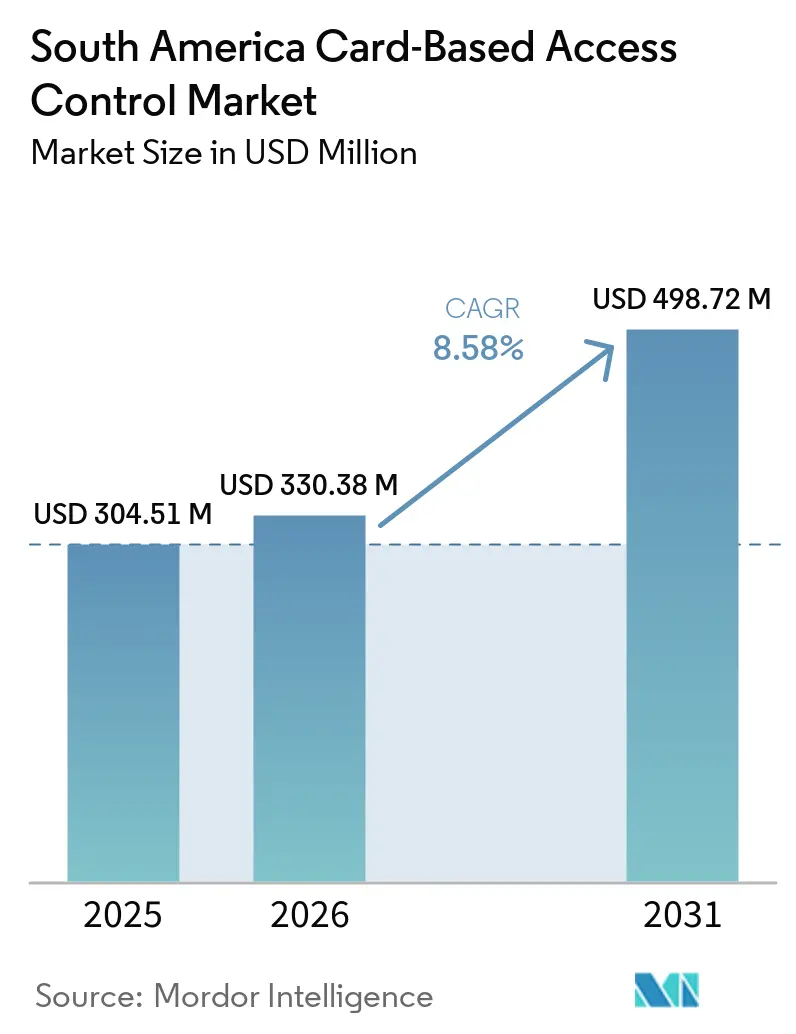
| Base Year Market Size (2025) | USD 304.51 Million |
| Market Size (2026) | USD 330.38 Million |
| Market Size (2031) | USD 498.72 Million |
| Growth Rate (2026 - 2031) | 8.58 % |
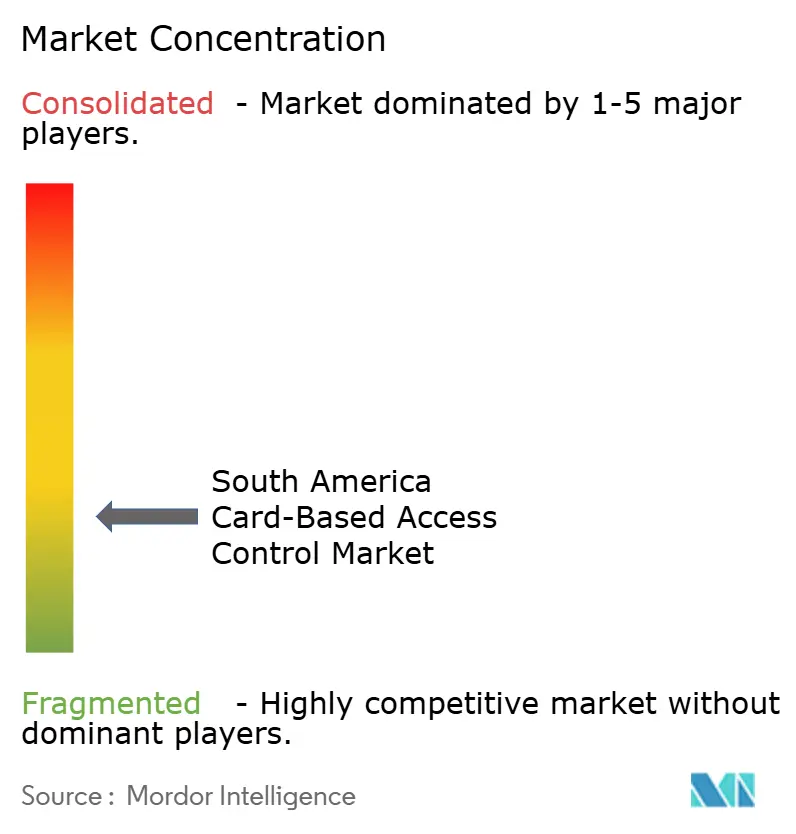
| Market Concentration | Low |
Major Players *Disclaimer: Major Players sorted in no particular order Image © Mordor Intelligence. Reuse requires attribution under CC BY 4.0. | |
South America Card-Based Access Control Market Analysis by Mordor Intelligence
The South America Card-Based Access Control Market size was valued at USD 304.51 million in 2025 and is estimated to grow from USD 330.38 million in 2026 to reach USD 498.72 million by 2031, at a CAGR of 8.58% during the forecast period (2026-2031). Public-security programs, infrastructure construction, and the demand for auditable facility access support across the region. Organizations in the South America Card Based Access Control Market are retaining compatible card systems while adding encrypted, mobile, and cloud-connected capabilities. Suppliers that support legacy readers alongside newer credentials can reduce migration costs for customers. Growing integration of physical access with identity management favors vendors with software, controller, and service capabilities.
Key Report Takeaways
- By card type, RFID proximity cards accounted for 42.36% of the South America Card-Based Access Control Market revenue in 2025, while smart cards recorded the highest projected CAGR at 9.72% through 2031.
- By component, card readers accounted for 38.41% of revenue in 2025, while access control panels recorded the highest projected CAGR at 10.14% through 2031.
- By end-user vertical, commercial accounted for 31.87% of the South America Card-Based Access Control Market revenue in 2025, while healthcare recorded the highest projected CAGR at 9.81% through 2031.
- By deployment, on-premises accounted for 56.23% of revenue in 2025, while cloud recorded the highest projected CAGR at 10.47% through 2031.
- Among authentication technologies, RFID/NFC held a 44.92% revenue share in the South America Card-Based Access Control Market in 2025, while multi-technology credentials recorded the highest projected CAGR at 9.68% through 2031.
- By geography, Brazil accounted for 48.16% of revenue in 2025, while Colombia recorded the highest projected CAGR at 10.23% through 2031.
Note: Market size and forecast figures in this report are generated using Mordor Intelligence’s proprietary estimation framework, updated with the latest available data and insights as of January 2026.
Market Trends and Insights
Drivers Impact Analysis of South America Card-Based Access Control Market*
| Driver | (~) % Impact on CAGR Forecast | Geographic Relevance | Impact Timeline |
|---|---|---|---|
| Rising Security Requirements and Public-Sector Investment | +2.3% | Brazil, Colombia, Chile, Argentina | Short term (≤ 2 years) |
| Evolution of Smart Card and RFID Technology | +1.8% | Brazil, Chile, Colombia | Medium term (2-4 years) |
| Construction, Logistics, and Smart-City Infrastructure Expansion | +1.5% | Brazil, Colombia, Chile | Medium term (2-4 years) |
| Increasing Urban Crime and Asset-Protection Requirements | +1.2% | Brazil, Colombia, Venezuela, Rest of South America | Short term (≤ 2 years) |
| Migration to Mobile, Cloud, and Multi-Technology Credentials | +0.9% | Brazil, Chile, Colombia | Medium term (2-4 years) |
| Credential Interoperability for Near-Shoring and Distributed Facilities | +0.7% | Brazil, Colombia, Chile, Rest of South America | Long term (≥ 4 years) |
| Source: Mordor Intelligence | |||
Rising Security Requirements and Public-Sector Investment
Government agencies are placing greater emphasis on controlled access in critical facilities. Brazil’s data protection rules have increased the value of documented access rights and activity logs for organizations handling sensitive information. Commercial property managers and banks can use these records to support internal oversight and compliance processes. Bogotá’s C4 program integrated 1,200 new monitoring points in 2026, increasing the need to protect associated operational areas.[1] This setting supports electronic credentials for server rooms, command centers, and restricted work areas, which strengthens the South America Card-Based Access Control Market. The South America Card-Based Access Control Market benefits when public procurement raises the expected standard for access documentation.
Evolution of Smart Card and RFID Technology
RFID and smart card systems provide a practical upgrade route for facilities with established reader networks. ISO/IEC 14443 and ISO/IEC 15693 specifications support interoperable contactless and vicinity-card deployments. Cryptographic credentials can address cloning concerns in banking, healthcare, and government facilities. Available intelligent controllers support high user volumes and encrypted communication for multi-site deployments. Software updates can also introduce credential functions without immediately replacing every reader. This helps the South America Card-Based Access Control Market serve customers who need improved security but must manage capital spending carefully.
Construction, Logistics, and Smart-City Infrastructure Expansion
New transport, healthcare, logistics, and public facilities need controlled entry for employees and contractors. These projects create demand that is separate from replacement activity in existing buildings. A new facility may require readers, panels, locks, cards, and centralized management software simultaneously. Medellín’s planned C5i complex was described as a COP 205 billion (USD 66.68 million) facility with 18,800 m² across 9 floors.[2] Such sites require different access levels for public safety, technical, and data-center spaces. The South America Card-Based Access Control Market gains from specifications that include access records early in a project’s design stage.
Increasing Urban Crime and Asset-Protection Requirements
Security concerns are encouraging commercial, banking, industrial, and residential sites to improve control of entry points. Businesses use card credentials to limit access by role, time, and location. The U.S. International Trade Administration reported that access control accounted for 20.8% of demand for electronic security equipment in Brazil, while 78% of Brazilian companies planned to increase security investment in 2025.[3] Financial institutions increasingly combine cards with other authentication methods and centralized logging. This can move access control from a discretionary property upgrade toward a security and insurance requirement. The South America Card-Based Access Control Market, therefore, has scope in secondary cities and logistics corridors where facility density is increasing.
Restraints Impact Analysis of South America Card-Based Access Control Market*
| Restraint | (~) % Impact on CAGR Forecast | Geographic Relevance | Impact Timeline |
|---|---|---|---|
| High Upfront Cost and Total Cost of Ownership | -1.8% | Brazil, Argentina, Venezuela, Rest of South America | Short term (≤ 2 years) |
| Availability of Biometric and Mobile-Only Alternatives | -1.2% | Brazil, Colombia, Chile | Medium term (2-4 years) |
| Privacy, Cybersecurity, and Data-Governance Concerns | -0.8% | Brazil, Chile, Colombia | Medium term (2-4 years) |
| Import, Certification, Connectivity, and Power-Infrastructure Barriers | -0.7% | Argentina, Venezuela, Rest of South America | Long term (≥ 4 years) |
| Source: Mordor Intelligence | |||
High Upfront Cost and Total Cost of Ownership
Card-based systems require spending on readers, controllers, panels, locks, cabling, credentials, and software. Smaller businesses may delay projects when financing costs and equipment prices are high. Imported hardware can create further cost pressure in markets with tariffs, exchange-rate volatility, or local-content requirements. Cloud-based access control can reduce the upfront purchase cost by shifting some costs to recurring subscriptions. The move toward remote management shows that buyers are considering subscription-based alternatives to hardware-led projects. The South America Card-Based Access Control Market may lose smaller accounts when suppliers cannot offer staged deployments, financing, or subscription options.
Availability of Biometric and Mobile-Only Alternatives
Mobile and biometric systems compete for new high-traffic installations because they can reduce the need for physical card issuance. HID launched Converged Credentials in March 2026 to combine physical and logical access with a phishing-resistant mobile credential.[4] These alternatives can appeal to enterprises that want a single identity process for buildings and digital systems. Their rollout still depends on compatible devices, network coverage, and reliable smartphone access. Cards remain useful where connectivity is inconsistent or a physical credential is required for operational resilience. The South America Card-Based Access Control Market faces a constraint mainly in new installations rather than in the rapid displacement of existing card-based systems.
*Our forecasts treat driver/restraint impacts as directional, not additive. The impact forecasts reflect baseline growth, mix effects, and variable interactions.
South America Card-Based Access Control Market Segment Analysis
By Card Type:
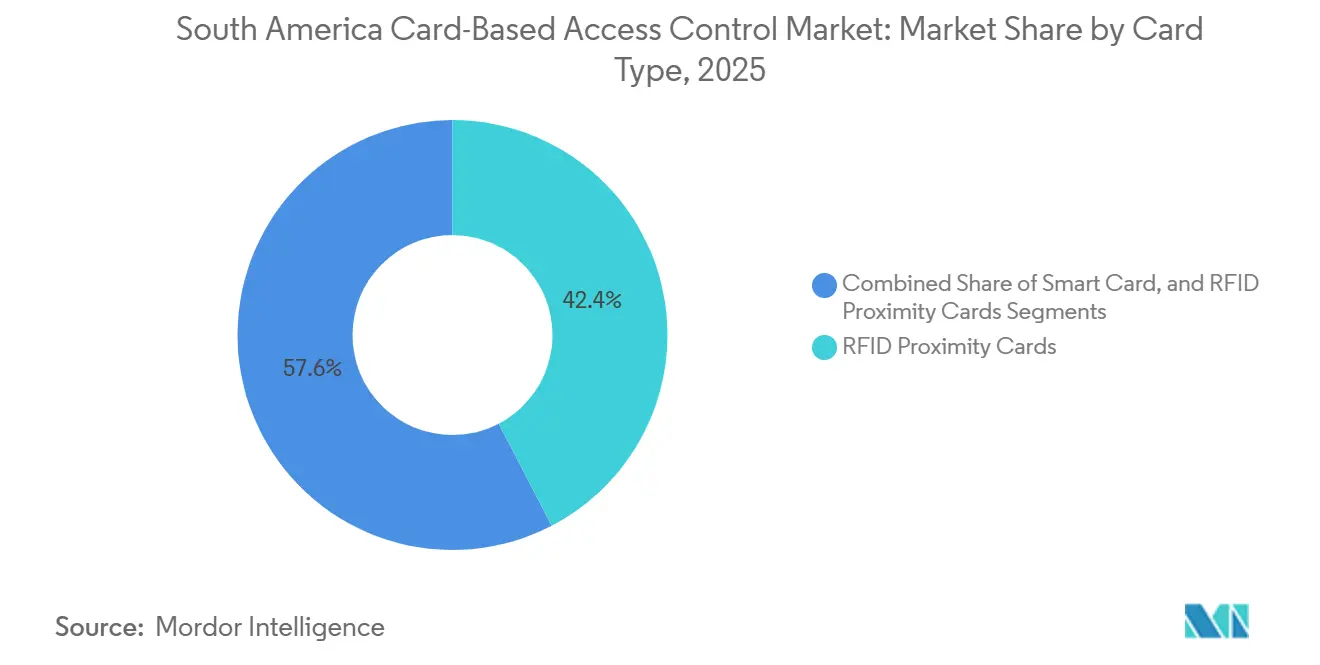
RFID Retains the Installed Base While Smart Cards Support UpgradesRFID proximity cards held 42.36% of the South America Card Based Access Control Market share in 2025. Their installed base spans offices, industrial campuses, and government facilities. Many legacy readers use 125 kHz technology and work with low-cost proximity cards. This compatibility makes RFID a practical option for large retrofits where reader replacement would be expensive. Swipe cards represented the smallest and declining portion of this category.
Their use remains concentrated in older hospitality installations, where magnetic stripes are vulnerable to damage and cloning. Smart cards are projected to grow at a 9.72% CAGR during 2026-2031. Contact and contactless smart cards provide encrypted credential management for higher-security applications. Banking, healthcare, and government sites can use these credentials to strengthen identity controls. The South America Card-Based Access Control Market supports a parallel shift toward both physical smart cards and mobile credentials that use comparable encryption.

By Component:
Readers Lead Procurement While Panels Add CapabilityCard readers accounted for 38.41% of the component category in 2025. Every controlled door needs a reader, making readers the highest-volume hardware item in most projects. Lower-cost proximity readers remain common in price-sensitive installations. Contactless readers with OSDP v2 protocols are gaining use in corporate and financial facilities. Keypads provide a PIN-based backup or override method.
Electronic locks form the physical actuation layer for controlled doors. Access control panels are forecast to grow at a 10.14% CAGR from 2026 to 2031. Multi-door panels can integrate with human resources, visitor management, and cloud platforms. Firmware-enabled panels can add credential support while retaining compatibility with existing reader hardware. This approach gives the South America Card-Based Access Control Market a panel-led path for upgrades instead of requiring a complete system replacement.
By End-User Vertical:
Commercial Leads While Healthcare Expands FastestCommercial users accounted for 31.87% of end-user revenue in 2025. Offices and logistics facilities require role-based access for employees, tenants, contractors, and visitors. Developers increasingly include electronic access control in smart-building specifications. International tenants also expect stronger audit records for physical security management. Government agencies maintain recurring demand through procurement for offices, courts, and public service facilities.
Healthcare is forecast to advance at a 9.81% CAGR during 2026-2031. Industrial, residential, transport and logistics, military and defense, and other users also need managed entry at sensitive zones. Hospitals and clinics require controlled access to laboratories, pharmaceutical storage areas, patient data areas, and treatment zones. Integrated healthcare security projects can combine card access with surveillance and other controls for restricted internal areas. This use case supports the South America Card-Based Access Control Market, where facilities need cards as part of a wider security architecture.
By Deployment:
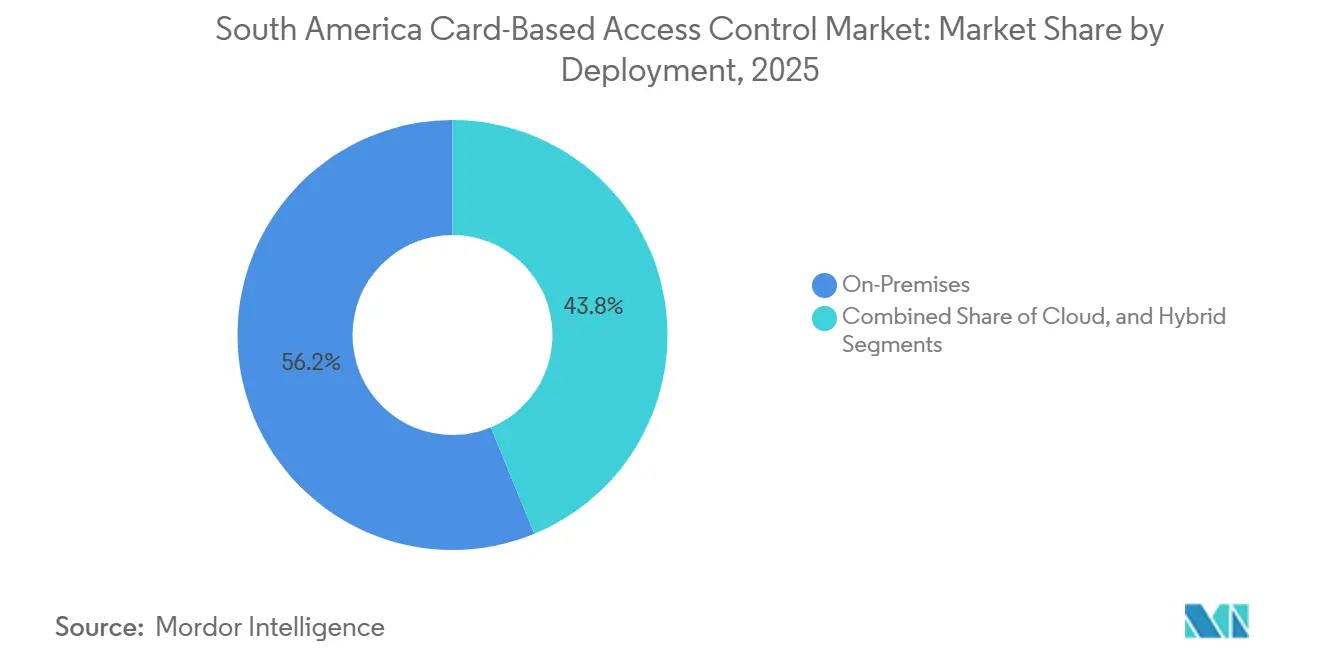
On-Premises Systems Lead While Cloud Adoption RisesOn-premises deployment held 56.23% of the segment in 2025. Government bodies, financial institutions, and critical infrastructure operators often prefer local management of sensitive access logs. Legacy systems can also make a fully cloud-based migration more difficult. These users value direct control over data, system configuration, and operational continuity. Edge and hybrid models help industrial and logistics sites keep local decisions running during connectivity interruptions.
Cloud deployment is projected to grow at a 10.47% CAGR from 2026 to 2031. Cloud systems can simplify administration for small businesses and organizations with several sites. SailPoint launched a Brazil-based software-as-a-service instance in June 2025 for finance, healthcare, and government users seeking local data residency. Edge and hybrid models help industrial and logistics sites keep local decisions running during connectivity interruptions. The South America Card-Based Access Control Market can use these models to connect newer cloud tools with legacy infrastructure. On-premises systems are likely to remain important where local data control outweighs cloud scalability.
By Authentication Technology:
RFID/NFC Leads While Multi-Technology Credentials GrowRFID/NFC accounted for 44.92% of the authentication technology category in 2025. Its lead reflects extensive 125 kHz and 13.56 MHz reader infrastructure across corporate, government, and industrial sites. Replacing every reader is costly, so organizations often phase migration over several years. This installed base preserves demand for compatible credentials and readers. Magnetic stripe systems retain a residual role in older hospitality, transit, and financial applications.
Multi-technology credentials are projected to grow at a 9.68% CAGR during 2026-2031. Contactless smart cards support cryptographic assurance where stronger authentication is required. They can work across legacy proximity readers, newer smart-card terminals, and NFC-enabled devices. Multi-technology reader designs can combine QR codes, RFID, BLE, and NFC in one device. The South America Card-Based Access Control Market has a clear need for this flexibility while customers operate several credential formats.
Geography Analysis
Brazil Card-Based Access Control Market
Brazil accounted for 48.16% of the South America Card Based Access Control Market share in 2025. The country has a large security procurement base and broad demand from commercial, public, industrial, and infrastructure users. The International Trade Administration reported 17% annual growth in Brazil’s electronic-security market in 2024. Access control was the second-largest equipment category after video surveillance. Data protection compliance also makes access logs more valuable for financial and healthcare buyers. Intelbras has a local manufacturing base and extensive domestic distribution, which can support cost and delivery advantages.
Colombia Card-Based Access Control Market
Colombia is expected to record the fastest geographic growth at a 10.23% CAGR during 2026-2031. Public-safety investment supports deployments in command centers, police facilities, hospitals, and logistics sites. Bogotá’s C4 network expansion added 1,200 monitoring points in 2026. These systems need controlled access to operational and technical areas. Medellín’s C5i project demonstrates the scale of the planned integrated security infrastructure. The South America Card-Based Access Control Market can benefit as these facilities specify access management alongside video and incident-response systems.
South America Card-Based Access Control Market
Argentina, Chile, Venezuela, and the rest of South America have more varied demand conditions. Argentina faces pressure from import costs and macroeconomic volatility, although banks and premium commercial properties continue to meet baseline requirements. Chile has a more mature environment for intelligent controllers and contactless readers in transport, commercial, healthcare, and financial sites. Venezuela remains limited by infrastructure constraints. Ecuador, Peru, Paraguay, and Uruguay offer emerging demand linked to logistics, ports, and facility development. Suppliers need local channels and adaptable pricing to serve these markets effectively.
Competitive Landscape
The South America Card-Based Access Control Market is fragmented among leading global access-control specialists, while distributors, integrators, and domestic suppliers create a fragmented lower tier. ASSA ABLOY, HID Global, dormakaba, Suprema, and Intelbras compete across credentials, readers, panels, locks, and management software. Product breadth matters because buyers often prefer a single supplier for compatible hardware and software. Local support and established channels are important where importing equipment raises cost or extends delivery times. The competitive focus is moving from equipment sales toward recurring software and service revenue.
HID launched Converged Credentials in March 2026, offering a mobile credential that combines physical and logical access. This move reflects the growing overlap between facility security and digital identity management. Suprema has focused on readers that support several card and mobile credential formats. dormakaba acquired Azure Access Technology and Apollo Security in August 2026 to expand its access-control component portfolio. These developments show how vendors are extending capability through product launches and acquisitions. The South America Card-Based Access Control Market favors companies that can manage card, mobile, and biometric options on a single platform.
Intelbras benefits from domestic production and an established Brazilian channel network. International vendors can address this advantage through long-term partnerships with distributors and integrators. The South America Card-Based Access Control Market can find cloud access control opportunities among small and midsize businesses that cannot fund large upfront installations. Multi-technology readers can help enterprises transition without replacing all existing credentials at once. Edge-capable controllers can suit industrial sites with inconsistent connectivity. Competition will remain based on compatibility, cybersecurity, local support, total ownership cost, and the ability to integrate physical and digital identity functions.
South America Card-Based Access Control Industry Leaders
-
Allegion plc
-
HID Global Corporation
-
Hangzhou Hikvision Digital Technology Co., Ltd.
-
Zhejiang Dahua Technology Co., Ltd.
-
dormakaba Holding AG
- *Disclaimer: Major Players sorted in no particular order
South America Card-Based Access Control Market Companies Covered in this Report
- ASSA ABLOY AB
- HID Global Corporation
- dormakaba Holding AG
- Allegion plc
- Gallagher Group Limited
- SALTO Systems, S.L.
- Nedap N.V.
- Identiv, Inc.
- Suprema Inc.
- Vanderbilt Industries, Inc.
- Paxton Access Ltd.
- Axis Communications AB
- Genetec Inc.
- Hangzhou Hikvision Digital Technology Co., Ltd.
- Dahua Technology Co., Ltd.
- IDEMIA Identity and Security France SAS
- Thales S.A.
- Intelbras S.A. Indústria de Telecomunicação Eletrônica Brasileira
- Secom Co., Ltd.
- Bosch Sicherheitssysteme GmbH
- Johnson Controls International plc
- Honeywell International Inc.
Recent Industry Developments in South America Card-Based Access Control Market
- August 2026: dormakaba acquired the operating businesses of Azure Access Technology Inc. and Apollo Security (ADME, Inc.), both U.S.-based access control hardware and systems suppliers, accelerating its open-component and OEM partner strategy and signaling an intent to expand internationally scalable components, including readers and controllers, through its global distribution network covering South America.
- July 2026: Suprema Inc. received ISO/IEC 42001 certification for the AI management system supporting facial and fingerprint authentication across its BioStation series, BioEntry series, and BioStar platform, a certification that provides South American enterprise procurement teams with a verifiable AI governance benchmark alongside existing ISO/IEC 27001 and 27701 certifications.
- May 2026: Suprema launched BioStation 3 Max, an enterprise biometric access control terminal featuring a dedicated neural processing unit for sub-0.3-second facial authentication, CC EAL6+ biometric template protection, and capacity for 100,000 enrolled users, targeting critical infrastructure and large enterprise environments.
- March 2026: HID Global launched HID Converged Credentials at ISC West 2026, enabling organizations to consolidate physical access and IT logical access under a single phishing-resistant credential without replacing existing reader infrastructure, directly targeting the enterprise segment managing both building access and network identity
South America Card-Based Access Control Market Report Scope
The South America card-based access control market refers to security systems that utilize physical credentials such as swipe cards, RFID proximity cards, and smart cards to regulate entry to buildings and restricted areas. These systems comprise card readers, control panels, electronic locks, and associated software, utilizing technologies ranging from magnetic stripes to contactless smart cards. Deployed across commercial, government, residential, and industrial sectors via on-premises, cloud, or hybrid models, they provide organizations across the region with reliable, scalable, and traceable physical security management.
The South America Card-Based Access Control Market Report is Segmented by Card Type (Swipe Cards, RFID Proximity Cards, and Smart Card), Component (Card Readers, Access Control Keypads, Access Control Panels, Electronic Lock Hardware, and Other Components), End-user Vertical (Commercial, Residential, Government, Industrial, Transport and Logistics, Healthcare, Military and Defense, and Other End-user Verticals), Deployment (On-Premises, Cloud, and Hybrid), Authentication Technology (Magnetic Stripe, RFID / NFC, Contact Smart Card, Contactless Smart Card, and Multi-Technology Credential), and Geography (Brazil, Argentina, Colombia, Chile, Venezuela, and Rest of South America). The Market Forecasts are Provided in Terms of Value (USD).
Segmentation Overview
| Swipe Cards |
| RFID Proximity Cards |
| Smart Card (Contact and Contactless) |
| Card Readers |
| Access Control Keypads |
| Access Control Panels |
| Electronic Lock Hardware |
| Other Components |
| Commercial |
| Residential |
| Government |
| Industrial |
| Transport and Logistics |
| Healthcare |
| Military and Defense |
| Other End-user Verticals |
| On-Premises |
| Cloud |
| Hybrid |
| Magnetic Stripe |
| RFID / NFC |
| Contact Smart Card |
| Contactless Smart Card |
| Multi-Technology Credential |
| Brazil |
| Argentina |
| Colombia |
| Chile |
| Rest of South America |
| By Card Type | Swipe Cards |
| RFID Proximity Cards | |
| Smart Card (Contact and Contactless) | |
| By Component | Card Readers |
| Access Control Keypads | |
| Access Control Panels | |
| Electronic Lock Hardware | |
| Other Components | |
| By End-user Vertical | Commercial |
| Residential | |
| Government | |
| Industrial | |
| Transport and Logistics | |
| Healthcare | |
| Military and Defense | |
| Other End-user Verticals | |
| By Deployment | On-Premises |
| Cloud | |
| Hybrid | |
| By Authentication Technology | Magnetic Stripe |
| RFID / NFC | |
| Contact Smart Card | |
| Contactless Smart Card | |
| Multi-Technology Credential | |
| By Geography | Brazil |
| Argentina | |
| Colombia | |
| Chile | |
| Rest of South America |
Key Questions Answered in the Report
What is the South America Card-Based Access Control Market size?
The South America Card-Based Access Control Market is estimated at USD 330.38 million in 2026 and is forecast to reach USD 498.72 million by 2031 at an 8.58% CAGR.
Which card type has the largest share?
RFID proximity cards led the card type category with a 42.36% share in 2025 because of their broad compatibility with installed reader infrastructure.
Which component is growing fastest?
Access control panels are forecast to expand at a 10.14% CAGR through 2031 as users add intelligent multi-door control and software integration.
Which end-user vertical is expanding fastest?
Healthcare is projected to grow at a 9.81% CAGR through 2031 as hospitals and clinics protect laboratories, pharmaceutical storage, and restricted treatment areas.
Why are cloud access systems gaining adoption?
Cloud deployment is projected to grow at a 10.47% CAGR through 2031 because it can simplify multi-site administration and reduce upfront infrastructure needs.
Which country is expected to grow fastest?
Colombia is projected to record a 10.23% CAGR through 2031, supported by public-safety infrastructure and command-center development.