
Market Overview
| Study Period | 2020 - 2031 |
|---|---|
| Forecast Data Period | 2026 - 2031 |
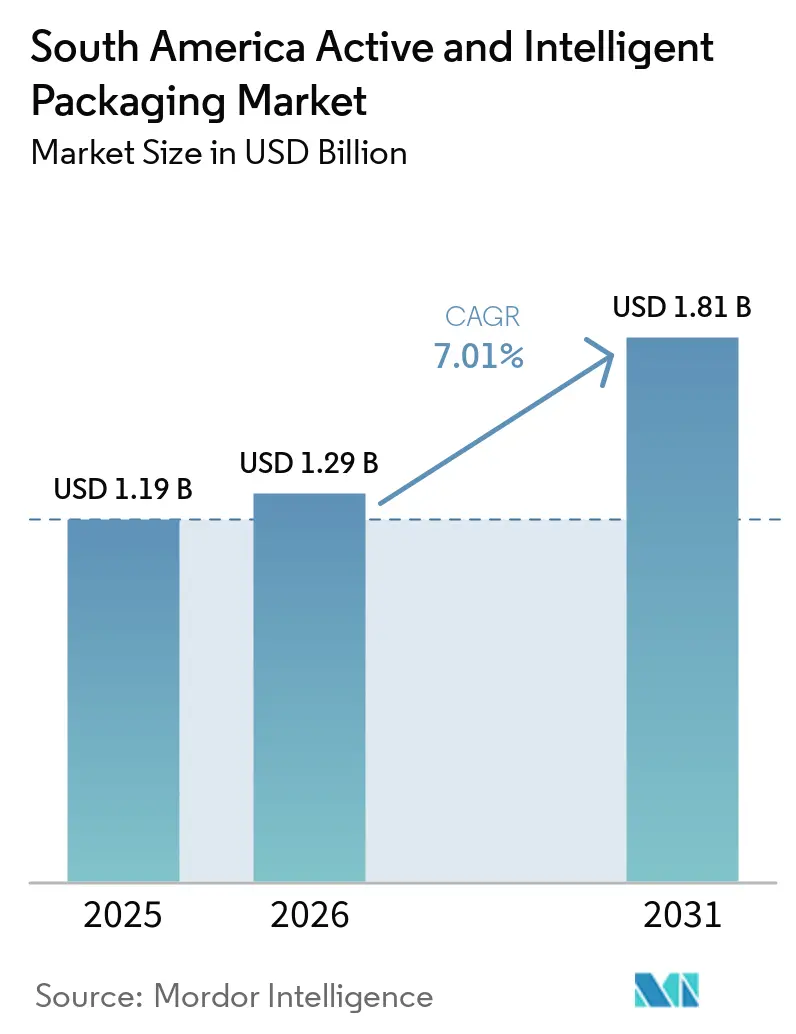
| Base Year Market Size (2025) | USD 1.19 Billion |
| Market Size (2026) | USD 1.29 Billion |
| Market Size (2031) | USD 1.81 Billion |
| Growth Rate (2026 - 2031) | 7.01 % |
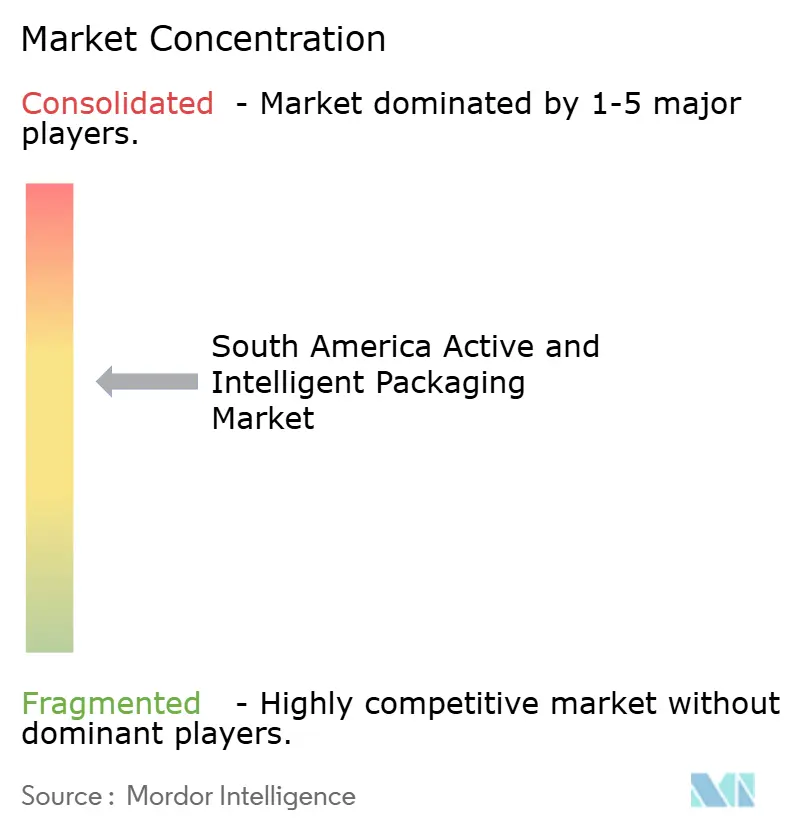
| Market Concentration | Medium |
Major Players *Disclaimer: Major Players sorted in no particular order Image © Mordor Intelligence. Reuse requires attribution under CC BY 4.0. | |
South America Active and Intelligent Packaging Market Analysis by Mordor Intelligence
The South America Active And Intelligent Packaging Market size is expected to grow from USD 1.19 billion in 2025 to USD 1.29 billion in 2026 and is forecast to reach USD 1.81 billion by 2031 at 7.01% CAGR over 2026-2031.
Demand is being shaped by food, beverage, and pharmaceutical producers that need to protect products across long export routes. Brazil remains central because its meat, poultry, and agricultural exports require dependable shelf-life control and cold-chain documentation. Established active formats continue to attract the most demand, while intelligent formats are gaining relevance where traceability, authentication, and temperature monitoring solve a defined operational need. Suppliers are combining materials, equipment, labels, and validation support to make deployments easier for large processors. Smaller processors face higher costs, fragmented rules, and limited digital systems, which keep adoption uneven across the region.
Key Report Takeaways
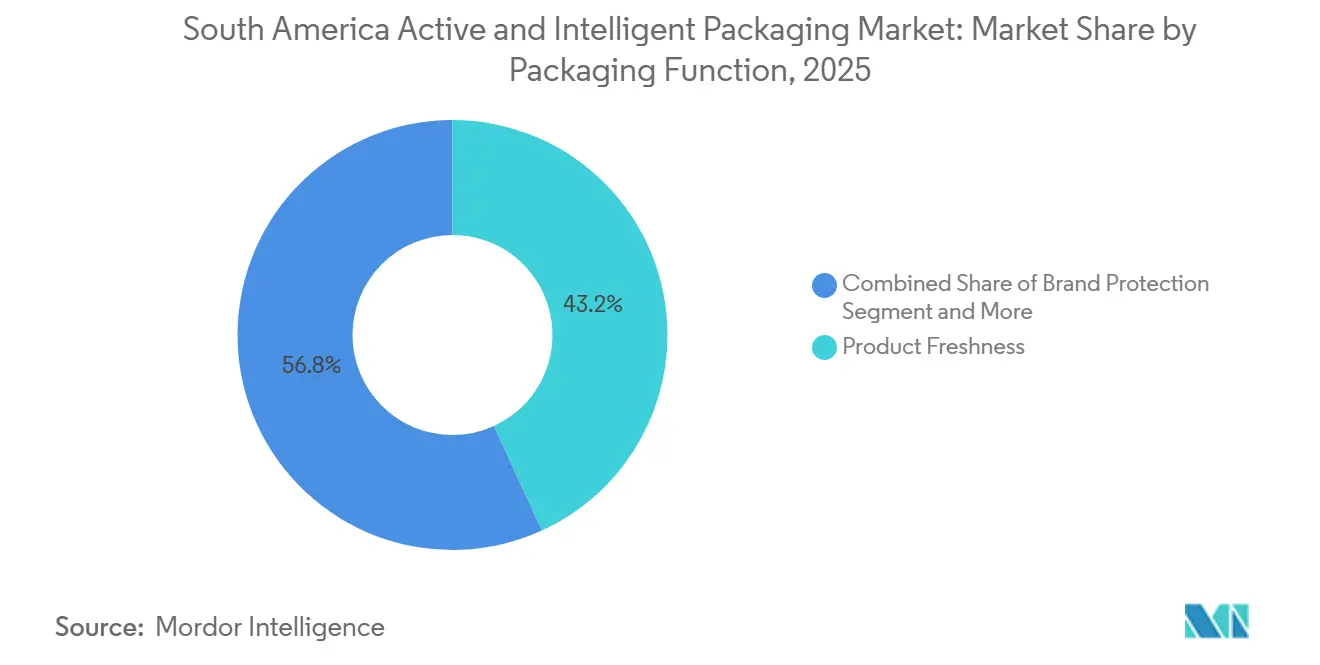
- By packaging function, Product Freshness held 43.18% of the South America active and intelligent packaging market share in 2025, while Brand Protection is projected to expand at a 7.94% CAGR through 2031
- By packaging technology, Active Packaging held 63.21% of revenue in 2025, while Intelligent Packaging is projected to expand at an 8.36% CAGR through 2031.
- By active packaging type, Gas Scavengers/Emitters held 38.42% of revenue in 2025, while Other Active Packaging Technologies are projected to expand at an 8.57% CAGR through 2031.
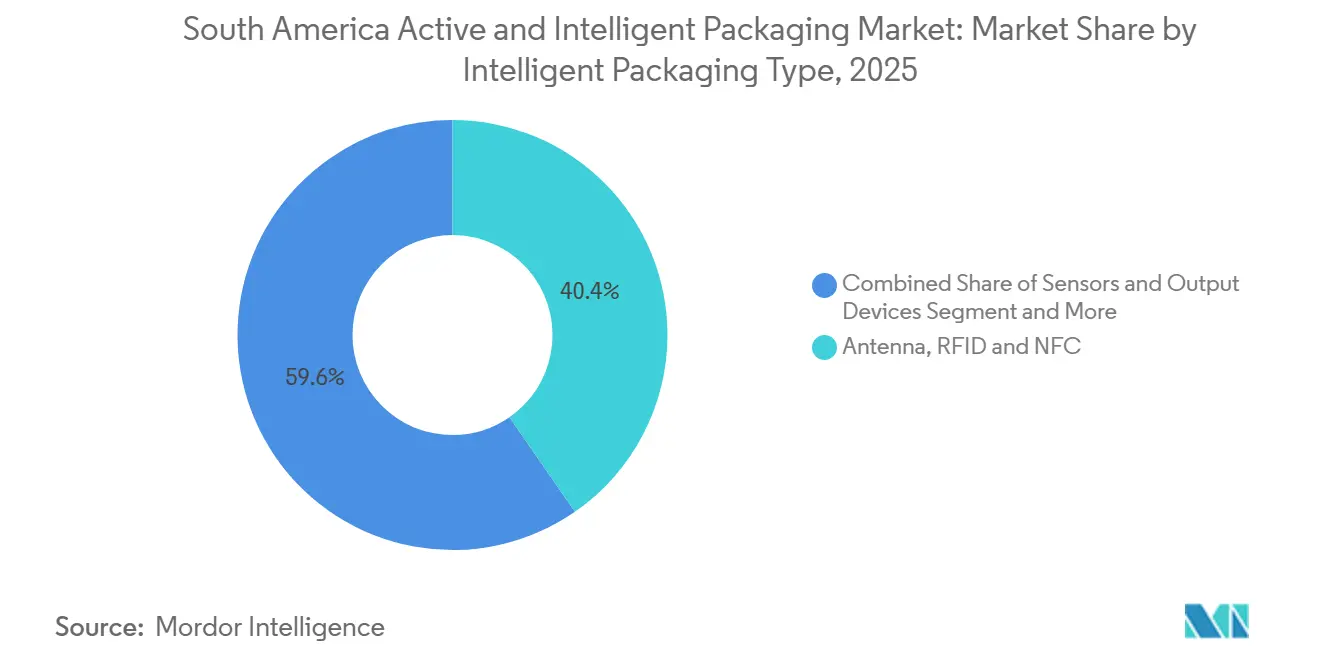
- By intelligent packaging type, Antenna, RFID, and NFC held 40.36% of revenue in 2025, while Sensors and Output Devices are projected to expand at a 9.51% CAGR through 2031.
- By end-user industry, Food held 37.80% of demand in 2025, while Pharmaceuticals are projected to expand at an 8.85% CAGR through 2031.
- By country, Brazil held 53.72% of revenue in 2025, while Colombia is projected to expand at a 7.76% CAGR through 2031.
Note: Market size and forecast figures in this report are generated using Mordor Intelligence’s proprietary estimation framework, updated with the latest available data and insights as of January 2026.
Market Trends and Insights
Drivers Impact Analysis of South America Active and Intelligent Packaging Market*
| Driver | (~) % Impact on CAGR Forecast | Geographic Relevance | Impact Timeline |
|---|---|---|---|
| Rising Demand for Extended Product Shelf Life | +1.8% | Global, concentrated in Brazil and Argentina | Short term (≤ 2 years) |
| Food Safety and Quality Requirements | +1.5% | Brazil, Argentina, Chile | Medium term (2-4 years) |
| Export-Oriented Food and Beverage Supply Chains | +1.2% | Brazil, Argentina, Colombia | Medium term (2-4 years) |
| Pharmaceutical Serialization and Traceability | +0.9% | Brazil, Colombia | Medium term (2-4 years) |
| Low-Cost Digital Connectivity Through QR Codes and Smart Labels | +0.6% | Brazil, Colombia, with spillover to Peru and Chile | Short term (≤ 2 years) |
| Localization of Active Materials and Packaging Intelligence | +0.4% | Brazil, with early gains in São Paulo and Curitiba corridors | Long term (≥ 4 years) |
| Source: Mordor Intelligence | |||
Rising Demand for Extended Product Shelf Life
Extended shelf life remains the most immediate reason for active packaging adoption across South America. Brazil’s protein exporters need packaging that preserves product condition during refrigerated journeys lasting 30-90 days to China, Europe, and the Middle East. A shipment that does not meet these requirements can lose export eligibility and expose exporters to substantial commercial losses. In June 2026, Amcor installed its Moda Vac rotary vacuum chamber sealing technology at Barra Mansa Alimentos in Brazil, replacing up to 9 conventional belt chamber machines on 1 deboning line. The installation shows how a major processor is using vacuum sealing to extend shelf life while increasing line throughput. Research on active formats also reported that ethylene scavengers, gas emitters, and modified-atmosphere packaging can extend fresh-produce shelf life by 40-60% compared with passive packaging, which can reduce losses in Chilean, Colombian, and Peruvian export corridors.
Food Safety and Quality Requirements
Food safety rules are changing packaging specifications beyond basic label compliance in the South America active and intelligent packaging market. Brazil’s ANVISA issued RDC No. 961/2025, which changed the positive list of monomers and polymers authorized for plastic containers in food contact. The change increases the importance of documented material selection and food-contact validation for converters serving food processors[1]. Validated active materials can therefore compete on demonstrated performance and compliance support, rather than on material price alone. Research published in 2025 found that plant-based oxygen scavengers, including catechu-calcium carbonate systems, could support biodegradable active packaging with food-safety applications. This creates an opening for suppliers that can combine shelf-life performance, regulatory documentation, and lower-impact material options.
Export-Oriented Food and Beverage Supply Chains
Export-oriented food and beverage supply chains create demand that domestic retail analysis can miss. Brazil’s orange juice, soy, beef, and poultry supply chains require packaging that protects product condition and supports overseas buyer requirements. Colombia’s coffee exports, along with Chilean fruit and produce shipments, face similar needs across long-distance routes. In October 2025, INIA Chile presented research on biopolymer-based active packaging with mustard and fennel essential oils that suppressed Botrytis infection in blueberry exports. QR codes, NFC tags, and coding systems can add information on provenance and product condition from the packing house to the port. These tools give suppliers in the South America active and intelligent packaging market a route into export categories where compliance and product condition carry direct commercial value.
Pharmaceutical Serialization and Traceability
Brazil’s pharmaceutical sector is moving toward digital identification systems that support intelligent packaging demand. ANVISA resumed mandatory electronic reporting through its SNGPC system on a rolling regional schedule from September 2025 through January 2026. The agency’s medical-device identification project also progressed toward machine-to-machine data exchange through its second phase. These systems support demand for serialized coding, RFID-ready blister packs, and NFC-enabled tamper-evident formats. Brazil revoked the former SNCM drug serialization mandate through RDC No. 886/2024, but large pharmaceutical companies can still use serialization voluntarily to distinguish products and strengthen brand protection. This leaves the South America active and intelligent packaging market exposed to both regulatory requirements and voluntary investment in traceability.
Restraints Impact Analysis of South America Active and Intelligent Packaging Market*
| Restraint | (~) % Impact on CAGR Forecast | Geographic Relevance | Impact Timeline |
|---|---|---|---|
| High Implementation and Validation Costs | -1.2% | Brazil, Argentina, Colombia | Short term (≤ 2 years) |
| Regulatory and Food-Contact Compliance Complexity | -0.8% | MERCOSUR bloc, with spillover to Chile and Peru | Medium term (2-4 years) |
| Dependence on Imported RFID, NFC, Sensor, and Electronic Components | -0.5% | Brazil, Colombia, acute in Rest of South America | Medium term (2-4 years) |
| Uneven Recycling Infrastructure for Multicomponent Smart Packs | -0.3% | Rest of South America, secondary in Buenos Aires and Bogotá | Long term (≥ 4 years) |
| Source: Mordor Intelligence | |||
High Implementation and Validation Costs
Cost remains the most immediate obstacle for mid-tier food processors considering advanced packaging systems. RFID reader networks, sensor-compatible filling lines, and gas-flush equipment can require hundreds of thousands of USD for each production line. Companies must also fund material validation work required by food-contact and pharmaceutical compliance frameworks. ABRE and FGV IBRE reported that Brazilian packaging production rose only 0.4% in 2025, following 6.7% expansion in 2024, indicating a more constrained investment setting for converters[2]. Large multinationals can spread validation expenses across broader volumes and regional procurement programs. Smaller Brazilian and Colombian processors bear similar compliance costs against a much smaller revenue base, which limits wider deployment in the South America active and intelligent packaging market.
Regulatory and Food-Contact Compliance Complexity
Regional food-contact rules create a second barrier for converters that operate across national markets. MERCOSUR requirements for food-contact materials evolve alongside national procedures and implementation schedules. A line validated for Brazilian requirements may need additional testing or documentation before it is accepted elsewhere in the region. This work can delay product launches and make newer active or intelligent formats less attractive for smaller converters. The burden is greatest when a format uses multiple layers, coatings, sensors, or other components that require separate evaluation. As a result, suppliers with established regulatory teams and validated material portfolios hold an advantage in the South America active and intelligent packaging market.
*Our forecasts treat driver/restraint impacts as directional, not additive. The impact forecasts reflect baseline growth, mix effects, and variable interactions.
South America Active and Intelligent Packaging Market Segment Analysis
By Packaging Function:
Product Freshness Leads Demand While Brand Protection AdvancesProduct Freshness held 43.18% of the South America active and intelligent packaging market share by packaging function in 2025. The leading position reflects the need for barrier performance and gas management across protein, fresh produce, and processed-food export routes. Food companies view shelf-life control as an export requirement because chilled products must maintain quality during extended transit and handling periods. Packaging that controls oxygen, moisture, and gas composition can help preserve appearance, texture, and usable life without changing the product itself.
The scale of this function also reflects the region’s reliance on cold-chain-dependent agricultural trade. Beef, poultry, cheese, bakery products, and fresh produce each require packaging performance that remains consistent from the processing plant through overseas distribution. Exporters can use active formats to reduce the risk that the product condition deteriorates before products reach the destination market. This gives the South America active and intelligent packaging market a foundation in operational requirements rather than discretionary packaging upgrades.
Brand Protection is projected to expand at a 7.94% CAGR through 2031, making it the fastest-moving packaging function. Pharmaceutical manufacturers and premium food brands are using authentication features to make counterfeiting harder and product verification easier. NFC-enabled labels can support authentication, while QR-based formats can provide product information and consumer engagement. These approaches are particularly useful where brand owners need to establish a clear connection between a physical pack and a trusted digital record.
Supply Chain Management and Product Information functions are also gaining relevance in e-commerce and pharmaceutical distribution. QR-code-based traceability and smart labels can support accountability as products move through packing, storage, fulfillment, and delivery. These functions can be useful even when a pack does not need a high-cost sensor or RFID infrastructure. Consumer Convenience remains the smallest function, although microwave-susceptor packaging is gradually supporting ready-to-cook products in Brazil and Argentina.

By Packaging Technology:
Active Formats Retain Scale as Intelligent Formats Gain GroundActive Packaging held 63.21% of the packaging technology segment in 2025. Gas scavengers, moisture-control formats, and modified-atmosphere systems remain established choices for preservation across long distribution chains. These formats address a physical packaging requirement and do not always need the reader networks or data systems required by intelligent alternatives. Their established use in food preservation makes them practical for processors that first need dependable freshness protection.
The preference for active formats is also connected to the region’s food and agricultural export profile. A processor can apply an oxygen or moisture-control function within the pack without building a new digital data-capture process. This makes the technology easier to use for operations with limited information technology infrastructure. This practical fit explains why active systems retain the larger position in the South America active and intelligent packaging market.
Intelligent Packaging is projected to expand at an 8.36% CAGR through 2031. Its strongest use cases occur in pharmaceutical and logistics applications where tracking and product-condition information produce measurable operational value. RFID, NFC, coding, and smart labels can support item identification, product authentication, and movement visibility. The technology is therefore most relevant when the user has a defined reason to collect, read, and act on the information carried by the pack.
Newer hybrid systems pair an active function, such as oxygen scavenging, with a digital sensor that shows when the function has been used. This combination can blur the boundary between the two technology categories and can provide both protection and information in 1 format. Avery Dennison reported that its intelligent labels business achieved a 15% growth by 2024 and targeted the same long-term organic rate, with food and pharmaceutical uses relevant to South America. The South America active and intelligent packaging market can therefore adopt intelligent formats in applications where the added information directly supports a processing, quality, or traceability decision.
By Active Packaging Type:
Gas Scavengers Lead as Bio-Based Options EmergeGas Scavengers/Emitters held 38.42% of the active packaging type segment in 2025. Their leading position is tied to beef, poultry, processed cheese, and bakery exports that need reliable oxygen and gas control. These packs help address the product-condition requirements that occur when food spends extended periods in refrigerated distribution. Their role is most visible in categories where loss of freshness can compromise both product quality and export acceptance.
Iron-based oxygen scavengers remain the main chemistry used in many food applications. Their established position reflects their familiarity and their ability to serve packaging formats already used by food processors. Moisture Scavengers form the second-largest type because Brazil’s soybean, coffee, and powdered-food exports need humidity control to reduce caking and microbial risks. Microwave Susceptors serve a smaller use case in convenience-food packaging, especially for products aimed at urban consumers seeking ready-to-cook meal formats.
Other Active Packaging Technologies are projected to expand at an 8.57% CAGR through 2031. This category includes antimicrobial films, ethylene absorbers for fresh produce, and controlled-release aroma emitters. These formats address product-specific quality conditions and take active packaging beyond basic gas and moisture management. Their growth reflects supplier efforts to adapt packaging functions to the needs of different food products and transit conditions.
Research has described non-iron systems, including plant-derived polyphenolic and polybutadiene-based materials, with oxygen-scavenging capacities up to 200 mL O₂ g⁻¹. Plant-based catechu-calcium carbonate combinations could create biodegradable and food-safe alternatives when they meet commercial validation requirements. Such alternatives must demonstrate shelf-life performance and food-contact suitability before they can displace proven incumbent materials. This development gives the South America active and intelligent packaging market a potential route toward formats that respond to both preservation needs and material-selection requirements.
By Intelligent Packaging Type:
RFID and NFC Lead While Sensors Set the Growth PaceAntenna, RFID, and NFC solutions held 40.36% of the intelligent packaging type segment in 2025. Their existing role in pharmaceutical coding, retail brand protection, and logistics tracking supports this leading position. These technologies can link a package with an identification record, which helps users verify items and monitor their movement. Their use is most practical in distribution settings where an organization already has the ability to read and use the information.
Coding and Markings continue to serve pharmaceutical traceability requirements and remain important for serialized packaging. They provide a comparatively established route for marking individual packs without requiring every participant to install advanced sensor systems. ANVISA’s SNGPC and medical-device identification work provide a regulatory setting that supports more item-level identification in Brazil. This regulatory environment supports continued demand for coding systems as pharmaceutical packaging becomes more closely connected to digital records.
Sensors and Output Devices are projected to expand at a 9.51% CAGR through 2031. Time-temperature indicators and freshness sensors are moving into pharmaceutical cold chains and premium protein logistics, where condition monitoring can support quality decisions. These devices are relevant where a temperature excursion or loss of freshness has material implications for safety, value, or customer acceptance. The GS1 Sunrise 2027 transition toward 2D barcode acceptance is also encouraging upgrades in coding and scanning infrastructure.
In February 2026, Avery Dennison launched the AD IdentiFresh RFID inlay series for moisture-rich fresh-food settings, using Impinj M800 endpoint ICs with Gen2X enhancement[3]. The product addresses read-performance challenges that previously limited RFID use in meat cases and bakery shelves. Better read reliability can make RFID more useful in fresh-food environments where moisture and dense product conditions complicate scanning. This example shows why sensors and output devices are drawing attention in the South America active and intelligent packaging market.
By End-User Industry:
Food Holds the Largest Position as Pharmaceuticals AccelerateFood accounted for 37.80% of end-user demand in 2025. South America’s role in agri-food supply gives food producers a clear reason to invest in shelf-life extension and condition documentation. Brazil’s protein sector is a major buyer of active formats because export routes require dependable product preservation. Food processors need packaging that supports consistent quality from production and cold storage through overseas transportation and downstream retail handling.
The food segment includes applications that differ by product, but each depends on control of conditions that can affect quality. Meat and poultry use vacuum and gas-management solutions, while fresh produce can use ethylene control and formats that manage respiration. Coffee, soybeans, and powdered foods rely on humidity control to protect product characteristics during distribution. Amcor’s Moda Vac deployment at Barra Mansa Alimentos illustrates the focus on vacuum sealing within Brazilian beef processing.
Pharmaceuticals are projected to expand at an 8.85% CAGR through 2031. Digital traceability frameworks for controlled substances and medical devices are changing packaging from a passive container into an information carrier. Pharmaceutical companies need item-level identification, traceable coding, and tamper-evident features that can support regulated distribution. This gives intelligent packaging technologies a more defined value proposition than in food applications where the data systems may not yet be in place.
Beverages are adding QR-enabled engagement labels and anti-counterfeiting seals for premium spirits and functional drinks. Logistics and industrial users are adopting RFID-readable labels to reduce picking errors and support returns processing. Braskem stated in February 2026 that packaging represented 70% of polyethylene and polypropylene production and sales in South America, showing the broad material base supporting end-user demand[4]. The range of uses across food, beverages, pharmaceuticals, logistics, and industrial operations gives the South America active and intelligent packaging market several paths for adoption, even though the pace differs by application.
Geography Analysis
Brazil Active and Intelligent Packaging Market
Brazil held 53.72% of regional revenue in 2025. Its position reflects its scale as the region’s leading manufacturing center and a major exporter of agricultural products. Brazil’s packaging sector recorded 6.7% physical production expansion in 2024 and 0.4% in 2025, while export qualification needs and ANVISA traceability requirements continued to support advanced formats. In June 2026, Amcor installed its first Moda Vac rotary vacuum sealing system in Brazil with Barra Mansa Alimentos.
Argentina Active and Intelligent Packaging Market
Argentina holds the second-largest regional position, supported by food and beverage exports that include wine, beef, and horticultural products. Active barrier packaging remains important for products shipped from Mendoza, Cuyo, and Patagonian export corridors. Macroeconomic volatility during 2022-2024 weakened the Argentine peso against the USD and increased the import cost of electronic components. This cost gap has kept RFID and NFC deployment less accessible than in Brazil. Argentina, therefore, has a stronger near-term role in active systems than in digitally enabled solutions that rely on imported components. Modified-atmosphere and gas-scavenging formats remain necessary for many export categories that must meet international quality requirements. This continuing demand gives the South America active and intelligent packaging market an important base in Argentina despite the constraints on intelligent-packaging investment.
South America Active and Intelligent Packaging Market
Colombia is projected to expand at a 7.76% CAGR through 2031, the fastest rate among the listed country markets. Its processed-food sector, coffee exports, and pharmaceutical manufacturing base support demand for preservation and traceability solutions. In March 2026, ProAmpac rebranded its regional operations as ProAmpac LATAM and consolidated converter assets that include Olefinas and Caplast in Colombia and Panama. Chile, Peru, and Ecuador also contribute through fresh produce, salmon, wine, asparagus, avocado, and other export supply chains. These countries require packaging that protects products during international transit, while evolving food-contact and recyclable-material rules increase the value of validated formats in the South America active and intelligent packaging market.
Competitive Landscape
The South America active and intelligent packaging market is moderately consolidated among the largest active packaging suppliers. Global converters lead in active formats because their material science capabilities, procurement scale, and regional production footprints support demanding food and pharmaceutical applications. Intelligent packaging remains more fragmented, with specialists in labeling, RFID infrastructure, coding, and software competing alongside integrated packaging suppliers. This difference means that the competitive structure varies by the technology and service required.
Amcor completed its acquisition of Berry Global in April 2025, creating a combined packaging company with approximately 400 facilities in 140 countries and USD 23.5 billion in FY2026 net sales. Its scale supports purchasing across resins, gas-management additives, and labeling components for South American supply chains. The company also installed its Moda Vac system at Barra Mansa Alimentos in June 2026, linking equipment and packaging capability for Brazilian protein processors. Avery Dennison introduced the AD IdentiFresh RFID inlay series in February 2026, using Impinj technology to improve performance in moisture-rich food environments. These moves show how leading companies are combining hardware, materials, and repeat-use labels to address specific processing or traceability needs.
Compliance capability is becoming an important competitive factor because food-contact rules and ANVISA identification systems require documentation and validation. Larger suppliers can maintain specialist teams and use validated materials across broad customer bases. Regional participants include labeling companies such as Haco Etiquetas and Markem-Imaje, RFID providers such as Zebra Technologies and Impinj, and labeling software suppliers such as Loftware. Mid-sized food processors in Colombia and northern Argentina remain less well served by offerings designed for enterprise-scale buyers. Brazilian developers in the São Paulo area are beginning to combine bio-based active elements with printed electronics in lower-cost intelligent formats. This activity can increase competition in commodity active-packaging lines while preserving opportunities for specialized solutions.
South America Active and Intelligent Packaging Industry Leaders
-
Amcor plc
-
Sealed Air Corporation
-
BASF SE
-
Crown Holdings, Inc.
-
Berry Global, Inc.
- *Disclaimer: Major Players sorted in no particular order
South America Active and Intelligent Packaging Market Companies Covered in this Report
- Amcor plc
- Sealed Air Corporation
- BASF SE
- Crown Holdings, Inc.
- Ball Corporation
- Berry Global, Inc.
- Smurfit Westrock plc
- Avery Dennison Corporation
- CCL Industries Inc.
- Tetra Pak International S.A.
- Huhtamaki Oyj
- Sonoco Products Company
- Mondi plc
- Stora Enso Oyj
- Braskem S.A.
- Multisorb Technologies
- Timestrip Ltd
- Zebra Technologies Corporation
- Impinj, Inc.
- Loftware, Inc.
- Markem-Imaje
- Haco Etiquetas Ltda.
Recent Industry Developments in South America Active and Intelligent Packaging Market
- June 2026: Amcor installed its first Moda Vac rotary vacuum chamber sealing system in Brazil, in partnership with Barra Mansa Alimentos, one of Brazil's top-10 beef processors. The system, replacing up to 9 conventional belt chamber machines per deboning line, is being deployed across 3 lines in 2026 and positions Barra Mansa to operate one of South America's most advanced vacuum sealing configurations. The deployment reinforces Amcor's stated strategy of expanding its protein-packaging footprint in South America through integrated equipment and materials solutions.
- February 2026: Avery Dennison launched the AD IdentiFresh™ RFID inlay series for fresh food retail, targeting bakery, meat, deli, and produce categories in moisture-dense cold-chain environments. The inlays are powered by Impinj M800 series endpoint ICs with Gen2X enhancement, providing improved read range and accuracy in conditions where standard RFID previously underperformed. The launch has direct supply-chain traceability implications for South American protein and produce exporters.
- March 2025: ANVISA published RDC No. 961/2025, modifying the positive list of monomers and polymers authorized for plastic containers in contact with food, updating compliance requirements for converters operating across Brazil's food-contact packaging supply chain.
South America Active and Intelligent Packaging Market Report Scope
Active and intelligent packaging represents an advanced sector of the global packaging market that extends traditional containment functions by actively interacting with product contents or providing real-time data regarding product history and quality. Active packaging systems incorporate constituents that absorb or release substances into the package environment to maintain or improve shelf life, while intelligent packaging systems monitor external or internal conditions to communicate functional status or historical integrity.
The South America Active and Intelligent Packaging Market Report is Segmented by Packaging Function (Supply Chain Management, Product Freshness, Consumer Convenience, Brand Protection, and Product Information), Packaging Technology (Active Packaging and Intelligent Packaging), Active Packaging Type (Gas Scavengers/Emitters, Moisture Scavengers, Microwave Susceptors, and Other Active Packaging Types), Intelligent Packaging Type (Coding and Markings, Antenna [RFID and NFC], Sensors and Output Devices, and Other Intelligent Packaging Types), End-user Industry (Food, Beverages, Pharmaceuticals, Industrial, Logistics, and Other End-user Industries), Country (Brazil, Argentina, Colombia, and Rest of South America). The Market Forecasts are Provided in Terms of Value (USD).
Segmentation Overview
By Packaging Function
| Supply Chain Management |
| Product Freshness |
| Consumer Convenience |
| Brand Protection |
| Product Information |
By Packaging Technology
| Active Packaging |
| Intelligent Packaging |
By Active Packaging Type
| Gas Scavengers/Emitters |
| Moisture Scavengers |
| Microwave Susceptors |
| Other Active Packaging Types |
By Intelligent Packaging Type
| Coding and Markings |
| Antenna, RFID and NFC |
| Sensors and Output Devices |
| Other Intelligent Packaging Types |
By End-user Industry
| Food |
| Beverages |
| Pharmaceuticals |
| Industrial |
| Logistics |
| Other End-user Industries |
By Country
| Brazil |
| Argentina |
| Colombia |
| Rest of South America |
| By Packaging Function | Supply Chain Management |
| Product Freshness | |
| Consumer Convenience | |
| Brand Protection | |
| Product Information | |
| By Packaging Technology | Active Packaging |
| Intelligent Packaging | |
| By Active Packaging Type | Gas Scavengers/Emitters |
| Moisture Scavengers | |
| Microwave Susceptors | |
| Other Active Packaging Types | |
| By Intelligent Packaging Type | Coding and Markings |
| Antenna, RFID and NFC | |
| Sensors and Output Devices | |
| Other Intelligent Packaging Types | |
| By End-user Industry | Food |
| Beverages | |
| Pharmaceuticals | |
| Industrial | |
| Logistics | |
| Other End-user Industries | |
| By Country | Brazil |
| Argentina | |
| Colombia | |
| Rest of South America |
Key Questions Answered in the Report
What is the size of the South America active and intelligent packaging market?
The sector was valued at USD 1.29 billion in 2026 and is projected to reach USD 1.81 billion by 2031, advancing at a 7.01% CAGR. The estimate reflects demand for product preservation, traceability, and export-ready packaging across food, beverages, and pharmaceuticals.
Which packaging function holds the leading position in South America?
Product Freshness led packaging functions with a 43.18% share in 2025. Its position reflects the need to protect protein, produce, and other food products across long refrigerated export routes.
Which technology is expanding the fastest in active and intelligent packaging?
Intelligent Packaging is projected to expand at an 8.36% CAGR through 2031. Its use is strongest in pharmaceutical and logistics applications where organizations can capture and use information from labels, tags, or sensors.
Why are food companies adopting active packaging formats?
Food companies use these formats to manage oxygen, moisture, and gas conditions, helping protect product quality across long export routes. The formats can address physical preservation needs without requiring a full reader network or a new digital data system.
Which country is the largest regional market?
Brazil held a 53.72% share in 2025 because of its manufacturing base, food exports, and traceability requirements. Its protein-processing and agri-food supply chains create recurring demand for advanced preservation and packaging equipment.
Which end-user group has the fastest projected expansion?
Pharmaceuticals are projected to expand at an 8.85% CAGR through 2031 as digital identification requirements increase demand for traceable packs. Serialized coding, RFID-ready formats, and tamper-evident solutions are relevant to this application.