
South Africa Margarine Market Size and Share
Market Overview
| Study Period | 2021 - 2031 |
|---|---|
| Forecast Data Period | 2026 - 2031 |
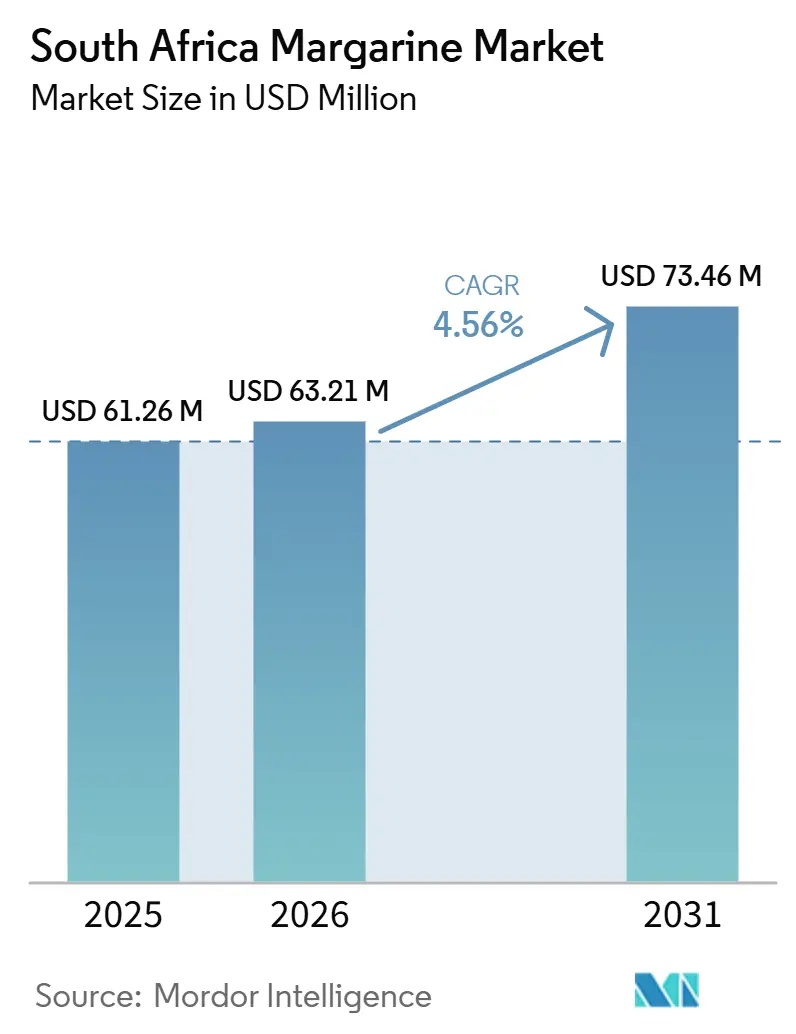
| Base Year Market Size (2025) | USD 61.26 Million |
| Market Size (2026) | USD 63.21 Million |
| Market Size (2031) | USD 73.46 Million |
| Growth Rate (2026 - 2031) | 4.56% CAGR |
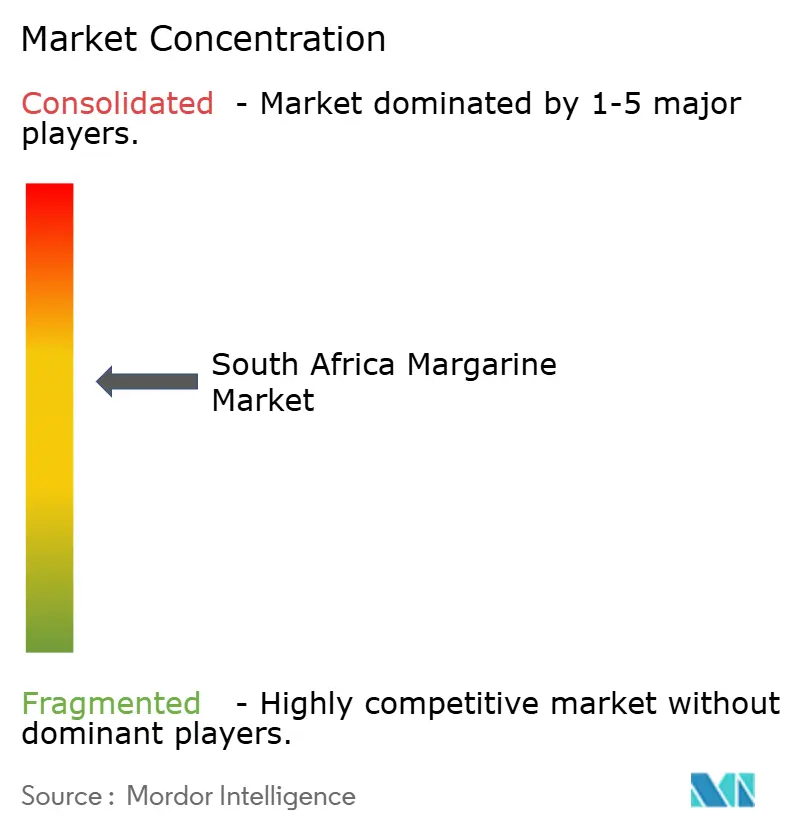
| Market Concentration | Medium |
Major Players *Disclaimer: Major Players sorted in no particular order Image © Mordor Intelligence. Reuse requires attribution under CC BY 4.0. | |
South Africa Margarine Market Analysis by Mordor Intelligence
The South Africa margarine market size was valued at USD 61.26 million in 2025 and estimated to grow from USD 63.21 million in 2026 to reach USD 73.46 million by 2031, at a CAGR of 4.56% during the forecast period (2026-2031). The category remains an everyday staple because vegetable-fat spreads are priced below butter for many households. Commercial baking, confectionery, and foodservice purchases also give suppliers a stable volume base. Product reformulation is becoming more important as producers seek trans-fat-compliant, fortified, and plant-oil-based offerings. This creates room for differentiated products, while the core South Africa margarine market continues to depend on cost efficiency and reliable supply. Larger suppliers are likely to focus on distribution, application support, and product differentiation rather than price coordination after recent competition enforcement actions. Input cost volatility and changing views on processed fats remain important limits on growth.
Key Report Takeaways
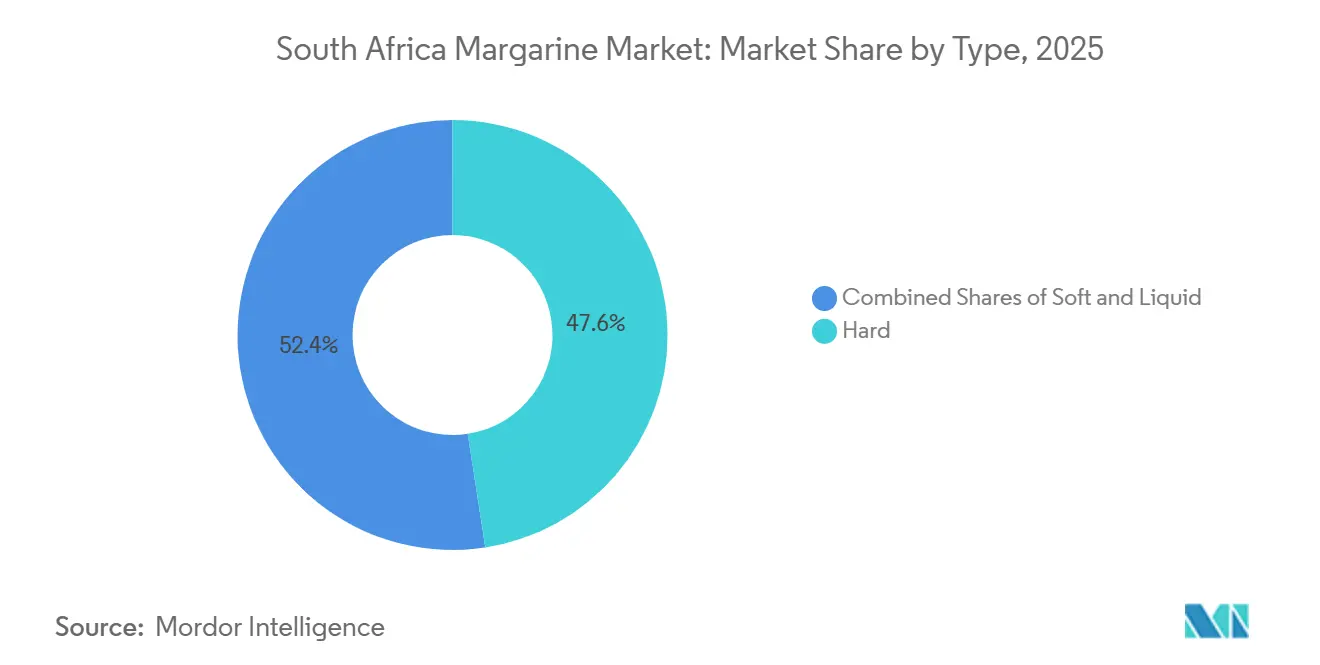
- By type, Hard margarine held 47.56% of the South Africa margarine market share in 2025, while Soft margarine is projected to grow at a 5.68% CAGR through 2031.
- By fat content, Regular margarine held 38.68% of the South Africa margarine market share in 2025, while Low-Fat margarine is projected to grow at a 5.82% CAGR through 2031.
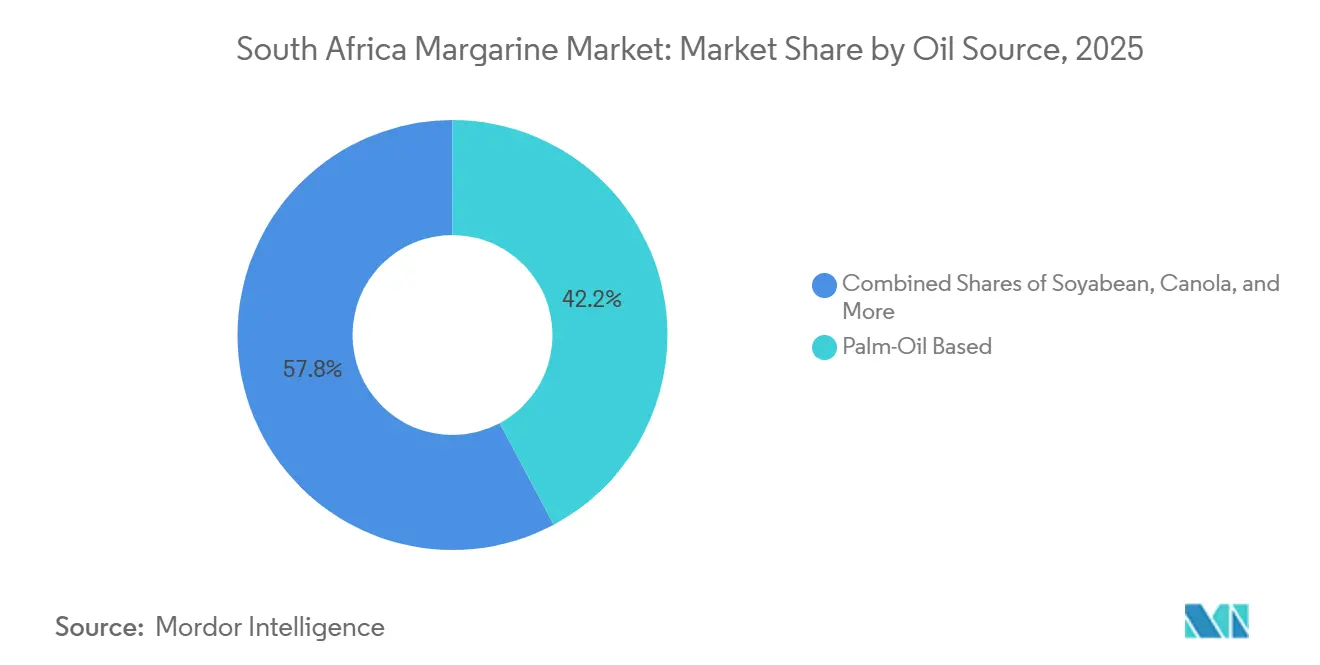
- By oil source, Palm-Oil-Based margarine held a 42.19% share in 2025, while Soybean-Oil-Based margarine is projected to grow at a 6.11% CAGR through 2031.
- By packaging type, Tubs and Cups held a 38.62% share in 2025, while Sticks and Blocks are projected to grow at a 5.93% CAGR through 2031.
- By end user, Retail held a 52.17% share in 2025, while HoReCa and Foodservice are projected to grow at a 6.56% CAGR through 2031.
Note: Market size and forecast figures in this report are generated using Mordor Intelligence’s proprietary estimation framework, updated with the latest available data and insights as of January 2026.
South Africa Margarine Market Trends and Insights
Drivers Impact Analysis*
| Driver | (~) % Impact on CAGR Forecasts | Geographic Relevance | Impact Timeline |
|---|---|---|---|
| Growing Demand for Affordable Butter Alternatives | +1.3% | National; strongest in low-to-middle income urban centers (Johannesburg, Durban, Cape Town) | Short term (≤ 2 years) |
| Expansion of the Bakery and Confectionery Industry | +1.1% | National; manufacturing concentration in KwaZulu-Natal and Gauteng | Medium term (2–4 years) |
| Growing Foodservice and QSR Sector | +0.9% | National; early gains in Gauteng, Western Cape, and KwaZulu-Natal metros | Medium term (2–4 years) |
| Technological Improvements in Margarine Formulations | +0.7% | National, with spill-over to SADC export markets | Long term (≥ 4 years) |
| Increasing Demand for Plant-Based Food Products | +0.6% | National; stronger adoption in urban retail hubs | Medium term (2–4 years) |
| Growth in Household Baking Activities | +0.4% | National, across peri-urban and rural segments | Short term (≤ 2 years) |
| Source: Mordor Intelligence | |||
Growing Demand for Affordable Butter Alternatives
The price gap between butter and margarine widened through 2024 and 2025 as dairy commodity costs kept butter prices above vegetable-fat alternatives. This supported the South Africa margarine market among households that closely manage grocery spending. The effect was especially clear in township and peri-urban retail channels, where margarine is a regular grocery purchase instead of an occasional product. Hard and Regular-Fat products benefit because institutional bakeries also buy these formats through annual volume contracts. Those contracts give suppliers a steadier base than retail footfall alone. Private-label ranges at Shoprite Checkers and Pick n Pay still put pressure on branded prices, which favors producers that combine scale with established brands.
Expansion of the Bakery and Confectionery Industry
Bakery, biscuit, pastry, and confectionery production remains a dependable institutional outlet for the South Africa margarine market. These users purchase Hard and Regular-Fat products because shortening performance, creaming, and heat stability matter in finished goods. Larger national bakery producers have gained volume from supermarket bakeries and independent operators. This leaves more purchasing power with fewer buyers and increases pressure on supplier pricing. Smaller producers can face weaker margins even when overall volumes rise. Chipkins Puratos illustrates the value of application development and technical support in bakery ingredients, where suppliers can compete on service rather than price alone[1]Source: Chipkins Puratos, “Chipkins Puratos,” Chipkins Puratos, chipkinspuratos.co.za.
Growing Foodservice and Quick-Service Restaurant (QSR) Sector
Foodservice remains a key growth outlet for the South Africa margarine market, as commercial kitchens consistently use bulk cooking fats, liquid margarine, and soft spreads across high-volume meal preparation. Famous Brands reported 53.00 new South African leading-brand restaurant locations for the six months ended August 31, 2025. During the same period, its South African leading brands recorded 6.00% system-wide sales growth, and its network reached 2,666 stores. This restaurant footprint expansion strengthens recurring demand from standardized kitchens that rely on consistent product specifications, portioning practices, and supplier arrangements. Compact kitchens, drive-through locations, and cloud-kitchen formats further support predictable cooking-fat usage and regular procurement cycles, as these formats typically require efficient inventory management and dependable ingredient availability.
Technological Improvements in Margarine Formulations and Plant-Based Products
Reformulation is a key area of competition in the South Africa margarine market. Producers are using interesterification, fractionation, and plant-oil blending to support trans-fat compliance, functional fat profiles, and clearer ingredient lists. These capabilities can create a barrier for smaller producers that lack refining infrastructure or cannot produce consistent formulations at scale. Omega-3-fortified and vitamin-enhanced spreads are also giving selected products a more functional position. Siqalo Foods uses plant-based formulations with omega-3 fatty acids and vitamins A, D, and E in its Flora range. Demand for plant-origin spreads is more visible in urban supermarkets, while household baking activity also supports smaller baking formats and related product use.
Restraints Impact Analysis*
| Restraint | (~) % Impact on CAGR Forecasts | Geographic Relevance | Impact Timeline |
|---|---|---|---|
| Volatility in Vegetable Oil Prices | -1.0% | National; upstream exposure concentrated at KwaZulu-Natal and Gauteng refining and blending hubs | Short term (≤ 2 years) |
| Health Concerns Associated with Processed Fats | -0.8% | National; stronger headwinds in urban premium retail segments (Cape Town, Johannesburg North) | Medium term (2–4 years) |
| Competition from Alternative Spreads and Oils | -0.6% | National; imported premium alternatives gaining ground in urban modern trade | Medium term (2–4 years) |
| Stringent Nutritional and Food Labeling Regulations | -0.4% | National | Long term (≥ 4 years) |
| Source: Mordor Intelligence | |||
Volatility in Vegetable Oil Prices
The South Africa margarine market remains exposed to input-cost volatility, as producers depend on imported palm oil and are also affected by global sunflower and soybean oil price cycles. According to the National Agricultural Marketing Council, global vegetable oil prices are projected to reach a three-year high by mid-2025, reflecting pressure across key edible oil categories[2]Source: National Agricultural Marketing Council, “Food and Input Cost Report Q2, September 2025,” NAMC, namc.co.za. Rising biofuel demand and tighter oilseed supply from the Black Sea region are expected to contribute to these pricing conditions and intensify procurement challenges for margarine manufacturers. Since palm oil is dollar-denominated, rand-dollar exchange rate movements can increase local input costs even when international benchmark prices remain stable. Vertically integrated companies can partly absorb or manage this pressure through refining operations and upstream margins, giving them a stronger cost position. In contrast, smaller blenders that depend on spot-market purchases have limited protection against price swings and currency movements, which may encourage consolidation during the forecast period.
Health Concerns Associated with Processed Fats, Alternative Products, and Labeling Requirements
Health concerns are changing purchase choices in higher-income urban areas of the South Africa margarine market. Some consumers are trying butter, cold-pressed oils, and avocado-based alternatives because they associate processed spreads with saturated fat and cardiovascular risk. This pressure is strongest in premium retail rather than across the full category. Lower-income households may regard margarine’s energy content as useful, so demand for Regular-Fat products is not weakening evenly. Competition from premium alternatives and tighter labeling expectations therefore require producers to manage portfolios for different income and retail groups. Low-Fat products, plant-oil blends, and functional claims can help address these needs, but they do not replace the role of value-oriented products.
*Our forecasts treat driver/restraint impacts as directional, not additive. The impact forecasts reflect baseline growth, mix effects, and variable interactions.
Segment Analysis
By Type: Hard Formats Anchor Commercial Baking Volumes
Hard margarine held 47.56% of the South Africa margarine market share in 2025. Commercial biscuit, pastry, and confectionery producers rely on its shortening power, creaming performance, and heat stability. These functional requirements support regular purchasing through industrial and commercial channels. Hard formats are particularly important where production standards require consistent results across large batches. Liquid margarine remains the smallest type by volume. It is gaining use in foodservice kitchens that prefer pump-dispensable and ready-to-use fat formats. These formats reduce preparation steps in kitchens that are managing labor and throughput. The South Africa margarine market size for Hard products is therefore supported by institutional demand as well as household use.
Soft margarine is projected to grow at a 5.68% CAGR through 2031. Its growth is linked to spreadability, lower saturated-fat positioning, plant-based oil blends, and table use. Siqalo Foods uses its Flora soft spread range to combine plant-based positioning with omega-3 and vitamin enrichment. Plant-based spread purchases are becoming more common in urban supermarket chains, where premium products have gained shelf space. Hard and Soft products serve different needs rather than directly replacing each other. Hard products remain central to commercial procurement. Soft products are where more incremental value is being created. Liquid and Soft variants also have stronger links with retail and HoReCa supply chains than Hard products.



By Fat Content: Low-Fat Variants Gain Structural Momentum
Regular margarine held 38.68% of the South Africa margarine market share in 2025. It remains important in institutional buying because fat content affects creaming and shortening results in baked goods. These operational needs can outweigh concern about nutritional labels for commercial buyers. Light margarine, with less than 40% fat, serves consumers who prioritize a lower-fat table spread. It is the smallest part of the mix. Low-Fat products with 40% to 80% fat sit between those two categories. Producers are developing blended soybean, sunflower, and canola oil profiles to meet target fat ranges. The South Africa margarine market continues to need products that balance nutrition, taste, and cooking performance.
Low-Fat margarine is forecast to grow at a 5.82% CAGR through 2031. This rate exceeds the 4.56% CAGR forecast for the overall category. The segment is not limited to premium grocery retail. Foodservice and institutional caterers can specify Low-Fat products for meal programs that manage caloric density. This adds demand beyond household choices. Flora’s plant-oil-enriched Low-Fat extensions show how established suppliers are bringing nutritional differentiation into a category that has often competed on price. Consumers and institutional buyers are giving more attention to fat management. This supports the segment’s stronger growth outlook.
By Oil Source: Palm Oil Leads, Soybean-Based Variants Outpace on Growth
Palm-Oil-Based margarine held 42.19% of the South Africa margarine market share in 2025. Palm oil provides a cost and functionality balance for Hard and Soft variants. It is widely used in local blending and emulsification. Rapeseed and canola oil products serve buyers seeking particular nutritional profiles or more feedstock diversity. Sunflower-oil-based blends have historically been important within the Others category because South Africa has domestic sunflower crushing capacity. Palm oil remains the main feedstock, but retail and foodservice buyers are giving greater attention to certified-origin supply. This can influence procurement policies and supplier selection. The South Africa margarine market size for palm-based products remains tied to both cost control and functional performance.
Soybean-Oil-Based margarine is projected to grow at a 6.11% CAGR through 2031. Soybean oil supports omega-3 and polyunsaturated-fat claims, and it is becoming more relevant to plant-based formulated food supply chains. In June 2025, Siqalo Foods became the first company in Africa to receive Malaysian Sustainable Palm Oil certification. The certification covered purchases of certified refined, bleached, and deodorized palm oil derivatives for fat spreads and margarine under the Mass Balance supply-chain model. The certification gives the company a sourcing credential in Southern Africa. Competitors may face pressure as MSPO and RSPO requirements enter downstream procurement policies. Certified palm supply may command a premium, changing input-cost conditions across the segment.
By Packaging Type: Sticks and Blocks Reshape Industrial Procurement Logic
Tubs and Cups held 38.62% of the South Africa margarine market share in 2025. The format is established in household retail because it is suitable for spreading and light baking. Sachets and Pouches serve single-serve and catering uses in QSR table service, airline catering, and institutional meal programs. Bulk packs of 10 kg or more supply industrial bakery lines that purchase fats by the pallet through annual contracts. Each format meets a different purchasing requirement. This limits direct substitution between formats. It also gives the packaging structure stability across retail, foodservice, and industrial sales. The South Africa margarine market retains a clear division between consumer packs and purpose-built commercial formats.
Sticks and Blocks are forecast to grow at a 5.93% CAGR through 2031. Commercial bakers and pastry operations use pre-measured formats to reduce weighing work and support recipe consistency. The packs can also reduce cross-contamination risk in high-throughput settings. Their value is stronger when energy and labor costs are rising. Household baking activity that began during the extended 2023 and 2024 load-shedding period continued into 2026. This has created demand from home bakers for smaller baking formats. Willowton Group’s WoodenSpoon brand is available in a brick format and is endorsed by the SA Cake Decorators Guild. The format can therefore serve both commercial and household baking users.
By End User: Retail Retains Scale, Foodservice Resets Growth Ambitions
Retail held 52.17% of the South Africa margarine market share in 2025. Supermarkets and Hypermarkets are the leading pathway, supported by Shoprite Checkers, Pick n Pay, and SPAR. Convenience and Grocery Stores are important in township and peri-urban areas. Their proximity can matter more than mall-based modern retail for many consumers. Private-label and value-tier products have a strong price position in these outlets. Online Retail Stores remain the smallest retail sub-channel. Their use is increasing as grocery delivery platforms mature and younger consumers become more comfortable with digital grocery purchases. The South Africa margarine market size in Retail remains larger than other end-user channels because households purchase the product frequently.
HoReCa and Foodservice are projected to grow at a 6.56% CAGR through 2031. This is supported by QSR expansion, hospitality activity, and institutional catering demand. Famous Brands’ network reached 2,666 stores by mid-2025, and the company reported 5 new drive-through restaurants during the period. Industrial and B2B Processing also gives producers a stable outlet through food manufacturers that use margarine in biscuits, confectionery, instant noodles, and ready meals. Annual supply agreements can reduce exposure to changes in household store traffic. Foodservice growth does not remove Retail’s importance. It does increase the role of commercial procurement in supplier planning and product formats.
Geography Analysis
Gauteng, including Johannesburg and Pretoria, accounts for a large part of retail and foodservice demand. Its population density, household incomes, and formal trade infrastructure support consumption. The province also has the country’s largest concentration of Supermarket and Hypermarket floor space. The Western Cape has stronger demand for premium and health-positioned variants. Retailers in Cape Town carry a broader selection of Low-Fat and plant-oil-fortified products than the national average.
KwaZulu-Natal is important to the South African margarine market because Durban-based infrastructure supports a meaningful share of local production capacity. Siqalo Foods has a production network in the province. In February 2026, Wilmar SA committed ZAR 47 million, equivalent to USD 2.50 million, for a packaging plant in Durban that is expected within 12 to 15 months[3]Source: Competition Commission of South Africa, “Commission Welcomes Tribunal Confirmation of the Settlement Agreement Concluded with Wilmar SA,” Competition Commission of South Africa, compcom.co.za. Willowton Group has manufacturing sites in KwaZulu-Natal, Gauteng, Limpopo, and the Western Cape. This multi-site structure can reduce logistics costs and limit exposure to infrastructure disruption. The Eastern Cape, Limpopo, and North West remain less served by modern retail, where spaza shops and small grocery stores favor value-tier and private-label products.
South Africa also serves as a supply base for nearby SADC markets. Willowton Group has expanded manufacturing into Zambia and Zimbabwe while using its South African base as a regional platform. This provides an outlet beyond domestic demand for producers with regional reach. The South Africa margarine market may therefore support capacity use even when local consumer demand grows gradually. New refining or blending investment can serve domestic consumption and selected regional customers. The country’s role as a production and distribution hub strengthens the long-term case for local supply infrastructure.
Competitive Landscape
The South Africa margarine market is moderately consolidated in nature because a small group of established producers holds strong branded retail and commercial positions. Siqalo Foods and Willowton Group are key branded participants. Siqalo’s portfolio includes Rama, Flora, Stork, and Rondo. Willowton supplies WoodenSpoon, Crown, and related fat products. These portfolios cover mass-market cooking margarines, fortified spreads, and commercial baking fats. AAK AB and Vandemoortele NV focus more on tailored B2B formulations and application support. Their buyers can require specific melting, crystallization, and performance properties rather than commodity products.
Sustainable sourcing and health positioning remain an open area for differentiation in the South Africa margarine market. No brand in the supplied material combines certified-origin palm oil transparency with clinically substantiated nutritional claims as its leading position. Bunge Limited and Wilmar International can benefit if retail and foodservice buyers place more weight on traceable sourcing. Siqalo Foods’ June 2025 MSPO certification is a specific move toward verified palm-oil sourcing. The certification can support procurement discussions with buyers that require sustainable sourcing credentials. Product formulation, ingredient traceability, and operational energy efficiency are also important areas of investment. These moves help suppliers respond to regulation, customer requirements, and price pressure.
Competition enforcement has changed the strategic setting for the South Africa margarine market. In February 2025, the Competition Tribunal confirmed a ZAR 101 million settlement agreement with DH Brothers Industries, part of the Willowton Group, concerning edible oils, baking fats, and margarine. In February 2026, the Tribunal confirmed a settlement with Wilmar SA that included ZAR 49.50 million in public-interest obligations and the Durban packaging-plant commitment. These outcomes make compliance a central management issue. They also encourage companies to compete through product differentiation, supply-chain investment, and sustainability credentials. The concentration level is consistent with strong positions for major suppliers, but it still leaves room for technical specialists and differentiated entrants.
South Africa Margarine Industry Leaders
Siqalo Foods
The Willowton Group
Africa Sun Oil
SD Guthrie International South Africa
Clover S.A. Proprietary Limited
- *Disclaimer: Major Players sorted in no particular order

Recent Industry Developments
- February 2026: The South Africa Competition Tribunal confirmed a settlement agreement with Wilmar SA (Pty) Ltd, concluding a 10-year litigation over price-fixing in the edible oils, baking fats, and margarine market. Wilmar committed ZAR 1 million in settlement and ZAR 49.50 million in public-interest obligations, covering bursaries, school infrastructure funding, and SMME enterprise development.
- June 2025: Siqalo Foods Proprietary Limited became the first company on the African continent to achieve Malaysian Sustainable Palm Oil certification. The certification covered purchases of MSPO-certified RBD Palm Oil Derivatives for fat spreads, butter, and margarine through the Mass Balance supply-chain model. Certificate MSPO 820825 runs from June 25, 2025, to June 24, 2030. The development set a benchmark for sustainable palm-oil sourcing in Southern Africa’s margarine and fat-spread sector.


South Africa Margarine Market Report Scope
| Hard |
| Soft |
| Liquid |
| Regular (>80% Fat) |
| Low-Fat (40–80% Fat) |
| Light (<40% Fat) |
| Palm-Oil-Based |
| Soybean-Oil-Based |
| Rapeseed/Canola-Oil-Based |
| Others |
| Tubs and Cups |
| Sticks and Blocks |
| Sachets and Pouches |
| Bulk (10 kg+) |
| Retail | Supermarkets/Hypermarkets |
| Convenience and Grocery Stores | |
| Online Retail Stores | |
| Other Channels | |
| HoReCa/Foodservice | |
| Industrial/B2B Processing |
| By Type | Hard | |
| Soft | ||
| Liquid | ||
| By Fat Content | Regular (>80% Fat) | |
| Low-Fat (40–80% Fat) | ||
| Light (<40% Fat) | ||
| By Oil Source | Palm-Oil-Based | |
| Soybean-Oil-Based | ||
| Rapeseed/Canola-Oil-Based | ||
| Others | ||
| By Packaging Type | Tubs and Cups | |
| Sticks and Blocks | ||
| Sachets and Pouches | ||
| Bulk (10 kg+) | ||
| By End User | Retail | Supermarkets/Hypermarkets |
| Convenience and Grocery Stores | ||
| Online Retail Stores | ||
| Other Channels | ||
| HoReCa/Foodservice | ||
| Industrial/B2B Processing | ||


Key Questions Answered in the Report
What is the projected value of the South Africa margarine market by 2031?
The category is projected to reach USD 73.46 million by 2031, from USD 63.21 million in 2026, at a 4.56% CAGR.
Which type of margarine has the largest share in South Africa?
Hard margarine held the largest type share at 47.56% in 2025, supported by commercial baking and confectionery demand.
Which fat-content category is growing the fastest?
Low-Fat margarine is projected to grow at a 5.82% CAGR through 2031, ahead of the overall category rate.
Why is palm oil important for margarine production in South Africa?
Palm-Oil-Based products held 42.19% share in 2025 because palm oil offers a useful balance of cost and performance.
Page last updated on:






