
Solid State Cooling Market Size and Share
Market Overview
| Study Period | 2021 - 2031 |
|---|---|
| Market Size (2026) | USD 1.02 Billion |
| Market Size (2031) | USD 1.58 Billion |
| Growth Rate (2026 - 2031) | 9.15 % |
| Fastest Growing Market | Asia-Pacific |
| Largest Market | Asia-Pacific |
| Market Concentration | Medium |
Major Players *Disclaimer: Major Players sorted in no particular order Image © Mordor Intelligence. Reuse requires attribution under CC BY 4.0. | |
Solid State Cooling Market Analysis by Mordor Intelligence
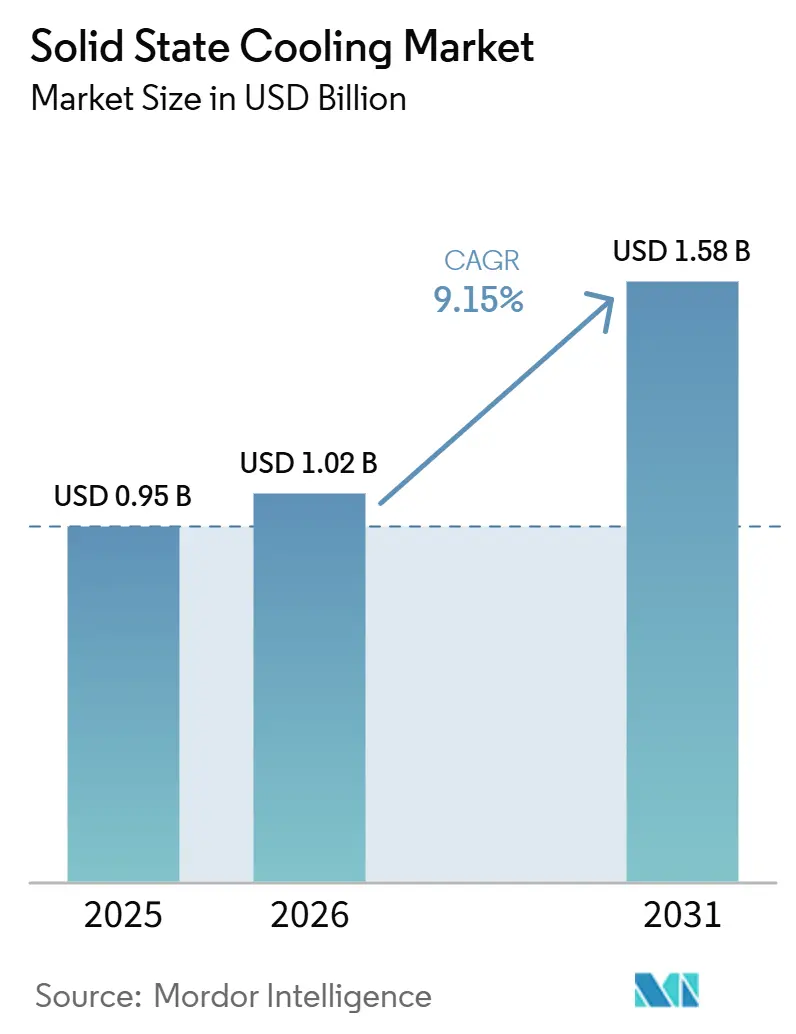
The Solid State Cooling Market size was estimated at USD 0.95 billion in 2025 and is estimated to grow from USD 1.02 billion in 2026 to USD 1.58 billion by 2031, at a CAGR of 9.15% during the forecast period (2026-2031). The solid-state cooling market is expanding beyond specialized instruments as electronics, medical equipment, and high-density computing applications require tighter temperature control. Regulatory requirements are accelerating this shift, as solid-state equipment avoids refrigerant handling and associated compliance obligations. AI hardware also generates short, concentrated heat loads that facility-level cooling cannot manage at the component level. The market presents opportunities in applications where silence, low vibration, reliability, and compact form factors are more important than bulk cooling capacity. These include optical inspection, medical diagnostics, power electronics, laboratory equipment, portable refrigeration, and compact AI devices, where conventional compressor systems are less suitable. Suppliers are responding by offering integrated systems and control software rather than stand-alone modules, as customers in data centers, semiconductor facilities, laboratories, and medical equipment require suppliers capable of addressing module selection, heat rejection, sensor inputs, power management, mechanical integration, service requirements, and the operating parameters that maintain stable temperature conditions during normal use.
Key Report Takeaways
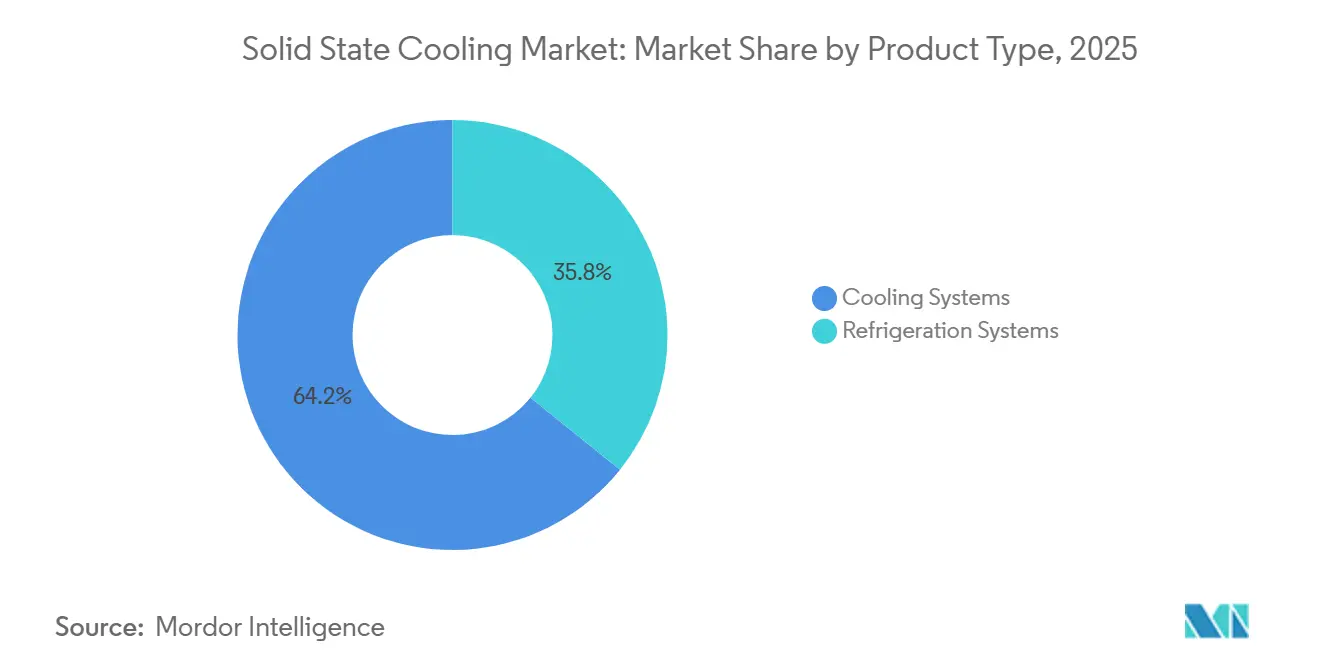
- By product type, Cooling Systems held 64.22% of Solid State cooling market share in 2025, while Refrigeration Systems are projected to grow at a 9.83% CAGR through 2031.
- By technology, Thermoelectric Cooling accounted for 53.47% of Solid State cooling market share in 2025, while Magnetocaloric Cooling is forecast to expand at a 10.71% CAGR through 2031.
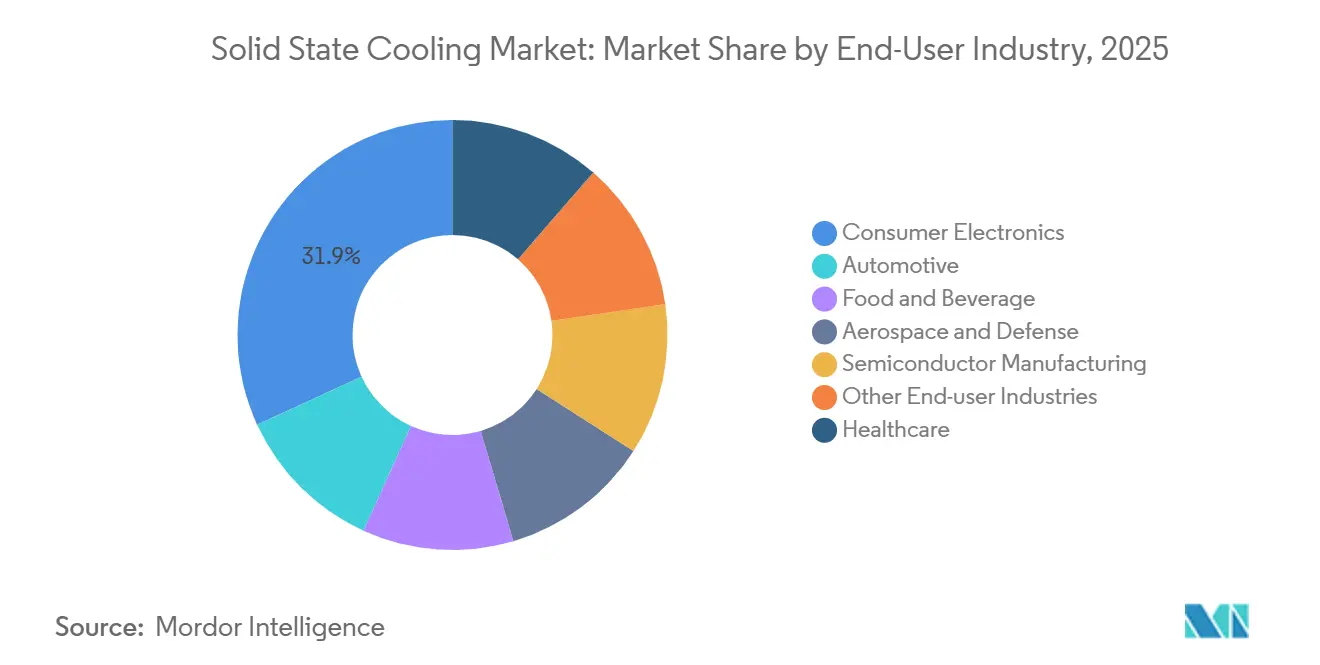
- By end-user industry, Consumer Electronics commanded 31.85% of revenue in 2025, while Semiconductor Manufacturing is forecast to grow at an 11.04% CAGR through 2031.
- By geography, Asia-Pacific accounted for 42.53% of revenue in 2025 and is projected to grow at a 9.73% CAGR through 2031.
Note: Market size and forecast figures in this report are generated using Mordor Intelligence’s proprietary estimation framework, updated with the latest available data and insights as of January 2026.
Global Solid State Cooling Market Trends and Insights
Drivers Impact Analysis*
| Drivers | (~) % Impact on CAGR Forecast | Geographic Relevance | Impact Timeline |
|---|---|---|---|
| Increasing Demand for Refrigerant-Free Cooling in Electronics and Medical Devices | +1.8% | Global, with regulatory-driven acceleration in the EU and North America | Short term (≤ 2 years) |
| Growing Thermal Management Requirements for EV Batteries and Power Electronics | +1.6% | Asia-Pacific as a core, with spillover to Europe and North America | Medium term (2-4 years) |
| Rising Adoption of Solid-State Cooling for Data Center Rack and Localized Cooling Applications | +1.5% | North America and Asia-Pacific hyperscaler markets | Short term (≤ 2 years) |
| Increasing Preference for Low-Maintenance Cooling Systems in Industrial Automation | +0.8% | Global, with early gains in Germany, Japan, and South Korea | Medium term (2-4 years) |
| Growing Demand for Precision Cooling in Semiconductor Manufacturing and Laboratory Equipment | +1.3% | Asia-Pacific as a core, with significant pull from North American fab expansion | Short term (≤ 2 years) |
| Sustainability-Led Replacement of High-Global Warming Potential (GWP) Refrigerants | +1.0% | Global, with binding regulatory timelines in the EU and North America | Medium term (2-4 years) |
| Source: Mordor Intelligence | |||
Increasing Demand for Refrigerant-Free Cooling in Electronics and Medical Devices
The EU F-gas Regulation prohibits F-gases in domestic refrigeration from January 1, 2026, while the US American Innovation and Manufacturing (AIM) Act establishes a phasedown framework for hydrofluorocarbons[1]U.S. Environmental Protection Agency, “Frequent Questions on the Phasedown of Hydrofluorocarbons,” U.S. Environmental Protection Agency, epa.gov. These requirements compress OEM evaluation schedules for cooling designs that use conventional refrigerants, as product teams must avoid delayed qualification, refrigerant servicing obligations, documentation burdens, and exposure to changing regulations in products intended for long operating lives. Medical device manufacturers must also account for lengthy authorization cycles when selecting thermal systems. Thermoelectric equipment carries no refrigerant charge, requires no refrigerant handling, and has zero global warming potential at the point of use. The solid-state cooling market can benefit when manufacturers incorporate thermal architecture into product platforms with multiyear design cycles. Sustainability requirements reinforce this preference for new products, even where existing equipment remains in service, because a refrigerant-free design can simplify product documentation, reduce exposure to future changes in refrigerant availability, and provide manufacturers with a common thermal platform for products sold across multiple regulated regions.
Growing Thermal Management Requirements for Electric Vehicle (EV) Batteries and Power Electronics
Solid-state battery designs require precise heating in cold conditions, while inverters, onboard chargers, and motor controllers generate concentrated heat at the module level. Conventional liquid loops remain appropriate for removing bulk heat from the vehicle. Thermoelectric devices address a different need by managing local hot spots near cell interfaces, power junctions, and charging contacts, where temperature gradients can affect component reliability, charging consistency, and the usable life of sensitive electronics. A 2026 review described the growing application of thermoelectric cooling to localized temperature-gradient management in solid-state battery modules. Research published in 2026 also documented improved performance and reliability from thermoelectric active thermal management in gallium nitride power devices. The solid-state cooling market benefits from this division of roles, as precision thermal control can complement, rather than replace, vehicle liquid cooling. This allows vehicle designers to direct liquid systems toward broad heat removal and deploy small solid-state units only at locations where local temperature accuracy is more critical than capacity.
Rising Adoption for Data Center Rack and Localized Cooling Applications
AI workloads generate localized heat fluxes of 100–300 W/cm² around GPU high-bandwidth memory (HBM) stacks and co-packaged optics. These loads can peak within milliseconds, whereas facility cooling responds over longer intervals. This response gap creates a role for local thermoelectric control in high-density racks, as direct control can respond to component load changes without waiting for a facility system to adjust coolant flow, air movement, or broader rack conditions. In March 2026, Phononic stated that its GPU HBM solution delivered 40% greater compute performance, 0.15 Power Usage Effectiveness (PUE) savings, and a 5x lifetime improvement in deployments across major hyperscalers. The company also introduced Thermal Fabric, which uses real-time telemetry and workload-aware control for thermoelectric systems. The solid-state cooling market is shifting toward longer-term relationships with data center operators rather than one-time module purchases, as operators require controls that integrate with hardware telemetry, respond to changing workloads, and maintain thermal conditions as rack configurations, processor designs, operating loads, and maintenance conditions evolve over extended operating periods.
Growing Demand for Precision and Low-Maintenance Cooling in Semiconductor and Industrial Equipment
Automated optical inspection equipment for 5 nm semiconductor fabrication requires stable operating temperatures to preserve laser accuracy and image resolution. Thermoelectric recirculating chillers eliminate compressor pulsation, which can introduce mechanical noise into optical imaging. Tark Thermal Solutions stated that its Underwriters Laboratories (UL)-certified NRC400 chiller delivers 400 W of cooling capacity and ±0.05°C stability for semiconductor metrology and inspection systems. These same characteristics support laboratory instruments and industrial automation equipment that require quiet, low-maintenance operation, repeatable measurement conditions, smaller thermal footprints, and reduced disruption from moving mechanical parts during continuous production or analysis. The solid-state cooling market gains ground where equipment is designed from the outset for precise and distributed thermal control. Planned semiconductor fabrication projects also support forward demand for process cooling equipment through 2030, as inspection, metrology, and quality-control tools require stable operating conditions throughout installation, process ramp-up, and routine production, not only during peak output.
Restraints Impact Analysis*
| Restraints | (~) % Impact on CAGR Forecast | Geographic Relevance | Impact Timeline |
|---|---|---|---|
| High Material Costs and Lower Energy Efficiency Compared with Conventional Cooling Technologies | -1.8% | Global | Long term (≥ 4 years) |
| Integration Challenges with Existing HVAC and Conventional Refrigeration Systems | -1.0% | Global, more pronounced in emerging markets with older infrastructure | Medium term (2-4 years) |
| Limited Commercialization and Large-Scale Manufacturing of Electrocaloric and Magnetocaloric Technologies | -0.8% | Global, with commercial activity still concentrated in the EU | Medium term (2-4 years) |
| Source: Mordor Intelligence | |||
High Material Costs, Energy Efficiency Constraints, and Early-Stage Manufacturing
Bismuth telluride modules cost 3-5 times as much as equivalent-capacity vapor-compression components. The cost difference becomes more pronounced at larger capacities because the thermoelectric coefficient of performance declines faster with scale than compressor efficiency. A 2025 study reported a water-cooled integrated thermoelectric cooler with a COP of 3.26 at 80 W, but the design remained application-specific[2]Wei Fan, Zihan Wu, Seunguk Hong, et al., “High-Performance Integrated Thermoelectric Coolers for Electronics Cooling,” Communications Materials, nature.com. Tellurium is a byproduct of copper refining, and China accounts for 40% of global production, limiting module producers' ability to quickly increase supply when new orders rise or when geopolitical conditions disrupt established trading patterns. This concentration creates cost uncertainty for module manufacturers and limits the use of thermoelectric modules in HVAC and commercial refrigeration applications. Magnetocaloric and electrocaloric solutions present an additional constraint, as their commercial manufacturing remains in early stages despite their potential as future alternatives.
Integration Challenges with Existing HVAC and Refrigeration Infrastructure
Retrofitting solid-state components into vapor-compression systems can require new piping layouts, control logic, power delivery, and thermal interface materials. In complex buildings and industrial plants, the engineering effort can cost more than the components themselves. A 2025 study found that separately configured thermoelectric architectures could support building-façade integration but required custom engineering beyond standard HVAC practice. New data centers and semiconductor facilities avoid much of this burden because cooling is specified during the design phase, allowing power delivery, control architecture, thermal interfaces, service access, and operating procedures to be planned around the selected technology rather than adapted after installation. Older infrastructure in emerging markets can add further complexity where local thermoelectric integration support is limited. These conditions constrain the solid-state cooling market in retrofit-heavy applications, even when the performance case is strong, as site owners must weigh equipment benefits against engineering costs, shutdown risk, changes to established maintenance routines, and the availability of technicians familiar with both the facility and the thermal system being added.
*Our forecasts treat driver/restraint impacts as directional, not additive. The impact forecasts reflect baseline growth, mix effects, and variable interactions.
Segment Analysis
By Product Type: Refrigeration Systems Are Growing Faster Than the Established Cooling Base
Cooling Systems accounted for 64.22% of the Solid State Cooling Market in 2025. This segment includes scientific instruments, medical diagnostics, semiconductor metrology, and consumer electronics that require active, localized thermal control. Its dominant position reflects the maturity of Peltier-effect modules and a supplier base that includes Ferrotec, Kryotherm, Crystal Ltd., and TE Technology. These modules have been manufactured at an industrial scale for more than 4 decades, providing equipment makers with extensive performance data, established qualification practices, known failure modes, and multiple suppliers capable of supporting product development cycles. Their established use provides equipment designers with familiar component options for precise cooling. Regulation (EU) 2024/573 was not fully reflected in 2025 revenue due to the time required for product qualifications, but its direction encouraged the adoption of refrigerant-free thermal designs in new product development.
Refrigeration Systems are forecast to expand at a 9.83% CAGR from 2026 to 2031. This growth reflects early commercial use of magnetocaloric and electrocaloric refrigeration in food retail and pharmaceutical cold chains. The supplied analysis described Magnotherm's Eclipse cabinet as achieving 15% higher energy efficiency than propane cases during an 11-week REWE pilot, indicating that refrigerant-free refrigeration could compete on both operating costs and environmental requirements. Established thermoelectric mini-coolers, portable vaccine refrigerators, and automotive beverage compartments provide an existing demand base, supported further by Electric Vehicle (EV) adoption and off-grid medical cold-chain needs. The Solid State Cooling Market is likely to see refrigeration expand from a smaller base while localized cooling remains the larger product category. Commercial scale will depend on cost reduction and proven performance across a wider set of installations, including stores with varying ambient conditions, maintenance capabilities, load profiles, product configurations, and local requirements for food preservation and energy use.


By Technology: Thermoelectric Cooling Leads While Magnetocaloric Systems Advance
Thermoelectric Cooling represented 53.47% of the Solid State Cooling Market in 2025. Bismuth telluride has the strongest record of thermal-to-electrical conversion maturity among available materials, with established supply chains and applications across consumer electronics, defense electronics, and precision instruments. A 2025 study reported that a water-cooled integrated design achieved a coefficient of performance (COP) of 3.26 at 80 W and a 16°C reduction in maximum smartphone temperature under sustained AI workloads. The performance gap with vapor compression is narrowing in devices below 200 W, keeping thermoelectric cooling relevant in consumer electronics and medical equipment through 2031. This is particularly the case where designers need to manage a limited heat load in a compact enclosure, preserve quiet operation, avoid the size of a compressor system, or maintain a controlled temperature close to a sensitive component. The installed base also provides suppliers with practical experience in module qualification and integration, including electrical controls, heat rejection, condensation management, mechanical mounting, system sealing, and the user expectations that shape product specifications across different end uses.
Magnetocaloric Cooling is forecast to record a 10.71% CAGR from 2026 to 2031, moving from engineering proof-of-concept to initial commercial installations. Magnotherm planned 10 to 20 Eclipse installations in REWE stores during 2026 following its pilot and announced a 125 kW Stellar system for data centers and commercial Heating, Ventilation, and Air Conditioning (HVAC). Electrocaloric cooling also attracted EUR 2.2 million (USD 2.4 million) for Qurie in May 2026, as stated in the supplied material. Other technologies, including barocaloric and thermoacoustic systems, remain pre-commercial and are limited to pilot activity through 2031. The Solid State Cooling Market has room for these alternatives, as they could reduce dependence on tellurium-based thermoelectric materials and offer refrigeration designs that do not follow the conventional vapor-compression approach. However, their role will remain limited until suppliers demonstrate consistent equipment operation, manufacturability, and serviceability. Growth will also depend on manufacturing capacity, system integration, repeated field performance, predictable material supply, maintenance procedures, adequate service networks, and evidence that energy and operating benefits remain consistent across commercial installations.
By End-User Industry: Semiconductor Manufacturing Has the Fastest Demand Growth
Consumer Electronics accounted for 31.85% of end-user revenue in 2025. Gaming laptops, AI-enabled PCs, high-performance smartphones, and wearable health monitors all require sustained cooling in compact enclosures, favoring designs with lower noise and vibration than fan- or compressor-based systems. The supplied content identified solid-state cooling as a performance enabler for AI-edge devices rather than only a premium feature, citing Frore Systems' AirJet Mini G2 in Qualcomm Snapdragon X2 Elite notebook and Mini-PC reference designs at the Consumer Electronics Show (CES) 2025. Healthcare, automotive, food and beverage, and aerospace and defense form mid-tier demand groups, each with specific requirements: quiet operation in surgical settings, vibration-free cooling in avionics, stable temperatures for diagnostics, portable refrigeration for food and health products, and reliable operation in environments with constrained service access. These applications provide diversified demand for the Solid State Cooling Market, even though they grow more slowly than semiconductor manufacturing, as each has a distinct operational reason to choose solid-state thermal control and does not depend on the same capital-investment cycle as large fabrication plants or hyperscale computing facilities.
The semiconductor manufacturing segment is projected to expand at an 11.04% CAGR from 2026 to 2031. New fabrication facilities specify thermoelectric process chillers in the original design rather than retrofitting them into older systems, allowing the segment to grow faster without requiring a broad replacement of alternative cooling technologies. The NRC400 provides 400 W of capacity and ±0.05°C stability for continuous automated optical inspection. A 2026 IEEE study reported reliability improvements from thermoelectric thermal management in gallium nitride Schottky barrier diodes. Fabrication programs in the United States, Europe, and Asia create a policy-supported pipeline for precision cooling equipment, while the equipment's role in inspection and quality assurance ties demand to process capability and production reliability rather than to chip output alone. This demand positions the market to establish higher-value systems with strict performance specifications. Semiconductor equipment suppliers are likely to favor vendors that can combine application engineering with reliable module supply, documented temperature stability, low vibration, lifecycle support, predictable lead times, and the ability to tailor chiller performance to inspection and metrology tools.

Geography Analysis
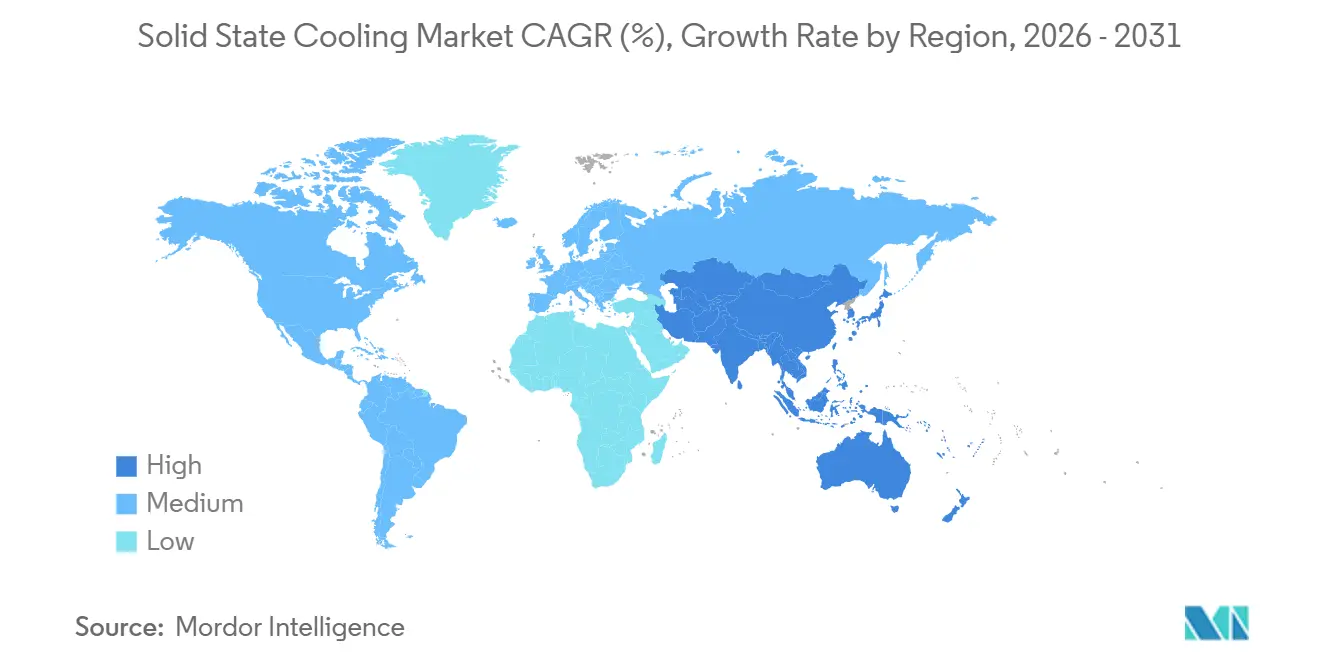
Asia-Pacific accounted for 42.53% of the solid state cooling market in 2025 and is forecast to grow at a 9.73% CAGR through 2031. The region has the largest consumer electronics and semiconductor manufacturing base. China accounted for 39% of regional revenue, driven by semiconductor self-sufficiency programs, electric vehicle (EV) production, and green technology transitions. South Korea supports demand through memory and display production, where process tools require stable temperatures. Japan contributes high-value demand from precision optics, scientific instruments, and automotive power electronics. India is expanding electronics manufacturing and medical diagnostics capacity under production-linked incentive programs. The regional module supply chain, centered on Chinese, Russian, and Japanese producers, provides Asia-Pacific OEMs with procurement advantages that support local design wins. This supply chain also gives the market a broad manufacturing base, including closer access to component suppliers, shorter coordination between equipment makers and module producers, and familiarity with the requirements of electronics and semiconductor customers.
North America is the second-largest regional segment, with AI hyperscalers, defense electronics, semiconductor metrology, and medical diagnostics as major sources of demand. U.S. fabrication construction supports new installations of process chillers for wafer inspection and quality control, where vibration and contamination requirements limit conventional options. In March 2026, Phononic expanded its AI data center portfolio and announced that its systems were deployed across major hyperscalers, positioning the region as an early adopter of workload-aware thermal control. Europe is the third-largest region, with Germany and the United Kingdom contributing demand for automotive engineering, industrial automation, and medical technology. The EU fluorinated gas (F-gas) regulations give European refrigeration OEMs a clear near-term reason to evaluate refrigerant-free alternatives.
South America and the Middle-East & Africa remain smaller regional segments. Brazil leads demand in pharmaceutical cold-chain, telecom cooling, and industrial monitoring, while Argentina is developing early electronics manufacturing activity. Saudi Arabia and the UAE support demand through defense modernization, oil and gas electronics, and smart-city projects. South Africa requires remote medical diagnostics and off-grid laboratory equipment. The maintenance-free nature of thermoelectric equipment is an advantage where compressor servicing is difficult and centralized refrigerant infrastructure is unavailable. The solid state cooling market faces a longer adoption path in these regions; however, its applications align with modular and distributed thermal control, particularly where cooling must operate at a remote point of use, space is limited, service networks are uneven, and operators seek to avoid dependence on refrigerant-handling infrastructure.

Competitive Landscape
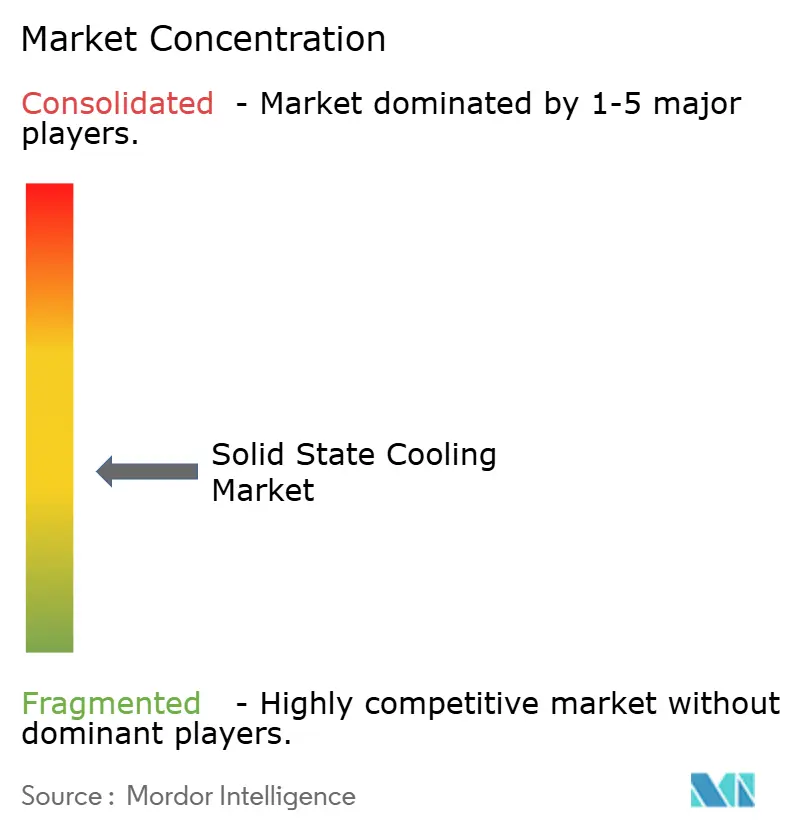
The solid state cooling market is moderately fragmented. Ferrotec, Kryotherm, Crystal Ltd., TE Technology, TEC Microsystems, Laird Thermal Systems, and Tark Thermal Solutions compete on material quality, cycle life, manufacturing scale, and application knowledge, while Phononic and Gentherm compete through system design and application-specific thermal control. Coherent Corp. applies thermoelectric capabilities across its broader photonics and precision materials portfolio. No single company represented more than 20-25% of global thermoelectric module production, even as semiconductor metrology and medical diagnostics customers increasingly seek complete thermal solutions rather than components. This leaves room for specialized suppliers while creating an incentive for firms to add application engineering, controls, and full-system support. This trend is reflected in Laird Thermal Systems' July 2024 acquisition of Tark, Inc., which combined module supply with application engineering, although systems integration remains only partly connected to component manufacturing.
Phononic's March 2026 portfolio expansion illustrates the movement toward software-defined thermal control. The company introduced GPU High Bandwidth Memory (HBM) cooling solutions and Thermal Fabric, a real-time platform with workload-aware thermoelectric management. It reported 0.15 Power Usage Effectiveness (PUE) savings and 40% greater compute performance, shifting the commercial focus to system outcomes rather than module specifications. These outcomes include a rack's ability to sustain computing performance, reduce the impact of thermal limits, and provide operators with a measurable basis for comparing an integrated solution against a component purchase. Coherent demonstrated its thermoelectric generator platform at the Optical Fiber Communication Conference (OFC) 2026, indicating a direction toward devices that both manage cooling and recover waste heat. A 2026 Nature Communications study described a low-temperature, water-free route to magnesium-based micro thermoelectric coolers that could reduce reliance on bismuth telluride in selected precision applications.
Magnetocaloric and electrocaloric systems remain areas without a dominant supplier. Food retail, industrial enclosures, electronics, medical devices, automotive systems, data centers, and commercial HVAC have been identified as potential early-adoption settings where the solid state cooling market can compete through application-specific performance, reduced vibration, and the absence of conventional refrigerants. Southeast Asia and Sub-Saharan Africa also present off-grid medical and telecom demand before established supplier relationships form. The market rewards providers that can integrate materials, modules, controls, thermal interfaces, and equipment-level support. Qualification requirements in medical, semiconductor, defense, and high-density computing moderate price competition and make proven reliability, documentation, service capability, and a clear understanding of the customer's operating environment important factors in supplier selection, particularly where equipment must perform continuously and meet tightly defined temperature, vibration, and maintenance requirements.
Solid State Cooling Industry Leaders
Ferrotec Corporation
Coherent Corp.
Delta Electronics, Inc.
Tark Thermal Solutions
Phononic
- *Disclaimer: Major Players sorted in no particular order

Recent Industry Developments
- March 2026: Phononic expanded its AI data center solid-state cooling portfolio by announcing GPU HBM cooling solutions that delivered up to 0.15 PUE savings, 40% greater compute performance, 5X lifetime improvement, and 3X ROI. The company also introduced the industry's first qualified and deployed 1.6 T high-volume manufacturing solution for co-packaged optics, along with Thermal Fabric, a software-defined, real-time thermal control platform offering millisecond response times and workload-aware thermoelectric management across major hyperscalers.
- March 2026: Delta Electronics presented its AI data center cooling solutions at NVIDIA GTC 2026. These included an 800 V 2.4 MW Coolant Distribution Unit (CDU) supporting 2,400 kW of cooling capacity and an 800 V 3,000 kW In-Row CDU. Both solutions were developed in collaboration with NVIDIA as part of an AI factory architecture targeting energy efficiency and high compute density.


Global Solid State Cooling Market Report Scope
Solid state cooling uses the physical properties of solid materials to transfer heat, eliminating the need for noisy compressors and ozone-depleting refrigerants used in traditional systems. Instead, these systems rely on specialized materials, such as semiconductors or caloric alloys, which pump or absorb heat when an electric, magnetic, or mechanical field is applied.
The solid state cooling market is segmented by product type, technology, end-user industry, and geography. By product type, the market is segmented into cooling systems and refrigeration systems. By technology, the market is segmented into thermoelectric cooling, magnetocaloric cooling, electrocaloric cooling, and other solid-state cooling technologies. By end-user industry, the market is segmented into consumer electronics, healthcare, automotive, food and beverage, aerospace and defense, semiconductor manufacturing, and other end-user industries. The report also covers the market size and forecasts for the solid state cooling market in 16 countries across major regions. The market sizes and forecasts are provided in terms of value (USD).
| Cooling Systems |
| Refrigeration Systems |
| Thermoelectric Cooling |
| Magnetocaloric Cooling |
| Electrocaloric Cooling |
| Other Solid-State Cooling Technologies |
| Consumer Electronics |
| Healthcare |
| Automotive |
| Food and Beverage |
| Aerospace and Defense |
| Semiconductor Manufacturing |
| Other End-user Industries |
| Asia-Pacific | China |
| India | |
| Japan | |
| South Korea | |
| Rest of Asia-Pacific | |
| North America | United States |
| Canada | |
| Mexico | |
| Europe | Germany |
| United Kingdom | |
| France | |
| Italy | |
| Russia | |
| Rest of Europe | |
| South America | Brazil |
| Argentina | |
| Rest of South America | |
| Middle-East and Africa | Saudi Arabia |
| South Africa | |
| Rest of Middle-East and Africa |
| By Product Type | Cooling Systems | |
| Refrigeration Systems | ||
| By Technology | Thermoelectric Cooling | |
| Magnetocaloric Cooling | ||
| Electrocaloric Cooling | ||
| Other Solid-State Cooling Technologies | ||
| By End-User Industry | Consumer Electronics | |
| Healthcare | ||
| Automotive | ||
| Food and Beverage | ||
| Aerospace and Defense | ||
| Semiconductor Manufacturing | ||
| Other End-user Industries | ||
| By Geography | Asia-Pacific | China |
| India | ||
| Japan | ||
| South Korea | ||
| Rest of Asia-Pacific | ||
| North America | United States | |
| Canada | ||
| Mexico | ||
| Europe | Germany | |
| United Kingdom | ||
| France | ||
| Italy | ||
| Russia | ||
| Rest of Europe | ||
| South America | Brazil | |
| Argentina | ||
| Rest of South America | ||
| Middle-East and Africa | Saudi Arabia | |
| South Africa | ||
| Rest of Middle-East and Africa | ||


Key Questions Answered in the Report
What is current market size of Solid State Cooling Market?
The Solid State Cooling Market size was estimated at USD 0.95 billion in 2025 and is estimated to grow from USD 1.02 billion in 2026 to USD 1.58 billion by 2031, at a CAGR of 9.15% during the forecast period (2026-2031).
Which product category has the largest revenue position?
Cooling Systems accounted for 64.22% of revenue in 2025, driven by use in instruments, diagnostics, metrology, and electronics.
Which technology is growing the fastest?
Magnetocaloric Cooling is projected to grow at a 10.71% CAGR through 2031 as initial commercial deployments expand.
Which end-user application is growing fastest?
Semiconductor Manufacturing is projected to grow at an 11.04% CAGR through 2031 because new fabs need precise, low-vibration process cooling.
Page last updated on:





