
Solder Materials Market Size and Share
Market Overview
| Study Period | 2021 - 2031 |
|---|---|
| Market Size (2026) | USD 5.25 Billion |
| Market Size (2031) | USD 6.72 Billion |
| Growth Rate (2026 - 2031) | 5.06 % |
| Fastest Growing Market | Asia-Pacific |
| Largest Market | Asia-Pacific |
| Market Concentration | Medium |
Major Players *Disclaimer: Major Players sorted in no particular order Image © Mordor Intelligence. Reuse requires attribution under CC BY 4.0. | |
Solder Materials Market Analysis by Mordor Intelligence
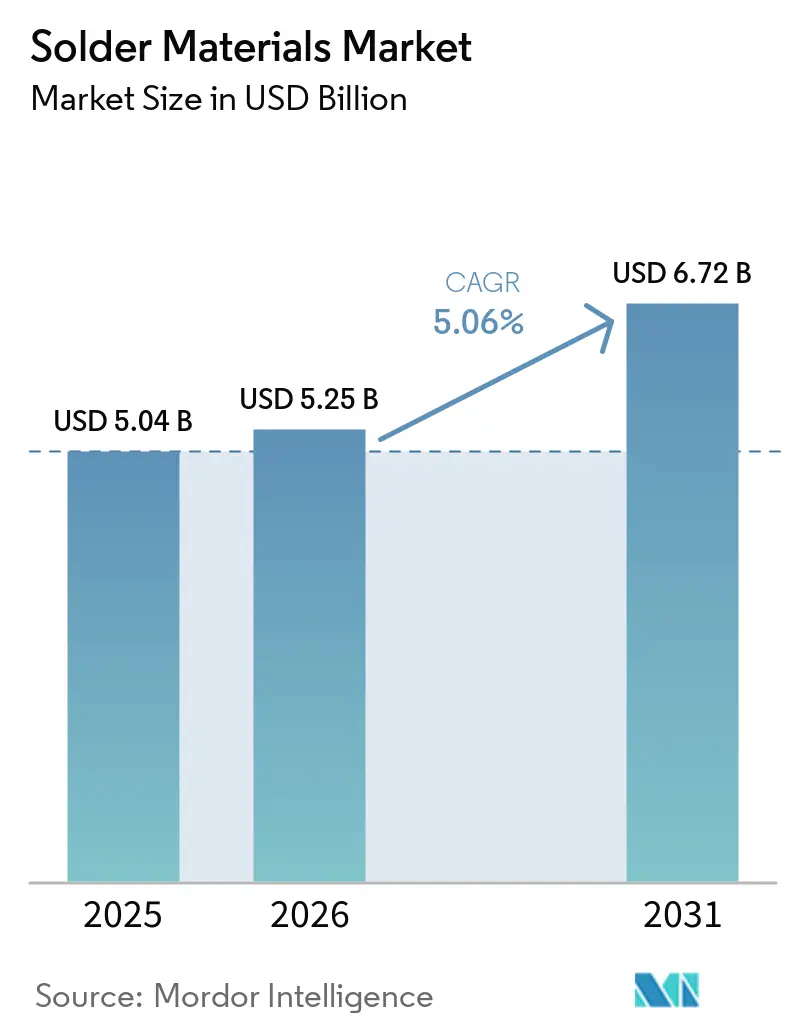
The Solder Materials Market size was valued at USD 5.04 billion in 2025 and estimated to grow from USD 5.25 billion in 2026 to reach USD 6.72 billion by 2031, at a CAGR of 5.06% during the forecast period (2026-2031). Demand is tied to electronics assembly because paste, wire, bar, flux, and preforms are used at several joining stages throughout the production process. Automotive electrification is increasing the importance of higher-reliability alloy formulations in power modules, battery systems, and control electronics. Regulatory changes are also narrowing the remaining uses of lead-based materials in several applications. Fine-pitch assembly and advanced semiconductor packaging are shifting requirements toward finer powder grades and more localized joining processes. The solder materials market, therefore, offers stronger opportunities for suppliers that combine alloy development, application support, and reliable regional supply
Key Report Takeaways
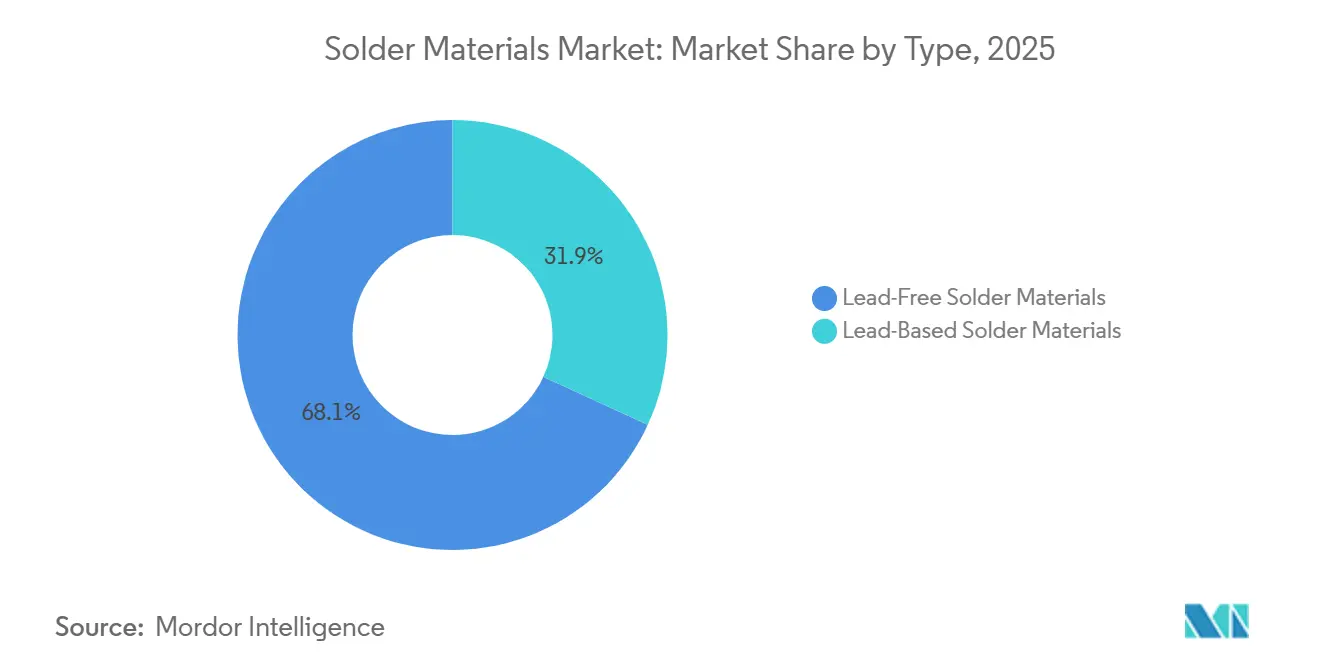
- By type, lead-free solder materials held 68.14% of the solder materials market share in 2025 and are forecast to expand at a 5.14% CAGR through 2031.
- By product type, paste held 34.82% of the solder materials market share in 2025 and is forecast to grow at a 5.92% CAGR through 2031.
- By process type, reflow soldering held 46.57% of the solder materials market share in 2025, while laser soldering is forecast to grow at a 6.44% CAGR through 2031.
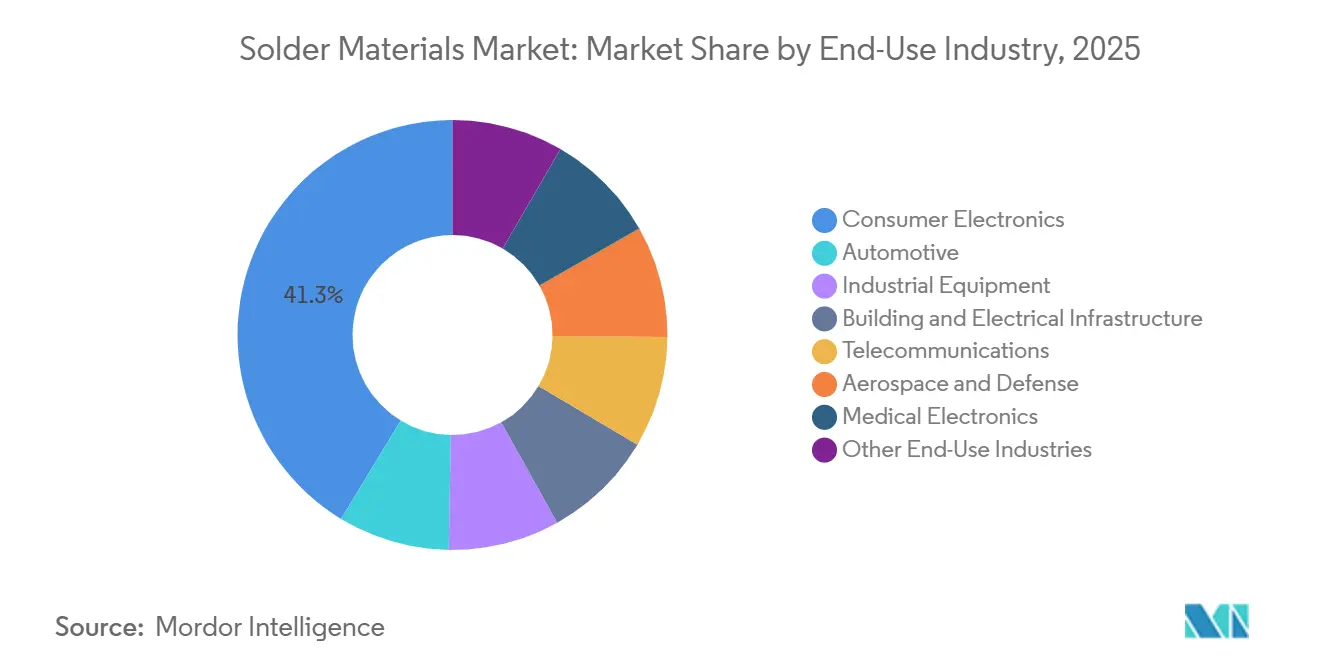
- By end-use industry, consumer electronics held 41.33% of the solder materials market share in 2025, while automotive is forecast to grow at a 6.37% CAGR through 2031.
- By geography, the Asia-Pacific held 52.69% of the solder materials market share in 2025 and is forecast to expand at a 5.78% CAGR through 2031.
Note: Market size and forecast figures in this report are generated using Mordor Intelligence’s proprietary estimation framework, updated with the latest available data and insights as of January 2026.
Market Trends and Insights
Drivers Impact Analysis of Solder Materials Market*
| Driver | (~) % Impact on CAGR Forecast | Geographic Relevance | Impact Timeline |
|---|---|---|---|
| Expansion of Electronics Manufacturing and PCB Assembly | +1.2% | Global, concentrated in APAC core (China, Taiwan, South Korea, India) with spill-over to Vietnam, Mexico | Short term (≤ 2 years) |
| Automotive Electrification and Rising Semiconductor Content per Vehicle | +1.0% | Global; led by China, Europe, and North America EV production centers | Medium term (2-4 years) |
| Lead-Free Conversion Driven by RoHS and Related Substance Restrictions | +0.9% | Europe and East Asia (China, Japan, South Korea); progressive spill-over to North America and South Asia | Medium term (2-4 years) |
| Miniaturization, Fine-Pitch Assembly, and Advanced Semiconductor Packaging | +0.8% | APAC core (Taiwan, South Korea, Japan); North America | Long term (≥ 4 years) |
| Qualification Demand for High-Reliability Electronics in Harsh Environments | +0.6% | Global | Medium term (2-4 years) |
| Source: Mordor Intelligence | |||
Expansion of Electronics Manufacturing and PCB Assembly
Electronics manufacturing growth supports recurring consumption of solder paste, wire, bar, and flux in the solder materials market. Assembly activity for cloud hardware, AI infrastructure, and electric-vehicle electronics increases the number of boards that require these materials. India approved the Electronics Component Manufacturing Scheme on April 8, 2025, with an outlay of INR 22,919 crore (approximately USD 2.7 billion) to strengthen domestic electronics component manufacturing[1]. The program supported the development of Printed Circuit Board (PCB) fabrication capacity and expanded the domestic assembly base. New production hubs in India, Vietnam, Thailand, and Mexico require local material availability, controlled storage, process support, and responsive supply arrangements. This favors formulators that can manage approvals, distribution, process trials, and consistent technical support across several regions.
Automotive Electrification and Rising Semiconductor Content Per Vehicle
Automotive electrification is increasing solder requirements in power modules, battery management systems, gate drivers, and high-voltage control equipment. These applications require interconnects that can tolerate wide temperature changes, repeated thermal cycles, vibration, and sustained electrical loading. This requirement favors reinforced formulations over standard SAC305 in demanding automotive programs. KOKI introduced SB6NX58-G850 in June 2025 for automotive and industrial assemblies exposed to harsh operating conditions. The product reflects demand for lower-void, high-reliability solder joints in these applications. The solder materials market benefits when automotive customers qualify more specialized alloy systems for safety-critical electronics and use them across longer production programs.
Lead-Free Conversion Driven by RoHS and Related Substance Restrictions
Lead-free conversion continues to shape material selection across electronics, automotive, and industrial equipment. The European Commission published Delegated Directives 2025/1802, 2025/2363, and 2025/2364 on November 21, 2025. The measures divided the former Restriction of Hazardous Substances (RoHS) Exemption 7(a) into 7 targeted subcategories, each scheduled to expire on December 31, 2027. Assemblers using affected high-melting-temperature lead solders were required to identify product-specific uses and manage renewal applications by June 30, 2026. Similar hazardous-substance requirements in China and South Korea add compliance demands for multinational assemblers. Suppliers with a broad lead-free portfolio can support customers as they evaluate alternatives before exemption deadlines.
Miniaturization, Fine-Pitch Assembly, and Advanced Semiconductor Packaging
Advanced packaging is moving from 2.5D designs toward 3D stacking with interconnect pitches below 10 micrometers. These designs require Type 5 to Type 7 powder grades rather than conventional commodity Surface Mount Technology (SMT) paste. Intel’s EMIB-T technology uses embedded silicon bridges and power-delivery channels for high-bandwidth memory stacks. This architecture requires fine-pitch package-level interconnects with controlled solder volume and placement accuracy. Research published in 2026 found that laser-assisted micro-solder-ball bonding can provide joint characteristics comparable to conventional reflow for advanced packaging. These applications create demand for fine powders, controlled deposition, localized heating, and specialized process knowledge in the solder materials market.
Restraints Impact Analysis of Solder Materials Market*
| Restraint | (~) % Impact on CAGR Forecast | Geographic Relevance | Impact Timeline |
|---|---|---|---|
| Tin, Silver, Copper, and Lead Price Volatility | -0.8% | Global | Short term (≤ 2 years) |
| Higher Processing Windows and Qualification Costs for Lead-Free Alloys | -0.6% | Global | Medium term (2-4 years) |
| Reliability and Thermal-Fatigue Risk in High-Density Assemblies | -0.5% | Global | Long term (≥ 4 years) |
| Source: Mordor Intelligence | |||
Tin, Silver, Copper, and Lead Price Volatility
Metal prices remain a direct risk for the solder materials market because SAC305 contains 96.5% tin by weight. Price changes affect margins for assemblers and formulators, especially in standard wire and bar products where material costs form a large share of selling prices. There is no mass-scale substitute for the core metal roles within commonly used solder alloys. The International Energy Agency reported sharply rising tin and base-metal prices between January 2025 and April 2026 while supply conditions remained tight[2]. Cost pressure is most acute where supply agreements offer limited flexibility and customers require qualified alloys without changes to production settings. Low-silver alternatives such as AIM Solder’s REL61 can improve the cost position of suppliers serving high-volume electronics manufacturing.
Higher Processing Windows and Qualification Costs for Lead-Free Alloys
Lead-free SAC alloys require peak reflow temperatures of 235 °C to 250° C. These temperatures are 30 °C higher than those for traditional tin-lead chemistries. Assemblers may therefore need higher-rated laminates, components, calibrated reflow profiles, and nitrogen-atmosphere processes in automotive production. Automotive validation can last 12 to 18 months under Automotive Electronics Council Q100 (AEC-Q100) requirements. International Microelectronics Assembly and Packaging Society (IMAPS) work on automotive power modules found that standard SAC305 underperformed purpose-engineered alloys at service temperatures of 125 °C or more. The longer qualification process slows alloy replacement, even when manufacturers seek lower-cost formulations.
*Our forecasts treat driver/restraint impacts as directional, not additive. The impact forecasts reflect baseline growth, mix effects, and variable interactions.
Solder Materials Market Segment Analysis
By Type:
Lead-Free Solder Materials Maintain Regulatory and Performance AdvantagesLead-free solder materials held 68.14% of overall revenue in 2025 and are projected to grow at a 5.14% CAGR through 2031. Their role is supported by compliance needs in electronics, automotive, and industrial equipment. SAC305, with tin, silver, and copper, remains a standard alloy for RoHS-compliant SMT assembly. Bismuth, antimony, and indium additives can improve thermal-fatigue performance for automotive control units and power modules. The November 2025 EU restructuring of RoHS Exemption 7(a) introduced a defined compliance timetable for affected high-melting-temperature lead solder uses. This narrows the addressable base for lead-based materials in applications without a continuing exemption.
Lead-based solder materials still serve certain military electronics and aerospace die-attach applications. Their use depends on valid exemptions and qualified application requirements. Low-temperature bismuth-tin alloys are gaining use in heat-sensitive flexible substrates, wearables, and camera modules. These alloys can reflow near 160 °C, compared with 240 °C for SAC305. The lower thermal exposure is useful where component or substrate sensitivity limits process temperatures. The solder materials industry is therefore seeing lead-free growth across both high-reliability and temperature-sensitive applications. The solder materials market retains a smaller, specialized role for lead-based products where performance and exemption conditions allow their use.
By Product Type:
Paste Leads in Value and GrowthPaste held 34.82% of overall revenue in 2025 and is forecast to grow at a 5.92% CAGR through 2031. Its position reflects surface-mount technology use in new electronics designs. Paste also supports advanced packaging applications that require Type 5 through Type 7 powder grades. Indium Corporation received a Circuits Assembly New Product Introduction (NPI) Award in March 2026 for Indium12.9HF, a Type 5 halogen-free paste for low-silver SAC105 and SAC0307 alloys. The product was designed for 01005 fine-feature printing. These product requirements support the value contribution of paste within the solder materials market.
Wire solder supplies selective and robotic soldering applications for through-hole parts and connectors. Bar solder is used in wave-soldering baths, particularly for consumer and industrial electronic assemblies. Flux is consumed across process types, with ongoing movement toward halogen-free and no-clean chemistries. Powder and preforms occupy smaller but higher-value product positions. Preforms are used in power-device die attach, where accurate alloy volume affects heat transfer and long-term joint reliability. The solder materials industry uses each format for a distinct assembly need. Product selection depends on board design, production method, precision requirements, and the expected service environment.
By Process Type:
Reflow Soldering Retains Scale While Laser Soldering Grows FasterReflow soldering accounted for 46.57% of overall revenue in 2025. It remains the standard SMT process for consumer electronics, server hardware, and telecommunications equipment. Throughput and first-pass yield support its use in large-volume production. Laser soldering is projected to grow at a 6.44% CAGR through 2031. It offers a localized 10-to-50-micrometer heat spot for 3D chiplet packages, high-bandwidth memory interconnects, and camera modules. This process can avoid thermal damage that broader oven profiles may create. The solder materials market gains from laser use in applications requiring greater placement accuracy and thermal control.
Research in the Journal of Welding and Joining found comparable joint reliability for laser-bonded micro-bump interconnects and conventional reflow methods. This supports the use of laser joining in high-reliability packaging supply chains. Wave soldering and selective soldering remain important for mixed-technology boards with through-hole components. Automotive control units, industrial modules, and power supplies retain these design requirements. Robotic soldering is also used in high-mix, low-volume work that needs automated precision. Aerospace, medical, and industrial maintenance programs are relevant examples. Process choice in the solder materials market remains closely linked to package geometry, production volume, and reliability requirements.
By End-Use Industry:
Consumer Electronics Leads Demand While Automotive Raises Material RequirementsConsumer electronics held 41.33% of overall revenue in 2025. Smartphones, tablets, wearables, smart speakers, and home gateway equipment provide regular demand for paste and flux. A flagship smartphone can contain more than 1,000 surface-mount components. These components require fine-pitch placement and reflow at sub-0.3-millimeter pitches. High production volumes make consumer electronics central to material demand. The automotive segment is forecast to grow at a 6.37% CAGR through 2031. This growth is linked to electric powertrains, battery management electronics, and advanced driver-assistance systems.
Automotive applications require alloys that meet AEC-Q100 conditions and withstand more than 3,000 thermal cycles. Low voiding, rising voltage requirements, and thermal-fatigue resistance have become baseline specifications for many programs. Industrial equipment, aerospace and defense, and medical electronics use specialized formulations that carry higher prices because reliability is central to product performance. KOKI’s SB6NX58-G850 addresses automotive and industrial equipment that operates under sustained thermal-mechanical stress. Telecommunications hardware also requires high paste intensity in dense radio frequency (RF) front-end modules. The solder materials market serves these end-user industries with materials tailored to thermal, electrical, and mechanical demands.

Geography Analysis
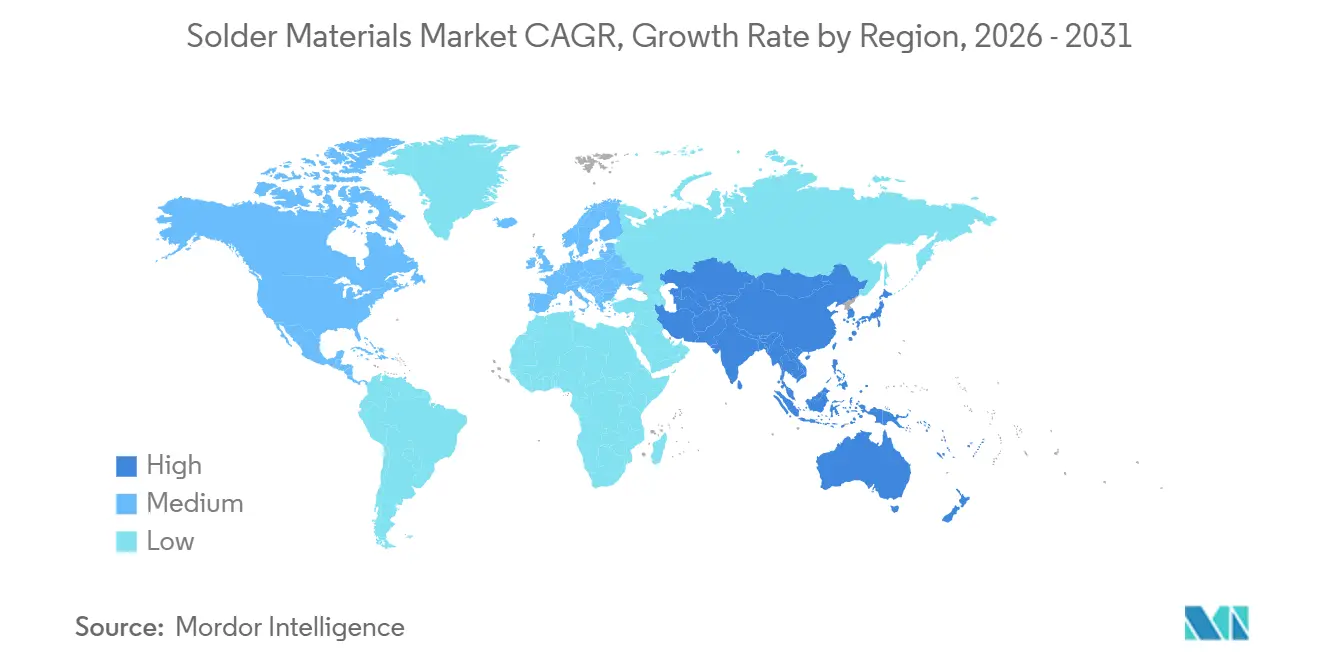
APAC Solder Materials Market
Asia-Pacific held 52.69% of overall revenue in 2025 and is forecast to grow at a 5.78% CAGR through 2031. China remains a major regional consumption center because of its broad PCB and electronics assembly base. South Korea supports fine-feature paste and performance demand through its semiconductor packaging and memory manufacturing operations. Japan remains important in precision and high-reliability materials, including automotive-grade and advanced packaging alloys. Senju Metal Industry and KOKI are among the suppliers serving these specialized requirements. Southeast Asia is becoming more important as electronics manufacturing services (EMS) capacity expands in Vietnam, Thailand, and Malaysia.
APAC, North America and Europe Solder Materials Market
India is also expanding its electronics production base. New PCB fabrication facilities can create local demand for paste and wire from domestic and international suppliers. The solder materials market in North America is weighted toward defense, aerospace, medical devices, and advanced packaging. These uses require technical qualifications and customer-specific alloy certifications. Europe has demand from automotive electronics and industrial machinery production, especially in Germany and Italy. EU RoHS changes are increasing near-term qualification work for certain high-melting-temperature lead applications.
MEA and South America Solder Materials Market
South America and Middle-East and Africa represent demand areas with different manufacturing profiles. Brazil has domestic electronics assembly for consumer goods and industrial equipment under the Zona Franca de Manaus framework. Argentina retains electronics manufacturing for domestic appliance applications. Saudi Arabia and the United Arab Emirates provide developing electronics assembly demand through industrial investment and free-trade-zone activity. South Africa supports mining and energy electronics maintenance needs. These regions represent developing areas for the solder materials market, supported by local-content policies and industrialization programs over the longer term.
Competitive Landscape
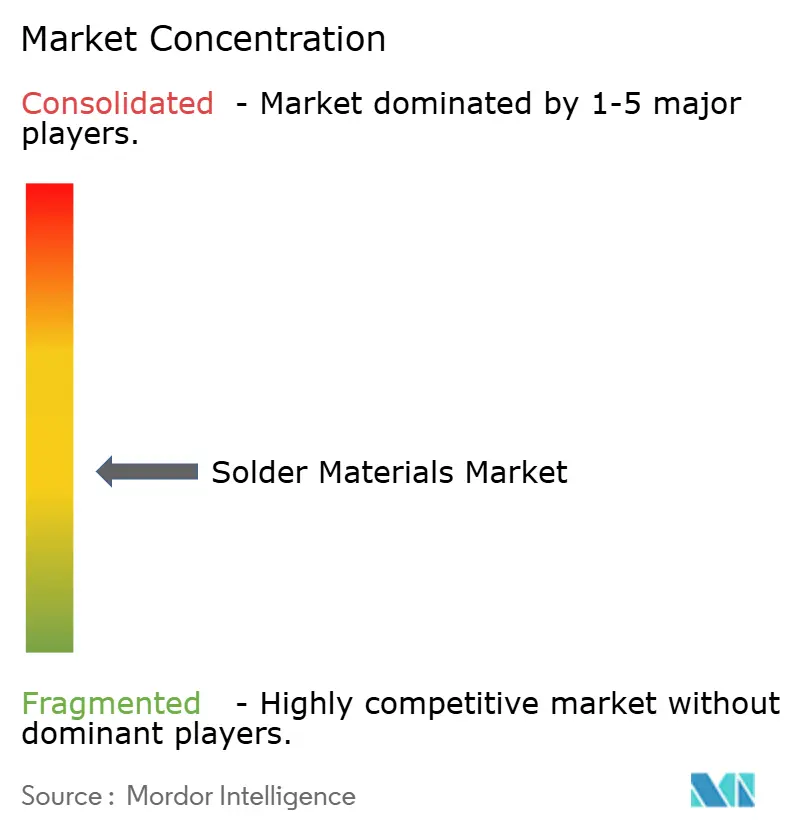
The solder materials market is moderately concentrated, with the top five players including Henkel AG & Co. KGaA, Indium Corporation, Kester, Senju Metal Industry Co., Ltd., and KOKI Company Ltd. MacDermid Alpha Electronics Solutions, Indium Corporation, Senju Metal Industry, Henkel AG & Co. KGaA, and Kester have established positions with automotive and advanced packaging customers. Their customer relationships rely on qualification records, technical support, and process performance. Standard-grade products face greater competition from regional blenders that compete on metal pricing. This creates different competitive conditions across premium and commodity material categories.
Senju Metal Industry received Intel’s EPIC Supplier Award in 2026 for the second consecutive year, following its 2025 award and the Amkor Technology Supplier Excellence Award in 2025. The company also received U.S. Patent 12,569,941 in March 2026 for a solder alloy and related products intended for in-vehicle electronic circuits. The patent covers a bismuth-antimony-cobalt-iron-arsenic composition for improved thermal-fatigue performance. SHENMAO America acquired Taiwan-based Profound Material Technology Co., Ltd. (PMTC) in July 2025 to add solder-ball capabilities for Fine-pitch Chip Scale Package (FCCSP) and Wafer-Level Chip Scale Package (WLCSP) semiconductor packaging. The transaction expanded its role in the semiconductor packaging supply chain. These actions show how suppliers are strengthening technology and product positions in demanding applications.
Low-silver and silver-free reformulation is a further competitive focus in the solder materials market. AIM Solder highlighted REL61, a tin-bismuth-copper formulation with lower silver content than SAC305, for manufacturers managing metal-cost exposure. Advanced packaging is also drawing investment because it requires solder balls, fine powders, and specialized joining formats. Indium Corporation presented its Formic Acid Soldering Technology at Power Conversion Intelligent Motion (PCIM) Expo 2026. The platform uses flux-free preforms and pastes for low-void, high-reliability power-electronics joints. These approaches address the need for reliable joints and reduced post-reflow cleaning. Competitive strength depends on a supplier’s qualified portfolio, customer support, and ability to address metal-cost and performance requirements.
Solder Materials Industry Leaders
-
Henkel AG & Co. KGaA
-
Indium Corporation
-
Kester
-
Senju Metal Industry Co., Ltd.
-
KOKI Company Ltd.
- *Disclaimer: Major Players sorted in no particular order
Solder Materials Market Companies Covered in this Report
- AIM Solder
- Balver Zinn GmbH
- DUKSAN Holdings
- Fusion Inc.
- Henkel AG & Co. KGaA
- Indium Corporation
- Kester
- KOKI Company Ltd.
- MacDermid Alpha Electronics Solutions
- Nihon Superior Co., Ltd.
- Qualitek International, Inc.
- Senju Metal Industry Co., Ltd.
- Stannol GmbH & Co. KG
- Tamura Corporation
Recent Industry Developments in Solder Materials Market
- December 2025: Indium Corporation launched SiPaste C312HF, a halogen-free, cleanable solder paste designed for fine-feature printing. The product featured Type 7 powder for aperture sizes down to 60 µm, consistent deposit spread, and post-reflow residue cleanability.
- June 2025: KOKI Company Ltd. launched a new high-reliability solder paste, SB6NX58-G850, for SMT applications, formulated with a solid-solution-strengthened solder alloy that suppressed microstructural transformation at solder joints. The paste offered strong thermal and mechanical resistance, making it suited for harsh environments in automotive and industrial equipment, contributing to longer product life.
Global Solder Materials Market Report Scope
Solder materials are fusible metal alloys and associated products used to create reliable electrical and mechanical connections between electronic components and circuit boards. They are available in various forms and compositions to meet performance, reliability, and regulatory requirements across electronics manufacturing, automotive, telecommunications, aerospace, medical, and industrial applications.
The Solder Materials Market is segmented by type, product type, process type, end-use industry, and geography. By type, the market is segmented into lead-based solder materials and lead-free solder materials. By product type, the market is segmented into paste, wire, bar, flux, powder, preforms, and other products. By process type, the market is segmented into wave soldering, reflow soldering, selective soldering, robotic soldering, and laser soldering. By end-use industry, the market is segmented into consumer electronics, automotive, industrial equipment, building and electrical infrastructure, telecommunications, aerospace and defense, medical electronics, and other end-use industries. The report also covers the market size and forecasts for solder materials in 16 countries across major regions. For each segment, the market sizing and forecasts have been done on the basis of value (USD).
Segmentation Overview
| Lead-Based Solder Materials |
| Lead-Free Solder Materials |
| Paste |
| Wire |
| Bar |
| Flux |
| Powder |
| Preforms |
| Other Products |
| Wave Soldering |
| Reflow Soldering |
| Selective Soldering |
| Robotic Soldering |
| Laser Soldering |
| Consumer Electronics |
| Automotive |
| Industrial Equipment |
| Building and Electrical Infrastructure |
| Telecommunications |
| Aerospace and Defense |
| Medical Electronics |
| Other End-Use Industries |
| Asia-Pacific | China |
| India | |
| Japan | |
| South Korea | |
| Rest of Asia-Pacific | |
| North America | United States |
| Canada | |
| Mexico | |
| Europe | Germany |
| United Kingdom | |
| France | |
| Italy | |
| Russia | |
| Rest of Europe | |
| South America | Brazil |
| Argentina | |
| Rest of South America | |
| Middle-East and Africa | Saudi Arabia |
| South Africa | |
| Rest of Middle-East and Africa |
| By Type | Lead-Based Solder Materials | |
| Lead-Free Solder Materials | ||
| By Product Type | Paste | |
| Wire | ||
| Bar | ||
| Flux | ||
| Powder | ||
| Preforms | ||
| Other Products | ||
| By Process Type | Wave Soldering | |
| Reflow Soldering | ||
| Selective Soldering | ||
| Robotic Soldering | ||
| Laser Soldering | ||
| By End-Use Industry | Consumer Electronics | |
| Automotive | ||
| Industrial Equipment | ||
| Building and Electrical Infrastructure | ||
| Telecommunications | ||
| Aerospace and Defense | ||
| Medical Electronics | ||
| Other End-Use Industries | ||
| By Geography | Asia-Pacific | China |
| India | ||
| Japan | ||
| South Korea | ||
| Rest of Asia-Pacific | ||
| North America | United States | |
| Canada | ||
| Mexico | ||
| Europe | Germany | |
| United Kingdom | ||
| France | ||
| Italy | ||
| Russia | ||
| Rest of Europe | ||
| South America | Brazil | |
| Argentina | ||
| Rest of South America | ||
| Middle-East and Africa | Saudi Arabia | |
| South Africa | ||
| Rest of Middle-East and Africa | ||
Key Questions Answered in the Report
What is the size of the solder materials market?
The solder materials market stands at USD 5.25 billion in 2026 and is projected to reach USD 6.72 billion by 2031.
Which type leads market demand?
Lead-free solder materials led with 68.14% share in 2025 and are projected to grow at a 5.14% CAGR through 2031.
Why did the paste lead product type demand in 2025?
Paste held 34.82% share in 2025 because surface-mount assembly and advanced packaging require precise material deposition.
Which end-use industry is expected to grow fastest through 2031?
Automotive is projected to grow at a 6.37% CAGR through 2031 because electric powertrains, battery management electronics, and control systems need reliable interconnects that tolerate repeated thermal cycles.